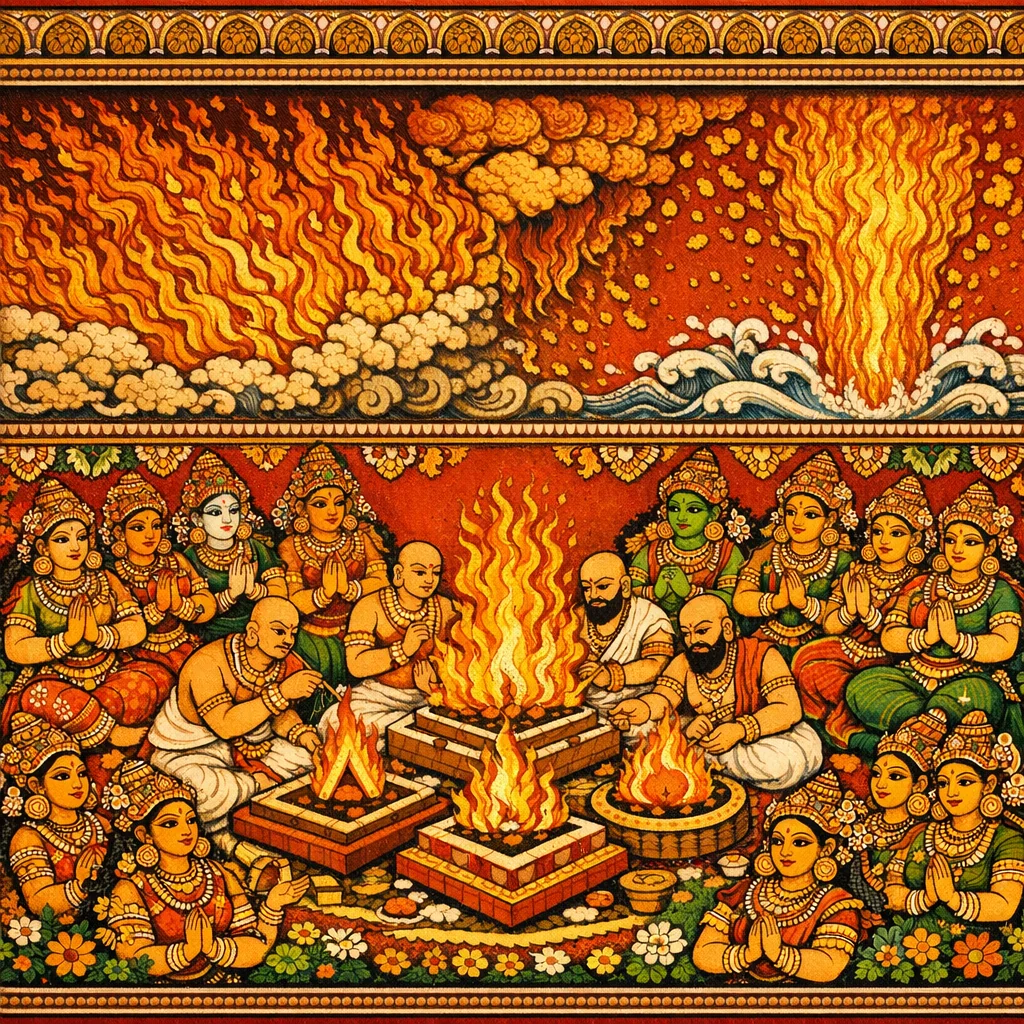
Adhyaya 51: Genealogy and Classification of Sacred Fires (Agni) in Sacrifice and Across Manvantaras
अग्निवंशवर्णनम् (जातवेदसां स्थान-प्रचयः)
Speaker: Rishis, Suta
The Ṛṣis ask for a systematic account of the sacred fires ever worthy of worship by the twice-born, with their vamśa (lineage) in proper order. Sūta replies by tracing Agni’s origin to the Svāyambhuva Manvantara as Abhimānī, mind-born of Brahmā, and then distinguishing the chief fire-forms (Pāvaka, Pavamāna, Śuci) and their ritual identities: Havyavāha; Gārhapatya as the churned household fire; Āhavanīya as Abhimānī; and Dakṣiṇāgni in Atharvanic settings. He describes sixteen river-consorts and the dhiṣṇyas (ritual stations) that generate station-deities (dhiṣṇava/Agnīdhras), specifying which fires are to be approached for worship (upāsteya) and which are to be visited/used (viharaṇīya). The narration extends to special fires—Avabhṛtha fire with Varuṇa, Jāṭharāgni, Saṃvartaka, Vaḍavāmukha, Kravyāda—lists notable sons and groupings (sets of eight and fourteen), and concludes that these ordered arrangements recur in every Manvantara with the Yāmas and presiding deities, forming a complete prācaya (ordered accumulation) of fires.
Key Concepts
Shlokas in Adhyaya 51
Verse 1
*ऋषय ऊचुः ये पूज्याः स्युर् द्विजातीनाम् अग्नयः सूत सर्वदा तानिदानीं समाचक्ष्व तद्वंशं चानुपूर्वशः //
The sages said: “O Sūta, tell us now—those sacred fires that are ever to be worshipped by the twice-born—describe them, and also recount their lineages in proper order.”
Verse 2
*सूत उवाच यो ऽसाव् अग्निरभीमानी स्मृतः स्वायम्भुवे ऽन्तरे ब्रह्मणो मानसः पुत्रस् तस्मात्स्वाहा व्यजीजनत् //
Sūta said: In the Svāyambhuva Manvantara, that Agni remembered as Abhimānī is held to be a mind-born son of Brahmā; from him Svāhā was born.
Verse 3
पावकं पवमानं च शुचिरग्निश्च यः स्मृतः निर्मथ्यः पवमानो ऽग्निर् वैद्युतः पावकात्मजः //
He is remembered as Pāvaka, as Pavamāna, and as Śuci-Agni, the pure Fire. The fire produced by churning (nirmanthya) is called Pavamāna, while the lightning-born fire (vaidyuta) is said to be the son of Pāvaka.
Verse 4
शुचिरग्निः स्मृतः सौरः स्थावराश्चैव ते स्मृताः पवमानात्मजो ह्य् अग्निर् हव्यवाहः स उच्यते //
Śuci-Agni is remembered as Saura (solar in nature), and these too are remembered as Sthāvara (stationary). That Agni, born of Pavamāna, is called Havyavāha, the bearer of sacrificial offerings.
Verse 5
पावकः सहरक्षस्तु हव्यवाहमुखः शुचिः देवानां हव्यवाहो ऽग्निः प्रथमो ब्रह्मणः सुतः //
Agni is called Pāvaka; he is accompanied by the Rākṣasas; he is the pure one whose mouth conveys the oblations. Among the gods, Agni is Havyavāha, the bearer of offerings, the first-born son of Brahmā.
Verse 6
सहरक्षः सुराणां तु त्रयाणां ते त्रयो ऽग्नयः एतेषां पुत्रपौत्राश्च चत्वारिंशत्तथैव च //
Along with Saharākṣa, for those three classes of gods there are three sacred Fires (Agni-deities). And of these, their sons and grandsons are likewise forty in number.
Verse 7
प्रवक्ष्ये नामतस्तान्वै प्रविभागेन तान्पृथक् पावनो लौकिको ह्य् अग्निः प्रथमो ब्रह्मणश्च यः //
Now I shall declare their names and set them forth separately according to their divisions. The first is the purifying, worldly (domestic) fire—indeed, the fire that belongs to the Brāhmaṇa.
Verse 8
ब्रह्मौदनाग्निस् तत्पुत्रो भरतो नाम विश्रुतः वैश्वानरो हव्यवाहो वहन्हव्यं ममार सः //
From Brahmaudanāgni, his son—famed by the name Bharata—was born. He was Vaiśvānara, the carrier of oblations (Havyavāha); bearing the offering, he met his end.
Verse 9
स मृतो ऽथर्वणः पुत्रो मथितः पुष्करोदधिः यो ऽथर्वा लौकिको ह्य् अग्निर् दक्षिणाग्निः स उच्यते //
That son of Atharvan—called Puṣkarodadhi—who was produced by churning and then died: the Atharvanic fire used in worldly rites is said to be the Dakṣiṇāgni, the southern sacred fire.
Verse 10
भृगोः प्रजायताथर्वा ह्य् अङ्गिराथर्वणः स्मृतः तस्य ह्य् अलौकिको ह्य् अग्निर् दक्षिणाग्निः स वै स्मृतः //
From Bhṛgu was born Atharvan; he is remembered as Aṅgiras-Atharvan. Of him, the fire regarded as non-worldly (extraordinary) is indeed known as the Dakṣiṇāgni, the southern sacred fire.
Verse 11
अथ यः पवमानस्तु निर्मथ्यो ऽग्निः स उच्यते स च वै गार्हपत्यो ऽग्निः प्रथमो ब्रह्मणः स्मृतः //
Now, the fire called Pavamāna is the fire produced by churning (the fire-drill). Indeed, that very fire is the Gārhapatya, the householder’s sacred fire, remembered as the first among Brahmā’s fires.
Verse 12
ततः सभ्यावसथ्यौ च संशत्यास् तौ सुतावुभौ ततः षोडश नद्यस्तु चकमे हव्यवाहनः यः खल्वाहवनीयो ऽग्निर् अभिमानी द्विजैः स्मृतः //
Thereafter, from Saṃśatya were born two sons, Sābhya and Āvasathya. Then Havyavāhana (Agni), taking the sixteen sacred rivers as his consorts, begot offspring; and he is indeed remembered by the twice-born as Abhimānī—the very Āhavanīya fire employed for oblations.
Verse 13
कावेरीं कृष्णवेणीं च नर्मदां यमुनां तथा गोदावरीं वितस्तां च चन्द्रभागामिरावतीम् //
Kāverī, Kṛṣṇaveṇī, Narmadā, and likewise Yamunā; Godāvarī and Vitastā as well; and also Candrabhāgā and Irāvatī—these sacred rivers are to be remembered and revered.
Verse 14
विपाशां कौशिकीं चैव शतद्रुं सरयूं तथा सीतां मनस्विनीं चैव ह्रादिनीं पावनां तथा //
Vipāśā, Kauśikī, Śatadru, and Sarayū; and also Sītā, Manasvinī, Hrādinī, and Pāvanā—these sacred rivers are to be remembered and revered.
Verse 15
तासु षोडशधात्मानं प्रविभज्य पृथक्पृथक् तदा तु विहरंस्तासु धिष्ण्येच्छः स बभूव ह //
Having divided his own presence into sixteen parts, each distinct, he then moved about within them; and at that time he became intent upon the various residential seats—dhiṣṇyas.
Verse 16
स्वाभिधानस्थिता धिष्ण्यास् तासूत्पन्नाश्च धिष्णवः धिष्ण्येषु जज्ञिरे यस्मात् ततस्ते धिष्णवः स्मृताः //
The dhiṣṇyas are established according to their own proper designations; and from them arise the dhiṣṇavas. Because they originate within the dhiṣṇyas, they are therefore remembered as “dhiṣṇavas.”
Verse 17
इत्येते वै नदीपुत्रा धिष्ण्येषु प्रतिपेदिरे तेषां विहरणीया ये उपस्थेयाश्च ताञ्शृणु विभुः प्रवाहणो ऽग्नीध्रस् तत्रस्था धिष्णवो ऽपरे //
Thus these sons of the river indeed attained their respective dhiṣṇyas (celestial stations). Now hear which among them are to be approached with reverence and which are to be visited or resorted to. There the mighty Pravāhaṇa and Agnīdhra are stationed, along with other beings established in those dhiṣṇyas.
Verse 18
विहरति यथास्थानं पुण्याहे समुपक्रमे अनिर्देश्यानिवार्याणाम् अग्नीनां शृणुत क्रमम् //
At the auspicious beginning of the rite, one should proceed in accordance with the proper ritual places as prescribed. Now hear the correct sequence of those sacred fires which are not to be casually specified by name and are not to be obstructed or restrained.
Verse 19
वासवो ऽग्निः कृशानुर्यो द्वितीयोत्तरवेदिकः सम्राडग्निसुतो ह्यष्टाव् उपतिष्ठन्ति तान्द्विजाः //
That fire is called Vāsava and also Kṛśānu; it is the second, stationed upon the northern altar-platform. Samrāṭ, the son of Agni—these eight (forms/attendants) are duly attended upon by the dvija, the twice-born (Brahmins).
Verse 20
पर्जन्यः पवमानस्तु द्वितीयः सो ऽनुदृश्यते पावकोष्णः समूह्यस्तु वोत्तरे सो ऽग्निरुच्यते //
Parjanya—also called Pavamāna—is described as the second form. And in the subsequent account, the fire known as Pāvaka (also called Uṣṇa) is stated to be the collective or aggregated (samūhya) one.
Verse 21
हव्यसूदो ह्य् असंमृज्यः शामित्रः स विभाव्यते शतधामा सुधाज्योती रौद्रैश्वर्यः स उच्यते //
He is the consumer of the sacrificial oblations (havya), the unassailable one, and the subduer. He is contemplated as the bearer of a hundred abodes (or splendors), as nectar-like radiance, and as lordly power—fierce, Rudra-like—in sovereignty.
Verse 22
ब्रह्मज्योतिर् वसुधामा ब्रह्मस्थानीय उच्यते अजैकपादुपस्थेयः स वै शालामुखो यतः //
He is called the radiance of Brahman and the abode upon the earth; he is also said to occupy Brahmā’s own station. He is to be approached and worshipped as Aja‑Ekapāda; for that reason he is indeed known as Śālāmukha.
Verse 23
अनिर्देश्यो ह्यहिर्बुध्न्यो बहिरन्ते तु दक्षिणौ पुत्रा ह्येते तु सर्वस्य उपस्थेया द्विजैः स्मृताः //
Ahirbudhnya is indeed indescribable; and Bahiranta and Dakṣiṇa are his sons. These two are remembered by the twice-born as deities to be worshipped, being connected with the generative source of all.
Verse 24
ततो विहरणीयांस्तु वक्ष्याम्यष्टौ तु तान्सुतान् हौत्रियस्य सुतो ह्यग्निर् बर्हिषो हव्यवाहनः //
Thereafter I shall describe those eight noteworthy sons. Agni is the son of Hautriya, and Havyavāhana is the son of Barhiṣ.
Verse 25
प्रशंस्यो ऽग्निः प्रचेतास्तु द्वितीयः संसहायकः सुतो ह्यग्नेर् विश्ववेदा ब्राह्मणाच्छंसिरुच्यते //
Agni is praised as the first; Pracetas is the second, described as a helpful ally. And the son of Agni—Viśvavedā—is said to be the Brahmanical reciter, the officiant who chants the praises.
Verse 26
अपां योनिः स्मृतः स्वाम्भः सेतुर्नाम विभाव्यते धिष्ण्य आहरणा ह्येते सोमेनेज्यन्त वै द्विजैः //
“Svāmbha” is remembered as the womb and source of the waters; it is also understood by the name “Setu.” These are the dhishṇyas (ritual stations) and the āharaṇas (the bringing and arranging of implements) by which the twice-born perform worship through the Soma-sacrifice.
Verse 27
ततो यः पावको नाम्ना यः सद्भिर्योग उच्यते अग्निः सो ऽवभृथो ज्ञेयो वरुणेन सहेज्यते //
Then the Fire called “Pāvaka,” which the virtuous proclaim to be a sacred ‘yoga’ (a disciplined rite of union), is to be understood as the Avabhṛtha, the concluding purificatory rite; it is to be worshipped together with Varuṇa.
Verse 28
हृदयस्य सुतो ह्यग्नेर् जठरे ऽसौ नृणां पचन् मन्युमाञ्जठरश्चाग्निर् विद्धाग्निः सततं स्मृतः //
Indeed, this fire—born from the heart’s fire—abides in the belly; it cooks (digests) the food of human beings. Therefore this abdominal fire, endowed with forceful energy, is remembered as the ever-awake, ever-kindled fire.
Verse 29
परस्परोत्थितो ह्यग्निर् भूतानीह विभुर्दहन् अग्नेर्मन्युमतः पुत्रो घोरः संवर्तकः स्मृतः //
From mutual friction and interaction arises the all-pervading fire, which here burns living beings; it is remembered as the dreadful Saṃvartaka, the son of Agni, born of his wrath.
Verse 30
पिबन्नपः स वसति समुद्रे वडवामुखे समुद्रवासिनः पुत्रः सहरक्षो विभाव्यते //
Drinking up the waters, he dwells in the ocean at the Mare’s-mouth, Vaḍavāmukha; he is understood as the son of the ocean-dweller and is conceived as attended by protective powers.
Verse 31
सहरक्षस्तु वै कामान् गृहे स वसते नृणाम् क्रव्यादग्निः सुतस्तस्य पुरुषान्यो ऽत्ति वै मृतान् //
Along with the rākṣasa-spirit, desires indeed dwell in the houses of men. From him is born the fire called Kravyādāgni, which consumes the bodies of the dead.
Verse 32
इत्येते पावकस्याग्नेर् द्विजैः पुत्राः प्रकीर्तिताः ततः सुतास्तु सौवीर्याद् गन्धर्वैरसुरैर् हृताः //
Thus these sons of Agni Pāvaka were proclaimed by the learned twice-born. Thereafter, however, those sons—because of their notable prowess—were carried off by the Gandharvas and the Asuras.
Verse 33
मथितो यस्त्वरण्यां तु सो ऽग्निराप समिन्धनम् आयुर् नाम्ना तु भगवान् पशौ यस्तु प्रणीयते //
The fire that is churned forth in the forest is Agni called Āpa, the kindler of the fuel. And the blessed one who is led forth in the Paśu-sacrifice is (Agni) named Āyus.
Verse 34
आयुषो महिमान्पुत्रो दहनस्तु ततः सुतः पाकयज्ञेष्व् अभीमानी हुतं हव्यं भुनक्ति यः //
From Āyu was born the son Mahimān, and from him was born Dahana. He is the presiding deity in the pākayajñas (domestic rites), and it is he who consumes the offered havya poured into the fire.
Verse 35
सर्वस्माद्देवलोकाच्च हव्यं कव्यं भुनक्ति यः पुत्रो ऽस्य सहितो ह्यग्निर् अद्भुतः स महायशाः //
That illustrious, wondrous Fire—present together with a man’s son—partakes of the oblations meant for the gods (havis) and those meant for the ancestors (kavis), drawing them even from every realm, including the world of the gods.
Verse 36
प्रायश्चित्तेष्वभीमानी हृतं हव्यं भुनक्ति यः अद्भुतस्य सुतो वीरो देवांशस्तु महान्स्मृतः //
He who, in rites of expiation (prāyaścitta), swollen with arrogance, consumes the consecrated havya that has been taken away (or misappropriated), is remembered as the heroic son of Adbhuta—indeed a great being, a portion of the gods.
Verse 37
विविधाग्निस्ततस्तस्य तस्य पुत्रो महाकविः विविधाग्निसुतादर्काद् अग्नयो ऽष्टौ सुताः स्मृताः //
From him was born Vividhāgni; and from Vividhāgni came his son, the great sage-poet Mahākavi. From Arkā, the son of Vividhāgni, eight sons are remembered, known collectively as the Agnis.
Verse 38
काम्यास्विष्टिष्वभीमानी रक्षोहायतिकृच्च यः सुरभिर्वसुमान्नादो हर्यश्वश्चैव रुक्मवान् //
In the kāmya and sv-iṣṭi offerings, the one designated as Abhīmānī; and the performer of the Rakṣo-hāyati rite; also Surabhi, Vasumān, Nāda, Haryaśva, and likewise Rukmavān—these are the ritual appellations to be known.
Verse 39
प्रवर्ग्यः क्षेमवांश्चैव इत्यष्टौ च प्रकीर्तिताः शुच्यग्नेस्तु प्रजा ह्येषा अग्नयश्च चतुर्दश //
“Pravargya” and “Kṣemavān”—thus these eight have been declared. And these are said to be the progeny of the pure Fire (Śucy-agni); the fires of this group are fourteen in number.
Verse 40
इत्येते ह्यग्नयः प्रोक्ताः प्रणीता ये हि चाध्वरे समतीते तु सर्गे ये यामैः सह सुरोत्तमैः //
Thus have these sacred fires been described—those that are duly established in the sacrificial rite; and those which, at the passing away of a cycle of creation, depart together with the Yāmas and the foremost of the gods.
Verse 41
स्वायम्भुवे ऽन्तरे पूर्वम् अग्नयस्ते ऽभिमानिनः एते विहरणीयेषु चेतनाचेतनेष्विह //
Formerly, in the Svāyambhuva Manvantara, these were the presiding deities of Fire (the Abhimānins). Here they move about in the realms that are to be traversed, among beings both sentient and insentient.
Verse 42
स्थानाभिमानिनो ऽग्नीध्राः प्रागासन्हव्यवाहनाः काम्यनैमित्तिकाद्यास्ते ये ते कर्मस्ववस्थिताः //
Formerly, those Agnīdhras—presiding powers identified with their respective stations—were Havyavāhanas, the bearers of oblations. They are the ones established in rites such as kāmya (desire-motivated) and naimittika (occasional) actions, and the like.
Verse 43
पूर्वे मन्वन्तरे ऽतीते शुक्रैर्यामैश्च तैः सह एते देवगणैः सार्धं प्रथमस्यान्तरे मनोः //
When the earlier Manvantara had passed, together with the Śukras and the Yāmas, these very groups of gods existed in the Manvantara of the first Manu as well.
Verse 44
इत्येता योनयो ह्यक्ताः स्थानाख्या जातवेदसाम् स्वारोचिषादिषु ज्ञेयाः सवर्णान्तेषु सप्तसु //
Thus these womb-origins, known as the “abodes” of Jātavedas (Agni), have been declared. They are to be understood in the seven Manvantaras beginning with Svārociṣa, up to the one ending with Sāvarṇa.
Verse 45
तैरेवं तु प्रसंख्यातं साम्प्रतानागतेष्विह मन्वन्तरेषु सर्वेषु लक्षणं जातवेदसाम् //
Thus, by them (the sages), the characteristics of Jātavedas—Agni and the fire-deities—have been duly enumerated here for all the Manvantaras, both the present and those yet to come.
Verse 46
मन्वन्तरेषु सर्वेषु नानारूपप्रयोजनैः वर्तन्ते वर्तमानैश्च यामैर्देवैः सहाग्नयः //
In every Manvantara, the cosmic fires continue to function for purposes of many kinds and forms, along with the presiding deities and the Yāmas (time-divisions) as they proceed in their ongoing course.
Verse 47
अनागतैः सुरैः सार्धं वत्स्यन्तो ऽनागतास्त्वथ इत्येष प्रचयो ऽग्नीनां मया प्रोक्तो यथाक्रमम् विस्तरेणानुपूर्व्या च किमन्यच्छ्रोतुमिच्छथ //
“Together with the gods yet to come, the fires yet to come will dwell here.” Thus have I explained the arrangement and accumulation of the sacred fires—step by step, in proper sequence, and in detail. What else do you wish to hear?
Frequently Asked Questions
The chapter’s primary instruction is a structured, worship-oriented map of sacred fires (Agni) for the twice-born: their origins, names, ritual functions, and lineages. It teaches how the key śrauta fires (Gārhapatya, Āhavanīya, Dakṣiṇāgni) are to be understood not only as ritual installations but as living deities with genealogies (Abhimānī, Pāvaka, Pavamāna, Śuci and their descendants). It also clarifies that different rites (Soma-sacrifice, pākayajñas, paśu-yāga, prāyaścitta, avabhṛtha) invoke distinct Agni-aspects, and that these arrangements persist across Manvantaras with presiding station-deities (Agnīdhras/dhiṣṇavas) and time-divisions (Yāmas).
This Adhyāya is primarily Genealogy and Ritual Theology: a Purāṇic genealogy (vamśa) of Agni-forms and their descendants, plus a śrauta-ritual classification of fires and stations (dhiṣṇyas). It is not a Vāstu-Śāstra chapter in the architectural sense, nor a Rājadharma/statecraft chapter; however, it does contain a ‘ritual-architecture’ layer through the concept of dhiṣṇyas (designated bases/stations in a sacrificial layout) and the correct placement/sequence of fires on altars/vedikās.
It identifies Pavamāna (the churned fire) with the Gārhapatya, presenting it as the foundational domestic fire. It associates Abhimānī (mind-born in the Svāyambhuva Manvantara) with the Āhavanīya, the offering-fire approached by the twice-born. It also describes Dakṣiṇāgni as connected with Atharvanic fire traditions, distinguishing worldly (laukika) and non-worldly (alaukika) contexts while still naming Dakṣiṇāgni as the southern sacred fire in these accounts.
Dhiṣṇyas are the designated ritual stations/bases in the sacrificial system; from them arise the dhiṣṇavas (station-linked beings/presiding powers). The chapter uses dhiṣṇyas to explain how Agni’s presence is distributed (notably through the sixteen-part division linked to the rivers) and how specific presiding entities (including Agnīdhra and Pravāhaṇa) are ‘approached’ or ‘resorted to’ in the correct order and placement during rites.
Yes. It explicitly describes Jāṭharāgni (the abdominal/digestive fire that ‘cooks’ food in humans), Saṃvartaka (a dreadful, wrath-born fire associated with all-consuming burning), Vaḍavāmukha (the mare’s-mouth submarine fire dwelling in the ocean and ‘drinking’ waters), and Kravyāda (the fire that consumes corpses). These extend Agni’s meaning from altar-ritual into cosmology and embodied physiology.