Adhyaya 38
शमीवृक्षस्थायुधप्रकाशनम् / Revelation and Identification of the Weapons on the Śamī Tree
Upa-parva: Śamī-vṛkṣa-āyudha-pratyāhāra (Recovery of Weapons from the Śamī Tree) — Virāṭa-parva episode
Vaiśaṃpāyana narrates Arjuna (as Bṛhannadā) guiding Prince Uttara to the śamī tree and explaining that the Pāṇḍavas’ weapons are stored there. Arjuna frames Uttara as physically delicate and inexperienced for battle, asserting the need to retrieve the heavier, superior arms. Uttara resists due to a prevalent report that a ‘body’ is tied to the tree; he cites kṣatriya propriety and concerns about impurity and social dealings if he were to touch it. Bṛhannadā reassures him that no corpse is present and that Uttara will remain pure and acceptable. Uttara ascends the tree, removes the coverings, and beholds multiple radiant bows and armaments whose brilliance is compared to celestial bodies at rising. Struck by awe and fear, Uttara questions the ownership of the richly ornamented bows, arrows, quivers, and swords. Bṛhannadā identifies them systematically: foremost is Arjuna’s Gāṇḍīva, described with its storied custodianship among divine beings; then the distinguished weapons of Bhīma, Yudhiṣṭhira, Nakula, and Sahadeva are specified, including characteristic arrow sets and swords. The chapter functions as an inventory-catalogue with ethical subtext: purity discourse is resolved, and concealed power is formally reintroduced into the narrative.
Chapter Arc: विराटनगरी से बाहर निकलते ही उत्तरकुमार का हृदय काँप उठता है—दूर क्षितिज पर कौरवों की विशाल रथ-सेना समुद्र-सी उमड़ती दिखती है, और उसका शौर्य भय में गलने लगता है। → उत्तर का भय बढ़ता जाता है; वह पीछे हटने, लौट चलने और अपने ही वचनों से मुकरने को व्याकुल होता है। अर्जुन (छन्न-वेष में) उसे धैर्य देता है, घोड़ों को तेज़ करता है, और उसे समझाता है कि भय के आगे झुकना क्षत्रिय-धर्म का पतन है। कौरव-सेना की दुर्धर्षता और निकट आती गर्जना उत्तर के मन को और दबाती है। → अर्जुन निर्णायक क्षण में उत्तर को रथ पर चढ़ा देता है—भयपीड़ित, अनिच्छुक उत्तर को भी वह संभालकर बैठाता है और स्वयं युद्ध का भार अपने ऊपर ले लेता है; उत्तर से कहता है कि तुम केवल सारथि बनो, युद्ध मैं करूँगा। → उत्तर का पलायन रुकता है; रथ आगे बढ़ता है। अर्जुन का आत्मविश्वास और नियंत्रण स्थापित होता है—वह घोड़ों को साधकर, रथ को युद्ध-भूमि की ओर मोड़कर, आगामी संघर्ष के लिए भूमिका बाँध देता है। → कौरवों के रथानीक में घुसकर ‘पशु-विजय’ और सेना-भेदन का अर्जुन का संकल्प घोषित हो चुका है—अब अगला क्षण सीधे टकराव और शस्त्र-प्रयोग का है।
Shlokas
Verse 1
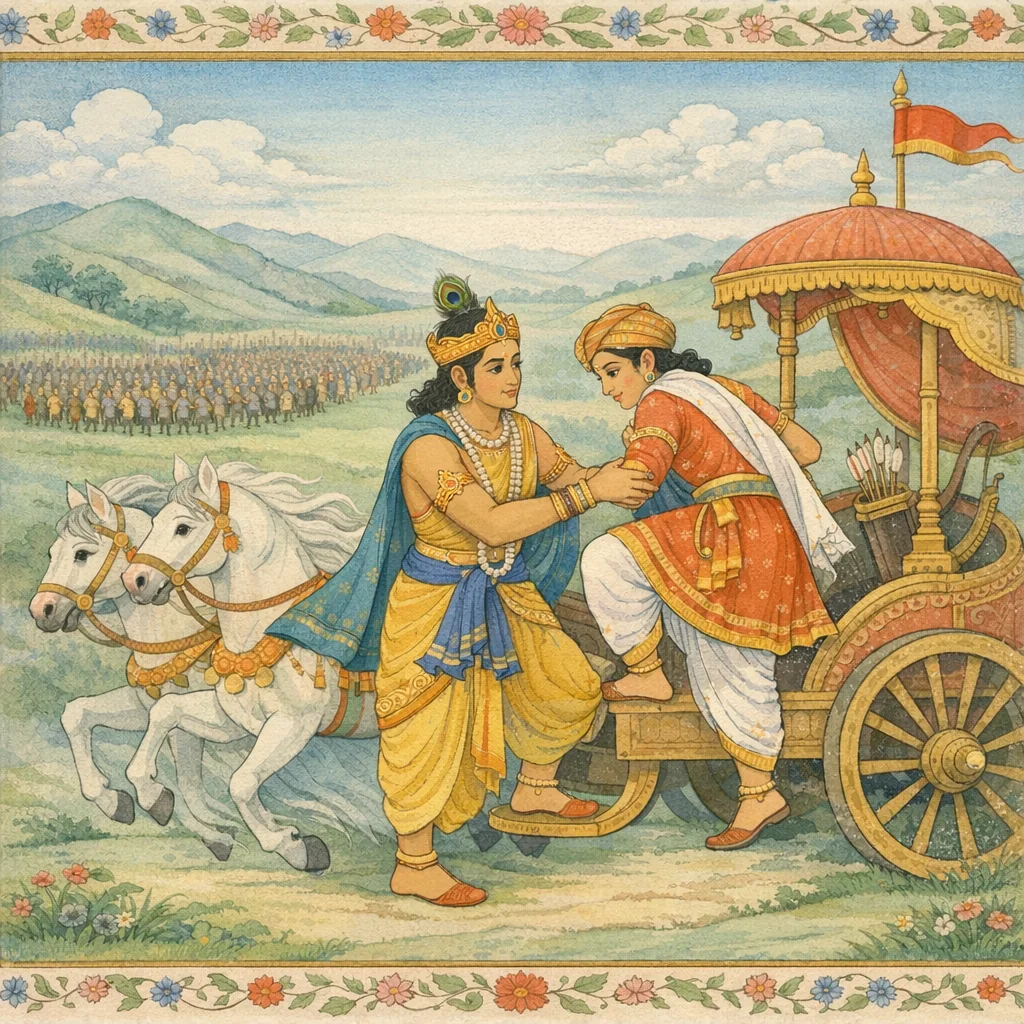
हि आय न (0) ऑन अप अष्टात्रिशो&् ध्याय: उत्तरकुमारका भय और अर्जुनका उसे आश्वासन देकर रथपर चढ़ाना वैशम्पायन उवाच स राजधान्या निर्याय वैराटिरकुतो भय: । प्रयाहीत्यब्रवीत् सूतं यत्र ते कुरवो गता:,वैशम्पायनजी कहते हैं--जनमेजय! राजधानीसे निकलकर विराटकुमार उत्तरने सर्वथा निर्भय हो सारथिसे कहा--“बृहन्नले! जहाँ कौरव गये हैं, उधर ही रथ ले चलो
Vaiśampāyana said: Then the prince of Virāṭa, having set out from the capital and becoming wholly fearless, addressed the charioteer: “Drive on, O charioteer—go in the very direction where those Kauravas have gone.” In the narrative context, this marks Uttara’s resolve after receiving reassurance, turning fear into duty-bound action in the face of impending conflict.
Verse 2
/* ७०५४०१९- 4 >प#- 587 अ--+ी एस 5५५. 70% :४4%2 ६ ८वरससच ( 5 आत॥न्ण छल | 40 एलटी: ६६ ह- ; (2० है।। 22 गास्तेषां क्षिप्रमादाय पुनरेष्याम्यहं पुरम्,'मैं यहाँ विजयकी आशासे एकत्र होनेवाले समस्त कौरवोंको परास्त करके उनसे अपनी गौएँ वापस ले शीघ्र अपने नगरमें लौट आऊँगा”
Vaiśampāyana said: “With the hope of victory, I shall defeat all the Kauravas who have gathered here, recover my cattle from them, and then return swiftly to my city.”
Verse 3
ततस्तांश्वोदयामास सदश्वान् पाण्डुनन्दन: । ते हया नरसिंहेन नोदिता वातरंहस: । आलिखन्त इवाकाशमूहु: काज्चनमालिन:,तब पाण्डुनन्दन अर्जुनने उत्तरके उत्तम जातिके घोड़ोंको हाँका और उनकी बाग ढीली कर दी। नरश्रेष्ठ अर्जुनके हाँकनेपर सोनेकी माला पहने हुए वे घोड़े हवाके समान वेगसे चलने लगे, मानो आकाशगमें अपनी टाप अड़ाते हुए रथ लिये उड़े जा रहे हों
Then the son of Pāṇḍu urged on those excellent horses. Driven by Arjuna, the lion among men, the steeds—wearing golden garlands—rushed forward with the speed of the wind, as though their hooves were scratching the very sky while they bore the chariot onward.
Verse 4
नातिदूरमथो गत्वा मत्स्यपुत्रधनंजयौ । अवेक्षेताममित्रघ्नी कुरूणां बलिनां बलम्,थोड़ी ही दूर जानेपर शत्रुहन्ता विराटपुत्र उत्तर और धनंजयने महाबली कौरवोंकी विशाल सेना देखी
Having gone only a short distance, Uttara—the prince of Matsya, slayer of foes—and Dhanañjaya (Arjuna) beheld the mighty host of the powerful Kurus.
Verse 5
श्मशानमभितो गत्वा आससाद कुरूनथ । तां शमीमन्ववीक्षेतां व्यूढानीकांश्व॒ सर्वश:,श्मशानभूमिके समीप जाकर उन्होंने कौरवोंको पा लिया। वे दोनों उस शमीवृक्षके आसपास सब ओर सेनाका व्यूह बनाकर खड़े हुए कौरव-सैनिकोंकी ओर देखने लगे
Having gone around the cremation-ground, they then came upon the Kurus. The two of them, keeping their eyes on that śamī tree, looked in every direction at the Kuru soldiers who stood drawn up in battle-formation.
Verse 6
तदनीकं महत् तेषां विबभौ सागरोपमम् | सर्पमाणमिवाकाशे वन॑ बहुलपादपम्,उनकी वह विशालवाहिनी समुद्रके समान जान पड़ती थी। जब वह चलती, तब ऐसा जान पड़ता था, मानो आकाशमें असंख्य वृक्षोंसे भरा हुआ वन चल रहा हो
Their great host shone forth like the ocean itself. As it advanced, it seemed as though a dense forest—filled with countless trees—were moving through the sky.
Verse 7
ददृशे पार्थिवो रेणुर्जनितस्तेन सर्पता । दृष्टिप्रणाशो भूतानां दिवस्पृक् कुरुसत्तम,कुरुश्रेष्ठ जनममेजय! कौरव-सेनाके चलनेसे ऊपर उठी हुई धरतीकी धूल अन्तरिक्षको छूती-सी दिखायी देती थी। उसके कारण समस्त प्राणियोंकी दृष्टिका लोप-सा हो गया था-- किसीको कुछ सूझ नहीं पड़ता था
As that host advanced, a cloud of earth-dust rose up and was seen as though it touched the sky. Because of it, the sight of living beings seemed to fail—nothing could be clearly made out—O best of the Kurus, O foremost Kuru, Janamejaya.
Verse 8
तदनीकं महद् दृष्टवा गजाश्वरथसंकुलम् | कर्णदुर्योधनकृपैर्गुप्तं शान्तनवेन च,वह भारी सेना हाथी, घोड़ों एवं रथोंसे भरी हुई थी। कर्ण, दुर्योधन, कृपाचार्य, भीष्म, अश्वत्थामा और महान् धनुर्धर एवं परम बुद्धिमान् द्रोण उसकी रक्षा कर रहे थे। उसे देखकर विराटपुत्र उत्तरके रोंगटे खड़े हो गये। उसने भयसे व्याकुल होकर अर्जुनसे कहा
Vaiśampāyana said: Seeing that vast battle-array, densely packed with elephants, horses, and chariots, and protected by Karṇa, Duryodhana, Kṛpa, and also by the son of Śantanu (Bhīṣma), Uttara, the prince of Virāṭa, was struck with terror—his hair standing on end—and, shaken by fear, spoke to Arjuna.
Verse 9
द्रोणेन च सपुत्रेण महेष्वासेन धीमता । हृष्टरोमा भयोद्विग्न: पार्थ वैराटिरब्रवीत्,वह भारी सेना हाथी, घोड़ों एवं रथोंसे भरी हुई थी। कर्ण, दुर्योधन, कृपाचार्य, भीष्म, अश्वत्थामा और महान् धनुर्धर एवं परम बुद्धिमान् द्रोण उसकी रक्षा कर रहे थे। उसे देखकर विराटपुत्र उत्तरके रोंगटे खड़े हो गये। उसने भयसे व्याकुल होकर अर्जुनसे कहा
Vaiśampāyana said: Seeing that mighty host protected by the supremely skilled and wise bowman Droṇa, together with his son, the prince of Virāṭa (Uttara) was seized with fear; his hair stood on end. Trembling with anxiety, he spoke to Pārtha (Arjuna).
Verse 10
उत्तर उवाच नोत्सहे कुरुभियोंद्धुं रोमहर्ष हि पश्य मे । बहुप्रवीरमत्युग्रं देवेरपि दुरासदम्,उत्तर बोला--बृहन्नले! मुझमें कौरवोंके साथ युद्ध करनेका साहस नहीं है; क्योंकि देखो, भयके कारण मेरे रोएँ खड़े हो गये हैं। इस सेनाके भीतर बहुतेरे बड़े-बड़े वीर हैं। यह बड़ी भयानक जान पड़ती है। इसे परास्त करना तो देवताओंके लिये भी अत्यन्त कठिन है
Uttara said: “I do not have the courage to fight with the Kurus. Look—my hairs are standing on end from fear. Their army contains many great heroes and appears exceedingly formidable; to overcome it would be difficult even for the gods.”
Verse 11
प्रतियोद्धुं न शक्ष्यामि कुरुसैन्यमनन्तकम् | नाशंसे भारती सेनां प्रवेष्ठं भीमकार्मुकाम्,कौरवोंकी सेनाका कहीं अन्त नहीं है। मैं इसका सामना नहीं कर सकता। भयानक धनुषवाली भरतवंशियोंकी इस विशाल वाहिनीमें प्रवेश करना तो दूर रहे, मैं उसके सम्बन्धमें बात भी नहीं कर सकता
Uttara said: “I am not able to fight the Kuru army, which seems without end. I do not even dare to speak of entering that Bharata host, armed with dreadful bows. Confronting such a vast force is beyond me.”
Verse 12
रथनागाश्व॒कलिलां पत्तिध्वजसमाकुलाम् | दृष्टवैव हि परानाजौ मन: प्रव्यथतीव मे,रथ, हाथी और घोड़ोंसे यह कौरवदल खचाखच भरा हुआ है। पैदल सिपाहियों और असंख्य ध्वजाओंसे व्याप्त है। इसलिये रणभूमिमें इन शत्रुओंको देखकर ही मेरा हृदय व्यथित-सा हो गया है
Uttara said: “This Kaurava host is densely packed with chariots, elephants, and horses; it is crowded with foot-soldiers and filled with countless banners. Therefore, merely upon seeing these enemies on the battlefield, my heart feels shaken and distressed.”
Verse 13
यत्र द्रोणश्न भीष्मश्न॒ कृप: कर्णो विविंशति: । अश्रृत्थामा विकर्णश्ष॒ सोमदत्तश्न बाह्विकः,जहाँ द्रोण, भीष्म, कृप, कर्ण, विविंशति, अश्व॒त्थामा, विकर्ण, सोमदत्त, बाह्लिक तथा रथियोंमें श्रेष्ठ वीर राजा दुर्योधन हैं। जो सबके सब तेजस्वी, महान् धनुर्धर और युद्धकी कलामें प्रवीण हैं
Uttara said: “There stand Droṇa and Bhīṣma, and also Kṛpa, Karṇa, and Viviṁśati; Aśvatthāmā and Vikarṇa as well; Somadatta and Bāhlika too.” By naming these renowned Kuru champions, Uttara points to the formidable concentration of martial authority on the Kaurava side—masters of warfare whose presence makes the prospect of battle morally sobering and practically terrifying for an inexperienced prince.
Verse 14
दुर्योधनस्तथा वीरो राजा च रथिनां वर: । द्युतिमन्तो महेष्वासा: सर्वे युद्धविशारदा:,जहाँ द्रोण, भीष्म, कृप, कर्ण, विविंशति, अश्व॒त्थामा, विकर्ण, सोमदत्त, बाह्लिक तथा रथियोंमें श्रेष्ठ वीर राजा दुर्योधन हैं। जो सबके सब तेजस्वी, महान् धनुर्धर और युद्धकी कलामें प्रवीण हैं
Uttara said: “There is the heroic King Duryodhana, foremost among chariot-warriors; and they are all radiant, mighty bowmen—each one skilled and seasoned in the arts of war.” In context, Uttara is overwhelmed by the reputation and martial excellence of the Kaurava champions, letting fear and awe of their prowess shape his judgment before the coming encounter.
Verse 15
(मत्ता इव महानागा युक्तध्वजपताकिन: । नीतिमन्तो महेष्वासा सर्वास्त्रिकृतनि श्चया: ।। दुर्जया: सर्वसैन्यानां देवेरपि सवासवै: । पताकिनश्च मातड्ा: सध्वजाश्न महारथा: ।। विप्रकीर्णा: कृतोद्योगा वाजिनश्रित्र भूषिता: । तान् जेतुं समरे शूरान् दुर्बुद्धिरहमागत: ।।) ये कौरववीर मदसे उन्मत्त हुए महान् गजराजोंके समान जान पड़ते हैं। ये सबके सब ध्वजा-पताकाओंसे युक्त, नीतिनिपुण, महाधनुर्धर तथा सम्पूर्ण अस्त्रविद्याका सुनिश्चित ज्ञान रखते हैं। इनपर विजय पाना सम्पूर्ण सेनाओंके लिये ही नहीं, इन्द्रसहित सम्पूर्ण देवताओंके लिये भी अत्यन्त कठिन है। इनके हाथियोंपर भी पताकाएँ फहरा रही हैं। बड़े-बड़े रथ ध्वजाओंसे सुशोभित हो रहे हैं। विचित्र आभूषणोंसे आभूषित घोड़े चारों ओर फैलकर विजयके लिये उद्योगशील प्रतीत होते हैं। ऐसे शूरवीर कौरवोंको युद्धमें जीतनेके लिये मैं दुर्बद्धि बालक कहाँ आ गया। दृष्टवैव हि कुरूनेतान् व्यूढानीकान् प्रहारिण: । हृषितानि च रोमाणि कश्मलं चागतं मम,सेनाकी व्यूहरचना करके प्रहारके लिये उद्यत खड़े हुए इन कौरवोंको देखकर ही मेरे रोंगटे खड़े हो गये हैं। मुझे मूर्च्छा-सी आ रही है
Uttara said: “These Kaurava heroes appear like great elephants gone mad with intoxication. All of them bear standards and banners; they are skilled in statecraft, mighty archers, and firmly assured in the knowledge and application of every weapon. To conquer them is exceedingly difficult—not only for entire armies, but even for the gods led by Indra. Their elephants too carry fluttering banners; their great chariots shine with standards; and their horses, adorned with varied ornaments, spread out on every side, seeming eager for victory. And yet I, a foolish boy, have come here to defeat such warriors in battle! Indeed, merely seeing these Kurus drawn up in battle-formation, ready to strike, my hair stands on end and a faintness—confusion and dread—has come over me.”
Verse 16
वैशम्पायन उवाच अविजातो विजातस्य मौखर््याद् धूर्तस्थ पश्यत: । परिदेवयते मन्द: सकाशे सव्यसाचिन:,वैशम्पायनजी कहते हैं--जनमेजय! मूर्ख उत्तर एक साधारण कोटिका मनुष्य था और छट्मावेशधारी सव्यसाची अर्जुन असाधारण वीर थे। अतः उनके प्रभावको न जाननेके कारण वह मूर्खतावश उनके पास रहकर भी उन्हींके देखते-देखते यों विलाप करने लगा --
Vaiśampāyana said: The dull-witted Uttara—an untried youth—through foolish talk, failed to recognize the greatness of the truly noble. Even while standing in the presence of the crafty (disguised) Arjuna, the ambidextrous master-archer, he began to lament aloud before him, unaware of Arjuna’s real power and worth.
Verse 17
त्रिगर्तान् मे पिता यातः शून्ये सम्प्रणिधाय माम् | सर्वा सेनामुपादाय न मे सन््तीह सैनिका:,“बृहन्नले! मेरे पिता सूने नगरमें उसकी रक्षाके लिये मुझे अकेला रखकर स्वयं सारी सेना साथ ले त्रिगर्तोंसे युद्ध करनेके लिये गये हैं। मेरे पास यहाँ कोई सैनिक नहीं है। मैं अकेला बालक हूँ और मैंने अस्त्रविद्यामें अभी अधिक परिश्रम भी नहीं किया है। ऐसी दशामें अस्त्र-शस्त्रोंके ज्ञाता और प्रौढ़ अवस्थावाले इन बहुसंख्यक कौरवोंका सामना मैं नहीं कर सकूँगा। अतः तुम रथ लेकर लौट चलो”
Vaiśampāyana said: “My father has gone to fight the Trigartas, leaving me stationed here in the empty city as its sole guard, taking the entire army with him. I have no soldiers here.” In context, the speaker underscores the ethical tension between duty to protect the city and the practical impossibility of resisting a superior force without support—setting up the need for wise counsel and strategic restraint rather than reckless valor.
Verse 18
सो5हमेको बहून् बाल: कृतास्त्रानकृतश्रम: । प्रतियोद्धुं न शक्ष्यामि निवर्तस्व बृहन्नले,“बृहन्नले! मेरे पिता सूने नगरमें उसकी रक्षाके लिये मुझे अकेला रखकर स्वयं सारी सेना साथ ले त्रिगर्तोंसे युद्ध करनेके लिये गये हैं। मेरे पास यहाँ कोई सैनिक नहीं है। मैं अकेला बालक हूँ और मैंने अस्त्रविद्यामें अभी अधिक परिश्रम भी नहीं किया है। ऐसी दशामें अस्त्र-शस्त्रोंके ज्ञाता और प्रौढ़ अवस्थावाले इन बहुसंख्यक कौरवोंका सामना मैं नहीं कर सकूँगा। अतः तुम रथ लेकर लौट चलो”
Vaiśampāyana said: “I am alone—only a boy—and though I have learned the use of weapons, I have not yet endured the hard discipline of practice. I cannot stand and fight against these many seasoned warriors. Therefore, O Bṛhannalā, turn back.”
Verse 19
ब॒ह्न्नलोवाच भयेन दीनरूपो<सि द्विषतां हर्षवर्धन: । न च तावत् कृतं कर्म परैः किंचिद् रणाजिरे,बृहन्नलाने कहा--राजकुमार! तुम भयके कारण दीन होकर शत्रुओंका हर्ष बढ़ा रहे हो। अभी तो शत्रुओंने युद्धके मैदानमें कोई पराक्रम भी नहीं प्रकट किया है
Bṛhannalā said: “Out of fear you have taken on a wretched look, increasing the joy of your enemies. And yet, so far the opposing side has accomplished nothing at all on the battlefield.”
Verse 20
स्वयमेव च मामात्थ वह मां कौरवानू् प्रति । सो हं त्वां तत्र नेष्यामि यत्रैते बहुला ध्वजा:,तुमने स्वयं ही कहा था कि मुझे कौरवोंके पास ले चलो; अतः जहाँ ये बहुत-सी ध्वजाएँ फहरा रही हैं, वहीं तुम्हें ले चलूँगी
Vaiśaṃpāyana said: “You yourself told me, ‘Carry me toward the Kauravas.’ Therefore I shall take you there—toward the place where those many banners are flying in abundance.”
Verse 21
मध्यमामिषगृध्राणां कुरूणामाततायिनाम् | नेष्यामि त्वां महाबाहो पृथिव्यामपि युध्यताम्,महाबाहो! जैसे गीध मांसपर टूट पड़ते हैं, उसी प्रकार जो गौओंको लूटनेके लिये यहाँ आये हैं, उन आततायी कौरवोंके बीच तुम्हें ले चलती हूँ। यदि ये पृथ्वीके लिये भी युद्ध ठानेंगे तो उसमें भी मैं तुम्हें ले चलूँगी
Vaiśampāyana said: “O mighty-armed one, I will lead you into the midst of those Kuru aggressors—greedy for flesh like vultures—who have come here to seize the cattle. And even if they resolve to fight for the very earth itself, I will still take you into that battle.”
Verse 22
तथा स्त्रीषु प्रतिश्रुत्य पौरुषं पुरुषेषु च । कत्थमानो5भिनिर्याय किमर्थ न युयुत्ससे,तुम स्त्रियों और पुरुषोंके बीच कौरवोंको हराकर अपने गोधनको वापस लानेकी प्रतिज्ञा करके पुरुषार्थके विषयमें अपनी श्लाघा करते हुए युद्धके लिये निकले थे; फिर अब क्यों युद्ध नहीं करना चाहते?
Vaiśampāyana said: “Having made a pledge of manly valor in the presence of women, and having proclaimed your prowess among men, you set out boasting for battle. Why, then, do you now refuse to fight?”
Verse 23
न चेद् विजित्य गास्तास्त्वं गृहान् वै प्रतियास्यसि । प्रहसिष्यन्ति वीरास्त्वां नरा नार्यक्ष॒ संगता:,यदि उन गौओंको बिना जीते ही तुम घर लौटोगे, तो वीर पुरुष तुम्हारी हँसी उड़ायेंगे और यत्र-तत्र स्त्रियाँ और पुरुष एकत्र हो तुम्हारा उपहास करेंगे
If you do not conquer and win back those cattle, and return home without victory, the heroes will laugh at you; and everywhere, men and women gathered together will mock you.
Verse 24
अहमप्यत्र सैरन्ध्रया ख्याता सारथ्यकर्मणि । न च शक्ष्याम्यनिर्जित्य गा: प्रयातुं पुरं प्रति,मैं भी सैरन्ध्रीके द्वारा सारथ्यके कार्यमें कुशल बतायी गयी हूँ, अतः अब गौओंको जीतकर वापस लिये बिना मैं नगरमें नहीं जा सकूँगी
Vaiśampāyana said: “I too am known here—through the maid Sairandhrī—as skilled in the work of a charioteer. Therefore I cannot return to the city without first defeating (the enemy) and winning back the cattle.”
Verse 25
स्तोत्रेण चैव सैरन्ध्रयास्तव वाक्येन तेन च । कथं न युध्येयमहं कुरून् सर्वान् स्थिरो भव
Vaiśampāyana said: “Moved by the hymn of the Sairandhrī and by your words as well, how could I not take up battle against all the Kurus? Stand firm and be resolute.”
Verse 26
सैरन्ध्री और तुमने भी बड़ी-बड़ी बातें कहकर मेरी बहुत स्तुति-प्रशंसा की है, फिर सम्पूर्ण कौरवोंके साथ मैं ही क्यों न युद्ध करूँ? तुम दृढ़तापूर्वक डट जाओ ।। उत्तर उवाच काम हरन्तु मत्स्यानां भूयांस: कुरवो धनम् । प्रहसन्तु च मां नार्यो नरा वापि बृहन्नले,उत्तर बोला--बृहन्नले! भारी संख्यामें आये हुए कौरव भले ही मत्स्यदेशका सारा धन इच्छानुसार हर ले जाया, स्त्रियाँ अथवा पुरुष जितना चाहें, मेरा उपहास करें तथा मेरी गौएँ भी चली जाया; किंतु इस युद्धमें मेरा कोई काम नहीं है। मेरा नगर सूना पड़ा है। [पिताजी उसकी रक्षाका भार मुझे दे गये थे|। मैं पिताजीसे डरता हूँ [इसलिये यहाँ नहीं ठहर सकता]
Uttara said: “O Bṛhannalā, let the Kurus—though far more numerous—carry off, as they please, the wealth of the Matsyas. Let women or men mock me as much as they wish. Yet I have no business with this battle. My city lies unguarded; my father entrusted its protection to me, and I fear my father—therefore I cannot remain here.”
Verse 27
संग्रामे न च कार्य मे गावो गच्छन्तु चापि मे । शून्यं मे नगरं चापि पितुश्चैव बिभेम्यहम्,उत्तर बोला--बृहन्नले! भारी संख्यामें आये हुए कौरव भले ही मत्स्यदेशका सारा धन इच्छानुसार हर ले जाया, स्त्रियाँ अथवा पुरुष जितना चाहें, मेरा उपहास करें तथा मेरी गौएँ भी चली जाया; किंतु इस युद्धमें मेरा कोई काम नहीं है। मेरा नगर सूना पड़ा है। [पिताजी उसकी रक्षाका भार मुझे दे गये थे|। मैं पिताजीसे डरता हूँ [इसलिये यहाँ नहीं ठहर सकता]
Uttara said: “I have no business in this battle. Let my cows be driven away as well. My city is left empty, and I am afraid of my father too.”
Verse 28
वैशम्पायन उवाच इत्युक्त्वा प्राद्रवद् भीतो रथात् प्रस्कन्द्य कुण्डली । त्यक्त्वा मानं च दर्प च विसृज्य सशरं धनु:,वैशम्पायनजी कहते हैं--जनमेजय! ऐसा कहकर मान और अभिमानको त्यागकर बाणसहित धनुषको वहीं छोड़कर कुण्डलधारी राजकुमार उत्तर रथसे कूद पड़ा और भयभीत होकर भाग चला
Vaiśampāyana said: Having spoken thus, the ear-ringed prince leapt down from the chariot and, seized by fear, ran away. Casting aside both self-respect and arrogance, he abandoned his bow together with its arrows.
Verse 29
बुह्न्नलोवाच नैष शूरै: स्मृतो धर्म: क्षत्रियस्य पलायनम् | श्रेयस्तु मरणं युद्धे न भीतस्यथ पलायनम्,तब बृहन्नलाने कहा--राजकुमार! क्षत्रियका युद्धसे भागना शूरवीरोंकी दृष्टिमें धर्म नहीं है। युद्ध करके मर जाना अच्छा है; किंतु भयभीत होकर भागना कदापि अच्छा नहीं है
Bṛhannalā said: “Prince, for a kṣatriya, fleeing from battle is not a dharma remembered by the brave. Better is death in combat; but to run away in fear is never good.”
Verse 30
वैशम्पायन उवाच एवमुक्त्वा तु कौन्तेय: सो5वप्लुत्य रथोत्तमात् । तमन्वधावद्ू धावन्तं राजपुत्र॑ धनंजय:
Vaiśampāyana said: Having spoken thus, the son of Kuntī leapt down from the excellent chariot; and Dhanaṃjaya (Arjuna) ran after the prince as he fled.
Verse 31
दीर्घा वेणीं विधुन्वान: साधु रक्ते च वाससी । विधूय वेणीं धावन्तमजानन्तो<र्जुनं तदा
Vaiśampāyana said: Shaking out his long braided hair and wearing fine red garments, he ran on, flinging his braid about—yet at that time they did not recognize him as Arjuna.
Verse 32
सैनिका: प्राहसन् केचित् तथारूपमवेक्ष्य तम् । त॑ं शीघ्रमभिधावन्तं सम्प्रेक्ष्य कुरवो5ब्रुवन्
Vaiśampāyana said: Seeing him in such a guise, some of the soldiers burst into laughter. Noticing him rushing swiftly toward them, the Kauravas spoke out.
Verse 33
वैशम्पायनजी कहते हैं--राजन! ऐसा कहकर कुन्तीनन्दन धनंजय भी उस उत्तम रथसे कूद पड़े और भागते हुए राजकुमारको पकड़नेके लिये अपनी लंबी चोटी हिलाते और लाल रंगकी साड़ी एवं दुपट्टेको फहराते हुए उसके पीछे-पीछे दौड़े। उस समय चोटी हिला- हिलाकर दौड़ते हुए अर्जुनको उस रूपमें देखकर उन्हें न जाननेवाले कुछ सैनिक ठहाका मारकर हँसने लगे। उन्हें शीघ्र गतिसे दौड़ते देख कौरव आपसमें कहने लगे--- || ३०-- ३२ || क एष वेषसंच्छन्ञो भस्मन्येव हुताशन: । किंचिदस्य यथा पुंस: किंचिदस्य यथा स्त्रिय:,“यह कौन है जो राखमें छिपी हुई अग्निकी भाँति नारीके वेशमें छिपा है? इसकी कुछ बातें तो पुरुषों-जैसी हैं और कुछ स्त्रियों-जैसी
Vaiśampāyana said: “O King! Having spoken thus, Kuntī’s son Dhanañjaya too leapt down from that excellent chariot and ran after the fleeing prince, shaking his long braid and letting his red sari and scarf stream behind him as he pursued. Seeing Arjuna in that guise, some soldiers who did not recognize him burst into loud laughter. And when the Kauravas saw him running so swiftly, they said to one another: ‘Who is this, concealed by a disguise—like fire hidden beneath ashes? In him there is something of a man, and something of a woman.’”
Verse 34
सारूप्यमर्जुनस्येव क्लीबरूपं बिभर्ति च | तदेवैतच्छिरो ग्रीवं तौ बाहू परिघोपमौ । तद्वदेवास्य विक्रान्तं नायमन्यो धनंजयात्
Vaiśampāyana said: “Though he bears the guise of a eunuch, his form is just like Arjuna’s. This very head and neck, and these two arms like iron clubs—his prowess too is the same. He is none other than Dhanañjaya (Arjuna).”
Verse 35
“इसका स्वरूप तो अर्जुनसे मिलता-जुलता है; किंतु वेषभूषा इसने नपुंसकों-जैसी बना रखी है। देखो न, वही अर्जुन-जैसा सिर है, वैसी ही ग्रीवा है, वे ही परिघ-जैसी मोटी भुजाएँ हैं और उन्हींके समान इसकी चाल-ढाल है; अत: यह अर्जुनके सिवा दूसरा कोई नहीं है ।। अमरेष्विव देवेन्द्रो मानुषेषु धनंजय: । एक: को<स्मानुपायायादन्यो लोके धनंजयात्,मनुष्योंमें धनंजयका वही स्थान है, जो देवताओंमें इन्द्रका है। संसारमें अर्जुनके सिवा दूसरा कौन वीर है, जो अकेला हमलोगोंका सामना करनेके लिये चला आये?
Vaiśampāyana said: “His very form looks like Arjuna’s, though he has adopted the dress and ornaments of a eunuch. Look—there is the same Arjuna-like head, the same neck, the same thick arms like iron bars, and the same manner of movement. Therefore, he can be none other than Arjuna. Among men, Dhanañjaya stands as Indra stands among the gods. Who else in the world, besides Dhanañjaya, would come alone to face us?”
Verse 36
एक: पुत्रो विराटस्य शून्ये संनिहित: पुरे । स एष किल निर्यातो बालभावान्न पौरुषात्,“विराटके सूने नगरमें उनका एक ही पुत्र देख-रेखके लिये रह गया था; सो यह बचपन (मूर्खता) के कारण हमारा सामना करनेके लिये चला आया, अपने पुरुषार्थसे प्रेरित होकर नहीं
Vaiśampāyana said: “In the now-deserted city, only one son of Virāṭa had been left behind to keep watch. And this youth, it seems, has come out to confront us—not driven by true manly resolve, but prompted by childishness and immaturity.”
Verse 37
इस प्रकार श्रीमह्या भारत विराटपर्वके अन्तर्गत गोहरणपर्वमें उत्तर दिशाकी ओरसे गौओके अपहरण के प्रसंगमें राजकुमार उत्तरका युद्धके लिये प्रस्थानविषयक सैंतीसवाँ अध्याय पूरा हुआ,सत्रेण नूनं छन्नं हि चरन्तं पार्थमर्जुनम् । उत्तर: सारथ्थि कृत्वा निर्यातों नगराद् बहिः “निश्चय ही कपटवेशमें छिपे हुए कुन्तीपुत्र अर्जुनको अपना सारथि बनाकर उत्तर नगरसे बाहर निकला था
Vaiśampāyana said: “Surely, by the stratagem of concealment, Prince Uttara went out beyond the city, having made Pārtha Arjuna—who was moving about in disguise—his charioteer.”
Verse 38
स नो मन्यामहे दृष्टवा भीत एष पलायते । त॑ नूनमेष धावन्तं जिघृक्षति धनंजय:,“मालूम होता है, हमलोगोंको देखकर यह बहुत डर गया है; इसीलिये भागा जाता है और ये अर्जुन अवश्य ही उस भागते हुए राजकुमारको पकड़ लाना चाहते हैं! (गाण्डीवं पुनरादातुमुपायात् तां शर्मीं प्रति ।। उत्तरं स समाश्वास्य कृत्वा यन्तारमर्जुन: ।) अर्जुन अपने गाण्डीव धनुषको लानेके लिये पुनः उस शमीवृक्षकी ओर गये। उन्होंने उत्तरको समझा-बुझाकार सारथि बननेके लिये राजी कर लिया था ।। इति श्रीमहाभारते विराटपर्वणि गोहरणपर्वणि उत्तरगोग्रहे उत्तराश्वासने अष्टात्रिंशोडध्याय:
Vaiśampāyana said: “It seems to us that, on seeing us, he has become frightened and is running away. Therefore Dhanañjaya (Arjuna) surely intends to seize that prince as he flees.”
Verse 39
वैशम्पायन उवाच इति सम कुरव: सर्वे विमृशन्तः पृथक् पृथक् । न च व्यवसितु किंचिदुत्तरं शकनुवन्ति ते
Vaiśampāyana said: Thus, all the Kurus, deliberating separately and each in his own way, were unable to arrive at any definite reply.
Verse 40
छन्न तथा त॑ सत्रेण पाण्डवं प्रेक्ष्य भारत । वैशम्पायनजी कहते हैं--भारत! इस प्रकार सभी कौरव अलग-अलग विचार-विमर्श करते थे, किंतु छद्गमावेषमें छिपे हुए पाण्डुनन्दन अर्जुन तथा उत्तरको देखकर भी वे किसी निश्चयपर नहीं पहुँच पाते थे ।। (दुर्योधन उवाचेदं सैनिकान् रथसत्तमान् ।। अर्जुनो वासुदेवो वा राम: प्रद्युम्न एव वा । ते हि नः प्रतिसंयातुं संग्रामे न च शक््नुयु: ।। अन्यो वा क्लीबरूपेण यद्यागच्छेद् गवां पदम् । अर्पयित्वा शरैस्ती&3्षणै: पातयिष्यामि भूतले ।। कथमेकतरस्तेषां समस्तान् योधयेत् कुरून् । अर्जुनो नेति चेत्येनं न व्यवस्यन्ति ते पुनः । इति सम कुरव: सर्वे मन्त्रयन्तो महारथा: ।। दृढवेधी महासत्त्व: शक्रतुल्यपराक्रम: । अद्यागच्छति ये योद्धुं सर्व संशयितं बलम् ।। न चाप्यन्यं नरं तत्र व्यवस्यन्ति धनंजयात् ।) उस समय दुर्योधनने रथियोंमें श्रेष्ठ समस्त सैनिकोंसे इस प्रकार कहा--“अर्जुन, श्रीकृष्ण, बलराम और प्रद्युम्न भी संग्रामभूमिमें हमलोगोंका सामना नहीं कर सकते। यदि कोई दूसरा मनुष्य ही हीजड़ेका रूप धारण करके इन गौओंके स्थानपर आयेगा, तो मैं उसे अपने तीखे बाणोंसे घायल करके धरतीपर सुला दूँगा। यह उपर्युक्त वीरोंमेंसे ही कोई एक हो, तो भी अकेला समस्त कौरवोंके साथ कैसे युद्ध कर सकता है?” उधर “यह अर्जुन ही तो नहीं है? नहीं, वे नहीं जान पड़ते।” इस प्रकार आपसमें मन्त्रणा करते हुए समस्त कौरव महारथी अर्जुनके विषयमें कोई निश्चय नहीं कर पाते थे। कई एक कहने लगे कि “अर्जुनकी शक्ति महान् है। उनका पराक्रम इन्द्रके समान है। वे दृढ़तापूर्वक शत्रुओंका वेधन करनेवाले हैं। यदि वे ही आज युद्ध करनेके लिये आ रहे हैं, तब तो समस्त सैनिकोंका जीवन संशयमें पड़ गया।” वे इस मनुष्यको वहाँ अर्जुनसे भिन्न भी नहीं निश्चित कर पाते थे ।। उत्तरं तु प्रधावन्तमभिद्रुत्य धनंजय: । गत्वा पदशतं तूर्ण केशपक्षे परामृशत्,उधर अर्जुनने भागते हुए उत्तरका पीछा करके सौ कदम दूर जाते-जाते उसके केश पकड़ लिये
O Bhārata, though the Pāṇḍava was before their eyes, the Kauravas—concealed by their own stratagems and divided in counsel—could not arrive at a firm conclusion about him. Then Duryodhana addressed the foremost of the chariot-warriors among his troops: “Even Arjuna, or Vāsudeva (Kṛṣṇa), or Rāma (Balarāma), or Pradyumna would not be able to stand against us in battle. And if some other man, disguised in the form of a eunuch, should come to this place of the cattle, I will strike him down to the ground with my sharp arrows. But if he is indeed one of those heroes, how could a single warrior fight all the Kurus together?” Thus all the Kuru great chariot-fighters debated among themselves, wavering: “Is this Arjuna—or is it not?” Some said, “Arjuna’s power is immense; his prowess is like Indra’s; he is a sure and unerring piercer of foes. If he has come today to fight, then the whole army’s fate is in doubt.” Yet even then they could not decisively identify the man as anyone other than Dhanañjaya (Arjuna).
Verse 41
सोर्डर्जुनेन परामृष्ट: पर्यदेवयदार्तवत् । बहुल कृपणं चैव विराटस्य सुतस्तदा
Struck and overpowered by Arjuna, Virāṭa’s son then lamented like one in distress, wailing profusely and pitiably.
Verse 42
अर्जुनके द्वारा पकड़ लिये जानेपर विराटपुत्र उत्तर बड़ी दीनताके साथ आर्तकी भाँति विलाप करने लगा ।। उत्तर उवाच शृणुयास्त्वं हि कल्याणि बृहन्नले सुमध्यमे । निवर्तय रथं क्षिप्रं जीवन् भद्राणि पश्यति,उत्तर बोला--सुन्दर कटिवाली कल्याणमयी बृहन्नले! तुम मेरी बात सुनो। मेरे रथको शीघ्र लौटाओ; क्योंकि मनुष्य जीवित रहे, तो वह अनेक बार मंगल देखता है
Uttara, the prince of Virāṭa, once seized by Arjuna, began to lament in distress like one overwhelmed by fear. He said: “O auspicious Bṛhannalā, O slender-waisted one, listen to me. Turn the chariot back at once. For as long as a person remains alive, he may yet behold good fortune again.”
Verse 43
शातकुम्भस्य शुद्धस्य शतं निष्कान् ददामि ते । मणीनष्टौ च वैदूर्यान् हेमबद्धान् महाप्रभान्,मैं तुम्हें शुद्ध सुवर्णकी सौ मोहरें देता हूँ, साथ ही अत्यन्त प्रकाशमान स्वर्णजटित आठ वैदूर्यमणियाँ भेंट करता हूँ
Uttara said: “I give you a hundred niṣkas of pure, refined gold; and also eight cat’s-eye (vaidūrya) gems, set in gold and shining with great brilliance.”
Verse 44
हेमदण्डप्रतिच्छन्नं रथ॑ युक्त च सुव्रतै: । मत्तांश्व दश मातड्न् मुज्च मां त्वं बृहन्नले,इतना ही नहीं, उत्तम घोड़ोंसे जुते हुए तथा सुवर्णमय दण्डसे युक्त एक रथ और दस मतवाले हाथी भी दे रहा हूँ। बृहन्नले! यह सब ले लो, किंतु तुम मुझे छोड़ दो
Uttara said: “I am offering you a chariot covered with golden fittings and yoked with excellent horses, and also ten rut-maddened elephants. O Bṛhannalā, take all this—only spare me; let me go.”
Verse 45
वैशम्पायन उवाच एवमादीनि वाक्यानि विलपन्तमचेतसम् । प्रहस्य पुरुषव्याप्रो रथस्यान्तिकमानयत्,वैशम्पायनजी कहते हैं--जनमेजय! उत्तर इसी प्रकारकी बातें कहता और विलाप करता हुआ अचेत हो रहा था। पुरुषसिंह अर्जुन उसकी बातोंपर हँसते हुए उसे रथके समीप ले आये
Vaiśampāyana said: “O Janamejaya, as Uttara spoke such words and lapsed into helpless lamentation, losing his composure, Arjuna—the tiger among men—smiled at his talk and brought him near the chariot.”
Verse 46
अथैनमब्रवीत् पार्थों भयार्त॑ नष्टचेतसम् | यदि नोत्सहसे योदधुं शत्रुभि: शत्रुकर्षण । एहि मे त्वं हयान् यच्छ युध्यमानस्य शत्रुभि:
Then Partha (Arjuna) spoke to him, who was overwhelmed by fear and had lost his composure: “O subduer of foes, if you do not have the courage to fight against the enemies, then come—hold and manage my horses while I engage the enemy in battle.”
Verse 47
जब वह भयसे आतुर होकर अपनी सुध-बुध खोने लगा तब अर्जुनने उससे कहा --“शत्रुनाशन! यदि तुम्हें शत्रुओंके साथ युद्ध करनेका उत्साह नहीं है तो चलो; मैं उनसे युद्ध करूँगा। तुम मेरे घोड़ोंकी बागडोर सँभालो ।। प्रयाह्मेतद् रथानीकं मद्वाहुबलरक्षित: । अप्रधृष्यतमं घोर गुप्तं वीरैर्महारथै:,“तुम मेरे बाहुबलसे सुरक्षित हो इस रथ-सेनाकी ओर चलो, जो महारथी वीरोंसे सुरक्षित, घोर एवं अत्यन्त दुर्धर्ष है
Vaiśampāyana said: When he, overwhelmed by fear, began to lose his presence of mind, Arjuna said to him: “O destroyer of foes! If you have no zeal to fight the enemies, then come—I shall fight them. You hold the reins of my horses. Let us advance toward that chariot-host, protected by the strength of my arms—a terrible force, most difficult to assail, guarded by heroic great chariot-warriors.”
Verse 48
मा भैस्त्वं राजपुत्राग्रय क्षत्रियोडसि परंतप । कथं पुरुषशार्दूल शत्रुमध्ये विषीदसि,*राजपुत्रशिरोमणे! भयभीत न होओ। शत्रुओंको संताप देनेवाले वीर! तुम क्षत्रिय हो, पुरुषसिंह! तुम शत्रुओंके बीचमें आकर विषाद कैसे कर रहे हो?”
Vaiśampāyana said: “Do not be afraid, foremost of princes. You are a kṣatriya, a scorcher of foes. How can you, tiger among men, lose heart in the very midst of enemies? O crest-jewel of royal sons, it is not fitting for you to sink into fear where valor and duty are demanded.”
Verse 49
अहं वै कुरुभियोंत्स्ये विजेष्यामि च ते पशून् | प्रविश्यैतद् रथानीकमप्रधृष्यं दुरासदम्,“देखो, मैं इस अतीव दुर्धर्ष तथा दुर्गम रथसेनामें घुसकर कौरवोंके साथ युद्ध करूँगा और तुम्हारे पशुओंको जीत लाऊँगा
Vaiśampāyana said: “I shall indeed fight with the Kurus and win back your cattle. Entering this chariot-host—so hard to assail and so difficult to approach—I will engage them in battle and recover your herds.”
Verse 50
एवं ब्रुवाणो बीभत्सुर्वैराटिमपराजित: । समाश्चास्य मुहुर्त तमुत्तरं भरतर्षभ,भरतश्रेष्ठ जनमेजय! प्रहार करनेवालोंमें श्रेष्ठ और कभी परास्त न होनेवाले कुन्तीपुत्र अर्जुनने उपर्युक्त बातें कहकर विराटकुमार उत्तरको दो घड़ीतक भलीभाँति समझाया- बुझाया। तत्पश्चात् युद्धकी कामनासे रहित, भयसे व्याकुल और भागनेके लिये छटपटाते हुए उत्तरको उन्होंने रथपर चढ़ाया
Vaiśampāyana said: Having spoken thus, the unconquered Bībhatsu (Arjuna) addressed Virāṭa’s son Uttara. O bull of the Bharatas—O best of the Bharatas, Janamejaya—Arjuna, foremost among those who strike and never defeated, instructed and steadied Uttara for about two muhūrtas. Then, seeing Uttara free of any desire for battle, shaken by fear and restless to flee, he nevertheless set him upon the chariot—preparing him to face what duty and circumstance demanded.
Verse 51
तत एन विचेष्टन्तमकामं भयपीडितम् | रथमारोपयामास पार्थ: प्रहरतां वर:,भरतश्रेष्ठ जनमेजय! प्रहार करनेवालोंमें श्रेष्ठ और कभी परास्त न होनेवाले कुन्तीपुत्र अर्जुनने उपर्युक्त बातें कहकर विराटकुमार उत्तरको दो घड़ीतक भलीभाँति समझाया- बुझाया। तत्पश्चात् युद्धकी कामनासे रहित, भयसे व्याकुल और भागनेके लिये छटपटाते हुए उत्तरको उन्होंने रथपर चढ़ाया
Vaiśampāyana said: Then Pārtha (Arjuna), the foremost among warriors, lifted onto the chariot that Uttara—restless and fidgeting to flee, devoid of any desire for battle, and crushed by fear. O Janamejaya, best of the Bharatas, having spoken those words, Arjuna steadied the prince’s wavering mind and compelled him to face his duty rather than be ruled by panic.
Verse 496
यन्ता भव नरश्रेष्ठ योत्स्येडहं कुरुभि: सह । “नरश्रेष्ठट तुम केवल मेरे सारथि बनकर बैठे रहो। इन कौरवोंके साथ युद्ध तो मैं करूँगा”
Vaiśampāyana said: “Be my charioteer, O best of men. Remain seated in that role; it is I who will fight these Kurus.”
Frequently Asked Questions
Uttara fears that touching the tree-bound bundle—rumored to be a corpse—would violate kṣatriya propriety and ritual purity, potentially damaging his social acceptability; the dilemma is whether urgent duty can justify contact with suspected impurity.
Bṛhannadā prioritizes informed judgment over rumor and aligns action with duty: he clarifies that no corpse is present and directs retrieval of the rightful weapons, modeling how ethical hesitation can be resolved by verification and responsibility.
No explicit phalaśruti appears here; the chapter’s meta-function is structural—reintroducing the Pāṇḍavas’ martial identity through a formal identification of arms and establishing readiness for subsequent defensive engagement.