Adhyaya 110
Ṛśyaśṛṅgopākhyāna-praveśaḥ — Lomāśa narrates the origins of Ṛśyaśṛṅga and the Anga drought (ऋश्यशृङ्गोपाख्यान-प्रवेशः)
Upa-parva: Ṛśyaśṛṅga-Upākhyāna (Legend of Ṛśyaśṛṅga) — within Āraṇyaka/Vana narrative cycle
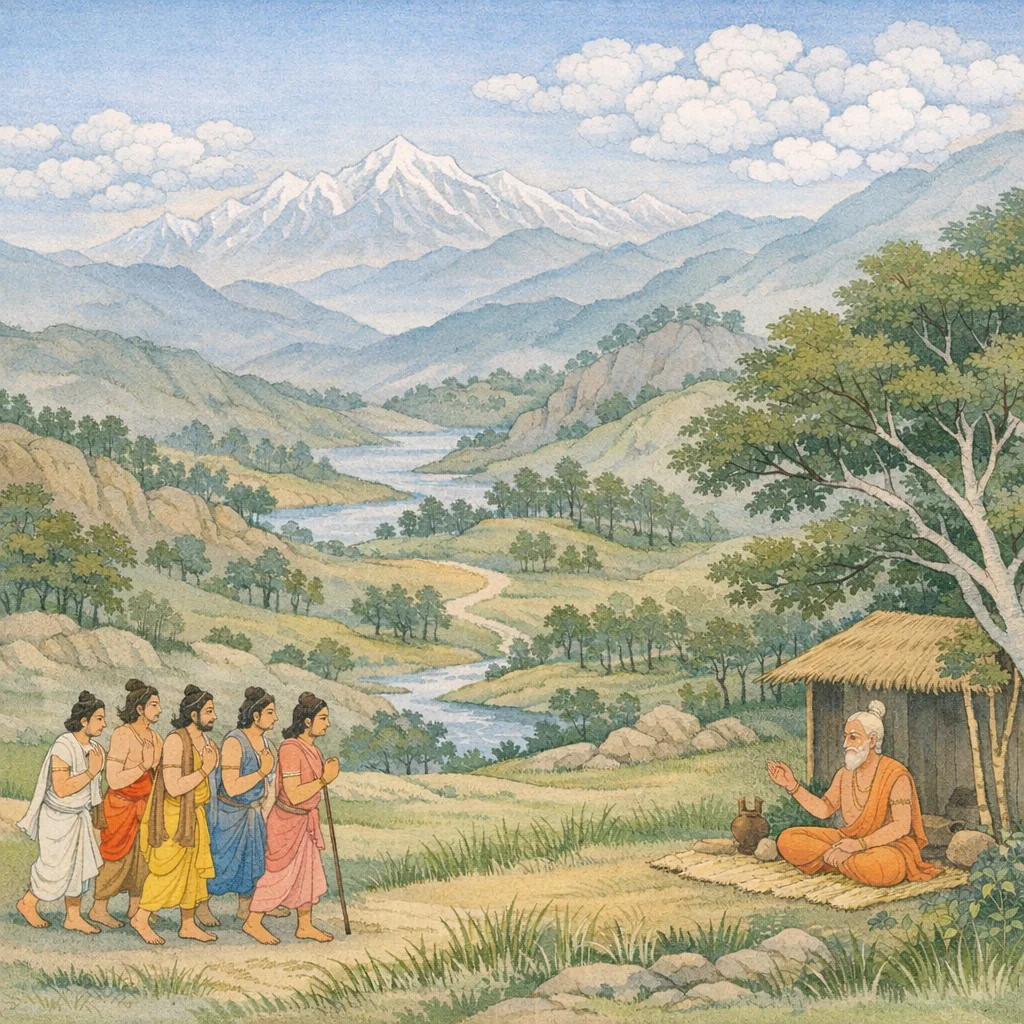
The chapter opens with Lomāśa indicating sacred geography to Yudhiṣṭhira: the holy river Kauśikī and the nearby āśrama of Viśvāmitra, along with the revered hermitage associated with the great Kāśyapa lineage. Lomāśa introduces Ṛśyaśṛṅga as an ascetic of exceptional restraint whose tapas is said to compel rainfall, even influencing Indra (Vāsava/Balavṛtrahā). Yudhiṣṭhira then poses a structured inquiry: how Ṛśyaśṛṅga was born from a doe (mṛgī) despite a “discordant” birth-context, why Indra feared him during drought, what Śāntā was like, and how Lomapāda’s realm came to be without rain. Lomāśa answers by recounting the conception: the brahmarṣi Vibhaṇḍaka, aroused upon seeing Urvaśī, releases seed that a thirsty doe drinks with water and becomes pregnant; from her is born Ṛśyaśṛṅga, marked by a horn on his head and raised in forest celibacy, having seen no humans besides his father. The narrative shifts to Anga: Lomapāda, friend of Daśaratha, incurs brāhmaṇa displeasure through misconduct connected to priestly norms; Indra withholds rain, the people suffer, and the king consults ascetics. A remedy is proposed: bring the forest-raised Ṛśyaśṛṅga into the kingdom, and rain will fall. Lomapāda convenes ministers, devises a plan, summons skilled courtesans to entice and gain the ascetic’s trust; most fear royal and curse repercussions, but an elderly woman volunteers after receiving resources, and proceeds toward the forest with selected women—ending the chapter on the initiation of this strategy.
Chapter Arc: लोमश ऋषि के साथ तीर्थयात्रा करते हुए युधिष्ठिर रोग-शोक-रहित हेमकूट पर्वत पर पहुँचते हैं, जहाँ प्रकृति स्वयं अलौकिक नियमों से चलती दिखती है—मानो देवताओं का कोई गुप्त प्रांगण। → राजा वहाँ ऐसे अद्भुत दृश्य देखते हैं: बिना वायु-सहारे मेघों का बँध जाना, सहस्रों शिलाओं-सा ओलावृष्टि, और तपस्वियों के शाप-आदेश से पर्वत, वायु और वर्षा का अनुशासित हो जाना—यह संकेत कि यह भूमि साधारण नहीं, तपस्या-शक्ति से शासित है। → लोमश का निर्देश निर्णायक बनता है—‘नन्दा’ में स्नान कर के ‘कौशिकी’ के पुण्य तट पर जाओ, जहाँ विश्वामित्र ने उग्र, अनुत्तम तप किया; तीर्थ का माहात्म्य और तपोबल का इतिहास एक ही क्षण में यात्रियों के सामने जीवित हो उठता है। → युधिष्ठिर अपने भाइयों सहित नन्दा में स्नान कर शीतल, रमणीय, शुभ जल वाली कौशिकी की ओर प्रस्थान करते हैं; यात्रा का अगला चरण अब तपस्या-परंपरा और ऋष्यशृंग-उपाख्यान की ओर मुड़ता है। → कौशिकी तट पर पहुँचते ही ऋष्यशृंग-उपाख्यान का सूत्र कसता है—आगे उसी मुनिकुमार को लाने/घटित कराने वाली कथा का द्वार खुलता है।
Shlokas
Verse 1
(दाक्षिणात्य अधिक पाठका १ श्लोक मिलाकर कुल २२ श्लोक हैं) #22. #+( 9) #:५../ &::./ दशाधिकशततमो<् ध्याय: नन््दा तथा कौशिकीका माहात्म्य, ऋष्यश्रृंग मुनिका उपाख्यान और उनको अपने राज्यमें लानेके लिये राजा लोमपादका प्रयत्न वैशम्पायन उवाच ततः प्रयात: कौन्तेय: क्रमेण भरतर्षभ । नन्दामपरनन्दां च नद्यौ पापभयापहे,वैशम्पायनजी कहते हैं--भरतश्रेष्ठ! तदनन्तर कुन्तीनन्दन युधिष्ठिर क्रमश: आगे बढ़ने लगे। उन्होंने पाप और भयका निवारण करनेवाली नन््दा और अपरनन्दा--इन दो नदियोंकी यात्रा की
Vaiśampāyana said: Then Kuntī’s son (Yudhiṣṭhira) proceeded onward step by step, O bull among the Bharatas. He came to the two rivers Nandā and Aparanandā, whose sacred presence is said to remove sin and dispel fear—marking another purifying stage in the Pāṇḍavas’ forest journey.
Verse 2
पर्वतं स समासाद्य हेमकूटमनामयम् | अचिन्त्यानद्भुतान् भावान् ददर्श सुबहून् नृप:,तत्पश्चात् रोग-शोकसे रहित हेमकूट पर्वतपर पहुँचकर राजा युधिष्ठिरने वहाँ बहुत-सी अचिन्त्य एवं अद्भुत बातें देखीं
Vaiśampāyana said: Having reached the Hemakūṭa mountain, free from affliction, King Yudhiṣṭhira beheld there many wondrous and unimaginable phenomena—signs that the forest journey is not merely hardship, but also a field where the righteous are tested and instructed through marvels beyond ordinary experience.
Verse 3
वाताबद्धा भवन्मेघा उपलाश्षन सहस्रश: । नाशवनुवंस्तमारोढुं विषण्णमनसो जना:,वहाँ वायुका सहारा लिये बिना ही बादल उत्पन्न हो जाते और अपने-आप हजारों पत्थर (ओले) पड़ने लगते थे। जिनके मनमें खेद भरा होता था ऐसे मनुष्य उस पर्वतपर चढ़ नहीं सकते थे
Vaiśampāyana said: Clouds would form as if bound and driven by the wind, and thousands of hailstones would fall of their own accord. People whose hearts were weighed down with dejection could not bring themselves to climb that mountain—only the resolute could face such harshness.
Verse 4
वायुर्नित्यं ववौ तत्र नित्यं देवश्न वर्षति । स्वाध्यायघोषश्न तथा श्रूयते न च दृश्यते
Vaiśampāyana said: “There a wind blew ceaselessly, and a divine rain fell without pause. Likewise, the sound of Vedic recitation was heard—yet the reciters themselves were not seen.”
Verse 5
सायं प्रातश्च भगवान् दृश्यते हव्यवाहन: । मक्षिकाश्नादशंस्तत्र तपस: प्रतिघातिका:
Vaiśampāyana said: “At evening and again at dawn, the revered Fire—Havyavāhana, the carrier of offerings—was seen there. Yet in that place he also spoke of fly-like, devouring impediments that strike against ascetic practice, warning that such distractions and afflictions can obstruct the fruit of tapas.”
Verse 6
निर्वेदो जायते तत्र गृहाणि स्मरते जन: । एवं बहुविधान् भावानद्धुतान् वीक्ष्य पाण्डव: । लोमशं पुनरेवाथ पर्यपृच्छत् तदद्भुतम्
There, dispassion arises, and a person begins to remember home. Having thus witnessed many astonishing states and occurrences, the Pāṇḍava (Yudhiṣṭhira) questioned Lomaśa again about that marvel—seeking understanding rather than mere wonder, as one who learns from extraordinary sights to steady the mind and discern what is right.
Verse 7
वहाँ प्रतेदिन हवा चलती और रोज-रोज मेघ वर्षा करता था। वेदोंके स्वाध्यायकी ध्वनि तो सुनायी पड़ती; परंतु स्वाध्याय करनेवालेका दर्शन नहीं होता था। सायंकाल और प्रातःकाल भगवान् अग्निदेव प्रज्वलित दिखायी देते थे। तपस्यामें विघ्न डालनेवाली मक्खियाँ वहाँ लोगोंको डंक मारती रहती थीं, अतः वहाँ विरक्ति होती और लोग घरोंकी याद करने लगते थे। इस प्रकार बहुत-सी अद्भुत बातें देखकर पाण्डुनन्दन युधिष्ठिरने लोमशजीसे पुनः इस अद्भुत अवस्थाके विषयमें पूछा ।। (युधिष्टिर उवाच यदेतद् भगवंश्रित्र॑ पर्वतेडस्मिन् महौजसि । एतन्मे सर्वमाचक्ष्व विस्तरेण महाद्युते ।।) युधिष्ठिने कहा--महातेजस्वी भगवन्! इस परम तेजोमय पर्वतपर जो ये आश्चर्यजनक बातें होती हैं, इसका क्या रहस्य है? यह सब विस्तारपूर्वक मुझे बताइये। लोगमश उवाच यथाश्रुतमिदं पूर्वमस्माभिररिकर्शन । तदेकाग्रमना राजन् निबोध गदतो मम,तब लोमशजीने कहा--शत्रुसूदन! हमने पूर्वकालमें जैसा सुन रखा है वैसा बताया जाता है। तुम एकाग्रचित्त हो मेरे मुखसे इसका रहस्य सुनो
Yudhiṣṭhira said: “O venerable sage, on this mighty, radiant mountain these wondrous occurrences are seen. O greatly luminous one, explain all of this to me in detail—what is its hidden cause?” Lomaśa said: “O subduer of foes, I shall relate it exactly as we heard it in former times. O king, with a focused mind, listen to me as I speak.”
Verse 8
अस्मिन्नृषभकूटे5 भूदूषभो नाम तापस: । अनेकशतवर्षायुस्तपस्वी कोपनो भृशम्
Lomaśa said: “On this Ṛṣabhakūṭa (peak) there lived an ascetic named Bhūdūṣabha. He had a lifespan of many hundreds of years, was rich in austerity, and yet was exceedingly prone to anger.”
Verse 9
पहलेकी बात है, इस ऋषभकूटपर ऋषभनामसे प्रसिद्ध एक तपस्वी रहते थे। उनकी आयु कई सौ वर्षोकी थी। वे तपस्वी होनेके साथ ही बड़े क्रोधी थे ।। स वै सम्भाष्यमाणो<न्यै: कोपाद् गिरिमुवाच ह | य इह व्याहरेत् कश्िदुपलानुत्सूजेस्तथा
Lomaśa said: “In former times, on this peak called Ṛṣabhakūṭa, there lived an ascetic renowned by the name Ṛṣabha. He had lived for many hundreds of years. Though a man of austerity, he was also fiercely prone to anger. Once, while others were speaking with him, he—overcome by wrath—addressed the mountain itself: ‘Whoever here utters a word, let him at once cast away stones (as a vow of silence/penance),’ thus laying down a harsh rule born of anger.”
Verse 10
वातं चाहूय मा शब्दमित्युवाच स तापस: । व्याहरंश्वेह पुरुषो मेघशब्देन वार्यते
Lomaśa said: Having summoned the wind, that ascetic declared, “Make no sound.” Yet here a man is heard speaking, though his words are drowned out by the roar of the clouds.
Verse 11
एवमेतानि कर्माणि राजंस्तेन महर्षिणा । कृतानि कानिचित् क्रोधात् प्रतिषिद्धानि कानिचित्
Thus, O king, some of these deeds were carried out by that great sage; and some, in anger, he forbade. The account shows that even ascetic power must be ruled by restraint, and that wrath can turn authority into prohibition rather than guidance.
Verse 12
उन्होंने दूसरोंके बुलानेपर कुपित होकर उस पर्वतसे कहा--“जो कोई यहाँपर बातचीत करे उसपर तू ओले बरसा।' इसी प्रकार वायुको भी बुलाकर उन तपस्वी मुनिने कहा --'देखो, यहाँ किसी प्रकारका शब्द नहीं होना चाहिये।” तबसे जो कोई पुरुष यहाँ बोलता है उसे मेघकी गर्जनाद्वारा रोका जाता है। राजन! इस प्रकार उन महर्षिने ही ये अद्भुत कार्य किये हैं। उन्होंने क्रोधवश कुछ कार्योका विधान और कुछ बातोंका निषेध कर दिया है ।। ९ १३९ || नन्दां त्वभिगता देवा: पुरा राजन्निति श्रुति: । अन्वपद्यन्त सहसा पुरुषा देवदर्शिन:,राजन! यह सुना जाता है कि प्राचीन कालमें देवतालोग नन््दाके तटपर आये थे, उस समय उनके दर्शनकी इच्छासे बहुतेरे मनुष्य सहसा वहाँ आ पहुँचे
Lomāśa said: “O King, when others called upon him, that ascetic sage grew angry and said to the mountain, ‘Whoever speaks here, rain hail upon him.’ In the same way he summoned the Wind and commanded, ‘See that no sound of any kind arises here.’ From that time on, whoever speaks in this place is checked by the thunderous roar of the clouds. O King, thus it was that very great sage who wrought these marvels: in wrath he ordained some acts and forbade some speech. And it is heard in ancient tradition, O King, that the gods once came to the river-bank of Nandā; then, eager for a vision of the divine, many men—seekers of the gods—suddenly gathered there.”
Verse 13
ते दर्शनं त्वनिच्छन्तो देवा: शक्रपुरोगमा: । दुर्ग चक्कुरिमं देशं गिरिं प्रत्यूहरूपकम्,इन्द्र आदि देवता उन्हें दर्शन देना नहीं चाहते थे, अतः विधघ्नस्वरूप इस पर्वतीय प्रदेशको उन्होंने जनसाधारणके लिये दुर्गम बना दिया
Lomāśa said: Since the gods, led by Śakra (Indra), did not wish to grant them an audience, they made this region difficult to approach—turning the mountain itself into an obstacle—so that ordinary people could not easily reach it.
Verse 14
तदाप्रभृति कौन्तेय नरा गिरिमिमं सदा | नाशवनुवन्नभिद्रष्टं कुत एवाधिरोहितुम्,कुन्तीनन्दन! तभीसे साधारण मनुष्य इस पर्वतको देख भी नहीं सकते, चढ़ना तो दूरकी बात है
Lomāśa said: “From that time onward, O son of Kuntī, ordinary men have never been able even to behold this mountain; how then could they possibly climb it, O Kuntī’s son?”
Verse 15
नातप्ततपसा शकक््यो द्रष्टमेष महागिरि: । आरोढुं वापि कौन्तेय तस्मान्नियतवाग् भव,कुन्तीकुमार! जिसने तपस्या नहीं की है वह मनुष्य इस महान् पर्वतको न तो देख सकता है और न चढ़ ही सकता है; अतः तुम मौन व्रत धारण करो
Lomāśa said: “O son of Kuntī, one who has not undergone austerity cannot truly behold this great mountain, nor can he climb it. Therefore, restrain your speech and undertake the discipline of silence.”
Verse 16
इह देवास्तदा सर्वे यज्ञानाजहुरुत्तमान् तेषामेतानि लिड्जानि दृश्यन्तेद्यापि भारत,उन दिनों सम्पूर्ण देवताओंने यहाँ आकर उत्तम यज्ञोंका अनुष्ठान किया था। भारत! उनके ये चिह्न आज भी प्रत्यक्ष देखे जाते हैं
Here, long ago, all the gods came and performed excellent sacrificial rites. O Bhārata, the marks and signs of those sacrifices are still visible even today.
Verse 17
कुशाकारेव दूर्वेयं संस्तीर्णेव च भूरियम् । यूपप्रकारा बहवो वृक्षाश्वेमे विशाम्पते,यह दूर्वा कुशके आकारकी दिखायी देती है और यह भूमि ऐसी लगती है मानो इसपर कुश बिछाये गये हों। महाराज! ये वृक्ष भी यज्ञयूपके समान जान पड़ते हैं
Lomasa said: “This dūrvā grass appears shaped like kuśa, and this ground looks as though it has been spread over with kuśa blades. O lord of the people, these many trees too seem like sacrificial posts (yūpas).”
Verse 18
देवाक्ष ऋषयश्नैव वसन्त्यद्यापि भारत । तेषां सायं तथा प्रातर्दश्यते हव्यवाहन:,भारत! आज भी यहाँ देवता तथा ऋषि निवास करते हैं। सायंकाल और प्रात:काल यहाँ उनके द्वारा प्रजजलित की हुई अग्निका दर्शन होता है
Lomasa said: “O Bhārata, even today the gods and the seers dwell here. At evening and again at dawn, the sacred fire kindled by them is seen here.”
Verse 19
इहाप्लुतानां कौन्तेय सद्यः पाप्माभिहन्यते । कुरुश्रेष्ठाभिषेकं॑ वै तस्मात् कुरु सहानुज:,कुन्तीनन्दन! इस तीर्थमें गोता लगानेवाले मानवोंका सारा पाप तत्काल नष्ट हो जाता है। अतः कुरुश्रेष्ठी तुम अपने भाइयोंके साथ यहाँ स्नान करो
Lomasha said: “O son of Kuntī, for those who bathe here, sin is destroyed at once. Therefore, O best of the Kurus, perform the sacred bathing rite here together with your younger brothers.”
Verse 20
ततो नन्दाप्लुताड्स्त्वं कौशिकीमभियास्यसि । विश्वामित्रेण यत्रोग्रं तपस्तप्तमनुत्तमम्,ननन््दामें गोता लगानेके पश्चात् तुम्हें कौशिकीके तटपर चलना होगा जहाँ महर्षि विश्वामित्रजीने उत्तम एवं उग्र तपस्या की थी
Lomasa said: “After you have bathed in the river Nandā, you should proceed to the bank of the Kauśikī. There, the sage Viśvāmitra once performed unsurpassed and formidable austerities.”
Verse 22
वैशम्पायनजी कहते हैं--तदनन्तर राजा युधिष्ठिर अपने दल-बलके साथ नन््दामें गोता लगाकर रमणीय एवं शीतल जलवाली शुभ पुण्यमयी कौशिकीके तटपर गये ।। लोगश उवाच एषा देवनदी पुण्या कौशिकी भरतर्षभ । विश्वामित्रा श्रमो रम्य एष चात्र प्रकाशते,वहाँ लोमशजीने कहा--भरतगश्रेष्ठ! यह देवताओंकी नदी पुण्यसलिला कौशिकी है और यह विश्वामित्रका रमणीय आश्रम है, जो यहाँ प्रकाशित हो रहा है
Lomaśa said: “O bull among the Bharatas, this is the sacred Kauśikī, a divine river whose waters are purifying. And here, clearly visible before us, is the delightful hermitage of Viśvāmitra.”
Verse 23
आश्रमश्रैव पुण्याख्य: काश्यपस्य महात्मन: । ऋष्यशूड़ः सुतो यस्य तपस्वी संयतेन्द्रिय:,यहीं कश्यपगोत्रीय महात्मा विभाण्डकका “पुण्य” नामक आश्रम है। इन्हींके तपस्वी एवं जितेन्द्रिय पुत्र महात्मा ऋष्यशंग हैं, जिन्होंने अपनी तपस्याके प्रभावसे इन्द्रद्वारा वर्षा करवायी थी। उन दिनों देशमें घोर अनावृष्टि फैल रही थी, वैसे समयमें ऋष्यशृंग मुनिके भयसे बल और वृत्रासुरके विनाशक देवराज इन्द्रने उस देशमें वर्षा की थी
Lomaśa said: “There is also the hermitage called ‘Puṇya’, belonging to the great sage Kaśyapa. His son is Ṛṣyaśṛṅga—an austere ascetic, master of his senses. By the power of his penance, he once caused Indra to send rain, ending a terrible drought that had gripped the land.”
Verse 24
तपसो य: प्रभावेण वर्षयामास वासवम् । अनावृष्ट्यां भयाद् यस्य ववर्ष बलवृत्रहा,यहीं कश्यपगोत्रीय महात्मा विभाण्डकका “पुण्य” नामक आश्रम है। इन्हींके तपस्वी एवं जितेन्द्रिय पुत्र महात्मा ऋष्यशंग हैं, जिन्होंने अपनी तपस्याके प्रभावसे इन्द्रद्वारा वर्षा करवायी थी। उन दिनों देशमें घोर अनावृष्टि फैल रही थी, वैसे समयमें ऋष्यशृंग मुनिके भयसे बल और वृत्रासुरके विनाशक देवराज इन्द्रने उस देशमें वर्षा की थी
Lomaśa said: “He whose ascetic power was so great that he could compel Vāsava (Indra) to send rain—during a time of dreadful drought, it was out of fear of that sage that the slayer of Bala and Vṛtra poured down rain upon the land.”
Verse 25
मृग्यां जात: स तेजस्वी काश्यपस्य सुतः प्रभु: । विषये लोमपादस्य यश्चकाराद्धुतं महत्,वे तेजस्वी एवं शक्तिशाली मुनि मृगीके पेटसे पैदा हुए थे और कश्यपनन्दन विभाण्डकके पुत्र थे। उन्होंने राजा लोमपादके राज्यमें अत्यन्त अद्भुत कार्य किया था
He was a radiant and powerful sage, born of a doe, of Kāśyapa’s line—Vibhāṇḍaka’s son. In King Lomapāda’s realm he accomplished a great and astonishing deed.
Verse 26
निर्वर्तितेषु सस्येषु यस्मै शान्तां ददौ नृप: । लोमपादो दुहितरं सावित्रीं सविता यथा,जब वर्षासे खेती अच्छी तरह लहलहा उठी तब राजा लोमपादने अपनी पुत्री शान्ता ऋष्यशृंगको ब्याह दी; ठीक उसी तरह, जैसे सूर्यदेवने अपनी बेटी सावित्रीका ब्रह्माजीके साथ ब्याह किया था
When the crops had been brought to fruition and the realm was at peace, King Lomapāda gave his daughter Śāntā in marriage to Ṛṣyaśṛṅga—just as Savitṛ, the Sun-god, gave his daughter Sāvitrī to Brahmā.
Verse 27
युधिछिर उवाच ऋष्यश्ड्र: कथं मृग्यामुत्पन्न: काश्यपात्मज: । विरुद्धे योनिसंसगे कथं च तपसा युतः,युधिष्ठिरने पूछा--भगवन्! कश्यपनन्दन विभाण्डकके पुत्र ऋष्यशुंग मृगीके पेटसे कैसे उत्पन्न हुए? मनुष्यका पशुयोनिसे संसर्ग करना तो शास्त्र और व्यवहार दोनों ही दृष्टियोंसे विरुद्ध है। ऐसे विरुद्ध योनि-संसर्गसे उत्पन्न हुआ बालक तपस्वी कैसे हो सका? उस बुद्धिमान् बालकके भयसे बल और वृत्रासुरका विनाश करनेवाले देवराज इन्द्रने अनावृष्टिके समय वर्षा कैसे की?
Yudhiṣṭhira said: “O venerable sage, how was Ṛṣyaśṛṅga—son of Vibhāṇḍaka, descended from Kaśyapa—born from a doe? For union across such incompatible wombs is contrary both to śāstra and to accepted conduct. How, then, could a child born from such a transgressive union become endowed with ascetic power? And how did Indra—slayer of Bala and Vṛtra—when drought prevailed, bring about rain, driven by fear of that wise boy?”
Verse 28
किमर्थ च भयाच्छक्रस्तस्य बालस्य धीमत: । अनावृष्ट्यां प्रवृत्तायां ववर्ष बलवृत्रहा,युधिष्ठिरने पूछा--भगवन्! कश्यपनन्दन विभाण्डकके पुत्र ऋष्यशुंग मृगीके पेटसे कैसे उत्पन्न हुए? मनुष्यका पशुयोनिसे संसर्ग करना तो शास्त्र और व्यवहार दोनों ही दृष्टियोंसे विरुद्ध है। ऐसे विरुद्ध योनि-संसर्गसे उत्पन्न हुआ बालक तपस्वी कैसे हो सका? उस बुद्धिमान् बालकके भयसे बल और वृत्रासुरका विनाश करनेवाले देवराज इन्द्रने अनावृष्टिके समय वर्षा कैसे की?
Yudhiṣṭhira said: “For what reason did Śakra (Indra) fear that wise boy? And when drought had set in, how did the slayer of Bala and Vṛtra bring down rain?”
Verse 29
कथंरूपा च सा शान्ता राजपुत्री यतव्रता । लोभयामास या चेतो मृगभूतस्य तस्य वै,नियम और व्रतका पालन करनेवाली राजकुमारी शान्ता भी कैसी थी, जिसने मृगस्वरूप मुनिका भी मन मोह लिया। राजर्षि लोमपाद तो बड़े धर्मात्मा सुने गये हैं, फिर उनके राज्यमें इन्द्र वर्षा क्यों नहीं करते थे?
Yudhiṣṭhira said: “What manner of woman was that princess Śāntā—so self-restrained and faithful to her vows—who could captivate even the mind of that sage who had taken the form of a deer?”
Verse 30
लोमपाददश्न राजर्षिययदाश्रूयत धार्मिक: । कथं वै विषये तस्य नावर्षत् पाकशासन:,नियम और व्रतका पालन करनेवाली राजकुमारी शान्ता भी कैसी थी, जिसने मृगस्वरूप मुनिका भी मन मोह लिया। राजर्षि लोमपाद तो बड़े धर्मात्मा सुने गये हैं, फिर उनके राज्यमें इन्द्र वर्षा क्यों नहीं करते थे?
Yudhiṣṭhira said: “King Lomapāda is indeed heard of as a royal sage, a man devoted to dharma. If so, how did it happen that in his realm Pākaśāsana (Indra), the lord of rain, did not send showers?”
Verse 31
एतन्मे भगवन् सर्व विस्तरेण यथातथम् । वक्तुमहसि शुश्रूषोरऋष्यशृज्गस्य चेष्टितम्,भगवन्! ये सब बातें आप विस्तारपूर्वक यथार्थ-रूपसे बताइये। मैं महर्षि ऋष्यशुंगके चरित्रको सुनना चाहता हूँ
O Blessed one, please tell me all this in full detail, exactly as it happened. I am eager to listen; therefore, O venerable sage, recount to me the deeds and life-story of Ṛṣyaśṛṅga.
Verse 32
लोगश उवाच विभाण्डकस्य विप्रर्षेस्तपसा भावितात्मन: । अमोघवीर्यस्य सत: प्रजापतिसमद्युते:,लोमशजीने कहा--राजन! ब्रह्मर्षि विभाण्डकका अन्तःकरण तपस्यासे पवित्र हो गया था। वे प्रजापतिके समान तेजस्वी और अमोघवीर्य महात्मा थे। उनके प्रतापी पुत्र ऋष्यशृंगका जन्म कैसे हुआ, यह बताता हूँ, सुनो। जैसे विभाण्डक मुनि परम पूजनीय थे, वैसे ही उनका पुत्र भी बड़ा तेजस्वी हुआ। वह बाल्यावस्थामें भी वृद्ध पुरुषोंद्वारा सम्मानित होता था
Lomaśa said: “O king, the inner being of the brahmarṣi Vibhāṇḍaka had been purified and strengthened by austerity. He was a true and noble sage, of unfailing spiritual potency, radiant like Prajāpati himself.”
Verse 33
शृणु पुत्रो यथा जात ऋष्यशुड़ प्रतापवान् | महाहस्य महातेजा बाल: स्थविरसम्मत:,लोमशजीने कहा--राजन! ब्रह्मर्षि विभाण्डकका अन्तःकरण तपस्यासे पवित्र हो गया था। वे प्रजापतिके समान तेजस्वी और अमोघवीर्य महात्मा थे। उनके प्रतापी पुत्र ऋष्यशृंगका जन्म कैसे हुआ, यह बताता हूँ, सुनो। जैसे विभाण्डक मुनि परम पूजनीय थे, वैसे ही उनका पुत्र भी बड़ा तेजस्वी हुआ। वह बाल्यावस्थामें भी वृद्ध पुरुषोंद्वारा सम्मानित होता था
Lomaśa said: “Listen, O king, to how the illustrious Ṛṣyaśṛṅga was born. Though still a boy, he was radiant with great spiritual power, marked by an innocent, gentle cheerfulness, and was held in esteem even by elders.”
Verse 34
महाह्द समासाद्य काश्यपस्तपसि स्थित: । दीर्घकालं परिश्रानन््त ऋषि: स देवसम्मित:,कश्यपगोत्रीय विभाण्डक मुनि देवताओंके समान सुन्दर थे। वे एक बहुत बड़े कुण्डमें प्रविष्ट होकर तपस्या करने लगे। उन्होंने दीर्घकालतक महान् क्लेश सहन किया
Having reached a vast lake, the sage Kāśyapa entered upon severe austerities there. For a long time he endured exhausting hardship; that ṛṣi, revered as equal to the gods, remained steadfast in his penance.
Verse 35
तस्य रेत: प्रचस्कन्द दृष्टवाप्सरसमुर्वशीम् । अप्सूपस्पृशतो राजन् मृगी तच्चापिबत् तदा,राजन्! एक दिन जब वे जलमें स्नान कर रहे थे, उर्वशी अप्सराको देखकर उनका वीर्य स्खलित हो गया। उसी समय प्याससे व्याकुल हुई एक मृगी वहाँ आयी और पानीके साथ उस वीर्यको भी पी गयी। इससे उसके गर्भ रह गया। वह पूर्वजन्ममें एक देवकन्या थी। लोकस्रष्टा भगवान् ब्रह्माने उसे यह वचन दिया था कि तू मृगी होकर एक मुनिको जन्म देनेके पश्चात् उस योनिसे मुक्त हो जायगी। ब्रह्माजीकी वाणी अमोघ है और दैवके विधानको कोई टाल नहीं सकता, इसलिये विभाण्डकके पुत्र महर्षि ऋष्यशृंगका जन्म मृगीके ही पेटसे हुआ। वे सदा तपस्यामें संलग्न रहकर वनमें ही निवास करते थे
Seeing the apsaras Urvaśī, his semen involuntarily fell. O King, while he was bathing and touching the waters, a thirsty doe came there and, along with the water, drank that semen as well.
Verse 36
सह तोयेन तृषिता गर्भिणी चाभवत् ततः । सा पुरोक्ता भगवता ब्रह्मणा लोककर्तणा,राजन्! एक दिन जब वे जलमें स्नान कर रहे थे, उर्वशी अप्सराको देखकर उनका वीर्य स्खलित हो गया। उसी समय प्याससे व्याकुल हुई एक मृगी वहाँ आयी और पानीके साथ उस वीर्यको भी पी गयी। इससे उसके गर्भ रह गया। वह पूर्वजन्ममें एक देवकन्या थी। लोकस्रष्टा भगवान् ब्रह्माने उसे यह वचन दिया था कि तू मृगी होकर एक मुनिको जन्म देनेके पश्चात् उस योनिसे मुक्त हो जायगी। ब्रह्माजीकी वाणी अमोघ है और दैवके विधानको कोई टाल नहीं सकता, इसलिये विभाण्डकके पुत्र महर्षि ऋष्यशृंगका जन्म मृगीके ही पेटसे हुआ। वे सदा तपस्यामें संलग्न रहकर वनमें ही निवास करते थे
Thirsty, she drank along with the water, and from that she became pregnant. This had been foretold to her earlier by the Blessed Brahmā, the creator of the worlds: that after becoming a doe and giving birth to a sage, she would be released from that animal womb. Thus, what appears as an irregular birth is framed as the unfailing working of divine ordinance and prior destiny.
Verse 37
देवकन्या मृगी भूत्वा मुनिं सूय विमोक्ष्यसे । अमोघत्वाद् विधेश्वैव भावित्वाद् दैवनिर्मितात्,राजन्! एक दिन जब वे जलमें स्नान कर रहे थे, उर्वशी अप्सराको देखकर उनका वीर्य स्खलित हो गया। उसी समय प्याससे व्याकुल हुई एक मृगी वहाँ आयी और पानीके साथ उस वीर्यको भी पी गयी। इससे उसके गर्भ रह गया। वह पूर्वजन्ममें एक देवकन्या थी। लोकस्रष्टा भगवान् ब्रह्माने उसे यह वचन दिया था कि तू मृगी होकर एक मुनिको जन्म देनेके पश्चात् उस योनिसे मुक्त हो जायगी। ब्रह्माजीकी वाणी अमोघ है और दैवके विधानको कोई टाल नहीं सकता, इसलिये विभाण्डकके पुत्र महर्षि ऋष्यशृंगका जन्म मृगीके ही पेटसे हुआ। वे सदा तपस्यामें संलग्न रहकर वनमें ही निवास करते थे
Lomaśa said: “Having become a doe, you will be released from that animal birth after giving birth to a sage. For the word of the Ordainer, Brahmā, is unfailing, and what destiny has fashioned must come to pass.”
Verse 38
तस्यां मृग्यां समभवत् तस्य पुत्रो महानृषि: । ऋष्यशूज्गस्तपोनित्यो वन एवाभ्यवर्तत,राजन्! एक दिन जब वे जलमें स्नान कर रहे थे, उर्वशी अप्सराको देखकर उनका वीर्य स्खलित हो गया। उसी समय प्याससे व्याकुल हुई एक मृगी वहाँ आयी और पानीके साथ उस वीर्यको भी पी गयी। इससे उसके गर्भ रह गया। वह पूर्वजन्ममें एक देवकन्या थी। लोकस्रष्टा भगवान् ब्रह्माने उसे यह वचन दिया था कि तू मृगी होकर एक मुनिको जन्म देनेके पश्चात् उस योनिसे मुक्त हो जायगी। ब्रह्माजीकी वाणी अमोघ है और दैवके विधानको कोई टाल नहीं सकता, इसलिये विभाण्डकके पुत्र महर्षि ऋष्यशृंगका जन्म मृगीके ही पेटसे हुआ। वे सदा तपस्यामें संलग्न रहकर वनमें ही निवास करते थे
From that doe a son was conceived, and he became a great sage. That son was Ṛṣyaśṛṅga, ever devoted to austerity, who lived and moved about only in the forest.
Verse 39
तस्यर्षे: शुड़ं शिरसि राजन्नासीन्महात्मन: । तेनर्ष्पशूज़ इत्येवं तदा स प्रथितो5भवत्,राजन! उन महात्मा मुनिके सिरपर एक सींग था, इसलिये उस समय उनका ऋष्यशुग नाम प्रसिद्ध हुआ
O King, that great-souled sage had a horn upon his head. Because of that, he became renowned at that time by the name Ṛṣyaśṛṅga—“the sage with the horn.”
Verse 40
न तेन दृष्टपूर्वोउन्य: पितुरन्यत्र मानुष: । तस्मात् तस्य मनो नित्य ब्रह्मचर्येडभवन्नूप,नरेश्वर! उन्होंने अपने पिताके सिवा दूसरे किसी मनुष्यको पहले कभी नहीं देखा था, इसलिये उनका मन सदा स्वभावसे ही ब्रह्मचर्यमें संलग्न रहता था
“Other than his own father, he had never before seen any human being. Therefore, O king, his mind naturally and constantly remained inclined toward brahmacarya—self-restraint and celibate discipline.”
Verse 41
एतस्मिन्नेव काले तु सखा दशरथस्य वै । लोमपाद इति ख्यातो हाज्रानामीश्वरो5भवत्,इन्हीं दिनों राजा दशरथके मित्र लोमपाद अंगदेशके राजा हुए
At that very time, Daśaratha’s friend—renowned by the name Lomapāda—became the ruler of the Aṅgas.
Verse 42
तेन कामात् कृतं भिथ्या ब्राह्मणस्येति न: श्रुति: । स ब्राह्मणै: परित्यक्तस्ततो वै जगत: पति:,उन्होंने जान-बूझकर एक ब्राह्मणके साथ मिथ्या व्यवहार किया--यह बात हमारे सुननेमें आयी है। इसी अपराधके कारण ब्राह्मणोंने राजा लोमपादको त्याग दिया था। राजाने पुरोहितपर मनमाना दोषारोपण किया था, इसलिये इन्द्रने उनके राज्यमें वर्षा बंद कर दी। इस अनावृष्टिके कारण प्रजाको बड़ा कष्ट होने लगा
We have heard that, driven by desire, he acted falsely toward a brāhmaṇa. Because of that offense, the brāhmaṇas abandoned him—indeed, that lord of the people. The passage frames the wrongdoing as a deliberate breach of truth and respect toward a brāhmaṇa, and presents social-religious withdrawal (the brāhmaṇas’ rejection) as the moral consequence that undermines a ruler’s legitimacy and welfare.
Verse 43
पुरोहितापचाराच्च तस्य राज्ञो यदृच्छया । न ववर्ष सहस्राक्षस्ततो5पीड्यन्त वै प्रजा:,उन्होंने जान-बूझकर एक ब्राह्मणके साथ मिथ्या व्यवहार किया--यह बात हमारे सुननेमें आयी है। इसी अपराधके कारण ब्राह्मणोंने राजा लोमपादको त्याग दिया था। राजाने पुरोहितपर मनमाना दोषारोपण किया था, इसलिये इन्द्रने उनके राज्यमें वर्षा बंद कर दी। इस अनावृष्टिके कारण प्रजाको बड़ा कष्ट होने लगा
Because that king had, by a heedless lapse, committed an offence against his royal priest, Sahasrākṣa (Indra) did not send rain. As a result, the people were indeed afflicted—suffering under drought brought on by the ruler’s disregard for the sanctity of the priestly office and the moral order it upholds.
Verse 44
स ब्राह्मणान् पर्यपृच्छत् तपोयुक्तान् मनीषिण: । प्रवर्षणे सुरेन्द्रस्य समर्थान् पृथिवीपते,युधिष्ठिर! तब राजाने तपस्वी, मेधावी और इन्द्रसे वर्षा करवानेमें समर्थ ब्राह्मणोंको बुलाकर इस संकटके निवारणका उपाय पूछा
O king Yudhiṣṭhira, he summoned Brahmins—ascetic, wise, and capable even of inducing rainfall from Indra—and questioned them about the means to remove this calamity. The scene underscores a ruler’s duty to seek counsel from the spiritually disciplined and learned when the welfare of the realm is threatened.
Verse 45
कथं प्रवर्षेत् पर्जन्य उपाय: परिदृश्यताम् । तमूचुश्नोदितास्ते तु स््वमतानि मनीषिण:,“विप्रगण! मेघ कैसे वर्षा करे--यह उपाय सोचिये।” उनके पूछनेपर मनीषी महात्माओंने अपना-अपना विचार बताया
Lomaśa said, “How can the rain-cloud be made to pour? Let a means be devised.” When the learned sages were thus questioned, each of those wise men set forth his own considered view—seeking a righteous and effective remedy for the drought.
Verse 46
तत्र त्वेको मुनिवरस्तं राजानमुवाच ह । कुपितास्तव राजेन्द्र ब्राह्मणा निष्कृतिं चर,उन्हीं ब्राह्मणोंमें एक श्रेष्ठ महर्षि भी थे। उन्होंने राजासे कहा--'राजेन्द्र! तुम्हारे ऊपर ब्राह्मण कुपित हैं; इसके लिये तुम प्रायश्चित्त करो"
There, one eminent sage addressed the king: “O best of kings, the Brahmins are angered with you. Therefore, undertake expiation and make amends.” The statement frames royal duty as accountability before spiritual and moral authority, urging the ruler to restore harmony through prescribed atonement rather than force or denial.
Verse 47
ऋष्यश्ड़ूं मुनिसुतमानयस्व च पार्थिव । वानेयमनभिज्ञं च नारीणामार्जवे रतम्,'भूपाल! साथ ही हम तुम्हें यह सलाह देते हैं कि अपने राज्यमें महर्षि विभाण्डकके पुत्र वनवासी ऋष्यशृंगको बुलाओ। वे स्त्रियोंसे सर्वया अपरिचित हैं और सदा सरल व्यवहारमें ही तत्पर रहते हैं। महाराज! वे महातपस्वी ऋष्यशुड़् यदि आपके राज्यमें पदार्पण करें तो तत्काल ही मेघ वर्षा करेगा इस विषयमें मुझे तनिक भी संदेह नहीं है!
The sage said: “O king, bring here Ṛṣyaśṛṅga, the son of the muni. He is a forest-dweller, wholly unacquainted with women, and devoted to straightforward, guileless conduct. If that great ascetic Ṛṣyaśṛṅga sets foot in your realm, rain-bearing clouds will pour down at once—of this I have not the slightest doubt.”
Verse 48
स चेदवतरेद् राजन विषयं ते महातपा: । सद्यः प्रवर्षेत् पर्जन्य इति मे नात्र संशय:,'भूपाल! साथ ही हम तुम्हें यह सलाह देते हैं कि अपने राज्यमें महर्षि विभाण्डकके पुत्र वनवासी ऋष्यशृंगको बुलाओ। वे स्त्रियोंसे सर्वया अपरिचित हैं और सदा सरल व्यवहारमें ही तत्पर रहते हैं। महाराज! वे महातपस्वी ऋष्यशुड़् यदि आपके राज्यमें पदार्पण करें तो तत्काल ही मेघ वर्षा करेगा इस विषयमें मुझे तनिक भी संदेह नहीं है!
Lomaśa said: “O king, if that great ascetic were to set foot within your realm, then the rain-cloud would pour down at once—of this I have no doubt.”
Verse 49
एतच्छुत्वा वचो राजन् कृत्वा निष्कृतिमात्मन: । स गत्वा पुनरागच्छत् प्रसन्नेषु द्विजातिषु,“राजन्! यह सुनकर राजा लोमपाद अपने अपराधका प्रायश्ित्त करके ब्राह्मणोंके पास गये और जब वे प्रसन्न हो गये तब पुन: अपनी राजधानीको लौट आये”
O King, having heard these words, he performed expiation for his own fault. Then he went to the twice-born (brāhmaṇas); and when they were appeased and gracious, he returned again to his capital.
Verse 50
राजानमागरतं श्रुत्वा प्रतिसंजहृषु: प्रजा: । ततो$ज्भपतिराहूय सचिवान् मन्त्रकोविदान्,राजाका आगमन सुनकर प्रजाजनोंको बड़ा हर्ष हुआ। तदनन्तर अंगराज मन्त्रकुशल मन्त्रियोंको बुलाकर उनसे सलाह करके एक निश्चयपर पहुँच जानेके बाद मुनिकुमार ऋष्यशृंगको अपने यहाँ ले आनेके प्रयत्नमें लग गये। राजाके मन्त्री शास्त्रज्ञ, अर्थशास्त्रके विद्वान् और नीतिनिपुण थे। अपनी मर्यादासे कभी च्युत न होनेवाले नरेशने उन मन्त्रियोंके साथ विचार करके एक उपाय जान लिया। तत्पश्चात् भूपाल लोमपादने दूसरोंको लुभानेकी सब कलाओंमें कुशल प्रधान-प्रधान वेश्याओंको बुलाया और कहा--“तुमलोग कोई उपाय करके मुनिकुमार ऋष्यशृंंगको यहाँ ले आओ
Hearing that the king had arrived, the people rejoiced greatly. Then the lord of Aṅga (King Lomapāda) summoned his ministers skilled in counsel, intending to deliberate and settle upon a course of action—one that would lead to bringing the sage’s son Ṛṣyaśṛṅga to his own realm.
Verse 51
ऋष्यशृज्भरागमे यत्नमकरोन्मन्त्रनिश्चये । सो<ध्यगच्छदुपायं तु तैरमात्यै: सहाच्युत:,राजाका आगमन सुनकर प्रजाजनोंको बड़ा हर्ष हुआ। तदनन्तर अंगराज मन्त्रकुशल मन्त्रियोंको बुलाकर उनसे सलाह करके एक निश्चयपर पहुँच जानेके बाद मुनिकुमार ऋष्यशृंगको अपने यहाँ ले आनेके प्रयत्नमें लग गये। राजाके मन्त्री शास्त्रज्ञ, अर्थशास्त्रके विद्वान् और नीतिनिपुण थे। अपनी मर्यादासे कभी च्युत न होनेवाले नरेशने उन मन्त्रियोंके साथ विचार करके एक उपाय जान लिया। तत्पश्चात् भूपाल लोमपादने दूसरोंको लुभानेकी सब कलाओंमें कुशल प्रधान-प्रधान वेश्याओंको बुलाया और कहा--“तुमलोग कोई उपाय करके मुनिकुमार ऋष्यशृंंगको यहाँ ले आओ
Lomaśa said: “When he heard of Ṛṣyaśṛṅga’s coming, the king exerted himself to reach a firm decision through counsel. Unswerving from propriety, he deliberated together with his ministers and discovered a practical means (to bring the sage’s son).”
Verse 52
शास्त्रज्ैरलमर्थज्ञै्नीत्यां च परिनिष्ठितै: । ततश्नानाययामास वारमुख्या महीपति:,राजाका आगमन सुनकर प्रजाजनोंको बड़ा हर्ष हुआ। तदनन्तर अंगराज मन्त्रकुशल मन्त्रियोंको बुलाकर उनसे सलाह करके एक निश्चयपर पहुँच जानेके बाद मुनिकुमार ऋष्यशृंगको अपने यहाँ ले आनेके प्रयत्नमें लग गये। राजाके मन्त्री शास्त्रज्ञ, अर्थशास्त्रके विद्वान् और नीतिनिपुण थे। अपनी मर्यादासे कभी च्युत न होनेवाले नरेशने उन मन्त्रियोंके साथ विचार करके एक उपाय जान लिया। तत्पश्चात् भूपाल लोमपादने दूसरोंको लुभानेकी सब कलाओंमें कुशल प्रधान-प्रधान वेश्याओंको बुलाया और कहा--“तुमलोग कोई उपाय करके मुनिकुमार ऋष्यशृंंगको यहाँ ले आओ
Then the king, having taken counsel with ministers learned in the śāstras, skilled in polity and wealth (artha), and steadfast in right conduct, summoned the foremost courtesans for the task. When their deliberation had settled upon a firm plan, the ruler set the means in motion to bring Ṛśyaśṛṅga, the sage’s son, into his own realm—showing how royal policy, for good or ill, can harness expertise and social instruments to reach a desired end.
Verse 53
वेश्या: सर्वत्र निष्णातास्ता उवाच स पार्थिव: । ऋष्यश्ज्भमृषे: पुत्रमानयध्वमुपायत:,राजाका आगमन सुनकर प्रजाजनोंको बड़ा हर्ष हुआ। तदनन्तर अंगराज मन्त्रकुशल मन्त्रियोंको बुलाकर उनसे सलाह करके एक निश्चयपर पहुँच जानेके बाद मुनिकुमार ऋष्यशृंगको अपने यहाँ ले आनेके प्रयत्नमें लग गये। राजाके मन्त्री शास्त्रज्ञ, अर्थशास्त्रके विद्वान् और नीतिनिपुण थे। अपनी मर्यादासे कभी च्युत न होनेवाले नरेशने उन मन्त्रियोंके साथ विचार करके एक उपाय जान लिया। तत्पश्चात् भूपाल लोमपादने दूसरोंको लुभानेकी सब कलाओंमें कुशल प्रधान-प्रधान वेश्याओंको बुलाया और कहा--“तुमलोग कोई उपाय करके मुनिकुमार ऋष्यशृंंगको यहाँ ले आओ
Lomapāda, the king, addressed the courtesans skilled in every art: “By some stratagem, bring here Ṛśyaśṛṅga, the sage’s son.” In the tale, the king—after consulting ministers versed in policy—chooses a pragmatic yet morally fraught means to secure the presence of a powerful ascetic whose arrival is believed to restore welfare to the realm, laying bare the tension between artha and dharma.
Verse 54
लोभयित्वाभिविश्वास्य विषयं मम शोभना: । ता राजभयभीताश्चन शापभीताक्षु योषित:,'सुन्दरियो! तुम लुभाकर उन्हें सब प्रकारसे सुख-सुविधाका विश्वास दिलाकर मेरे राज्यमें ले आना।” महाराजकी यह बात सुनते ही वेश्याओंका रंग फीका पड़ गया। वे अचेत-सी हो गयीं। एक ओर तो उन्हें राजाका भय था और दूसरी ओर वे मुनिके शापसे डरी हुई थीं; अतः उन्होंने इस कार्यको असम्भव बताया। उन सबमें एक बूढ़ी स्त्री थी। उसने राजासे इस प्रकार कहा--
Lomaśa said: “O fair women, entice him, win his trust, and bring him into my domain, assuring him of every kind of comfort and convenience.” At the king’s command the courtesans’ faces fell; they stood as if stunned. They feared the king on one side and the sage’s curse on the other, and so declared the task impossible. Among them was an aged woman, who then addressed the king as follows.
Verse 55
अशक्यमूचुस्तत् कार्य विवर्णा गतचेतस: । तत्र त्वेका जरद्योषा राजानमिदमब्रवीत्,'सुन्दरियो! तुम लुभाकर उन्हें सब प्रकारसे सुख-सुविधाका विश्वास दिलाकर मेरे राज्यमें ले आना।” महाराजकी यह बात सुनते ही वेश्याओंका रंग फीका पड़ गया। वे अचेत-सी हो गयीं। एक ओर तो उन्हें राजाका भय था और दूसरी ओर वे मुनिके शापसे डरी हुई थीं; अतः उन्होंने इस कार्यको असम्भव बताया। उन सबमें एक बूढ़ी स्त्री थी। उसने राजासे इस प्रकार कहा--
“It cannot be done,” they said—pale-faced and shaken in mind. Yet among them there was one aged woman, and she addressed the king as follows. The scene underscores a moral tension: fear of royal command on one side and fear of a sage’s curse on the other, showing how coercion and wrongdoing entangle agents in ethical peril.
Verse 56
प्रयतिष्ये महाराज तमानेतुं तपोधनम् । अभिप्रेतांस्तु मे कामांस्त्वमनुज्ञातुमहसि,“महाराज! मैं उन तपोधन मुनिकुमारको लानेका प्रयत्न करूँगी; परंतु आप यह आज्ञा दें कि मैं इसके लिये मनचाही व्यवस्था कर सकूँ। यदि मेरी इच्छा पूर्ण हुई तो मैं मुनिपुत्र ऋष्यशृंगको यहाँ लानेमें सफल हो सकूँगी।” राजाने उसकी इच्छाके अनुसार व्यवस्था करनेकी आज्ञा दे दी
The aged woman said, “O great king, I will strive to bring that treasure of asceticism (the sage’s son) here. But you must grant me leave to make the arrangements I deem necessary for this purpose. If my wish is fulfilled, I will be able to succeed in bringing Ṛśyaśṛṅga, the sage’s son, to this place.” The king then authorized the arrangements according to her desire.
Verse 57
ततः शक्ष्याम्यानयितुमृष्यशूड्रमृषे: सुतम् । तस्या: सर्वमभिप्रेतमन्वजानात् स पार्थिव:,“महाराज! मैं उन तपोधन मुनिकुमारको लानेका प्रयत्न करूँगी; परंतु आप यह आज्ञा दें कि मैं इसके लिये मनचाही व्यवस्था कर सकूँ। यदि मेरी इच्छा पूर्ण हुई तो मैं मुनिपुत्र ऋष्यशृंगको यहाँ लानेमें सफल हो सकूँगी।” राजाने उसकी इच्छाके अनुसार व्यवस्था करनेकी आज्ञा दे दी
Then she said, “O king, I shall be able to bring here the sage’s son, Ṛṣyaśṛṅga. But you must grant me freedom to arrange everything as I deem fit for this purpose. If my wish is fulfilled, I will succeed in bringing the muni’s son here.” The king, consenting to her plan, authorized her to make all the arrangements according to her desire.
Verse 58
धनं च प्रददौ भूरि रत्नानि विविधानि च | ततो रूपेण सम्पन्ना वयसा च महीपते । स्त्रिय आदाय काश्चित् सा जगाम वनमज्जसा,साथ ही उसे प्रचुर धन और नाना प्रकारके रत्न भी दिये। युधिष्ठिर! तदनन्तर वह वेश्या रूप और यौवनसे सम्पन्न कुछ सुन्दरी स्त्रियोंको साथ लेकर शीघ्रतापूर्वक वनकी ओर चल दी
She bestowed abundant wealth and many kinds of jewels as well. Then, O king, endowed with beauty and youth, she took along certain women and swiftly set out toward the forest.
Verse 109
इस प्रकार श्रीमहाभारत वनपर्वके अन्तर्गत तीर्थयात्रापर्वमें लोमशती र्थयात्राके प्रसंगमें अगस्त्यमाहात्म्यकथनविषयक एक सौ नवाँ अध्याय पूरा हुआ
Thus ends the one hundred and ninth chapter of the Mahābhārata’s Vana Parva, within the Tīrtha-yātrā section, in the context of Lomāśa’s pilgrimage narrative, dealing with the account of Agastya’s greatness. This closing colophon marks the completion of that thematic unit and signals a transition to the next portion of the pilgrimage discourse.
Verse 110
इति श्रीमहा भारते वनपर्वणि तीर्थयात्रापर्वणि लोमशतीर्थयात्रायामृष्यशृंगोपाख्याने दशाधिकशततमो<ध्याय:
Thus ends the one-hundred-and-tenth chapter of the Vana Parva of the Śrī Mahābhārata, within the section on pilgrimage (Tīrtha-yātrā Parva), in the account of Lomaśa’s pilgrimage, in the episode concerning Ṛśyaśṛṅga.
Verse 231
वैशम्पायन उवाच ततस्तत्र समाप्लुत्य गात्राणि सगणो नृप: । जगाम कौशिकी पुण्यां रम्यां शीतजलां शुभाम्
Vaiśampāyana said: Then, having bathed there and refreshed his limbs, the king—together with his attendants—went on to the Kauśikī river, a sacred and lovely stream, auspicious and cool with clear waters.
Frequently Asked Questions
The chapter frames a governance dilemma: a ruler’s lapse toward brāhmaṇa norms results in collective suffering (drought), requiring acknowledgement and corrective action, while the proposed remedy involves ethically ambiguous persuasion of an innocent ascetic.
It presents tapas and conduct as socially consequential forces: personal discipline and communal order are interlinked, and political authority is portrayed as accountable to ethical-ritual constraints rather than autonomous power.
No explicit phalaśruti appears in the provided passage; instead, the chapter functions as etiological instruction—explaining causality (misconduct → drought → remedy) and preparing the listener for the ensuing ethical and narrative complications.