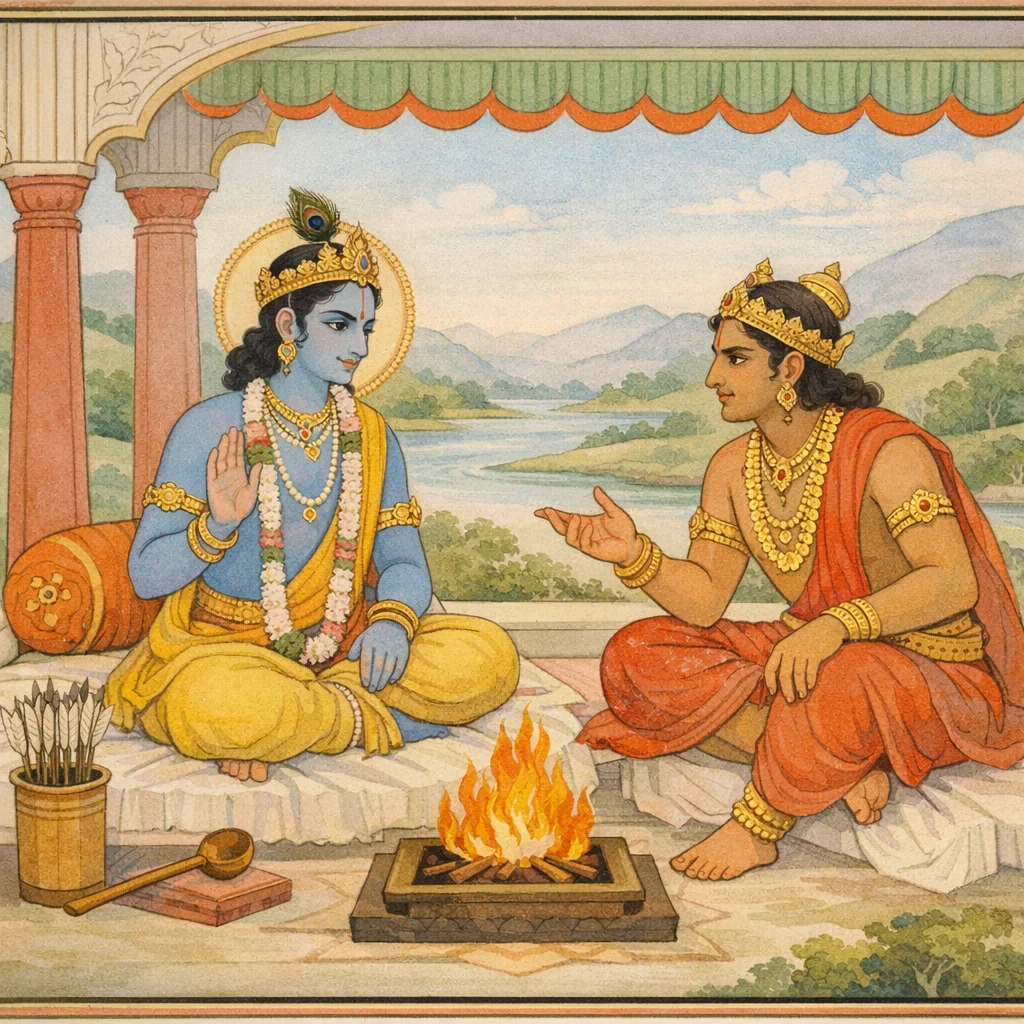
Adhyaya 140
उद्योगपर्व — अध्याय १४० (कृष्णेन कर्णं प्रति पाण्डवबल-वैशिष्ट्यप्रदर्शनम्) / Udyoga Parva, Chapter 140 (Krishna’s appraisal of Pandava advantage and war portents)
Upa-parva: Karna–Krishna Saṁvāda (Counsel on War-Readiness and Portents)
Sañjaya reports that, after hearing Karṇa’s words, Keśava (Kṛṣṇa) responds with measured irony and a strategic warning. He questions whether Karṇa feels regret that he refuses to govern the earth allegedly “offered” by Kṛṣṇa, then asserts the certainty of Pāṇḍava victory. The argument proceeds through emblematic and sensory imagery: Arjuna’s victory-banner is described as crowned by the fierce Vānararāja (Hanumān), radiant like Indra’s standard, elevated beyond natural obstacles, and accompanied by fear-inducing, otherworldly manifestations—signaling auspicious advantage and psychological dominance. Kṛṣṇa then projects battlefield scenarios: Karṇa will witness Arjuna with white horses and Kṛṣṇa as charioteer deploying celestial weapons; he will hear the thunder-like resonance of Gāṇḍīva; he will see Yudhiṣṭhira performing protective rites while sustaining his host; Bhīmasena in a ferocious, vow-driven combat posture; and the Mādrī twins disrupting the Dhārtarāṣṭra formations. The speech culminates by imagining Kaurava leaders—Droṇa, Bhīṣma, Kṛpa, Duryodhana, Jayadratha—checked by Arjuna’s prowess. A calendrical note follows: Kṛṣṇa instructs Karṇa to tell the commanders that the month is favorable in supplies and conditions, and that an upcoming new-moon day is regarded as Indra-aligned for engagement. The chapter closes with a stark forecast that kings and princes adhering to Duryodhana’s policy will meet death by weapons and attain their “final course,” framing war as both strategic outcome and moral consequence.
Chapter Arc: कृष्ण के दूत-धर्म और हितवचन के सामने कर्ण स्वयं को खोलता है—वह स्वीकार करता है कि वह पाण्डु-पुत्र है, पर फिर भी दुर्योधन-पक्ष में रहने का निश्चय सुनाता है। → कर्ण अपने जन्म-रहस्य का क्रमवार उद्घाटन करता है—कुन्ती का सूर्य से गर्भ, लोकलज्जा में त्याग, अधिरथ-सूत द्वारा पालन और राधा का स्नेह। इस सत्य के साथ ही वह कृष्ण के उपदेश को ‘हितार्थ’ मानकर भी, अपने कृतज्ञता-बंधन और प्रतिज्ञा-धर्म को अधिक भारी बताता है। → कर्ण युद्ध को ‘समर-यज्ञ’ के रूपक में उठाकर घोषणा करता है कि अर्जुन के गाण्डीव, दिव्यास्त्र (ऐन्द्र, पाशुपत, ब्राह्म आदि) और सव्यसाची की मंत्र-प्रयुक्त शक्ति के बावजूद वह दुर्योधन के लिए ही खड़ा रहेगा; साथ ही वह स्वीकार करता है कि पाण्डवों के प्रति कटुवचन उसने दुर्योधन-प्रियार्थ कहे और उसी कर्म से तप रहा है। → कर्ण कृष्ण से निवेदन करता है कि यह मंत्रणा गुप्त रहे और कुन्ती-पुत्र (अर्जुन) को युद्ध के लिए प्रस्तुत किया जाए; वह युद्ध-कीर्ति की अक्षयता का भी उच्चारण करता है—जब तक पर्वत-सरिताएँ रहेंगी, महाभारत-युद्ध की कथा सभाओं में गाई जाएगी। → कर्ण का अडिग निश्चय संवाद को युद्ध की अनिवार्यता तक पहुँचा देता है—अब कृष्ण के दूत-प्रयास के बाद अगला कदम रण की ओर ही मुड़ता है।
Shlokas
Verse 1
ऑपन--माज बछ। अकाल एकचत्वारिंशर्दाधिकशततमो< ध्याय: कर्णका दुर्योधनके पक्षमें रहनेके निश्चित विचारका प्रतिपादन करते हुए समरयज्ञके रूपकका वर्णन करना कर्ण उवाच असंशयं सौहृदान्मे प्रणयाच्चात्थ केशव । सख्येन चैव वार्ष्णेय श्रेयय्कामतयैव च,कर्णने कहा--केशव! आपने सौहार्द, प्रेम, मैत्री और मेरे हितकी इच्छासे जो कुछ कहा है, वह नि:संदेह ठीक है
Karna said: “O Keshava, what you have spoken to me—out of goodwill, affection, friendship, and with a desire for my true welfare—is without doubt right.”
Verse 2
सर्व चैवाभिजानामि पाण्डो: पुत्रोडस्मि धर्मत: । निश्चयाद् धर्मशास्त्राणां यथा त्वं कृष्ण मन्यसे,श्रीकृष्ण! जैसा कि आप मानते हैं, धर्मशास्त्रोंके निर्णयके अनुसार मैं धर्मतः पाण्डुका ही पुत्र हूँ। इन सब बातोंको मैं अच्छी तरह जानता और समझता हूँ
Karna said: “I understand all of this clearly: by the rule of dharma I am indeed Pandu’s son. According to the settled determinations of the dharma-texts—just as you, O Krishna, hold—I accept that this is the rightful conclusion.”
Verse 3
कन्या गर्भ समाधत्त भास्करान्मां जनार्दन । आदित्यवचनाच्चैव जात॑ मां सा व्यसर्जयत्
Karna said: “O Janārdana, while still an unmarried girl, she conceived me by the Sun-god (Bhāskara). And then, acting under the Sun’s instruction, after I was born she set me adrift—abandoning me to fate.”
Verse 4
जनार्दन! कुन्तीने कन्यावस्थामें भगवान् सूर्यके संयोगसे मुझे गर्भमें धारण किया था और मेरा जन्म हो जानेपर उन सूर्यदेवकी आज्ञासे ही मुझे जलमें विसर्जित कर दिया था ।। सो<5स्मि कृष्ण तथा जात: पाण्डो: पुत्रो5स्मि धर्मतः । कुन्त्या त्वहमपाकीर्णो यथा न कुशलं तथा,श्रीकृष्ण! इस प्रकार मेरा जन्म हुआ है। अतः मैं धर्मतः पाण्डुका ही पुत्र हूँ; परंतु कुन्तीदेवीने मुझे इस तरह त्याग दिया, जिससे मैं सकुशल नहीं रह सकता था
Karna said: “O Janārdana, when Kuntī was still unmarried, she conceived me through the divine union with the Sun-god. And once I was born, by the very command of that Sun-deity, she set me adrift upon the waters. Thus, O Kṛṣṇa, this is how I came into the world: by right of dharma I am the son of Pāṇḍu’s line; yet Kuntī cast me away in such a manner that my very safety and well-being were left unprotected.”
Verse 5
सूतो हि मामधिरथो दृष्टवैवा भ्यानयद् गृहान् । राधायाश्रैव मां प्रादात् सौहार्दान्मधुसूदन
Karna said: “Adhiratha the charioteer, seeing me, took me at once into his home. And out of affection, O Madhusūdana, he entrusted me to Rādhā as her own.”
Verse 6
मधुसूदन! उसके बाद अधिरथ नामक सूत मुझे जलमें देखते ही निकालकर अपने घर ले आये और बड़े स्नेहसे मुझे अपनी पत्नी राधाकी गोदमें दे दिया ।। मत्स्नेहाच्चैव राधायां सद्यः क्षीरमवातरत् | सा मे मूत्र पुरीषं च प्रतिजग्राह माधव,उस समय मेरे प्रति अधिक स्नेहके कारण राधाके स्तनोंमें तत्काल दूध उतर आया। माधव! उस अवस्थामें उसीने मेरा मल-मूत्र उठाना स्वीकार किया
“O Madhusūdana! Thereafter Adhiratha the charioteer, seeing me in the water, drew me out at once and brought me to his home; and with great affection he placed me in the lap of his wife, Rādhā. Out of deep love for me, Rādhā’s milk flowed immediately. O Mādhava, in that helpless infancy she accepted even the task of cleaning my urine and feces—embracing the full burden of motherhood with tenderness and responsibility.”
Verse 7
तस्या: पिण्डव्यपनयं कुर्यादस्मद्विध: कथम् | धर्मविद् धर्मशास्त्राणां श्रवणे सततं रत:,अतः सदा धर्मशास्त्रोंके श्रवणमें तत्पर रहनेवाला मुझ-जैसा धर्मज्ञ पुरुष राधाके मुखका ग्रास कैसे छीन सकता है? (उसका पालन-पोषण न करके उसे त्याग देनेकी क्रूरता कैसे कर सकता है?)
How could a man such as I—one who knows dharma and is ever devoted to hearing the dharma-śāstras—snatch the very morsel from Rādhā’s mouth? (How could I commit the cruelty of abandoning her, refusing to sustain and care for her?)
Verse 8
तथा मामभिजानाति सूतश्चाधिरथ: सुतम् । पितरं चाभिजानामि तमहं सौहृदात् सदा,अधिरथ सूत भी मुझे अपना पुत्र ही समझते हैं और मैं भी सौहार्दवश उन्हें सदासे अपना पिता ही मानता आया हूँ
In the same way, the charioteer Adhiratha recognizes me as his son; and I too, out of enduring affection and loyalty, have always acknowledged him as my father.
Verse 9
स हि मे जातकर्मादि कारयामास माधव । शास्त्रदृष्टेन विधिना पुत्रप्रीत्या जनार्दन
“For he, O Mādhava, had my birth-rites and other sacraments performed according to the procedure laid down in the scriptures—out of affection for me as his son, O Janārdana.”
Verse 10
नाम वै वसुषेणेति कारयामास वै द्विजै: । माधव! उन्होंने मेरे जातकर्म आदि संस्कार करवाये तथा जनार्दन! उन्होंने ही पुत्रप्रेमवश शास्त्रीय विधिसे ब्राह्मणोंद्वारा मेरा “वसुषेण” नाम रखवाया ।। भार्याश्नोढा मम प्राप्ते यौवने तत्परिग्रहात्
“My name, ‘Vasuṣeṇa,’ was formally bestowed by Brahmins. O Mādhava, they had my birth-rites and other sacraments performed; and O Janārdana, out of affection for me as a son, they themselves—following the scriptural rule through Brahmins—established the name ‘Vasuṣeṇa’ for me. And when I reached youth, I took a wife in due form.”
Verse 11
तासु पुत्राश्न पौत्राश्न मम जाता जनार्दन | तासु मे हृदयं कृष्ण संजातं कामबन्धनम्
Karna said: “O Janārdana, through those women my sons and grandsons were born. And, O Kṛṣṇa, toward them my heart has become bound—tied fast by the fetters of affection and desire.”
Verse 12
श्रीकृष्ण! मेरी युवावस्था होनेपर अधिरथने सूत-जातिकी कई कन्याओंके साथ मेरा विवाह करवाया। अब उनसे मेरे पुत्र और पौत्र भी पैदा हो चुके हैं। जनार्दन! उन स्त्रियोंमें मेरा हृदय कामभावसे आसक्त रहा है ।। न पृथिव्या सकलया न सुवर्णस्य राशिभि: । हर्षाद् भयाद् वा गोविन्द मिथ्या कर्तु तदुत्सहे,गोविन्द! अब मैं सम्पूर्ण पृथिवीका राज्य पाकर, सुवर्णकी राशियाँ लेकर अथवा हर्ष या भयके कारण भी वह सब सम्बन्ध मिथ्या नहीं करना चाहता
Karna said: “Śrī Kṛṣṇa, when I was still young, Adhiratha arranged my marriage with several maidens of the sūta community. From them I now have sons and even grandsons. Janārdana, my heart has remained bound to those women by the force of desire and attachment. Govinda, not for the sovereignty of the whole earth, nor for heaps of gold, nor out of joy or fear, am I able—or willing—to make those bonds false. Even now, I do not wish to repudiate or invalidate those relationships.”
Verse 13
धृतराष्ट्रकुले कृष्ण दुर्योधनसमाश्रयात् । मया त्रयोदश समा भुक्तं राज्यमकण्टकम्,श्रीकृष्ण! मैंने दुर्योधनका सहारा पाकर धुृतराष्ट्रके कुलमें रहते हुए तेरह वर्षोतक अकण्टक राज्यका उपभोग किया है
Karna said: “O Krishna, having taken refuge in Duryodhana, I have lived within Dhritarashtra’s royal house and for thirteen years enjoyed a kingdom free of thorns—untroubled and unopposed.”
Verse 14
इष्टं च बहुभिय्यज्ञै: सह सूतैर्मयासकृत् । आवाहाश्न विवाहाश्नव सह सूतैर्मया कृता:,वहाँ मैंने सूतोंके साथ मिलकर बहुत-से यज्ञोंका अनुष्ठान किया है तथा उन्हींके साथ रहकर अनेकानेक कुलधर्म एवं वैवाहिक कार्य सम्पन्न किये हैं
Karna said: “Many sacrifices have been performed by me repeatedly in the company of the sūtas; and living among them, I have also carried out numerous rites of family custom, including betrothal and marriage ceremonies. Thus my life has been bound up with them in religious duty and social conduct alike.”
Verse 15
मां च कृष्ण समासाद्य कृत: शस्त्रसमुद्यम: । दुर्योधनेन वार्ष्णेय विग्रहश्चापि पाण्डवै:,वृष्णिनन्दन श्रीकृष्ण! दुर्योधनने मेरे ही भरोसे हथियार उठाने तथा पाण्डवोंके साथ विग्रह करनेका साहस किया है
Karna said: “O Krishna, having approached and relied upon me, Duryodhana has dared to take up arms; and, O scion of the Vrishnis, he has also ventured into open hostility with the Pandavas. In truth, it is confidence in my support that has emboldened him to choose the path of war.”
Verse 16
तस्माद् रणे द्वैरथे मां प्रत्युद्यातारमच्युत । वृतवान् परमं कृष्ण प्रतीपं सव्यसाचिन:,अतः अच्युत! मुझे द्वैरथ युद्धमें सव्यसाची अर्जुनके विरुद्ध लोहा लेने तथा उनका सामना करनेके लिये उसने चुन लिया है
Therefore, O Acyuta, in the chariot-duel of battle he has chosen me—O supreme Kṛṣṇa—to ride out against him and stand as the direct opponent of Savyasācin (Arjuna). The statement underscores the deliberate selection of a worthy counter to Arjuna, framing the coming combat as a test of prowess and resolve within the moral tension of fratricidal war.
Verse 17
वधाद् बन्धाद् भयाद् वापि लोभाद् वापि जनार्दन | अनृतं नोत्सहे कर्तु धार्तराष्ट्रस्य धीमत:,जनार्दन! इस समय मैं वध, बन्धन, भय अथवा लोभसे भी बुद्धिमान् धृतराष्ट्रपुत्र दुर्योधनके साथ मिथ्या व्यवहार नहीं करना चाहता
Karna said: “O Janārdana, whether from the threat of death, imprisonment, fear, or even greed, I cannot bring myself to act falsely. Even now, I do not wish to deal deceitfully with the wise son of Dhṛtarāṣṭra—Duryodhana.”
Verse 18
यदि हाद्य न गच्छेयं द्वैरथं सव्यसाचिना । अकीर्ति: स्याद्धूषीकेश मम पार्थस्य चो भयो:,हृषीकेश! अब यदि मैं अर्जुनके साथ द्वैरथ युद्ध न करूँ तो यह मेरे और अर्जुन दोनोंके लिये अपयशकी बात होगी
Karna said: “If today I do not go to fight a chariot-duel with Savyasācin (Arjuna), O Hṛṣīkeśa, it will bring disgrace upon both of us—upon me and upon Pārtha. For a warrior of our standing, refusing the appointed encounter would be a moral failure in the eyes of the world and a stain upon our honor.”
Verse 19
असंशयं हितार्थाय ब्रूयास्त्वं मधुसूदन । सर्व च पाण्डवा: कुर्युस्त्वद्वशित्वान्न संशय:,मधुसूदन! इसमें संदेह नहीं कि आप मेरे हितके लिये ही ये सब बातें कहते हैं। पाण्डव आपके अधीन हैं; इसलिये आप उनसे जो कुछ भी कहेंगे, वह सब वे अवश्य ही कर सकते हैं
Undoubtedly, O Madhusūdana, you speak all this only for my welfare. And the Pāṇḍavas are under your influence; therefore, whatever you tell them to do, they will surely do—of this too there is no doubt.
Verse 20
मन्त्रस्थ नियम॑ कुर्यस्त्विमत्र मधुसूदन । एतदत्र हित॑ मन्ये सर्व यादवनन्दन,परंतु मधुसूदन! मेरे और आपके बीचमें जो यह गुप्त परामर्श हुआ है, उसे आप यहींतक सीमित रखें। यादवनन्दन! ऐसा करनेमें ही मैं यहाँ सब प्रकारसे हित समझता हूँ
Karna said: “O Madhusūdana, keep the rule of secrecy regarding this confidential counsel—let it remain confined to this point alone. O joy of the Yadus, I judge this to be wholly beneficial here: that what has been spoken privately between you and me should not be disclosed.”
Verse 21
यदि जानाति मां राजा धर्मात्मा संयतेन्द्रिय: । कुन्त्या: प्रथमजं पुत्र न स राज्यं ग्रहीष्यति
Karna said: “If the king—righteous in spirit and master of his senses—comes to know that I am Kunti’s firstborn son, then he will not accept the kingdom.”
Verse 22
अपनी इन्द्रियोंको संयममें रखनेवाले धर्मात्मा राजा युधिष्ठिर यदि यह जान लेंगे कि मैं (कर्ण) कुन्तीका प्रथम पुत्र हूँ, तब वे राज्य ग्रहण नहीं करेंगे ।। प्राप्प चापि महद् राज्यं तदहं मधुसूदन । स्फीतं दुर्योधनायैव सम्प्रदद्यामरिंदम,शत्रुदमन मधुसूदन! उस दशामें मैं उस समृद्धिशाली विशाल राज्यको पाकर भी दुर्योधनको ही सौंप दूँगा
Karna said: “If the righteous King Yudhiṣṭhira—master of his senses—were to learn that I am Kuntī’s firstborn, he would refuse to accept the kingdom. And even if I were to obtain that vast and prosperous realm, O Madhusūdana, subduer of foes, I would hand it over to Duryodhana alone.”
Verse 23
स एव राजा थधर्मात्मा शाश्वतो<स्तु युधिष्ठिर: । नेता यस्य हृषीकेशो योद्धा यस्य धनंजय:,मैं भी यही चाहता हूँ कि जिनके नेता हृषीकेश और योद्धा अर्जुन हैं, वे धर्मात्मा युधिष्ठिर ही सर्वदा राजा बने रहें
May that very righteous-souled Yudhiṣṭhira alone remain king forever—he whose leader is Hṛṣīkeśa (Kṛṣṇa) and whose champion in battle is Dhanaṃjaya (Arjuna).
Verse 24
पृथिवी तस्य राष्ट्र च यस्य भीमो महारथ: । नकुल: सहदेवश्न द्रौपदेयाश्व माधव,माधव! जनार्दन! जिनके सहायक महारथी भीम, नकुल, सहदेव, द्रौपदीके पाँचों पुत्र, पांचालराजकुमार धृष्टद्युम्न, महारथी सात्यकि, उत्तमौजा, युधामन्यु, सोमक-वंशी सत्यधर्मा, चेदिराज धृष्टकेतु, चेकितान, अपराजित वीर शिखण्डी, इन्द्रगोपके समान वर्णवाले पाँचों भाई केकय-राजकुमार, इन्द्रधनुषके समान रंगवाले महामना कुन्तिभोज, भीमसेनके मामा महारथी श्येनजित्, विराटपुत्र शंख तथा अक्षयनिधिके समान आप हैं, उन्हीं युधिष्ठिरके अधिकारमें यह सारा भूमण्डल तथा कौरव-राज्य रहेगा
Karna said: “The earth and the kingdom belong to him whose side is upheld by the great chariot-warrior Bhima—along with Nakula and Sahadeva, and the sons of Draupadi. O Madhava, O Janardana—when such mighty allies stand in support, the whole realm, even the Kuru dominion, will inevitably remain under Yudhishthira’s rightful authority.”
Verse 25
धृष्टय्युम्नश्ष॒ पाउ्चाल्य: सात्यकिश्न महारथ: । उत्तमौजा युधामन्यु: सत्यधर्मा च सौमकि:,माधव! जनार्दन! जिनके सहायक महारथी भीम, नकुल, सहदेव, द्रौपदीके पाँचों पुत्र, पांचालराजकुमार धृष्टद्युम्न, महारथी सात्यकि, उत्तमौजा, युधामन्यु, सोमक-वंशी सत्यधर्मा, चेदिराज धृष्टकेतु, चेकितान, अपराजित वीर शिखण्डी, इन्द्रगोपके समान वर्णवाले पाँचों भाई केकय-राजकुमार, इन्द्रधनुषके समान रंगवाले महामना कुन्तिभोज, भीमसेनके मामा महारथी श्येनजित्, विराटपुत्र शंख तथा अक्षयनिधिके समान आप हैं, उन्हीं युधिष्ठिरके अधिकारमें यह सारा भूमण्डल तथा कौरव-राज्य रहेगा
Karna said: “Dhṛṣṭadyumna, the Pāñcāla prince, and Sātyaki, that great chariot-warrior; Uttamaujā and Yudhāmanyu; and Satyadharmā of the Somaka line—these are among the foremost champions aligned with Yudhiṣṭhira. With such allies and protectors, the sovereignty over the whole earth, along with the Kuru realm, will rest under Yudhiṣṭhira’s authority.”
Verse 26
चैद्यश्न चेकितानश्रु शिखण्डी चापराजित: । इन्द्रगोपकवर्णाश्व॒ केकया भ्रातरस्तथा । इन्द्रायुधसवर्णश्र॒ कुन्तिभोजो महामना:,माधव! जनार्दन! जिनके सहायक महारथी भीम, नकुल, सहदेव, द्रौपदीके पाँचों पुत्र, पांचालराजकुमार धृष्टद्युम्न, महारथी सात्यकि, उत्तमौजा, युधामन्यु, सोमक-वंशी सत्यधर्मा, चेदिराज धृष्टकेतु, चेकितान, अपराजित वीर शिखण्डी, इन्द्रगोपके समान वर्णवाले पाँचों भाई केकय-राजकुमार, इन्द्रधनुषके समान रंगवाले महामना कुन्तिभोज, भीमसेनके मामा महारथी श्येनजित्, विराटपुत्र शंख तथा अक्षयनिधिके समान आप हैं, उन्हीं युधिष्ठिरके अधिकारमें यह सारा भूमण्डल तथा कौरव-राज्य रहेगा
Karna said: “On their side stand the Cedi prince Dhṛṣṭaketu and Cekitāna; Śikhaṇḍī too, unconquered in battle; and the Kekaya brothers, whose horses are the color of the indragopa insect; and the high-souled Kuntibhoja, radiant like Indra’s bow. With such mighty allies supporting Yudhiṣṭhira, the balance of power and the moral claim to sovereignty are being asserted: the earth and the Kuru realm are envisioned as falling under his rightful authority.”
Verse 27
मातुलो भीमसेनस्य श्येनजिच्च महारथ: । शड्ख: पुत्रो विराटस्य निधिस्त्वं च जनार्दन,माधव! जनार्दन! जिनके सहायक महारथी भीम, नकुल, सहदेव, द्रौपदीके पाँचों पुत्र, पांचालराजकुमार धृष्टद्युम्न, महारथी सात्यकि, उत्तमौजा, युधामन्यु, सोमक-वंशी सत्यधर्मा, चेदिराज धृष्टकेतु, चेकितान, अपराजित वीर शिखण्डी, इन्द्रगोपके समान वर्णवाले पाँचों भाई केकय-राजकुमार, इन्द्रधनुषके समान रंगवाले महामना कुन्तिभोज, भीमसेनके मामा महारथी श्येनजित्, विराटपुत्र शंख तथा अक्षयनिधिके समान आप हैं, उन्हीं युधिष्ठिरके अधिकारमें यह सारा भूमण्डल तथा कौरव-राज्य रहेगा
Karna said: “Bhīmasena’s maternal uncle, the great chariot-warrior Śyenajit; Śaṅkha, the son of Virāṭa; and you yourself, O Janārdana—O Mādhava, O Janārdana—are like an inexhaustible treasure. With such allies and supports, the whole circle of the earth and the sovereignty of the Kurus will remain under Yudhiṣṭhira’s rightful command.”
Verse 28
महानयं कृष्ण कृत: क्षत्रस्य समुदानय: । राज्यं प्राप्तमिदं दीप्तं प्रथितं सर्वराजसु,श्रीकृष्ण! दुर्योधनने यह क्षत्रियोंका बहुत बड़ा समुदाय एकत्र कर लिया है तथा समस्त राजाओंमें विख्यात एवं उज्ज्वल यह कुरुदेशका राज्य भी उसे प्राप्त हो गया है
Karna said: “O Kṛṣṇa, this is a great mustering of the warrior order that has been brought about. And this radiant kingdom—renowned among all kings—has come into Duryodhana’s possession. By your policy and the course of events, the Kuru sovereignty has become both illustrious and widely acknowledged, and the Kṣatriya hosts now stand gathered around it.”
Verse 29
धार्तराष्ट्रस्य वार्ष्णेय शस्त्रयज्ञों भविष्यति । अस्य यज्ञस्य वेत्ता त्वं भविष्यसि जनार्दन,जनार्दन! वृष्णिनन्दन! अब दुर्योधनके यहाँ एक शस्त्र-यज्ञ होगा, जिसके साक्षी आप होंगे
Karna said: “O Vārṣṇeya, for the son of Dhṛtarāṣṭra there will be a ‘sacrifice of weapons’—a war. Of this sacrifice, you, O Janārdana—O Janārdana, delight of the Vṛṣṇis—will be the knower and witness.”
Verse 30
आध्वर्यवं च ते कृष्ण क्रतावस्मिन् भविष्यति । होता चैवात्र बीभत्सु: संनद्धः स कपिध्वज:,श्रीकृष्ण! इस यज्ञमें अध्वर्युका काम भी आपको ही करना होगा। कवच आदिसे सुसज्जित कपिध्वज अर्जुन इसमें होता बनेंगे
Karna said: “O Kṛṣṇa, in this sacrifice you will have to perform the office of the Adhvaryu as well; and here Bībhatsu (Arjuna), the monkey-bannered hero, fully armed and prepared, will serve as the Hotṛ.”
Verse 31
गाण्डीवं ख्रुक् तथा चाज्यं वीर्य पुंसां भविष्यति । ऐन्द्रं पाशुपतं ब्राह्मं स्थूणाकर्ण च माधव । मन्त्रास्तत्र भविष्यन्ति प्रयुक्ता: सव्यसाचिना
Karna said: “O Mādhava, the Gāṇḍīva bow, the khruk weapon, and the sacred ghee will become the very measure of men’s prowess. There the divine missiles—Indra’s, Paśupati’s, and Brahmā’s—together with the Sthūṇākarṇa weapon, will come into play when the ambidextrous Arjuna, Savyasācin, sets them in motion by mantra.”
Verse 32
गाण्डीव धनुष सुवाका काम करेगा और विपक्षी वीरोंका पराक्रम ही हवनीय घृत होगा। माधव! सव्यसाची अर्जुनद्वारा प्रयुक्त होनेवाले ऐन्द्र, पाशुपत, ब्राह्म और स्थूणाकर्ण आदि अस्त्र ही वेद-मन्त्र होंगे ।। अनुयातश्न पितरमधिको वा पराक्रमे । गीत॑ स्तोत्र स सौभद्र: सम्यक् तत्र भविष्यति,सुभद्राकुमार अभिमन्यु भी अस्त्रविद्यामें अपने पिताका ही अनुसरण करनेवाला अथवा पराक्रममें उनसे भी बढ़कर है। वह इस शस्त्रयञ्ञमें उत्तम स्तोत्रगान (उदगातृकर्म)-की पूर्ति करेगा
Karna said: “Subhadrā’s son, Abhimanyu, follows in his father’s footsteps in the science of weapons—or may even surpass him in valor. In this great ‘sacrifice’ of battle, he will fittingly fulfill the role of the singer of hymns, offering the proper chants of praise.”
Verse 33
उदगातात्र पुनर्भीम: प्रस्तोता सुमहाबल: । विनदन् स नरव्याप्रो नागानीकान्तकूद् रणे
Then, on that occasion, Bhīma again rose up as the lead singer of the war-chant—mighty beyond measure. Roaring aloud, that tiger among men advanced in battle, a destroyer of elephant-corps, embodying the fierce resolve that drives warriors to confront overwhelming force without yielding.
Verse 34
अभिमन्यु ही उदगाता और महाबली नरश्रेष्ठ भीमसेन ही प्रस्तोता होंगे, जो रणभूमिमें गर्जना करते हुए शत्रुपक्षके हाथियोंकी सेनाका विनाश कर डालेंगे ।। स चैव तत्र धर्मात्मा शश्वद् राजा युधिष्ठिर: । जपैहेमिश्न संयुक्तो ब्रह्म॒त्वं कारयिष्यति,वे धर्मात्मा राजा युधिष्ठिर ही सदा जप और होममें संलग्न रहकर उस यज्ञमें ब्रह्माका कार्य सम्पन्न करेंगे
Karna declares that Abhimanyu will serve as the udgātṛ priest, and the mighty Bhīmasena—best among men—will be the prastotṛ; roaring on the battlefield, he will shatter the enemy’s elephant corps. And there, the ever-righteous King Yudhiṣṭhira, constantly devoted to mantra-recitation and fire-offerings (homa), will carry out the role of Brahmā-priest for that solemn rite—framing the coming war as a grim sacrifice governed by dharma and discipline.
Verse 35
शड्खशब्दा: समुरजा भेर्यश्व मधुसूदन । उत्कृष्टसिंहनादश्न सुब्रह्मण्यो भविष्यति
Karna said: “O Madhusūdana, the blare of conches will rise together with the roll of drums and the neighing of horses; and there will be a lofty lion-roar. The auspicious war-cry ‘Subrahmaṇya!’ will be raised.”
Verse 36
मधुसूदन! शंख, मुरज तथा भेरियोंके शब्द और उच्चस्वरसे किये हुए सिंहनाद ही सुब्रह्मण्यनाद होंगे ।। नकुल: सहदेवश्न माद्रीपुत्रौ यशस्विनौ । शामित्र तौ महावीर्यो सम्यक् तत्र भविष्यत:,माद्रीके यशस्वी पुत्र महापराक्रमी नकुल-सहदेव उसमें भलीभाँति शामित्रकर्मका सम्पादन करेंगे
Karna said: “O Madhusudana (Krishna)! The blare of conches, the beat of drums, the peal of kettledrums, and the lion-roars raised in a high pitch—these alone will be the auspicious ‘Subrahmanya’ acclamation. And Nakula and Sahadeva, the illustrious sons of Madri—both great in valor—will, on that occasion, duly perform the rites and duties belonging to the śāmītra ceremonial office.”
Verse 37
कल्माषदण्डा गोविन्द विमला रथपद्धक्तय: । यूपा: समुपकल्पन्तामस्मिन् यज्ञे जनार्दन
Karna said: “O Govinda, O Janardana—let the spotless, well-prepared chariot-tracks be set in order, and let the sacrificial posts (yūpa) be made ready for this sacrifice.”
Verse 38
गोविन्द! जनार्दन! विचित्र ध्वजदण्डोंसे सुशोभित निर्मल रथपंक्तियाँ ही इस रणयज्ञमें यूपोंका काम करेंगी ।। कर्णिनालीकनाराचा वत्सदन्तोपबृंहणा: । तोमरा: सोमकलशा: पवित्राणि धनूंषि च,कर्णि, नालीक, नाराच और वत्सदन्त आदि बाण उपबृंहण (सोमाहुतिके साधनभूत चमस आदि पात्र) होंगे। तोमर सोमकलशका और धनुष पवित्रीका काम करेंगे
Karna said: “O Govinda, O Janardana! In this sacrifice of battle, the spotless rows of chariots—adorned with wondrous flagstaffs—will themselves serve as the sacrificial posts. Karṇi, nālika, nārāca, and vatsadanta arrows will be the auxiliary implements of offering; the tomara-spears will be the Soma-vessels; and the bows will serve as the purifying strainers (pavitra).”
Verse 39
असयोअत्र कपालानि पुरोडाशा: शिरांसि च | हविस्तु रुधिरं कृष्ण तस्मिन् यज्ञे भविष्यति,श्रीकृष्ण! उस यज्ञमें खड़ग ही कपाल, शत्रुओंके मस्तक ही पुरोडाश तथा रुधिर ही हविष्य होंगे
Karna declares to Krishna: “O Krishna! In that sacrifice, swords will serve as the sacrificial bowls, the severed heads of enemies will be the puroḍāśa-offerings, and blood itself will be the oblation (havis).”
Verse 40
इध्मा: परिधयश्रैव शक्तयो विमला गदा: । सदस्या द्रोणशिष्याश्व॒ कृपस्य च शरद्वत:,निर्मल शक्तियाँ और गदाएँ सब ओर बिखरी हुई समिधाएँ होंगी। द्रोण और कृपाचार्यके शिष्य ही सदस्यका कार्य करेंगे
Karna said: “In that sacrifice, the fuel-sticks (idhma) and the enclosing logs (paridhi) will lie scattered all around, along with spotless spears and maces. And the ritual officiants (sadasya) will be none other than the disciples of Droṇa and of Kṛpa Śāradvata.”
Verse 41
इषवोत्र परिस्तोमा मुक्ता गाण्डीवधन्चना । महारथप्रयुक्ताश्च द्रोणद्रौणिप्रचोदिता:
Karna said: “Here, volleys of arrows—released in dense, encircling patterns—have been shot from the Gāṇḍīva-bearer (Arjuna). They are the missiles of a great chariot-warrior, and they are being driven on and intensified under the urging of Droṇa and Droṇa’s son (Aśvatthāman).”
Verse 42
गाण्डीवधारी अर्जुनके छोड़े हुए तथा द्रोणाचार्य, अश्वत्थामा एवं अन्य महारथियोंके चलाये हुए बाण यज्ञकुण्डके सब ओर बिछाये जानेवाले कुशोंका काम देंगे ।। प्रतिप्रास्थानिकं कर्म सात्यकिस्तु करिष्यति । दीक्षितों धार्तराष्ट्रोडत्र पत्नी चास्य महाचमू:,सात्यकि प्रतिस्थाता (अध्वर्युके दूसरे सहयोगी)-का कार्य करेंगे। धृतराष्ट्रपुत्र दुर्योधन इस रणयज्ञकी दीक्षा लेगा और उसकी विशाल सेना ही यजमानपत्नीका काम करेगी
Karna declares that the arrows released by Arjuna, bearer of the Gāṇḍīva, and those shot by Droṇa, Aśvatthāmā, and other great chariot-warriors will serve the role of the kuśa-grass spread all around a sacrificial altar. Sātyaki will perform the function of the pratiprasthātṛ (the assistant priest). In this ‘battle-sacrifice’, the Dhārtarāṣṭra prince (Duryodhana) will be the one who undergoes consecration as the sacrificer, and his vast army will stand in for the sacrificer’s wife.
Verse 43
घटोत्कचो<त्र शामित्र करिष्यति महाबल: । अतितरात्रे महाबाहो वितते यज्ञकर्मणि,महाबाहो! इस महायज्ञका अनुष्ठान आरम्भ हो जानेपर उसके अतिरात्रयागमें (अथवा आधी रातके समय) महाबली घटोत्कच शामित्रकर्म करेगा
Karna said: “Here, the mighty Ghaṭotkaca will perform the śāmitra rite. When this great sacrificial undertaking has been set in motion, at the Atirātra (the ‘overnight’ Soma-sacrifice)—that is, in the deep of night—he will carry out the ritual act.”
Verse 44
दक्षिणा त्वस्य यज्ञस्य धृष्टद्युम्न: प्रतापवान् | वैतानिके कर्ममुखे जातो यः कृष्ण पावकात्,श्रीकृष्ण! जो श्रौत यज्ञके आरम्भमें ही साक्षात् अग्निकुण्डसे प्रकट हुआ था, वह प्रतापी वीर धृष्टद्युम्न इस यज्ञकी दक्षिणाका कार्य सम्पादन करेगा
Karna said: “For this sacrifice, the sacrificial fee (dakṣiṇā) will be carried out by the mighty Dhṛṣṭadyumna—he who, O Kṛṣṇa, was born from the sacred fire at the very commencement of the Vedic rite. Let him accomplish the function of the dakṣiṇā for this yajña.”
Verse 45
यदब्रुवमहं कृष्ण कटुकानि सम पाण्डवान् | प्रियार्थ धार्तराष्ट्रस्य तेन तप्ये हुकर्मणा,श्रीकृष्ण! मैंने जो धृतराष्ट्रपुत्र दुर्योधनका प्रिय करनेके लिये पाण्डवोंको बहुत-से कटुवचन सुनाये हैं, उस अयोग्य कर्मके कारण आज मुझे बड़ा पश्चात्ताप हो रहा है
Karna said: “O Krishna, for the sake of pleasing Dhritarashtra’s son, I once hurled many harsh words at the Pandavas. Today I burn with remorse because of that unworthy deed.”
Verse 46
यदा द्रक्ष्यसि मां कृष्ण निहतं सव्यसाचिना । पुनश्चितिस्तदा चास्य यज्ञस्थाथ भविष्यति
Karna said: “O Kṛṣṇa, when you see me slain by Savyasācin (Arjuna), then his funeral pyre too will, once again, become as though it were a sacrificial altar.”
Verse 47
श्रीकृष्ण! जब आप सव्यसाची अर्जुनके हाथसे मुझे मारा गया देखेंगे, उस समय इस यज्ञका पुनश्चिति-कर्म (यज्ञके अनन्तर किया जानेवाला चयनारम्भ) सम्पन्न होगा ।। दुःशासनस्य रुधिरं यदा पास्यति पाण्डव: । आनर्द नर्दत: सम्यक् तदा सुत्यं भविष्यति,जब पाण्डुनन्दन भीमसेन सिंहनाद करते हुए दुःशासनका रक्त पान करेंगे, उस समय इस यज्ञका सुत्य (सोमाभिषव) कर्म पूरा होगा
Karna said: “O Kṛṣṇa, when you see me slain by Savyasācin Arjuna, then the rite of punar-citi—the re-laying of the altar after the sacrifice—will be fulfilled. And when the Pāṇḍava Bhīmasena, roaring like a lion, drinks Duḥśāsana’s blood, then the Soma-pressing rite (sutya) of this ‘sacrifice’ will be truly completed.”
Verse 48
यदा द्रोणं च भीष्म॑ च पाज्चाल्यौ पातयिष्यत: । तदा यज्ञावसानं तद् भविष्यति जनार्दन,जनार्दन! जब दोनों पांचालराजकुमार धृष्टद्युम्म और शिखण्डी द्रोणाचार्य और भीष्मको मार गिरायेंगे, उस समय इस रणयज्ञका अवसान (बीच-बीचमें होनेवाला विराम) कार्य सम्पन्न होगा
Karna said: “O Janārdana, when the two princes of Pāñcāla—Dhṛṣṭadyumna and Śikhaṇḍī—have brought down Droṇa and Bhīṣma, then the avasāna, the closing interval of this war-sacrifice, will come.”
Verse 49
दुर्योधनं यदा हनता भीमसेनो महाबल: । तदा समाप्स्यते यज्ञो धार्तराष्ट्स्य माधव,माधव! जब महाबली भीमसेन दुर्योधनका वध करेंगे, उस समय धूृतराष्ट्रपुत्रका प्रारम्भ किया हुआ यह यज्ञ समाप्त हो जायगा
Karna said: “O Mādhava, when the mighty Bhīmasena has slain Duryodhana, then the ‘sacrifice’ begun by the son of Dhṛtarāṣṭra will come to its end.”
Verse 50
स््नुषाश्न प्रस्नुषाश्वैव धृतराष्ट्रस्य सड़ता: । हतेश्वरा नष्टपुत्रा हतनाथाश्व केशव
Karna said: “O Keśava, the daughters-in-law and granddaughters-in-law of Dhṛtarāṣṭra will be left utterly ruined—bereft of their lords, their sons destroyed, and their protectors slain.”
Verse 51
रुदत्य: सह गान्धार्या श्वगृध्रकुरराकुले । स यज्ञेडस्मिन्नवभूथो भविष्यति जनार्दन
O Janārdana—when Gāndhārī weeps amid a tumult thronged with dogs, vultures, and kurara-birds, this battle will become the concluding purificatory bath (avabhṛtha) of this sacrifice.
Verse 52
केशव! जिनके पति, पुत्र और संरक्षक मार दिये गये होंगे, वे धृतराष्ट्रके पुत्रों और पौत्रोंकी बहुएँ जब गान्धारीके साथ एकत्र होकर कुत्तों, गीधों और कुरर पक्षियोंसे भरे हुए समरांगणमें रोती हुई विचरेंगी, जनार्दन! वही उस यज्ञका अवभृथस्नान होगा ।। विद्यावृद्धा वयोवृद्धा: क्षत्रिया: क्षत्रियर्षभ । वृथा मृत्युं न कुर्वीरिस्त्वत्कृते मधुसूदन,क्षत्रियशिरोमणि मधुसूदन! तुम्हारे इस शान्ति-स्थापनके प्रयत्नसे कहीं ऐसा न हो कि विद्यावृद्ध और वयोवृद्ध क्षत्रियगण व्यर्थ मृत्युको प्राप्त हों (युद्धमें शस्त्रोंसे होनेवाली मृत्युसे वंचित रह जायाँ)
Keśava, when the husbands, sons, and protectors of those women have been slain, the daughters-in-law of Dhṛtarāṣṭra’s sons and grandsons will gather with Gāndhārī and wander weeping across a battlefield crowded with dogs, vultures, and kurara-birds. O Janārdana—this, indeed, will be the avabhṛtha bath of that sacrifice. O bull among kṣatriyas, Madhusūdana: let not learned and aged kṣatriyas meet a futile death on your account—lest your effort to establish peace end by denying warriors the death they deem fitting in battle.
Verse 53
शस्त्रेण निधन गच्छेत् समृद्ध क्षत्रमण्डलम् | कुरुक्षेत्रे पुण्यतमे त्रैलोक्यस्थापि केशव,केशव! कुरुक्षेत्र तीनों लोकोंके लिये परम पुण्यतम तीर्थ है। यह समृद्धिशाली क्षत्रियसमुदाय वहीं जाकर शस्त्रोंक आघातसे मृत्युको प्राप्त हो
Let this prosperous host of kṣatriyas meet death by weapons on Kurukṣetra, the most sacred of fields, renowned throughout the three worlds, O Keśava. For Kurukṣetra is a supremely holy pilgrimage-ground for all the worlds; let this mighty warrior community go there and attain death under the stroke of arms.
Verse 54
तदत्र पुण्डरीकाक्ष निधत्स्व यदभीप्सितम् । यथा कार्त्स्न्येन वार्ष्णेय क्षत्रं स्वर्गमवाप्रुयात्,कमलनयन वृष्णिनन्दन! आप भी इसकी सिद्धिके लिये ही ऐसा मनोवांछित प्रयत्न करें, जिससे यह सारा-का-सारा क्षत्रियसमूह स्वर्गलोकमें पहुँच जाय
Therefore, O lotus-eyed one, decide here upon what you truly desire. O Vārṣṇeya, act with such resolve—seeking the very accomplishment you intend—that the entire body of kṣatriyas may, in its entirety, attain heaven.
Verse 55
यावत् स्थास्यन्ति गिरय: सरितश्न जनार्दन । तावत् कीर्तिभव: शब्द: शाश्वतो5यं भविष्यति
Karna said: “So long as the mountains stand and the rivers flow, O Janārdana, this fame-born report—this enduring renown—will remain everlasting.”
Verse 56
जनार्दन! जबतक ये पर्वत और सरिताएँ रहेंगी, तबतक इस युद्धकी कीर्ति-कथा अक्षय बनी रहेगी ।। ब्राह्मणा: कथयिष्यन्ति महाभारतमाहवम् । समागमेषु वार्ष्णेय क्षत्रियाणां यशोधनम्,वार्ष्णेय! ब्राह्मणलोग क्षत्रियोंक समाजमें इस महाभारतयुद्धका, जिसमें राजाओंके सुयशरूपी धनका संग्रह होनेवाला है, वर्णन करेंगे
Karna said: “O Janārdana, as long as these mountains and rivers endure, the fame and story of this war will remain imperishable. O Vārṣṇeya, in gatherings the Brahmins will recount this great Bhārata battle—an event that becomes a treasury of renown for the Kṣatriyas.”
Verse 57
समुपानय कौन्तेयं युद्धाय मम केशव । मन्त्रसंवरणं कुर्वन् नित्यमेव परंतप,शत्रुओंकोी संताप देनेवाले केशव! आप इस मन्त्रणाको सदा गुप्त रखते हुए ही कुन्तीकुमार अर्जुनको मेरे साथ युद्ध करनेके लिये ले आवें
Karna said: “O Keśava, bring Kaunteya (Arjuna) to fight with me. While doing so, keep this counsel strictly concealed at all times, O scorcher of foes.”
Verse 141
इति श्रीमहाभारते उद्योगपर्वणि भगवद्यानपर्वणि कर्णोपनिवादे एकचत्वारिंशदधिकशततमो<ध्याय:
Thus ends the one-hundred-and-forty-first chapter in the Udyoga Parva of the Śrī Mahābhārata, within the section concerning the Lord’s embassy, in the episode of Karṇa’s rebuttal.
Frequently Asked Questions
The dilemma concerns loyalty versus ethical foresight: whether steadfast alignment with Duryodhana remains defensible when counsel predicts catastrophic loss and when participation would amplify harm despite the availability of reconsideration.
Symbolic legitimacy and moral momentum are presented as real forces in political life: signs, reputations, and alliances shape collective confidence, and ignoring such indicators is portrayed as both imprudent and ethically negligent.
Rather than an explicit phalāśruti, the chapter functions as consequential meta-commentary: it frames the discourse as predictive counsel whose comprehension is tied to recognizing how choices (policy and allegiance) generate outcomes (defeat, death, and posthumous destiny).