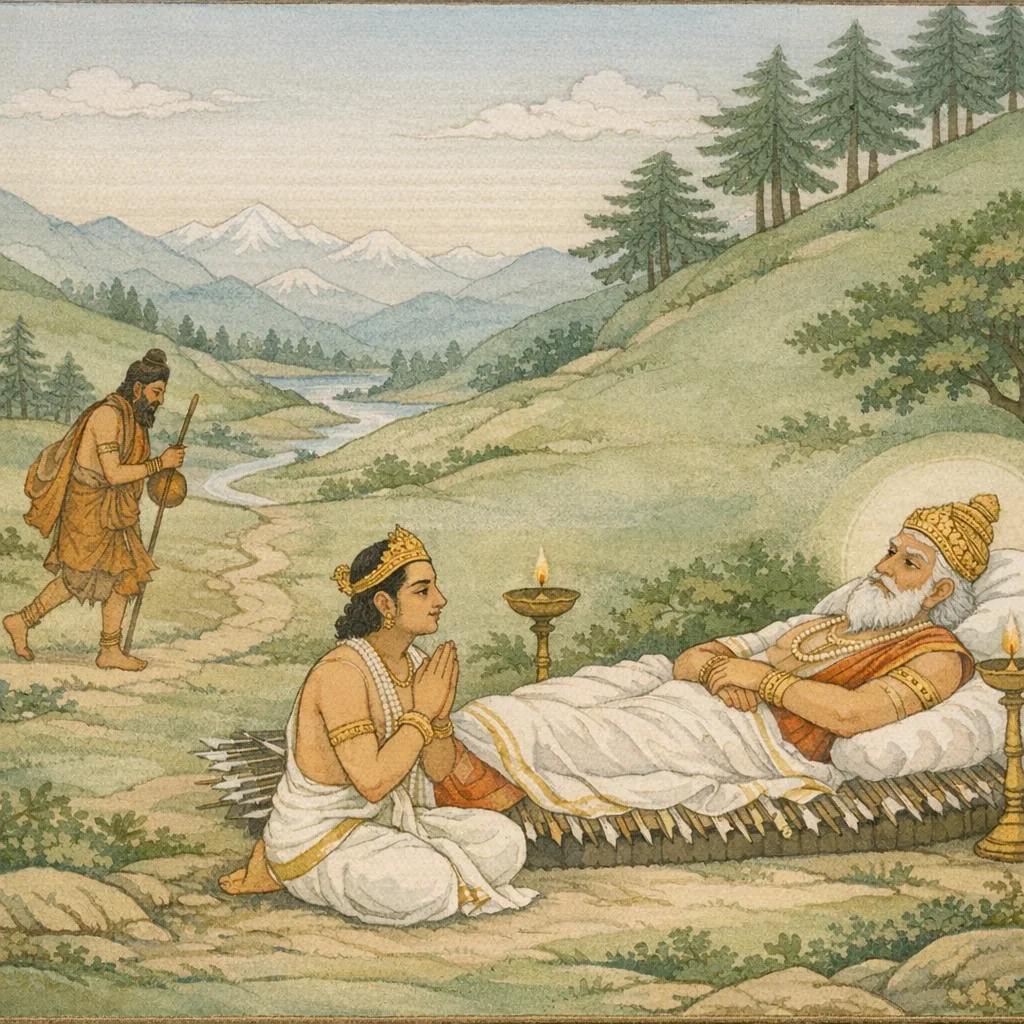
Adhyaya 35
Prāyaścitta and Contextual Non-Culpability (प्रायश्चित्त-निमित्त-अदोषवाद)
Upa-parva: Prāyaścitta–Dharma (Expiation and Non-culpability Discourse)
The chapter opens with Yudhiṣṭhira’s inquiry into which actions render a person liable for prāyaścitta and what leads to release (mucyeta). The responding voice attributed here to Vyāsa enumerates transgressions of omission (neglecting prescribed duties) and commission (performing prohibited acts), followed by extended catalogues of socially and ritually censured behaviors (e.g., breaches of brahmacarya discipline, improper ritual conduct, forbidden trades, harm, deceit, and violations involving teacher/authority). The discourse then introduces a critical hermeneutic: the same categories of acts may be non-tainting under specified nimitttas (conditions). Examples include defensive killing of an armed aggressor, acts done in ignorance or under threat to life, and limited allowances in service of a teacher or during emergencies. Additional clarifications address vow-impairment in involuntary states (sleep, involuntary emission), the impropriety of needless animal harm, and the principle that expiation procedures can purify certain violations such as consumption of prohibited food. The chapter ends by signaling that detailed prāyaścitta prescriptions will be explained subsequently, establishing this adhyāya as a classificatory and interpretive preface to expiatory law.
Chapter Arc: युद्ध की धूल बैठ चुकी है, पर मनुष्य के भीतर का कलुष नहीं—भीष्म युधिष्ठिर को स्मृति-वचनों के सहारे बतलाते हैं कि पाप का रूप अनेक है और उसका प्रायश्चित्त भी उतना ही कठोर। → सूची खुलती जाती है: सुवर्ण-चोरी, सुरापान, ब्रह्महत्या, गुरु-पत्नीगमन—हर अपराध के साथ तप, भिक्षा, व्रत, दान, जप, तीर्थ-यात्रा और देह-शोषण के विधान सामने आते हैं; प्रश्न उठता है—क्या शुद्धि कर्म से है, या अंतःकरण के परिवर्तन से? → अत्यंत तीव्र प्रायश्चित्तों का विधान चरम पर पहुँचता है—ब्रह्महत्या के लिए दीर्घकालीन भिक्षाचर्या, वेद-जप सहित दूरगमन, सर्वस्व-दान; सुरापान के लिए अग्निवर्ण तप्त मदिरा; गुरु-पत्नीगमन के लिए तप्त लोहे पर शयन या देह-छेदन जैसे कठोर उपाय—यहाँ धर्म ‘दंड’ नहीं, ‘आत्म-परिवर्तन’ की अग्नि बनकर प्रकट होता है। → भीष्म निष्कर्ष देते हैं कि विधि का सार श्रद्धा, अनसूया, सत्य-प्रकाशन और संयम में है; महायज्ञ (अश्वमेध आदि) भी पाप-क्षालन का साधन कहे गए हैं, पर नास्तिक, अश्रद्दधान, दम्भ-द्वेषप्रधान के लिए यह विधि फलित नहीं होती—क्योंकि पात्रता ही शुद्धि का द्वार है। → युधिष्ठिर के सामने अगला प्रश्न उभरता है—यदि विधि श्रद्धाहीन पर लागू नहीं, तो राज्य-धर्म में ऐसे जनों का शोधन/दंड/संस्कार कैसे किया जाए?
Shlokas
Verse 1
है ० बक। ] अति्शशाए:<ह - क्योंकि 'स्वर्णहारी तु कुनखी सुरापः श्यामदन्तकः” (कर्म-विपाक) इस स्मृतिके अनुसार वे पूर्व जन्ममें क्रमशः सुवर्णकी चोरी करनेवाले और शराबी होते हैं। पज्चत्रिशो< ध्याय: पापकर्मके प्रायश्षित्तोंका वर्णन व्यास उवाच तपसा कर्मणा चैव प्रदानेन च भारत । पुनाति पापं पुरुष: पुनश्चैन्न प्रवर्तते,व्यासजी बोले--भरतनन्दन! मनुष्य तपसे यज्ञ आदि सत्कर्मोंसे तथा दानके द्वारा पापको धो-बहाकर अपने-आपको पवित्र कर लेता है, परंतु यह तभी सम्भव होता है, जब वह फिर पापमें प्रवृत्त न हो
Vyāsa said: O Bhārata, a person cleanses away sin through austerity, through righteous action (such as sacrifice and other prescribed works), and through giving. Yet this purification truly holds only when one does not again turn back toward sin.
Verse 2
एककालं तु भुञज्जीत चरन् भैक्ष्यं स्वकर्मकृत् कपालपाणि: खट्वाज़ी ब्रह्मचारी सदोत्थित:,यदि किसीने ब्रह्महत्या की हो तो वह भिक्षा मागकर एक समय भोजन करे, अपना सब काम स्वयं ही करे, हाथमें खप्पर और खाटका पाया लिये रहे, सदा ब्रह्मचर्यव्रतका पालन करे, उद्यमशील बना रहे, किसीके दोष न देखे, जमीन पर सोये और लोकमें अपना पापकर्म प्रकट करता रहे। इस प्रकार बारह वर्षतक करनेसे ब्रह्महत्यारा पापमुक्त हो जाता है
Vyāsa explains the expiation for the grave sin of brahmahatyā (killing a brāhmaṇa): the offender should live by begging, eat only once a day, and perform all necessary tasks by himself. He should carry a skull-bowl in his hand and a staff (khaṭvāṅga), remain steadfast in celibacy, and stay constantly active and disciplined. Living simply—sleeping on the ground and openly acknowledging his wrongdoing before society—he undertakes this austere regimen for twelve years; by such sustained penance, the slayer of a brāhmaṇa becomes freed from the sin.
Verse 3
अनसूयुरध:शायी कर्म लोके प्रकाशयन् | पूर्णद्धादिशभिर्वर्षेब्रद्म॒हा विप्रमुच्यते,यदि किसीने ब्रह्महत्या की हो तो वह भिक्षा मागकर एक समय भोजन करे, अपना सब काम स्वयं ही करे, हाथमें खप्पर और खाटका पाया लिये रहे, सदा ब्रह्मचर्यव्रतका पालन करे, उद्यमशील बना रहे, किसीके दोष न देखे, जमीन पर सोये और लोकमें अपना पापकर्म प्रकट करता रहे। इस प्रकार बारह वर्षतक करनेसे ब्रह्महत्यारा पापमुक्त हो जाता है
Vyāsa said: “A slayer of a brāhmaṇa becomes freed from the sin when, for a full twelve years, he lives without malice, sleeps on the ground, and openly acknowledges his deed before the world. He should beg for alms and eat only once a day, perform all his tasks himself, carry a skull-bowl and a staff, maintain the vow of celibacy, remain industrious, and refrain from fault-finding in others. By such sustained penance and self-discipline, the stain of brahmahatyā is released.”
Verse 4
लक्ष्य: शस्त्रभृतां वा स्याद् विदुषामिच्छया55त्मन: । प्रास्येदात्मानमग्नौ वा समिद्धे त्रिरवाकृशिरा:,अथवा प्रायश्रित्त बतानेवाले विद्वानोंकी या अपनी इच्छासे शस्त्रधारी पुरुषोंके अस्त्र- शस्त्रोंका निशाना बन जाय अथवा अपनेको प्रज्वलित आगमें झोंक दे अथवा नीचे सिर किये किसी भी एक वेदका पाठ करते हुए तीन बार सौ-सौ योजनकी यात्रा करे अथवा किसी वेदवेत्ता ब्राह्मगको अपना सर्वस्व समर्पण कर दे या जीवन-निर्वाहके लिये पर्याप्त धन अथवा सब सामानोंसे भरा हुआ घर ब्राह्मणको दान कर दे--इस प्रकार गौओं और ब्राह्मणोंकी रक्षा करनेवाला पुरुष ब्रह्महत्यासे मुक्त हो जाता है
Vyāsa said: A learned man, by his own resolve, may undertake severe expiations—such as offering himself as a target to armed warriors, or casting himself into a well-kindled fire, or (with head lowered) performing a prescribed arduous rite three times. By such acts of atonement—together with acts of surrendering one’s all in gift to a Veda-knowing brāhmaṇa, or donating sufficient wealth or a fully furnished house for a brāhmaṇa’s livelihood—a man who has protected cows and brāhmaṇas becomes freed from the taint of brahma-hatyā (the sin of killing a brāhmaṇa).
Verse 5
जपन् वान्यतमं वेदं योजनानां शतं व्रजेत् । सर्वस्वं वा वेदविदे ब्राह्मणायोपपादयेत्,अथवा प्रायश्रित्त बतानेवाले विद्वानोंकी या अपनी इच्छासे शस्त्रधारी पुरुषोंके अस्त्र- शस्त्रोंका निशाना बन जाय अथवा अपनेको प्रज्वलित आगमें झोंक दे अथवा नीचे सिर किये किसी भी एक वेदका पाठ करते हुए तीन बार सौ-सौ योजनकी यात्रा करे अथवा किसी वेदवेत्ता ब्राह्मगको अपना सर्वस्व समर्पण कर दे या जीवन-निर्वाहके लिये पर्याप्त धन अथवा सब सामानोंसे भरा हुआ घर ब्राह्मणको दान कर दे--इस प्रकार गौओं और ब्राह्मणोंकी रक्षा करनेवाला पुरुष ब्रह्महत्यासे मुक्त हो जाता है
Vyāsa said: “One may undertake severe expiation—such as continuously reciting any one Veda while traveling a hundred yojanas, or even repeating such a journey; or one may surrender one’s entire wealth to a Brahmin who truly knows the Veda. By such arduous acts of penance and by generous restitution to the learned, a man who has protected cows and Brahmins is released from the sin of brahmahatyā (the killing of a Brahmin).”
Verse 6
धनं वा जीवनायालं गृहं वा सपरिच्छदम् । मुच्यते ब्रह्महत्याया गोप्ता गोब्राह्मणस्य च,अथवा प्रायश्रित्त बतानेवाले विद्वानोंकी या अपनी इच्छासे शस्त्रधारी पुरुषोंके अस्त्र- शस्त्रोंका निशाना बन जाय अथवा अपनेको प्रज्वलित आगमें झोंक दे अथवा नीचे सिर किये किसी भी एक वेदका पाठ करते हुए तीन बार सौ-सौ योजनकी यात्रा करे अथवा किसी वेदवेत्ता ब्राह्मगको अपना सर्वस्व समर्पण कर दे या जीवन-निर्वाहके लिये पर्याप्त धन अथवा सब सामानोंसे भरा हुआ घर ब्राह्मणको दान कर दे--इस प्रकार गौओं और ब्राह्मणोंकी रक्षा करनेवाला पुरुष ब्रह्महत्यासे मुक्त हो जाता है
Vyāsa said: Even by giving wealth sufficient for one’s livelihood, or by gifting a fully furnished house, a person who has acted as a protector of cows and brāhmaṇas is released from the sin of brahma-hatyā (the killing of a brāhmaṇa). The verse frames protection of the vulnerable—especially cows and brāhmaṇas—as a decisive ethical act, and presents substantial, life-supporting gifts as a concrete form of restitution that can cleanse grave wrongdoing.
Verse 7
षड्भिर्वर्ष: कृच्छुभोजी ब्रह्महा पूयते नर: । मासे मासे समझश्र॑स्तु त्रिभिर्वर्ष: प्रमुच्यते
Vyāsa said: A man guilty of brahmin-slaying is purified by living for six years on the austere Kṛcchra regimen. But if, month after month, he performs the prescribed observances with steady discipline, he is released from the taint in three years.
Verse 8
यदि ब्रह्महत्या करनेवाला पुरुष कृच्छुव्रतके अनुसार भोजन करे तो छ: वर्षोमें वह शुद्ध हो जाता है और एक-एक मासमें एक-एक कृच्छुव्रतका निर्वाह करते हुए भोजन करे तो वह तीन ही वर्षो्में पापमुक्त हो जाता है ।। संवत्सरेण मासाशी पूयते नात्र संशय: । तथैवोपवसन् राजन् स्वल्पेनापि प्रपूयते,यदि एक-एक मासपर भोजनक्रम बदलते हुए अत्यन्त तीव्र कृच्छुव्रतके अनुसार अन्न ग्रहण करे तो एक वर्षमें ही ब्रह्महत्यासे छुटकारा मिल सकता हैः इसमें संशय नहीं है। राजन! इसी प्रकार यदि केवल उपवास करनेवाला मनुष्य हो तो उसकी स्वल्प समयमें ही शुद्धि हो जाती है
Vyāsa said: “By taking food only once a month, a man becomes purified within a year—of this there is no doubt. Likewise, O King, one who undertakes fasting is purified even within a short time.” The passage emphasizes graded austerities (especially severe dietary restraints and fasting) as expiations that cleanse grave sin, presenting self-discipline as a dharmic means of moral restoration.
Verse 9
क्रतुना चाश्वमेधेन पूयते नात्र संशय: । ये चाप्पवभूथस्नाता: केचिदेवंविधा नरा:
By the sacrificial rite—especially the Aśvamedha—one becomes purified; of this there is no doubt. And there are also certain men of this kind who, having performed the concluding bath (avabhṛtha) after the sacrifice, are regarded as cleansed and ritually fulfilled.
Verse 10
ब्राह्मणार्थे हतो युद्धे मुच्यते ब्रह्महत्यया,जो पुरुष ब्राह्मणके लिये युद्धमें प्राण दे देता है, वह भी ब्रह्महत्यासे छूट जाता है। ब्रह्महत्यारा होनेपर भी जो सुपात्र ब्राह्मणोंको एक लाख गौओंका दान करता है, वह सम्पूर्ण पापोंसे मुक्त हो जाता है
Vyāsa declares that even the grave taint of brahmin-slaying can be released: a man who is killed in battle for the sake of a Brāhmaṇa—or who gives up his life in war to protect a Brāhmaṇa—becomes freed from the sin of brahmahatyā. Likewise, even one stained by brahmahatyā, if he donates a hundred thousand cows to worthy Brāhmaṇas, is said to be liberated from all sins.
Verse 11
गवां शतसहसं्रं तु पात्रेभ्य: प्रतिपादयेत् । ब्रह्महा विप्रमुच्येत सर्वपापेभ्य एव च,जो पुरुष ब्राह्मणके लिये युद्धमें प्राण दे देता है, वह भी ब्रह्महत्यासे छूट जाता है। ब्रह्महत्यारा होनेपर भी जो सुपात्र ब्राह्मणोंको एक लाख गौओंका दान करता है, वह सम्पूर्ण पापोंसे मुक्त हो जाता है
Vyāsa said: Even a slayer of a brāhmaṇa is released: if he duly bestows a hundred thousand cows upon worthy recipients, he becomes freed from all sins.
Verse 12
कपिलानां सहस्राणि यो दद्यात् पजचविंशतिम् | दोग्ध्रीणां स च पापेभ्य: सर्वेभ्यो विप्रमुच्यते
Vyāsa said: Whoever gives away twenty-five thousand tawny (kapilā) milch-cows is freed from all sins.
Verse 13
जो दूध देनेवाली पचीस हजार कपिला गौओंका दान करता है, वह समस्त पापोंसे छुटकारा पा जाता है ।। गोसहसतरं सवत्सानां दोग्ध्रीणां प्राणसंशये । साधुभ्यो वै दरिद्रेभ्यो दत्त्वा मुच्येत किल्बिषात्,जब मृत्युकाल निकट हो, उस समय सदाचारी दरिद्र ब्राह्मणोंको दूध देनेवाली एक हजार सवत्सा गौओंका दान करके भी मनुष्य सब पापोंसे मुक्त हो सकता है
Vyāsa said: One who gives in charity twenty-five thousand tawny (kapilā) milk-yielding cows becomes freed from all sins. Indeed, when life is in peril and death draws near, a person may be released from wrongdoing by gifting a thousand milk-giving cows with their calves to the virtuous and the poor—especially to impoverished, well-conducted brāhmaṇas.
Verse 14
शतं वै यस्तु काम्बोजान ब्राह्मणेभ्य: प्रयच्छति । नियतेभ्यो महीपाल स च पापात् प्रमुच्यते,भूपाल! जो संयम-नियमसे रहनेवाले ब्राह्मणोंको सौ काबुली घोड़ोंका दान करता है, उसे भी पापसे छुटकारा मिल जाता है
Vyāsa said: O king, whoever gives a hundred Kāmboja horses in charity to disciplined brāhmaṇas—men steadfast in restraint and observance—he too is released from sin.
Verse 15
मनोरथं तु यो दद्यादेकस्मा अपि भारत | न कीर्तयेत दत्त्वा य: स च पापात् प्रमुच्यते,भरतनन्दन! जो एक ब्राह्मणको भी उसकी मनोवांछित वस्तु दे देता है और देकर फिर उसकी कहीं चर्चा नहीं करता, वह भी पापसे मुक्त हो जाता है
Vyāsa says: O Bhārata, even a person who grants to just one individual the gift that fulfills his heartfelt wish—and, after giving, does not publicize it—becomes freed from sin.
Verse 16
सुरापानं सकृत् कृत्वा योडग्निवर्णा सुरां पिबेत् । स पावयत्यथात्मानमिह लोके परत्र च,जो एक बार मदिरा-पान करके फिर आगके समान गर्म की हुई मदिरा पी लेता है, वह इहलोक और परलोकमें भी अपनेको पवित्र कर लेता है
Vyāsa says: If a person, having once committed the act of drinking liquor, then drinks liquor heated until it is fire-like, he thereby purifies himself—both in this world and in the world beyond.
Verse 17
मरुप्रपातं प्रपतन् ज्वलनं वा समाविशन् । महाप्रस्थानमातिष्ठ न् मुच्यते सर्वकिल्बिषै:,जलहीन देशमें पर्वतसे गिरकर अथवा अग्निमें प्रवेश करके या महाप्रस्थानकी विधिसे हिमालयमें गलकर प्राण दे देनेसे मनुष्य सब पापोंसे छुटकारा पा जाता है
Vyāsa said: “Whether one falls from a mountain in a waterless wilderness, or enters blazing fire, or undertakes the ‘Great Departure’—the prescribed final journey, giving up life and dissolving in the Himalaya—one is released from all sins.”
Verse 18
बृहस्पतिसवेनेष्ट्वा सुरापो ब्राह्मण: पुनः । समितिं ब्राह्मणो गच्छेदिति वै ब्रह्मण: श्रुति:,मदिरा पीनेवाला ब्राह्मण “बृहस्पति-सव” नामक यज्ञ करके शुद्ध होनेपर ब्रह्माजीकी सभामें जा सकता है--ऐसा श्रुतिका कथन है
Vyāsa said: “Even a Brāhmaṇa who has drunk intoxicating liquor, after performing the sacrifice called the Bṛhaspati-sava, becomes purified again; the Śruti declares that such a Brāhmaṇa may then enter the assembly of Brahmā.”
Verse 19
भूमिप्रदानं कुर्याद् यः सुरां पीत्वा विमत्सर: । पुनर्न च पिबेद् राजन् संस्कृत: स च शुद्ध्यति,राजन! जो मदिरा पी लेनेपर ईर्ष्या-द्रेषसे रहित हो भूमिदान करे और फिर कभी उसे न पीये, वह संस्कार करनेके पश्चात् शुद्ध होता है
Vyāsa said: “O King, if a person who has drunk intoxicating liquor, free from envy and malice, performs the gift of land and thereafter never drinks again, then—after undergoing the prescribed purificatory rite—he becomes purified.”
Verse 20
गुरुतल्पी शिलां तप्तामायसीमभिसंविशेत् | अवकृत्यात्मन: शेफं प्रव्रजेदूर्ध्वदर्शन:
Vyāsa said: “One who has violated the teacher’s bed should lie upon a heated iron slab; or, having cut off his own organ, he should go forth as a renunciant, keeping his gaze lifted upward.”
Verse 21
कर्मभ्यो विप्रमुच्यन्ते यत्ता: संवत्सरं स्त्रिय:,स्त्रियाँ भी एक वर्षतक मिताहार एवं संयमपूर्वक रहनेपर उक्त पापकर्मोसे मुक्त हो जाती हैं। जो महाव्रतका (एक महीनेतक जल न पीनेके नियमका) पालन करता है, ब्राह्मणोंको अपना सर्वस्व समर्पित कर देता है अथवा गुरुके लिये युद्धमें मारा जाता है, वह अशुभ कर्मके बन्धनसे मुक्त हो जाता है
Vyāsa said: “Women who live for a full year with disciplined restraint and measured food are released from the consequences of sinful actions. Likewise, one who undertakes the great vow—abstaining from water for a month—one who devoutly surrenders all his possessions to the Brāhmaṇas, or one who is slain in battle for the sake of his teacher, is freed from the binding fetters of inauspicious deeds.”
Verse 22
महाव्रतं चरेद् यस्तु दद्यात् सर्वस्वमेव तु । गुर्वर्थे वा हतो युद्धे स मुच्येत् कर्मणो5शुभात्,स्त्रियाँ भी एक वर्षतक मिताहार एवं संयमपूर्वक रहनेपर उक्त पापकर्मोसे मुक्त हो जाती हैं। जो महाव्रतका (एक महीनेतक जल न पीनेके नियमका) पालन करता है, ब्राह्मणोंको अपना सर्वस्व समर्पित कर देता है अथवा गुरुके लिये युद्धमें मारा जाता है, वह अशुभ कर्मके बन्धनसे मुक्त हो जाता है
Vyāsa said: Whoever undertakes the great vow, or gives away his entire wealth, or is slain in battle for the sake of his teacher—such a person is released from the bondage of inauspicious deeds. The teaching emphasizes that severe self-discipline, complete generosity, and self-sacrifice in loyal service can function as powerful means of moral purification.
Verse 23
अनृतेनोपवर्ती चेत् प्रतिरोद्धा गुरोस्तथा । उपाहत्य प्रियं तस्मै तस्मात् पापात् प्रमुच्यते,झूठ बोलकर जीविका चलानेवाला तथा गुरुका अपमान करनेवाला पुरुष गुरुजीको मनचाही वस्तु देकर प्रसन्न कर ले तो उस पापसे मुक्त हो जाता है
Vyāsa said: If a man sustains himself by falsehood, or if he has obstructed and offended his teacher, then by giving the teacher something dear and pleasing—thereby restoring the teacher’s satisfaction—he becomes released from that sin. The verse frames expiation not as denial of wrongdoing, but as repairing the violated relationship of reverence through sincere appeasement and restitution.
Verse 24
अवकीर्णिनिमित्त तु ब्रह्महत्याव्रतं चरेत् । गोचर्मवासा: षण्मासांस्तथा मुच्येत किल्बिषात्,जिसका ब्रह्मचर्यव्रत खण्डित हो गया हो, वह ब्रह्मचारी उस दोषकी निवृत्तिके उद्देश्यसे ब्रह्महत्याके लिये बताये हुए व्रतका आचरण करे तथा छ: महीनों-तक गोचर्म ओढ़कर रहे; ऐसा करनेपर वह पापसे मुक्त हो सकता है
Vyāsa said: If a brahmacārin’s vow has been broken (through the fault called avakīrṇa), then, for the sake of removing that taint, he should undertake the expiatory observance prescribed for brahmahatyā. Wearing a cowhide garment for six months, he is said to be released from the sin.
Verse 25
परदारापहारी तु परस्थापहरन् वसु | संवत्सरं व्रती भूत्वा तथा मुच्येत किल्बिषात्,परायी स्त्री तथा पराये धनका अपहरण करनेवाला पुरुष एक वर्षतक कठोर व्रतका पालन करनेपर उस पापसे मुक्त होता है
Vyāsa says: A man who abducts another man’s wife, or who steals another’s property and wealth, may be released from that sin if he undertakes a strict vow and observes it for a full year. The verse frames such acts as grave ethical transgressions, yet points to disciplined penance as a means of purification.
Verse 26
धनं तु यस्यापहरेत् तस्मै दद्यात् समं वसु । विविधेनाभ्युपायेन तदा मुच्येत किल्बिषात्,जिसके धनका अपहरण करे, उसे अनेक उपाय करके उतना ही धन लौटा दे तो उस पापसे छुटकारा मिल सकता है
Vyāsa said: If one has taken away another person’s wealth, one should give that very person an equal amount of property back. By restoring it—using whatever lawful and practical means are available—one may then be released from the stain of that wrongdoing.
Verse 27
कृच्छाद् द्वादशरात्रेण संयतात्मा व्रते स्थित: । परिवेत्ता भवेत् पूत: परिवित्तिस्तथैव च,बड़े भाईके अविवाहित रहते हुए विवाह करनेवाला छोटा भाई और उसका वह बड़ा भाई--ये दोनों मनको संयममें रखते हुए बारह राततक कृच्छुव्रतका अनुष्ठान करनेसे शुद्ध हो जाते हैं
Vyāsa said: By undertaking the Kṛcchra penance for twelve nights, steadfast in the vow and self-controlled in mind, the younger brother who marries while his elder brother remains unmarried becomes purified; and likewise the elder brother who has been thus “passed over” is also purified.
Verse 28
निवेश्यं तु पुनस्तेन सदा तारयता हा | नतु स्त्रिया भवेद् दोषो न तु सा तेन,इसके सिवा, बड़े भाईका विवाह होनेके बाद पहलेका व्याहा हुआ छोटा भाई पितरोंके उद्धारके निमित्त पुनः विवाह-संस्कार करे; ऐसा करनेसे उस स्त्रीके कारण उसे दोष नहीं प्राप्त होता और न वह स्त्री ही उसके दोषसे लिप्त होती है
Vyāsa said: If, after the elder brother’s marriage, the younger brother who had previously been married performs the marriage rite again for the sake of rescuing the ancestors, then no fault is incurred on account of that woman; nor is that woman tainted by any fault arising from him.
Verse 29
भोजन हान्तराशुद्ध॑ चातुर्मास्ये विधीयते । स्त्रियस्तेन प्रशुध्यन्ति इति धर्मविदो विदु:,चौमासेमें एक दिनका अन्तर देकर भोजन करनेका विधान है। उसके पालनसे स्त्रियाँ शुद्ध हो जाती हैं, ऐसा धर्मज्ञ पुरुषोंका कथन है
Vyāsa said: During the Cāturmāsya observance, a rule is prescribed concerning purity through spacing one’s meals—eating with an interval. The learned in dharma state that, by following this discipline, women become ritually purified.
Verse 30
स्त्रियस्त्वाशड्किता: पापा नोपगम्या विजानता । रजसा ता विशुध्यन्ते भस्मना भाजनं यथा
Vyāsa said: Women who are suspected (of impropriety) and sinful should not be approached by one who understands what is right. They become purified through their monthly flow, just as a vessel is cleansed by ashes.
Verse 31
यदि अपनी स्त्रीके विषयमें पापाचारकी आशड्का हो तो विज्ञपुरुषको रजस्वला होनेतक उनके साथ समागम नहीं करना चाहिये। रजस्वला होनेपर वे उसी प्रकार शुद्ध हो जाती हैं, जैसे राखसे माँजा हुआ बर्तन ।। पादजोच्छिष्टकांस्यं यद् गवा प्रातमथापि वा । गण्डूषोच्छिष्टमपि वा विशुध्येद् दशभिस्तु तत्,यदि काँसेका बर्तन शूद्रके द्वारा जूठा कर दिया जाय अथवा उसे गाय सूँघ ले अथवा किसीके भी कुल्ला करनेसे वह जूठा हो जाय तो वह दस वस्तुओंसे शोधन करनेपर शुद्ध होता है-
Vyāsa said: If a man suspects immoral conduct in relation to his wife, a discerning person should not have sexual relations with her until she becomes menstruant. When she menstruates, she is considered purified—like a vessel cleansed by being scoured with ash. Likewise, if a bronze vessel has been rendered impure by contact with the foot-washings of a Śūdra, or if a cow has licked it, or if it has been tainted by someone’s mouth-rinse, it becomes pure again when cleansed by ten prescribed purifying substances.
Verse 32
चतुष्पात् सकलो धर्मों ब्राह्मणस्य विधीयते । पादावकृष्टो राजन्ये तथा धर्मो विधीयते
Vyāsa said: “For the Brāhmaṇa, dharma is prescribed in its complete, four-footed form. For the Kṣatriya, however, dharma is likewise prescribed, but with one ‘foot’ diminished—less complete than that of the Brāhmaṇa.”
Verse 33
विद्यादेवंविधेनैषां गुरुलाघवनिश्चयम्,इसी प्रकार इन पापोंके गौरव और लाघवका निश्चय करना चाहिये। पशु-पक्षियोंका वध और दूसरे-दूसरे बहुत-से वृक्षोंका उच्छेद करके पापयुक्त हुआ पुरुष अपनी शुद्धिके लिये तीन दिन, तीन रात केवल हवा पीकर रहे और अपना पापकर्म लोगोंपर प्रकट करता रहे
Vyāsa said: “In this manner one should determine the relative gravity and lightness of such sins. A man who has become tainted by wrongdoing—by killing beasts and birds and by cutting down many other trees—should, for the sake of purification, live for three days and three nights drinking only air, and he should openly disclose his sinful act before the people.”
Verse 34
इस प्रकार श्रीमह्याभारत शान्तिपर्वके अन्तर्गत राजधर्मानुशासनपर्वमें प्रायक्षित्तके प्रकरणमें चौंतीसवाँ अध्याय पूरा हुआ,तिर्यग्योनिवधध॑ कृत्वा द्रुमाश्छित्त्वेतरान् बहून् । त्रिरात्रं वायुभक्ष: स्यात् कर्म च प्रथयन्नर: इसी प्रकार इन पापोंके गौरव और लाघवका निश्चय करना चाहिये। पशु-पक्षियोंका वध और दूसरे-दूसरे बहुत-से वृक्षोंका उच्छेद करके पापयुक्त हुआ पुरुष अपनी शुद्धिके लिये तीन दिन, तीन रात केवल हवा पीकर रहे और अपना पापकर्म लोगोंपर प्रकट करता रहे
Vyāsa says: A man who has incurred sin by killing creatures of the animal and bird realms and by cutting down many other trees should, for his purification, live for three days and three nights taking only air as his sustenance, while openly declaring the wrongful deed he has done. The passage frames expiation as both bodily restraint and moral accountability through confession, proportionate to the gravity of harm inflicted on living beings and the environment.
Verse 35
अगम्यागमने राजन प्रायश्षित्तं विधीयते । आईद्रवस्त्रेण षण्मासान विहार्य भस्मशायिना,राजन! जो स्त्री समागम करनेके योग्य नहीं है, उसके साथ समागम कर लेनेपर प्रायश्चित्तका विधान है। उसे छः महीनेतक गीला वस्त्र पहनकर घूमना और राखके ढेरपर सोना चाहिये इति श्रीमहाभारते शान्तिपर्वणि राजधर्मानुशासनपर्वणि प्रायक्षित्तीये पज्चत्रिंशो 5 ध्याय: इस प्रकार श्रीमह्याभारत शान्तिपर्वके अन्तर्गत राजधर्मानुशासनपर्वमें प्रायक्षित्तवर्णनके प्रसड़में पैतीसवाँ अध्याय पूरा हुआ
Vyāsa said: O King, when one has sexual intercourse with a woman with whom intercourse is forbidden, an expiation is prescribed. He should, for six months, go about wearing wet garments and sleep upon a heap of ashes. The teaching underscores that transgressions of sexual and social boundaries are treated as serious breaches of dharma, requiring sustained, humbling penance aimed at restraint and moral restoration.
Verse 36
एष एव तु सर्वेषामकार्याणां विधिर्भवेत् । ब्राह्मणोक्तेन विधिना दृष्टान्तागमहेतु्भि:,जितने न करनेयोग्य पापकर्म हैं, उन सबके लिये यही विधि है। ब्राह्मणग्रन्थोंमें बतायी हुई विधिसे दृष्टान्त बतानेवाले शास्त्रोंकी युक्तियोंसे इसी तरह पापशुद्धिके लिये प्रायश्ित्त करना चाहिये
This alone is the proper rule for all forbidden acts: one should undertake expiation for the purification of sin in this very manner—according to the procedure taught by the Brahmanical authorities, supported by illustrative precedents and by the reasoned grounds of the sacred tradition.
Verse 37
सावित्रीमप्यधीयीत शुचौ देशे मिताशन: । अहिंसो मन्दको<जल्पो मुच्यते सर्वकिल्बिषै:,जो पवित्र स्थानमें मिताहारी हो हिंसाका सर्वथा त्याग करके राग-द्वेष, मान-अपमान आदिसे शून्य हो मौनभावसे गायत्रीमन्त्रका जप करता है, वह सब पापोंसे मुक्त हो जाता है
Vyāsa said: Even the Sāvitrī (Gāyatrī) should be studied and recited. One who, in a pure place, eats moderately, renounces violence entirely, and performs japa with restrained and quiet speech is freed from all stains of sin.
Verse 38
अह:ःसु सततं तिष्ठेदभ्याकाशं निशां स्वपन् । त्रिरह्नि त्रिर्निशायां च सवासा जलमाविशेत्,मनुष्यको चाहिये कि वह दिनमें खड़ा रहे, रातमें खुले मैदानमें सोये, तीन बार दिनमें और तीन बार रातमें वस्त्रों सहित जलमें घुसकर स्नान करे और इस व्रतका पालन करते समय स्त्री-शूद्र और पतितसे बातचीत न करे, ऐसा नियम लेनेवाला द्विज अज्ञानवश किये हुए सब पापोंसे मुक्त हो जाता है
Vyāsa said: “Let him remain standing continually through the day, and at night sleep under the open sky. Three times in the day and three times in the night, clothed as he is, let him enter water (for bathing).” A twice-born who undertakes such a vow is said to be released from sins committed through ignorance.
Verse 39
स्त्रीशूद्रं पतितं चापि नाभिभाषेद् व्रतान्वित: । पापान्यज्ञानत: कृत्वा मुच्येदेवंत्रतो द्विज:,मनुष्यको चाहिये कि वह दिनमें खड़ा रहे, रातमें खुले मैदानमें सोये, तीन बार दिनमें और तीन बार रातमें वस्त्रों सहित जलमें घुसकर स्नान करे और इस व्रतका पालन करते समय स्त्री-शूद्र और पतितसे बातचीत न करे, ऐसा नियम लेनेवाला द्विज अज्ञानवश किये हुए सब पापोंसे मुक्त हो जाता है
Vyāsa said: “A twice-born man who has undertaken this observance should not converse with women, Śūdras, or those deemed fallen. By maintaining such a vow, he becomes freed from sins committed through ignorance.”
Verse 40
शुभाशुभफल प्रेत्य लभते भूतसाक्षिकम् | अतिरिच्येत यो यत्र तत्कर्ता लभते फलम्,मनुष्य शुभ और अशुभ जो कर्म करता है, उसके पाँच महाभूत साक्षी होते हैं। उन शुभ और अशुभ कर्मोका फल मृत्युके पश्चात् उसे प्राप्त होता है। उन दोनों प्रकारके कर्मोंमें जो अधिक होता है, उसीका फल कर्ताको प्राप्त होता है
Vyāsa said: After death, a person receives the fruit of his good and evil deeds, with the five great elements standing as witnesses. And of the two—merit and demerit—whichever is greater, the doer chiefly attains the corresponding result.
Verse 41
तस्माद् दानेन तपसा कर्मणा च फल॑ शुभम् | वर्धयेदशुभं कृत्वा यथा स्यादतिरेकवान्,इसलिये यदि मनुष्यसे अशुभ कर्म बन जाय तो वह दान, तपस्या और सत्कर्मके द्वारा शुभ फलकी वृद्धि करे, जिससे उसके पास अशुभको दबाकर शुभका ही संग्रह अधिक हो जाय
Therefore, if a person happens to commit an unwholesome deed, he should increase the store of auspicious results through generosity, austerity, and righteous action—so that the good outweighs and suppresses the bad, and an excess of merit remains.
Verse 42
कुर्याच्छुभानि कर्माणि निवर्तेत् पापकर्मण: । दद्यान्नित्यं च वित्तानि तथा मुच्येत किल्बिषात्,मनुष्यको चाहिये कि वह शुभ कर्मोंका ही अनुष्ठान करे, पापकर्मसे सर्वथा दूर रहे तथा प्रतिदिन (निष्कामभावसे) धनका दान करे; ऐसा करनेसे वह पापोंसे मुक्त हो जाता है
Vyāsa says that a person should actively perform auspicious deeds, turn completely away from sinful actions, and give wealth in charity every day with a selfless intent; by living in this way, one becomes freed from the stain of sin.
Verse 43
अनुरूपं हि पापस्य प्रायश्ित्तमुदाह्तम् । महापातकवर्ज तु प्रायश्षित्तं विधीयते,मैंने तुम्हारे सामने पापके अनुरूप प्रायश्चित्त बतलाया है, परंतु महापातकोंसे भिन्न पापोंके लिये ही ऐसा प्रायश्षित्त किया जाता है
Vyāsa said: “I have set forth expiations proportionate to the particular sin. Yet such prescribed expiation is laid down only for sins other than the great, deadly transgressions (mahāpātakas).”
Verse 44
भक्ष्याभक्ष्येषु चान्येषु वाच्यावाच्ये तथैव च । अज्ञानज्ञानयो राजन् विहितान्यनुजानतः,राजन! भक्ष्य, अभक्ष्य, वाच्य और अवाच्य तथा जान-बूझकर और बिना जाने किये हुए पापोंके लिये ये प्रायश्चित्त कहे गये हैं। विज्ञ पुरुषको समझकर इनका अनुष्ठान करना चहिये
Vyāsa said: “O King, these expiatory rites have been prescribed for transgressions connected with what may or may not be eaten, what may or may not be spoken, and likewise for sins committed knowingly and unknowingly. A discerning person should undertake them with clear understanding and due authorization, in accordance with rule.”
Verse 45
जानता तु कृतं॑ पापं गुरु सर्व भवत्युत । अज्ञानात् स्वल्पको दोष: प्रायश्षित्तं विधीयते,जान-बूझकर किया हुआ सारा पाप भारी होता है और अनजानमें वैसा पाप बन जानेपर कम दोष लगता है। इस प्रकार भारी और हलके पापके अनुसार ही उसके प्रायश्चित्तका विधान है
Vyāsa said: A sin committed knowingly becomes wholly grave. But when a fault arises from ignorance, the blame is comparatively slight; therefore, expiation is prescribed in accordance with the heaviness or lightness of the wrongdoing.
Verse 46
शकक््यते विधिना पापं यथोक्तेन व्यपोहितुम् । आस्तिके श्रद्धधाने च विधिरेष विधीयते,शास्त्रोक्त विधिसे प्रायश्चित्त करके सारा पाप दूर किया जा सकता है। परंतु यह विधि आस्तिक और श्रद्धालु पुरुषके लिये ही कही गयी है
Vyāsa said: Sin can be removed by the prescribed procedure, exactly as it is taught. But this rule is laid down only for one who is a believer and who practices with faith—only such a person is truly eligible for the scriptural method of expiation.
Verse 47
नास्तिकाश्रद्दधानेषु पुरुषेषु कदाचन । दम्भद्वेषप्रधानेषु विधिरेष न दृश्यते,जिनमें दम्भ और द्वेषकी प्रधानता है, उन नास्तिक और श्रद्धाहीन पुरुषोंके लिये कभी ऐसे प्रायक्षित्तका विधान नहीं देखा जाता है
Vyāsa said: For men who are atheistic and devoid of faith—especially those in whom hypocrisy and hatred predominate—no such rule is ever seen: there is no prescribed expiation that truly applies to them. Atonement has meaning only where there is sincerity, openness to counsel, and a will to reform; where inner hostility and pretence rule, ritual remedy cannot take hold.
Verse 48
शिष्टाचारश्व शिष्ट श्न धर्मो धर्मभूतां वर । सेवितव्यो नरव्याघ्र प्रेत्येह च सुखेप्सुना,धर्मात्माओंमें श्रेष्ठ पुरुषसिंह! जो इहलोक और परलोकमें सुख चाहता हो उसे श्रेष्ठ पुरुषोंके आचार तथा उनके उपदेश किये हुए धर्मका सदा ही सेवन करना चाहिये
Vyāsa said: “O best of the upholders of dharma, O tiger among men—whoever seeks happiness both here in this world and after death should constantly follow the conduct of the virtuous and practice the dharma as taught by the righteous.”
Verse 49
स राजन मोक्ष्यसे पापात् तेन पूर्णेन हेतुना । प्राणार्थ वा धनेनैषामथवा नृपकर्मणा,नरेश्वर! तुमने तो अपने प्राणोंकी रक्षा, धनकी प्राप्ति अथवा राजोचित कर्तव्यका पालन करनेके लिये ही शत्रुओंका वध किया है; अत: इतना ही पर्याप्त कारण है, जिससे तुम पापमुक्त हो जाओगे
O king, by that sufficient and complete cause you will be released from sin. O lord of men: you slew your enemies only to safeguard your life, to gain wealth, or to fulfill the duty proper to a ruler; that reason alone is enough for you to become free of guilt.
Verse 50
अथवा ते घृणा काचित् प्रायश्षित्तं चरिष्यसि । मा त्वेवानार्यजुष्टेन मन्युना निधनं गम:,अथवा यदि तुम्हारे मनमें उन अतीत घटनाओंके कारण कोई घृणा या ग्लानि हो तो उनके लिये प्रायश्चित्त कर लेना। परंतु इस प्रकार अनार्य पुरुषोंद्वारा सेवित खेद या रोषके वशीभूत होकर आत्महत्या न करो
Or, if some feeling of aversion or remorse remains in your mind because of those past events, then undertake an act of expiation for it. But do not, under the sway of grief or anger—sentiments embraced by the ignoble—go to your own destruction; do not seek death.
Verse 51
वैशम्पायन उवाच एवमुक्तो भगवता धर्मराजो युधिष्ठिर: । चिन्तयित्वा मुहूर्तेन प्रत्युवाच तपोधनम्,वैशम्पायनजी कहते हैं--जनमेजय! भगवान् व्यासके ऐसा कहनेपर धर्मराज युधिष्ठिने दो घड़ीतक कुछ सोच-विचार करके तपोधन व्यासजीसे इस प्रकार कहा
Vaiśampāyana said: Thus addressed by the venerable sage, King Yudhiṣṭhira—steadfast in dharma—reflected for a moment and then replied to the ascetic treasure (Vyāsa).
Verse 93
ते सर्वे धूतपाप्मानो भवन्तीति परा श्रुति: । अश्वमेध यज्ञ करनेसे भी ब्रह्महत्याका पाप शुद्ध हो जाता है, इसमें संशय नहीं है। जो इस प्रकारके लोग महायज्ञोंमें अवभूथ-स्नान करते हैं, वे सभी पापमुक्त हो जाते हैं--ऐसा श्रुतिका3 कथन है
Vyāsa said: “The highest scriptural testimony declares that all such persons become cleansed of sin. Even the grave sin of brahmahatyā is purified by performing the Aśvamedha sacrifice—of this there is no doubt. Those who, in this manner, undertake the great sacrifices and perform the concluding avabhṛtha bath are all freed from sin, as the śruti affirms.”
Verse 206
शरीरस्य विमोक्षेण मुच्यते कर्मणो5शुभात् । गुरुपत्नीगमन करनेवाला मनुष्य तपायी हुई लोहेकी शिलापर सो जाय अथवा अपनी मृत्रेन्द्रिय काटकर ऊपरकी ओर देखता हुआ आगे बढ़ता चला जाय। इस प्रकार शरीर छूट जानेपर वह उस पापकर्मसे मुक्त हो जाता है
Vyāsa said: By the release of the body (i.e., by death), one becomes freed from the burden of an inauspicious deed. In this context, the text points to the grievous sin of approaching the teacher’s wife: the sinner is described as undergoing extreme, self-destructive penances—such as lying upon a red-hot iron slab or cutting off his sexual organ and moving forward while looking upward. When the body finally falls away, he is said to be released from that sinful act. The passage frames a harsh ethical warning: certain transgressions are portrayed as demanding severe expiation, even at the cost of life.
Verse 326
तथा वैश्ये च शूद्रे च पाद: पादो विधीयते । ब्राह्मणके लिये चारों पादोंसे युक्त सम्पूर्ण धर्मके पालनका विधान है। तात्पर्य यह कि वह शौचाचार या आत्मशुद्धिके लिये किये जानेवाले प्रायश्चित्तका पूरा-पूरा पालन करे। क्षत्रियके लिये एक पाद कमका विधान है। इसी तरह वैश्यके लिये उसके दो पाद और शूद्रके लिये एक पादके पालनकी विधि है। (उदाहरणके तौरपर जहाँ ब्राह्मणके लिये चार दिन उपवासका विधान हो, वहाँ क्षत्रियके लिये तीन दिन, वैश्यके लिये दो दिन और शाूद्रके लिये एक दिनके उपवासका विधान समझना चाहिये)
Vyāsa said: In the case of the Vaiśya and the Śūdra as well, the observance is prescribed by ‘quarters’ (pādas). The intent is that the full, fourfold measure of dharma—especially in purificatory conduct and expiations undertaken for inner and outer cleanliness—is required of a Brāhmaṇa; for a Kṣatriya one quarter is reduced; for a Vaiśya two quarters are reduced; and for a Śūdra three quarters are reduced. Thus, where a four-day fast is enjoined for a Brāhmaṇa, it is to be understood as three days for a Kṣatriya, two for a Vaiśya, and one for a Śūdra.
Frequently Asked Questions
How to distinguish acts that require expiation from acts that, despite resembling prohibitions, do not produce taint—using criteria such as omission vs. commission, intention, necessity, and situational context.
Dharma is rule-based yet context-sensitive: culpability is moderated by knowledge, compulsion, and protective necessity, and purification is addressed through prāyaścitta rather than moral fatalism.
Rather than a formal phalaśruti, it offers a functional meta-point: it frames prāyaścitta as a means of śuddhi (purification) and explicitly defers the detailed expiation procedures to subsequent instruction, positioning the chapter as a doctrinal gateway.