Adhyaya 11
Śalya–Bhīma Gadā-saṃnipāta and Śalya’s Bāṇa-jāla against Yudhiṣṭhira (Book 9, Chapter 11)
Upa-parva: Gadā-yuddha and the Madra–Pāṇḍava Engagements (Śalya Parva, episodic battle unit)
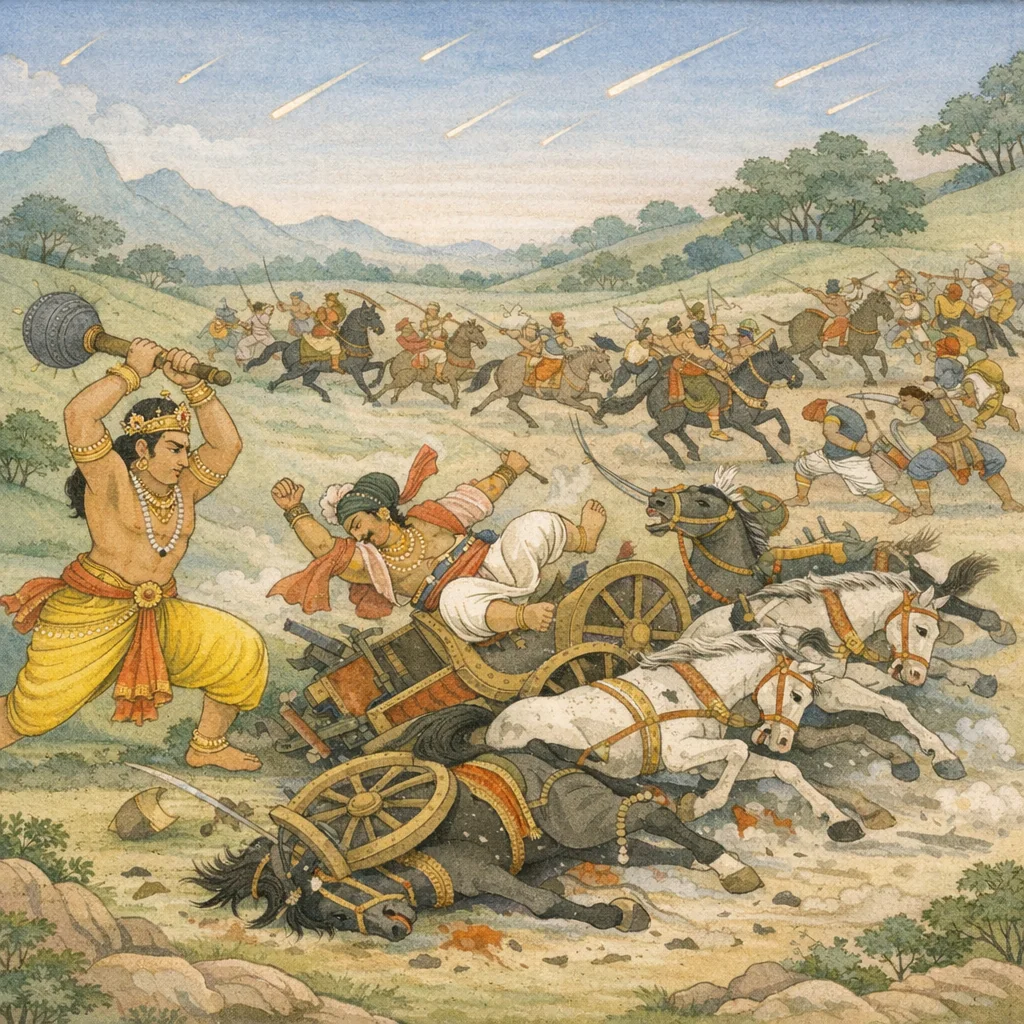
Sañjaya describes Śalya arming himself with an all-iron mace upon seeing the charioteer fallen, standing immovable and compared through a chain of similes to cosmic and royal powers. Bhīma charges with his own heavy gadā, and the battlefield responds with conches, instruments, and acclamations as both sides acknowledge the rarity of such force. The two circle in regulated patterns (maṇḍala movement), exchanging heavy strikes; their maces flash with metallic brilliance, and impacts are rendered as sparks and showers of embers, emphasizing the material physics of iron-on-iron combat. Both are repeatedly struck yet remain steady, and the sound of blows is likened to thunderbolt resonance. In a synchronized collision, both fall stunned; Kṛpa withdraws Śalya, while Bhīma rises and calls him back. The narrative then widens: Kaurava forces surge, Pāṇḍavas counter-advance, and Cekitāna is slain by Duryodhana’s spear, prompting intensified missile exchanges. Śalya engages Yudhiṣṭhira directly, wounding him; Yudhiṣṭhira responds with precise arrows, cuts Śalya’s banner, and Śalya answers with a dense arrow-net that obscures directions and visibly reduces Yudhiṣṭhira’s momentum, marking a tactical shift from duel spectacle to suppressive ranged pressure.
Chapter Arc: संजय धृतराष्ट्र से कहते हैं—जब दोनों सेनाएँ एक-दूसरे को रौंदती हुई विलुलित हो चलीं, पदातियों की कूजन-स्तनन और रथ-द्विपों की टक्कर से रणभूमि स्वयं एक गर्जन बन गई। → घोर संहार में नाना शस्त्रों का समावेश, रथ-हाथी-घोड़े की व्यतिषक्ति, और आकाश से उल्काओं का सूर्य-मण्डल से टकराकर गिरना—ये अपशकुन युद्ध को ‘अंतकाल’ की छाया देते हैं। इसी उन्माद में जगह-जगह सैकड़ों द्वंद्व-युद्ध भड़क उठते हैं; भीमसेन का प्रचण्ड वेग कृतवर्मा के रथ और घोड़ों को रौंदता हुआ आगे बढ़ता है। → भीमसेन शल्य पर टूट पड़ते हैं—भयंकर शब्द करने वाली गदा से शल्य के चारों महावेगवान घोड़े गिरा देते हैं और फिर उसी क्षण शल्य के सारथी का हृदय भेद देते हैं; मद्रराज का रथ-तंत्र टूटता है और शल्य क्षणभर के लिए रण-गति से विच्छिन्न हो जाते हैं। → शल्य अपने प्रहार का प्रत्युत्तर देखकर आश्चर्यचकित होते हैं; वे गदा का आश्रय लेकर प्रतिद्वन्द्वी को देखते हैं—अर्थात् पराजय के झटके के बाद भी उनका धैर्य और युद्ध-धर्म जाग्रत रहता है, और युद्ध का प्रवाह फिर से शल्य-केंद्रित द्वंद्व की ओर मुड़ता है। → शल्य गदा संभालकर भीम के सामने स्थिर होते हैं—अब प्रश्न यह है कि क्या मद्रराज इस अपमान का प्रतिशोध लेकर भीम को रोकेंगे, या भीम की प्रचण्डता शल्य-सेना को और पीछे ढकेलेगी?
Shlokas
Verse 1
ऑपन--माजण बछ। अकाल एकादशोब< ध्याय: शल्यका पराक्रम
Sañjaya said: O King, when in that great battle the armies were thrown into confusion and, striking one another down, were being mutually slain—when the warriors began to flee and the elephants roared—then the field became a scene of terror and ruin. The verse frames war as a self-consuming violence: fear spreads, order collapses, and the destruction of embodied life accelerates, pressing the listener to confront the ethical cost of victory sought through slaughter.
Verse 2
कूजतां स्तनतां चैव पदातीनां महाहवे । निहतेषु महाराज हयेषु बहुधा तदा
Sañjaya said: “O King, in that great battle, as many horses were being slain on all sides, the foot-soldiers cried out and groaned, and the tumult of war rose—an ominous sign of mounting destruction as the slaughter spread through the ranks.”
Verse 3
प्रक्षये दारुणे घोरे संहारे सर्वदेहिनाम् । नानाशस्त्रसमावाये व्यतिषक्तरथद्विपे
Sañjaya said: “O King, when that dreadful and terrifying destruction—the slaughter of all embodied beings—was unfolding, and when weapons of many kinds met and clashed, chariots and elephants became entangled with one another.”
Verse 4
हर्षणे युद्धशौण्डानां भीरूणां भयवर्धने । गाहमानेषु योधेषु परस्परवधैषिषु
Sañjaya said: “O King, as the battle raged on—delighting the war-skilled and intensifying the fear of the timid—warriors on both sides pressed into one another, each intent on the other’s death.”
Verse 5
प्राणादाने महाघोरे वर्तमाने दुरोदरे । संग्रामे घोररूपे तु यमराष्ट्रविवर्धने
Sañjaya said: “O King, when that dreadful exchange of lives was underway—hard to endure—in the battle of terrifying form that swells the realm of Yama (Death), the war turned into a ruthless slaughter. Warriors pressed into one another with the intent to kill; fear and exhilaration rose according to each man’s nature; and the conflict, wagering life itself, advanced as a grim engine of destruction.”
Verse 6
पाण्डवास्तावकं सैन्यं व्यधमन्निशितै: शरै: । तथैव तावका योधा जघ्नु: पाण्डवसैनिकान्
Sañjaya said: “O King, the Pāṇḍavas were cutting down your army with sharp arrows; and in the same way, your warriors too struck down the soldiers of the Pāṇḍavas.”
Verse 7
तस्मिंस्तथा वर्तमाने युद्धे भीरुभयावहे । पूर्वाह्न चापि सम्प्राप्ते भास्करोदयनं प्रति
Sañjaya said: “O King, while that battle—terrifying and calculated to increase the fear of the timid—was thus raging, and as the forenoon advanced toward sunrise, the enemy warriors, protected from the great Arjuna and skilled at striking their targets, engaged your army, having fixed death itself as the only limit beyond which they would not withdraw from the fight.”
Verse 8
लब्धलक्षा: परे राजन् रक्षितास्तु महात्मना | अयोधयंस्तव बल मृत्युं कृत्वा निवर्तनम्
Sañjaya said: O King, the enemy warriors—unerring in aim and guarded by the great-souled Arjuna—joined battle with your forces, having set death itself as the only boundary of their retreat. In the savage fighting at sunrise, they drove forward to deepen the fear of the faint-hearted, choosing honor in combat over withdrawal.
Verse 9
बलिभि: पाण्डवैर्दप्तैर्लब्धलक्षै: प्रहारिभि: । कौरव्यसीदत् पृतना मृगीवाग्निसमाकुला
Sañjaya said: Struck by the mighty Pāṇḍavas—proud of their prowess, unfailing in aim, and skilled in delivering blows—the Kaurava host began to collapse, like a doe hemmed in by a raging forest-fire.
Verse 10
इस प्रकार श्रीमह्याभारत शल्यपर्वमें संकुलयुद्धाविषयक दसवाँ अध्याय पूरा हुआ
Seeing the Kaurava host sinking into distress—like a weak cow stuck in mire—King Śalya, wishing to rescue it, advanced at that time against the sons of Pāṇḍu.
Verse 11
मद्रराज: सुसंक्रुद्धों गृहीत्वा धनुरुत्तमम् । अभ्यद्रवत संग्रामे पाण्डवानाततायिन:
Sañjaya said: The king of Madra, Śalya, inflamed with intense wrath, seized his excellent bow and charged into the battle against the Pāṇḍavas, who stood ready to strike him down.
Verse 12
पाण्डवा अपि भूपाल समरे जितकाशिन: । मद्रराजं समासाद्य बिभिदुर्निशितै: शरै:,भूपाल! समरमें विजयसे सुशोभित होनेवाले पाण्डव भी मद्रराज शल्यके निकट जाकर उन्हें अपने पैने बाणोंसे बींधने लगे
Sañjaya said: O king, the Pāṇḍavas too—radiant with the confidence of victory in battle—closed in upon Śalya, the king of Madra, and began to pierce him with their sharp arrows.
Verse 13
तत:ः शरशतैस्ती&णैर्मद्रराजो महारथ: । अर्दयामास तां सेनां धर्मराजस्य पश्यत:,तब महारथी मद्रराज धर्मराज युधिष्ठिरके देखते-देखते उनकी सेनाको अपने सैकड़ों तीखे बाणोंसे संतप्त करने लगे
Sañjaya said: Then the king of Madra, a great chariot-warrior, with hundreds of sharp arrows began to harass and scorch that army—while Dharmarāja Yudhiṣṭhira looked on.
Verse 14
प्रादुरासन् निमित्तानि नानारूपाण्यनेकश: । चचाल शब्दं कुर्वाणा मही चापि सपर्वता,उस समय नाना प्रकारके बहुत-से अशुभसूचक निमित्त प्रकट होने लगे। पर्वतोंसहित पृथ्वी महान् शब्द करती हुई डोलने लगी
Sañjaya said: Many ominous portents of diverse kinds manifested on every side. Even the earth, together with its mountains, trembled and shook, resounding with a great roar.
Verse 15
सदण्डशूला दीप्ताग्रा: शीर्यमाणा: समन्ततः । उल्का भूमिं दिव: पेतुराहत्य रविमण्डलम्
Sañjaya said: Meteors, their tips blazing, fell from the sky to the earth, as though striking the orb of the sun. Shattering and scattering in every direction, they rained down together with spear-like shafts and staff-armed spikes.
Verse 16
मृगाश्न महिषाश्चापि पक्षिणश्न विशाम्पते । अपसव्य॑ं तदा चक्रुः सेनां ते बहुशो नूप,प्रजानाथ! नरेश्वर! उस समय मृग, महिष और पक्षी आपकी सेनाको बारंबार दाहिने करके जाने लगे
Sañjaya said: “O lord of the people, O king, at that time deer, buffaloes, and birds repeatedly moved around your army keeping it to their right (circling in an inauspicious direction).”
Verse 17
भगुसूनुधरापुत्रौो शशिजेन समन्वितौ । चरम॑ पाण्डुपुत्राणां पुरस्तात् सर्वभूभुजाम्,शुक्र और मंगल बुधसे संयुक्त हो पाण्डवोंके पृष्ठभागमें तथा अन्य सब नरेशोंके सम्मुख उदित हुए थे
Sañjaya said: Venus, the son of Bhṛgu, and Mars, the son of the Earth, accompanied by the Moon, rose in the sky—appearing at the rear of the sons of Pāṇḍu and in front of all the other kings.
Verse 18
शस्त्राग्रेष्वभवज्ज्वाला नेत्राण्याहत्य वर्षती | शिर:स्वलीयन्त भृशं काकोलूकाश्व केतुषु
On the weapon-points a flame seemed to flare, dazzling the eyes before it fell upon the earth. And among the warriors’ heads and on their standards, crows and owls again and again crept into hiding.
Verse 19
ततस्तद् युद्धमत्युग्रमभवत् सहचारिणाम् | तथा सर्वाण्यनीकानि संनिपत्य जनाधिप
Sañjaya said: Thereupon the battle among the allied companions grew exceedingly fierce. And so, O king, all the divisions of the armies, closing in together, collided in a single, tumultuous engagement.
Verse 20
शल्यस्तु शरवर्षेण वर्षन्निव सहस्रदूक्
Sañjaya said: But Śalya, raining down a storm of arrows, looked like a cloud pouring forth its deluge; and as he surveyed the battlefield, his gaze seemed to multiply a thousandfold.
Verse 21
अभ्यवर्षत धर्मात्मा कुन्तीपुत्रं युधिष्ठिरम् । धर्मात्मा राजा शल्यने वर्षा करनेवाले इन्द्रकी भाँति कुन्तीपुत्र युधिष्ठिरपर बाणोंकी वर्षा आरम्भ कर दी ।।
Sañjaya said: The righteous-minded son of Kuntī, Yudhiṣṭhira, was showered with arrows—King Śalya, himself famed as righteous, began to rain shafts upon him like Indra who brings the monsoon. With arrows whose golden feathers were honed upon stone, the mighty Śalya also struck Bhīmasena, each of Draupadī’s sons, Mādrī’s twin sons Nakula and Sahadeva, Dhṛṣṭadyumna, Sātyaki, and Śikhaṇḍin—piercing each of them with ten arrows. Thereafter he poured forth a veritable downpour of missiles, like Indra sending rain in the season of clouds.
Verse 22
द्रौपदेयांस्तथा सर्वान् माद्रीपुत्रौी च पाण्डवौ । धृष्टद्युम्नं च शैनेयं शिखण्डिनमथापि च
Sañjaya said: He struck all the sons of Draupadī, and the two Pāṇḍava brothers born of Mādrī, as well as Dhṛṣṭadyumna, Śaineya (Sātyaki), and Śikhaṇḍin. Wounding each of them with ten arrows—golden-winged and sharpened upon the whetstone—he then began to pour forth a rain of shafts, like Indra sending down torrents in the season of rains.
Verse 23
एकैकं दशभिर्बाणैविव्याध स महाबल: । ततो5सृजद् बाणवर्ष घर्मान्ति मघवानिव
Sañjaya said: That mighty warrior pierced each of them with ten arrows. Then he unleashed a shower of arrows, like Indra (Maghavān) sending down rain at the end of the hot season.
Verse 24
ततः प्रभद्रका राजन् सोमकाश्न सहस्रश: । पतिता: पात्यमानाश्च दृश्यने शल्यसायकै:,राजन! तत्पश्चात् सहस्रों प्रभ)द्रक और सोमक योद्धा शल्यके बाणोंसे घायल होकर गिरे और गिरते हुए दिखायी देने लगे
Sañjaya said: Then, O King, thousands of Prabhadrakas and Somakas were seen falling—some already struck down, others collapsing as they fell—wounded by Śalya’s arrows.
Verse 25
भ्रमराणामिव व्राता: शलभानामिव व्रजा: । ह्वादिन्य इव मेघेभ्य: शल्यस्य न्यपतन् शरा:,शल्यके बाण भ्रमरोंके समूह, टिड्डियोंके दल और मेघोंकी घटासे प्रकट होनेवाली बिजलियोंके समान पृथ्वीपर गिर रहे थे
Sañjaya said: Arrows shot by Śalya kept falling to the earth in dense swarms—like clusters of bees, like bands of locusts, and like lightning-flashes bursting forth from rain-clouds.
Verse 26
द्विरदास्तुरगाश्चार्ता: पत्तयो रथिनस्तथा । शल्यस्य बाणैरपतन् बश्रमुर्व्यनदंस्तथा,शल्यके बाणोंकी मार खाकर पीड़ित हुए हाथी, घोड़े, रथी और पैदल-सैनिक गिरने, चक्कर काटने और आर्तनाद करने लगे
Sañjaya said: Struck and tormented by Śalya’s arrows, elephants and horses, as well as foot-soldiers and chariot-warriors, fell down; others reeled in confusion across the earth and cried out in anguish.
Verse 27
आविष्ट इव मद्रेशो मन््युना पौरुषेण च | प्राच्छादयदरीन् संख्ये कालसृष्ट इवान्तक:
Sañjaya said: The lord of Madra, as if possessed—fired by wrath and manly prowess—overwhelmed the enemy ranks in the battle, like Death itself unleashed by Time.
Verse 28
प्रलयकालमें प्रकट हुए यमराजके समान मद्रराज शल्य क्रोधसे आविष्ट हुए पुरुषकी भाँति अपने पुरुषार्थसे युद्धस्थलमें शत्रुओंको बाणोंद्वारा आच्छादित करने लगे ।।
Sañjaya said: Roaring aloud, the mighty lord of Madra—Śalya—like a thundercloud, like Yama revealed at the time of dissolution, began to cover the foes on the battlefield with a rain of arrows. As he poured his shafts into the fray, the Pāṇḍava host was cut and harried by him, and in the war’s moral darkness his force seemed like Death itself.
Verse 29
अजातशत्रुं कौन्तेयम भ्यधावद् युधिष्ठिरम् । महाबली मद्रराज मेघोंकी गर्जनाके समान सिंहनाद कर रहे थे। उनके द्वारा मारी जाती हुई पाण्डव-सेना भागकर अजातशत्रु कुन्तीकुमार युधिष्ठिरके पास चली गयी ।।
Sañjaya said: The mighty king of Madra rushed toward Yudhiṣṭhira, Kuntī’s son, known as Ajātaśatru. Roaring like a lion, like the thunder of clouds, he spread terror across the field. The Pāṇḍava army, cut down by him, broke and fled toward Ajātaśatru Yudhiṣṭhira. Then, crushing them in the battle, that swift-handed warrior pierced them with sharp arrows.
Verse 30
तमापततन्तं पत्त्यश्वै: क्रुद्धो राजा युधिछिर:
Sañjaya said: Seeing him rushing forward, King Yudhiṣṭhira—angered—advanced to meet him with his infantry and cavalry.
Verse 31
तस्य शल्य: शरं घोरं मुमोचाशीविषोपमम्
Sañjaya said: Then Śalya loosed at him a dreadful arrow, likened to a venomous serpent.
Verse 32
स निर्भिद्य महात्मानं वेगेनाभ्यपतच्च गाम् । उस समय शल्यने युधिष्ठिरपर विषैले सर्पके समान एक भयंकर बाणका प्रहार किया। वह बाण बड़े वेगसे महात्मा युधिष्ठिरको घायल करके पृथ्वीपर गिर पड़ा ।।
Sañjaya said: The missile, flying with great force, struck and pierced the noble-souled Yudhiṣṭhira, and then fell to the earth. Seeing this, Bhīma (Vṛkodara), aflame with wrath, pierced Śalya with seven arrows. Then Sahadeva with five, Nakula with ten, and the sons of Draupadī with many more, wounded Śalya—the foe-slaying hero—grievously.
Verse 33
पजञ्चभि: सहदेवस्तु नकुलो दशभि: शरै: । द्रौपदेयाश्न शत्रुघ्नं शूरमार्तायनिं शरै:
Sañjaya said: Sahadeva struck him with five arrows, and Nakula with ten. The sons of Draupadī too showered shafts upon the heroic Ārtāyani (Śalya), the slayer of foes. Seeing this, Bhīmasena flared with wrath and pierced Śalya with seven arrows. Thus, amid the crush of battle, the Pāṇḍavas and Draupadī’s sons together wounded Śalya, driven by duty to subdue a formidable enemy commander.
Verse 34
अभ्यवर्षन् महाराज मेघा इव महीधरम् | ततो दृष्ट्वा वार्यमाणं शल्यं पार्थ: समनन््ततः
Sañjaya said: “O King, they showered arrows upon Śalya as clouds pour rain upon a mountain. Then Pārtha, seeing Śalya being checked and hemmed in on every side, pressed the attack from all directions.”
Verse 35
कृतवर्मा कृपश्चैव संक्रुद्धाव भ्यधावताम् । उलूकश्च महावीर्य: शकुनिश्चापि सौबल:
Sañjaya said: Enraged, Kṛtavarmā and Kṛpa rushed forward. Along with them came the mighty Ulūka and Śakuni, son of Subala—moving in to protect Śalya as he was being hemmed in on all sides by Kuntī’s sons. The scene shows how, in the heat of war, loyalty to one’s commander and faction overrides hesitation, drawing even seasoned warriors into escalating violence.
Verse 36
समागम्याथ शनकैर श्वत्थामा महाबल: । तव पुत्राश्च कार्त्स्न्येन जुगुपु: शल्यमाहवे
Sañjaya said: Then the mighty Aśvatthāmā, approaching gradually, and all of your sons together, protected Śalya in the battle. Seeing Śalya hemmed in on every side by Kuntī’s sons, Kṛtavarmā and Kṛpācārya, inflamed with anger, rushed toward them; and with them came the valiant Ulūka and Śakuni, son of Subala, to defend Śalya amid the storm of arrows. The passage underscores how loyalty to one’s commander and factional duty intensify violence, as the warriors’ choices are driven by wrath and allegiance rather than restraint.
Verse 37
भीमसेन त्रिभिर्विद्ध्वा कृतवर्मा शिलीमुखै: । बाणवर्षेण महता क्रुद्धस-पमवारयत्,कृतवमनि क्रोधमें भरे हुए भीमसेनको तीन बाणोंसे घायल करके भारी बाण-वर्षकि द्वारा आगे बढ़नेसे रोक दिया
Sañjaya said: Kṛtavarmā, having pierced Bhīmasena with three sharp arrows, checked the wrathful warrior’s advance by unleashing a great shower of shafts. In the press of battle, restraint is achieved not by counsel but by force, as each fighter seeks to halt the other’s momentum within the rules of armed combat.
Verse 38
धृष्टद्युम्न॑ कृप: क्रुद्धो बाणवर्षैरपीडयत् । द्रौपदेयांश्व शकुनिर्यमौ च द्रौणिरभ्ययात्
Sañjaya said: Enraged, Kṛpa assailed Dhṛṣṭadyumna, tormenting him with a shower of arrows. Śakuni advanced against the sons of Draupadī, while Droṇa’s son Aśvatthāman charged at the twin brothers Nakula and Sahadeva.
Verse 39
दुर्योधनो युधां श्रेष्ठ आहवे केशवार्जुनौ । समभ्ययादुग्रतेजा: शरैश्लाप्पहनद् बली
Sañjaya said: Duryodhana—foremost among warriors—advanced in the thick of battle against Keśava and Arjuna. Fierce in splendor and strong in might, he struck at them with volleys of arrows.
Verse 40
एवं द्वन्द्शशतान्यासंस्त्वदीयानां परै:ः सह । घोररूपाणि चित्राणि तत्र तत्र विशाम्पते,प्रजानाथ! इस प्रकार जहाँ-तहाँ आपके सैनिकोंके शत्रुओंके साथ सैकड़ों भयानक एवं विचित्र द्वन्द्ययुद्ध होने लगे
Sañjaya said: Thus, O lord of the people, there arose here and there hundreds of single combats between your warriors and their foes—terrible in aspect and strange in their variety—as the battle broke into countless personal duels.
Verse 41
ऋक्षवर्णाञ्जघानाश्वान् भोजो भीमस्य संयुगे । सो<वतीर्य रथोपस्थाद्धताश्वात् पाण्डुनन्दन:
Sañjaya said: In the thick of battle, the Bhoja warrior struck down Bhīma’s horses—those of bear-like hue. With his steeds slain, the son of Pāṇḍu leapt down from the chariot-platform and continued the fight on foot.
Verse 42
प्रमुखे सहदेवस्य जघानाश्वान् स मद्रराट्
Sañjaya said: In the very forefront of the battle, the king of Madra struck down Sahadeva’s horses.
Verse 43
गौतम: पुनराचार्यों धृष्टद्युम्मनमयोधयत्
Sañjaya said: Then Gautama, the venerable teacher, once again engaged Dhṛṣṭadyumna in battle. The scene shows how, in the chaos of war, even revered elders are driven by duty to take up arms and confront formidable foes without hesitation.
Verse 44
असम्भ्रान्तमसमश्रान्तो यत्नवान् यत्नवत्तरम् | कृपाचार्य बिना किसी घबराहटके विजयके लिये यत्नशील हो सम्भ्रमरहित और अधिक प्रयत्नशील धृष्टद्युम्नके साथ युद्ध करने लगे ।।
Sañjaya said: Unflurried and untiring, exerting himself with ever greater effort for victory, Kripa entered the fight; and likewise he struck Draupadī’s heroic sons, each one, with ten arrows. The passage highlights disciplined composure in combat—energy governed by steadiness rather than panic—within the grim moral landscape of fratricidal war.
Verse 45
अविद्धयदाचार्यसुतो नातिक्ुद्धों हसन्निव | आचार्य द्रोणके पुत्र अश्वत्थामाने अधिक क़्ुद्ध न होकर हँसते हुए-से दस-दस बाणोंद्वारा द्रौपदीके वीर पुत्रोंमेंसे प्रयेकको घायल कर दिया ।।
Sañjaya said: Drona’s son Aśvatthāmā, not excessively enraged and seeming almost to smile, struck each of Draupadī’s heroic sons with ten arrows, wounding them. Meanwhile Bhīmasena had mounted another chariot; in the thick of battle Kṛtavarmā again slew Bhīma’s horses. When his horses were killed, the mighty Pāṇḍava Bhīma quickly leapt down from the chariot. Enraged, raising his weapon like a rod of punishment and taking up his mace like Death itself, he smashed Kṛtavarmā’s horses and chariot to pieces. Kṛtavarmā then sprang from that chariot and fled.
Verse 46
सो<वतीर्य रथात्तूर्ण हताश्वः पाण्डुनन्दन: । कालो दण्डमिवोद्यम्य गदां क्रुद्धो महाबल:
Sañjaya said: Then the mighty son of Pāṇḍu, his horses slain, quickly descended from his chariot. Enraged, and raising his mace like Death himself lifting a rod of punishment, he advanced with terrible force—showing how, in the moral chaos of war, wrath and retribution can momentarily eclipse restraint and measured conduct.
Verse 47
पोथयामास तुरगान् रथं च कृतवर्मण: । कृतवर्मा त्ववप्लुत्य रथात् तस्मादपाक्रमत्
Sañjaya said: He smashed the horses and the chariot of Kṛtavarmā. Kṛtavarmā, however, leapt down from that chariot and withdrew. (Meanwhile Bhīmasena had mounted another chariot.) Kṛtavarmā again, on the battlefield, killed Bhīma’s horses. When the horses were slain, the mighty Pāṇḍu’s son Bhīmasena quickly descended from his chariot; enraged, raising his weapon like a staff and taking up his mace like Death itself, he crushed Kṛtavarmā’s horses and chariot to pieces. Kṛtavarmā then sprang from that chariot and fled.
Verse 48
शल्यो<पि राजन संक्रुद्धो निध्नन् सोमकपाण्डवान् । पुनरेव शितैर्बाणैर्युधेष्टिमपीडयत्
Sañjaya said: O King, Śalya too, inflamed with wrath, struck down the Somakas and the Pāṇḍavas; and once again, with razor-sharp arrows, he pressed hard upon Yudhiṣṭhira.
Verse 49
राजन! इधर शल्य भी अत्यन्त क्रोधमें भरकर सोमकों और पाण्डवयोद्धाओंका संहार करने लगे। उन्होंने पुनः पैने बाणोंद्वारा युधिष्ठिरको पीड़ा देना प्रारम्भ किया ।।
Sañjaya said: Seeing this, Bhīma, inflamed with wrath on the battlefield, clenched his teeth. Resolving upon Śalya’s destruction, the mighty warrior seized his mace.
Verse 50
यमदण्डप्रतीकाशां कालरात्रिमिवोद्यताम् | गजवाजिमनुष्याणां देहान्तकरणीमपि
Sañjaya said: “(He beheld that weapon/force) blazing like Yama’s staff, raised aloft like Kālarātri—the Night of Time—and able to bring about the end of the bodies of elephants, horses, and men as well.”
Verse 51
यह देख पराक्रमी भीमसेन कुपित हो ओठ चबाते हुए रणभूमिमें शल्यके विनाशका संकल्प लेकर यमदण्डके समान भयंकर गदा लिये उनपर टूट पड़े। हाथी
Sañjaya said: Seeing this, the mighty Bhīmasena, enraged and biting his lip, formed a firm resolve on the battlefield to destroy Śalya. Grasping a dreadful mace like Yama’s rod of punishment, he rushed upon him. That mace—able to shatter the bodies of elephants, horses, and men—looked like Kālarātri, the Night of Doom, poised for annihilation. Bound with bands of gold, it blazed like a flaming meteor; forged of iron and hard as a thunderbolt, it seemed as terrifying as a serpent coiled upon a whetstone. Smeared all over with fat and marrow, it appeared—by grim contrast—like a beloved woman anointed with sandal and aloe; to behold, it was as fearsome as the tongue of Death itself.
Verse 52
चन्दनागुरुपड्काक्तां प्रमदामीप्सितामिव । वसामेदोपदिग्धाज़ीं जिह्दां वैवस्चतीमिव
Sañjaya said: It appeared like a beloved, longed-for woman anointed with sandal and aloe—yet in truth it was smeared with fat and marrow, dreadful to behold like the tongue of Vaivasvata (Yama).
Verse 53
पटुघण्टाशतरवां वासवीमशनीमिव । निर्मुक्ताशीविषाकारां पृक्तां गजमदैरपि
Sañjaya said: “That mace, ringing with the keen clamor of hundreds of bells, looked dreadful like Indra’s thunderbolt. Like a venomous serpent that has cast off its slough, it struck fear into the hearts of all beings, even as it heightened the exhilaration of its own host; it was also smeared with the rut-fluid of elephants.”
Verse 54
त्रासनीं सर्वभूतानां स्वसैन्यपरिहर्षिणीम् । मनुष्यलोके विख्यातां गिरिशृज्भविदारणीम्
Sañjaya said: “That mace, famed throughout the world of men, was a terror to all creatures and a source of exhilaration to its own army. It was said to be capable of rending mountain-peaks.”
Verse 55
यया कैलासभवने महेश्वरसखं बली । आह्वयामास युद्धाय भीमसेनो महाबल:,यह वही गदा है, जिसके द्वारा महाबली भीमसेनने कैलासशिखरपर भगवान् शंकरके सखा कुबेरको युद्धके लिये ललकारा था
Sañjaya said: “With that very mace, the mighty Bhīmasena—of great strength—once challenged Kubera, the friend of Lord Maheśvara, to combat in the abode of Kailāsa.”
Verse 56
यया मायामयान् दृप्तान् सुबहून् धनदालये । जघान गुह्ुकान क्रुद्धो नदन् पार्थो महाबल:
Sañjaya said: “With that, the mighty Pārtha, roaring in wrath, slew very many arrogant foes—those who fought by deceptive, illusory devices—there in the abode of the Lord of Wealth (Dhanada).”
Verse 57
तां वज़्मणिरत्नौचकल्मषां वज्रगौरवाम्
Sañjaya said: “That was marked by the brilliance of diamonds, gems, and precious jewels, and it bore the heavy, adamantine majesty of the thunderbolt.”
Verse 58
गदया युद्धकुशलस्तया दारुणनादया
Sañjaya said: Skilled in combat with the mace, he advanced with that weapon whose dreadful roar proclaimed the ferocity of the encounter—an image of war’s brutal craft, where prowess and violence move together, often eclipsing gentler claims of dharma.
Verse 59
ततः शल्यो रणे क्रुद्ध: पीने वक्षसि तोमरम्
Sañjaya said: Then Śalya, enraged amid the battle, hurled a spear at the broad, well-built chest (of his opponent), pressing the fight forward with fierce intent.
Verse 60
निचखान नदन् वीरो वर्म भित्त्वा च सो5भ्ययात् | तब रणभूमिमें कुपित हो गर्जना करते हुए वीर शल्यने भीमसेनके विशाल वक्ष:स्थलमें एक तोमर धँसा दिया। वह उनके कवचको छेदकर छातीमें गड़ गया ।।
Sañjaya said: Roaring aloud, the hero drove his weapon in, and after piercing the armour he pressed forward. Then, on the battlefield, the valiant Śalya—angered and thundering—plunged a tomara into Bhīmasena’s broad chest. It tore through his cuirass and lodged deep in his breast. Yet Vṛkodara, unshaken, seized that very spear and tore it out.
Verse 61
स भिजन्नमर्मा रुधिरं वमन् वित्रस्तमानस:
Sañjaya said: With his vital points shattered, vomiting blood, and his mind seized by terror, he was left in a grievously wounded state—an image of how the violence of war swiftly reduces even the mighty to helpless suffering.
Verse 62
पपाताभिमुखो दीनो मद्रराजस्त्वपाक्रमत् | इससे सारथिका मर्मस्थल विदीर्ण हो गया और वह मुहसे रक्त वमन करता हुआ दीन एवं भयभीतचित्त होकर शल्यके सामने ही रथसे नीचे गिर पड़ा। फिर तो मद्रराज शल्य वहाँसे पीछे हट गये ।।
Sañjaya said: Facing forward, the wretched warrior fell down, while the king of Madra, Śalya, withdrew. Seeing that the counterstroke had been fully repaid, Śalya’s mind was struck with astonishment—an episode that underscores how, in the brutal economy of war, violence begets immediate retribution and even seasoned fighters recoil when the consequences of their own actions return upon them.
Verse 63
ततः सुमनस: पार्था भीमसेनमपूजयन् । ते दृष्टवा कर्म संग्रामे घोरमक्लिष्टकर्मण:
Sañjaya said: Then the sons of Pṛthā (Kuntī), their hearts filled with joy, honored Bhīmasena. Seeing his dreadful prowess in battle—great deeds accomplished without strain—they praised him again and again, uplifted by what he had done in the fight.
Verse 193
अभ्ययु: कौरवा राजन् पाण्डवानामनीकिनीम् । नरेश्वर! तत्पश्चात् एक साथ संगठित होकर जूझनेवाले दोनों पक्षोंके वीरोंका वह युद्ध बड़ा भयंकर हो गया। राजन! कौरव-योद्धाओंने अपनी सारी सेनाओंको एकत्र करके पाण्डव-सेनापर धावा बोल दिया
Sañjaya said: O King, the Kauravas charged against the Pāṇḍavas’ army. Then, O lord of men, as the heroes of both sides closed ranks and fought together in a single mass, the battle became exceedingly dreadful. O King, the Kaurava warriors, having gathered all their forces, rushed upon the Pāṇḍava host.
Verse 293
बाणवर्षेण महता युधिष्ठिरमताडयत् । शीघ्रतापूर्वक हाथ चलानेवाले शल्यने युद्धस्थलमें पैने बाणोंद्वारा पाण्डव-सेनाका मर्दन करके बड़ी भारी बाण-वर्षके द्वारा युधिष्ठिरको भी गहरी चोट पहुँचायी
Sañjaya said: With a mighty shower of arrows, Śalya struck Yudhiṣṭhira. Swift of hand in releasing missiles, Śalya, on the battlefield, cut down the Pāṇḍava forces with sharp shafts and then, with an even heavier rain of arrows, inflicted a deep wound upon Yudhiṣṭhira as well.
Verse 303
अवारयच्छरैस्ती4॥णैर्महाद्विपमिवाड्कुशै: । तब क्रोधमें भरे हुए राजा युधिष्ठिरने पैदलों और घुड़सवारोंके साथ आते हुए शल्यको अपने तीखे बाणोंसे उसी प्रकार रोक दिया
Sañjaya said: Filled with wrath, King Yudhiṣṭhira checked Śalya as he advanced with foot-soldiers and horsemen, stopping him with sharp arrows—just as a mahout restrains a massive elephant from charging forward by striking it with the goad.
Verse 416
कालो दण्डमिवोद्यम्य गदापाणिरयुध्यत । कृतवमनि युद्धस्थलमें भीमसेनके रीछके समान रंगवाले घोड़ोंको मार डाला। घोड़ोंके मारे जानेपर पाण्डुनन्दन भीमसेन रथकी बैठकसे नीचे उतरकर हाथमें गदा ले युद्ध करने लगे
Sañjaya said: Like Time itself raising a rod of punishment, the mace‑wielding warrior fought on. On the battlefield Kṛtavarman struck down Bhīmasena’s horses, tawny in hue like a bear. When the horses were slain, Bhīma—the joy of the Pāṇḍus—stepped down from the chariot-seat, took up his mace, and engaged in combat, as though Yama were lifting his staff to deliver chastisement.
Verse 426
ततः शल्यस्य तनयं सहदेवोडसिनावधीत् । मद्रराज शल्यने अपने सामने आये हुए सहदेवके घोड़ोंको मार डाला। तब सहदेवने भी शल्यके पुत्रको तलवारसे मार गिराया
Sañjaya said: Then Sahadeva struck down Śalya’s son with his sword. Śalya, the king of Madra, killed Sahadeva’s horses that had come before him. Thereupon Sahadeva at once repaid him, felling Śalya’s son with the edge of his blade.
Verse 563
निवार्यमाणो बहुभिद्रौपद्या: प्रियमास्थित: । तथा जिसके द्वारा क्रोधमें भरे हुए महाबलवान् कुन्तीकुमार भीमने बहुतोंके मना करनेपर भी द्रौपदीका प्रिय करनेके लिये उद्यत हो गर्जना करते हुए कुबेरभवनमें रहनेवाले बहुत-से मायामय अभिमानी गुह्य॒कोंका वध किया था
Sañjaya said: Though restrained by many, he remained intent on doing what was dear to Draupadī. Thus Bhīma, Kuntī’s mighty son, filled with wrath and resolved—despite repeated attempts to dissuade him—to please Draupadī, roared aloud and slew many proud, illusion-wielding Guhyakas who dwelt in Kubera’s abode.
Verse 573
समुद्यम्य महाबाहु: शल्यमभ्यपतद् रणे । जिसमें वज्जकी गुरुता भरी है और जो हीरे
Sañjaya said: Lifting up the mighty spear, the strong-armed Śalya rushed forward on the battlefield. Bearing a weapon heavy as a thunderbolt and splendidly adorned with diamonds, gems, and clustered jewels, he charged to strike Bhīmasena.
Verse 583
पोथयामास शल्यस्य चतुरो<श्चवान् महाजवान् | युद्धकुशल भीमसेनने भयंकर शब्द करनेवाली उस गदाके द्वारा शल्यके महान् वेगशाली चारों घोड़ोंको मार गिराया
Sañjaya said: Skilled in battle, Bhīmasena, wielding his mace that roared with a terrifying sound, struck down Śalya’s four horses—swift and powerful—thereby crippling his chariot in the midst of war.
Verse 603
यन्तारं मद्रराजस्य निर्बिभेद ततो हृदि । इससे भीमसेनको तनिक भी घबराहट नहीं हुई। उन्होंने उसी तोमरको निकालकर उसके द्वारा मद्रराज शल्यके सारथिकी छाती छेद डाली
Sañjaya said: Then Bhīmasena pierced the charioteer of the king of Madra straight in the heart. Unshaken by the blow he had received, he wrenched out the very spear and, in the fury of battle, drove it back to bore through the chest of Śalya’s driver.
Verse 623
गदाम॒श्रित्य धर्मात्मा प्रत्यमित्रमवैक्षत । अपने प्रहारका भरपूर उत्तर प्राप्त हुआ देख धर्मात्मा शल्यका चित्त आश्वर्यसे चकित हो उठा। वे गदा हाथमें लेकर अपने शत्रुकी ओर देखने लगे
Sañjaya said: Taking hold of his mace, the righteous-hearted warrior looked toward his opposing foe. Seeing that his own blow had been fully answered in return, Śalya’s mind was struck with astonishment, and he stood amazed—mace in hand, fixing his gaze upon the enemy before him.
Frequently Asked Questions
The chapter frames the tension between personal heroics and command responsibility: whether to pursue decisive single combat or shift to broader tactical measures that protect one’s side while increasing collective harm.
It illustrates that technique and endurance alone do not conclude conflicts; battlefield outcomes depend on timely transitions—regrouping, extraction, and ranged suppression—integrated with disciplined conduct.
No explicit phalaśruti appears here; the chapter functions as embedded war-chronicle, where meaning is conveyed through narrative sequencing, similes, and tactical causality rather than overt doctrinal closure.
Read Mahabharata in the Vedapath app
Scan the QR code to open this directly in the app, with audio, word-by-word meanings, and more.