Adhyaya 156
उपायैः पूर्ववधकथनम् / Strategic Justifications for Prior Eliminations
Upa-parva: Droṇa-parva — Strategic Counsel and Prior Eliminations (Upāya-kathana episode)
Arjuna asks Kṛṣṇa how, for the Pāṇḍavas’ benefit, formidable earth-kings such as Jarāsandha and others were previously brought down, and by what yogas/upāyas (means). Kṛṣṇa replies that if Jarāsandha, the Cedi king, and the Naiṣāda (Ekalavya) had not been neutralized earlier, they would have become a severe danger and would likely have joined Duryodhana, protecting the entire Kaurava host like deathless guardians. Kṛṣṇa then recounts the Jarāsandha episode in technical detail: Jarāsandha hurls a blazing mace; Balarāma (Rohiṇīnandana) counters with the Sthūṇākarṇa weapon, causing the mace to fall and shake the earth; the narrative includes the etiological account of the rākṣasī Jarā who ‘joined’ the two half-bodies, explaining Jarāsandha’s name. Jarāsandha is then rendered without his mace and is slain by Bhīma, with the claim that even gods could not defeat him if armed. Kṛṣṇa next frames Ekalavya’s disabling (thumb removal) as a deliberate measure linked to Droṇa’s teacherly authority, asserting Ekalavya’s near-unconquerability. He also notes the slaying of the Cedi king by himself, presenting these as necessary acts against otherwise unbeatable opponents. The discourse expands to other hostile figures (e.g., Hiḍimba-related rākṣasas, Bakā, Kirmīra, Māyāvī, Alāyudha, and the use of Indra-given śakti against Ghaṭotkaca), categorizing them as disruptors of ritual and social order. Kṛṣṇa concludes with a normative statement: those who undermine dharma are to be restrained/removed; he affirms his alignment with virtues such as truth, restraint, purity, modesty, prosperity, firmness, and forgiveness. He counsels Arjuna not to despair regarding Karṇa and promises to teach a means to overcome him; he also indicates Bhīma will kill Duryodhana and that he will explain that method. The chapter ends by returning to immediate battlefield urgency: the tumult rises, Pāṇḍava troops scatter, and Droṇa is described as devastating their forces.
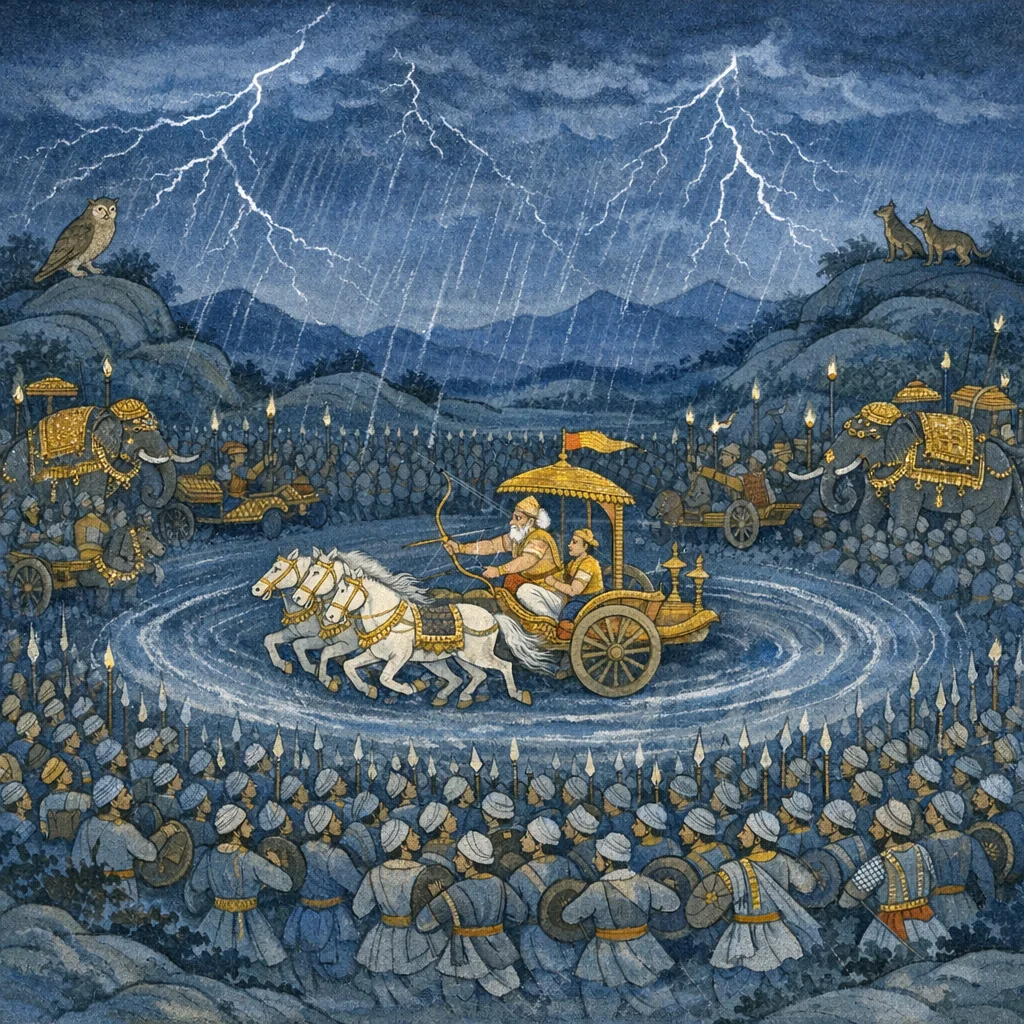
Chapter Arc: धृतराष्ट्र, रात्रियुद्ध की भयावहता सुनकर संजय से पूछते हैं—रथ पर विचरते महाधनुर्धर द्रोण को पाण्डवों ने कैसे घेरा, और उनके चक्र के दक्षिण-उत्तर पक्ष की रक्षा किसने की। → अन्धकार में शस्त्रों की झंकार—ऋष्टि, शक्ति, गदा, बाण, मुसल, प्रास, पट्टिश—चारों ओर चलती है। पाञ्चालों के प्रहारक दल और पाण्डवों के महारथी द्रोण पर धावा बोलते हैं, जबकि द्रोण शत्रुओं का संहार करते हुए अपने चक्र को गतिमान रखते हैं। रात्रि के अपशकुन—उल्लू, सियारिनों का कोलाहल, अग्नि-सा मुख—कौरव-सेना में विशेष भय का संकेत देते हैं। → रात्रि के प्रथम प्रहर में युद्ध का कोलाहल चरम पर पहुँचता है—कायरों को त्रस्त करने वाला, शूरों का हर्ष बढ़ाने वाला। बिजली-सहित मेघों की भाँति स्वर्णभूषित हाथी और रथ अन्धकार में चमकते दिखते हैं; उसी दृश्य-भ्रम और गर्जना के बीच पाण्डव-सेना द्रोण को चारों ओर से घेरने का प्रयत्न करती है और द्रोण अपने रथ से घूम-घूमकर प्रचण्ड संहार करते हैं। → संजय रात्रियुद्ध की संरचना बताता है—द्रोण के चक्र के दोनों पक्षों की रक्षा-व्यवस्था, पाण्डवों के आक्रमण-दल, और कौरव-पक्ष में फैलते भय के लक्षण। युद्ध थमता नहीं; केवल रात्रि का एक पहर बीतता है और रण का वेग बना रहता है। → अगले प्रहर में द्रोण के विरुद्ध पाण्डवों की घेराबन्दी सफल होगी या कौरव-चक्र अन्धकार में और अधिक घातक रूप लेगा—यह अनिश्चितता बनी रहती है।
Shlokas
Verse 1
/ (दाक्षिणात्य अधिक पाठके ७ श्लोक मिलाकर कुल ५१ श्लोक हैं।) चतुष्पञ्चाशर्दाधिकशततमो< ध्याय: रात्रियुद्धमें पाण्डव-सैनिकोंका द्रोणाचार्यपर आक्रमण और द्रोणाचार्यद्वारा उनका संहार धृतराष्ट्र रवाच यत् तदा प्राविशत् पाण्डूनाचार्य: कुपितो बली । उक्त्वा दुर्योधन मन्दं मम शास्त्रातिगं सुतम्,धृतराष्ट्रने पूछा--संजय! मेरी आज्ञाका उल्लंघन करनेवाले मेरे मूर्ख पुत्र दुर्योधनसे पूर्वोक्त बातें कहकर क्रोधमें भरे हुए बलवान् आचार्य द्रोणने जब वहाँ पाण्डव-सेनामें प्रवेश किया, उस समय रथपर बैठकर सेनाके भीतर प्रवेश करके सब ओर विचरते हुए महाधनुर्धर शूरवीर द्रोणाचार्यको पाण्डवोंने किस प्रकार रोका?
Dhṛtarāṣṭra asked: “Sañjaya, when the mighty preceptor Droṇa—angered after rebuking my dull-witted son Duryodhana for overstepping my command—entered the Pāṇḍava host and moved about within the army from his chariot, how did the Pāṇḍavas check and confront that great archer? In that night-battle, by what means did they attempt to restrain him as he began to cut down their forces?”
Verse 2
प्रविश्य विचरन्तं च रथे शूरमवस्थितम् । कथं द्रोणं महेष्वासं पाण्डवा: पर्यवारयन्,धृतराष्ट्रने पूछा--संजय! मेरी आज्ञाका उल्लंघन करनेवाले मेरे मूर्ख पुत्र दुर्योधनसे पूर्वोक्त बातें कहकर क्रोधमें भरे हुए बलवान् आचार्य द्रोणने जब वहाँ पाण्डव-सेनामें प्रवेश किया, उस समय रथपर बैठकर सेनाके भीतर प्रवेश करके सब ओर विचरते हुए महाधनुर्धर शूरवीर द्रोणाचार्यको पाण्डवोंने किस प्रकार रोका?
Sañjaya said: “When the heroic Droṇa—seated on his chariot—had entered the Pāṇḍava host and was ranging about within it, how did the Pāṇḍavas check and contain that great archer?”
Verse 3
केडरक्षन् दक्षिणं चक्रमाचार्यस्य महाहवे । के चोत्तरमरक्षन्त निघ्नतः शात्रवान् बहून्,उस महासमरमें बहुसंख्यक शत्रुयोद्धाओंका संहार करनेवाले आचार्य द्रोणके दायें चक्रकी किन लोगोंने रक्षा की तथा किन लोगोंने उनके रथके बायें पहियेकी रखवाली की?
Sañjaya said: “In that great battle, while the preceptor Droṇa was cutting down many hostile warriors, who guarded the right wheel of his chariot, and who protected the left wheel?”
Verse 4
के चास्य पृष्ठतो5न्वासन् वीरा वीरस्य योधिन: । के पुरस्तादवर्तन्त रथिनस्तस्य शत्रव:,युद्धपरायण वीर रथी आचार्यके पीछे कौन-से वीर थे और शत्रुपक्षेके कौन-कौनसे वीर उनके सामने खड़े हुए थे
Sañjaya said: “Which heroes, the warriors of that heroic commander, were following behind him? And which chariot-fighters of his enemy stood arrayed before him?”
Verse 5
मन्ये तानस्पृशच्छीतमतिवेलमनार्तवम् । मन्ये ते समवेपन्त गावो वै शिशिरे यथा
Sañjaya said: “I think they were struck by a chill beyond measure—an untimely cold. I think they all trembled together, like cows shivering in the winter.”
Verse 6
मैं तो समझता हूँ शत्रुओंको बहुत देरतक बिना मौसमके ही सर्दी लगने लगी होगी। जैसे शिशिर-ऋतुमें गायें सर्दीके मारे काँपने लगती हैं, उसी तरह वे शत्रु-सैनिक भी आचार्यके भयसे थर-थर काँपने लगे होंगे ।। यत्प्राविशन्महेष्वास: पठचालानपराजित: । नृत्यन् स रथमार्गेषु सर्वशस्त्रभूृतां वर:
Sañjaya said: “I think the enemies were seized for long by an unseasonable cold. As cows shiver in the winter, so too did those hostile soldiers tremble in fear of the preceptor. When that unconquered great archer entered the Paṭacāla ranks, moving as if dancing along the chariot-lanes, he—foremost among all who bear weapons—made the enemy host quake with dread.”
Verse 7
क्योंकि किसीसे परास्त न होनेवाले, सम्पूर्ण शस्त्रधारियोंमें श्रेष्ठ महाधनुर्धर द्रोणाचार्यने पांचालोंकी सेनामें रथके मार्गोंपर नृत्य-सा करते हुए प्रवेश किया था ।। निर्दहन् सर्वसैन्यानि पञ्चालानां रथर्षभ: । धूमकेतुरिव क्रुद्ध: कथं मृत्युमुपेयिवान्,रथियोंमें श्रेष्ठ द्रोण क्रोधमें भरे हुए धूमकेतुके समान प्रकट होकर पांचालोंकी समस्त सेनाओंको दग्ध कर रहे थे; फिर उनकी मृत्यु कैसे हो गयी?
Sañjaya said: “That bull among chariot-warriors, Droṇa, was burning down all the forces of the Pañcālas. Appearing in wrath like a blazing comet—unconquered and supreme among all weapon-bearers—how could he come to meet death?”
Verse 8
संजय उवाच सायाह्रे सैन्धवं हत्वा राज्ञा पार्थ: समेत्य च | सात्यकिश्न महेष्वासो द्रोणमेवाभ्यधावताम्,संजयने कहा--राजन! सायंकाल सिंधुराज जयद्रथका वध करके राजा युधिष्ठिरसे मिलकर कुन्तीकुमार अर्जुन और महाथनुर्थर सात्यकि दोनोंने द्रोणाचार्यपर ही धावा किया
Sañjaya said: “O King, toward evening, after slaying the Sindhu prince (Jayadratha), Pārtha (Arjuna) met with the king (Yudhiṣṭhira). Then Arjuna and the great bowman Sātyaki rushed straight at Droṇācārya.”
Verse 9
तथा युधिष्ठिरस्तूर्ण भीमसेनश्न पाण्डव: । पृथक्चमूशभ्यां संयत्तौ द्रोणमेवाभ्यधावताम्,इसी प्रकार राजा युधिष्ठिर और पाण्डुपुत्र भीमसेनने भी पृथक्-पृथक् सेनाओंके साथ तैयार हो शीघ्रतापूर्वक द्रोणाचार्यपर ही आक्रमण किया
Sañjaya said: In the same manner, King Yudhiṣṭhira and Bhīmasena, the son of Pāṇḍu, each having readied his own division of troops, rushed swiftly—directing their assault specifically against Droṇa.
Verse 10
तथैव नकुलो धीमान् सहदेवश्न दुर्जय: । धृष्टद्युम्न: सहानीको विराटश्व॒ सकेकय:,मत्स्या: शाल्वा: ससेनाश्न द्रोणमेव ययुर्युधि । इसी तरह बुद्धिमान् नकुल, दुर्जय वीर सहदेव, सेनासहित धृष्टद्युम्न, राजा विराट, केकयराजकुमार तथा मत्स्य और शाल्वदेशके सैनिक अपनी सेनाओंके साथ युद्धस्थलमें द्रोणाचार्यपर ही चढ़ आये
Sañjaya said: Likewise, the wise Nakula and the hard-to-defeat Sahadeva—together with Dhṛṣṭadyumna at the head of his troops, King Virāṭa, the Kekaya prince, and the warriors of Matsya and Śālva with their armies—advanced on the battlefield straight toward Droṇācārya.
Verse 11
।। द्रुपदश्ष तथा राजा पञ्चालैरभिरक्षित:
Sañjaya said: Drupada too—the king—was being guarded and protected by the Pañcālas.
Verse 12
द्रौपदेया महेष्वासा राक्षसश्नल घटोत्कच:
Sañjaya said: The sons of Draupadī—mighty archers—and the Rākṣasa Ghaṭotkaca too were there, counted among the foremost fighters in that grim phase of the war.
Verse 13
प्रभद्रकाश्न॒ पञज्चाला: षट्सहस्रा: प्रहारिण:
Sañjaya said: The Prabhadrakas and the Pañcālas—six thousand strong—advanced as fierce assailants, striking in the thick of battle.
Verse 14
तथेतरे नरव्याप्रा: पाण्डवानां महारथा:
Sañjaya said: So too, the other great chariot-warriors of the Pāṇḍavas, fully engaged in the work of men—striving and intent on their duty in battle—pressed on with their efforts.
Verse 15
सहिता: संन्यवर्तन्त द्रोणमेव द्विजर्षभम् । इसी प्रकार पाण्डव-सेनाके अन्य महारथी वीर पुरुषसिंह भी एक साथ द्विजदश्रेष्ठ ट्रोणाचार्ुकी ओर ही लौट आये ।। १४ $ ।। तेषु शूरेषु युद्धाय गतेषु भरतर्षभ
Sañjaya said: United together, they turned back—toward Droṇa alone, the bull among Brahmins. And when those heroes had gone forth for battle, O best of the Bharatas, events moved toward a decisive confrontation centered on Droṇa.
Verse 16
योधानामशिवा रौद्रा राजन्नन्तकगामिनी
Sañjaya said: O King, for the warriors there arose an inauspicious, terrifying omen—one that seemed to lead straight toward Antaka (Death).
Verse 17
तस्यां रजन्यां घोरायां नदन्त्य: सर्वतः शिवा:
Sañjaya said: In that dreadful night, jackals howled from every direction—an ominous sign foretelling calamity amid the war’s unfolding.
Verse 18
उलूकाश्चाप्यदृश्यन्त शंसन्तो विपुलं भयम्
Sañjaya said: “And owls too were seen, foretelling an immense terror.” In the war-chronicle, such ominous signs underscore the moral darkness and the approaching surge of violence, as nature itself seems to warn of the fearful consequences of adharma and unchecked wrath.
Verse 19
ततः सैन्येषु राजेन्द्र शब्द: समभवन्महान्,खुरशब्दनिपातैश्न तुमुल: सर्वतो5भवत् । राजेन्द्र! तदनन्तर सारी सेनाओंमें रणभेरीकी भारी आवाज, मृदंगोंकी ध्वनि, हाथियोंके चिग्घाड़ने, घोड़ोंके हिनहिनाने और धरतीपर उनकी टाप पड़नेसे चारों ओर अत्यन्त भयंकर शब्द गूँजने लगा
Then, O king of kings, a great uproar arose among the armies; from the pounding fall of hooves and the thunder of their trampling, a tumult swelled on every side. O king of kings, thereafter the heavy blare of the war-drums, the resonance of the mṛdaṅga, the trumpeting of elephants, the neighing of horses, and the beat of their hooves upon the earth made a most dreadful din resound in all directions.
Verse 20
भेरीशब्देन महता मृदड्भानां स्वनेन च । गजानां बंहितैश्वापि तुरड्राणां च ह्रेषितै:
Sañjaya said: “With the mighty blare of war-drums, with the rolling resonance of kettledrums, with the trumpeting of elephants, and with the neighing of horses, the battlefield resounded.” In this war-scene, the soundscape signals the deliberate escalation of conflict—an outward display of power that heightens fear and resolve, reminding the listener how collective frenzy can overtake discernment and dharma in the press of battle.
Verse 21
ततः समभवद् युद्ध संध्यायामतिदारुणम्
Sañjaya said: Then, at twilight, a battle arose—exceedingly dreadful—signaling a grim turning of the day’s violence into an even more perilous hour, when fading light and rising fury together deepen the moral and human cost of war.
Verse 22
तमसा चावृते लोके न प्राज्ञायत किंचन
Sañjaya said: When the world was veiled in darkness, nothing at all could be clearly discerned—an image of how, amid the turmoil of war, perception and judgment themselves become obscured.
Verse 23
नरस्याश्वस्य नागस्य समसज्जत शोणितम्
Sañjaya said: The blood of men, horses, and elephants clotted together, mingling into a single mass—an image of the battlefield’s indiscriminate slaughter, where all embodied beings, regardless of strength or status, are equally consumed by the violence of war.
Verse 24
रात्रौ वंशवनस्येव दह्यमानस्य पर्वते
Sañjaya said: “In the night, it appeared like a mountain whose bamboo-grove was ablaze”—a vivid image of the battlefield’s fires and tumult, suggesting how war’s violence turns the natural world into a spectacle of destruction and dread.
Verse 25
मृदज्रानकनिह्वदिर्सझरै: पटहैस्तथा
Sañjaya said: “There arose a resounding din—of mṛdaṅgas and ānakas, of jharas, and likewise of paṭaha war-drums.” The verse underscores how the battlefield’s instruments amplify collective resolve and intimidation, signaling the escalation of conflict and the moral weight of war’s momentum.
Verse 26
नैव स्वे न परे राजन प्राज्ञायन्त तमोवृते
Sañjaya said: O King, when everything was shrouded in darkness, people could discern neither their own side nor the opposing side—wisdom and recognition failed amid the obscuring gloom.
Verse 27
भौमं॑ रजो<थ राजेन्द्र शोणितेन प्रणाशितम्
Sañjaya said: “Then, O king of kings, the earth-born dust was obliterated by blood—so thickly did gore spread over the ground that the very haze of battle-dust disappeared.”
Verse 28
ततः: सा भारती सेना मणिहेमविभूषिता
Then that Bharata host—adorned with jewels and gold—stood forth in splendor, its outward magnificence masking the grim moral weight of the battle that was about to unfold.
Verse 29
द्यौरिवासीत् सनक्षत्रा रजन्यां भरतर्षभ | भरतश्रेष्ठ] उस समय रात्रिकालमें मणियों तथा सुवर्णके आभूषणोंसे विभूषित हुई वह कौरव-सेना नक्षत्रोंसे युक्त आकाशके समान सुशोभित होती थी ।। गोमायुबलसंघुष्टा शक्तिध्वजसमाकुला
Sañjaya said: O bull among the Bharatas, in the night that Kaurava host—adorned with jewels and golden ornaments—shone like the sky filled with stars. It resounded with the cries of jackals and the tumult of troops, and it was crowded with spears and banners—an ominous splendor that frames the moral darkness of war even as it dazzles the eye.
Verse 30
तत्राभवन्महाशब्दस्तुमुलो लोमहर्षण:
Sañjaya said: There arose there a great uproar—deafening and tumultuous—so intense that it made the hair stand on end.
Verse 31
सा निशी्थे महाराज सेनादृश्यत भारती
Sañjaya said: “O great king, in the deep of night the Bhārata host became visible (again),” indicating a tense nocturnal moment in the war where darkness, fear, and vigilance shape what can be perceived and how commanders must act responsibly amid uncertainty.
Verse 32
तत्र नागा रथाश्वैव जाम्बूनदविभूषिता:
Sañjaya said: There, the war-elephants, the chariots, and the horses were all adorned with Jāmbūnada gold—royal splendor set amid the grim reality of battle, where outward magnificence stands against the inward cost of violence.
Verse 33
ऋष्टिशक्तिगदाबाणमुसलप्रासपट्टिशा:
Sañjaya said: “(They bore and hurled) spears and javelins, maces and arrows, clubs, lances, and swords—an array of weapons unleashed in the fury of battle.”
Verse 34
दुर्योधनपुरोवातां रथनागबलाहकाम्,तां प्राविशन्नतिभयां सेनां युद्धचिकीर्षव: । युद्ध करनेकी इच्छावाले सैनिकोंने उस अत्यन्त भयंकर सेनामें प्रवेश किया, जो मेघोंकी घटाके समान जान पड़ती थी। दुर्योधन उसके लिये पुरवैया हवाके समान था। रथ और हाथी बादलोंके दल थे। रणवाद्योंकी गम्भीर ध्वनि मेघोंकी गर्जनाके समान जान पड़ती थी। धनुष और ध्वज बिजलीके समान चमक रहे थे। द्रोणाचार्य और पाण्डव पर्जन्यका काम देते थे। खड़ग, शक्ति और गदाका आघात ही वज्रपात था। बाणरूपी जलकी वहाँ वर्षा होती थी। अस्त्र ही पवनके समान प्रतीत होते थे। सर्दी और गर्मीसे व्याप्त हुई वह अत्यन्त भयंकर उग्र सेना सबको विस्मयमें डालनेवाली और योद्धाओंके जीवनका उच्छेद करनेवाली थी। उससे पार होनेके लिये नौकास्वरूप कोई साधन नहीं था
Sañjaya said: Eager to engage in battle, the warriors entered that exceedingly dreadful host—like a mass of storm-clouds—where Duryodhana was as the driving wind before it, and chariots and elephants were like clustered clouds. The scene shows not only the scale of war but its consuming, impersonal force: once one enters such a tempest of arms, it threatens to sweep away lives and judgment alike.
Verse 35
वादित्रघोषस्तनितां चापविद्युद्ध्वजैर्व॒ताम् । द्रोणपाण्डवपर्जन्यां खड्गशक्तिगदाशनिम्
Sañjaya said: “It was ringed by the thunder-like roar of instruments, and by banners flashing like lightning above drawn bows. That storm of battle—raised between Droṇa and the Pāṇḍavas—was like a rain-cloud, hurling down swords, spears, and maces as its thunderbolts.”
Verse 36
शरधारास्त्रपवनां भुशं शीतोष्णसंकुलाम् । घोरां विस्मापनीमुग्रां जीवितच्छिदमप्लवाम्
Sañjaya said: “A dreadful storm-wind of weapons and streams of arrows arose—fierce, astonishing, and terrifying—mixed with extremes of cold and heat, cutting down life itself and leaving no refuge or means of crossing to safety.”
Verse 37
तस्मिन् रात्रिमुखे घोरे महाशब्दनिनादिते
Sañjaya said: At that dreadful onset of night, resounding with a great tumult, the battlefield grew ominous—darkness gathered, yet the clamor of war did not abate, heightening fear and moral tension amid the slaughter that still went on.
Verse 38
रात्रियुद्धे महाघोरे वर्तमाने सुदारुणे
Sañjaya said: “When the night-battle was underway—most dreadful and exceedingly cruel—…”
Verse 39
ये ये प्रमुखतो राजन्नावर्तन्त महारथा:
Sañjaya said: O King, those foremost great chariot-warriors who were turning back from the front did so in the lead, setting the movement of the battle-line and the morale of their followers.
Verse 40
तानि नागसहस्राणि रथानामयुतानि च,उस प्रदोषकालमें अकेले द्रोणाचार्यने अपने नाराचोंद्वारा एक हजार हाथी, दस हजार रथ तथा लाखों-करोड़ों पैदल एवं घुड़सवार नष्ट कर दिये
Sañjaya said: In that twilight hour, Drona alone, with his sharp arrows, destroyed a thousand elephants, ten thousand chariots, and countless foot-soldiers and horsemen—an account that underscores both the terrifying efficiency of martial skill and the immense human cost that war exacts when dharma has already been eclipsed by vengeance and rivalry.
Verse 41
पदातिहयसंघानां प्रयुतान्यर्बुदानि च | द्रोणेनैकेन नाराचैर्निर्भिन्नानि निशामुखे,उस प्रदोषकालमें अकेले द्रोणाचार्यने अपने नाराचोंद्वारा एक हजार हाथी, दस हजार रथ तथा लाखों-करोड़ों पैदल एवं घुड़सवार नष्ट कर दिये
Sañjaya said: At the coming on of night, Droṇa alone, with his nārāca arrows, shattered vast masses of infantry and cavalry—tens of thousands and even crores—and struck down a thousand elephants and ten thousand chariots. The verse underscores the terrifying asymmetry of power on the battlefield and the moral weight of martial prowess when it becomes sheer slaughter rather than measured, dharma-guided combat.
Verse 116
धृष्टद्युम्नपिता राजन् द्रोणमेवाभ्यवर्तत । राजन! पांचाल-सैनिकोंसे सुरक्षित धृष्टद्युम्न-पिता राजा द्रुपदने भी द्रोणाचार्यका ही सामना किया
Sañjaya said: O King, Drupada—the father of Dhṛṣṭadyumna—though protected by the Pañcāla troops, advanced to confront Droṇācārya himself. The moment lays bare the grim ethics of war: personal enmity and duty converge as a father-king enters direct combat against a formidable teacher-warrior.
Verse 126
ससैन्यास्ते न्यवर्तन्त द्रोणमेव महाद्युतिम् महाधनुर्धर द्रौपदीकुमार तथा राक्षस घटोत्कच भी अपनी सेनाओंके साथ महातेजस्वी द्रोणाचार्यकी ही ओर लौट आये
Sañjaya said: Then those warriors, along with their respective troops—Draupadī’s son, the great archer, and the rākṣasa Ghaṭotkaca—turned back and advanced again toward Droṇācārya alone, the mighty and radiant commander. The scene underscores a deliberate return to confront the principal pillar of the opposing force, where courage and strategy converge with the grave moral weight of war.
Verse 133
द्रोणमेवा भ्यवर्तन्त पुरस्कृत्य शिखण्डिनम् । प्रहार करनेमें कुशल छ: हजार प्रभद्रक और पांचाल योद्धा भी शिखण्डीको आगे करके द्रोणाचार्यपर ही चढ़ आये
Sañjaya said: Keeping Śikhaṇḍin in the forefront, they advanced straight against Droṇa. Skilled in delivering blows, six thousand Prabhadrakas and the Pāñcāla warriors too, placing Śikhaṇḍin ahead, charged directly at Droṇācārya. The episode underscores the grim ethics of war: a tactical formation is chosen not for fairness, but to neutralize an invincible teacher by exploiting his moral restraint.
Verse 153
इस प्रकार श्रीमह्ाभारत द्रोणपर्वके अन्तर्गत घटोत्कचवधपर्वमें रात्रिकालिक युद्धके प्रसंगमें दुर्योधन-पराजयविषयक एक सौ तिरपनवाँ अध्याय पूरा हुआ
Thus, in the Śrī Mahābhārata, within the Droṇa Parva—specifically in the section on the slaying of Ghaṭotkaca—during the episode of the night-time battle, the one-hundred-and-fifty-third chapter, dealing with Duryodhana’s defeat, comes to an end.
Verse 154
इति श्रीमहाभारते द्रोणपर्वणि घटोत्कचवधपर्वणि रात्रियुद्धे चतुष्पड्चाशदधिकशततमोड्ध्याय:
Thus, in the Śrī Mahābhārata, within the Droṇa Parva—specifically the section describing the slaying of Ghaṭotkaca and the night-battle—this marks the conclusion of the one hundred and fifty-sixth chapter. The colophon frames the episode as a morally charged turning point: warfare continues beyond daylight into a night engagement, and extraordinary means and escalating violence reshape the ethical landscape of the conflict.
Verse 156
बभूव रजनी घोरा भीरूणां भयवर्धिनी । भरतश्रेष्ठ! युद्धके लिये उन शूरवीरोंके आ पहुँचनेपर वह रात बड़ी भयंकर हो गयी, जो भीरु पुरुषोंके भयको बढ़ानेवाली थी
Sañjaya said: When those heroes arrived, ready for battle, the night turned dreadful—one that magnifies the fear of the timid. Thus does war’s approach darken the mind: courage is tested, and those without steadiness are overwhelmed by terror.
Verse 163
कुण्जराश्वमनुष्याणां प्राणान्तकरणी तदा । राजन! वह रात्रि समस्त योद्धाओंके लिये अमंगल-कारक, भयंकर यमराजके पास ले जानेवाली तथा हाथी, घोड़े और मनुष्योंके प्राणोंका अन्त करनेवाली थी
Sañjaya said: “O King, that night proved a bringer of ill omen for all the warriors. It was dreadful—like a force that drives beings toward Yama, the Lord of Death—and it brought the lives of elephants, horses, and men to their end.”
Verse 183
विशेषत: कौरवाणां ध्वजिन्यामतिदारुणा: । विशेषत: कौरव-सेनामें महान् भयकी सूचना देनेवाले अत्यन्त दारुण उल्लू पक्षी भी दिखायी दे रहे थे
Sañjaya said: In particular, within the Kauravas’ battle-array, there appeared exceedingly dreadful omens. Most notably, in the Kaurava army, harsh and terrifying owls—portents that signal great fear—were seen, foreshadowing calamity and moral collapse amid the violence of war.
Verse 203
खुरशब्दनिपातैश्न तुमुल: सर्वतो5भवत् । राजेन्द्र! तदनन्तर सारी सेनाओंमें रणभेरीकी भारी आवाज, मृदंगोंकी ध्वनि, हाथियोंके चिग्घाड़ने, घोड़ोंके हिनहिनाने और धरतीपर उनकी टाप पड़नेसे चारों ओर अत्यन्त भयंकर शब्द गूँजने लगा
Sañjaya said: “O king of kings, then, as the horses’ hooves struck the ground, a tumult rose on every side. Thereafter, throughout the armies, the deep blare of war-drums and kettledrums, the roll of mṛdaṅgas, the trumpeting of elephants, the neighing of horses, and the pounding of their hoofbeats made an exceedingly dreadful roar resound in all directions.”
Verse 216
द्रोणस्प च महाराज सृञ्जयानां च सर्वश: । महाराज! तत्पश्चात् संध्याकालमें समस्त सूंजयवीरों तथा द्रोणाचार्यका अत्यन्त दारुण संग्राम होने लगा
Sañjaya said: O King, then there arose, on every side, a most dreadful battle between Droṇa and the Sṛñjaya warriors. Thereafter, at the time of twilight, the entire host of Sṛñjaya heroes and Droṇācārya were locked in an exceedingly fierce combat—an encounter that shows how, as day wanes, the struggle of duty and allegiance only intensifies amid the ruin of war.
Verse 226
सैन्येन रजसा चैव समन्तादुत्थितेन ह । सारा जगत् अंधकारसे तथा सेनाद्वारा सब ओर उड़ायी हुई धूलसे आच्छादित होनेके कारण किसीको कुछ भी ज्ञात नहीं होता था
Sañjaya said: With dust raised on every side by the armies, the whole scene became like darkness itself. Covered by the clouds of dust churned up by the troops, no one could clearly recognize anything—friend or foe, direction or formation—so the battle’s moral and practical order alike dissolved into confusion.
Verse 233
नापश्याम रजो भौम॑ कश्मलेनाभिसंवृता: । मनुष्यों, घोड़ों और हाथियोंके रक्तमें सन जानेके कारण हमें धरतीकी धूल दिखायी नहीं देती थी। हम सब लोगोंपर मोह-सा छा गया था
Sañjaya said: We could not see the earth-born dust, for we were enveloped by bewilderment. With the blood of men, horses, and elephants soaking and darkening everything, the very dust of the ground was no longer visible; a kind of delusion spread over all of us amid the carnage.
Verse 243
घोरश्नट्चटाशब्द: शस्त्राणां पततामभूत् । जैसे पर्वतपर रातके समय बाँसोंका जंगल जल रहा हो और उन बाँसोंका चटखनेका घोर शब्द सुनायी दे रहा हो, उसी प्रकार शस्त्रोंक आघात-प्रत्याघातसे घोर चटचट शब्द कानोंमें पड़ रहा था
Sañjaya said: A dreadful crackling sound arose as the weapons fell and struck—an ominous din born of impact and counter-impact, like the terrifying snapping heard when a bamboo thicket burns at night. The battlefield’s violence thus announced itself not only through sight, but through sound that shook the senses and signaled the relentless escalation of slaughter.
Verse 256
फेत्कारैहेषितै: शब्दै: सर्वमेवाकुलं बभौ | मृदंग और ढोलोंकी आवाजसे, झाँझ और पटहोंकी ध्वनिसे तथा हाथी-घोड़ोंके फुंकार और हींसनेके शब्दोंसे वहाँका सब कुछ व्याप्त जान पड़ता था
Sañjaya said: With the blaring cries, the neighing sounds, and the many clamorous noises, everything there appeared thrown into confusion—pervaded on all sides by the tumult of war, as drums and kettledrums resounded, cymbals and battle-kettles rang out, and elephants and horses filled the field with their trumpeting and neighing.
Verse 266
उन्मत्तमिव तत् सर्व बभूव रजनीमुखे । राजन्! उस अन्धकाराच्छन्न प्रदेशमें अपने और परायेकी पहचान नहीं होती थी। उस प्रदोषकालमें सब कुछ उन्मत्त-सा जान पड़ता था
Sañjaya said: “O King, at the coming of night everything seemed as if maddened. In that region veiled by darkness, no one could distinguish friend from foe; in that twilight hour, all appeared confused and deranged.”
Verse 273
शातकौम्भैश्न कवचैर्भूषणैश्ल तमो5भ्यगात् । राजेन्द्र! रक्तकी धाराने धरतीकी धूलको नष्ट कर दिया। सोनेके कवचों और आभूषणोंकी चमकसे अंधकार दूर हो गया
Sanjaya said: O king, the darkness was dispelled by the gleam of golden cuirasses and ornaments. The earth’s dust, stained by streams of blood, seemed as though wiped away; and by the radiance of gold armor and jewelry, the gloom of the battlefield receded.
Verse 296
वारणाभिरस्ता घोरा क्ष्वेडितोत्क्रुष्टनादिता । उस सेनाके आसपास सियारोंके समूह अपनी भयंकर बोली बोल रहे थे। शक्तियों तथा ध्वजोंसे सारी सेना व्याप्त थी। कहीं हाथी चिग्घाड़ रहे थे, कहीं योद्धा सिंहनाद कर रहे थे और कहीं एक सैनिक दूसरेको पुकारते तथा ललकारते थे। इन शब्दोंसे कोलाहलपूर्ण हुई वह सेना बड़ी भयानक जान पड़ती थी
Sañjaya said: Around that host, dreadful cries rang out—trumpeting elephants, warriors roaring like lions, and soldiers calling and challenging one another. Filled with weapons and standards, the army became a single tumult of sound, appearing terrifying in the very atmosphere it created.
Verse 306
समावृण्वन् दिश: सर्वा महेन्द्राशनिनि:स्वन: । थोड़ी देरमें वहाँ रोंगटे खड़े कर देनेवाला अत्यन्त भयंकर महान् शब्द गूँज उठा। ऐसा जान पड़ता था देवराज इन्द्रके वज्रकी गड़गड़ाहट फैल गयी हो। वह शब्द वहाँ सारी दिशाओंमें छा गया था
Sañjaya said: A tremendous sound arose there, spreading over every direction—hair-raising and exceedingly terrifying. It seemed as though the thunder of Indra’s vajra had burst forth and filled the sky. That roar covered the entire field, overwhelming all quarters with its dreadful resonance.
Verse 316
अड्डदे: कुण्डलैरनिष्कि: शस्त्रैश्वैवावभासिता | महाराज! रातके समय कौरव-सेना अपने बाजूबन्द, कुण्डल, सोनेके हार तथा अस्त्र- शस्त्रोंसे प्रकाशित हो रही थी
Sanjaya said: O great king, in the night-time the Kaurava host shone forth—its warriors illuminated by their armlets, earrings, golden necklaces, and by the gleam of their weapons.
Verse 333
सम्पतन्तो व्यदृश्यन्त भ्राजमाना इवाग्नय: । वहाँ चारों ओर गिरते हुए ऋष्टि, शक्ति, गदा, बाण, मूसल, प्रास और पट्टिश आदि अस्त्र आगके अंगारोंके समान प्रकाशित दिखायी देते थे
Sañjaya said: As the weapons rained down on every side, they were seen flashing like fires. Spears, javelins, maces, arrows, iron clubs, lances, and battle-axes fell all around, glowing like embers of flame.
Verse 363
तां प्राविशन्नतिभयां सेनां युद्धचिकीर्षव: । युद्ध करनेकी इच्छावाले सैनिकोंने उस अत्यन्त भयंकर सेनामें प्रवेश किया, जो मेघोंकी घटाके समान जान पड़ती थी। दुर्योधन उसके लिये पुरवैया हवाके समान था। रथ और हाथी बादलोंके दल थे। रणवाद्योंकी गम्भीर ध्वनि मेघोंकी गर्जनाके समान जान पड़ती थी। धनुष और ध्वज बिजलीके समान चमक रहे थे। द्रोणाचार्य और पाण्डव पर्जन्यका काम देते थे। खड़ग, शक्ति और गदाका आघात ही वज्रपात था। बाणरूपी जलकी वहाँ वर्षा होती थी। अस्त्र ही पवनके समान प्रतीत होते थे। सर्दी और गर्मीसे व्याप्त हुई वह अत्यन्त भयंकर उग्र सेना सबको विस्मयमें डालनेवाली और योद्धाओंके जीवनका उच्छेद करनेवाली थी। उससे पार होनेके लिये नौकास्वरूप कोई साधन नहीं था
Sañjaya said: Eager to engage in battle, the warriors entered that exceedingly terrifying host. It appeared like a dense mass of storm-clouds: Duryodhana was like the driving wind for it; chariots and elephants were its clustered clouds; the deep roar of war-drums was like thunder; bows and banners flashed like lightning. Droṇa and the Pāṇḍavas seemed to play the role of Parjanya, the rain-god; the blows of swords, spears, and maces were like thunderbolts; there was a downpour of arrow-water; and the weapons moved like gusting winds. That fierce army—filled with the extremes of cold and heat—astonished all and cut down the lives of fighters; and there was no boat-like means by which to cross beyond it.
Verse 383
द्रोणमभ्यद्रवन् क्रुद्धा: सहिता: पाण्डुसृज्जया: । जब वह अत्यन्त भयंकर और दारुण रात्रियुद्ध चल रहा था, उस समय क्रोधमें भरे हुए पाण्डवों तथा सूंजयोंने द्रोणाचार्यपर एक साथ धावा किया
Sañjaya said: Enraged and acting in concert, the Pāṇḍavas and the Sṛñjayas charged straight at Droṇa. In the midst of that dreadful night-fighting, their collective assault signals both the desperation of war and the moral tension of confronting a revered teacher on the battlefield.
Verse 393
तान् सर्वान् विमुखांक्षक्रे कांश्रिन्निन्ये यमक्षयम् । राजन! जो-जो प्रमुख महारथी द्रोणाचार्यके सामने आये, उन सबको उन्होंने युद्धसे विमुख कर दिया और कितनोंको यमलोक पहुँचा दिया
Sañjaya said: O King, he turned all of them away from the battle—driving them into retreat—and he sent some of them to Yama’s imperishable realm. The verse underscores the grim moral weight of war: prowess on the field can mean both the breaking of an enemy’s will and the irreversible taking of life.
Verse 1736
न्यवेदयन् भयं घोरं सज्वालकवलै मुख: । उस घोर रजनीमें सब ओर कोलाहल करती हुई सियारिनें अपने मुँहले आग उगलती हुई घोर भयकी सूचना दे रही थीं
Sañjaya said: In that dreadful night, jackals raised a tumult on every side, as though their mouths were spitting fire. By these terrifying portents they announced a great and imminent fear—an ominous sign of the moral and physical ruin that war brings when dharma is eclipsed.
Verse 3236
निशायां प्रत्यदृश्यन्त मेघा इव सविद्युत: । वहाँ रात्रिमें सुवर्णभपूषित हाथी और रथ बिजलीसहित मेघोंके समान दिखायी दे रहे थे
Sañjaya said: In the night, they appeared like clouds streaked with lightning—gold-adorned elephants and chariots gleaming in the darkness, their splendor flashing amid the terrors of war.
Verse 3736
भीरूणां त्रासजनने शूराणां हर्षवर्धने । महान् शब्दसे मुखरित एवं भयंकर रात्रिका प्रथम पहर बीत रहा था, जो कायरोंको डरानेवाला और शूरवीरोंका हर्ष बढ़ानेवाला था
Sañjaya said: “That great, resounding uproar—terrifying to the timid yet heartening to the brave—filled the air. Thus, amid the dread of night and the tumult of battle, the first watch of the night passed.”
Frequently Asked Questions
The tension between idealized direct combat and the use of indirect means (upāya/yoga) to neutralize otherwise unstoppable opponents—raising the question of how dharma is maintained when straightforward victory is unattainable.
Kṛṣṇa frames strategic restraint and preventive action as compatible with dharma when aimed at protecting social order and limiting wider harm; he also emphasizes composure in crisis and reliance on informed counsel to meet superior force.
No explicit phalaśruti is stated; the meta-commentary appears as Kṛṣṇa’s normative claim that destroyers of dharma are to be checked for dharma’s re-establishment, positioning the episode as ethical rationale within the epic’s larger soteriological and social framework.