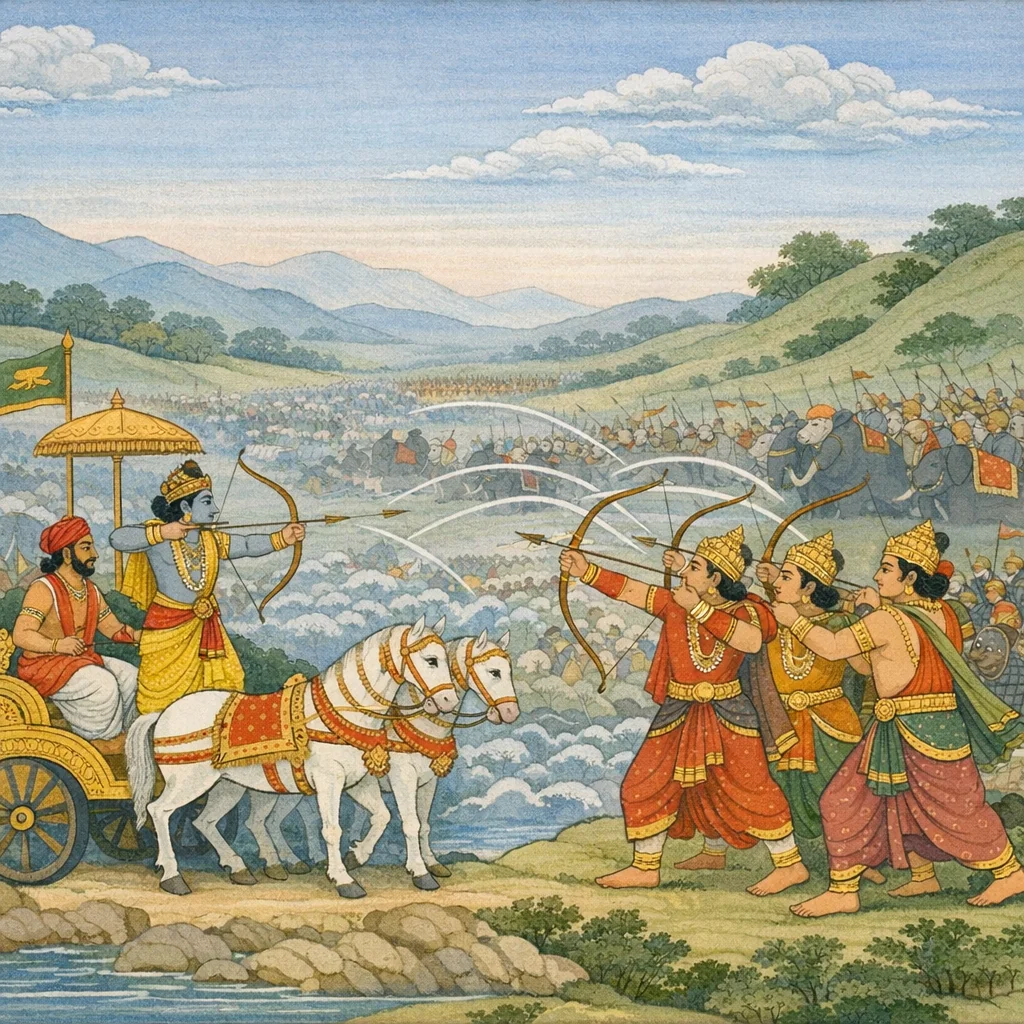
Adhyaya 122
अर्जुनस्य गुरुधर्मविलापः तथा शैनेयकर्णयोर्युद्धारम्भः | Arjuna’s Lament on Guru-Dharma and the Opening of the Sātyaki–Karṇa Duel
Upa-parva: Saindhava-vadha-anantara Saineya–Karṇa-saṃgama (Post–Jayadratha Episode: Sātyaki vs Karṇa)
Dhṛtarāṣṭra asks Sañjaya what the Kauravas did after Jayadratha’s death. Sañjaya reports that Kṛpa Śāradvata, driven by indignation, and Aśvatthāmā together shower Arjuna with missiles from their chariots, causing severe pressure. Arjuna counters their weapons with weapons, releasing moderated arrows while intending to neutralize both teacher-figures without excessive harm. Kṛpa is struck by Arjuna’s arrows, collapses into a faint on his chariot, and is withdrawn by his charioteer; Aśvatthāmā shifts position. Seeing Kṛpa incapacitated, Arjuna laments, recalling earlier counsel that one must not strike a guru; he frames his action as potentially merit-destroying and infernal in consequence, and offers reverential salutations even while in combat. The narrative then turns: Karṇa advances, apparently unable to tolerate recent losses, and Arjuna instructs Kṛṣṇa to drive toward Karṇa’s target (Sātyaki) to prevent Sātyaki from being pushed into a fatal trajectory. Kṛṣṇa acknowledges timing and notes strategic constraints regarding Arjuna’s direct engagement with Karṇa. Sañjaya describes Kṛṣṇa’s foreknowledge and logistical signaling to Dāruka; Sātyaki mounts Kṛṣṇa’s chariot and meets Karṇa. A high-profile duel unfolds with complex chariot maneuvers; Sātyaki breaks Karṇa’s defenses, kills his horses, and renders him chariotless, after which Karṇa mounts Duryodhana’s chariot. The chapter closes with additional attrition notes: many Kaurava sons are felled by Bhīma, while Sātyaki and Arjuna continue to cause extensive losses, framed as consequences of Dhṛtarāṣṭra’s earlier misgovernance.
Chapter Arc: संजय धृतराष्ट्र से कहते हैं—यवन और काम्बोजों को जीतकर, सिंह-सा सात्यकि विचित्र ध्वज-कवच धारण किए आपकी सेना में ऐसे घुसा जैसे व्याघ्र मृगों के झुंड में। → द्रोणाचार्य और कृतवर्मा की दुस्तर व्यूह-रेखा को लाँघकर सात्यकि ‘जल-संधि’ समान कठिन मोर्चे को पार करता है। रथ-हाथी-घोड़े और पदातियों की लहरों से भरे ‘सेना-महार्णव’ के किनारे (वेला) पर वह टिककर एक-एक कर महारथियों को चुनौती देता है; कौरव रथी चारों ओर से घेरकर बाण-वर्षा करते हैं। → दुःशासन, दुःसह, दुर्मुख और स्वयं दुर्योधन सहित अनेक कौरव-वीर एक साथ सात्यकि पर शर-प्रहार करते हैं; प्रत्युत्तर में सात्यकि तीक्ष्ण, सुवर्ण-पंख वाले बाणों की घनघोर वर्षा कर रथों की पंक्तियाँ तोड़ देता है और दुर्योधन-पक्ष में भगदड़ मचा देता है। → कौरव सेना के भागने पर सात्यकि पीछा कर उन्हें और अधिक क्षत-विक्षत करता है; दुर्योधन भाइयों सहित रणभूमि से हटने/पलायन की स्थिति में आ जाता है, और कौरव पंक्तियाँ बिखर जाती हैं। → सात्यकि की प्रचण्ड गति के सामने कौरवों का अगला प्रतिरोध कौन संभालेगा—और क्या द्रोण/कृतवर्मा पुनः उसे रोक पाएँगे?
Shlokas
Verse 1
&--“&<&< श्नु नासा त्सथिस विशत्यधिकशततमो< ध्याय: सात्यकिद्वारा दुर्योधनकी सेनाका संहार तथा भाइयोंसहित दुर्योधनका पलायन संजय उवाच जित्वा यवन काम्बोजान् युयुधानस्ततो<र्जुनम् जगाम तव सैन्यस्य मध्येन रथिनां वर:,संजय कहते हैं--राजन! रथियोंमें श्रेष्ठ युयुधान यवनों और काम्बोजोंको पराजित करके आपकी सेनाके बीचसे होते हुए अर्जुनकी ओर चले
Sañjaya said: O King, Yuyudhāna—foremost among chariot-warriors—having defeated the Yavanas and the Kāmbojas, then drove on toward Arjuna, passing through the midst of your army. The verse highlights steadfast loyalty to one’s chosen cause and the relentless momentum of battle, where valor and duty are measured by one’s ability to press through opposing forces without wavering.
Verse 2
चारुदंष्टो नरव्याप्रो विचित्रकवचध्वज: । मृगं व्याप्र इवाजिप्रंस्तव सैन्यम भीषयत्
Sañjaya said: With handsome fangs, a tiger among men, bearing a wondrous coat of mail and banner, he swiftly charged and terrified your army—like a tiger rushing upon a deer. The verse underscores how, in the moral chaos of war, fear spreads not merely by weapons but by the visible signs of prowess and resolve.
Verse 3
पुरुषसिंह सात्यकिके दाँत बड़े सुन्दर थे। उनके कवच और ध्वज भी विचित्र थे। वे मृगकी गन्ध लेते हुए व्याप्रके समान आपकी सेनाको भयभीत कर रहे थे ।। स रथेन चरन् मार्गान् धनुरभ्रामयद् भृशम् । रुक्मपृष्ठं महावेगं रुक्मचन्द्रकसंकुलम्,युयुधान रथके द्वारा विभिन्न मार्गोपर विचरते हुए अपने उस महावेगशाली धनुषको जोर-जोरसे घुमा रहे थे, जिसका पृष्ठभाग सोनेसे मढ़ा था और जो सुवर्णमय चन्द्राकार चिह्नोंसे व्याप्त था
Sañjaya said: Moving along the various paths in his chariot, Yuyudhāna (Sātyaki) powerfully whirled his bow. That bow, swift in its cast and formidable in force, had a back plated with gold and was marked all over with golden crescent emblems—an awe-inspiring display meant to shake the enemy’s resolve amid the righteous fury of battle.
Verse 4
रुक्माड्गदशिरस्त्राणो रुक्मवर्मसमावृत: । रुक्मध्वजथनु: शूरो मेरुशुज्मिवाबभौ,उनके भुजबंद और शिरस्त्राण सुवर्णके बने हुए थे। वे स्वर्णमय कवचसे आच्छादित थे। सोनेके ध्वज और धनुषसे सुशोभित शूरवीर सात्यकि मेरुपर्वतके शिखरकी भाँति शोभा पा रहे थे
Sañjaya said: The heroic Sātyaki, wearing golden armlets and a golden helmet, covered in golden armour, and adorned with a golden banner and bow, shone forth like the peak of Mount Meru. The verse heightens the moral atmosphere of the battle by portraying martial splendour as a sign of resolve and disciplined readiness, even amid the tragic necessity of war.
Verse 5
सभनुर्मण्डल: संख्ये तेजोभास्कररश्मिवान् । शरदीवोदित: सूर्यो नूसूर्यों विरराज ह,युद्धस्थलमें मण्डलाकार धनुष धारण किये अपने तेजस्वरूप सूर्यरश्मियोंसे प्रकाशित, मानव-सूर्य सात्यकि शरतकालमें उगे हुए सूर्यदेवके समान देदीप्यमान हो रहे थे
Sañjaya said: In the thick of battle, Sātyaki—like a “sun among men”—shone brilliantly, bearing a circular bow and blazing with radiance like the sun’s own rays, as if the autumn sun had newly risen.
Verse 6
वृषभस्कन्धविक्रान्तो वृषभाक्षो नरर्षभ: । तावकानां बभौ मध्ये गवां मध्ये यथा वृष:
Sañjaya said: With the power of a bull’s shoulders, bull-eyed, the best of men, he shone in the midst of your warriors—like a bull standing among a herd of cows.
Verse 7
उनके कंधे और चाल-ढाल वृषभके समान थे। नेत्र भी वृषभके ही तुल्य बड़े-बड़े थे। वे नरश्रेष्ठ सात्यकि आपके सैनिकोंके बीचमें उसी प्रकार सुशोभित होते थे, जैसे गौओंके झुंडमें साँड़की शोभा होती है ।। मत्तद्विरदसंकाशं मत्तद्विरदगामिनम् | प्रभिन्नमिव मातडूं यूथमध्ये व्यवस्थितम्
Sañjaya said: Sātyaki, the foremost of men, appeared amid your troops like a rutting elephant—massive in presence and moving with the gait of a maddened tusker—like a great elephant that has broken into the midst of a herd.
Verse 8
द्रोणानीकमतिक्रान्तं भोजानीकं च दुस्तरम्
Sañjaya said: Having already broken through Droṇa’s battle-array, they also crossed the formidable Bhoja contingent—an obstacle difficult to overcome in the press of war.
Verse 9
जलसंधार्णवं तीर्त्वा काम्बोजानां च वाहिनीम् । हार्दिक्यमकरान्मुक्त तीर्ण वै सैन्यसागरम्
Sañjaya said: Having crossed that ocean-like mass of waters and the Kāmboja host as well, and having escaped the “crocodiles” in the form of Hārdikya’s warriors, he indeed crossed the sea of armies.
Verse 10
परिवत्र॒ुः सुसंक्रुद्धास्त्वदीया: सात्यकिं रथा: । वे सात्यकि जब द्रोणाचार्य और कृतवर्माकी दुस्तर सेनाको लाँधचकर जलसंधरूपी सिन्धुको पार करके काम्बोजोंकी सेनाका संहारकर कृतवर्मारूपी ग्राहके चंगुलसे छूटकर आपकी सेनाके समुद्रसे पार हो गये, उस समय अत्यन्त क्रोधमें भरे हुए आपके रथियोंने उन्हें चारों ओरसे घेर लिया || ८-९ $ ।। दुर्योधनश्रित्रसेनो दःशासनविविंशती,पृष्ठतः सात्यकिं यान्तमन्वधावन्नमर्षिण: । दुर्योधन, चित्रसेन, दुःशासन, विविंशति, शकुनि, दुःसह, तरुण वीर दुर्धर्ष क्रथ तथा अन्य बहुत-से दुर्जय शूरवीर, अमर्षमें भरकर अस्त्र-शस्त्र लिये वहाँ आगे बढ़ते हुए सात्यकिके पीछे-पीछे दौड़े
Sañjaya said: Your chariot-warriors, inflamed with fierce anger, closed in on Sātyaki from every side. Having broken through formidable enemy formations and escaped peril, Sātyaki became the focus of a retaliatory encirclement—an image of war’s escalating cycle of wrath and counter-wrath, where prowess provokes pursuit and anger drives men beyond restraint.
Verse 11
शकुनिर्दु:सहश्वैव युवा दुर्धर्षण: क्रथ: । अन्ये च बहव: शूरा: शस्त्रवन्तो दुरासदा:
Sañjaya said: “Śakuni, and Duḥsaha as well; the young warrior Durdharṣaṇa; and Kratha—along with many other heroes—were armed and formidable, difficult for any opponent to assail.”
Verse 12
अथ शब्दो महानासीत् तव सैन्यस्य मारिष
Sañjaya said: Then, O venerable one, a great roar arose from your army—an ominous surge of sound marking the intensification of the battle-spirit and the collective agitation of the Kaurava host.
Verse 13
मारुतोद्धूतवेगस्य सागरस्येव पर्वणि । माननीय नरेश! पूर्णिमाके दिन वायुके झकोरोंसे वेगपूर्वक ऊपर उठनेवाले महासागरके समान आपकी सेनामें बड़े चोर-जोरसे गर्जन-तर्जनका शब्द होने लगा ।। तानभिद्रवत: सर्वान् समीक्ष्य शिनिपुड़व:
Sañjaya said: “O revered king! Just as the ocean, driven by gusting winds, heaves up with force at the time of the full moon, so in your army there arose a tremendous roar—shouts and threats swelling together like a storm-tossed sea. Seeing all of them rushing forward, the bull among the Śinis looked on.”
Verse 14
शनैर्याहीति यन्तारमब्रवीत् प्रहसन्निव | उन सबको आक्रमण करते देख शिनिप्रवर सात्यकिने अपने सारथिसे हँसते हुए-से कहा--'सूत! धीरे-धीरे चलो ।। १३ $ ।। इदमेतत् समुद्धूतं धार्तराष्ट्रस्य यदू बलम्,ला | वेलेव मकरालयम् । 'सूत! यह हाथी, घोड़े, रथ और पैदलोंसे भरी हुई जो दुर्योधनकी सेना युद्धके लिये उद्यत हो मेरी ही ओर तीव्र वेगसे चली आ रही है, इस सेना-समुद्रको मैं इस महान् समरांगणमें अपने रथकी घर्घराहटसे सम्पूर्ण दिशाओंको प्रतिध्वनित करता तथा पृथ्वी, अन्तरिक्ष एवं सागरोंको भी कँपाता हुआ आगे बढ़नेसे रोकूँगा। ठीक उसी तरह, जैसे तटकी भूमि पूर्णिमाको उद्वेलित होनेवाले महासागरको रोक देती है
Sañjaya said: Seeing them all rushing to attack, the foremost of the Śinis—Sātyaki—spoke to his charioteer with a smile, “Charioteer, drive slowly.” “This swelling force of Dhṛtarāṣṭra’s son, stirred up for battle and surging toward me—filled with elephants, horses, chariots, and foot-soldiers—I shall check it here on this great field, making the quarters resound with my chariot’s roar and shaking earth, sky, and even the seas—just as the shoreline holds back the ocean when it rises in full tide.”
Verse 15
मामेवाभिमुखं तूर्ण गजाश्वरथपत्तिमत् । नादयन् वै दिश: सर्वा रथघोषेण सारथे
Sañjaya said: “Rushing straight toward me with elephants, horses, chariots, and foot-soldiers, he made all the directions resound with the thunder of his chariot—O charioteer.”
Verse 16
पृथिवीं चान्तरिक्षं च कम्पयन् सागरानपि । एतद् बलार्णवं सूत वारयिष्ये महारणे
Sañjaya said: “Shaking the earth and the mid-air, and even setting the oceans in turmoil—O charioteer, in this great battle I shall hold back this ocean-like surge of force.”
Verse 17
पश्य मे सूत विक्रान्तमिन्द्रस्येव महामृधे
Sañjaya said: “O charioteer, behold my hero’s prowess in this great battle—like that of Indra himself.”
Verse 18
निहतानाहवे पश्य पदात्यश्चवरथद्विपान्
Sañjaya said: “Behold—slain in the thick of battle—foot-soldiers as well as the finest chariot-warriors and elephants.”
Verse 19
मच्छरैरग्निसंकाशैरविंद्धदेहानू सहस्रश: । “इस युद्धस्थलमें मेरे द्वारा मारे गये सहस्रों पैदलों, घुड़सवारों, रथियों और हाथीसवारोंको देखना, जिनके शरीर मेरे अग्निसदृश बाणोंद्वारा विदीर्ण हुए होंगे” ।। इत्येवं ब्रुवतस्तस्य सात्यकेरमितौजस:,अमित तेजस्वी सात्यकि जब इस प्रकार कह रहे थे, उसी समय युद्धके लिये उत्सुक हुए आपके सारे सैनिक शीघ्र ही उनके समीप आ पहुँचे। वे “दौड़ो, मारो, ठहरो, देखो-देखो” इत्यादि बातें बोल रहे थे
Sañjaya said: “With arrows blazing like fire, he pierced bodies by the thousand. ‘Look here on this battlefield at the thousands of foot-soldiers, horsemen, chariot-warriors, and elephant-riders slain by me—men whose bodies will be torn apart by my fire-like shafts.’ While the mighty Sātyaki was speaking in this manner, all your troops, eager for battle, quickly closed in upon him, shouting commands such as, ‘Run! Strike! Stand fast! Look—look!’”
Verse 20
समीपे सैनिकास्ते तु शीघ्रमीयुर्युयुत्सव: । जह्याद्रवस्व तिछेति पश्य पश्येति वादिन:,अमित तेजस्वी सात्यकि जब इस प्रकार कह रहे थे, उसी समय युद्धके लिये उत्सुक हुए आपके सारे सैनिक शीघ्र ही उनके समीप आ पहुँचे। वे “दौड़ो, मारो, ठहरो, देखो-देखो” इत्यादि बातें बोल रहे थे
Just then, as the mighty, radiant Sātyaki spoke in this way, all your soldiers—eager for battle—quickly rushed up to him. They were shouting, “Run! Strike! Halt! Look—look!” and the like.
Verse 21
तानेवं ब्रुवतो वीरान् सात्यकिर्निशितै: शरै: । जघान त्रिशतानश्चान् कुज्जरांश्व चतु:ःशतान्,(लघ्वस्त्रश्चनित्रयोधी च प्रहसन् शिनिपुड्भवः ।) शीघ्रतापूर्वक अस्त्र चलानेवाले एवं विचित्र युद्धकी कलामें निपुण शिनिप्रवर सात्यकिने हँसते हुए वहाँ उपर्युक्त बातें बोलनेवाले तीन सौ वीर घुड़सवारों तथा चार सौ हाथीसवारोंको अपने तीखे बाणोंसे मार गिराया
Sañjaya said: As those warriors spoke in that manner, Sātyaki struck them down with his keen arrows—three hundred horsemen and four hundred elephant-riders. Swift in the discharge of weapons and skilled in the subtle arts of battle, the foremost of the Śinis, smiling, felled those who were crying out such words.
Verse 22
स सम्प्रहारस्तुमुलस्तस्य तेषां च धन्विनाम् । देवासुररणप्रख्य: प्रावर्तत जनक्षय:,सात्यकि तथा आपकी सेनाके धनुर्धरोंका वह नरसंहारकारी युद्ध देवासुर-संग्रामके समान अत्यन्त भयंकर हो चला
Sañjaya said: The clash between him and those bowmen swelled into a tumultuous engagement. A slaughter of men began to unfold, dreadful as the war of the gods against the asuras.
Verse 23
मेघजालनिभ सैन्यं तव पुत्रस्य मारिष । प्रत्यगृह्नाच्छिने: पौत्र: शरैराशीविषोपमै:,माननीय नरेश! शिनिपौत्र सात्यकिने अपने विषधर सर्पके समान भयंकर बाणोंद्वारा मेघोंकी घटाके समान प्रतीत होनवाली आपके पुत्रकी सेनाका अकेले ही सामना किया
Sañjaya said: “O venerable King, the grandson of Śini—Sātyaki—single-handedly faced your son’s army, which looked like a mass of storm-clouds, and struck it with arrows dreadful as venomous serpents.”
Verse 24
प्रच्छाद्यमान: समरे शरजालै: स वीर्यवान् । असम्भ्रमन् महाराज तावकानवधीद् बहून्,महाराज! उस समरांगणमें पराक्रमी सात्यकि बाणोंके समूहसे आच्छादित हो गये थे, तो भी उन्होंने मनमें तनिक भी घबराहट नहीं आने दी और आपके बहुत-से सैनिकोंका संहार कर डाला
Sañjaya said: Though in that battle the valiant Sātyaki was being covered over by a net of arrows, he did not lose his composure, O King; unshaken in mind, he slew many of your soldiers.
Verse 25
आश्चर्य तत्र राजेन्द्र सुमहद् दृष्टवानहम् । न मोघ:ः सायकः: कश्चित् सात्यकेरभवत् प्रभो,शक्तिशाली राजेन्द्र! वहाँ सबसे महान् आश्वर्यकी बात मैंने यह देखी कि सात्यकिका कोई भी बाण व्यर्थ नहीं गया
Sañjaya said: “O best of kings, I witnessed there a truly great marvel: not a single arrow of Sātyaki went in vain, O lord. Each shot found its mark, revealing the disciplined mastery and unwavering resolve with which he fought amid the chaos of war.”
Verse 26
रथनागाश्वकलिल: पदात्यूमिसमाकुल: । शैनेयवेलामासाद्य स्थित: सैन्यमहार्णव:,रथ, हाथी और घोड़ोंसे भरी तथा पैदलरूपी लहरोंसे व्याप्त हुई आपकी सागर-सदृश सेना सात्यकिरूपी तटभूमिके समीप आकर अवरुद्ध हो गयी
Sañjaya said: Your ocean-like army—dense with chariots, elephants, and horses, and heaving with the wave-like masses of infantry—reached the shoreline that was Śaineya (Sātyaki) and there stood checked, its advance obstructed.
Verse 27
सम्भ्रान्तनरनागाश्चवमावर्तत मुहुर्मुहु: । तत् सैन्यमिषुभिस्तेन वध्यमानं समन्ततः,सात्यकिके बाणोंद्वारा सब ओरसे मारी जाती हुई आपकी सेनाके पैदल, हाथी और घोड़े सभी घबरा गये और बारंबार चक्कर काटने लगे
Sañjaya said: Struck with panic, the foot-soldiers and the elephants (and the rest of the host) wheeled about again and again. Hemmed in on every side and being cut down by his arrows, your army fell into confusion, circling helplessly under Sātyaki’s assault.
Verse 28
बश्राम तत्र तत्रैव गाव: शीतार्दिता इव । पदातिन रथं नागं सादिनं तुरगं तथा
Sañjaya said: There and there, they collapsed on the very spot—like cattle stricken by bitter cold: foot-soldiers, chariots, elephants, horsemen, and horses as well.
Verse 29
न तादूक् कदनं राजन् कृतवांस्तत्र फाल्गुन:
Sañjaya said: O King, there on that field Phālguna (Arjuna) wrought no such slaughter as that.
Verse 30
अत्यर्जुनं शिने: पौत्रो युध्यते पुरुषर्षभ:
Sañjaya said: Śini’s grandson—that bull among men—fought with Arjuna, meeting him face to face in battle, as the war’s fiercest champions drove their rivalry to its height.
Verse 31
वीतभीर्लाघवोपेत: कृतित्वं सम्प्रदर्शयन् । शिनिपौत्र पुरुषश्रेष्ठ सात्यकि निर्भय हो बड़ी फुर्तीसे अस्त्र चलाते और अपनी कुशलताका प्रदर्शन करते हुए अर्जुनसे भी अधिक पराक्रमपूर्वक युद्ध कर रहे थे || ३० $ई || ततो दुर्योधनो राजा सात्वतस्य त्रिभि: शरै:,तब राजा दुर्योधनने तीन बाणोंसे सात्यकिके सारथिको और चार पैने बाणोंद्वारा उनके चारों घोड़ोंको घायल कर दिया। तत्पश्चात् सात्यकिको भी पहले तीन बाणोंसे बींधकर फिर आठ बाणोंद्वारा गहरी चोट पहुँचायी
Sañjaya said: Fearless and endowed with swift agility, Sātyaki—the finest of men, grandson of Śini—moved without hesitation, displaying his mastery of arms. In that clash he fought with bold prowess, making his skill evident amid the press of battle.
Verse 32
विव्याध सूत॑ निशितैश्नतुर्भिश्चतुरों हयान् सात्यकिं च त्रिभिविद्ध्वा पुनरष्टाभिरेव च,तब राजा दुर्योधनने तीन बाणोंसे सात्यकिके सारथिको और चार पैने बाणोंद्वारा उनके चारों घोड़ोंको घायल कर दिया। तत्पश्चात् सात्यकिको भी पहले तीन बाणोंसे बींधकर फिर आठ बाणोंद्वारा गहरी चोट पहुँचायी
Sañjaya said: With four sharp arrows the king struck Sātyaki’s charioteer, and with four more he wounded the four horses. Then, piercing Sātyaki first with three arrows and again with eight, he inflicted deep wounds. Thus, in the fierce code of chariot-war, Duryodhana sought to disable both the vehicle and the warrior, pressing the battle without respite.
Verse 33
दुःशासन: षोडशभिर्विव्याध शिनिपुड्भवम् | शकुनि: पञ्चविंशत्या चित्रसेनश्व॒ पठचभि:,तदनन्तर दुःशासनने सोलह, शकुनिने पचीस और चित्रसेनने पाँच बाणोंद्वारा शिनिप्रवर सात्यकिको बींध डाला
Sanjaya said: Duhshasana pierced the foremost of the Shinis with sixteen arrows; Shakuni struck him with twenty-five, and Chitrasena with five. The scene underscores the ruthless coordination of the Kaurava side against a single eminent warrior, where prowess is met not only by valor but by concentrated, ethically fraught aggression on the battlefield.
Verse 34
दुःसह: पठचदशभिर्विव्याधोरसि सात्यकिम् | उत्स्मयन् वृष्णिशार्दटूलस्तथा बाणै: समाहतः
Sañjaya said: Duḥsaha pierced Sātyaki in the chest with fifteen arrows. Yet that tiger among the Vṛṣṇis, smiling, was likewise struck by volleys of shafts—showing the grim steadiness of warriors who, even while wounded, refuse to yield in the press of battle.
Verse 35
गाढविद्धानरीन् कृत्वा मार्गणै: सोडतितेजनै:
Sañjaya said: With arrows of unendurable, blazing force, he struck the foes so deeply that they were left grievously pierced—an image of the war’s ruthless momentum, where prowess is measured by the capacity to wound and overwhelm rather than by restraint.
Verse 36
शैनेय: श्येनवत् संख्ये व्यचरल्लघुविक्रम: । उस युद्धस्थलमें शीघ्रतापूर्वक पराक्रम करनेवाले शिनिवंशी सात्यकि अपने अत्यन्त तेज बाणोंद्वारा शत्रुओंको गहरी चोट पहुँचाकर बाजके समान सब ओर विचरने लगे ।। ३५ हे || सौबलस्य धनुश्कछित्त्वा हस्तावापं निकृत्य च
Sañjaya said: In the thick of battle, Śaineya (Sātyaki), swift in prowess, moved about like a hawk—striking the enemy with keen, blazing arrows and ranging rapidly across the field. The image underscores disciplined martial energy: speed and precision directed toward the immediate duty of combat rather than personal cruelty.
Verse 37
चित्रसेनं शतेनैव दशभिर्दु:सहं तथा
Sañjaya said: With a hundred (warriors) he struck down Citrasena, and likewise with ten he overcame Duḥsaha—marking the relentless, escalating tempo of the battle where prowess is measured in swift, decisive subjugation rather than restraint.
Verse 38
अथान्यद् धनुरादाय श्यालस्तव विशाम्पते,प्रजानाथ! तत्पश्चात् आपके सालेने दूसरा धनुष लेकर सात्यकिको पहले आठ बाण मारे। फिर पाँच बाणोंसे उन्हें घायल कर दिया। दुःशासनने दस और दुःसहने भी तीन बाण मारे
Sañjaya said: Then, O lord of the people, O ruler of men, your brother-in-law took up another bow. With it he first struck Sātyaki with eight arrows, and thereafter wounded him with five more. Duhśāsana shot ten arrows, and Duhsaha too discharged three. Thus, in the press of battle, the Kaurava warriors sought to overwhelm Sātyaki by coordinated volleys—an image of war’s harsh logic, where prowess is tested amid relentless, collective assault.
Verse 39
अष्टाभि: सात्यकिं विदृध्वा पुनर्विव्याध पञ्चभि: । दुःशासनश्व दशभिर्दु:सहश्न त्रिभि: शरै:ः,प्रजानाथ! तत्पश्चात् आपके सालेने दूसरा धनुष लेकर सात्यकिको पहले आठ बाण मारे। फिर पाँच बाणोंसे उन्हें घायल कर दिया। दुःशासनने दस और दुःसहने भी तीन बाण मारे
Sañjaya said: Having struck Sātyaki with eight arrows, he again pierced him with five more. Duḥśāsana then hit him with ten arrows, and Duḥsaha with three. Thus, O lord of men, Sātyaki was pressed hard in the battle—an image of how, in war, many assailants converge upon a single warrior, testing endurance and resolve amid the relentless momentum of adharma-driven violence.
Verse 40
दुर्मुखश्न॒ द्वादशभी राजन् विव्याध सात्यकिम् | दुर्योधनस्त्रिसप्तत्या विद्ूध्वा भारत माधवम्
Sañjaya said: O King, Durmukha pierced Sātyaki with twelve arrows; and Duryodhana, O descendant of Bharata, struck Mādhava with seventy-three shafts, driving the battle onward with relentless force and intent.
Verse 41
ततोअस्य निशितैर्बाणैस्त्रिभिविंव्याध सारथिम् । राजन! दुर्मुखने बारह बाणोंसे सात्यकिको क्षत-विक्षत कर दिया। भारत! इसके बाद दुर्योधनने तिहत्तर बाणोंसे युयुधानको घायल करके तीन पैने बाणोंद्वारा उनके सारथिको भी बींध डाला || ४० ई || तान् सर्वान् सहितान् शूरान् यतमानान् महारथान्
Sañjaya said: Thereafter, with three sharp arrows he pierced that warrior’s charioteer. In the harsh dharma of the battlefield, even a combatant’s support—such as the driver who keeps the chariot in motion—becomes a strategic target, as each side strives to cripple the other’s power to fight.
Verse 42
ततः स रथियनां श्रेष्ठस्तव पुत्रस्य सारथिम्
Sañjaya said: Then that foremost among chariot-warriors turned his attention to the charioteer of your son—marking a decisive shift in how the battle would unfold.
Verse 43
पतिते सारथौ तस्मिंस्तव पुत्ररथ: प्रभो
Sañjaya said: “O lord, when that charioteer had fallen, your son’s chariot stood in a moment of grave peril.” It shows how, in war, the fall of the one who guides and steadies can suddenly expose even a mighty warrior.
Verse 44
वातायमानैस्तैरश्वैरपानीयत संगरात् । प्रभो! उस सारथिके धराशायी होनेपर आपके पुत्रका रथ हवाके समान तीव्र वेगसे भागनेवाले घोड़ोंद्वारा युद्धस्थलसे दूर हटा दिया गया ।। ४३ $ ।। ततस्तव सुता राजन् सैनिकाश्न विशाम्पते
Sañjaya said: O lord, when that charioteer fell to the ground, your son’s chariot was swiftly drawn away from the battlefield by those horses, rushing with wind-like speed. Then, O king, your sons and the soldiers too, O ruler of men, responded as the battle’s momentum shifted.
Verse 45
राज्ञो रथमभिप्रेक्ष्य विद्रुता:शतशो5भवन् | राजन! प्रजानाथ! तदनन्तर आपके पुत्र और सैनिक राजा दुर्योधनके रथकी वैसी दशा देखकर सैकड़ोंकी संख्यामें भाग खड़े हुए || ४४ $ ।। विद्रुतं तत्र तत् सैन्यं दृष्टवा भारत सात्यकि:
Sañjaya said: Seeing the king’s chariot in that condition, hundreds fled in panic. O King, O lord of the people—after that, your sons and the soldiers, beholding King Duryodhana’s chariot brought to such a plight, broke and ran in great numbers. Seeing that army there in flight, Sātyaki …
Verse 46
विद्राव्य सर्वसैन्यानि तावकानि सहस्रश:
Sañjaya said: Having routed all your forces in every direction, they drove them back in their thousands.
Verse 47
प्रययौ सात्यकी राजन श्वेताश्वस्य रथं प्रति । राजन्! इस प्रकार आपके सहस्रों सैनिकोंको भगाकर सात्यकि श्वेतवाहन अर्जुनके रथकी ओर चल दिये ।। (तं प्रयान्तं महाबाहुं तावका:ः प्रेक्ष्य मारिष । दृष्टं चादृष्टवत्कृत्वा क्रियामन्यां प्रयोजयन् ।।) आर्य! महाबाहु सात्यकिको आगे जाते देखकर आपके सैनिक उस देखी हुई घटनाको भी अनदेखी करके दूसरे काममें लग गये। त॑ं शरानाददानं च रक्षमाणं च सारथिम् । आत्मानं पालयानं च तावका: समपूजयन्,सात्यकि बाणोंको ग्रहण करते हुए अपनी और सारथिकी भी रक्षा करते थे। उनके इस कार्यकी आपके सैनिकोंने भी भूरि-भूरि प्रशंसा की
Sañjaya said: O King, Sātyaki advanced toward the chariot of Arjuna of the white steeds. Seeing that mighty-armed warrior moving ahead, your men—O venerable one—treated even what they had plainly witnessed as though it were unseen, and turned themselves to other tasks. Yet they praised Sātyaki for his disciplined conduct: as he took up arrows, protected his charioteer, and safeguarded himself.
Verse 76
व्याप्रा इव जिघांसन्तस्त्वदीया: समुपाद्रवन् । मतवाले हाथीके समान पराक्रमी और मदोनन््मत्त गजराजके समान मन्दगतिसे चलनेवाले सात्यकि जब मदस्रावी मातंगके समान कौरव-सैनिकोंके मध्यभागमें खड़े हुए, उस समय आपके योद्धा उन्हें मार डालनेकी इच्छासे भूखे बाघोंके समान उनपर टूट पड़े
Sañjaya said: Your warriors rushed forward, intent on killing, like tigers. When Sātyaki stood firm amid the Kaurava ranks like a rutting elephant—mighty, slow-moving as a lordly bull-elephant—your fighters sprang upon him with the hunger to slay.
Verse 113
पृष्ठतः सात्यकिं यान्तमन्वधावन्नमर्षिण: । दुर्योधन, चित्रसेन, दुःशासन, विविंशति, शकुनि, दुःसह, तरुण वीर दुर्धर्ष क्रथ तथा अन्य बहुत-से दुर्जय शूरवीर, अमर्षमें भरकर अस्त्र-शस्त्र लिये वहाँ आगे बढ़ते हुए सात्यकिके पीछे-पीछे दौड़े
Sañjaya said: As Sātyaki moved on, the Kaurava warriors—burning with resentment—pursued him from behind. Duryodhana, Citrasena, Duḥśāsana, Viviṃśati, Śakuni, Duḥsaha, the young hero Durdharṣa, Kratha, and many other hard-to-conquer champions seized their weapons and, driven by wrath, surged forward and ran in Sātyaki’s wake.
Verse 119
इस प्रकार श्रीमह्ााभारत द्रोणपर्वके अन्तर्गत जयद्रथवधपर्वमें सात्यकिके कौरव-सेनामें प्रवेशके प्रसंगमें यवनोंकी पराजयविषयक एक सौ उन्नीसवाँ अध्याय पूरा हुआ
Sañjaya concludes: Thus ends the one hundred and nineteenth chapter of the Jayadratha-slaying section within the Droṇa Parva of the revered Śrī Mahābhārata, in the episode describing Sātyaki’s entry into the Kaurava host and the defeat of the Yavanas. The closing underscores that, amid the moral tumult of war, individual valor and steadfast strategy can overturn even formidable resistance.
Verse 120
इति श्रीमहा भारते द्रोणपर्वणि जयद्रथवधपर्वणि सात्यकिप्रवेशे दुर्योधनपलायने विंशत्यधिकशततमो<ध्याय:
Thus, in the revered Mahābhārata, within the Droṇa Parva—specifically in the Jayadratha-slaying section—ends the chapter describing Sātyaki’s entry into battle and Duryodhana’s retreat. This closing colophon places the episode within the war’s broader moral and strategic arc, marking the moment when valor and tactical pressure compel a key leader to withdraw.
Verse 166
ला | वेलेव मकरालयम् । 'सूत! यह हाथी, घोड़े, रथ और पैदलोंसे भरी हुई जो दुर्योधनकी सेना युद्धके लिये उद्यत हो मेरी ही ओर तीव्र वेगसे चली आ रही है, इस सेना-समुद्रको मैं इस महान् समरांगणमें अपने रथकी घर्घराहटसे सम्पूर्ण दिशाओंको प्रतिध्वनित करता तथा पृथ्वी, अन्तरिक्ष एवं सागरोंको भी कँपाता हुआ आगे बढ़नेसे रोकूँगा। ठीक उसी तरह, जैसे तटकी भूमि पूर्णिमाको उद्वेलित होनेवाले महासागरको रोक देती है
Sañjaya said: “O charioteer, look—Duryodhana’s army, packed with elephants, horses, chariots, and foot-soldiers, is rushing straight toward me at great speed, eager for battle. Here on this vast field of war, I shall halt that ocean-like host from advancing, making every direction resound with the thunder of my chariot and shaking earth, sky, and even the seas—just as the firm land of the shore holds back the mighty ocean when it swells at the full moon.”
Verse 176
एष सैन्यानि शत्रूणां विधमामि शितै: शरै: । 'सारथे! इस महायुद्धमें देवराज इन्द्रके समान मेरा पराक्रम तुम देखो। मैं अभी-अभी अपने पैने बाणोंसे शत्रुओंकी सेनाओंका संहार कर डालता हूँ
Sañjaya said: “I shall now shatter the enemy hosts with my keen arrows. O charioteer, behold in this great battle my prowess, like that of Indra, king of the gods. Even now I will destroy the armies of the foes with sharp shafts.”
Verse 283
अदिद्धं तत्र नाद्राक्षं युयुधानस्य सायकै: । सर्दीसे पीड़ित हुई गायोंके समान आपकी सारी सेना वहीं चक्कर लगा रही थी। मैंने वहाँ एक भी पैदल, रथी, हाथी तथा सवारसहित घोड़ेको ऐसा नहीं देखा, जो युयुधानके बाणोंसे विद्ध न हुआ हो
Sañjaya said: There I did not see a single warrior left unpierced by Yuyudhāna’s arrows. The entire host, struck and bewildered, kept wheeling about in confusion—like cattle afflicted by a painful ailment—showing how, in war, unchecked fury and fear can dissolve order and discernment.
Verse 293
यादृक् क्षयमनीकानामकरोत् सात्यकिर्नूप । राजन! नरेश्वर! सात्यकिने आपके सैनिकोंका जैसा संहार किया था, वैसा वहाँ अर्जुनने भी नहीं किया था
Sañjaya said: “O king, O lord of men, the destruction that Sātyaki wrought among the battle-formations was such that even Arjuna did not accomplish the like there. The slaughter Sātyaki inflicted upon your troops surpassed what was otherwise thought possible, even by the foremost archer.”
Verse 343
तानविध्यन्महाराज सवनिव त्रिभिस्त्रिभि: | इसके बाद दुःसहने सात्यकिकी छातीमें पंद्रह बाण मारे। महाराज! इस प्रकार उन बाणोंसे आहत होकर वृष्णिवंशके सिंह सात्यकिने मुसकराते हुए ही उन सबको ही तीन- तीन बाणोंसे घायल कर दिया
Sañjaya said: “O King, he struck them, like Savani (Indra) of old, with three arrows each. Then, after Duhsaha had pierced Sātyaki’s chest with fifteen shafts, the lion of the Vṛṣṇi line—Sātyaki—though wounded by those arrows, smiled and in return wounded them all again with three arrows apiece.”
Verse 363
दुर्योधन त्रिभिरबाणिरभ्यविध्यत् स्तनान्तरे । उन्होंने सुबलपुत्र शकुनिके धनुष और दस्ताने काटकर दुर्योधनकी छातीमें तीन बाण मारे
Sañjaya said: He struck Duryodhana with three arrows in the region between the breasts. He cut down the bow and the gauntlets of Śakuni, son of Subala, and then drove three arrows into Duryodhana’s chest.
Verse 413
पज्चभि: पज्चभिर्बाणै: पुनर्विव्याध सात्यकि: | तब सात्यकिने एक साथ विजयके लिये प्रयत्न करनेवाले उन समस्त शूरवीर महारथियोंको पुन: पाँच-पाँच बाणोंसे घायल कर दिया
Sañjaya said: With five arrows each, Sātyaki again pierced them. Then, those heroic great chariot-warriors who were striving together, as one, to overcome Sātyaki—he once more wounded them, striking each with five arrows.
Verse 426
आजघानाशु भल्लेन स हतो न्यपतद् भुवि । तत्पश्चात् रथियोंमें श्रेष्ठ सात्यकिने आपके पुत्रके सारथिके ऊपर शीघ्र ही एक भल्लका प्रहार किया। सारथि उसके द्वारा मारा जाकर पृथ्वीपर गिर पड़ा
Sañjaya said: Swiftly striking with a bhalla arrow, he slew him, and the man fell to the ground. Thereafter, Sātyaki—foremost among chariot-warriors—quickly delivered a bhalla-shot against the charioteer of your son. Struck down, the charioteer died and collapsed upon the earth.
Verse 456
अवाकिरच्छरैस्तीक्ष्ण रुक्मपुड्खै: शिलाशितै: । भारत! आपकी सेनाको भागती देख सात्यकिने सानपर चढ़ाकर तेज किये हुए सुवर्णमय पंखवाले तीखे बाणोंकी वर्षा आरम्भ कर दी
Sañjaya said: Seeing your army in flight, Sātyaki began a fierce shower of arrows—sharp, whetted on stone, and fitted with golden feathers—to check the rout and drive the battle onward. The scene shows how, in war, a commander’s resolve and skill can steady collapsing ranks, even as the violence of the means remains stark.
Verse 3736
दुःशासन तु विंशत्या विव्याध शिनिपुड्भव: । फिर शिनिवंशके प्रमुख वीरने चित्रसेनको सौ, दुःसहको दस और दुःशासनको बीस बाणोंसे घायल कर दिया
Sañjaya said: The hero born in the Śini line pierced Duḥśāsana with twenty arrows. Then that foremost warrior of the Śinis wounded Citraseṇa with a hundred, Duḥsaha with ten, and Duḥśāsana with twenty shafts. The scene underscores the battle’s relentless escalation, where prowess is measured in precise, overwhelming strikes, and the warriors’ choices remain bound to their loyalties under the moral weight of fratricidal war.
Frequently Asked Questions
Arjuna confronts the conflict between battlefield necessity and the prohibition against harming one’s ācārya: he neutralizes Kṛpa under pressure, then interprets the act through the lens of guru-obligation and karmic consequence.
Instruction (vidyā) creates enduring ethical debt; even justified action can require moral reckoning. The chapter models reflective accountability—evaluating conduct not only by outcome but by relational duty and intention.
No explicit phalaśruti appears; the meta-commentary is functional and ethical—Sañjaya frames events as consequence-laden history, culminating in an attribution of large-scale loss to earlier failures of counsel and governance.