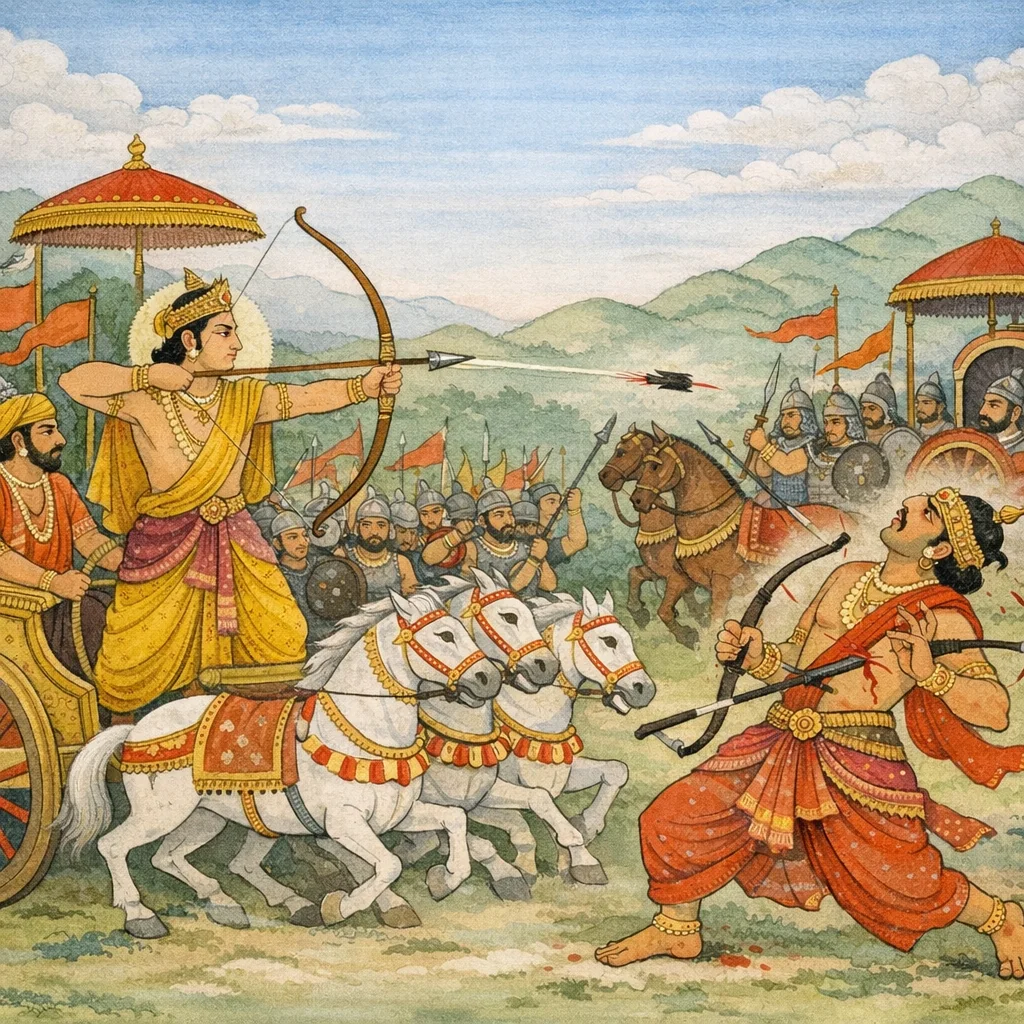
Adhyaya 87
Irāvān-nidhana-anantaraṃ Ghaṭotkaca-nādaḥ (After Irāvān’s fall: Ghaṭotkaca’s roar and the clash with Duryodhana)
Upa-parva: Ghaṭotkaca–Duryodhana Saṃgrāma (Elephant-corps engagement after Irāvān’s fall)
Dhṛtarāṣṭra asks Sañjaya what the Pāṇḍava champions did upon seeing Irāvān slain (1). Sañjaya reports that Ghaṭotkaca, observing Irāvān’s death, emits an immense roar; its sonic impact is described cosmically—earth, seas, mountains, forests, directions, and sky seem to tremble (2–3). The Kaurava host experiences physiological fear responses (rigidity, trembling, sweating) and a collapse of resolve, clustering defensively (4–5). Ghaṭotkaca advances in a terrifying form, bearing a flaming spear and accompanied by rākṣasa elites with varied weapons, likened to eschatological forces (6–7). Seeing him, much of the opposing force turns away in fear (8). Duryodhana advances with a great bow, lion-like in sound, and is supported by the king of Vanga with ten thousand elephants (9–10). Ghaṭotkaca, angered at the elephant-screened advance, and Duryodhana’s troops enter a tumultuous engagement (11–12). Rākṣasas charge the elephant corps like storm clouds, striking elephant-warriors with arrows, spears, and heavy implements; elephants are depicted bleeding and breaking under assault (13–16). As the elephant fighters diminish and scatter, Duryodhana renews his attack, releasing sharp arrows and killing prominent rākṣasas; he fells named rākṣasa leaders and pours a difficult-to-endure arrow-shower into the night-stalker forces (17–21). Witnessing Duryodhana’s effectiveness, Ghaṭotkaca’s anger intensifies; he draws his bow, rushes Duryodhana, and delivers an accusatory speech listing prior wrongs—exile, deceit in dice, Draupadī’s humiliation, and abuse by Jayadratha—declaring he will end Duryodhana if he does not abandon the field (22–28). He then bares fangs, licks his lips, and inundates Duryodhana with a massive arrow-rain, compared to monsoon clouds drenching a mountain (29–30).
Chapter Arc: सप्तम युद्ध-दिवस की धूल और रण-नाद के बीच धर्मराज युधिष्ठिर स्वयं रथ बढ़ाकर श्रुतायु पर टूट पड़ते हैं—राजा का यह प्रत्यक्ष आक्रमण संकेत देता है कि आज धैर्य नहीं, निर्णायक प्रहार का दिन है। → श्रुतायु तीखे बाणों से युधिष्ठिर को रोकने का यत्न करता है; प्रत्युत्तर में युधिष्ठिर उसके प्रेषित शरों को साधकर लौटा देते हैं। इसी उथल-पुथल में कृपाचार्य भी धनुष त्यागकर तलवार लेकर वेग से धावा बोलते हैं; परिश्रम और घावों से योद्धाओं पर मूर्च्छा का साया पड़ता है, और रथ-रथ की टक्करें रक्त-धारा बनाती जाती हैं। → धनुष कट जाने पर भी युधिष्ठिर अवसर नहीं छोड़ते—वे सबके देखते श्रुतायु के वक्ष में नाराच उतार देते हैं, और रणभूमि में उसका तेज टूटता है; उसी क्षण युद्ध ‘शोणितोदक’—रक्त को जल मानो—ऐसा विकराल रूप ले लेता है। → कृपाचार्य की स्थिति को शकुनि शीघ्र रथ पर चढ़ाकर संभालता है; दोनों पक्ष अपने-अपने प्रमुख रथियों को समेटकर पंक्तियाँ फिर बाँधते हैं। अध्याय का अंत व्यापक संग्राम के फैलाव और भीष्म के दुर्जेय केंद्र के संकेत के साथ होता है—मानो यह सब किसी बड़े टकराव की भूमिका हो। → अर्जुन (श्वेतवाहन) वासुदेव से कुछ कहने को उद्यत होता है—भीष्म के चारों ओर करोड़ों रथियों की भीड़ के बीच अगला निर्णायक प्रसंग उसी संवाद/रण-योजना की ओर मुड़ता है।
Shlokas
Verse 1
[दाक्षिणात्य अधिक पाठका १६ “लोक मिलाकर कुल ५८ $ “लोक हैं।] #-ि>ोी >> श््जु हम की चतुरशीतितमो< ध्याय: युधिष्ठिरसे राजा क मूच्छित होना, होना, युद्धमें चेकितान और कृपाचार्यका होना, भूरिश्रवासे धृष्टकेतुका और अभिमन्युसे आदिका पराजित होना एवं सुशर्मा आदिसे अर्जुनका युद्धारम्भ संजय उवाच ततो युधिष्ठिरो राजा मध्यं प्राप्ते दिवाकरे । श्रुतायुषमभिप्रेक्ष्य प्रेषयामास वाजिन:,संजय कहते हैं--महाराज! जब सूर्यदेव दिनके मध्यभागमें आ गये, तब राजा युधिष्ठिरने श्रुतायुको देखकर उसकी ओर अपने घोड़ोंको बढ़ाया
Sañjaya said: When the sun had reached the middle of the day, King Yudhiṣṭhira, fixing his gaze upon Śrutāyus, urged his cavalry forward toward him. In the thick of battle, the righteous king does not withdraw from responsibility; he deliberately engages a specific opponent as the day advances and the struggle intensifies.
Verse 2
अभ्यधावत् ततो राजा श्रुतायुषमरिंदमम् । विनिघ्नन् सायकैस्ती&#णैर्नवभिरनतपर्वभि:,उस समय झुकी हुई गाँठवाले नौ तीखे सायकोंद्वारा शत्रुदमन श्रुतायुको घायल करते हुए राजा युधिष्ठिरने उसपर धावा किया
Sañjaya said: Then King Yudhiṣṭhira charged at Śrutāyus, the subduer of foes, striking him with nine sharp arrows whose joints were bent downward, wounding him in the press of battle. The scene shows the king—though devoted to righteousness—compelled by the demands of war to meet aggression with force, acting within the harsh duties of kṣatriya-dharma.
Verse 3
स संवार्य रणे राजा प्रेषितान् धर्मसूनुना । शरान् सप्त महेष्वास: कौन्तेयाय समार्पयत्,तब महाथनुर्धर राजा श्रुतायुने युद्धमें धर्मपुत्र युधिष्ठिरके चलाये हुए बाणोंका निवारण करके उन कुन्तीकुमारको सात बाण मारे
Sañjaya said: In the thick of battle, the king—an eminent archer—checked the arrows that had been shot by Dharma’s son (Yudhiṣṭhira). Having thus warded them off, he returned the challenge by delivering seven arrows upon the son of Kuntī. The scene underscores the disciplined reciprocity of kṣatriya combat: restraint in defense followed by measured retaliation, all within the accepted code of war.
Verse 4
ते तस्य कवचं भित्त्वा पपु: शोणितमाहवे । असूनिव विचिन्वन्तो देहे तस्य महात्मन:,संग्राममें वे बाण महात्मा युधिष्ठिरके शरीरमें उनके प्राणोंको ढूँढ़ते हुए-से कवच छेदकर घुस गये और उनका रक्त पीने लगे
Sañjaya said: In the thick of battle, the arrows pierced through his armor and drank his blood, as though searching within the body of that great-souled warrior for his very life-breath. The line underscores the merciless intensity of war, where even a noble person’s body becomes the target of relentless violence, testing the limits of endurance and righteousness on the battlefield.
Verse 5
पाण्डवस्तु भृशं क्रुद्धो विद्धस्तेन महात्मना । रणे वराहकर्णेन राजानं हृद्यविध्यत,महामना श्रुतायुके बाणोंसे घायल होनेपर पाण्डुनन्दन युधिष्छिर अत्यन्त कुपित हो उठे और उन्होंने रणक्षेत्रमें वराहकर्ण नामक एक बाण चलाकर राजा श्रुतायुकी छातीमें चोट पहुँचायी
But the son of Pāṇḍu, Yudhiṣṭhira, sorely wounded by that great-souled warrior, was seized by fierce wrath. In the thick of battle he loosed an arrow called Varāhakārṇa and struck King Śrutāyu in the chest.
Verse 6
अथापरेण भल््लेन केतुं तस्य महात्मन: । रथश्रेष्ठो रथात् तूर्ण भूमौ पार्थो न््यपातयत्,तत्पश्चात् रथियोंमें श्रेष्ठ कुन्तीपुत्र युधिष्ठिने भल्ल नामक दूसरे बाणसे महामना श्रुतायुके ध्वजको काटकर तुरंत ही रथसे पृथ्वीपर गिरा दिया
Then, with another broad-headed arrow, Pārtha—the foremost of chariot-warriors—severed the banner of that great-souled fighter and swiftly brought it down from the chariot to the ground.
Verse 7
केतुं विपतितं दृष्टवा श्रुतायु: स तु पार्थिव: । पाण्डवं विशिखैस्तीक्ष्ण राजन् विव्याध सप्तभि:,राजन! ध्वजको गिरा हुआ देख राजा श्रुतायुने अपने सात तीखे बाणोंद्वारा पाण्डुनन्दन युधिष्ठिरको घायल कर दिया
O King, seeing his banner fallen, King Śrutāyu pierced the Pāṇḍava (Yudhiṣṭhira) with seven keen arrows.
Verse 8
ततः क्रोधात् प्रजज्वाल धर्मपुत्रो युधिष्ठिर: यथा युगान्ते भूतानि दिधक्षुरिव पावक:,यह देख धर्मपुत्र युधिष्ठिर प्रलयकालमें सम्पूर्ण भूतोंको जला डालनेकी इच्छावाले अग्निदेवके समान क्रोधसे प्रज्वयलित हो उठे
Then, in wrath, Dharmaputra Yudhiṣṭhira blazed forth like the fire at the end of an age, as though intent on burning up all beings.
Verse 9
क्रुद्धं तु पाण्डवं दृष्टवा देवगन्धर्वराक्षसा: । प्रविव्यथुर्महाराज व्याकुलं चाप्यभूज्जगत्,महाराज! पाण्डुपुत्र युधिष्ठिरको कुपित देख देवता, गन्धर्व और राक्षस व्यथित हो उठे तथा सारा जगत् भी भयसे व्याकुल हो गया
O great king, seeing the Pāṇḍava Yudhiṣṭhira inflamed with anger, the gods, Gandharvas, and Rākṣasas trembled in dread; indeed, the whole world, too, was thrown into fearful agitation.
Verse 10
सर्वेषां चैव भूतानामिदमासीन्मनोगतम् । त्रीललोकानद्य संक्रुद्धो नृपो5यं धक्ष्यतीति वै,उस समय समस्त प्राणियोंके मनमें यह विचार उठा कि आज निश्चय ही ये राजा युधिष्ठिर कुपित होकर तीनों लोकोंको भस्म कर डालेंगे
Sañjaya said: In the minds of all beings this thought arose—“Today, surely, this king, inflamed with anger, will burn up the three worlds.”
Verse 11
ऋषयश्चैव देवाश्न चक्र: स्वस्त्ययनं महत् । लोकानां नृप शान्त्यर्थ क्रोधिते पाण्डवे तदा,नरेश्वर! पाण्डुपुत्र युधिष्ठिरके कुपित होनेपर उस समय सम्पूर्ण लोकोंकी शान्तिके लिये देवता तथा ऋषिलोग श्रेष्ठ स्वस्तिवाचन करने लगे
Sañjaya said: When the Pāṇḍava was angered at that time, the ṛṣis and the gods performed a great rite of auspicious benediction, seeking the peace of all the worlds, O king.
Verse 12
स च क्रोधसमाविष्ट: सृक्किणी परिसंलिहन् । दधारात्मवपुर्घोरं युगान्तादित्यसंनिभम्,उन्होंने क्रोधसे व्याप्त हो मुखके दोनों कोनोंको चाटते हुए अपने शरीरको प्रलयकालके सूर्यके समान अत्यन्त भयंकर बना लिया
Sañjaya said: Overwhelmed by wrath, licking the corners of his mouth, he assumed a terrifying form—his very body blazing like the sun at the end of an age.
Verse 13
ततः सैन्यानि सर्वाणि तावकानि विशाम्पते । निराशान्यभवंस्तत्र जीवितं प्रति भारत,प्रजानाथ! भरतनन्दन! उस समय आपकी सारी सेनाएँ वहाँ अपने जीवनसे निराश हो गयीं
Sañjaya said: Then, O lord of the people, all your forces there—those belonging to your side—lost hope regarding their very lives, O Bhārata.
Verse 14
स तु धैर्येण तं कोपं संनिवार्य महायशा: । श्रुतायुष: प्रचिच्छेद मुष्टिदेशे महाधनु:,परंतु महायशस्वी युधिष्ठिरने धैर्यपूर्वक अपने क्रोधको दबा दिया और श्रुतायुके विशाल धनुषको, जहाँ उसे मुद्ठीसे पकड़ा जाता है, उसी जगहसे काट दिया
But the illustrious one, mastering that surge of anger through steadfast self-control, cut Śrutāyus’s great bow at the very grip—where the hand holds it.
Verse 15
अथैनं छिन्नथन्वानं नाराचेन स्तनान्तरे । निर्बिभेद रणे राजा सर्वसैन्यस्य पश्यत:,राजन! धनुष कट जानेपर महाबली राजा युधिष्ठिरने श्रुतायुकी छातीमें नाराचसे प्रहार किया। फिर उन्होंने समस्त सेनाओंके देखते-देखते रणक्षेत्रमें महामना श्रुतायुके घोड़ोंको तुरंत मार डाला और उसके सारथिको भी शीघ्र ही मौतके मुखमें डाल दिया
Sañjaya said: Then the king, before the eyes of the entire army, pierced him—his bow already cut—right in the chest with a nārāca arrow on the battlefield.
Verse 16
सत्वरं च रणे राजंस्तस्य वाहान् महात्मन: । निजघान शरै:ः क्षिप्रं सूतं च सुमहाबल:,राजन! धनुष कट जानेपर महाबली राजा युधिष्ठिरने श्रुतायुकी छातीमें नाराचसे प्रहार किया। फिर उन्होंने समस्त सेनाओंके देखते-देखते रणक्षेत्रमें महामना श्रुतायुके घोड़ोंको तुरंत मार डाला और उसके सारथिको भी शीघ्र ही मौतके मुखमें डाल दिया
Sañjaya said: “O King, in the thick of battle, the exceedingly mighty warrior swiftly struck down with arrows the horses of that high-souled hero, and quickly slew his charioteer as well.”
Verse 17
हताश्चं तु रथं त्यक्त्वा दृष्टवा राज्ञोडस्य पौरुषम् विप्रदुद्राव वेगेन श्रुतायु: समरे तदा,रथके घोड़े मारे गये, यह देखकर तथा युद्धमें राजा युधिष्ठिरके पुरुषार्थका भी अवलोकन करके श्रुतायु उस समय बड़े वेगसे रथ छोड़कर भाग गया
Sañjaya said: When his horses had been slain, Śrutāyu abandoned his chariot; and, seeing the valor of King Yudhiṣṭhira in the battle, he fled at that time with great speed.
Verse 18
तस्मिज्जिते महेष्वासे धर्मपुत्रेण संयुगे । दुर्योधनबलं राजन् सर्वमासीत् पराड्मुखम्,राजन! संग्राममें धर्मपुत्र युधिष्ठिरद्वारा महाधनुर्धर श्रुतायुके पराजित होनेपर दुर्योधनकी सारी सेना पीठ दिखाकर भागने लगी
Sañjaya said: When that great archer was defeated in battle by Dharmaputra (Yudhiṣṭhira), O King, the entire force of Duryodhana turned its back and fled.
Verse 19
एतत् कृत्वा महाराज धर्मपुत्रो युधिष्ठिर: । व्यात्ताननो यथा कालस्तव सैन्यं जघान ह,महाराज! ऐसा पराक्रम करके धर्मपुत्र युधिष्ठिर मुँह फैलाये कालके समान आपकी सेनाका संहार करने लगे
Sañjaya said: “Having done this, O King, Dharmaputra Yudhiṣṭhira began to strike down your army—like Time itself, with gaping jaws.”
Verse 20
चेकितानस्तु वार्ष्णेयो गौतमं रथिनां वरम् | प्रेक्षतां सर्वसैन्यानां छादयामास सायकै:,उधर वृष्णिवंशी चेकितानने रथियोंमें श्रेष्ठ कृपाचार्यको सब सेनाओंके देखते-देखते अपने सायकोंसे आच्छादित कर दिया
Sañjaya said: Then Cekitāna of the Vṛṣṇi line, before the eyes of all the armies, covered Gautama—Kṛpācārya, foremost among chariot-warriors—with a shower of arrows. Thus does war’s relentless code make even revered elders and teachers a target when they stand as combatants on the field.
Verse 21
संनिवार्य शरांस्तांस्तु कृप: शारद्वतो युधि । चेकितानं रणे यत्तं राजन् विव्याध पत्रिभि:,राजन! शरद्वानके पुत्र कृपाचार्यने युद्धमें उन सब बाणोंको काटकर सावधानीके साथ युद्ध करनेवाले चेकितानको पंखवाले बाणोंसे बींध डाला
Sañjaya said: Having checked and cut down those arrows in the thick of battle, Kṛpa—son of Śaradvat—then, O King, pierced Cekitāna, who fought with vigilant resolve, with feathered shafts. Thus is war’s harsh discipline revealed: skill and composure decide, even as valor meets its peril.
Verse 22
अथापरेण भल्ल्लेन धनुश्चिच्छेद मारिष । सारथिं चास्य समरे क्षिप्रहस्तो न््यपातयत्,आर्य! फिर दूसरे भललसे उसका धनुष काट दिया और अपने हाथोंकी फुर्ती दिखाते हुए समरमें उसके सारथिको भी मार गिराया
Sañjaya said: Then, with another sharp arrow, he cut the opponent’s bow. And, swift of hand in the thick of battle, he struck down that warrior’s charioteer as well—displaying decisive martial skill amid the grim duties of war.
Verse 23
अश्वांश्वास्यावधीद् राजन्नुभौ तौ पार्ष्णिसारथी । सो<वसप्लुत्य रथात् तूर्ण गदां जग्राह सात्वत:,राजन! तदनन्तर चेकितानके चारों घोड़ों और दोनों पृष्ठरक्षकोंको भी कृपाचार्यने मार डाला। तब सात्वतवंशी चेकितानने रथसे कूदकर तुरंत ही गदा हाथमें ले ली
Sañjaya said: O King, Kṛpācārya slew the horses and the horse-keepers, and also both the rear-guards. Then Cekitāna of the Sātvata line leapt down from his chariot and swiftly seized his mace—choosing to continue the fight on foot despite the sudden loss of his chariot’s support.
Verse 24
स तया वीरघातिन्या गदया गदिनां वर: । गौतमस्य हयान् हत्वा सारथिं च न्यपातयत्,गदाधारियोंमें श्रेष्ठ चेकितानने उस वीरघातिनी गदासे कृपाचार्यके घोड़ोंको मारकर उनके सारथिको भी धराशायी कर दिया
Sañjaya said: With that hero-slaying mace, Cekitāna—foremost among mace-bearers—killed the horses of Gautama (Kṛpa) and struck down his charioteer as well. The episode lays bare the brutal efficiency of battlefield tactics: by crippling mobility through horse and driver, a contest may be decided, even as it sharpens the moral tension between martial necessity and war’s harsh cost.
Verse 25
भूमिष्ठो गौतमस्तस्य शरांश्षिक्षेप षोडश । शरास्ते सात्वतं भित्त्वा प्राविशन् धरणीतलम्,तब कृपाचार्यने भूमिपर ही खड़े होकर चेकितानको सोलह बाण मारे। वे बाण चेकितानको छेदकर धरतीमें समा गये
Sañjaya said: Standing firm upon the ground, Gautama (Kṛpācārya) discharged sixteen arrows at him. Those shafts, piercing the Sātvata warrior, sank into the very surface of the earth—showing the relentless precision of battle where skill and resolve, rather than mercy, govern the moment.
Verse 26
चेकितानस्ततः क्रुद्धः पुनश्चिक्षेप तां गदाम् । गौतमस्य वधाकाड़ूक्षी वृत्रस्येव पुरंदर:,तब क्रोधमें भरे हुए चेकितानने कृपाचार्यके वधकी इच्छासे उनपर पुनः वैसे ही गदाका प्रहार किया, जैसे इन्द्र वृत्रासुरपर प्रहार करते हैं
Sañjaya said: Then Cekitāna, inflamed with anger and intent on killing Gautama (Kṛpācārya), once again hurled that mace at him—just as Purandara (Indra) strikes at Vṛtra. The verse frames Cekitāna’s act as a fierce, single-minded attempt to slay a revered warrior-teacher, intensifying the moral tension of battlefield duty against the gravity of targeting an elder and preceptor.
Verse 27
तामापतन्ती विमलामश्मगर्भा महागदाम् | शरैरनेकसाहसैर्वारयामास गौतम:,उस निर्मल एवं लोहेकी बनी हुई विशाल गदाको अपने ऊपर आती देख कृपाचार्यने अनेक सहस्र बाणोंद्वारा दूर गिरा दिया
Sañjaya said: Seeing that great mace—bright and hard as stone—hurtling toward him, Gautama (Kṛpācārya) checked it and drove it back by releasing many thousands of arrows. The scene underscores the grim discipline of war: even a teacher-warrior must meet lethal force with measured skill, restraining danger without losing composure amid chaos.
Verse 28
चेकितानस्तत: खडूगं क्रोधादुद्धृत्य भारत । लाघवं परमास्थाय गौतम॑ं समुपाद्रवत्,भारत! तब चेकितानने क्रोधपूर्वक तलवार खींच ली और बड़ी फुर्तीके साथ कृपाचार्यपर धावा किया
Sañjaya said: Then Cekitāna, seized by anger, drew his sword; and, relying on utmost swiftness, he rushed straight at Gautama (Kṛpācārya). The verse highlights how wrath can propel a warrior into sudden, decisive violence on the battlefield, where speed and impulse often override deliberation.
Verse 29
गौतमो<पि धनुस्त्यक्त्वा प्रगृह्मासिं सुसंयत: । वेगेन महता राजंश्लेकितानमुपाद्रवत्,राजन्! यह देख कृपाचार्यने भी धनुष फेंककर तलवार हाथमें ले ली और पूरी सावधानीके साथ वे बड़े वेगसे चेकितानकी ओर दौड़े
Sañjaya said: “O King, Gautama (Kṛpācārya) too, casting aside his bow, seized his sword and, with disciplined caution, rushed at Ślekita with great speed.”
Verse 30
तावुभौ बलसम्पन्नौ निस्त्रिंशवरधारिणौ । निस्त्रिंशाभ्यां सुतीक्ष्णा भ्यामन्योन्यं संततक्षतु:,वे दोनों ही बलवान् थे। दोनोंने ही उत्तम खड़ग धारण कर रखे थे। अतः अपनी उन अत्यन्त तीखी तलवारोंसे वे एक-दूसरेको काटने लगे
Sañjaya said: Both were endowed with great strength, each bearing an excellent sword. With those exceedingly sharp blades, they repeatedly struck and cut at one another without pause.
Verse 31
निस्त्रिंशवेगाभिहतौ ततस्तौ पुरुषर्षभौ | धरणीं समनुप्राप्ती सर्वभूतनिषेविताम्,तलवारकी गहरी चोटसे घायल होकर वे दोनों पुरुषश्रेष्ठ सम्पूर्ण भूतोंकी निवासभूत पृथ्वीपर गिर पड़े
Sañjaya said: Then those two bull-like heroes, struck by the swift force of the sword, fell upon the earth—the common refuge and dwelling-place of all beings.
Verse 32
मूर्छयाभिपरीताज्री व्यायामेन तु मोहितौ । ततो<भ्यधावद् वेगेन करकर्ष: सुहृत्तया,उनके सारे अंगोंमें मूर्च्छा व्याप्त हो रही थी। दोनों ही अधिक परिश्रमके कारण अचेत हो गये थे। उस समय युद्धमें उन््मत्त होकर लड़नेवाला करकर्ष चेकितानको वैसी अवस्थामें पड़ा देख सौहार्दके नाते बड़े वेगसे दौड़ा और सम्पूर्ण सेनाके देखते-देखते उसने उन्हें अपने रथपर चढ़ा लिया
Sañjaya said: Overcome by faintness, their limbs were seized by swoon; and, exhausted by excessive exertion, both became insensible. Then Karakarṣa, fighting in a frenzy of battle, saw Cekitāna lying in that condition and—out of comradeship and goodwill—ran swiftly toward him; and before the eyes of the entire army, he lifted him up and placed him upon his own chariot.
Verse 33
चेकितानं तथाभूतं दृष्टवा समरदुर्मद: । रथमारोपयच्चैनं सर्वसैन्यस्य पश्यत:,उनके सारे अंगोंमें मूर्च्छा व्याप्त हो रही थी। दोनों ही अधिक परिश्रमके कारण अचेत हो गये थे। उस समय युद्धमें उन््मत्त होकर लड़नेवाला करकर्ष चेकितानको वैसी अवस्थामें पड़ा देख सौहार्दके नाते बड़े वेगसे दौड़ा और सम्पूर्ण सेनाके देखते-देखते उसने उन्हें अपने रथपर चढ़ा लिया
Sañjaya said: Seeing Cekitāna lying in that condition, the warrior—maddened by the fury of battle—lifted him onto his chariot, in full view of the entire army.
Verse 34
तथैव शकुनि: शूर: श्यालस्तव विशाम्पते । आरोपयद् रथं तूर्ण गौतमं रथिनां वरम्,प्रजानाथ! इसी प्रकार आपके साले शूरवीर शकुनिने रथियोंमें श्रेष्ठ कृपाचार्यको शीघ्र ही अपने रथपर बैठा लिया
Sañjaya said: “Just so, your valiant brother-in-law Śakuni, O lord of the people, swiftly helped Gautama—foremost among chariot-warriors—mount his chariot.”
Verse 35
सौमदत्तिं तथा क्रुद्धो धृष्टकेतुर्महाबल: । नवत्या सायकै: क्षिप्रं राजन् विव्याध वक्षसि,राजन्! दूसरी ओर महाबली धृष्टकेतुने क्रोधमें भरकर नब्बे बाणोंसे शीघ्रतापूर्वक भूरिश्रवाकी छातीमें चोट पहुँचायी
Sañjaya said: Then the mighty Dhṛṣṭaketu, inflamed with anger, swiftly pierced Saumadatti (Bhūriśravas) in the chest with ninety arrows, O King.
Verse 36
सौमदत्तिरुरःस्थैस्तैर्भूशं बाणैरशो भत । मध्यन्दिने महाराज रश्मिभिस्तपनो यथा,महाराज! छातीमें धँसे हुए उन बाणोंसे भूरिश्रवा उसी प्रकार शोभा पाने लगा, जैसे दोपहरके समय सूर्य अपनी किरणोंद्वारा अधिक प्रकाशित होता है
Sañjaya said: O King, Saumadatti (Bhūriśravas), with those arrows lodged in his chest, appeared adorned—just as the sun at midday shines all the more brilliantly with its rays.
Verse 37
भूरिश्रवास्तु समरे धृष्टकेतुं महारथम् । हतसूतहयं चक्रे विरथं सायकोत्तमै:,तब भूरिश्रवाने समरभूमिमें उत्तम सायकोंद्वारा महारथी धृष्टकेतुके घोड़ों और सारथिको मारकर उन्हें रथहीन कर दिया
Sañjaya said: In the thick of battle, Bhūriśravā struck down Dhṛṣṭaketu’s charioteer and horses with superb arrows, thereby rendering that great chariot-warrior chariotless.
Verse 38
विरथं तं समालोक्य हताश्वं हतसारथिम् । महता शरवर्षेण च्छादयामास संयुगे,भूरिश्रवाने धृष्टकेतुको घोड़े और सारथिके मारे जानेसे रथहीन हुआ देख युद्धस्थलमें बाणोंकी बड़ी भारी वर्षा करके ढक दिया
Sañjaya said: Seeing him left without a chariot—his horses slain and his charioteer killed—Bhūriśravas, in the thick of battle, covered Dhṛṣṭaketu with a mighty shower of arrows.
Verse 39
सतुतं रथमुत्सृज्य धृष्टकेतुर्महामना: । आरुरोह ततो यानं शतानीकस्य मारिष,आर्य! तत्पश्चात् महामना धृष्टकेतु उस रथको छोड़कर शतानीककी सवारीपर जा बैठे
Sañjaya said: Then the high-souled Dhṛṣṭaketu, abandoning that chariot, mounted the conveyance of Śatānīka, O venerable one.
Verse 40
चित्रसेनो विकर्णश्न राजन् दुर्मर्षणस्तथा । रथिनो हेमसंनाहा: सौभद्रमभिदुद्रुवु:,राजन्! इसी समय चित्रसेन, विकर्ण तथा दुर्मर्षण--इन तीन रथियोंने सोनेके कवच बाँधकर सुभद्राकुमार अभिमन्युपर धावा किया
Sañjaya said: O King, Citraseṇa, Vikarṇa, and likewise Durmarṣaṇa—these three chariot-warriors, clad in golden armour, charged straight at Saubhadra (Abhimanyu). In the heat of battle, their concerted assault shows how the many turn against the one, testing both martial duty and the ethics of fair combat.
Verse 41
अभिमन्योस्ततस्तैस्तु घोरं युद्धमवर्तत । शरीरस्य यथा राजन् वातपित्तकफैस्सत्रिभि:,नरेश्वर! तब उनके साथ अभिमन्युका भयंकर युद्ध आरम्भ हुआ, ठीक उसी तरह, जैसे शरीरका वात, पित्त और कफ--इन तीनों धातुओंके साथ युद्ध होता रहता है
Sañjaya said: Then Abhimanyu’s battle with those warriors became exceedingly fierce, O King—just as within the body there is continual contention among the three humors: wind (vāta), bile (pitta), and phlegm (kapha). The simile underscores how war, like bodily imbalance, is a destructive turbulence that arises when opposing forces clash without harmony.
Verse 42
विरथांस्तव पुत्रांस्तु कृत्वा राजन् महाहवे । न जघान नरव्याप्र: स्मरन् भीमवचस्तदा,राजन्! उस महासमरमें आपके पुत्रोंको रथहीन करके पुरुषसिंह अभिमन्युने उस समय भीमसेनकी प्रतिज्ञाका स्मरण करके उनका वध नहीं किया
Sañjaya said: “O King, in that great battle, after rendering your sons chariotless, the tiger among men (Abhimanyu) did not slay them then, remembering Bhīmasena’s words (his vow).” The verse highlights a warrior’s restraint in war: even amid fierce combat, Abhimanyu honors an ethical boundary grounded in an elder’s pledge, choosing not to kill those made vulnerable.
Verse 43
ततो राज्ञां बहुशतैर्गजाश्वरथयायिभि: । संवृतं समरे भीष्म देवैरपि दुरासदम्,वासुदेवमुवाचेदं कौन्तेय: श्वेतवाहन: । तदनन्तर हाथी, घोड़े और रथपर यात्रा करनेवाले करोड़ों राजाओंसे घिरे हुए भीष्म, जो युद्धमें देवताओंके लिये भी दुर्जय थे, आपके पुत्रोंको बचानेके लिये एकमात्र बालक महारथी अभिमन्युको लक्ष्य करके तीव्र वेगसे आगे बढ़े। उनको उस ओर जाते देख श्ैेतवाहन कुन्तीपुत्र अर्जुनने वसुदेवनन्दन भगवान् श्रीकृष्णसे इस प्रकार कहा --
Sañjaya said: Then Bhīṣma—surrounded in battle by many hundreds of kings riding elephants, horses, and chariots, and formidable even to the gods—was addressed by the son of Kuntī, Arjuna of the white steeds, who spoke these words to Vāsudeva (Kṛṣṇa).
Verse 44
प्रयान्तं शीघ्रमुद्वी क्ष्य परित्रातुं सुतांस्तव । अभिमन्युं समुद्दिश्य बालमेक॑ महारथम्
Sañjaya said: Seeing him depart swiftly, (they moved) to protect your sons, aiming their efforts at Abhimanyu—the lone youthful great chariot-warrior.
Verse 45
चोदयाश्वान् हृषीकेश यत्रैते बहुला रथा:,“हृषीकेश! जहाँ ये बहुत-से रथ जा रहे हैं, उधर ही अपने घोड़ोंको हाँकिये। माधव! ये अस्त्र-विद्याके विद्वान् तथा रण-दुर्मद बहुसंख्यक शूरवीर जिस प्रकार हमारी सेनाका विनाश न कर सकें, उसी तरह इस रथको वहाँ ले चलिये”
Sanjaya said: “O Hrishikesha, drive the horses toward the place where many chariots are moving. O Madhava, take this chariot there in such a way that these numerous heroes—masters of weapon-lore and intoxicated with battle—may not bring about the destruction of our army.”
Verse 46
एते हि बहव: शूरा: कृतास्त्रा युद्धदुर्मदा: । यथा हन्युर्न नः सेनां तथा माधव चोदय,“हृषीकेश! जहाँ ये बहुत-से रथ जा रहे हैं, उधर ही अपने घोड़ोंको हाँकिये। माधव! ये अस्त्र-विद्याके विद्वान् तथा रण-दुर्मद बहुसंख्यक शूरवीर जिस प्रकार हमारी सेनाका विनाश न कर सकें, उसी तरह इस रथको वहाँ ले चलिये”
Sanjaya said: “For there are many valiant warriors—masters of weapons and intoxicated with the fury of battle. O Madhava, drive the chariot in such a way that they may not be able to strike down our army. Hrishikesha, where those many chariots are moving, urge the horses and take this chariot there—so that these numerous, weapon-skilled heroes, drunk with the pride of combat, do not bring ruin upon our forces.”
Verse 47
एवमुक्त: स वार्ष्णेय: कौन्तेयेनामितौजसा । रथं श्वेतहयैर्युक्ते प्रेषयामास संयुगे,अमिततेजस्वी कुन्तीकुमार अर्जुनके इस प्रकार कहनेपर वृष्णिकुलनन्दन भगवान् श्रीकृष्णने युद्धमें श्वेत घोड़ोंसे जुते हुए रथको आगे बढ़ाया
Sanjaya said: Thus addressed by Kunti’s son Arjuna, whose might was immeasurable, Varshneya Krishna directed the chariot—yoked with white horses—to move forward into the thick of battle.
Verse 48
निष्ठानको महानासीत् तव सैन्यस्य मारिष । यदर्जुनो रणे क्रुद्ध: संयातस्तावकान् प्रति,आर्य! रणभूमिमें क्रुद्ध हुए अर्जुन आपके सैनिकोंकी ओर जाने लगे, उस समय आपकी सेनामें बड़े जोरसे हाहाकार होने लगा
Sanjaya said: O venerable one, a great panic and tumult arose in your army when Arjuna, inflamed with wrath on the battlefield, advanced to engage your warriors.
Verse 49
समासाद्य तु कौन्तेयो राज्ञस्तान् भीष्मरक्षिण: । सुशर्माणमथो राजन्निदं वचनमत्रवीत्,राजन! कुन्तीकुमार अर्जुनने भीष्मकी रक्षा करनेवाले उन राजाओंके पास जाकर सुशर्मासे इस प्रकार कहा--
Sanjaya said: Then the son of Kunti approached those kings who were guarding Bhishma and, O King, addressed Susharman with these words.
Verse 50
जानामि व्वां युधां श्रेष्ठमत्यन्तं पूर्ववैरिणम् अनयस्याद्य सम्प्राप्तं फलं पश्य सुदारुणम्
Sañjaya said: I know you both to be the foremost of warriors, and bitter enemies from long ago. Behold today the terribly cruel fruit that has come from this misfortune—how past enmity and present folly ripen into ruin on the battlefield.
Verse 51
अद्य ते दर्शयिष्यामि पूर्वप्रेतानू पितामहान् । “वीर! मैं जानता हूँ, तुम पाण्डवोंके पूर्ववैरी और योद्धाओंमें अत्यन्त उत्तम हो। तुमलोगोंने जो अन्याय किया है, उसका यह अत्यन्त भयंकर फल आज प्राप्त हुआ है, इसे देखो। आज मैं तुम्हें तुम्हारे पहलेके मरे हुए पितामहोंका दर्शन कराऊँगा” || ५० इ ।। एवं संजल्पतस्तस्य बीभत्सो: शत्रुधातिन:,ऐसा कहते हुए शत्रुधाती अर्जुनके परुष वचनको सुनकर भी रथयूथपति सुशर्मा उनसे भला या बुरा कुछ भी न बोला
Sañjaya said: “Today I shall show you your forefathers—your grandsires—who have already departed. Behold the dreadful consequence that has ripened from wrongdoing: the past returns as an inescapable moral reckoning amid war.”
Verse 52
श्रुत्वापि परुषं वाक््यं सुशर्मा रथयूथप: । न चैनमब्रवीत् किंचिच्छुभं वा यदि वाशुभम्,ऐसा कहते हुए शत्रुधाती अर्जुनके परुष वचनको सुनकर भी रथयूथपति सुशर्मा उनसे भला या बुरा कुछ भी न बोला
Sañjaya said: Even after hearing Arjuna’s harsh words, Suśarmā, the leader of a chariot-troop, did not reply to him at all—neither with something courteous nor with something offensive. The moment underscores a deliberate restraint amid the provocations of war, where silence can serve as self-control rather than weakness.
Verse 53
अभिगम्यार्जुनं वीर राजभिरबहुभिव॒त: । पुरस्तात् पृष्ठतश्चैव पार्श्वतश्चैव सर्वतः,अनेक राजाओंसे घिरे हुए उस महारथीने आपके पुत्रोंको साथ ले युद्धमें वीर अर्जुनके सामने जाकर उन्हें आगे, पीछे और पार्श्रभाग--सब ओरसे घेर लिया और जैसे बादल सूर्यको ढक लेते हैं, उसी प्रकार बाणोंसे अर्जुनको आच्छादित कर दिया
Sañjaya said: Surrounded by many kings, that mighty warrior advanced to face the heroic Arjuna in battle. Bringing your sons with him, he hemmed Arjuna in from the front, the rear, and both flanks—on every side—then covered him with a dense shower of arrows, as clouds veil the sun.
Verse 54
परिवार्यार्जुनं संख्ये तव पुत्रर्महारथ: । शरै: संछादयामास मेघैरिव दिवाकरम्,अनेक राजाओंसे घिरे हुए उस महारथीने आपके पुत्रोंको साथ ले युद्धमें वीर अर्जुनके सामने जाकर उन्हें आगे, पीछे और पार्श्रभाग--सब ओरसे घेर लिया और जैसे बादल सूर्यको ढक लेते हैं, उसी प्रकार बाणोंसे अर्जुनको आच्छादित कर दिया
Sañjaya said: In the thick of battle, your son—the great chariot-warrior—surrounded Arjuna on all sides and then covered him with a dense shower of arrows, just as clouds veil the sun.
Verse 55
ततः प्रवृत्त: सुमहान् संग्राम: शोणितोदकः । तावकानां च समरे पाण्डवानां च भारत,भारत! तत्पश्चात् रणक्षेत्रमें आपके पुत्रों और पाण्डवोंमें खूनको पानीकी तरह बहानेवाला महान संग्राम छिड़ गया
Sañjaya said: Then there erupted a very great battle, in which blood flowed like water—between your sons and the Pāṇḍavas on the field of combat, O Bhārata.
Verse 84
इति श्रीमहा भारते भीष्मपर्वणि भीष्मवधपर्वणि सप्तमयुद्धदिवसे सुशर्मार्जुनसमागमे चतुरशीतितमो<ध्याय:
Thus, in the Śrī Mahābhārata, within the Bhīṣma Parva—specifically in the section concerning the slaying of Bhīṣma—on the seventh day of the great war, at the encounter between Suśarmā and Arjuna, ends the eighty-fourth chapter.
Verse 446
वासुदेवमुवाचेदं कौन्तेय: श्वेतवाहन: । तदनन्तर हाथी, घोड़े और रथपर यात्रा करनेवाले करोड़ों राजाओंसे घिरे हुए भीष्म, जो युद्धमें देवताओंके लिये भी दुर्जय थे, आपके पुत्रोंको बचानेके लिये एकमात्र बालक महारथी अभिमन्युको लक्ष्य करके तीव्र वेगसे आगे बढ़े। उनको उस ओर जाते देख श्ैेतवाहन कुन्तीपुत्र अर्जुनने वसुदेवनन्दन भगवान् श्रीकृष्णसे इस प्रकार कहा --
Sañjaya said: Then the son of Kunti, Arjuna of the white steeds, spoke these words to Vasudeva. Immediately thereafter Bhishma—surrounded by countless kings mounted on elephants, horses, and chariots, and formidable in battle even to the gods—surged forward at great speed, fixing his aim on the lone youthful maharatha Abhimanyu in order to protect your sons. Seeing Bhishma moving in that direction, Arjuna addressed Lord Krishna, the son of Vasudeva, in this manner.
Frequently Asked Questions
The chapter frames a dilemma between grievance-driven retribution and regulated kṣātra conduct: Ghaṭotkaca justifies lethal escalation by invoking earlier injustices, while the narrative simultaneously foregrounds the strategic risks of disproportionate retaliation amid massed formations.
The episode highlights that intention and memory shape action: collective recollection of dishonor can become an engine of escalation, while leadership must recognize morale as a causal force comparable to weapons and formations.
No explicit phalaśruti is presented in the supplied verses; the chapter functions as narrative-ethical documentation, where meaning is derived from causal sequencing (fear → command response → escalation) rather than a stated salvific reward.