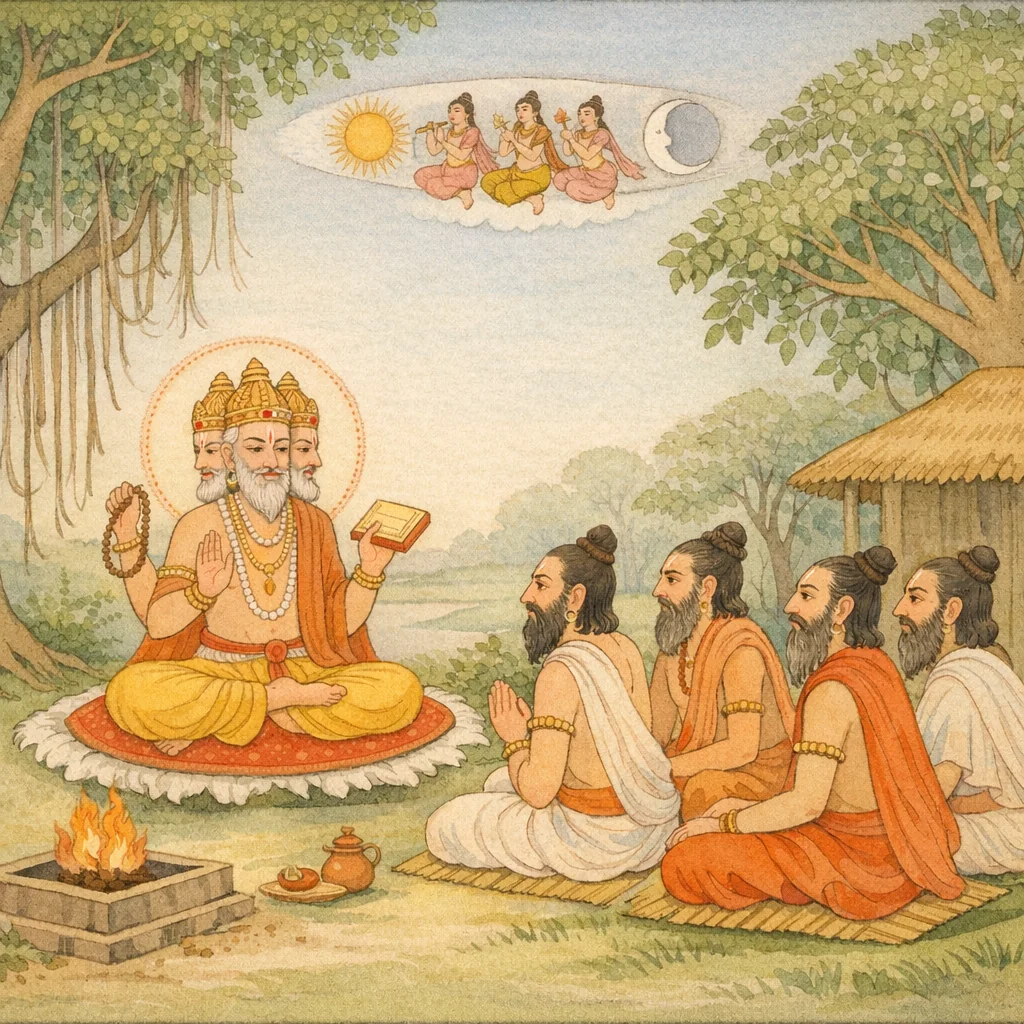
Adhyaya 43
Brahmopadeśa: Adhipatitva-kathana, Dharma-lakṣaṇa, and Kṣetra–Kṣetrajña Viveka (Book 14, Chapter 43)
Upa-parva: Āśvamedhika-parva — Brahmopadeśa on Dharma-lakṣaṇa and Kṣetrajña (Chapter 43 context unit)
Brahmā enumerates representative ‘chiefs’ or archetypal exemplars across categories (social orders, animals, trees, mountains, celestial bodies, deities), using adhipati/rāja language to map an ordered cosmos. The discourse then turns normative: dharma is defined by ahiṃsā, while adharma is defined by hiṃsā; kings are urged to protect dvijas and sādhus, with stated consequences for neglect versus protection. Next, the text supplies lakṣaṇas of elements and faculties—ākāśa as sound, vāyu as touch, waters as taste, earth as smell—alongside speech, mind (cintā), and buddhi (vyavasāya/decisive determination). It advances toward a sāṃkhya-leaning metaphysics: yoga is characterized by pravṛtti (disciplined engagement), jñāna by saṃnyāsa-lakṣaṇa, and liberation is described as transcending dualities. The latter portion distinguishes avyakta kṣetra (the field where guṇas arise and dissolve) from the nirguṇa kṣetrajña (knower), portrayed as unmarked (aliṅga), steady, and beyond ritualized self-assertion; the teaching culminates in the recommendation to relinquish attachment to guṇas and enter the standpoint of the kṣetrajña through knowledge and renunciation.
Chapter Arc: गुरु-शिष्य संवाद में ब्रह्माजी की वाणी से जगत के ‘अधिपतियों’ का क्रम खुलता है—चराचर प्राणियों, वृक्षों, ग्रह-नक्षत्रों और समाज-व्यवस्थाओं तक, मानो सृष्टि का शासन-मानचित्र सामने रख दिया गया हो। → सूची मात्र नहीं, एक सूक्ष्म संकेत उभरता है: बाह्य जगत में अधिपति-व्यवस्था जितनी स्पष्ट है, उतनी ही कठिन है भीतर के राज्य (मन-बुद्धि) का शासन। योग, ज्ञान और संन्यास के लक्षणों पर आते-आते प्रश्न तीखा होता है—किस मार्ग से मनुष्य द्वन्द्व, जरा और मृत्यु को लाँघे? → निर्णायक उद्घोष: ‘प्रवृत्तिलक्षणो योगो, ज्ञानं संन्यासलक्षणम्’—बुद्धिमान को ज्ञान को अग्रणी रखकर संन्यास (वैराग्य/त्याग-बुद्धि) की ओर झुकना चाहिए; ज्ञानयुक्त संन्यासी द्वन्द्वातीत होकर तम, मृत्यु और जरा को पार करता है। → अध्याय मन-बुद्धि के भेद-लक्षणों (चिन्तन मन का, निश्चय बुद्धि का) और धर्म-रक्षा से राज्य-कल्याण की परिणति (श्रेष्ठ पुरुषों की रक्षा करने वाले नरेश का लोक में आनंद) के साथ स्थिर निष्कर्ष देता है—बाह्य शासन का आदर्श भीतर की साधना से पुष्ट होता है।
Shlokas
Verse 1
>> ह््न हि कमी त्रिचत्वारिशो<् ध्याय: चराचर प्राणियोंके अधिपतियोंका, धर्म आदिके लक्षणोंका और विषयोंकी अनुभूतिके साधनोंका वर्णन तथा क्षेत्रज्ञकी विलक्षणता ब्रह्मोवाच मनुष्याणां तु राजन्य: क्षत्रियो मध्यमो गुण: । कुण्जरो वाहनानां च सिंहश्लारण्यवासिनाम्,ब्रह्माजीनी कहा--महर्षियो! मनुष्योंका राजा तो रजोगुणसे युक्त क्षत्रिय है। सवारियोंमें हाथी, बनवासियोंमें सिंह, समस्त पशुओंमें भेड़ और बिलमें रहनेवालोंमें सर्प, गौओंमें बैल एवं स्त्रियोंमें पुरुष प्रधान है
Brahmā said: “Among human beings, the ruling order—the Kṣatriya—is characterized chiefly by the middle quality, rajas (the drive to act and govern). Among mounts and conveyances, the elephant is foremost; and among creatures that dwell in the wilderness, the lion is preeminent.”
Verse 2
अवि: पशाूनां सर्वेषामहिस्तु बिलवासिनाम् | गवां गोवृषभश्चैव स्त्रीणां पुरुष एव च,ब्रह्माजीनी कहा--महर्षियो! मनुष्योंका राजा तो रजोगुणसे युक्त क्षत्रिय है। सवारियोंमें हाथी, बनवासियोंमें सिंह, समस्त पशुओंमें भेड़ और बिलमें रहनेवालोंमें सर्प, गौओंमें बैल एवं स्त्रियोंमें पुरुष प्रधान है
Vāyudeva said: “Among all domesticated animals, the sheep is foremost; among creatures that dwell in burrows, the serpent is foremost. Among cattle, the bull is preeminent; and among women, the man is regarded as the principal.”
Verse 3
न्यग्रोधो जम्बुवृक्षश्ष पिप्पल: शाल्मलिस्तथा । शिंशपा मेषशृज्ञश्न तथा कीचकवेणव:
Vāyu-deva said: “The nyagrodha (banyan), the jambu tree, the pippala (aśvattha), and the śālmali; likewise the śiṃśapā, the meṣaśṛṅgī, and also the kīcaka bamboos.”
Verse 4
हिमवान् पारियात्रश्न सह्यो विन्ध्यस्त्रिकूटवान्,हिमवान्, पारियात्र, सहा, विन्ध्य, त्रिकूट, श्वेत, नील, भास, कोष्ठवान् पर्वत, गुरुस्कन्ध, महेन्द्र और माल्यवान् पर्वत--ये सब पर्वत पर्वतोंके अधिपति हैं। गणोंके मरुद्गण, ग्रहोंके सूर्य और नक्षत्रोंके चन्द्रमा अधिपति हैं
Vāyu-deva declares a hierarchy within the natural and cosmic order: among mountains, Himavān, Pāriyātra, Sahya, Vindhya, Trikūṭa, Śveta, Nīla, Bhāsa, Koṣṭhavān, Guruskandha, Mahendra, and Mālyavān are regarded as sovereigns. Likewise, among the divine hosts the Maruts are foremost; among the planets the Sun is chief; and among the lunar mansions the Moon presides.
Verse 5
श्वैतो नीलक्ष भासश्न कोष्ठवांश्रैव पर्वत: । गुरुस्कन्धो महेन्द्रश्न माल्यवान् पर्वतस्तथा,हिमवान्, पारियात्र, सहा, विन्ध्य, त्रिकूट, श्वेत, नील, भास, कोष्ठवान् पर्वत, गुरुस्कन्ध, महेन्द्र और माल्यवान् पर्वत--ये सब पर्वत पर्वतोंके अधिपति हैं। गणोंके मरुद्गण, ग्रहोंके सूर्य और नक्षत्रोंके चन्द्रमा अधिपति हैं
Vāyu-deva said: “Śvaita, Nīla, Bhāsa, and Koṣṭhavān; likewise Guru-skandha, Mahendra, and the mountain Mālyavān; also Himavān, Pāriyātra, Sahya, Vindhya, Trikūṭa, Śveta, Nīla, Bhāsa, and Koṣṭhavān—these are the lords among mountains. Among the hosts (gaṇas), the Maruts are the chiefs; among the planets, the Sun is chief; and among the lunar mansions, the Moon is chief.”
Verse 6
एते पर्वतराजानो गणानां मरुतस्तथा । सूर्यो ग्रहाणामधिपो नक्षत्राणां च चन्द्रमा:,हिमवान्, पारियात्र, सहा, विन्ध्य, त्रिकूट, श्वेत, नील, भास, कोष्ठवान् पर्वत, गुरुस्कन्ध, महेन्द्र और माल्यवान् पर्वत--ये सब पर्वत पर्वतोंके अधिपति हैं। गणोंके मरुद्गण, ग्रहोंके सूर्य और नक्षत्रोंके चन्द्रमा अधिपति हैं
Vāyu-deva said: “These are the sovereign lords among mountains; likewise, the Maruts are the chiefs among the divine hosts (gaṇas). Among the planets, the Sun is the ruler, and among the constellations, the Moon is the ruler.”
Verse 7
यम: पितृणामधिप: सरितामथ सागर: । अम्भसां वरुणो राजा मरुतामिन्द्र उच्यते,यमराज पितरोंके और समुद्र सरिताओंके स्वामी हैं। वरुण जलके और इन्द्र मरुदगणोंके स्वामी कहे जाते हैं
Vāyu said: “Yama is the sovereign of the Pitṛs (the ancestral spirits). The ocean is the lord of rivers. Varuṇa is called the king of the waters, and Indra is said to be the lord of the Maruts.”
Verse 8
अरको<धिपतिरुष्णानां ज्योतिषामिन्दुरुच्यते । अग्निर्भूतपतिर्नित्यं ब्राह्मणानां बृहस्पति:,उष्णप्रभाके अधिपति सूर्य हैं और ताराओंके स्वामी चन्द्रमा कहे गये हैं। भूतोंके नित्य अधीश्वर अग्निदेव हैं तथा ब्राह्मणोंके स्वामी बृहस्पति हैं
Vāyu said: “Among the sources of heat, the Sun is declared the lord; among the luminaries, the Moon is spoken of as the sovereign. Agni is ever the ruler of living beings, and Bṛhaspati is the lord of the Brāhmaṇas.”
Verse 9
ओषधीनां पति: सोमो विष्णुर्बलवतां वर: । त्वष्टाधिराजो रूपाणां पशूनामीश्वर: शिव:,ओषधियोंके स्वामी सोम हैं तथा बलवानोंमें श्रेष्ठ विष्णु हैं। रूपोंके अधिपति सूर्य और पशुओंके ईश्वर भगवान् शिव हैं
Vāyu said: “Soma is the lord of medicinal herbs; Viṣṇu is the foremost among the mighty. Tvaṣṭṛ is the sovereign over forms, and Śiva is the Lord of beasts.”
Verse 10
दीक्षितानां तथा यज्ञो दैवानां मघवा तथा । दिशामुदीची विप्राणां सोमो राजा प्रतापवान्,दीक्षा ग्रहण करनेवालोंके यज्ञ और देवताओंके इन्द्र अधिपति हैं। दिशाओंकी स्वामिनी उत्तर दिशा है एवं ब्राह्मणोंके राजा प्रतापी सोम हैं
Vāyu said: “Among those who have undertaken consecration, the presiding lord is the Sacrifice itself; among the gods, Maghavā (Indra) is the lord. Among the directions, the northern quarter holds sovereignty; and among the Brahmins, the mighty King Soma is regarded as chief.”
Verse 11
कुबेर: सर्वरत्नानां देवतानां पुरंदर: । एव भूताधिप: सर्ग: प्रजानां च प्रजापति:,सब प्रकारके रत्नोंके स्वामी कुबेर, देवताओंके स्वामी इन्द्र और प्रजाओंके स्वामी प्रजापति हैं। यह भूतोंके अधिपतियोंका सर्ग है
Vāyu said: “Kubera is the lord of all treasures; Purandara (Indra) is the lord among the gods; and Prajāpati is the lord of creatures. Thus, within creation there are appointed overlords for beings—each presiding over a distinct domain.”
Verse 12
सर्वेषामेव भूतानामहं ब्रह्ममयो महान् । भूतं परतरं मत्तो विष्णोर्वापि न विद्यते,मैं ही सम्पूर्ण प्राणियोंका महान् अधीश्वर और ब्रह्ममय हूँ। मुझसे अथवा विष्णुसे बढ़कर दूसरा कोई प्राणी नहीं है
Vāyu-deva said: “I am the great lord of all beings, pervaded by Brahman. There exists no being higher than me—or even than Viṣṇu.”
Verse 13
राजाधिराज: सर्वेषां विष्णुब्रह्ममयों महान् । ईश्वरत्वं विजानी ध्वं कर्तारमकृतं हरिम,ब्रह्ममय महाविष्णु ही सबके राजाधिराज हैं, उन्हींको ईश्वर समझना चाहिये। वे श्रीहरि सबके कर्ता हैं, किंतु उनका कोई कर्ता नहीं है
Vāyu said: “The great Lord—King over kings for all beings—whose nature is pervaded by Viṣṇu and Brahman, should be recognized as the true Sovereign. Know Hari to be the doer of all deeds, yet Himself unmade and without any maker.”
Verse 14
नरकिन्नरयक्षाणां गन्धर्वोरगरक्षसाम् । देवदानवनागानां सर्वेषामीश्वरो हि सः,वे विष्णु ही मनुष्य, किन्नर, यक्ष, गन्धर्व, सर्प, राक्षस, देव, दानव और नाग सबके अधीश्वर हैं
Vāyu said: “He indeed is the sovereign Lord of all—of men, Kinnaras, Yakṣas, Gandharvas, serpents, Rākṣasas, Devas, Dānavas, and Nāgas.”
Verse 15
भगदेवानुयातानां सर्वासां वामलोचना । माहेश्वरी महादेवी प्रोच्यते पार्वती हि सा,कामी पुरुष जिनके पीछे फिरते हैं, उन सबमें सुन्दर नेत्रोंवाली स्त्री प्रधान है। एवं जो माहेश्वरी, महादेवी और पार्वती नामसे कही जाती हैं, उन मंगलमयी उमादेवीको स्त्रियोंमें सर्वोत्तम जानो तथा रमण करने योग्य स्त्रियोंमें स्वर्णविभूषित अप्सराएँ प्रधान हैं
Vāyu said: “Among all women whom men of desire pursue, the foremost is the fair-eyed one—she who is spoken of as Māheśvarī, Mahādevī, and indeed Pārvatī. Know that auspicious Umā-devī to be the best among women; and among women sought for pleasure, the apsarases adorned with gold ornaments are pre-eminent.”
Verse 16
उमां देवीं विजानी ध्वं नारीणामुत्तमां शुभाम् । रतीनां वसुमत्यस्तु स्त्रीणामप्सरसस्तथा,कामी पुरुष जिनके पीछे फिरते हैं, उन सबमें सुन्दर नेत्रोंवाली स्त्री प्रधान है। एवं जो माहेश्वरी, महादेवी और पार्वती नामसे कही जाती हैं, उन मंगलमयी उमादेवीको स्त्रियोंमें सर्वोत्तम जानो तथा रमण करने योग्य स्त्रियोंमें स्वर्णविभूषित अप्सराएँ प्रधान हैं
Vāyu said: “Know the goddess Umā—auspicious and supremely excellent among women. And among women who are objects of delight, the richly adorned Apsarases are foremost.”
Verse 17
धर्मकामाश्ष राजानो ब्राह्मणा धर्मसेतव: । तस्माद् राजा द्विजातीनां प्रयतेत सम रक्षणे,राजा धर्म-पालनके इच्छुक होते हैं और ब्राह्मण धर्मके सेतु हैं। अत: राजाको चाहिये कि वह सदा ब्राह्मणोंकी रक्षाका प्रयत्न करे
Vāyu said: “Kings are meant to be devoted to dharma and rightful aims, and the brāhmaṇas are the very bridge that upholds dharma. Therefore a king should always strive to protect the twice-born, for by safeguarding them he safeguards the continuity of dharma itself.”
Verse 18
राज्ञां हि विषये येषामवसीदन्ति साधव: । हीनास्ते स्वगुणै: सर्व: प्रेत्य चोन््मार्गगामिन:,जिन राजाओंके राज्यमें श्रेष्ठ पुरुषोंको कष्ट होता है, वे अपने समस्त राजोचित गुणोंसे हीन हो जाते और मरनेके बाद नीच गतिको प्राप्त होते हैं
Vāyu said: “Those kings in whose realm the virtuous are brought to distress lose all their own kingly excellences. And after death they fall into a base destiny, having gone astray from the right path.”
Verse 19
राज्ञां हि विषये येषां साधव: परिरक्षिता: । तेडस्मिल्लोके प्रमोदन्ते सुखं प्रेत्य च भुज्जते
For those kings in whose realm the righteous and virtuous are protected, such rulers rejoice in this very world; and after death as well, they enjoy happiness.
Verse 20
अत ऊर्ध्व॑ प्रवक्ष्यामि नियतं धर्मलक्षणम्,अब मैं सबके नियत धर्मके लक्षणोंका वर्णन करता हूँ। अहिंसा सबसे श्रेष्ठ धर्म है और हिंसा अधर्मका लक्षण (स्वरूप) है। प्रकाश देवताओंका और यज्ञ आदि कर्म मनुष्योंका लक्षण है
Vāyu said: “Now I shall declare the settled marks by which dharma is known. Non-violence (ahiṃsā) is the highest dharma, while violence is the defining sign of adharma. Radiance is the characteristic of the gods, and sacrificial and allied rites (yajña and the like) are the characteristic activity of human beings.”
Verse 21
अहिंसा परमो धर्मो हिंसा चाधर्मलक्षणा । प्रकाशलक्षणा देवा मनुष्या: कर्मलक्षणा:,अब मैं सबके नियत धर्मके लक्षणोंका वर्णन करता हूँ। अहिंसा सबसे श्रेष्ठ धर्म है और हिंसा अधर्मका लक्षण (स्वरूप) है। प्रकाश देवताओंका और यज्ञ आदि कर्म मनुष्योंका लक्षण है
Vāyu said: “I shall now describe the defining marks of the fixed duties of all beings. Non-violence is the highest dharma, while violence is the sign of adharma. The gods are characterized by radiance, whereas human beings are characterized by action—especially sacrificial and duty-bound works (yajña and the like).”
Verse 22
शब्दलक्षणमाकाशं वायुस्तु स्पर्शलक्षण: । ज्योतिषां लक्षणं रूपमापश्ष रसलक्षणा:,शब्द आकाशका, वायु स्पर्शका, रूप तेजका और रस जलका लक्षण है
Vāyu-deva said: “Sound is the defining mark of space (ākāśa). Touch is the defining mark of wind (vāyu). Form is the defining mark of light/fire (tejas). Taste is the defining mark of water (āpas).”
Verse 23
धारिणी सर्वभूतानां पृथिवी गन्धलक्षणा । स्वरव्यज्जनसंस्कारा भारती शब्दलक्षणा,गन्ध सम्पूर्ण प्राणियोंको धारण करनेवाली पृथ्वीका लक्षण है तथा स्वर-व्यंजनकी शुद्धिसे युक्त वाणीका लक्षण शब्द है
Vāyudeva said: “The Earth, which upholds all living beings, is characterized by fragrance (smell). Speech (Bhāratī), refined through the proper formation of vowels and consonants, is characterized by sound.”
Verse 24
मनसो लक्षण चिन्ता चिन्तोक्ता बुद्धिलक्षणा । मनसा चिन्तितानर्थान् बुद्धया चेह व्यवस्यति
Vāyu said: “The distinguishing function of the mind (manas) is ‘thinking’—it is expressed as thought. The distinguishing function of the intellect (buddhi) is ‘determination’: here, the intellect decisively ascertains the meanings and aims that the mind has merely conceived.”
Verse 25
लक्षणं मनसो ध्यानमव्यक्त साधुलक्षणम्,मनका लक्षण ध्यान है और श्रेष्ठ पुरुषका लक्षण बाहरसे व्यक्त नहीं होता (वह स्वसंवेद्य हुआ करता है)। योगका लक्षण प्रवृति और संन्यासका लक्षण ज्ञान है। इसलिये बुद्धिमान पुरुषको चाहिये कि वह ज्ञानका आश्रय लेकर यहाँ संन्यास ग्रहण करे
Vāyu said: “The mark of the mind is meditation; and the mark of the truly good is that it is not outwardly displayed—it is known inwardly by direct self-awareness. The sign of yoga is disciplined engagement in rightful action, while the sign of renunciation is knowledge. Therefore, a wise person should take refuge in knowledge and, here and now, embrace renunciation.”
Verse 26
प्रवृत्तिलक्षणो योगो ज्ञानं संन्यासलक्षणम् | तस्माजज्ञानं पुरस्कृत्य संन्यसेदिह बुद्धिमान्,मनका लक्षण ध्यान है और श्रेष्ठ पुरुषका लक्षण बाहरसे व्यक्त नहीं होता (वह स्वसंवेद्य हुआ करता है)। योगका लक्षण प्रवृति और संन्यासका लक्षण ज्ञान है। इसलिये बुद्धिमान पुरुषको चाहिये कि वह ज्ञानका आश्रय लेकर यहाँ संन्यास ग्रहण करे
Vāyu said: “Yoga is characterized by engagement in rightful action, while renunciation is characterized by true knowledge. Therefore, the wise person should place knowledge in the forefront and, in this very life, adopt renunciation—letting insight, not mere outward marks, be the basis of the renunciate path.”
Verse 27
संन्यासी ज्ञानसंयुक्तः प्राप्रोति परमां गतिम् | अतीतो द्वन्द्मभ्येति तमोमृत्युजरातिग:,ज्ञानयुक्त संन्यासी मौत और बुढ़ापाको लाँचकर सब प्रकारके द्वन्द्दोंसे परे हो अज्ञानान्धकारके पार पहुँचकर परमगतिको प्राप्त होता है
Vāyu said: “A renunciant endowed with true knowledge attains the highest goal. Having gone beyond the pairs of opposites, he crosses past the darkness of ignorance and, transcending death and old age, reaches the supreme state.”
Verse 28
धर्मलक्षणसंयुक्तमुक्त वो विधिवन्मया । गुणानां ग्रहणं सम्यग् वक्ष्माम्यहमत: परम्,महर्षियो! यह मैंने तुमलोगोंसे लक्षणोंसहित धर्मका विधिवत् वर्णन किया। अब यह बतला रहा हूँ कि किस गुणको किस इन्द्रियसे ठीक-ठीक ग्रहण किया जाता है
Vāyu said: “I have duly explained to you dharma together with its defining marks, in accordance with proper method. Now, O great seers, I shall go on to state clearly how each quality is correctly apprehended by the respective sense-faculty.”
Verse 29
पार्थिवो यस्तु गन्धो वै घप्राणेन हि स गृहाते । प्राणस्थश्न तथा वायुर्गन्धज्ञाने विधीयते,पृथ्वीका जो गन्ध नामक गुण है, उसका नासिकाके द्वारा ग्रहण होता है और नासिकामें स्थित वायु उस गन्धका अनुभव करानेमें सहायक होती है
Vāyu-deva said: “The fragrance that belongs to the earth-element is indeed apprehended through the nose. And the vital air situated in the organ of smell is appointed to enable the knowing of that fragrance.”
Verse 30
अपां धातू रसो नित्यं जिद्नया स तु गृहाते । जिद्दास्थश्न तथा सोमो रसज्ञाने विधीयते,जलका स्वाभाविक गुण रस है, जिसको जिद्ल्ाके द्वारा ग्रहण किया जाता है और जिह्लामें स्थित चन्द्रमा उस रसके आस्वादनमें सहायक होता है
Vāyu-deva said: “Taste is an eternal essence belonging to the element of water, and it is apprehended by the tongue. The Moon (Soma), abiding in the tongue, is appointed as an aid in the knowing and relishing of taste.”
Verse 31
ज्योतिषश्च गुणो रूप॑ चक्षुषा तच्च गृहाते । चक्षु:स्थश्व॒ सदा55दित्यो रूपज्ञाने विधीयते,तेजका गुण रूप है और वह नेत्रमें स्थित सूर्यदेवताकी सहायतासे नेत्रके द्वारा सदा देखा जाता है
Vāyu said: “Light is a quality, and form is apprehended by the eye. And the Sun, ever stationed within the eye, is appointed as the divine aid by which form is truly known.”
Verse 32
वायव्यस्तु सदा स्पर्शस्त्वाचा प्रज्ञायते च सः । त्वक्स्थश्वैव सदा वायु: स्पर्शने स विधीयते,वायुका स्वाभाविक गुण स्पर्श है, जिसका त्वचाके द्वारा ज्ञान होता है और त्वचामें स्थित वायुदेव उस स्पर्शका अनुभव करानेमें सहायक होता है
Vāyu-deva said: “Touch is ever the natural quality of the wind-element, and it is known through the skin. The Wind, abiding in the skin, is the agency that enables the experience of touch.”
Verse 33
आकाश स्य गुणो होष श्रोत्रेण च स गृहाते । श्रोत्रस्थाश्व दिश: सर्वा: शब्दज्ञाने प्रकीर्तिता:,आकाशके गुण शब्दका कानोंके द्वारा ग्रहण होता है और कानमें स्थित सम्पूर्ण दिशाएँ शब्दके श्रवणमें सहायक बतायी गयी हैं
Vāyu-deva said: “The distinctive quality of space (ākāśa) is sound, and it is apprehended through the ear. All the directions, abiding in the organ of hearing, are said to assist the cognition of sound.”
Verse 34
मनसश्च गुणश्रिन्ता प्रज्ञया स तु गृहाते । हृदिस्थश्लेतनो धातुर्मनोज्ञाने विधीयते,मनका गुण चिन्तन है, जिसका बुद्धिके द्वारा ग्रहण किया जाता है और हृदयमें स्थित चेतन (आत्मा) मनके चिन्तन-कार्यमें सहायता देता है
Vāyu said: “The mind engages in contemplating qualities, and that contemplation is apprehended through discernment (prajñā). The conscious principle (the inner Self) abiding in the heart is appointed to assist the mind’s act of knowing and reflection.”
Verse 35
बुद्धिरध्यवसायेन ज्ञानेन च महांस्तथा । निश्चित्य ग्रहणाद् व्यक्तमव्यक्तं नात्र संशय:,निश्चयके द्वारा बुद्धिका और ज्ञानके द्वारा महत्तत्त्वका ग्रहण होता है। इनके कार्योंसे ही इनकी सत्ताका निश्चय होता है और इसीसे इन्हें व्यक्त माना जाता है, किंतु वास्तवमें तो अतीन्द्रिय होनेके कारण ये बुद्धि आदि अव्यक्त ही हैं, इसमें संशय नहीं है
Vāyu said: “Through decisive resolve (adhyavasāya) the intellect is apprehended, and through knowledge the great principle (mahat) is likewise ascertained. Their existence is inferred from their functions and thus they are spoken of as ‘manifest’; yet in truth, because they lie beyond the senses, these—beginning with intellect—remain ‘unmanifest’. Of this there is no doubt.”
Verse 36
एते द्रुमाणां राजानो लोके5स्मिन् नात्र संशय: । बरगद, जामुन, पीपल, सेमल, शीशम, मेषशुंग (मेढ़ासिंगी) और पोले बाँस--ये इस लोकमें वृक्षोंके राजा हैं, इसमें संदेह नहीं है,अलिड्डग्रहणो नित्य: क्षेत्रज्ञो निर्गुणात्मक: । तस्मादलिड्: क्षेत्रज्ञ: केवलं ज्ञानलक्षण: नित्य क्षेत्रज्ञ आत्माका कोई ज्ञापक लिंग नहीं है; क्योंकि वह (स्वयंप्रकाश और) निर्गुण है। अतः: क्षेत्रज्ष अलिंग (किसी विशेष लक्षणसे रहित) है; अतः केवल ज्ञान ही उसका लक्षण (स्वरूप) माना गया है
Vāyu-deva said: “These are the sovereigns among trees in this world—there is no doubt of it. The eternal Knower of the Field (the Self) is not apprehended by any outward mark, for He is beyond qualities. Therefore the Knower of the Field is without distinguishing signs; pure consciousness alone is accepted as His defining characteristic.”
Verse 37
अब्यक्तं क्षेत्रमुद्दिष्टं गुणानां प्रभवाप्ययम् । सदा पश्याम्यहं लीनो विजानामि शृणोमि च,गुणोंकी उत्पत्ति और लयके कारणभूत अव्यक्त प्रकृतिको क्षेत्र कहते हैं। मैं उसमें संलग्न होकर सदा उसे जानता और सुनता हूँ
Vāyu said: “The unmanifest (Prakṛti) is declared to be the ‘field’ (kṣetra), for it is the source and the dissolution of the guṇas. Abiding merged within it, I ever perceive it; I understand it, and I also hear (its truth).”
Verse 38
पुरुषस्तद् विजानीते तस्मात् क्षेत्रज्ञ उच्यते । गुणवृत्तं तथा वृत्तं क्षेत्रज्ञ: परिपश्यति,आत्मा क्षेत्रको जानता है, इसलिये वह क्षेत्रज्ञ कहलाता है। क्षेत्रज्ष आदि, मध्य और अन्तसे युक्त समस्त उत्पत्तिशील अचेतन गुणोंके कार्यको और उनकी क्रियाको भी भलीभाँति जानता है, किंतु बारंबार उत्पन्न होनेवाले गुण आत्माको नहीं जान पाते
Vāyu said: “The inner Person knows that (field of experience); therefore he is called the Knower of the Field. The Knower of the Field clearly perceives the workings of the guṇas and their activities. Yet the guṇas—though repeatedly arising in the realm of change—do not truly know the Self.”
Verse 39
आदिमध्यावसानान्तं सृज्यमानमचेतनम् । न गुणा विदुरात्मानं सृज्यमाना: पुनः पुन:,आत्मा क्षेत्रको जानता है, इसलिये वह क्षेत्रज्ञ कहलाता है। क्षेत्रज्ष आदि, मध्य और अन्तसे युक्त समस्त उत्पत्तिशील अचेतन गुणोंके कार्यको और उनकी क्रियाको भी भलीभाँति जानता है, किंतु बारंबार उत्पन्न होनेवाले गुण आत्माको नहीं जान पाते
Vāyudeva said: “All that is produced—insentient in nature—has a beginning, a middle, and an end. The Self, however, is not known by the guṇas, though they arise again and again. Rather, the knower of the field (kṣetrajña) clearly knows the entire insentient field—its origin, activity, and dissolution—while the guṇas cannot comprehend the Self.”
Verse 40
न सत्यं विन्दते वक्षित क्षेत्रज्ञस्त्वेव विन्दति । गुणानां गुणभूतानां यत् परं परमं महत्,जो गुणों और गुणोंके कार्योंसे अत्यन्त परे है, उस परम महान् सत्यस्वरूप क्षेत्रज्ञको कोई नहीं जानता, परंतु वह सबको जानता है
Vāyu said: No one can truly know or fully describe that Supreme Reality—the Kṣetrajña, the Knower of the Field—who stands utterly beyond the guṇas and all effects born of the guṇas. Yet that great, highest Self knows all beings and all things.
Verse 41
तस्माद् गुणांश्नव सत्त्वं च परित्यज्येह धर्मवित् | क्षीणदोषो गुणातीत): क्षेत्रज्ञ प्रविशत्यथ,अतः इस लोकमें जिसके दोषोंका क्षय हो गया है, वह गुणातीत धर्मज्ञ पुरुष सत्त्व (बुद्धि) और गुणोंका परित्याग करके क्षेत्रज्ञके शुद्ध स्वरूप परमात्मामें प्रवेश कर जाता है
Therefore, in this very world, the knower of dharma should relinquish attachment to the guṇas—and even to sattva, the clarifying power of intellect. When one’s faults have been worn away, that person, having gone beyond the guṇas, enters the Kṣetrajña in His pure form—the Supreme Self.
Verse 42
इस प्रकार श्रीमह्याभारत आश्वमेधिकपर्वके अन्तर्गत अनुगीतापर्वमें गुरु-शिष्य- संवादविषयक बयालीसवाँ अध्याय पूरा हुआ,निर्द्धदद्वों निर्ममस्कारो नि:ःस्वाहाकार एव च | अचलकश्चानिकेतत्ष क्षेत्रज्ञ: स परो विभु: क्षेत्रज् सुख-दुखादि द्वन्द्ोंसे रहित, किसीको नमस्कार न करनेवाला, स्वाहाकाररूप यज्ञादि कर्म न करनेवाला, अचल और अनिकेत है। वही महान् विभु है
Vāyu said: The Knower of the Field (the inner Self) is free from all pairs of opposites such as pleasure and pain; he does not bow in dependence to anyone, nor is he bound to sacrificial acts performed with the utterance of “svāhā.” Unmoving and without any fixed abode, that Kṣetrajña is the supreme, all-pervading Lord.
Verse 43
इति श्रीमहाभारते आश्वमेधिके पर्वणि अनुगीतापर्वणि गुरुशिष्यसंवादे त्रिचत्वारिंशो 5ध्याय:
Thus ends the forty-third chapter of the Guru–Disciple dialogue in the Anugītā section of the Aśvamedhika Parva of the Śrī Mahābhārata.
Verse 193
प्राप्रुवन्ति महात्मान इति वित्त द्विजर्षभा: । द्विजवरो! जिनके राज्यमें श्रेष्ठ पुरुषोंकी सब प्रकारसे रक्षा की जाती है, वे महामना नरेश इस लोकमें आनन्दके भागी होते हैं और परलोकमें अक्षय सुख प्राप्त करते हैं, ऐसा समझो
Vāyu said: “Know this, O best of twice-born ones: those high-minded kings in whose realm excellent men are protected in every way enjoy happiness in this world, and after death attain imperishable bliss.”
Verse 243
बुद्धिह्हि व्यवसायेन लक्ष्यते नात्र संशय: । चिन्तन मनका और निश्चय बुद्धिका लक्षण है; क्योंकि मनुष्य इस जगतमें मनके द्वारा चिन्तन की हुई वस्तुओंका बुद्धिसे ही निश्चय करते हैं, निश्चयके द्वारा ही बुद्धि जाननेमें आती है, इसमें संदेह नहीं है
Vāyu said: “Intellect is recognized by its power of decisive resolve; of this there is no doubt. The mind may entertain thoughts and possibilities, but it is the intellect that determines and settles what is to be accepted. Thus, certainty and firm decision are the distinguishing marks by which intellect is known.”
Frequently Asked Questions
The chapter frames the ethical choice as governance through protection and non-harm: rulers must decide whether to uphold ahiṃsā-informed dharma by safeguarding sādhus and dvijas, or fall into adharma characterized by hiṃsā and neglect of moral dependents.
The listener is guided to diagnose reality via lakṣaṇas and to shift identification from guṇa-conditioned processes (kṣetra/avyakta) to the unmarked knower (kṣetrajña), cultivating knowledge and renunciation that culminate in freedom from dualities.
Rather than a formal phalaśruti formula, the chapter embeds outcome-statements: protecting the virtuous yields welfare here and favorable post-mortem results, while knowledge-linked saṃnyāsa leads to the ‘paramā gati’ described as beyond darkness, death, and aging.