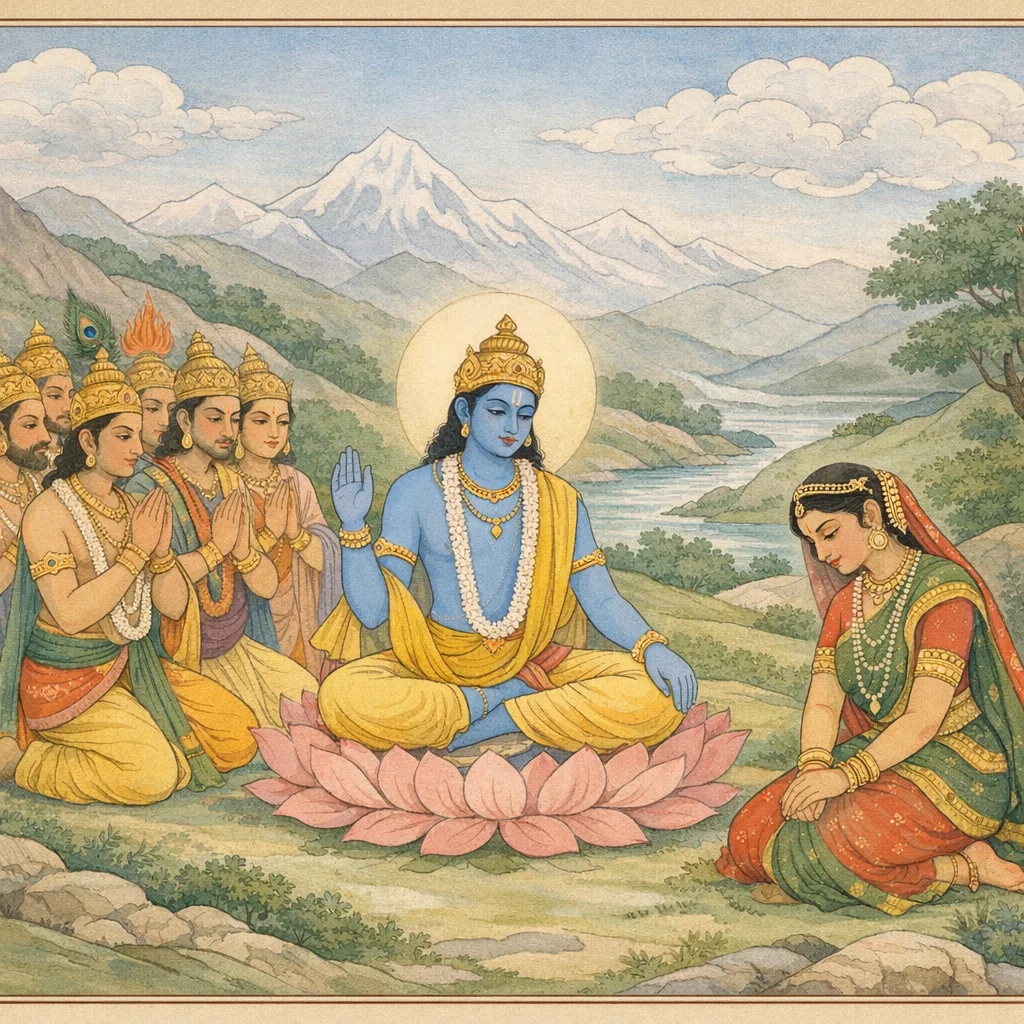
Adhyaya 64
Tapovana-praveśaḥ — The King’s Entry into the Sacred Grove and Vision of the Āśrama
Upa-parva: Āśrama-darśana (Kāśyapa/Kaṇva Tapovana Episode)
Vaiśaṃpāyana narrates how the king, after killing many deer, enters another forest alone, afflicted by hunger and thirst. He passes a superior hermitage-region and reaches an expansive, aesthetically perfected woodland: flowering trees, soft grass, cool fragrant winds carrying pollen, constant birdsong, and bees around fruit-laden, thornless plants. The scene intensifies into a near-paradisal ecology (likened to Nandana/Caitraratha), culminating in the discovery of a distinguished āśrama beside a holy, pleasant-watered river (Mālinī), inhabited by diverse beings and marked by ordered ritual life. The king observes Vedic recitations (including padakrama), yajña-competence, linguistic refinement, and philosophical disputation (nyāya, siddhānta, lokāyata referenced as soundscape of learning). He is struck by the careful arrangement of seats and the worship of shrines, feeling as though he stands in Brahmaloka. He then approaches the sage’s residence (Kāśyapa/Kaṇva named), leaves his army at the forest gate, removes royal insignia, and enters with minister and priest to seek darśana of the ascetic leader—an enacted transition from royal force to disciplined reverence.
Chapter Arc: Janamejaya presses Vaishampayana to reveal the hidden purpose for which god-like maharathas are born upon earth—what design stands behind their seemingly human lives. → Vaishampayana discloses a divine secret: in an earlier age, Kshatriyas flourish, uphold Veda and Upanishad-infused rites, and pour gifts in great sacrifices; yet prosperity swells into burden—earth teems with rulers and creatures until the very ground can no longer bear the weight. → The Earth, oppressed by overpopulation and the crush of power, approaches the supreme lord—Shambhu/Prajapati—seeking relief; the gods, led by Indra, then go to Purushottama Hrishikesha (Vishnu), praised as the refuge of all deities, and beg him to descend in a portion to cleanse the world. → Hari assents—‘So be it’—accepting the request to incarnate by an amsha for the purification of the earth, setting the cosmic rationale for the coming births and the eventual great conflict. → The promise of descent is made, but the chapter ends before naming the specific incarnations and the human lineages through which the divine plan will unfold.
Shlokas
Verse 1
/ (दाक्षिणात्य अधिक पाठके ४ ६ श्लोक मिलाकर कुल १३१६ “लोक हैं) चतु:षष्टितमो<5 ध्याय: ब्राह्मणोंद्वारा क्षत्रियवंशकी उत्पत्ति और वृद्धि तथा उस समयके धार्मिक राज्यका वर्णन; असुरोंका जन्म और उनके भारसे पीड़ित पृथ्वीका ब्रह्माजीकी शरणमें जाना तथा ब्रह्माजीका देवताओंको अपने अंशसे पृथ्वीपर जन्म लेनेका आदेश जनमेजय उवाच य एते कीर्तिता ब्रद्मन् ये चान्ये नानुकीर्तिता: । सम्यक् ताउ्छोतुमिच्छामि राज्ञश्चान्यानू सहस्रशः,जनमेजय बोले--ब्रह्म! आपने यहाँ जिन राजाओंके नाम बताये हैं और जिन दूसरे नरेशोंके नाम यहाँ नहीं लिये हैं, उन सब सहस्रों राजाओंका मैं भलीभाँति परिचय सुनना चाहता हूँ
Janamejaya said: “O Brahman, I wish to hear in full about those kings whose names you have recounted here, and also about the many others whose names have not been mentioned—indeed, about those thousands of rulers as well.”
Verse 2
यदर्थमिह सम्भूता देवकल्पा महारथा: । भुवि तन्मे महाभाग सम्यगाख्यातुमरहसि,महाभाग! वे देवतुल्य महारथी इस पृथ्वीपर जिस उद्देश्यकी सिद्धिके लिये उत्पन्न हुए थे, उसका यथावत् वर्णन कीजिये
Janamejaya said: “O noble one, for what purpose were these great chariot-warriors—godlike in prowess—born here upon the earth? Please relate to me, in full and in proper order, the true aim for which their incarnation was brought about.”
Verse 3
वैशम्पायन उवाच रहस्यं खल्विदं राजन् देवानामिति न: श्रुतम् । तत्तु ते कथयिष्यामि नमस्कृत्य स्वयम्भुवे,वैशम्पायनजीने कहा--राजन्! यह देवताओंका रहस्य है, ऐसा मैंने सुन रखा है। स्वयम्भू ब्रह्माजीको नमस्कार करके आज उसी रहस्यका तुमसे वर्णन करूँगा
Vaiśampāyana said: “O King, we have heard that this is indeed a secret belonging to the gods. Having first bowed in reverence to Svayambhū (Brahmā), I shall now relate that very secret to you.”
Verse 4
त्रि:सप्तकृत्व: पृथिवीं कृत्वा नि:क्षत्रियां पुरा । जामदग्न्यस्तपस्तेपे महेन्द्रे पर्वतोत्तमे,पूर्वकालमें जमदग्निनन्दन परशुरामने इक्कीस बार पृथ्वीको क्षत्रियरहित करके उत्तम पर्वत महेन्द्रपर तपस्या की थी। उस समय जब भृगुनन्दनने इस लोकको क्षत्रियशून्य कर दिया था, क्षत्रिय-नारियोंने पुत्रकी अभिलाषासे ब्राह्मणोंकी शरण ग्रहण की थी
Vaiśampāyana said: “In ancient times, Jāmadagnya (Paraśurāma) made the earth bereft of kṣatriyas twenty-one times, and then performed austerities on Mahendra, the most excellent of mountains.”
Verse 5
तदा निः:क्षत्रिये लोके भार्गवेण कृते सति । ब्राह्मणान् क्षत्रिया राजन् सुतार्थिन्योडभिचक्रमु:,पूर्वकालमें जमदग्निनन्दन परशुरामने इक्कीस बार पृथ्वीको क्षत्रियरहित करके उत्तम पर्वत महेन्द्रपर तपस्या की थी। उस समय जब भृगुनन्दनने इस लोकको क्षत्रियशून्य कर दिया था, क्षत्रिय-नारियोंने पुत्रकी अभिलाषासे ब्राह्मणोंकी शरण ग्रहण की थी
Vaiśaṃpāyana said: “When the world had been made bereft of kṣatriyas by Bhārgava (Paraśurāma), the kṣatriya women, desiring sons, approached the brāhmaṇas for refuge and assistance.”
Verse 6
ताभि: सह समापेतुर्ब्राह्मणा: संशितव्रता: । ऋतावृतौ नरव्यात्र न कामान्नानृती तथा,नररत्न! वे कठोर व्रतधारी ब्राह्मण केवल ऋतुकालमें ही उनके साथ मिलते थे; न तो कामवश और न बिना ऋतुकालके ही
Vaiśampāyana said: Those Brahmins, steadfast in their austere vows, approached and consorted with those women only in the proper season. O tiger among men, it was neither from mere lust nor at an improper time; thus they upheld restraint and truthfulness in conduct.
Verse 7
तेभ्यश्न लेभिरे गर्भ क्षत्रियास्ता: सहस्रश: । ततः सुषुविरे राजन क्षत्रियान् वीर्यवत्तरान्,राजन्! उन सहसों क्षत्राणियोंने ब्राह्मणोंसे गर्भ धारण किया और पुन: क्षत्रियकुलकी वृद्धिके लिये अत्यन्त बलशाली क्षत्रियकुमारों तथा कुमारियोंको जन्म दिया। इस प्रकार तपस्वी ब्राह्मणोंद्वारा क्षत्राणियोंके गर्भसे धर्मपूर्वक क्षत्रिय-संतानकी उत्पत्ति और वृद्धि हुई। वे सब संतानें दीर्घायु होती थीं। तदनन्तर जगतमें पुनः ब्राह्मणप्रधान चारों वर्ण प्रतिष्ठित हुए
Vaiśampāyana said: From those brahmins, thousands of kṣatriya women conceived. Then, O King, they gave birth to kṣatriya offspring endowed with great vigor—thus the kṣatriya line was restored and increased in a lawful manner through the agency of ascetic brahmins. Their progeny were long-lived, and thereafter the four social orders again became established in the world with brahmins in the leading role.
Verse 8
कुमारांश्व कुमारीश्व पुन: क्षत्राभिवृद्धये । एवं तद् ब्राह्माणै: क्षत्रं क्षत्रियासु तपस्विभि:,राजन्! उन सहसों क्षत्राणियोंने ब्राह्मणोंसे गर्भ धारण किया और पुन: क्षत्रियकुलकी वृद्धिके लिये अत्यन्त बलशाली क्षत्रियकुमारों तथा कुमारियोंको जन्म दिया। इस प्रकार तपस्वी ब्राह्मणोंद्वारा क्षत्राणियोंके गर्भसे धर्मपूर्वक क्षत्रिय-संतानकी उत्पत्ति और वृद्धि हुई। वे सब संतानें दीर्घायु होती थीं। तदनन्तर जगतमें पुनः ब्राह्मणप्रधान चारों वर्ण प्रतिष्ठित हुए
Vaiśampāyana said: “Thus, for the renewed increase of the Kṣatriya line, those ascetic Brāhmaṇas begot sons and daughters through Kṣatriya women. In this way, in accordance with dharma, Kṣatriya offspring were generated and the royal order was restored and strengthened. Those children were long-lived; and thereafter, in the world, the four varṇas again became firmly established with Brāhmaṇas in the leading role.”
Verse 9
जात॑ वृद्ध च धर्मेण सुदीर्घेणायुषान्वितम् । चत्वारो5पि ततो वर्णा बभूवुर््रल्मिणोत्तरा:,राजन्! उन सहसों क्षत्राणियोंने ब्राह्मणोंसे गर्भ धारण किया और पुन: क्षत्रियकुलकी वृद्धिके लिये अत्यन्त बलशाली क्षत्रियकुमारों तथा कुमारियोंको जन्म दिया। इस प्रकार तपस्वी ब्राह्मणोंद्वारा क्षत्राणियोंके गर्भसे धर्मपूर्वक क्षत्रिय-संतानकी उत्पत्ति और वृद्धि हुई। वे सब संतानें दीर्घायु होती थीं। तदनन्तर जगतमें पुनः ब्राह्मणप्रधान चारों वर्ण प्रतिष्ठित हुए
Vaiśampāyana said: Born and increased in accordance with dharma, and endowed with very long life, those descendants flourished. Thereafter, O King, all four social orders became established again in the world, with the Brāhmaṇas holding the foremost place.
Verse 10
अभ्यगच्छन्नृतौ नारीं न कामान्नानृतो तथा । तथैवान्यानि भूतानि तिर्यग्योनिगतान्यपि,उस समय सब लोग ऋतुकालमें ही पत्नीसमागम करते थे; केवल कामनावश या ऋतुकालके बिना नहीं करते थे। इसी प्रकार पशु-पक्षी आदिकी योनिमें पड़े हुए जीव भी ऋतुकालमें ही अपनी स्त्रियोंसे संयोग करते थे। भरतश्रेष्ठ] उस समय धर्मका आश्रय लेनेसे सब लोग सहस्र एवं शत वर्षोतक जीवित रहते थे और उत्तरोत्तर उन्नति करते थे
Vaiśampāyana said: In that earlier age, people approached their wives only during the proper season for conception; they did not do so merely out of desire, nor at an improper time. In the same way, other living beings as well—even those born in animal and bird wombs—also united with their females only in the proper season.
Verse 11
ऋतौ दारांश्ष गच्छन्ति तत् तथा भरतर्षभ | ततो<वर्धन्त धर्मेण सहस्र्शतजीविन:,उस समय सब लोग ऋतुकालमें ही पत्नीसमागम करते थे; केवल कामनावश या ऋतुकालके बिना नहीं करते थे। इसी प्रकार पशु-पक्षी आदिकी योनिमें पड़े हुए जीव भी ऋतुकालमें ही अपनी स्त्रियोंसे संयोग करते थे। भरतश्रेष्ठ] उस समय धर्मका आश्रय लेनेसे सब लोग सहस्र एवं शत वर्षोतक जीवित रहते थे और उत्तरोत्तर उन्नति करते थे
Vaiśampāyana said: “O bull among the Bharatas, in that age people approached their wives only in the proper season; so it was. Living in accordance with dharma, they prospered, and their lives extended to a thousand or a hundred years, advancing steadily in well-being.”
Verse 12
ता: प्रजा: पृथिवीपाल धर्मव्रतपरायणा: । आधिभिव्यचिभिश्वैव विमुक्ता: सर्वशो नरा:,भूपाल! उस समयकी प्रजा धर्म एवं व्रतके पालनमें तत्पर रहती थी; अतः सभी लोग रोगों तथा मानसिक चिन्ताओंसे मुक्त रहते थे
Vaiśampāyana said: “O king, the people in those days were devoted to dharma and steadfast in their sacred vows. Therefore, all men were entirely free from mental afflictions and bodily diseases.”
Verse 13
अथेमां सागरापाडज़ीं गां गजेन्द्रगताखिलाम् । अध्यतिष्ठत् पुन: क्षत्रं सशैलवनपत्तनाम्,गजराजके समान गमन करनेवाले राजा जनमेजय! तदनन्तर धीरे-धीरे समुद्रसे घिरी हुई पर्वत, वन और नगरोंसहित इस सम्पूर्ण पृथ्वीपर पुन: क्षत्रियजातिका ही अधिकार हो गया
Vaiśampāyana said: Thereafter, O King Janamejaya—whose progress is like that of the lord of elephants—the Kṣatriya order once again established its rule over this entire earth, bounded by the ocean and furnished with mountains, forests, and cities.
Verse 14
प्रशासति पुन: क्षत्रे धर्मेणेमां वसुन्धराम् । ब्राह्म॒णाद्यास्ततो वर्णा लेभिरे मुदमुत्तमाम्,जब पुन: क्षत्रिय शासक धर्मपूर्वक इस पृथ्वीका पालन करने लगे, तब ब्राह्मण आदि वर्णोको बड़ी प्रसन्नता प्राप्त हुई
Vaiśampāyana said: “When the kṣatriya power once again governed this earth in accordance with dharma, the social orders beginning with the brāhmaṇas attained the highest joy.”
Verse 15
कामक्रोधोद्धवान् दोषान् निरस्य च नराधिपा: । धर्मेण दण्डं दण्ड्येषु प्रणयन््तोडन््वपालयन्,उन दिनों राजालोग काम और क्रोधजनित दोषोंको दूर करके दण्डनीय अपराधियोंको धर्मानुसार दण्ड देते हुए पृथ्वीका पालन करते थे
Vaiśampāyana said: “In those days the kings, having cast off the faults born of desire and anger, upheld the earth by imposing punishment—upon those who deserved punishment—in accordance with dharma.”
Verse 16
तथा धर्मपरे क्षत्रे सहस्राक्ष: शतक्रतुः । स्वादु देशे च काले च वर्षेणापालयत् प्रजा:,इस तरह धर्मपरायण क्षत्रियोंके शासनमें सारा देश-काल अत्यन्त रुचिकर प्रतीत होने लगा। उस समय सहसनेत्रोंवाले देवराज इन्द्र समयपर वर्षा करके प्रजाओंका पालन करते थे
Vaiśampāyana said: When the kṣatriyas were devoted to dharma and ruled in that spirit, the land and the times themselves seemed pleasant and wholesome. In those days Indra—thousand-eyed, performer of a hundred sacrifices—protected the people by sending rain in due season.
Verse 17
न बाल एव ग्रियते तदा कश्चिज्जनाधिप । न च स्त्रियं प्रजानाति कक्षिदप्राप्तयौवन:,राजन! उन दिनों कोई भी बाल्यावस्थामें नहीं मरता था। कोई भी पुरुष युवावस्था प्राप्त हुए बिना स्त्री-सुखका अनुभव नहीं करता था
Vaiśaṃpāyana said: “O lord of men, in those days no one died while still a child; and no man, before attaining youth, came to know a woman.”
Verse 18
एवमायुष्मतीभिस्तु प्रजाभिर्भरतर्षभ । इयं सागरपर्यन्ता समापूर्यत मेदिनी,भरतश्रेष्ठ! ऐसी व्यवस्था हो जानेसे समुद्रपर्यन्त यह सारी पृथ्वी दीर्घकालतक जीवित रहनेवाली प्रजाओंसे भर गयी
Vaiśampāyana said: “Thus, O bull among the Bharatas, the earth—bounded by the ocean—became completely filled with long-lived subjects.”
Verse 19
ईजिरे च महायज्ञैः क्षत्रिया बहुदक्षिणै: । साज़्रोपनिषदान वेदान् विप्राश्नाधीयते तदा,क्षत्रियलोग बहुत-सी दक्षिणावाले बड़े-बड़े यज्ञोंद्वारा यजन करते थे। ब्राह्मण अंगों और उपनिषदोंसहित सम्पूर्ण वेदोंका अध्ययन करते थे
Vaiśampāyana said: In those days the kṣatriyas performed great sacrifices, rich in gifts and fees to the officiants; and the brāhmaṇas studied the Vedas in their entirety—together with the auxiliary disciplines and the Upaniṣads.
Verse 20
नच विक्रीणते ब्रह्म ब्राह्मणाश्न॒ तदा नूप । न च शूद्रसमभ्याशे वेदानुच्चारयन्त्युत,राजन्! उस समय ब्राह्मण न तो वेदका विक्रय करते और न शूद्रोंके निकट वेदमन्त्रोंका उच्चारण ही करते थे
Vaiśampāyana said: “And in those days, O king, the Brāhmaṇas did not sell sacred knowledge (the Veda), nor did they recite Vedic mantras in the proximity of Śūdras. Thus the sanctity of learning and the boundaries of ritual transmission were maintained according to the dharma of that age.”
Verse 21
कारयन्त: कृषिं गोभिस्तथा वैश्या: क्षिताविह । युज्जते धुरि नो गाश्न कृशाज्रांशज्षाप्पजीवयन्,वैश्यगण बैलोंद्वारा इस पृथ्वीपर दूसरोंसे खेती कराते हुए भी स्वयं उनके कंधेपर जुआ नहीं रखते थे--उन्हें बोझ ढोनेमें नहीं लगाते थे और दुर्बल अंगोंवाले निकम्मे पशुओंको भी दाना-घास देकर उनके जीवनकी रक्षा करते थे
Vaiśampāyana said: Even while agriculture on this earth was carried out with the help of oxen, the Vaiśyas did not yoke the cattle to the pole of burden, nor did they force them to carry loads. Even animals with weak limbs—unfit for hard labor—were sustained with fodder and grain, and their lives were protected.
Verse 22
फेनपांश्व तथा वत्सान् न दुहन्ति सम मानवा: | न कूटमानैर्वणिज: पाण्यं विक्रीणते तदा,जबतक बछड़े केवल दूधपर रहते, घास नहीं चरते, तबतक मनुष्य गौओंका दूध नहीं दुहते थे। व्यापारीलोग बेचने योग्य वस्तुओंका झूठे माप-तौलद्दवारा विक्रय नहीं करते थे
Vaiśampāyana said: In those days, people did not milk the cows while the calves were still dependent solely on milk. Nor did merchants sell their wares by using false weights and measures. Thus the narrative recalls an earlier age marked by restraint, fairness, and regard for the rightful share of others.
Verse 23
कर्माणि च नरव्याप्र धर्मोपेतानि मानवा: । धर्ममेवानुपश्यन्तश्नक्रुर्धर्मपरायणा:,नरश्रेष्ठ) सब मनुष्य धर्मकी ही ओर दृष्टि रखकर धर्ममें ही तत्पर हो धर्मयुक्त कर्मोंका ही अनुष्ठान करते थे
And the people, being pervaded by a spirit of human endeavor, performed actions that were in harmony with dharma. Keeping their gaze fixed on dharma alone, they acted with dharma as their highest refuge and aim.
Verse 24
स्वकर्मनिरताश्नासन् सर्वे वर्णा नराधिप । एवं तदा नरव्यात्र धर्मो न हसते क्वचित्,राजन्! उस समय सब वर्णोके लोग अपने-अपने कर्मके पालनमें लगे रहते थे। नरश्रेष्ठ! इस प्रकार उस समय कहीं भी धर्मका हास नहीं होता था
Vaiśampāyana said: “O king, all the social orders lived devoted to their own prescribed duties and sustained themselves accordingly. O tiger among men, in that time dharma did not decline anywhere; righteousness was not mocked or diminished, O ruler.”
Verse 25
काले गाव: प्रसूयन्ते नार्यश्व भरतर्षभ । भव्न्त्यृतुषु वृक्षाणां पुष्पाणि च फलानि च,भरतश्रेष्ठ! गौएँ तथा स्त्रियाँ भी ठीक समयपर ही संतान उत्पन्न करती थीं। ऋतु आनेपर ही वृक्षोंमें फूल और फल लगते थे
Vaiśampāyana said: “O bull among the Bharatas, in those days cows gave birth in their proper season, and women too conceived and delivered at the right time. When the seasons arrived, trees likewise bore their flowers and fruits in due order.” The verse evokes an age of harmony in which nature and human life follow dharma-like regularity—fertility, growth, and fruition occurring without disorder or untimeliness.
Verse 26
एवं कृतयुगे सम्यग् वर्तमाने तदा नूप । आपूर्यत मही कृत्स्ना प्राणिभिर्बहुभिर्भूशम्,नरेश्वर! इस तरह उस समय सब ओर सत्ययुग छा रहा था। सारी पृथ्वी नाना प्रकारके प्राणियोंसे खूब भरी-पूरी रहती थी
Vaiśampāyana said: “At that time, O king, when the Kṛta Yuga was prevailing in its full measure, the whole earth was abundantly filled—thronged everywhere—with many kinds of living beings.”
Verse 27
एवं समुदिते लोके मानुषे भरतर्षभ । असुरा वक्त क्षेत्रे राज्ञां तु मनुजेश्वर,भरतश्रेष्ठ) इस प्रकार सम्पूर्ण मानव-जगत् बहुत प्रसन्न था। मनुजेश्वर! इसी समय असुरलोग राजपतल्नियोंके गर्भसे जन्म लेने लगे
Vaiśampāyana said: “When the human world had thus become prosperous and well-ordered, O bull among the Bharatas, then—O lord of men—certain Asuras began to take birth in the wombs of kings’ wives.”
Verse 28
आदित्यैहि तदा दैत्या बहुशो निर्जिता युधि । ऐश्वर्याद् भ्रंशिता: स्वर्गात् सम्बभूवु: क्षिताविह,उन दिनों अदितिके पुत्रों (देवताओं)-द्वारा दैत्यगण अनेक बार युद्धमें पराजित हो चुके थे। स्वर्गके ऐश्वर्यसे भ्रष्ट होनेपर वे इस पृथ्वीपर ही जन्म लेने लगे
In those days the Daityas were many times defeated in war by the sons of Aditi (the Devas). Fallen from the sovereignty and splendor of heaven, they began to be born here upon the earth.
Verse 29
इह देवत्वमिच्छन्तो मानुषेषु मनस्विन: । जज्षिरे भुवि भूतेषु तेषु तेष्वसुरा विभो,प्रभो! यहीं रहकर देवत्व प्राप्त करनेकी इच्छासे वे मनस्वी असुर भूतलपर मनुष्यों तथा भिन्न-भिन्न प्राणियोंमें जन्म लेने लगे
Vaiśampāyana said: “Remaining here in this world, those resolute Asuras, desiring to attain the status of gods, were born upon the earth among human beings and likewise among various other living creatures.”
Verse 30
गोष्वश्वेषु च राजेन्द्र खरोष्ट्रमहिषेषु च । क्रव्यात्सु चैव भूतेषु गजेषु च मृगेषु च,राजेन्द्र! गौओं, घोड़ों, गदहों, ऊँटों, भैसों, कच्चे मांस खानेवाले पशुओं, हाथियों और मृगोंकी योनिमें भी यहाँ असुरोंने जन्म लिया और अभीतक वे जन्म धारण करते जा रहे थे। उन सबसे यह पृथ्वी इस प्रकार भर गयी कि अपने-आपको भी धारण करनेमें समर्थ न हो सकी
Vaiśampāyana said: “O king, the Asuras took birth here even among cows and horses, among donkeys, camels, and buffaloes; among flesh-eating creatures as well; and among elephants and deer. They continued to assume births without cease. By them all, the earth became so filled that she could no longer sustain even her own burden.”
Verse 31
जातैरिह महीपाल जायमानैश्न तैर्मही । न शशाकात्मना55त्मानमियं धारयितुं धरा,राजेन्द्र! गौओं, घोड़ों, गदहों, ऊँटों, भैसों, कच्चे मांस खानेवाले पशुओं, हाथियों और मृगोंकी योनिमें भी यहाँ असुरोंने जन्म लिया और अभीतक वे जन्म धारण करते जा रहे थे। उन सबसे यह पृथ्वी इस प्रकार भर गयी कि अपने-आपको भी धारण करनेमें समर्थ न हो सकी
Vaiśaṃpāyana said: O king, as those rulers were born here and continued to be born, the earth became so crowded with them that this very Earth, by her own power, could no longer sustain even herself.
Verse 32
अथ जाता महीपाला: केचिद् बहुमदान्विता: । दिते: पुत्रा दनोश्वैव तदा लोक इह च्युता:,स्वर्गसे इस लोकमें गिरे हुए तथा राजाओंके रूपमें उत्पन्न हुए कितने ही दैत्य और दानव अत्यन्त मदसे उन्मत्त रहते थे। वे पराक्रमी होनेके साथ ही अहंकारी भी थे। अनेक प्रकारके रूप धारण कर अपने शत्रुओंका मान-मर्दन करते हुए समुद्रपर्यज सारी पृथ्वीपर विचरते रहते थे
Vaiśampāyana said: Then there were born certain kings, filled with excessive pride—sons of Diti and of Danu—who, having fallen from the heavenly world, came down here into the human realm. Intoxicated with power and arrogance, they roamed the earth up to the ocean’s bounds, assuming many forms and crushing the honor of their enemies.
Verse 33
वीर्यवन्तो5वलिप्तास्ते नानारूपधरा महीम् । इमां सागरपर्यन्तां परीयुररिमर्दना:,स्वर्गसे इस लोकमें गिरे हुए तथा राजाओंके रूपमें उत्पन्न हुए कितने ही दैत्य और दानव अत्यन्त मदसे उन्मत्त रहते थे। वे पराक्रमी होनेके साथ ही अहंकारी भी थे। अनेक प्रकारके रूप धारण कर अपने शत्रुओंका मान-मर्दन करते हुए समुद्रपर्यज सारी पृथ्वीपर विचरते रहते थे
Vaiśampāyana said: Those beings—mighty yet swollen with pride—assumed many forms and, as crushers of their foes, roamed over this earth bounded by the ocean.
Verse 34
ब्राह्मणान् क्षत्रियान् वैश्याउछूद्रांश्नैवाप्पपीडयन् । अन्यानि चैव सत्त्वानि पीडयामासुरोजसा,वे ब्राह्मणों, क्षत्रियों, वैश्यों तथा शूद्रोंकी भी सताया करते थे। अन्यान्य जीवोंको भी अपने बल और पराक्रमसे पीड़ा देते थे
Vaiśampāyana said: They oppressed the brāhmaṇas, the kṣatriyas, the vaiśyas, and the śūdras as well; and with sheer force they tormented other living beings too.
Verse 35
त्रासयन्तो5भिनिध्नन्तः सर्वभूतगणांश्न ते । विचेरु: सर्वशो राजन् महीं शतसहसत्रश:,राजन! वे असुर लाखोंकी संख्यामें उत्पन्न हुए थे और समस्त प्राणियोंको डराते- धमकाते तथा उनकी हिंसा करते हुए भूमण्डलमें सब ओर घूमते रहते थे
Vaiśampāyana said: O King, those beings roamed everywhere across the earth in hundreds of thousands, terrifying all groups of living creatures and striking them down. Their conduct was marked by intimidation and violence, spreading fear and disorder among beings.
Verse 36
आश्रमस्थान् महर्षीश्न धर्षयन्तस्ततस्तत: । अब्रद्याण्या वीर्यमदा मत्ता मदबलेन च,वे वेद और ब्राह्मणके विरोधी, पराक्रमके नशेमें चूर तथा अहंकार और बलसे मतवाले होकर इधर-उधर आश्रमवासी महर्षियोंका भी तिरस्कार करने लगे
Vaiśampāyana said: Drunk with the pride of their prowess, hostile to the Vedas and to brāhmaṇas, and intoxicated by arrogance and brute strength, they roamed from place to place, harassing even the great sages who dwelt in forest hermitages.
Verse 37
एवं वीर्यबलोल्सिक्ति भूरियत्नैर्महासुरै: । पीड्यमाना मही राजन् ब्रह्माणमुपचक्रमे,राजन्! जब इस प्रकार बल और पराक्रमके मदसे उन्मत्त महादैत्य विशेष यत्नपूर्वक इस पृथ्वीको पीड़ा देने लगे, तब यह ब्रह्माजीकी शरणमें जानेको उद्यत हुई
Vaiśampāyana said: “O King, when the earth, tormented by mighty asuras intoxicated with their strength and prowess and striving without respite, could no longer bear the oppression, she set out to seek refuge with Brahmā.”
Verse 38
न हामी भूतसत्त्वौधा: पन्नगा: सनगां महीम् | तदा धारयितुं शेकुः संक्रान्तां दानवैर्बलातू,दानवोंने बलपूर्वक जिसपर अधिकार कर लिया था, पर्वतों और वृक्षोंसहित उस पृथ्वीको उस समय कच्छप और दिग्गज आदिकी संगठित शक्तियाँ तथा शेषनाग भी धारण करनेमें समर्थ न हो सके। महीपाल! तब असुरोंके भारसे आतुर तथा भयसे पीड़ित हुई पृथ्वी सम्पूर्ण भूतोंक पितामह भगवान् ब्रह्माजीकी शरणमें उपस्थित हुई। ब्रह्मलोकमें जाकर पृथ्वीने उन लोकस्रष्टा अविनाशी देव भगवान् ब्रह्माजीका दर्शन किया, जिन्हें महाभाग देवता, द्विज और महर्षि घेरे हुए थे
Vaiśampāyana said: Even the mighty hosts of beings—serpents and other supports of the world—together with the mountains, were then unable to bear the Earth, for she had been forcibly overrun by the Dānavas. Overwhelmed by the weight of the asuras and shaken by fear, the Earth sought refuge in Brahmā, the Pitāmaha, grandsire and father of all beings, approaching him in Brahmaloka amid the assembly of gods, sages, and twice-born seers.
Verse 39
ततो मही महीपाल भारार्ता भयपीडिता । जगाम शरण देव॑ सर्वभूतपितामहम्,दानवोंने बलपूर्वक जिसपर अधिकार कर लिया था, पर्वतों और वृक्षोंसहित उस पृथ्वीको उस समय कच्छप और दिग्गज आदिकी संगठित शक्तियाँ तथा शेषनाग भी धारण करनेमें समर्थ न हो सके। महीपाल! तब असुरोंके भारसे आतुर तथा भयसे पीड़ित हुई पृथ्वी सम्पूर्ण भूतोंक पितामह भगवान् ब्रह्माजीकी शरणमें उपस्थित हुई। ब्रह्मलोकमें जाकर पृथ्वीने उन लोकस्रष्टा अविनाशी देव भगवान् ब्रह्माजीका दर्शन किया, जिन्हें महाभाग देवता, द्विज और महर्षि घेरे हुए थे
Then, O king, the Earth—oppressed by the crushing burden and tormented by fear—went for refuge to the divine Pitāmaha, the grandsire of all beings, Brahmā.
Verse 40
सा संवृतं महाभागैर्देवद्धिजमहर्षिभि: । ददर्श देवं ब्रह्माणं लोककर्तारमव्ययम्,दानवोंने बलपूर्वक जिसपर अधिकार कर लिया था, पर्वतों और वृक्षोंसहित उस पृथ्वीको उस समय कच्छप और दिग्गज आदिकी संगठित शक्तियाँ तथा शेषनाग भी धारण करनेमें समर्थ न हो सके। महीपाल! तब असुरोंके भारसे आतुर तथा भयसे पीड़ित हुई पृथ्वी सम्पूर्ण भूतोंक पितामह भगवान् ब्रह्माजीकी शरणमें उपस्थित हुई। ब्रह्मलोकमें जाकर पृथ्वीने उन लोकस्रष्टा अविनाशी देव भगवान् ब्रह्माजीका दर्शन किया, जिन्हें महाभाग देवता, द्विज और महर्षि घेरे हुए थे
Surrounded by the noble gods, learned brāhmaṇas, and great seers, she (the Earth) beheld the divine Brahmā—imperishable creator and ordainer of the worlds.
Verse 41
गन्धर्वैरप्सतेभिश्व दैवकर्मसु निछितै: । वन्द्यमानं मुदोपेतैर्ववन्दे चैनमेत्य सा,देवकर्ममें संलग्न रहनेवाले अप्सराएँ और गन्धर्व उन्हें प्रसन्नतापूर्वक प्रणाम करते थे। पृथ्वीने उनके निकट जाकर प्रणाम किया
Vaiśampāyana said: The Gandharvas and Apsarases—ever intent upon the gods’ sacred rites—joyfully praised him and bowed in reverence. Then the Earth herself drew near and offered him solemn homage.
Verse 42
अथ विज्ञापयामास भूमिस्तं शरणार्थिनी । संनिधौ लोकपालानां सर्वेषामेव भारत,भारत! तदनन्तर शरण चाहनेवाली भूमिने समस्त लोकपालोंके समीप अपना सारा दुःख ब्रह्माजीसे निवेदन किया। राजन! स्वयम्भू ब्रह्मा सबके कारणरूप हैं, अतः पृथ्वीका जो आवश्यक कार्य था वह उन्हें पहलेसे ही ज्ञात हो गया था
Then the Earth, seeking refuge, made her petition—before the assembled guardians of the worlds, O Bhārata. In their very presence she set forth her distress, pleading for protection and redress, that balance might be restored and her burden lightened.
Verse 43
तत् प्रधानात्मनस्तस्य भूमे: कृत्यं स्वयम्भुवः । पूर्वमेवाभवद् राजन् विदितं परमेछ्िन:,भारत! तदनन्तर शरण चाहनेवाली भूमिने समस्त लोकपालोंके समीप अपना सारा दुःख ब्रह्माजीसे निवेदन किया। राजन! स्वयम्भू ब्रह्मा सबके कारणरूप हैं, अतः पृथ्वीका जो आवश्यक कार्य था वह उन्हें पहलेसे ही ज्ञात हो गया था
Vaiśampāyana said: O King, O Bhārata, the necessary task of that Earth—rooted in the primal principle—was already known beforehand to Svayambhū, Parameṣṭhin, the Self-born Creator. Thus, even before she sought refuge and voiced her sorrow, the Lord who is the cause of all had understood her need.
Verse 44
स्रष्टा हि जगत: कस्मान्न सम्बुध्येत भारत । ससुरासुरलोकानामशेषेण मनोगतम्,भारत! भला जो जगतके स्रष्टा हैं, वे देवताओं और असुरोंसहित समस्त जगत्का सम्पूर्ण मनोगत भाव क्यों न समझ लें
Vaiśampāyana said: “O Bhārata, how could the Creator of the world fail to comprehend completely the inner intentions of all beings—of the realms of gods and asuras alike?”
Verse 45
तामुवाच महाराज भूमिं भूमिपति: प्रभु: । प्रभव: सर्वभूतानामीश: शम्भु: प्रजापति:,महाराज! जो इस भूमिके पालक और प्रभु हैं, सबकी उत्पत्तिके कारण तथा समस्त प्राणियोंके अधीश्वर हैं, वे कल्याणमय प्रजापति ब्रह्माजी उस समय भूमिसे इस प्रकार बोले
Vaiśampāyana said: O King, then the Lord of the earth—Prajāpati, auspicious Śambhu, the sovereign and source of all beings—addressed the Earth in these words.
Verse 46
ब्रह्मोवाच यदर्थमभिसम्प्राप्ता मत्सकाशं वसुन्धरे । तदर्थ संनियोक्ष्यामि सर्वानेव दिवौकस:,ब्रह्माजीने कहा--वसुन्धरे! तुम जिस उद्देश्यसे मेरे पास आयी हो, उसकी सिद्धिके लिये मैं सम्पूर्ण देवताओंको नियुक्त कर रहा हूँ
Brahmā said: “O Vasundharā (Earth), for whatever purpose you have come into my presence, for the accomplishment of that very purpose I shall appoint all the gods to their respective tasks.”
Verse 47
वैशग्पायन उवाच इत्युक्त्वा स महीं देवो ब्रह्मा राजन् विसृज्य च । आदिदेश तदा सर्वान् विबुधान् भूतकृत् स्वयम्,वैशम्पायनजी कहते हैं--राजन्! सम्पूर्ण भूतोंकी सृष्टि करनेवाले भगवान् ब्रह्माजीने ऐसा कहकर उस समय पृथ्वीको तो विदा कर दिया और समस्त देवताओंको यह आदेश दिया--'देवताओ! तुम इस पृथ्वीका भार उतारनेके लिये अपने-अपने अंशसे पृथ्वीके विभिन्न भागोंमें पृथक्ू-पृथक् जन्म ग्रहण करो। वहाँ असुरोंसे विरोध करके अभीष्ट उद्देश्यकी सिद्धि करनी होगी”
Vaiśampāyana said: Having spoken thus, the god Brahmā—creator of beings—dismissed the Earth, O King, and then personally commanded all the gods: “To lighten the burden of the Earth, take birth separately in various regions through your own portions. There you must oppose the asuras and accomplish the intended purpose.”
Verse 48
अस्या भूमेर्निरसितुं भारं भागै: पृथक् पृथक् । अस्यामेव प्रसूयध्वं विरोधायेति चाब्रवीत्,वैशम्पायनजी कहते हैं--राजन्! सम्पूर्ण भूतोंकी सृष्टि करनेवाले भगवान् ब्रह्माजीने ऐसा कहकर उस समय पृथ्वीको तो विदा कर दिया और समस्त देवताओंको यह आदेश दिया--'देवताओ! तुम इस पृथ्वीका भार उतारनेके लिये अपने-अपने अंशसे पृथ्वीके विभिन्न भागोंमें पृथक्ू-पृथक् जन्म ग्रहण करो। वहाँ असुरोंसे विरोध करके अभीष्ट उद्देश्यकी सिद्धि करनी होगी”
Vaiśaṃpāyana said: “To remove the burden of this Earth, (Brahmā) instructed the gods: ‘Be born on this very Earth, each taking a distinct portion of your own divine power, in different regions. There you must oppose the asuric forces, so that the intended purpose may be accomplished.’”
Verse 49
तथैव स समानीय गन्धर्वाप्सरसां गणान् | उवाच भगवान् सर्वानिदं वचनमर्थवत्,इसी प्रकार भगवान् ब्रह्माने सम्पूर्ण गन्धरवों और अप्सराओंको भी बुलाकर यह अर्थसाधक वचन कहा
In the same manner, he summoned the hosts of Gandharvas and Apsarases as well. Then the Blessed One addressed them all with words that were purposeful and full of meaning.
Verse 50
ब्रह्मोवाच स्वै: स्वैरंशै: प्रसूयध्व॑ यथेष्टं मानुषेषु च । अथ शक्रादय: सर्वे श्रुत्वा सुरगुरोर्वच: । तव्यमर्थ्य च पथ्यं च तस्य ते जगृहुस्तदा,ब्रह्माजी बोले--तुम सब लोग अपने-अपने अंशसे मनुष्योंमें इच्छानुसार जन्म ग्रहण करो। तदनन्तर इन्द्र आदि सब देवताओंने देवगुरु ब्रह्माजीकी सत्य, अर्थलाधक और हितकर बात सुनकर उस समय उसे शिरोधार्य कर लिया
Brahmā said: “Be born among human beings, each of you through your own respective portions, as you wish.” Then Indra and all the other gods, having heard the words of Brahmā—the preceptor of the gods—accepted them at that time as true, purposeful, and wholesome.
Verse 51
अथ ते सर्वशों5शै: स्वैर्गन्तुं भूमिं कृतक्षणा: । नारायणममित्रघ्नं वैकुण्ठमुपचक्रमुः,अब वे अपने-अपने अंशोंसे भूलोकमें सब ओर जानेका निश्चय करके शत्रुओंका नाश करनेवाले भगवान् नारायणके समीप वैकुण्ठधाममें जानेको उद्यत हुए
Then they, having firmly resolved to descend to the earth in their respective portions (partial incarnations), set out for Vaikuṇṭha to approach Nārāyaṇa—the destroyer of foes—seeking his sanction and guidance for the descent.
Verse 52
य:ः स चक्रगदापाणि: पीतवासा: शितिप्रभ: । पद्मनाभ: सुरारिघ्न: पृथुचार्वज्चितेक्षण:,जो अपने हाथोंमें चक्र और गदा धारण करते हैं, पीताम्बर पहनते हैं, जिनके अंगोंकी कान्ति श्याम रंगकी है, जिनकी नाभिसे कमलका प्रादुर्भाव हुआ है, जो देव-शत्रुओंके नाशक तथा विशाल और मनोहर नेत्रोंसे युक्त हैं
Vaiśaṃpāyana said: “He is the one who bears the discus and the mace in his hands, who is clad in yellow garments, whose radiance is dark-hued and lustrous; whose navel is the source of the lotus; who destroys the foes of the gods; and who possesses broad, beautiful, attentive eyes.”
Verse 53
प्रजापतिपतिर्देव: सुरनाथो महाबल: । श्रीवत्साड्को हृषीकेश: सर्वदैवतपूजित:,जो प्रजापतियोंके भी पति, दिव्यस्वरूप, देवताओंके रक्षक, महाबली, श्रीवत्सचिह्नसे सुशोभित, इन्द्रियोंके अधिष्ठाता तथा सम्पूर्ण देवताओंद्वारा पूजित हैं
Vaiśaṃpāyana said: He is the Lord even of the Prajāpatis, divine in nature, the protector and leader of the gods, mighty in power; marked with the Śrīvatsa emblem, the master of the senses (Hṛṣīkeśa), and worshipped by all the deities.
Verse 54
तं॑ भुवः शोधनायेन्द्र उवाच पुरुषोत्तमम् । अंशेनावतरेत्येवं तथेत्याह च तं हरि:,उन भगवान् पुरुषोत्तमके पास जाकर इन्द्रने उनसे कहा--'प्रभो! आप पृथ्वीका शोधन (भार-हरण) करनेके लिये अपने अंशसे अवतार ग्रहण करें।” तब श्रीहरिने “तथास्तु' कहकर उनकी प्रार्थना स्वीकार कर ली
Then Indra addressed Puruṣottama (the Supreme Person), saying, “Lord, for the cleansing of the earth—removing her oppressive burden—please descend by a portion of Yourself.” Hari (Viṣṇu) replied, “So be it.”
Verse 64
इति श्रीमहाभारते आदिपर्वणि अंशावतरणपर्वणि चतु:षष्टितमो5ध्याय:
Thus ends the sixty-fourth chapter of the Aṃśāvataraṇa section within the Ādi Parva of the sacred Mahābhārata.
Frequently Asked Questions
The implicit dharma-choice is the king’s shift from pursuit and domination (hunting, armed movement) to reverent engagement with an āśrama. He must balance kṣatriya capacity for force with the obligation to protect and not disturb ascetic sanctuaries.
The chapter teaches that power is ethically completed by restraint: legitimate sovereignty includes recognizing domains where learning, ritual, and renunciation govern. The āśrama is portrayed as a parallel order that stabilizes society through knowledge and discipline.
No explicit phalaśruti is stated in the provided verses. The meta-function is descriptive and normative: by depicting the āśrama as Brahmaloka-like, the text elevates the value of darśana, study, and ritual order as civilizational ideals.