Adhyaya 235
Brahma-vidyā through Yoga: Restraint, Pranava Japa, and Samādhi leading to Mokṣa
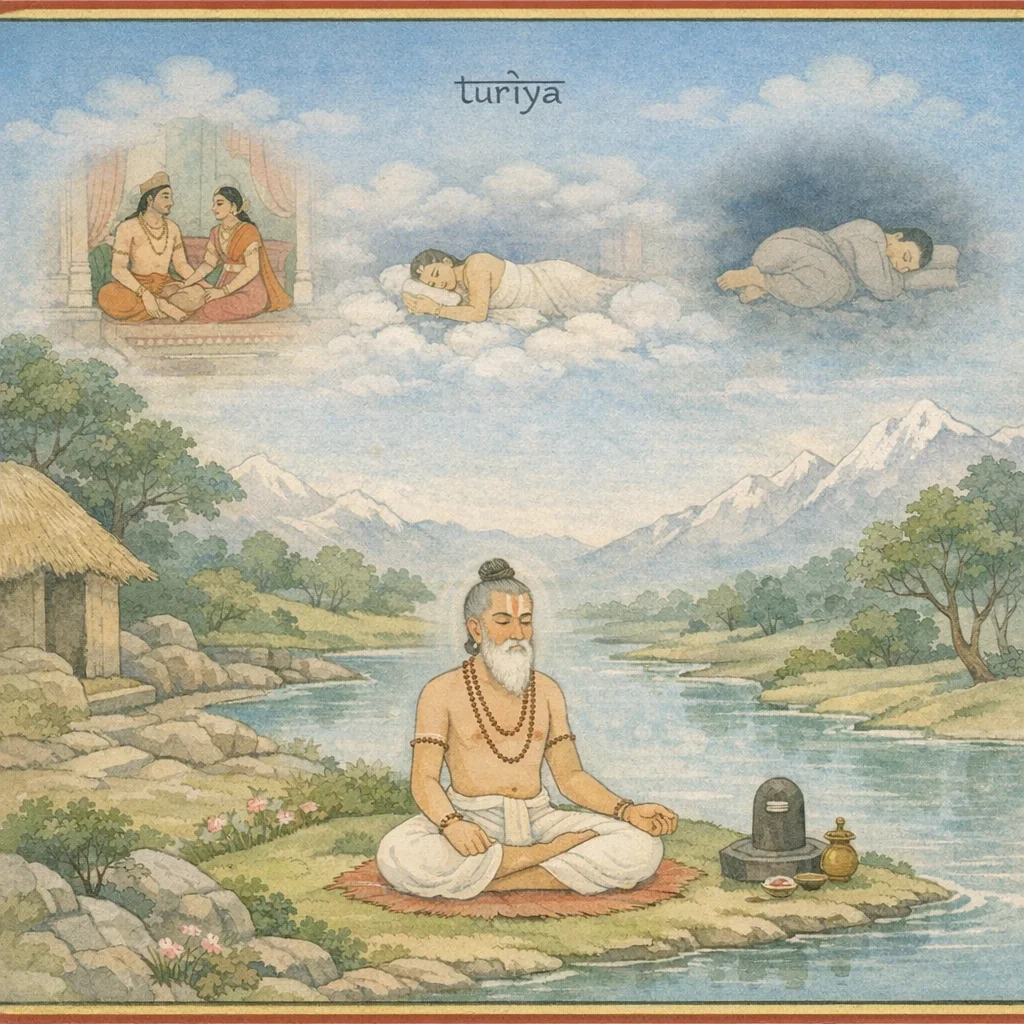
Continuing the Brahma Khanda’s drive toward liberating knowledge, Sūta presents Brahma-vidyā as a lived contemplative discipline: the seeker affirms oneness with Brahman/Viṣṇu, yet is reminded that the inner Lord bears fruit only when upheld by worship and dharma. The teaching turns from ethics to yoga by naming four bodily and verbal channels of sin and prescribing restraint—truthful, measured speech; ahiṃsā; non-stealing; sexual self-control; and moderation in food. It explains awareness in waking, dream, and deep sleep, and points beyond them to turīya, pure actionless consciousness. A subtle-body vision appears as the “city-of-eight” lotus (five sense-qualities with three guṇas), and liberation is described as transcending the psycho-physical complex and Prakṛti. The chapter details the six means of yoga (prāṇāyāma, japa, pratyāhāra, dhāraṇā, dhyāna, samādhi), gives mātrā measures for Oṁ, recommends “Oṁ namo Viṣṇave” and the Gāyatrī, and defines samādhi as nondual vision. It closes by warning of yogic obstacles and reaffirming that mokṣa comes from inner discipline and direct realization, not external form alone—bridging into further teachings on sustained practice and knowledge-centered devotion.
Shlokas
Verse 1
चतुस्त्रिंशदुत्तरद्विशततमो ऽध्यायः सूत उवाच वेदान्तसाङ्ख्यसिद्धान्तब्रह्मज्ञानं वदाम्यहम् / अहं ब्रह्म परं ज्योतिर्विष्णुरित्येव चिन्तयन्
Sūta said: “I shall expound the knowledge of Brahman established in the conclusions of Vedānta and Sāṅkhya—by contemplating thus: ‘I am Brahman, the supreme Light; I am indeed Viṣṇu.’”
Verse 2
सूर्ये हृद्व्योम्नि वह्नौ च ज्योतिरेकं त्रिधा स्थितम् / यथा सर्पिः शीरस्थं गवां न कुरुते बलम्
The one Light is established in three ways—in the Sun, in the sky of the heart, and in fire. Just as ghee, though present within milk, does not give strength to the cows until it is brought forth.
Verse 3
निर्गतं कर्मसंयुक्तं दत्तं तासां महा बलम् / तथा विष्णुः शरीरस्थो न करोति हितं नणाम्
When the embodied being departs, it goes forth bound to its karma, and to those karmic forces great power is thereby given. Likewise, even though Viṣṇu dwells within the body, He bestows no benefit upon people who do not align themselves with dharma and meritorious action.
Verse 4
विनाराधनया देवः सर्वगः परमेश्वरः / आरुरुक्षुमतीनां तु कर्मज्ञानमुदाहृतम्
Without worship, the all-pervading Supreme Lord, Parameśvara, is not truly attained; therefore, for those who seek to ascend the spiritual path, the knowledge of right action and sacred duty (dharma) is taught.
Verse 5
आरूढयोगवृक्षाणां ज्ञानं त्यागं परं मतम् / ज्ञातुमिच्छति शब्दादीन्रागो द्वेषो ऽथ जायते
For those who have climbed the tree of Yoga, the highest teaching is held to be knowledge and renunciation. Yet, when one seeks to “know” sense-objects beginning with sound, attachment and aversion arise.
Verse 6
लोभो मोहः क्रोध एतैर्युक्तः पापं नरश्चरेत् / हस्तावुपस्थमुदरं वाक्चतुर्थो चतुष्टयम्
A man, driven by greed, delusion, and anger, commits sin. The four instruments through which sin is carried out are: the two hands, the generative organ, the belly (appetite), and—fourth—the faculty of speech.
Verse 7
एतत्सुसंयतं यस्य स विप्रः कथ्यते बुधैः (धः) / परवित्तं न गृह्णाति न हिंसां कुरुते तथा
The wise declare that person to be a true vipra—one established in spiritual discipline—whose conduct is well restrained: who does not take another’s wealth and who likewise does not commit violence.
Verse 8
नाक्षक्रीडारतो यस्तु हस्तौ तस्य सुसंयतौ / परस्त्रीवर्जनरतस्तस्योपस्थं सुसंयतम्
One who does not delight in gambling has his hands well restrained; and one who delights in avoiding another man’s wife has his sexual organ well restrained.
Verse 9
अलोलुपमिदं भुङ्क्ते जठरं तस्य संयतम् / सत्यं हितं मितं ब्रूते यस्माद्वाक्तस्य संयता
He partakes of this food without greed; therefore his belly is restrained. He speaks what is true, beneficial, and measured; therefore his speech is restrained.
Verse 10
यस्य संयतान्येतानि तस्य किं तपसाध्वरैः / ऐक्यं यद्बुद्धिमनसोरिन्द्रियाणां च सर्वदा
For one who has brought these under restraint, what need is there of austerities or sacrificial rites? For him there is constant harmony—oneness—between intellect and mind, and of the senses as well.
Verse 11
सबीजं वापि निर्बोजं ध्यानमेतत्प्रकीर्तितम् / भ्रुवोर्मध्ये स्थितां बुद्धिं विषयेषु युनक्ति यः
This meditation (dhyāna) is declared to be of two kinds: with a seed (support) and without a seed (support). One who fixes the intellect in the space between the eyebrows and does not yoke it to sense-objects—he truly practices this dhyāna.
Verse 12
हन्द्रियाणामुपरमे मनसि ह्यव्यवस्थिते
When the senses have ceased to function, and the mind is indeed unsteady and ungrounded,
Verse 13
स्वप्नान्पश्यत्यसौ जीवो बाह्यानाभ्यन्तरानथ / जीवो जाग्रदवस्थायामेवमाहुर्विपाश्चितः
That individual soul (jīva) beholds dreams—some appearing as external and some as internal. Thus, the wise declare that even in the waking state the jīva functions in this manner.
Verse 14
हृदि स्थितः स तमसा मोहितो न स्मरत्यपि / यदा तस्य कुतो वेति सुषुप्तिरिति कथ्यते
Abiding in the heart, the individual consciousness is deluded by tamas and remembers nothing at all. When for him there is no awareness of “from where” or “to where,” that state is called suṣupti, deep sleep.
Verse 15
जाग्रतो यस्य नो तन्द्रा न मोहो न भ्रमस्तथा / उत्पद्यते न जानाति शब्दार्थविषयान्वशी
For one who remains wakeful, neither drowsiness nor delusion nor confusion arises; being self-controlled, he does not become entangled in the objects of sound and their meanings.
Verse 16
इन्द्रियाणि समाहृत्य विषयेभ्यो मनस्तथा / बुद्ध्याहङ्कारमपि च प्रकृत्या बुद्धिमेव च
Withdrawing the senses from their objects and restraining the mind likewise, one should also rein in the intellect (buddhi) and the ego-sense (ahaṅkāra); and by discerning Prakṛti, steady the intellect itself.
Verse 17
संयम्य प्रकृतिं चापि चिच्छक्त्या केवले स्थितः / पश्यत्यात्मानि चात्मानमात्मनात्मप्रकाशकम्
Having restrained even Prakṛti and abiding solely in the power of pure consciousness, one perceives the Self within the Self—self-luminous, revealed by the Self itself.
Verse 18
चिद्रूपममृतं शुद्धं निष्क्रियं व्यापकं शिवम् / तुरीयायामवस्थायामास्थितो ऽसौ न संशयः
He is of the nature of pure consciousness—immortal, stainless, actionless, all-pervading, and auspicious (Śiva). He abides in the fourth state (turīya); of this there is no doubt.
Verse 19
शब्दादयो गुणाः पञ्च सत्त्वाद्याश्च गुणास्त्रयः / पुर्यष्टकस्य पद्मस्य पत्राण्यष्टौ च तानि हि
Sound and the rest are the five sense-qualities, and sattva and the rest are the three guṇas. These indeed are the eight petals of the lotus called the “city-of-eight” (the subtle body).
Verse 20
साम्यावस्था गुणकृता प्रकृतिस्तत्र कर्णिका / कर्णिकायां स्थितो देवो देही चिद्रूप एव हि
In the equilibrium-state wrought by the guṇas, Prakṛti there is like the lotus’s central pericarp. In that pericarp abides the Divine; and the embodied self (dehī) is indeed of the very nature of consciousness (cit).
Verse 21
पुर्यष्टकं परित्यज्य प्रकृतिञ्च गुणात्मिकाम् / यदा याति तदा जीवो याति मुक्तिं न संशयः
When the jīva abandons the “city-of-eight” and also transcends Prakṛti, which is constituted of the three guṇas, then the jīva attains liberation—of this there is no doubt.
Verse 22
प्राणायामो जपश्चैव प्रत्याहारो ऽथ धारणा / ध्यानं समाधिरित्येते षड् योगस्य प्रसाधकाः
Breath-regulation, mantra-recitation, withdrawal of the senses, concentration, meditation, and samādhi—these six are the means that bring the discipline of Yoga to accomplishment.
Verse 23
पापक्षये देवतानां प्रीतिरिन्द्रियसंयमः / जपध्यानयुतो गर्भो विपरीतस्त्वगर्भकः
When sins are exhausted, the Devas are pleased and the senses come under restraint. A conception accompanied by japa and meditation is auspicious; but when it is the opposite, it yields a barren, fruitless outcome.
Verse 24
षट्त्रिंशन्मात्रकः श्रेष्ठश्चतुर्विंशतिमात्रकः / मध्यो द्वादशमात्रस्तु ओङ्कारं सततं जपेत्
Oṁ uttered with thirty-six mātrās is the best; that with twenty-four mātrās is also excellent; the medium measure is twelve mātrās. Therefore one should continually repeat the Oṁkāra.
Verse 25
वाचके प्रणवे ज्ञाते वाच्यं ब्रह्म प्रसीदति / (ओंनमो विष्णवे)।षष्ठाक्षरश्च जप्तव्यो गायत्त्री द्वादशाक्षरी
When the Pranava Oṁ—the sacred syllable as uttered sound—is rightly known, the Brahman to be realized becomes gracious and reveals Itself. Therefore one should repeat the six-syllabled mantra “Oṁ namo Viṣṇave,” and also the twelve-syllabled Gāyatrī.
Verse 26
सर्वेषामिन्द्रियाणां तु प्रवृतिर्विषयेषु च / निवृत्तिर्मनसस्तस्याः प्रत्याहारः प्रकीर्तितः
The senses naturally move outward toward their objects; but when the mind is withdrawn back from those objects, that turning-back is declared to be pratyāhāra (sense-withdrawal).
Verse 27
इन्द्रियाणीन्द्रियार्थेभ्यः समाहृत्य हितो हि सः / सहसा सह बुद्ध्या च प्रत्याहारेषु संस्थितः
He is truly benefited who gathers the senses back from their objects; promptly, and along with discerning intelligence (buddhi), he becomes established in the practice of pratyāhāra (sense-withdrawal).
Verse 28
प्राणायामैर्द्वादशभिर्यावत्कालःकृतो भवेत् / यस्तावत्कालपर्यन्तं मनो ब्रह्मणि धारयेत्
When the time-span equal to twelve regulated breath-cycles (prāṇāyāmas) has been completed, one should, for that very duration, hold the mind steadily in Brahman (the Supreme Reality).
Verse 29
ध्यायन्न चलते यस्य मनोभिध्यायतो भृशम्
One whose mind does not waver while meditating—who contemplates intensely and steadily.
Verse 30
प्राप्यावधिकृतं कालं यावत्सा धारणा स्मृता / ध्येये सक्तं मनो यस्य ध्येयमेवानुपश्यति
When the mind can be held steady for the prescribed time-limit, that is remembered as dhāraṇā (concentration). For one whose mind is absorbed in the object of meditation, he perceives only that object again and again.
Verse 31
नान्यं पदार्थं जानाति ध्यानमेतत्प्रकीर्तितम् / ध्येये मनो निश्चलतां याति ध्येयं विचिन्तयन्
This is proclaimed as dhyāna (meditation): one knows no other object. While contemplating the chosen object of meditation, the mind, fixed upon it, attains steadiness and becomes unmoving.
Verse 32
यत्तद्ध्यानं परं प्रोक्तं मुनिभिर्ध्यानचिन्तकैः / ध्येयमेव हि सर्वत्र ध्याता तन्मयतां गतः
This is the supreme meditation taught by sages devoted to contemplation: everywhere, the object of meditation alone is to be held. The meditator becomes absorbed into That, attaining identity with it.
Verse 33
पश्यति द्वैतरहितं समाधिः सो ऽभिधीयते / मनः सङ्कल्परहितमिन्द्रियार्थान्न चिन्तयेत्
That state in which one beholds Reality free from all duality is called samādhi. Let the mind be without saṅkalpa (mental constructions) and not dwell upon the objects of the senses.
Verse 34
यस्य ब्रह्मणि संलीनं समाधिस्थं तदोच्यते / ध्यायतः परमात्मानमात्मस्थं यस्य योगिनः
That yogin is said to be established in samādhi whose mind has merged into Brahman; and while meditating, he beholds the Paramātman, the Supreme Self, abiding within his own Self.
Verse 35
मनस्तन्मयतां याति समाधिस्थः स कीर्तितः / चित्तस्य स्थिरता भ्रान्तिर्दैर्मनस्यं प्रमादता
One whose mind becomes wholly absorbed in That (the Supreme) is said to be established in samādhi. But when the mind’s steadiness turns into delusion, dejection, and heedlessness, it is a deviation from true concentration.
Verse 36
योगिनां कथिता दोषा योगविघ्नप्रवर्तकाः / स्थित्यर्थं मनसः सर्वं स्थूलरूपं विचिन्तयेत्
The faults of yogins have been described—those that set in motion obstacles to yoga. Therefore, for the steadiness of the mind, one should contemplate everything in a gross, concrete form.
Verse 37
तद्व्रतं निश्चलीभूतं सूय्यस्थं स्थिरतां व्रजेत् / न विना परमात्मानं किञ्चिज्जगति विद्यते
Let that vow become unwavering and attain steadiness, abiding in the Sun—the luminous inner Witness. For in this world nothing whatsoever exists apart from the Paramātman, the Supreme Self.
Verse 38
विश्वरूपं तमेवैकमिति ज्ञात्वा विमुञ्चति / ओङ्कारं परमं ब्रह्म ध्यायेदब्जस्थितं विभुम्
Knowing that the One alone is that cosmic Reality of all forms, one is released. One should meditate on the syllable Oṁ as the Supreme Brahman—the all-pervading Lord abiding in the lotus of the heart.
Verse 39
क्षेत्रक्षेत्रज्ञरहितं जपेन्मात्रात्रयान्वितम् / हृदि सञ्चिन्तयेत्पूर्वं प्रधानं तस्य चोपरि
One should repeat in japa the mantra free from identification with the ‘field’ (the body) and the ‘knower of the field’ (the individual self), endowed with the three measures A‑U‑M. First contemplate Pradhāna, primordial Nature, within the heart, and then contemplate That which is above it.
Verse 40
तमो रजस्तथा सत्त्वं मण्डलत्रितयं क्रमात् / कृष्णरक्तसितं तस्मिन्पुरुषं जीवसंज्ञितम्
Tamas, rajas, and sattva—these are, in order, the three spheres: dark, red, and white. Within them is the person called the jīva, the individual living soul.
Verse 41
तस्योपरि गुणैश्वर्यमष्टपत्रं सरोरुहम् / ज्ञानं तु कर्णिका तत्र विज्ञानं केसराः स्मृताः
Upon that is the lotus of sovereign mastery over the guṇas, having eight petals. There, jñāna—knowledge—is said to be its central pericarp, and vijñāna—realized discernment—is remembered as its stamens.
Verse 42
वैराग्यनालं तत्कन्दो वैष्णवो धर्म उत्तमः / कर्णिकायां स्थितं तत्र जीववन्निश्चलं विभु
Its stalk is vairāgya—holy dispassion; its bulb-root is the supreme Vaiṣṇava dharma. There, established in the central pericarp, the all-pervading Lord abides—motionless, yet as if living within.
Verse 43
ध्यायेदुरसि संयुक्तमोङ्कारं मुक्तिसाधकम् / ध्यायन्यदि त्यजेत्प्राणान्याति ब्रह्म स्वसन्निधिम्
One should meditate upon the sacred syllable Oṃ, joined within the chest—the heart—as the means to liberation. If, while meditating, one relinquishes the life-breaths, one attains the very presence of Brahman.
Verse 44
हरिं संस्थाप्य देहाब्जे ध्यायन्यो गी च भक्तिभाक् / आत्मानमात्मना केचित्पश्यन्ति ध्यानचक्षुषः
Having established Hari within the lotus of the body—the heart—the yogin, endowed with devotion, meditates; and some, with the eye of contemplation, behold the Self by the Self.
Verse 45
सांख्यबुद्ध्या तथैवान्ये योगेनान्ये तु योगिनः / ब्रह्मप्रकाशकं ज्ञानं भवबन्धविभेदनम्
Some realize it through the discriminative insight of Sāṅkhya; others—yogins—through Yoga. This knowledge, which illumines Brahman, cuts asunder the bondage of saṃsāra.
Verse 46
तत्रैकचित्ततायोगो मुक्तिदो नात्र संशयः / जितेन्द्रियात्मकरणो ज्ञानदृप्तो हि यो भवेत्
There, the discipline of one-pointedness of mind bestows liberation—of this there is no doubt. Indeed, one who has conquered the senses and the inner instruments, and stands firm in the steadfast confidence of knowledge, becomes fit for that liberation.
Verse 47
स मुक्तः कथ्यते योगी परमात्मन्यवस्थितः / आसनस्थानविधयो न योगस्य प्रसाधकाः
That yogin is called ‘liberated’ who abides established in the Supreme Self (Paramātman). The rules regarding postures (āsana) and places of practice are not, by themselves, what accomplish Yoga.
Verse 48
विलम्बजनकाः सर्वे विस्तराः परिकीर्तिताः / शिशुपालः सिद्धिमाप स्मरणाभ्यासगौरवात्
All elaborate digressions are said to cause delay; yet Śiśupāla attained liberation through the great power of repeated remembrance of the Lord.
Verse 49
योगाभ्यासं प्रकुर्वन्तः पस्यन्त्यात्मानमात्मना / सर्वभूतेषु कारुण्यं विद्वेषं विषयेषु च
Those who diligently practice yoga behold the Self by the Self. They cultivate compassion toward all beings and dispassionate aversion toward sense-objects.
Verse 50
गुप्तशिश्रोदरादिश्च कुर्वन्योगी विमुच्यते / इन्द्रियैरिन्द्रियार्थांस्तु न जानाति नरो यदा
When a yogin practices restraint of the hidden organs, the belly, and the rest, he becomes liberated; for when a man no longer cognizes sense-objects through the senses, he is freed from bondage.
Verse 51
काष्ठवद्ब्रह्मसंलीनो योगी मुक्तस्तदा भवेत् / सर्ववर्णाः श्रियः सर्वाः कृत्वा पापानि भस्मसात्
Absorbed in Brahman like a piece of wood—utterly motionless and without ego—the yogin then becomes liberated. Having reduced sins to ashes, all forms of auspicious prosperity, of every kind, come to him.
Verse 52
ध्यानाग्निना च मेधावी लभते परमां गतिम् / मन्थनाद्दृश्यते ह्यग्निस्तद्वद्ध्यानेन वै हरिः
By the fire of meditation, the wise attain the supreme goal. As fire becomes visible through churning, so too Hari (Vishnu) is realized through meditation.
Verse 53
ब्रह्मात्मनोर्यदैकत्वं स योगश्चोत्तमोत्तमः / बाह्यरूपैर्न मुक्तिस्तु चान्तस्थैः स्याद्यमादिभिः
The realization that Brahman and the Self are one—this indeed is the highest, most excellent Yoga. Liberation does not arise from mere outward forms; it is attained through inner disciplines such as yama and the rest.
Verse 54
साङ्ख्यज्ञानेन योगेन वेदान्तश्रवणेन च / प्रत्यक्षतात्मनो या हि सा मुक्तिरभिधीयते / अनात्मन्यात्मरूपत्वमसतः सत्स्वरूपता
Through Sāṅkhya’s discriminative knowledge, through Yoga, and through listening to Vedānta, that direct realization of the Self is called liberation. Liberation is the removal of the superimposition of ‘Selfhood’ upon the non-Self, and the cessation of mistaking the unreal as having the nature of the Real.
Frequently Asked Questions
Meditation is described as supported (with a ‘seed’/object) and unsupported (without a ‘seed’). Practically, the instruction emphasizes fixing the intellect (e.g., between the eyebrows) without yoking it to sense-objects, culminating in absorption where only the chosen reality is known.
Pratyāhāra is the turning back of the mind and senses from outward-moving objects—gathering the senses inward so they no longer chase their respective fields, enabling stable concentration.
Samādhi is the nondual beholding of reality where mental constructions (saṅkalpa) cease; the mind merges into Brahman and the yogin recognizes the Supreme Self as abiding within one’s own Self.
It notes that apparent steadiness can degrade into delusion, dejection, or heedlessness—becoming a deviation from true concentration—so practitioners are advised to stabilize attention carefully (including using concrete supports when needed).