Adhyaya 230
Nārāyaṇa-Smaraṇa as the Supreme Dharma, Expiation, and Yogic Purifier
Continuing the Garuḍa Purāṇa’s stress on dharma and spiritual means, Sūta teaches Maitreya that after examining the śāstras the final conclusion is exclusive remembrance and meditation on Nārāyaṇa. The chapter contrasts outward merits—tīrthas, dāna, tapas, yajña, prāṇāyāma—with the surpassing power of smaraṇa and dhyāna, declaring that remembrance repairs ritual lapses and destroys the seeds of karma. It then turns to practical yoga: the mind’s movements in waking, dream, and deep sleep rest upon Acyuta, and perfected dhāraṇā is unwavering attention even amid daily actions. A vivid meditation-image follows—Nārāyaṇa within the solar orb, lotus-seated, radiant, bearing śaṅkha and cakra—linking contemplation to concrete visualization. The chapter closes by opening the path to all (even animals rise through surrendered mind), warning that even heaven can obstruct the highest fruit, and sealing the doctrine with Śiśupāla’s liberation through hostile remembrance—preparing the reader for later sections where inner orientation, not mere rite, determines destiny and release.
Shlokas
Verse 1
नामैकोनत्रिशदुत्तरद्विशततमो ऽध्यायः सूत उवाच / आलोक्य सर्वशास्त्राणि विचार्य च पुनः पुनः / इदमेकं सुनिष्पन्नं ध्येयो नारायणः सदा
Sūta said: Having surveyed all the scriptures and reflected upon them again and again, this one conclusion stands firmly established—Nārāyaṇa alone is ever to be meditated upon.
Verse 2
किं तस्य दानैः किन्तीर्थैः किं तपोभिः किमध्वरैः / यो नित्यं ध्यायते देवं नारायणमनन्यधीः
What need has he of gifts, pilgrimages, austerities, or sacrificial rites—he who constantly meditates on the Lord Narayana with an undivided mind?
Verse 3
षष्टिस्तीर्थसहस्राणि षष्टिस्तीर्थशतानि च / नारायणप्रणामस्य कलां नार्हन्ति षोडशीम्
Even sixty thousand sacred pilgrimage sites, and sixty hundreds of such holy places besides, do not equal even one sixteenth part of the merit obtained by bowing in reverence to Nārāyaṇa.
Verse 4
प्रयश्चित्तान्यशेषाणि तपः कर्माणि यानि वै / विद्धि तेषामशेषाणां कृष्णानुस्मरणं परम्
Know that among all expiations and all austerity-based rites, the supreme—surpassing them all—is the remembrance of Krishna.
Verse 5
कृतपापे ऽनुरक्तिश्च यस्य पुंसः प्रजायते / प्रायश्चित्तन्तु तस्यैकं हरेः संस्मरणं परम्
For the man in whom an attachment arises toward sin that has been committed, the one supreme atonement for him is the constant remembrance of Hari (Vishnu).
Verse 6
मुहूर्तमपि यो ध्यायेन्नारायणमतन्द्रितः / सो ऽपि स्वर्गतिमाप्नोति किं पुनस्तत्परायणः
Even one who, for only a single muhūrta, meditates on Nārāyaṇa with unwavering attentiveness attains the path to heaven—how much more, then, one who is wholly devoted to Him.
Verse 7
जाग्रत्स्वप्नसुषुप्तेषु योगस्थस्य च योगिनः / या काचिन्मनसो वृत्तिः सा भवत्यच्युताश्रयात्
For the yogin who abides in yoga, in waking, dreaming, and deep sleep—whatever movement of the mind may arise, that occurs only through reliance on Acyuta (the Imperishable Lord).
Verse 8
उत्तिष्ठन्निपतन्विष्णुं प्रलपन्विविशंस्तथा / भुञ्जञ्जाग्रच्च गोविन्दं माधवं यश्च संस्मरेत्
Whoever remembers Govinda—Mādhava, Viṣṇu—while rising and falling, while speaking and entering any place, while eating and while awake, keeps the Lord in constant recollection.
Verse 9
स्वेस्वे कर्मण्यभिरतः कुर्याच्चित्तं जनार्दने / एषा शास्त्रानुसारोक्तिः किमन्यैर्बहुभाषितैः
Engaged in one’s own rightful duties, one should fix the mind on Janārdana (Lord Viṣṇu). This alone is the teaching in accord with the śāstras; what use is there in much other talk?
Verse 10
ध्यानमेव परो धर्मो ध्यानमेव परं तपः / ध्यानमेव परं शौचं तस्माद्ध्यानपरो भवेत्
Meditation alone is the highest dharma; meditation alone is the supreme austerity. Meditation alone is the highest purity; therefore one should become devoted to meditation.
Verse 11
नास्ति विष्णोः परं ध्थेयं तपो नानशनात्परम् / तस्मात्प्रधानमत्रोक्तं वासुदेवस्य चिन्तनम्
There is no higher object of meditation than Viṣṇu, and no austerity greater than fasting. Therefore, what is declared here as foremost is contemplation of Vāsudeva.
Verse 12
यद्दुर्लभं परं प्राप्यं मनसो यन्न गोचरम् / तदप्यप्रार्थितं ध्यातो ददाति मधुसूदनः
Even that supreme attainment which is exceedingly hard to obtain, and which lies beyond the range of the mind—even that, unasked for, Madhusūdana grants to one who meditates upon Him.
Verse 13
प्रमादात्कुर्वतां कर्म प्रच्यवेताध्वरेषु यत् / स्मरणादेव तद्विष्णोः संपूर्णं स्यादिति श्रुतिः
The Śruti declares: whatever part of a rite (adhvara) may fall short due to inadvertence while performing actions, that very deficiency becomes complete merely by remembering Lord Viṣṇu.
Verse 14
ध्यानेन सदृशो नास्ति शोधनं पापकर्मणाम् / आगामिदेहहेतूनां दाहको योगपावकः
No purifier of sinful deeds equals meditation; the fire of yoga burns away the causes that would otherwise bring about a future embodiment.
Verse 15
विनिष्पन्नसमाधिस्तु मुक्तिमत्रैव जन्मनि / प्राप्नोति योगी योगाग्निदग्धकर्मा च यो ऽचिरात्
But the yogin whose samādhi has fully matured attains liberation in this very life; one whose karmas have been burned in the fire of yoga reaches it without delay.
Verse 16
यथाग्निरुद्यतशिखः कक्षं दहति वानिलः / तथा चित्तस्थिते विष्णौ योगिना सर्वकिल्बिषम्
Just as a wind-fanned fire with rising flames burns up dry brushwood, so too, when Viṣṇu is firmly established in the mind, the yogin burns away all sin and impurity.
Verse 17
यथाग्नियोगात्कनकममलं संप्रजायते / संप्लुष्टो वासुदेवेन मनुष्याणां सदा मलः
Just as, by contact with fire, gold becomes pure and stainless, so too the ever-present impurity of human beings is burned away by Vāsudeva.
Verse 18
गङ्गास्नानसहस्रेषु पुष्करस्नानकोटिषु / यत्पापं निलययाति स्मृते नश्यति तद्धरौ
Even after a thousand baths in the Gaṅgā and crores of baths at Puṣkara, the sin that would otherwise continue to lodge within a person is destroyed the moment Hari is remembered.
Verse 19
प्राणायामसहस्नैस्तु यत्पापं नश्यति ध्रुवम् / क्षणमात्रेण तत्पापं हरेर्ध्यानात्प्रणश्यति
That sin which surely perishes through thousands of practices of breath-control (prāṇāyāma)—that very sin is destroyed in a mere moment by meditation on Hari (Viṣṇu).
Verse 20
कलिप्रभावाद्दुष्टोक्तिः पाषण्डानां तथोक्तयः / न क्रामेन्मानसं तस्य यस्य चेतसि केशवः
Under the influence of the Kali age arise wicked sayings—and likewise the doctrines of heretics; yet they cannot enter the mind of one in whose heart Keśava (Viṣṇu) abides.
Verse 21
सा तिथिस्तदहोरात्रं स योगः स च चन्द्रमाः / लग्नं तदेव विख्यातं यत्र संस्मर्यते हरिः
That alone is the true lunar day (tithi); that alone is the full day-and-night; that alone is the auspicious yoga and that alone is the Moon; that alone is renowned as the right ascendant—where Hari is remembered.
Verse 22
सा हानिस्तन्महच्छिद्रं सा चार्थजडमूकता / चन्मुहूर्तं क्षणो वापि वासुदेवो न चिन्त्यते
That is true loss; that is a great breach in one’s life. That is indeed dullness and speechless folly—when, even for a single muhūrta or even a moment, Vāsudeva is not remembered.
Verse 23
कलौ कृत युगं तस्य कलिस्तस्य कृते युगे / हृदि नो यस्य गोविन्दो यस्य चेतसि नाच्युतः
For that person, even in the age of Kali it becomes as though the Kṛta (Satya) Yuga; for him, Kali is as if Kṛta Yuga—because Govinda is not absent from his heart and Acyuta is not absent from his mind.
Verse 24
यस्याग्रतस्तथा पृष्ठे गच्छतस्तिष्ठतो ऽपि वा / गोविन्दे नियतं चेतः कृतकृत्यः सदैव सः
He whose mind remains steadily fixed on Govinda—whether He is before him or behind him, whether he is walking or even standing still—such a person is ever fulfilled, having accomplished what truly needs to be done.
Verse 25
वासुदेवे मनो यस्य जपहोमार्चनादिषु / तस्यान्तरायो मैत्रेय वेवेन्द्रत्वादिकं फलम्
O Maitreya, for one whose mind is fixed on Vāsudeva through practices such as japa (repetition), homa (oblations), and arcana (worship), even the attainment of lordship among the gods (Indrahood and the like) becomes an obstacle to the supreme fruit.
Verse 26
असंत्यज्य च गार्हस्थयं स तप्त्वा च महत्तपः / छिनत्ति पौरुषीं मायां केशवार्पितमानसः
Without abandoning the householder’s life, and having performed great austerity, the one whose mind is offered to Keśava cuts through the delusion born of mere human self-assertion.
Verse 27
क्षमां कुर्वन्ति क्रुद्धेषु दयां मूर्खेषु मानवाः / मुदञ्च धर्मशीलेषु गोविन्दे हृदयस्थिते
People show forgiveness toward the angry, compassion toward the foolish, and joy in the company of the virtuous—when Govinda abides within the heart.
Verse 28
ध्यायेन्नारायणं देवं स्नानदानादिकर्मसु / प्रायश्चितेतेषु सर्वेषु दुष्कृतेषु विशेषतः
One should meditate on Lord Nārāyaṇa during acts such as bathing, charity, and other rites—especially in all forms of expiation (prāyaścitta) undertaken for misdeeds.
Verse 29
लाभस्तेषां जयस्तेषां कुतस्तेषां पराभवः / येषामिन्दीवरश्यामो हृदयस्थो जनार्दनः
Gain is theirs; victory is theirs—how could defeat ever be theirs—when Janārdana, dark as a blue lotus, dwells firmly established within their hearts.
Verse 30
कीटपक्षिगणानाञ्च हरौ संन्यस्तचेतसाम् / ऊर्ध्वा ह्येव गतिश्चास्ति किं पुनर्ज्ञानिनां नृणाम्
Even for hosts of insects and birds whose minds are surrendered to Hari, there is indeed an upward course to a higher destiny. How much more, then, for human beings who possess spiritual knowledge?
Verse 31
वासुदेवतरुच्छाया नातिशीतातितापदा / नरकद्वारशमनी सा किमर्थं न सेव्यते
The shade of the Vāsudeva-tree is neither excessively cold nor excessively hot; it pacifies even the gateway to hell—why, then, is it not sought and served?
Verse 32
न च दुर्वाससः शापो राज्यञ्चापि शचीपतेः / हन्तुं समर्थं हि सखे हृत्कृते मधुसूदने
Neither the curse of Durvāsas nor even the sovereignty of Śacīpati (Indra) can do harm, O friend, when Madhusūdana has been enshrined within the heart.
Verse 33
वदतस्तिष्ठतो ऽन्यद्वा स्वेच्छया कर्म कुर्वतः / नापयाति यदा चिन्ता सिद्धां मन्येत धारणाम्
Whether one is speaking, standing, or doing any other action by one’s own will—when the mind’s stream of thought does not wander away, one should regard that concentration (dhāraṇā) as perfected.
Verse 34
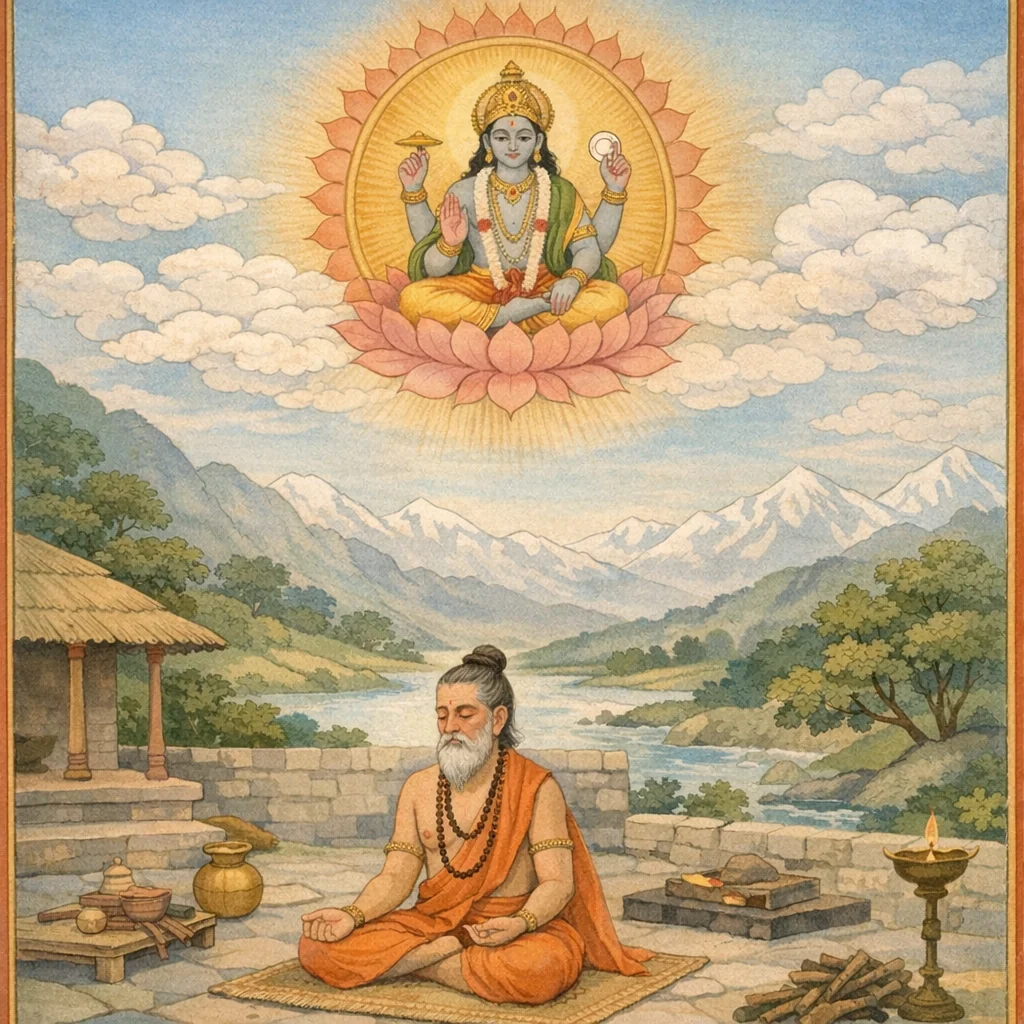
ध्येयः सदा सवितृमण्डलमध्यवर्तो नारायणः सरसिजासनसन्निविष्टः / केयूरवान्मकरकुण्डलवान्किरीटी हारी हिरण्मयवपुर्धृतशङ्खचक्रः
One should ever meditate upon Nārāyaṇa, abiding in the very center of the Sun’s orb, seated upon a lotus-throne—adorned with armlets, wearing makara-shaped earrings and a crown, bearing necklace and garland, radiant with a golden form, and holding the conch and the discus.
Verse 35
न हि ध्यानेन सदृशं पवित्रमिह विद्यते / श्वपचान्नानि भुञ्जानो पापी नैवात्र लिप्यते
Truly, nothing in this world is as purifying as meditation. Even a sinful person who eats food obtained from a dog-cooker (an outcaste) is not tainted here, when firmly established in such contemplation.
Verse 36
सदा चित्तं समासक्तं जन्तोर्विषयगोचरे / यदि नारायणे ऽप्येवं को न मुच्येत बन्धनात्
A creature’s mind is ever deeply attached to the range of sense-objects. If it becomes so steadfastly attached even to Nārāyaṇa, then who would not be freed from bondage?
Verse 37
सूत उवाच / विष्णुभक्तिर्यस्य चित्ते कं वा जीवो नमेत्सदा / स तारयति चात्मानं तदैव दुरितार्णवात्
Sūta said: In whose heart devotion to Viṣṇu abides—whom else would a living being ever bow to? Such a person delivers his own self at once from the ocean of sin and suffering.
Verse 38
तञ्ज्ञानं यत्र गोविन्दः सा कथा यत्र काशवः / तत्कर्म यत्तदर्थाय किमन्यैर्बहुभाषितैः
That alone is true knowledge wherein Govinda is the object. That alone is true discourse wherein Keśava is the theme. That alone is true action which is done for His sake—what need is there of much other talk?
Verse 39
सा जिह्वा या हरिं स्तौति तच्चित्तं यत्तदर्पितम् / तावेव केवलौ श्लाघ्यौ यौ तत्पूजाकरौ करौ
That alone is a true tongue which praises Hari; that alone is a true mind which is offered to Him. Only those two hands are truly worthy of praise which perform His worship.
Verse 40
प्रणाममीशस्य शिरः फलं विदुस्तदर्चनं पाणिफलं दिवौकसः / मनः फलं तद्गुणकर्मचिन्तनं वचस्तु गोविन्दगुणस्तुतिः फलम्
The wise know that bowing to the Lord is the true fruition of the head; worship of Him is the fruition of the hands. The fruit of the mind is contemplation on His qualities and deeds; and the fruit of speech is praise of Govinda’s virtues.
Verse 41
मेरुमन्दरमात्रो ऽपि राशिः पापस्य कर्मणः / केशवस्मरणादेव तस्य सर्वं विनश्यति
Even if the heap of sinful deeds is as vast as Meru and Mandara, by the mere remembrance of Keśava it all is destroyed.
Verse 42
यत्किञ्चित्कुरुते कर्म पुरुषः साध्वसाधु वा / सर्वं नारायणे न्यस्य कुर्वन्नपि न लिम्पति
Whatever action a person performs—whether virtuous or sinful—by placing it all in Nārāyaṇa as an offering and acting in that spirit, one is not tainted by it even while doing it.
Verse 43
तृणादिचतुरास्यान्तं भूतग्रामं चतुर्विधम् / चराचरं जगत्सर्वं प्रसुप्तं मायया तव
From blades of grass up to the four-faced Brahmā, the entire fourfold multitude of beings—everything in the universe, moving and unmoving—lies as though asleep under Your māyā.
Verse 44
यस्मिन्न्यस्तमतिर्न याति नरकं स्वर्गो ऽपि यच्चिन्तने विघ्नो यत्र नवा विशेत्कथमपि ब्राह्मो ऽपिलोको ऽल्पकः / मुक्तिञ्चेतसि संस्थितो जडधियां पुंसां ददात्यव्ययः किञ्चित्रं यदयं प्रयाति विलयं तत्राच्युते कीर्तिते
One who has set the mind in Him does not go to hell; even heaven becomes an obstacle when He is contemplated. Where no hindrance can enter in any way, even Brahmā’s world seems small. The Imperishable Lord, abiding in the heart, grants moksha even to those of dull understanding. What wonder, then, that all else dissolves away, when the Undecaying Acyuta is praised there?
Verse 45
अग्निकार्यं जपः स्नानं विष्णोर्ध्यानञ्च पूजनम् / गन्तुं दुः खोदधेः कुर्युर्ये च तत्र नरन्ति ते
Those who there perform fire-offerings, japa, purifying bathing, meditation on Viṣṇu, and worship—such people make the crossing of the ocean of sorrow possible; indeed, they are the ones who help one reach the far shore.
Verse 46
राष्ट्रस्य शरणं राजा पितरो बालकस्य च / धर्मश्च सर्वमर्त्यानां सर्वस्य शरणं हरिः
For a kingdom, the king is the refuge; for a child, the ancestors and elders are the refuge. For all mortals, Dharma is the refuge; and for everyone, Hari (Viṣṇu) is the ultimate refuge.
Verse 47
ये नमन्ति जगद्योनिं वासुदेवं सनातनम् / न येभ्यो विद्यते तीर्थमधिकं मुनिसत्तम्
Those who bow to the eternal Vāsudeva—the womb and source of the universe—have no pilgrimage-place (tīrtha) superior to them, O best of sages.
Verse 48
अनर्घरत्नपूजाञ्च कुर्यात्स्वाध्यायमेव च / तमेवोद्दिश्य गोविन्दं ध्यायन्नित्यमतन्द्रितः
One should perform worship with precious gems and also engage in svādhyāya (sacred self-study). Fixing one’s intention solely on Govinda, one should meditate on Him constantly, without negligence.
Verse 49
शूद्रं वा भगवद्भक्तं निषादं श्वपचं तथा / द्विजजाति समंमन्यो न याति नरकं नरः
A man does not go to hell if he regards as equal to the twice-born a Śūdra devoted to Bhagavān, as well as a Niṣāda and even a śvapaca (outcaste), when they are the Lord’s devotees.
Verse 50
आदरेण सदा स्तौति धनवन्तं धनेच्छया / तथा विश्वस्य कर्तारं को न मुच्येत बन्धनात्
If one, desiring wealth, always praises a wealthy man with deference, then by praising with reverence the Creator of the universe—who would not be released from bondage?
Verse 51
यथा प्राप्तवनो वह्निर्दहत्यार्द्रमपीन्धनम् / तथाविधः स्थितो विष्णुर्योगिनां सर्वकिल्विषम्
Just as a forest fire, once it has spread, burns even damp fuel, so too does Lord Viṣṇu, abiding thus as the Indweller, burn away all the sins of yogins.
Verse 52
आदीप्तं पर्वतं यद्वन्नाश्रयन्ति मृगादयः / तद्वत्पापनि सर्वाणि योगाभ्यासरतं नरम्
Just as deer and other creatures do not take shelter on a blazing mountain, so too all sins do not cling to a man devoted to the disciplined practice of yoga.
Verse 53
यस्य यावांश्च विश्वासस्तस्य सिद्धिस्तु तावती / एतवानेव कृष्णस्य प्रभावः परिमीयते
As great as a person’s faith is, so great indeed is that person’s attainment. By this alone is the power—the grace—of Kṛṣṇa understood and measured.
Verse 54
विद्वेषादपि गोविन्दं दमघोषात्मजः स्मरन् / शिशुपालो गतस्तत्त्वं किं पुनस्तत्परायणः
Even through hatred, by remembering Govinda, Śiśupāla—the son of Damaghoṣa—attained the Supreme Reality; how much more, then, will one wholly devoted and surrendered to Him attain it.
Frequently Asked Questions
The text frames smaraṇa as direct alignment with the Supreme (Nārāyaṇa), whereas tīrtha-merit is indirect and incremental. By asserting that even vast numbers of pilgrimage sites do not equal a fraction of the merit of bowing to Nārāyaṇa, it elevates inner God-centered consciousness above external sacred geography.
The chapter teaches a Nārāyaṇa-ārpaṇa-bhāva: whether actions are conventionally ‘good’ or ‘bad’, when performed with the orientation of offering to the Lord and with non-separative devotion, the doer is not bound in the usual way. This echoes karma-yoga logic: attachment and ego-claim are the binding factors, not action alone.
Nārāyaṇa is to be meditated upon in the center of the Sun’s orb (sūrya-maṇḍala), seated on a lotus-throne, adorned with armlets, makara-shaped earrings, crown, and garland, radiant and golden, holding conch (śaṅkha) and discus (cakra). This provides a concrete visualization template for upāsanā.
The chapter uses Śiśupāla as a limiting-case proof: intense, uninterrupted fixation on Govinda—even if motivated by hostility—can culminate in absorption because the mind is continually bound to the Divine object. The implied hierarchy remains: loving devotion is superior, but the example demonstrates the absolute potency of sustained God-remembrance.