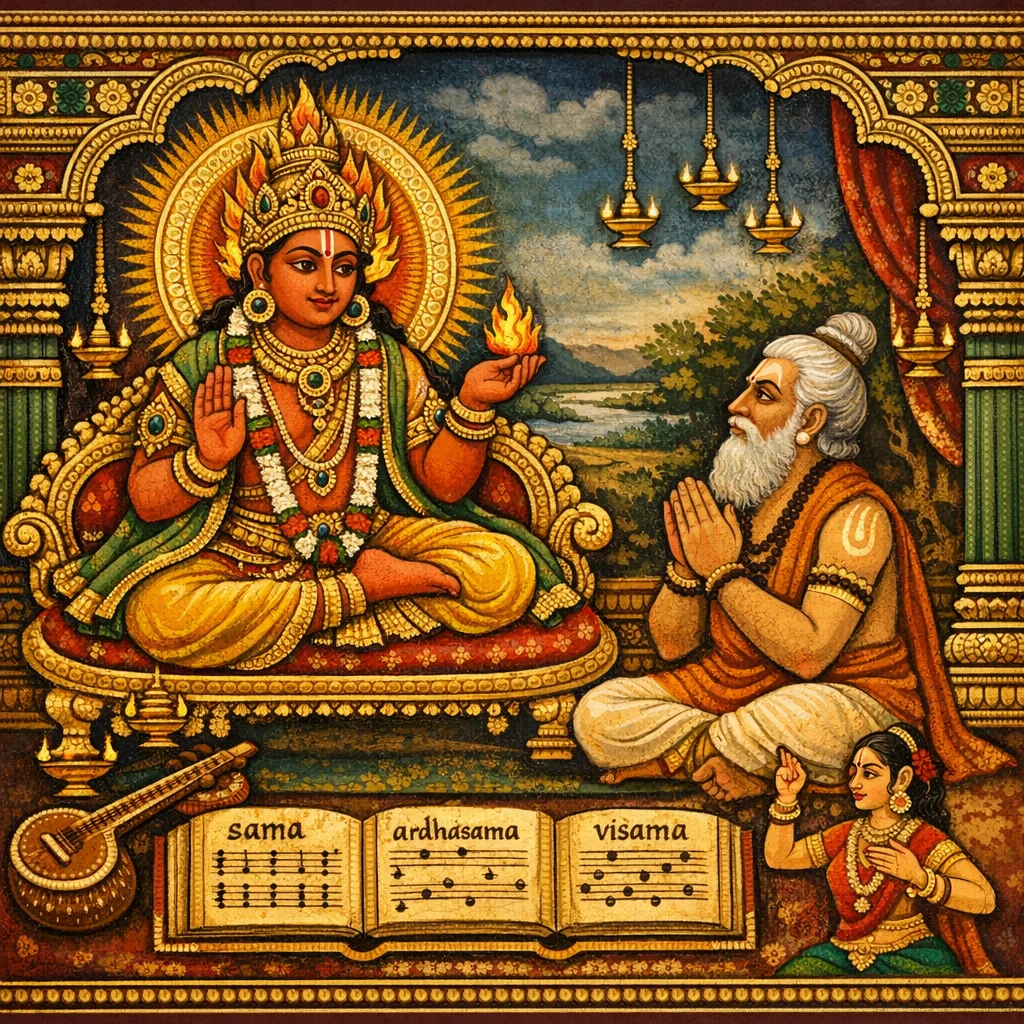
Adhyaya 336
Chapter 336 — काव्यादिलक्षणम् (Definitions of Poetry and Related Arts)
Lord Agni begins a systematic exposition of Sahitya-śāstra by defining the building blocks of vāṅmaya (verbal/literary expression): dhvani (sound), varṇa (phoneme), pada (word), and vākya (sentence). He distinguishes śāstra and itihāsa by their communicative priority—verbal formulation versus settled purport—and frames poetry through the primacy of abhidhā (denotation), stressing the rarity of true learning, poetic power, and discernment. Moving from linguistic foundations (inflections, sentence delimitation) to evaluative poetics, he states that kāvya is adorned with alaṅkāra, endowed with guṇas, and free from doṣas, drawing authority from both Veda and loka (usage). Agni then classifies composition by language register and by form (prose, verse, mixed), detailing prose sub-styles and the five gadyakāvya genres: ākhyāyikā, kathā, khaṇḍakathā, parikathā, kathānikā. The latter half introduces metrics (chandas) and major verse-forms, culminating in mahākāvya-lakṣaṇa: the great epic is enriched by rīti and rasa, with rasa declared the life of poetry even when verbal ingenuity dominates—uniting technical craft with aesthetic-spiritual purpose.
Shlokas
Verse 1
इत्य् आग्नेये महापुराणे शिक्षानिरूपणं नाम पञ्चत्रिंशदधिकत्रिशततमो ऽध्यायः खटवसा इति ख अथ षट्त्रिंशदधिकत्रिशततमो ऽध्यायः काव्यादिलक्षणं अग्निर् उवाच काव्यस्य नाटकादेश् च अलङ्कारान् वदाम्य् अथ ध्वनिर्वर्णाः पदं वाक्यमित्येतद्वाङ्मयं मतं
Thus, in the Agni Mahāpurāṇa, the chapter called “Exposition of Śikṣā (phonetics)”—the three-hundred-and-thirty-fifth—comes to its conclusion. [Textual marker: “khaṭavasā”.] Now begins the three-hundred-and-thirty-sixth chapter, “Definitions of Poetry and related arts.” Agni said: “Now I shall explain the ornaments (alaṅkāras) of poetry, of drama, and the rest. Dhvani (resonant suggestion), varṇas (phonemes), the word (pada), and the sentence (vākya)—this is what is regarded as verbal/literary expression (vāṅmaya).”
Verse 2
शास्त्रेतिहासवाक्यानां त्रयं यत्र समाप्यते शास्त्रे शब्दप्रधानत्वमितिहासेषु निष्ठता
Where the three kinds of statements—those of śāstra and those of itihāsa—are brought to completion, that is, defined and delimited, in śāstra the primacy lies in verbal formulation (śabda), while in the itihāsas the emphasis lies in settled purport and faithful adherence to the truth of the narrative.
Verse 3
अभिधायाः प्रधानत्वात् काव्यं ताभ्यां विभिद्यते नरत्वं दुर्लभं लोके विद्या तत्र च दुर्लभा
Because denotative expression (abhidhā) is primary, poetry (kāvya) is classified into two kinds on that basis. In the world, human birth is rare—and within that, true learning is rarer still.
Verse 4
कवित्वं दुर्लभं तत्र शक्तिस्तत्र च दुर्लभा व्युत्पातिर्दुर्लभा तत्र विवेकस्तत्र दुर्लभः
There, poetic genius (kavitva) is rare; there too, expressive power (śakti) is rare. There, learned mastery through study and usage (vyutpatti) is rare; and there, discriminating judgment (viveka) is also rare.
Verse 5
सर्वं शास्त्रमविद्वद्भिर्मृग्यमाणन्न सिध्यति आदिवर्णा द्वितीयाश् च महाप्राणस्तुरीयकः
No treatise (śāstra) is successfully mastered when sought by the unlearned. The first class of letters, the second class as well, and the fourth are to be known as ‘mahāprāṇa’ sounds—strongly aspirated.
Verse 6
वर्गेषु वर्णवृन्दं स्यात् पदं सुप्तिड्प्रभेदतः सङ्क्षेपाद्वाक्यमिष्टार्थव्यवछिन्ना पदाबली
Within the phonetic classes (varga), a cluster of sounds is called a ‘varṇa-vṛnda’ (group of letters). A ‘pada’ (word) is that which is differentiated by nominal and verbal inflections (sup and tiṅ). In brief, a ‘vākya’ (sentence) is a sequence of words delimited so as to convey the intended meaning.
Verse 7
काव्यं स्फुटदलङ्कारं गुणवद्दोषवर्जितम् योनिर्वेदश् च लोकश् च सिद्धमन्नादयोनिजं
Poetry (kāvya) is that in which the ornaments (alaṅkāras) are clearly manifest, which is endowed with excellences (guṇas) and free from faults (doṣas). Its sources are the Veda and worldly usage (loka); it is an established art, born from the primal sources beginning with ‘speech/food’—the foundations of human expression and sustenance.
Verse 8
देवादीनाम् संस्कृतं स्यात् प्राकृतं त्रिविधं नृणां गद्यं पद्यञ्च मिश्रञ्च काव्यादि त्रिविधं स्मृतम्
For the gods and those of their order, the language is Sanskrit; for human beings, Prakrit is of three kinds. Literary composition (kāvya and related forms) is likewise remembered as threefold: prose, verse, and mixed.
Verse 9
अपदः पदसन्तानो गद्यन्तदपि गद्यते चूर्णकोत्कलिकागन्धिवृत्तभेदात् त्रिरूपकम्
A continuous sequence of words without metrical feet (apada) is called prose; and even what has a verse-like closing cadence is still termed prose. Owing to differences in stylistic mode—cūrṇaka, utkalikā, and gandhī—this prose-form is classified in three ways.
Verse 10
अल्पाल्पविग्रहं नातिमृदुसन्दर्भनिर्भरं चूर्णकं नाम्तो दीर्घसमासात् कलिका भवेत्
A composition called cūrṇaka contains only a small degree of vigrāha (syntactic unpacking) and is not densely dependent on overly soft, smooth linkage; but when it is fashioned with long compounds, it becomes a kalikā.
Verse 11
भवेन्मध्यमसन्दर्भन्नातिकुत्सितविग्रहम् वृत्तच्छायाहरं वृत्तं गन्धिनैतत् किलोत्कटम्
It should have a moderate connectedness of expression, and its vigrāha (structure) should not be overly faulty. A metre (vṛtta) that steals the “shade”—that is, the characteristic cadence—of another metre is called gandhin (tainted/mixed); indeed, that is regarded as a serious defect.
Verse 12
आख्यायिका कथा खण्डकथा परिकथा तथा कथानिकेति मन्यन्ते गद्यकाव्यञ्च पञ्चधा
They consider prose literature (gadyakāvya) to be of five kinds: ākhyāyikā, kathā, khaṇḍakathā, parikathā, and kathānikā.
Verse 13
कर्तृवंशप्रशंसा स्याद्यत्र गद्येन विस्तरात् कन्याहरणसंग्रामविप्रलम्भविपत्तयः
That composition is the one in which, in expansive prose, the author’s lineage is praised, together with episodes such as the abduction of a maiden, battles, separation in love, and calamities.
Verse 14
भवन्ति यत्र दीप्ताश् च रीतिवृत्तिप्रवृत्तयः उच्छासैश् च परिच्छेदो यत्र या चूर्णकोत्तरा
That metrical composition is the one in which the usages of style (rīti) and the movement of metre (vṛtta) become vivid; where division is made by pauses (ucchvāsa), and where there is a concluding cadence called “cūrṇakottarā.”
Verse 15
वक्त्रं वापरवक्त्रं वा यत्र साख्यायिका स्मृता श्लोकैः स्ववंशं संक्षेपात् कविर्यत्र प्रशंसति
That composition is remembered as an ākhyāyikā (a formal narrative) in which the account is presented either in the poet’s own voice or through another speaker, and in which the poet, by means of verses (ślokas), briefly praises his own lineage.
Verse 16
सुख्यस्यार्थावताराय भवेद्यत्र कथान्तरम् परिच्छेदो न यत्र स्याद्भवेद्वालम्भकैः क्वचित्
There, a subsidiary episode (kathāntara) should be introduced only to make the intended meaning clearly enter in (artha-avatāra) and for the reader’s ease; and where there is no proper division (pariccheda), one may at times employ supporting link-passages (vālambhaka) to hold the narrative together.
Verse 17
सा कथा नाम तद्गर्भे निबध्नीयाच्चतुष्पदीं भवेत् खण्डकथा यासौ यासौ परिकथा तयोः
It is called a kathā (a full narrative) when, within its body, one composes an embedded catuṣpadī (a four-line/four-foot unit). Whatever is a fragmentary narrative is termed a khaṇḍa-kathā; and whatever is an ancillary, episodic narrative is termed a parikathā—thus these two are distinguished.
Verse 18
अमात्यं सार्थकं वापि द्विजं वा नायकं विदुः स्यात्तयोः करुणं विद्धि विप्रलम्भश् चतुर्विधः
They recognize as the dramatic hero (nāyaka) either a minister (amātya), a caravan-leader/merchant (sārthaka), or a Brāhmaṇa (dvija). In these cases, know that the dominant rasa is Karuṇa (pathos/compassion), and that separation (vipralambha) is fourfold.
Verse 19
समाप्यते तयोर् नाद्या सा कथामनुधावति कथाख्यायिकयोर्मिश्रभावात् परिकथा स्मृता
When the first of the two narratives is completed, the subsequent one proceeds along the course of a kathā. Because it is a mixed form of kathā and ākhyāyikā, it is remembered as the genre called parikathā.
Verse 20
भयानकं सुखपरं गर्भे च करुणो रसः अद्भुतो ऽन्ते सुकॢप्तार्थो नोदात्ता सा कथानिका
That narrative is called a kathānikā (short tale) which is fearsome yet oriented toward a pleasing outcome, bears Karuṇa rasa (compassion/pathos) in its middle, ends in Adbhuta (wonder), is well-constructed in meaning, and does not employ the elevated udātta style.
Verse 21
पद्यं चतुष्पदी तच्च वृत्तं जातिरितित्रिधा वृत्तमक्षरसंख्येयमुक्थं तत् कृतिशेषजम्
A metrical composition (padya) is four-lined, and it is of three kinds: (1) vṛtta, (2) jāti, and (3) what is called uktha, arising from what remains after metrical construction (kṛti). The vṛtta is determined by counting syllables (akṣaras).
Verse 22
मात्राभिर्गणना सा जातिरिति काश्यपः सममर्धसमं वृत्तं विषमं पैङ्गलं त्रिधा
According to Kāśyapa, counting by mātrās (metrical time-units) is called jāti. And vṛtta (metre), in Piṅgala’s system, is threefold: sama, ardhasama, and viṣama.
Verse 23
सा विद्या नौस्तितीषूर्णां गभीरं काव्यसागरं महाकाव्यं कलापश् च पर्याबन्धो विशेषकम्
That learning is a boat for those who wish to cross the deep ocean of poetry: it elucidates the mahākāvya (great epic), the kalāpa (poetic compendium), the paryābandha (a tightly structured composition), and the viśeṣaka (a specialized poetic form).
Verse 24
कुलकं मुक्तकं कोष इति पद्यकुटुम्बकम् सर्गबन्धो महाकाव्यमारब्धं संस्कृतेन यत्
A “padyakuṭumbaka” (a cluster or family of verses) is of the types kulaka, muktaka, and koṣa. A composition begun in polished Sanskrit and arranged as a sequence of cantos (sarga-bandha) is called a mahākāvya (epic poem).
Verse 25
तादात्म्यमजहत्तत्र तत्समं नाति दुष्यति इतिहासकथोद्भूतमितरद्वा सदाश्रयं
There, an identification (tādātmya) that does not abandon the principal sense is acceptable; and what is equivalent to it is not a serious fault. Whether arising from an itihāsa (epic) or a kathā (narrative), or from some other source, it should always rest upon a proper and well-grounded basis.
Verse 26
मन्त्रदूतप्रयाणाजिनियतं नातिविस्तरम् शक्कर्यातिजगत्यातिशक्कर्या त्रिष्टुभा तथा
The metres called Mantra-dūta, Prayāṇa, and Ājinī are regulated and not overly extended; likewise the metres Śakkarī, Ati-jagatī, Ati-śakkarī, and also Triṣṭubh are enumerated and recognized.
Verse 27
पुष्पिताग्रादिभिर्वक्राभिजनैश्चारुभिः समैः मुक्ता तु भिन्नवृत्तान्ता नातिसंक्षिप्तसर्गकम्
A composition adorned with “puṣpitāgra” (“flowering tips”) and the like, furnished with elegant obliqueness and noble diction, pleasing and even in cadence, is called Muktā—its sequences of episodes are varied, and its cantos (sarga) are not excessively condensed.
Verse 28
अतिशर्क्वरिकाष्टिभ्यामेकसङ्कीर्णकैः परः मात्रयाप्यपरः सर्गः प्राशस्त्येषु च पश्चिमः
Beyond the metres described earlier come the varieties called Atiśarkvarī and Kāṣṭī; then the mixed metres produced by a single mode of mixture. Another class is distinguished by mātrā (syllabic quantity); and among the laudatory metres used for eulogy, the last-mentioned variety is called Paścima.
Verse 29
कल्पो ऽतिनिन्दितस्तस्मिन्विशेषानादरः सतां नगरार्णवशैलर्तु चन्द्रार्काश्रमपादपैः
In that kind of composition, the kalpa (stylistic construction) is greatly censured: it disregards distinctions acknowledged by the learned, through improper or indiscriminate use of words such as “city,” “ocean,” “mountain,” “season,” “moon,” “sun,” “āśrama (hermitage),” and “tree.”
Verse 30
उद्यानसलिलक्रीडामधुपानरतोत्सवैः दूतीवचनविन्यासैर् असतीचरिताद्भूतैः
Through garden-and-water amusements, revelry devoted to drinking madhu (mead), festive indulgences, the artful phrasing of a dūtī’s (go-between’s) messages, and the astonishing exploits that mark an unchaste woman’s conduct—(she is thus depicted).
Verse 31
तमसा मरुताप्यन्यैर् विभावैर् अतिनिर्भरैः कश्यप इति ज , ञ , ट च तादर्थमजहत्तत्रेति ज अनुष्टुभेति ज व्यक्तेति ञ सर्ववृत्तिप्रवृत्तञ्च सर्वभावप्रभावितम्
Overpowered by darkness, by the wind, and by other intensely forceful agencies, the reading is recorded as “kaśyapa” according to the ja-, ña-, and ṭa-traditions. There, the ja-tradition notes, “it did not abandon its intended sense,” and also, “in the anuṣṭubh-metre,” says the ja-tradition; while “manifest,” says the ña-tradition—thus describing that which sets all functions into motion and is influenced by all states of being.
Verse 32
सर्वरीतिरसैः पुष्टं पुष्टङ्गुणविभूषणैः अत एव महाकाव्यं तत्कर्ता च महाकविः
That composition which is enriched with all rīti (styles) and all rasa (aesthetic sentiments), and adorned with fully developed guṇa (poetic qualities) and embellishments—therefore it is called a mahākāvya (great epic poem), and its composer is called a mahākavi (great poet).
Verse 33
वाग्वैदग्ध्यप्रधानेपि रस एवात्र जीवितम् पृथक्प्रयत्ननिर्वर्त्यं वाग्वक्रिम्नि रसाद्वपुः
Even when verbal cleverness predominates, rasa alone is the life-breath of poetry here. The artful obliqueness of speech is produced by a distinct effort, yet its very body is made of rasa.
Verse 34
चतुर्वर्गफलं विश्वग्व्याख्यातं नायकाख्यया समानवृत्तिनिर्व्यूटः कौशिकीवृत्तिकोमलः
Its result is the attainment of the four aims of life, and it is explained as universally applicable under the designation “Nāyaka”. It is composed in sama-vṛtta (an isometric metre) and is gentle in character, belonging to the Kauśikī vṛtti (the graceful style).
Verse 35
कलापो ऽत्र प्रवासः प्रागनुरागाह्वयो रसः सविशेषकञ्च प्राप्त्यादि संस्कृतेनेत्रेण च
Here, the sequence of themes is: pravāsa, separation caused by going abroad; then the rasa called prāg-anurāga, “prior love”; and also the sa-viśeṣaka, a particularized treatment, together with attainment (prāpti) and related stages—these are to be discerned through a refined eye, that is, through cultivated Sanskritic understanding.
Verse 36
श्लोकैर् अनेकैः कुलकं स्यात् सन्दानितकानि तत् मुक्तकं श्लोक एकैकश् चमत्कारक्षमः सता ं
When a composition consists of many ślokas, it is called a kulaka; that is also termed sandānitaka, a linked sequence. A muktaka, however, is a single śloka—each one, by itself, capable of producing poetic charm for discerning readers.
Verse 37
सूक्तिभिः कविसिंहानां सुन्दरीभिः समन्वितः कोषो ब्रह्मापरिच्छिन्नः स विदग्धाय रोचते
A treasury endowed with the beautiful well-spoken utterances (sukti) of lion-like poets—an inexhaustible store not delimited even by Brahmā—delights the discerning connoisseur.
Verse 38
आभासोपमशक्तिश् च सर्गे यद्भिन्नवृत्तता मिश्रं वपुरिति ख्यातं प्रकीर्णमिति च द्विधा श्रव्यञ्चैवाभिनेयञ्च प्रकीर्णं सकलोक्तिभिः
When, within a sarga (canto), there is a varied use of metres together with the figures called Ābhāsa, Upamā, and Śakti, that composition is known as “Miśra-vapu” (the mixed form). It is also termed “Prakīrṇa” (miscellaneous), of two kinds: (1) to be heard (śravya) and (2) to be enacted (ābhineya), furnished with all kinds of utterances and dialogic expressions.
Frequently Asked Questions
It defines the hierarchy of verbal units (dhvani–varṇa–pada–vākya), specifies pada via sup/tiṅ inflections, defines vākya as an intended-meaning-delimited word-sequence, and classifies metres by akṣara-count (vṛtta) and mātrā-count (jāti), including Piṅgala’s sama/ardhasama/viṣama scheme.
By treating literary science as disciplined speech aligned with dharma: it anchors poetry in Veda and loka, demands freedom from doṣa and cultivation of guṇa, and places rasa as the ‘life’ of expression—training discernment (viveka) and refined cognition that can support ethical living and inner purification.
As composition with clearly manifest alaṅkāras, endowed with guṇas, and devoid of doṣas, grounded in both Vedic authority and established worldly usage.
Ākhyāyikā, kathā, khaṇḍakathā, parikathā, and kathānikā.