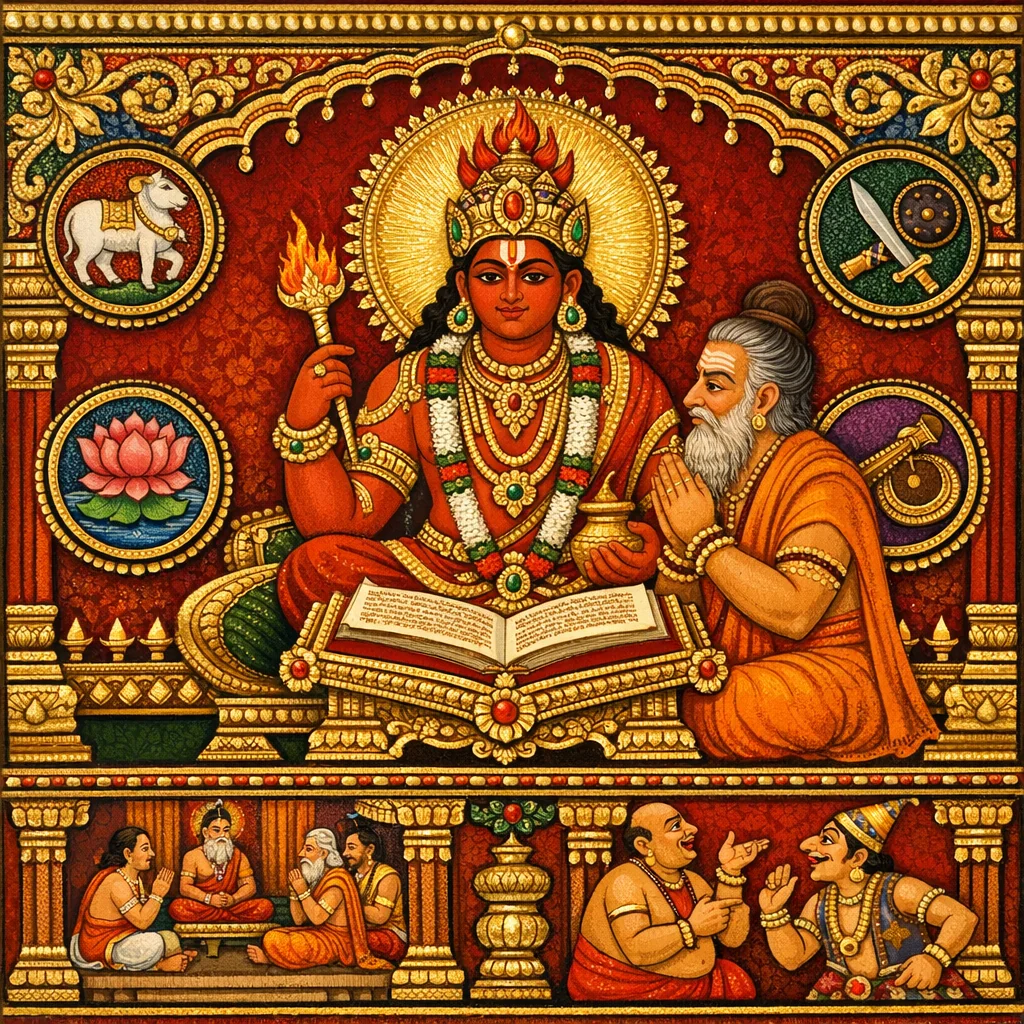
Adhyaya 339
Rīti-nirūpaṇam (Explanation of Poetic Style)
Continuing the Alaṅkāra (poetics) curriculum, Lord Agni moves from rasa-theory to rīti, presenting “style” as a formal element of vāk-vidyā (the science of speech). He classifies rīti into four regional-textural modes—Pāñcālī, Gauḍī (Gauḍadeśīyā), Vaidarbhī, and Lāṭī—distinguished by the density of ornament (upacāra), syntactic linkage (sandarbha), and structural extension (vighraha). The discussion then shifts from poetic style to dramaturgical style (vṛtti), describing four action-based modes—Bhāratī, Ārabhaṭī, Kauśikī, and Sāttvatī—thus integrating kāvya-theory with nāṭya principles. Bhāratī is portrayed as diction-forward and natural in speech, tied to Bharata’s tradition, and its limbs and allied dramatic forms (such as vīthī and prahasana) are outlined, including lists of vīthī-aṅga. Finally, prahasana is defined as comic farce, while Ārabhaṭī is marked by energetic scenes (magic, battle) and brisk stage-action, showing how aesthetic technique serves disciplined expression within dharmic culture.
Shlokas
Verse 1
इत्य् आग्नेये महापुराणे अलङ्कारे शृङ्गारादिरसनिरूपणं नामाष्टत्रिंशदधिकत्रिशततमो ऽध्यायः मुहुरिति ख अथोनचत्वारिंशदधिकत्रिशततमो ऽध्यायः रीतिनिरूपणं अग्निरुचाच वाग्विद्यासम्प्रतिज्ञाने रीतिः सापि चतुर्विधा पाञ्चाली गौडदेशीया वैदर्भी लाटजा तथा
Thus, in the Agni Mahāpurāṇa, in the section on poetics (alaṅkāra), ends the three-hundred-and-thirty-eighth chapter entitled “Explanation of rasas beginning with Śṛṅgāra (erotic sentiment).” Then begins the three-hundred-and-thirty-ninth chapter, “Explanation of rīti (poetic style).” Agni said: “In the formal exposition of the science of speech (vāk-vidyā), rīti is taught; it is of four kinds—Pāñcālī, Gauḍadeśīyā (Gauḍī), Vaidarbhī, and Lāṭajā.”
Verse 2
उपचारयुता मृद्वी पाञ्चाली ह्रस्वविग्रहा अनवस्थितसन्दर्भा गौडीया दीर्घविग्रहा
The Pāñcālī style is gentle and furnished with upacāras (ornate turns of expression), and its structure is compact. The Gauḍīya style has loosely arranged connections (an unsteady sequence of syntactic linkage) and an expansive structure.
Verse 3
उपचारैर् न बहुभिरुपचारैर् विवर्जिता नातिकोमलसन्दर्भा वैदर्भी मुक्तविग्रहा
The Vaidarbhī style is neither overloaded with excessive figures of speech nor devoid of ornamentation; its texture is not overly soft, and it is free from syntactic harshness (faulty or disjointed construction).
Verse 4
लाटीया स्फुटसन्धर्भा नातिविस्फुरविग्रहा परित्यक्तापि भूयोभिरुपचारैर् उदाहृता
The Lāṭī style has a clear, well-knit construction; its diction is not excessively flamboyant. Even if it is set aside in some circles, it is still described by many through numerous upacāras—conventional modes of usage.
Verse 5
क्रियास्वविषमा वृत्तिर्भारत्यारभटी तथा कौशिकी सात्वती चेति सा चतुर्धा प्रतिष्ठिता
That dramatic style (vṛtti), being varied in its modes of action, is established in four forms: Bhāratī, Ārabhaṭī, Kauśikī, and Sāttvatī.
Verse 6
वाक्प्रधाना नरप्राया स्त्रीयुक्ता प्राकृतोक्तिता भरतेन प्रणीतत्वाद् भारती रीतिरुच्यते
This rīti is called Bhāratī because it was propounded by Bharata: it is chiefly word-oriented (valuing diction), mostly associated with male characters, admits the presence of female characters, and employs speech expressed in a natural, vernacular manner.
Verse 7
चत्वार्यङ्गानि भारत्या वीथी प्रहसनन्तथा प्रस्तावना नाटकादेर्वीथ्यङ्गाश् च त्रयोदश
Bhāratī has four constituent limbs; likewise Vīthī and Prahasana are described. For nāṭaka and the other plays there is the prastāvanā (prologue); and the Vīthī has thirteen constituent limbs.
Verse 8
उद्घातकं तथैव स्याल्लपितं स्याद्द्वितीयकम् असत्प्रलापो वाक्श्रेणी नालिका विपणन्तथा
The first is called Udghātaka; the second is termed Lapita. Also named are Asatpralāpa (incoherent prattle), Vākśreṇī (a connected chain of speech), Nālikā (brief, rapid talk), and Vipaṇana (bargaining, market-style speech).
Verse 9
व्याहारस्तिमतञ्चैव छलावस्कन्दिते तथा वाग्वेणीति क , ञ , ट च व्याहारस्त्रिगतञ्चैवेति ख गण्डो ऽथ मृदवश् चैव त्रयोदशमथाचितम्
“Vyāhāra” is also called “timat”; likewise (there are) “chala” and “avaskandita”. For the consonant-classes ka, ña, and ṭa it is termed “vāgveṇī”; for kha it is termed “vyāhāra-trigata”. Then come “gaṇḍa” and also “mṛdava”; thus the thirteenth set of terms is stated.
Verse 10
तापसादेः प्रहसनं परिहासपरं वचः मायेन्द्रजालयुद्धादिबहुलारभटी स्मृता मङ्क्षिप्तकारपातौ च वस्तूत्थापनमेव च
A “prahasana” (farce) is a comic representation involving ascetics and the like, marked by speech directed toward jest. The vigorous dramatic style called “ārabhaṭī” is said to abound in scenes such as magical displays, conjuring tricks, and battles; and it includes swift hand-movements and the lifting or handling of stage properties.
Frequently Asked Questions
The chapter differentiates four rītis by measurable stylistic traits—ornament density (upacāra), coherence of linkage (sandarbha), and compact vs expansive phrasing (vighraha)—and then maps dramatic performance into four vṛttis (Bhāratī, Ārabhaṭī, Kauśikī, Sāttvatī).
By disciplining speech and representation—how emotion, action, and ornament are expressed—rīti and vṛtti cultivate sāttvika clarity, ethical communication, and refined attention, supporting dharma in society while aligning artistry with inner purification.