Adhyaya 342
Chapter 342: शब्दालङ्काराः (Verbal/Sound-based Ornaments)
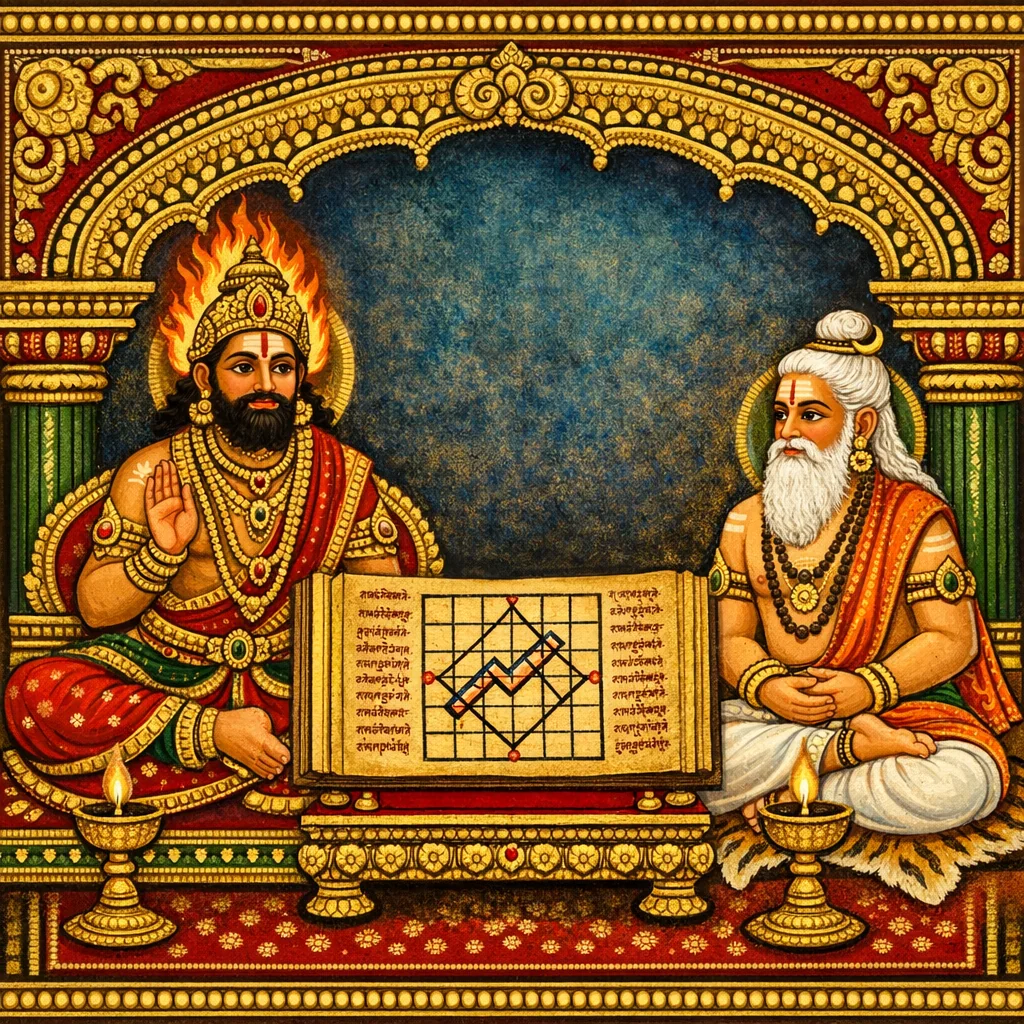
Lord Agni begins the teaching on shabda-alankara (sound-ornaments) by defining anuprasa as the patterned recurrence of phonemes across words and sentences, and cautions that ornament must be measured, not excessive. He then classifies single-phoneme predominance into five vrittis—madhura, lalita, praudha, bhadra, and parusha—stating phonetic constraints (limits by varga, effects of conjuncts, and the harshening of anusvara/visarga) that govern euphony and syllabic weight (laghu/guru). The chapter extends to multi-unit repetition as yamaka, distinguishing avyapeta (contiguous) and vyapeta (separated) forms, and listing principal subtypes up to a tenfold scheme with further variants. It next surveys citra-kavya in social settings (questions, riddles, hidden or displaced constructions), explaining how concealment and structural displacement yield secondary meanings. Finally it turns to bandha (pattern/shape poetry), describing famed visual layouts—sarvatobhadra, lotus (ambuja) designs, cakra and muraja patterns—together with technical placement rules and nomenclature, showing phonetics, meter, and visual arrangement converging as a disciplined art within dharma.
Shlokas
Verse 1
इत्य् आग्नेये महापुराणे अलङ्कारे अभिनयादिनिरूपणं नामैकचत्वारिंशदधिकत्रिशततमो ऽध्यायः अथ द्विचत्वारिंशदधिकत्रिशततमो ऽध्यायः शब्दालङ्काराः अग्निरुचाच स्यादावृत्तिरनुप्रासो वर्णानां पदवाक्ययोः एकवर्णानेकवर्णावृत्तेर्वर्णगुणो द्विधा
Thus, in the Agni Mahāpurāṇa, the three-hundred-and-forty-first chapter, within the section on alaṅkāra (poetic ornamentation), entitled “The Description of Acting (abhinaya) and Related Topics,” is concluded. Now begins the three-hundred-and-forty-second chapter: “Verbal (Sound-based) Ornaments.” Agni said: Anuprāsa (alliteration) is the repetition (āvṛtti) of phonemes (varṇas) in words and sentences; according to repetition of a single phoneme or of multiple phonemes, the phonetic ornament (varṇa-guṇa) is of two kinds.
Verse 2
एकवर्णगतावृत्तेर्जायन्ते पञ्च वृत्तयः मधुरा ललिता प्रौटा भद्रा परुषया सह
From the vṛtti that proceeds with a single dominant phonetic character (ekavarṇa), five stylistic modes arise: Madhurā (Sweet), Lalitā (Graceful), Prauḍhā (Mature/Weighty), Bhadrā (Auspicious/Good), together with Paruṣā (Harsh).
Verse 3
मधुरायाश् च वर्गन्तादधो वर्ग्या रणौ स्वनौ ह्रस्वस्वरेणान्तरितौ संयुक्तत्वं नकारयोः
And in the system of Madhurā, the letters of the class immediately below the end of a varga are the two sonants ra and ṇa; when separated by a short vowel, the two ‘na’-sounds are treated as forming a conjunct, that is, a consonant cluster.
Verse 4
न कार्या वर्ग्यवर्णानामावृत्तिः पञ्चमाधिका महाप्राणोष्मसंयोगप्रविमुक्तलघूत्तरौ
In the case of the consonants of a varga (the guttural, palatal, retroflex, dental, and labial series), repetition should not be made beyond the fifth, that is, beyond the nasal of the group. And in metrical/phonetic reckoning, the following syllables are treated as light in two cases: one that is free from conjunction with a mahāprāṇa (strong aspirate) and one that is free from conjunction with an ūṣman (sibilant/breathy sound).
Verse 5
ललिता बलभूयिष्ठा प्रौटा या पणवर्गजा ऊर्ध्वं रेफेण युज्यन्ते नटवर्गोनपञ्चमाः
The letters called lalitā, balabhūyiṣṭhā, and prauḍhā—those arising from the pa-varga—when combined with repha (r) placed above, are to be joined with the non-fifth letters of the ṭa-varga (i.e., with those other than the nasal of that series).
Verse 6
भद्रायां परिशिष्टाः स्युः परुषा साभिधीयते भवन्ति यस्यामूष्माणः संयुक्तास्तत्तदक्षरैः
In the group called Bhadrā, the remaining letters are included; that set is termed “Paruṣā” (the harsh class), in which the ūṣmāṇa-s (sibilant/aspirate sounds) occur in conjunction with their respective letters.
Verse 7
अकारवर्जमावृत्तिः स्वराणामतिभूयसी अनुस्वारविसर्गौ च पारुष्याय निरन्तरौ
Excessive repetition of vowels—excluding the letter “a”—and the continual use of anusvāra and visarga lead to harshness (pāruṣya) of sound.
Verse 8
शषसा रेफसंयुक्ताश्चाकारश्चापि भूयसा रशौ घनाविति ञ महाप्राणोष्मसंयोगादवियुक्तलघूत्तराविति ट ललिता वनभूयिष्ठेति ख ललिता वत्सभूयिष्ठेति ट अन्तस्थाभिन्नमाभ्याञ्च हः पारुष्याय संयुतः
When śa/ṣa/sa are combined with repha (r), and especially when preceded by a long ā, in the sequence “raśau” the sound is to be taken as “dense/compact”, i.e., pronounced with a heavier, more consolidated articulation. From the conjunction of a mahāprāṇa (strong aspirate) with a ūṣman (sibilant), the following sound is taught as “not separated”, with the lighter and heavier elements occurring in order. In the phrase “lalitā vanabhūyiṣṭh-” this is exemplified with kha; in “lalitā vatsabhūyiṣṭh-” it is exemplified with ṭa. And ha, when joined with the semivowels and the stop-series, produces harshness (pāruṣya) in pronunciation.
Verse 9
अन्यथापि गुरुर्वर्णः संयुक्तेपरिपन्थिनि पारुष्यायादिमांस्तत्र पूजिता न तु पञ्चमो
Even otherwise (i.e., where it might be taken as light), a syllable is to be treated as heavy when it is obstructed by a conjunct consonant; in the series beginning with “pāruṣyā”, that rule is accepted, but the fifth (case/option) is not.
Verse 10
क्षेपे शब्दानुकारे च परुषापि प्रयुज्यते कर्णाटी कौन्तली कौन्ती कौङ्कणी वामनासिका
The term “paruṣā” is also employed in the sense of “throwing/derision” and in the sense of “imitating a sound”; and it is further used as a designation connected with the Karṇāṭī, Kauntalī, Kauntī, Kauṅkaṇī, and Vāmanāsikā (regional/phonetic varieties).
Verse 11
द्रावणी माधवी पञ्चवर्णान्तस्थोष्मभिः क्रमात् अनेकवर्णावृत्तिर्या भिन्नार्थप्रतिपादिका
Drāvaṇī and Mādhavī are metres (verse-forms) constituted, in due order, by the five classes of consonants—vargas (stops), semivowels, and the sibilants/aspirate. That multi-syllabic metrical pattern which conveys distinct meanings is thus named and defined.
Verse 12
यमकं साव्यपेतञ्च व्यपेतञ्चेति तद्द्विधा आनन्तर्यादव्यपेतं व्यपेतं व्यवधानतः
Yamaka, the ornament of reduplication or alliterative repetition, is of two kinds: (1) avyapeta and (2) vyapeta. Avyapeta arises when the repeated sound or word is immediately contiguous; vyapeta arises when there is an interval or separation between the repetitions.
Verse 13
द्वैविध्येनानयोः स्थानपादभेदाच्चतुर्विधम् आदिपादादिमध्यान्तेष्वेकद्वित्रिनियोगतः
By this twofold division, and by distinguishing their positions and metrical quarters (pādas), it becomes fourfold. In the initial pāda, and at the beginning, middle, and end positions within the verse, it is applied by assigning one, two, or three units.
Verse 14
सप्तधा सप्तपूर्वेण चेत् पादेनोत्तरोत्तरः एकद्वित्रिपदारम्भस्तुल्यः षोढा तदापरं
If, proceeding pāda by pāda, each succeeding unit is reckoned with reference to the preceding sevenfold measure, then the pattern that begins with one-, two-, and three-pāda openings is of the same type; thereafter it is to be counted as sixteenfold.
Verse 15
तृतीयं त्रिविधं पादस्यादिमध्यान्तगोचरम् पादान्तयमकञ्चैव काञ्चीयमकमेव च
The third variety of yamaka is threefold, operating within a pāda at the beginning, the middle, or the end. It also includes the ‘pāda-end yamaka’ and the ‘kāñcī-yamaka’, the ‘girdle-belt’ type of yamaka.
Verse 16
संसर्गयमकञ्चैव विक्रान्तयमकन्तथा पादादियमकञ्चैव तथाम्रेडितमेव च
Also to be understood are ‘Saṃsarga-yamaka’ and likewise ‘Vikrānta-yamaka’; ‘Pādādi-yamaka’ too, and also ‘Āmreḍita’ (the repeated form), as additional varieties.
Verse 17
चतुर्व्यवसितञ्चैव मालायमकमेव च दशधा यमकं श्रेष्ठं तद्भेदा बहवो ऽपरे
‘Caturvyavasita’ and ‘Mālā-yamaka’ are also taught—yamaka is best understood as tenfold; and besides these, it has many other sub-varieties.
Verse 18
स्वतन्त्रस्यान्यतन्त्रस्य पदस्यावर्तना द्विधा बालवासिकेति ख , ट च वनवासिकेति ञ पूर्वपूर्वेणेति ज , ञ , ट च सम्बन्धयमकश् चैवेति ख भिन्नप्रयोजनपदस्यावृत्तिं मनुजा विदुः
The repetition (āvartanā) of a word—whether it stands independently (svatantra) or depends on another (anyatantra)—is of two kinds: (1) bālavāsikā and (2) vanavāsikā. It is also called “pūrvapūrveṇa” (repetition in earlier positions), and further “sambandha-yamaka” (relational yamaka). Learned authorities understand it as the recurrence of the same word with a different purpose, that is, with a distinct intended sense or function.
Verse 19
द्वयोरावृत्तपदयोः समस्ता स्यात्समासतः असमासात्तयोर्व्यस्ता पादे त्वेकत्र विग्रहात्
When two pādas have repeated wording, they are to be treated as ‘samastā’ (combined) by applying the rule of samāsa. But if the construction is non-compounded (asamāsa), then those two are to be treated as ‘vyastā’ (separated); and within a single pāda, separation is determined wherever an explicit analysis (vigraha) is made.
Verse 20
वाक्यस्यावृत्तिरप्येवं यथासम्भवमिष्यते अलङ्काराद्यनुप्रासो लघुमध्येवमर्हणात् *
Thus, repetition of a sentence too is accepted, insofar as it is feasible. But anuprāsa (alliteration) and related ornaments should be employed only lightly or in moderation, for excess is improper.
Verse 21
यया कयाचिद्वृत्या यत् समानमनुभूयते तद्रूपादिपदासत्तिः सानुप्रसा रसावहा
That in which, by some mode of expression, a sense of similarity is experienced—namely, the apt placing of words possessing similarity in form and the like—is called Anuprāsa, and it bears aesthetic relish (rasa).
Verse 22
गोष्ठ्यां कुतूहलाध्यायी वाग्बन्धश्चित्रमुच्यते प्रश्नः प्रहेलिका गुप्तं च्युतदत्ते तथोभयम्
In an assembly, a curiosity-arousing verbal construction is called a citra (a wonder-verse/figure). A praśna is a question; a prahelikā is an enigma (riddle). Gupta (the hidden form) is that in which the intended sense is concealed; cyuta-datta is that in which something is displaced and then supplied; and tathā-ubhayam is that which combines both (concealment and displacement).
Verse 23
समस्या सप्त तद्भेदा नानार्थस्यानुयोगतः यत्र प्रदीयते तुल्यवर्णविन्यासमुत्तरं
The poetic samasyā is of seven kinds, distinguished according to the prompting of a polysemous expression—namely, that in which an answer is supplied whose arrangement of letters is identical in pattern to the given words.
Verse 24
स प्रश्नः स्यादेकपृष्टद्विपृष्टोत्तरभेदतः द्विधैकपृष्टो द्विविधः समस्तो व्यस्त एव च
A praśna (question) is classified by whether it contains one inquiry or two, and by the form of the answer. The single-inquiry type is twofold; likewise the two-inquiry type is of two kinds—either combined (answered together) or separate (answered individually).
Verse 25
द्वयोरप्यर्थयोर्गुह्यमानशब्दा प्रहेलिका सा द्विधार्थो च शाब्दी च तत्रार्थी चार्थबोधतः
A prahelikā (riddle) is an expression whose wording is kept concealed with respect to both meanings; it is also classed as double-meaning (dvidhārtha) and as a verbal figure (śābdī). In it, the sense is to be understood according to the intended meaning (arthabodhataḥ).
Verse 26
शब्दावबोधतः शाब्दी प्राहुः षोढा प्रहेलिकां यस्मिन् गुप्ते ऽपि वाक्याङ्गे भाव्यर्थो ऽपारमार्थिकः
Based on the apprehension of words, the learned declare a riddle to be “śābdī” (verbal). It is said to be of sixteen kinds: even when a member of the sentence is concealed, an intended meaning is to be inferred, yet that meaning is not the primary (paramārthika, literal) sense.
Verse 27
तदङ्गविहिताकाङ्क्षस्तद्गुप्तं गूढमप्यदः यत्रार्थान्तरनिर्भासो वाक्याङ्गच्यवनादिभिः
That expression is also called gūḍha (“hidden/oblique”) when an expectation (ākāṅkṣā) is generated by a member of the sentence, yet the intended sense remains concealed; in it, the appearance of a different meaning (arthāntara-nirbhāsa) arises through devices such as displacement or omission of sentence-members and related structural shifts.
Verse 28
तदङ्गविहिताकाङ्क्षस्तच्चुतं स्याच्चतुर्विधम् लघुमप्येवमर्हणादिति ट लघुमध्येव वर्हणादिति ज लघुमध्येवमर्हणात्, लघुमप्येवमर्हणात्, लघुमध्येव वर्हणात् एतत् पाठत्रयं न सम्यक् प्रतिभाति स्वरव्यञ्जनविन्दूनां विसर्गस्य च विच्युतेः
When, by the requirements laid down by its component rules, a syllable is expected to have a certain quantity (short/long) but is found to deviate from that, such deviation is said to be fourfold. As for the three alternative readings—“laghum apy evam arhaṇāt” (ṭa), “laghumadhyeva varhaṇāt” (ja), and “laghumadhyevamarhaṇāt / laghum apy evam arhaṇāt / laghumadhyeva varhaṇāt”—this triad does not appear satisfactory, because of corruption affecting vowels, consonants, nasal-dot/diacritic marks, and the visarga.
Verse 29
दत्तेपि यत्र वाक्याङ्गे द्वितीयोर्थः प्रतीयते दत्तन्तदाहुस्तद्भेदाः स्वराद्यैः पूर्ववन्मताः
Even when a word-form is “given” (datta) in a member of the sentence, if a second meaning is understood there, that is called “datta”; and its subtypes—beginning with those based on svara (accent/intonation) and the like—are held to be as stated earlier.
Verse 30
अपनीताक्षरस्थाने न्यस्ते वर्णान्तरे ऽपि च भासते ऽर्थान्तरं यत्र च्युतदत्तं तदुच्यते
When, in the place of a removed syllable, another letter is inserted and thereby a different meaning becomes apparent, this fault is called cyuta-datta (“displaced substitution”).
Verse 31
सुश्लिष्टपद्यमेकं यन्नानाश्लोकांशनिर्मितम् सा ममस्या परस्यात्मपरयोः कृतिसङ्करात्
A single, well-knit verse constructed from portions of many different verses is called “mama” when it is a mixture of one’s own and another’s compositions; and it is called “parasya” when one’s own composition is mixed with that of another author.
Verse 32
दुःखेन कृतमत्यर्थं कविसामर्थ्यसूचकम् दुष्करं नीरसत्वेपि विदग्धानां महोत्सवः
A composition produced with great effort is a clear indicator of a poet’s capability. Even when it lacks rasa (aesthetic relish), what is difficult to compose or accomplish becomes a grand festival for discerning connoisseurs.
Verse 33
नियमाच्च विदर्भाच बन्धाच्च भवति त्रिधा कवेः प्रतिज्ञा निर्माणरम्यस्य नियमः स्मृतः
A poet’s opening proposition (pratijñā) is threefold—arising from (i) niyama (rule or constraint), (ii) the Vaidarbhī style (vidarbha), and (iii) bandha (metrical or structural binding). This is remembered as the “niyama”, the governing principle that makes composition pleasing in its construction.
Verse 34
स्थानेनापि स्वरेणापि व्यञ्जनेनापि स त्रिधा विकल्पः प्रातिलोम्यानुलोम्यादेवाभिधीयते
That phonetic variation (vikalpa) is threefold—arising from change of place of articulation, from change of vowel, and from change of consonant; and it is specifically described in terms of reversal and direct order (prātilomya and anulomya).
Verse 35
प्रतिलोम्यानुलोम्यञ्च शब्देनार्थेन जायते अनेकधावृत्तवर्णविन्यासैः शिल्पकल्पना
Through prātilomya and anulomya—at the levels of both word and meaning—artistic composition arises; it is fashioned by arranging letters in many ways and by repeated, patterned placements.
Verse 36
तत्तत्प्रसिद्धवस्तूनां बन्ध इत्य् अभिधीयते गोमूत्रिकार्धभ्रमणे सर्वतोभद्रमम्बुजम्
A patterned arrangement is called “bandha” when it is shaped into forms of well-known objects. In the “half-turn of the gomūtrikā” (a particular looping, curved layout), it becomes the “sarvatobhadra” and the “ambuja” (lotus) designs.
Verse 37
चक्रञ्चक्राब्जकं दण्डो मुरजाश्चेति चाष्टधा प्रत्यर्धं प्रतिपादं स्यादेकान्तरसमाक्षरा
The metrical patterns are eightfold—named Cakra, Cakra, Abjaka, Daṇḍa, Muraja, and so forth. In each half-verse and each quarter-verse, the syllables are to be arranged with equal letters alternating (a regularly matched alternating pattern).
Verse 38
द्विधा गोमूत्रिकां पूर्वामाहुरश्वपदां परे अन्त्याङ्गोमूत्रिकां धेनुं जालबन्धं वदन्ति हि
The earlier arrangement called gomūtrikā is said to be of two kinds; some call it aśvapadā. But the gomūtrikā whose final segment is arranged in that manner is called dhenū, and indeed it is termed jāla-bandha, a net-like binding.
Verse 39
अर्धाभ्यामर्धपादैश् च कुर्याद्विन्यासमेतयोः जानुबन्धमिति क , ख च न्यस्तानामिह वर्णानामधोधः क्रमभागिनां
Using two halves—and also by half-lines—one should carry out the vinyāsa (placement) of these two. Here the consonants “ka” and “kha” are called the “jānubandha” (knee-joint); and the letters that are set, insofar as they belong to the sequence, are to be placed successively lower and lower, in descending order.
Verse 40
अधोधःस्थितवर्णानां यावत्तूर्यपदन्नयेत् तुर्यपादान्नयेदूर्ध पादार्धं प्रातिलोम्यतः
For the syllables placed below in the metrical scheme, one should proceed up to the fourth quarter (tūrya-pada). From that fourth quarter one then moves upward, reversing the order, through the half-verse (pādārdha) by the prātilomya (retrograde) method.
Verse 41
तदेव सर्वतोभद्रं त्रिविधं सरसीरुहं चतुष्पत्रं ततो विघ्नं चतुष्पत्रे उभे अपि
That very diagram is the Sarvatobhadra; the lotus-diagram (sarasīruha) is of three kinds. Next comes the four-petalled lotus, and thereafter the Vighna (obstacle-warding) diagram—both of these are drawn as four-petalled forms.
Verse 42
अथ प्रथमपादस्य मूर्धन्यस्त्रिपदाक्षरं सर्वेषामेव पादानामन्ते तदुपजायते
Now, for the first pāda, there arises a tripartite syllabic element termed mūrdhanya (formed with the tongue-tip at the palate, i.e., retroflex); that very element likewise occurs at the end of all pādas.
Verse 43
प्राक्पदस्यान्तिमं प्रत्यक् पादादौ प्रातिलोम्यतः अन्त्यपादान्तिमञ्चाद्यपादादावक्षरद्वयं
By reversing the order at the beginning of a pāda, one should take the final syllable of the preceding pāda; likewise, take the final syllable of the last pāda. Thus, at the start of the first pāda, a pair of syllables is to be supplied/recognized.
Verse 44
चतुश्छदे भवेदष्टच्छदे वर्णत्रयं पुनः स्यात् षोडशच्छदे त्वेकान्तरञ्चेदेकमक्षरं
In a four-footed metre it is regulated as eight-footed; again, in the eight-footed form there should be a group of three syllables. But in the sixteen-footed form, if arranged with alternation, each unit is a single syllable.
Verse 45
कर्णिकां तोलयेदूर्ध्वं पत्राकाराक्षरावलिं प्रवेशयेत् कर्णिकायाञ्चतुष्पत्रसरोरुहे
One should raise (mark) the karnikā, the pericarp, upward, and insert into the karnikā the series of letters shaped like petals, within the four-petalled lotus.
Verse 46
कर्णिकायां लिखेदेकं द्वे द्वे दिक्षु विदिक्षु च प्रवेशनिर्गमौ दिक्षु कुर्यादष्टच्छदे ऽम्बुजे
In the pericarp (the central core) one should inscribe a single mark or letter; in the cardinal and intermediate directions one should inscribe two in each. In the eight-petalled lotus, one should also arrange the entrances and exits according to the directions.
Verse 47
विश्वग्विषमवर्णानां तावत् पत्राबलीजुषां मध्ये समाक्षरन्यासःसरोजे षोडशच्छदे
In that sixteen-petalled lotus-diagram, after placing the mantra’s syllables in sequence upon the petals that bear the diverse and unequal classes of letters, one should then perform samākṣara-nyāsa—placing equal syllables—in the middle of the lotus.
Verse 48
द्विधा चक्रं चतुररं षडरन्तत्र चादिमं पूर्वार्धे सदृशा वर्णाः पादप्रथमपञ्चमाः
There (in this metrical scheme), the “wheel” is divided into two; it has four spokes and then six spokes, with the first arrangement taken as primary. In the first half, the syllables at the first and fifth positions of each pāda (quarter-verse) are alike, corresponding to one another.
Verse 49
अयुजो ऽश्वयुजश् चैव तुर्यावप्यष्टमावपि तस्योपपादप्राक्प्रत्यगरेषु च यथाक्रमं
Likewise, (the nakṣatras are arranged as) the odd set, Aśvayujā, the fourth and also the eighth; and, in due order, they are to be placed in its subsidiary quarters—at the feet, on the eastern side, and on the western side.
Verse 50
स्यात्पादार्धचतुष्कन्तु नाभौ तस्याद्यमक्षरं पश्चिमारावधि नयेन्नेमौ शेषे पदद्वयी
When the verse has four pādas (quarters), one should place the first syllable at its “navel” (the central junction), and then carry the division up to the western boundary; in what remains, two pādas are left to be set apart.
Verse 51
तृतीयं तुर्यपादान्ते प्रथमौ सदृशावुभौ वर्णौ पादत्रयस्यापि दशमः सदृशो यदि
If, at the end of the fourth pāda, the third syllable from the end is the same, and if in the first three pādas the first two syllables are alike, and if the tenth syllable (counted within the pāda) is also identical, then the verse is to be recognized by that metrical pattern.
Verse 52
प्रथमे चरमे तस्य षड्तर्णाः पथिमे यदि भवन्ति द्व्यन्तरं तर्हि वृहच्च क्रमुदाहृतं
If, in the first and the last quarter of that metre, each pāda contains six tāra-units (countable mātrā/beat units), and in the middle there is a separation of two units, then that metrical arrangement is declared to be the ‘Vṛhat’ as well as the ‘Krama’ pattern.
Verse 53
सम्मुखारद्वये पादमेकैकं क्रमशो लिखेत् नाभौ तु वर्णं दशमं नेमौ तूर्यपदन्नयेत्
On the two forward-facing spokes (or lines), one should write the pāda-syllables one by one in proper sequence. In the navel (central hub) one should place the tenth letter; and on the rim one should lead (place) the fourth set of syllables/words.
Verse 54
श्लोकस्याद्यन्तदशमाः समा आद्यन्तिमौ युजोः आदौ वर्णः समौ तुर्यपञ्चमावाद्यतर्ययोः
In the śloka metre, the first, the last, and the tenth syllables are heavy (guru). In the even pādas, the first and the last syllables are heavy; and at the beginning of the remaining pādas, the fourth and fifth syllables are heavy according to this rule.
Verse 55
द्वितीयप्रातिलोम्येन तृतीयं जायते यदि पदं विदध्यात् पत्रस्य दण्डश् चक्राब्जकं कृतेः
If, by reversing (prātilomya) the second pattern, the third metrical foot arises, then one should construct that foot accordingly: in the ‘patra’ scheme there is a ‘daṇḍa’ (staff), and in the ‘kṛti’ scheme there is the ‘cakrābjaka’ (wheel–lotus) pattern.
Verse 56
द्वितीयौ प्राग्दले तुल्यौ सप्तमौ च तथापरौ सदृशावुत्तरदलौ द्वितीयाभ्यामथार्धयोः
In the first half (pāda), the two second syllabic positions are equal; likewise the seventh and the remaining positions. In the latter half (pāda) they are similar; thus, in both halves, the pattern is fixed with reference to the second positions.
Verse 57
द्वितीयषष्ठाः सदृशाश् चतुर्थपञ्चमावपि आद्यन्तपादयोस्तुल्यौ परार्धसप्तमावपि
The second and the sixth pāda are alike; likewise the fourth and the fifth. The first and the last pāda are identical; and so too is the seventh pāda in the latter half of the metrical scheme.
Verse 58
समौ तुर्यं पञ्चमन्तु क्रमेण विनियोजयेत् तुर्यौ योज्यौ तु तद्वच्च दलान्ताः क्रमपादयोः
One should, in due order, assign the even syllables as the fourth unit and the fifth. Likewise, two fourth-units are to be joined; and the half-lines (dalas) are to be placed at the ends, in sequence, in the two pādas.
Verse 59
अर्धयोरन्तिमाद्यौ तु मुरजे सदृशावभौ पादार्धपतितो वर्णः प्रातिलोम्यानुलोमतः
In the metre called Muraja, the last syllable of the first half and the first syllable of the second half are alike. A syllable falling at the midpoint of a pāda is to be determined by scanning in reverse and in forward order (prātilomya and anuloma).
Verse 60
अन्तिमं परिबध्नीयाद्यावत्तुर्यमिहादिमत् पादात्तुर्याद्यदेवाद्यं नवमात् षोडशादपि
Here one should firmly bind (securely place) the final element up to the fourth unit, beginning from the first. And within the pāda, starting from the fourth, one should also bind/place the ‘deva-ādi’ (deva-first) series, from the ninth up to the sixteenth as well.
Verse 61
अक्षरात् पुटके मध्ये मध्ये ऽक्षरचतुष्टयम् कृत्वा कुर्याद्यथैतस्य मुरजाकारता भवेत्
In the prosodic “puṭaka” (packet), beginning from a syllable, one should insert groups of four syllables at each interval, arranging them so that the pattern assumes a form resembling a mṛdaṅga-drum (muraja).
Verse 62
द्वितीयं चक्रशार्दूलविक्रीडितकसम्पदम् गोमूत्रिका सर्ववृत्तैर् अन्ये बन्धास्त्वनुष्टुभा
The second arrangement is the “Cakra–Śārdūla–Vikrīḍitaka–Sampad” pattern. “Gomūtrikā” is formed with all metres; the other bandhas, however, are in the Anuṣṭubh metre.
Verse 63
नामधेयं यदि न चेदमीषु कविकाव्ययोः मित्रधेयाभितुष्यन्ति नामित्रः खिद्यते तथा
If there is no proper name (title) for these—namely, the poet and the poem—then those who are pleased by mere friendly appellations are satisfied; but one who is not a friend is likewise distressed.
Verse 64
वाणवाणासनव्योमखड्गमुद्गरशक्तयः द्विचतुर्थत्रिशृङ्गाटा दम्भोलिमुषलाङ्कुशाः
Arrows; bow-and-arrow equipment; aerial (projectile) weapons; swords; maces; spears; and weapons with two, four, or three prongs—also the vajra (thunderbolt), the club, and the goad (ankusha).
Verse 65
पदं रथस्य नागस्य पुष्करिण्यसिपुत्रिका एते बन्धास् तथा चान्ये एवं ज्ञेयाः स्वयं बुधैः
“Pada”, “rathasya”, “nāgasya”, “puṣkariṇī”, “asiputrikā”—these are technical names of bandhas (bindings/fastenings); and other such terms too are to be understood in this same manner by the learned themselves.
Frequently Asked Questions
It formalizes sound-based ornamentation through repeat-pattern rules (anuprasa/yamaka), including phonetic constraints (varga limits, conjunct-induced heaviness, anusvara/visarga harshening) and then extends the same rigor to riddle-forms and diagrammatic bandha placements (sarvatobhadra/lotus/cakra/muraja).
By treating poetic technique as disciplined vidya: measured ornamentation, truthful structure, and rule-governed creativity become dharmic training of speech (vak) that refines aesthetic awareness (rasa) and aligns artistry with sacred order.