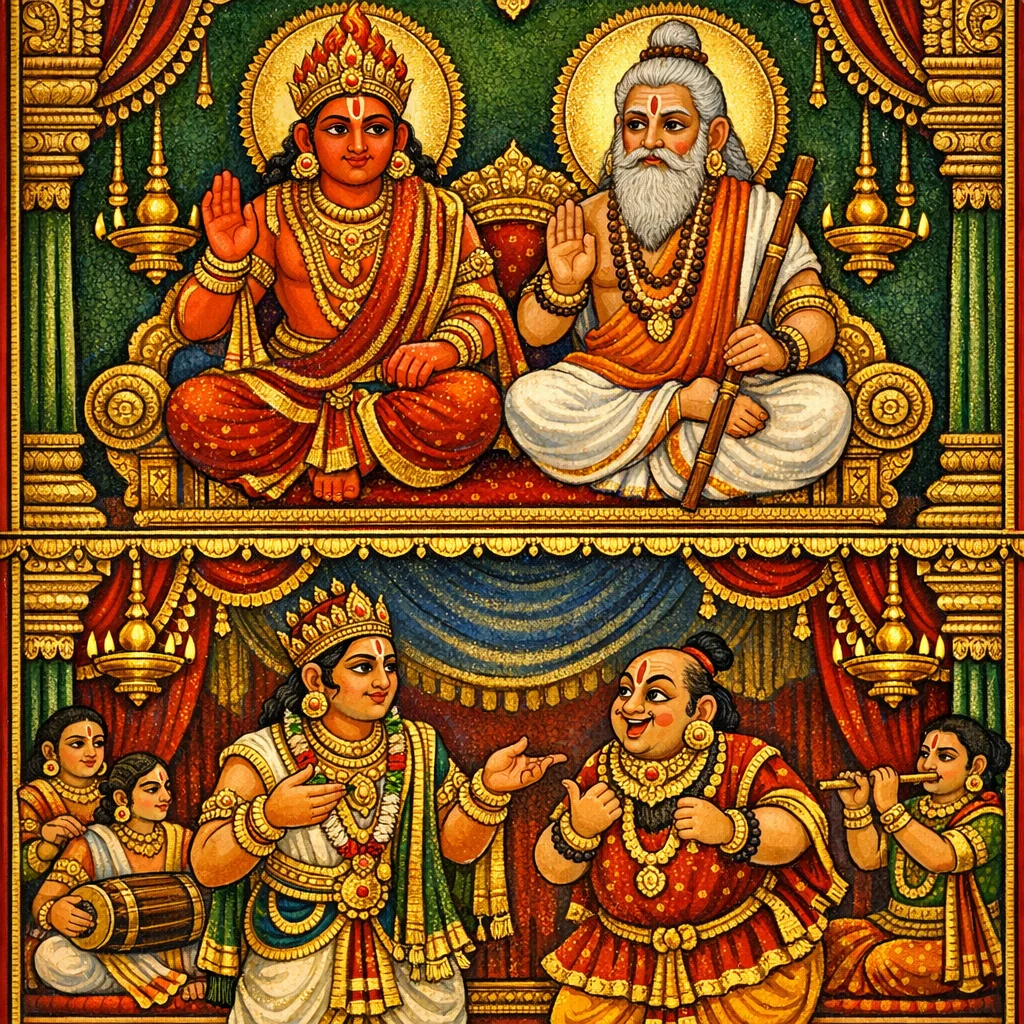
Adhyaya 337
Nāṭaka-nirūpaṇam (Exposition of Drama / Dramatic Genres and Plot-Structure)
Lord Agni begins a systematic teaching on nāṭya by listing the accepted dramatic and performative‑literary genres (rūpaka and allied forms), thereby establishing drama’s taxonomy as a śāstric discipline. He then distinguishes general and particular application in lakṣaṇā (indicative sense) and in dramaturgical rules, clarifying the constituents common to all drama—rasa, bhāva, vibhāva–anubhāva, abhinaya, aṅka, and dramatic progression (sthiti). Next he presents pūrvaraṅga as the procedural foundation of performance, including nāndī elements, salutations and blessings, and the formal entry of the sūtradhāra, with attention to lineage‑praise and authorial competence. The chapter defines prologue/opening devices (āmukha/prastāvanā, pravṛttaka, kathodghāta, prayoga, prayogātiśaya) and establishes itivṛtta (plot) as the “body” of drama, divided into siddha (traditional) and utprekṣita (poet‑created). Finally, it details plot design through five arthaprakṛtis and five sandhis, emphasizing the need to specify time and place for coherent narrative unfolding.
Shlokas
Verse 1
इत्य् आग्नेये महापुराणे अलङ्कारे काव्यादिलक्षणं नाम षट्त्रिंशदधिकत्रिशततमो ऽध्यायः जुष्टमिति ज , ट च अथ सप्तत्रिंशदधिकत्रिशततमो ऽध्यायः नाटकनिरूपणम् अग्निर् उवाच नाटकं सप्रकरणं डिम ईहामृगो ऽपि वा ज्ञेयः समवकारश् च भवेत् प्रहसनन्तथा
Thus, in the Agni Mahāpurāṇa, in the section on Alaṅkāra (poetics), ends the chapter titled “Definitions of poetry and related forms,” the three-hundred-and-thirty-sixth (Adhyāya 336). (Textual note: “juṣṭam iti”—letters ja and ṭa.) Now begins the three-hundred-and-thirty-seventh chapter, “Exposition of Drama.” Agni said: The dramatic genres should be understood as Nāṭaka, Prakaraṇa, Ḍima, Īhāmṛga; also Samavakāra, and likewise Prahasana.
Verse 2
व्यायोगभाणवीथ्यङ्कत्रोटकान्यथ नाटिका सट्टकं शिल्पकः कर्णा एको दुर्मल्लिका तथा
Also, the dramatic forms include Vyāyoga, Bhāṇa, Vīthī, Aṅka, and Troṭaka; likewise Nāṭikā, Saṭṭaka, Śilpaka, Karṇā, Eka, and Durmallikā.
Verse 3
प्रस्थानं भाणिका भाणी गोष्ठी हल्लीशकानि च काव्यं श्रीगदितं नाट्यरासकं रासकं तथा
Prasthāna, Bhāṇikā, Bhāṇī, Goṣṭhī, Hallīśaka, Kāvyā, Śrī-gadita, Nāṭya-rāsaka, and likewise Rāsaka—these are recognized forms of literary and dramatic composition.
Verse 4
उल्लाप्यकं प्रेङ्क्षणञ्च सप्तविंशतिरेव तत् सामान्यञ्च विशेषश् च लक्षणस्य द्वयी गतिः
‘Ullāpyaka’ and ‘Preṅkṣaṇa’—these indeed bring the total to twenty-seven. And the course of lakṣaṇā (secondary or indicative meaning) is twofold: the general (sāmānya) and the particular (viśeṣa).
Verse 5
सामान्यं सर्वविषयं शेषः क्वापि प्रवर्तते पूर्वरङ्गे निवृत्ते द्वौ देशकालावुभावपि
The “general” (sāmānya) applies to all topics; the “residual” (śeṣa) is applied wherever required. And when the preliminary rite (pūrvaraṅga) has concluded, both—place and time—are also to be specified.
Verse 6
रसभावविभावानुभावा अभिनयास् तथा अङ्कः स्थितिश् च सामान्यं सर्वत्रैवोपसर्पणात्
Rasa, bhāva, vibhāva and anubhāva, as well as the modes of dramatic representation (abhinaya), the act (aṅka), and the dramatic progression (sthiti)—all these are “general” (common to drama), because they pervade and apply everywhere.
Verse 7
विशेषो ऽवसरे वाच्यः सामान्यं पूर्वमुच्यते त्रिवर्गसाधनन्नाट्यमित्याहुः करणञ्च यत्
The particular (viśeṣa) should be stated when the occasion arises; the general principle is stated first. Drama (nāṭya), they say, is a means for accomplishing the three aims of life (dharma, artha, and kāma)—and so too is what is called “karaṇa” (a technical unit of performance).
Verse 8
इतिकर्तव्यता तस्य पूर्वरङ्गो यथाविधि नान्दीमुखानि द्वात्रिंशदङ्गानि पूर्वरङ्गके
Its procedure (what is to be done) is the pūrvaraṅga, to be performed according to rule; in the pūrvaraṅga there are the introductory benedictory sections (nāndīmukhas) and thirty-two constituent parts (aṅgas).
Verse 9
देवतानां नमस्कारो गुरूणामपि च स्तुतिः गोब्राह्मणनृपादीनामाशीर्वादादि गीयते
At the outset, one should sing (utter) salutations to the deities, praises of the teachers, and blessings and the like for cows, Brahmins, kings, and others.
Verse 10
नान्द्यन्ते सूत्रधारो ऽसौ रूपकेषु निबध्यते गुरुपूर्वक्रमं वंशप्रशंसा पौरुषं कवेः
In dramatic compositions (rūpaka), the Sūtradhāra is to be introduced at the close of the Nāndī; and in the prologue one should set forth the traditional succession of teachers, praise of the lineage, and the poet’s own merit and ability.
Verse 11
सम्बन्धार्थौ च काव्यस्य पञ्चैतानेष निर्दिशेत् नटी विदूषको वापि पारिपार्श्विक एव वा
He should state these five constituents of a poetic work, including its sambandha (connection) and artha (meaning)—whether the statement is delivered by the actress, the Vidūṣaka (jester), or the attendant character (pāripārśvika).
Verse 12
सहिताः सूत्रधारेण संलापं यत्र कुर्वते चित्रैर् वाक्यैः स्वकार्योत्थैः प्रस्तुताक्षेपिभिर्मिथः
Where, together with the Sūtradhāra, they converse with one another—using striking utterances that arise from their own dramatic aims and that include pointed, context-relevant interjections—such is the manner of that dramatic dialogue.
Verse 13
आमुखं तत्तु विज्ञेयं बुधैः प्रस्तावनापि सा प्रवृत्तकं कथोद्घातः प्रयोगातिशयस् तथा
The learned should understand that the “āmukha” is also the “prastāvanā” (prefatory introduction); likewise there are opening devices called pravṛttaka, kathodghāta, and prayogātiśaya.
Verse 14
आमुखस्य त्रयो भेदा वीजांशेषूपजायते कालं प्रवृत्तमाश्रित्य सूत्रधृग्यत्र वर्णयेत्
The āmukha (prologue) is of three kinds; it arises in relation to the bīja (seed of the plot) and the aṃśeṣa (remaining portion). Having regard to the time or stage already set in motion, the author—who holds the thread of the narrative—should describe it there.
Verse 15
तदाश्रयश् च पात्रस्य प्रवेशस्तत् प्रवृत्तकं सूत्रधारस्य वाक्यं वा यत्र वाक्यार्थमेव वा
The entrance (praveśa) of a character that rests upon the preceding matter is called a pravṛttaka; or it is the Sūtradhāra’s speech, wherein only the intended purport of the sentence is conveyed.
Verse 16
गृहीत्वा प्रविशेत् पात्रं कथोद्घातः स उच्यते प्रयोगेषु प्रयोगन्तु सूत्रधृग्यत्र वर्णयेत्
When a character enters after taking up a topic or prop, that is called kathodghāta (“narrative opening”). And in a performance, the portion in which the Sūtradhāra explains the practical staging is called prayoga (“theatrical application/production”).
Verse 17
ततश् च प्रविशेत् पात्रं प्रयोगातिशयो हि सः शरीरं नाटकादीनामितिवृत्तं प्रचक्षते
Thereafter the character should enter, for that is the excellence of stage-performance. The itivṛtta (plot) is declared to be the very body of dramas and other theatrical works.
Verse 18
सिद्धमुत्प्रेक्षितञ्चेति तस्य भेदाबुभौ स्मृतौ सिद्धमागमदृष्टञ्च सृष्टमुत्प्रेक्षितं कवेः
Its two divisions are traditionally remembered as ‘siddha’ and ‘utprekṣita’. ‘Siddha’ is what is seen in the āgama (received tradition), while ‘utprekṣita’ is what the poet creatively fashions (sṛṣṭa) by imagination.
Verse 19
वीजं विन्दुः पताका च प्रकरी कार्यमेव च अर्थप्रकृतयः पञ्च पञ्च चेष्टा अपि क्रमात्
The five structural elements of the plot (arthaprakṛti) are, in order: vīja (Seed), vindu (Point/Drop), patākā (Episode/Banner), prakarī (minor episode), and kārya (action/outcome). Correspondingly, there are also five progressive dramatic movements (ceṣṭā) in the same sequence.
Verse 20
प्रारम्भश् च प्रयत्नश् च प्राप्तिः सद्भाव एव च नियता च फलप्राप्तिः फलयोगश् च पञ्चमः
Commencement and sustained effort, attainment, and indeed the right disposition (good intent), together with the assured acquisition of the result—these are the fivefold conjunctions with success (the fifth being the linkage to the outcome).
Verse 21
मुखं प्रतिमुखं गर्भो विमर्षश् च तथैव च तथा निर्वहणञ्चेति क्रमात् पञ्चैव सन्धयः
In due sequence, the plot-junctures (sandhi-s) are five indeed: the Opening (mukha), the Counter-opening (pratimukha), the Development (garbha), the Deliberation/Turning-point (vimarśa), and the Resolution (nirvahaṇa).
Verse 22
अल्पमात्रं समुद्दिष्टं बहुधा यत् प्रसर्पति फलावसानं यच्चैव वीजं तदभिधीयते
That which is indicated in a small measure, yet spreads in many ways and culminates in its fruit (result)—that indeed is called the poetic “seed” (bīja).
Verse 23
यत्र वीजसमुत्पत्तिर्नानार्थरससम्भवा काव्ये शरीरानुगतं तन्मुखं परिकीर्तितं
That part of a poem in which the “seed” (bīja)—capable of generating many meanings and aesthetic flavors (rasa)—first arises, and which is connected to the body of the composition, is declared to be the “mukha”, the opening.
Verse 24
इष्टस्यार्थस्य रचना वृत्तान्तस्यानुपक्षयः रागप्राप्तिः प्रयोगस्य गुह्यानाञ्चैव गूहनम्
The composition should present the intended meaning; the narrative should not be allowed to lapse or break; the application of expression should yield aesthetic relish (rāga); and secret matters should indeed be kept concealed.
Verse 25
आश् चर्यवदभिख्यातं प्रकाशानां प्रकाशनम् अङ्गहीनं नरो यद्वन्न श्रेष्ठं काव्यमेव च
Celebrated as “marvellous” and as the illuminator of all illuminations—so too is poetry: if it lacks its constituent limbs, it is not excellent, just as a man is not excellent when deficient in bodily limbs.
Verse 26
देशकालौ विना किञ्चिन्नेतिवृत्तं प्रवर्तते अतस्तयोरुपादाननियमात् पदमुच्यते
No narrative (itivṛtta) can proceed in any way without place and time. Therefore, because there is a fixed rule that these two must be stated, the term “pada” is applied to that requisite grounding in the narrative.
Verse 27
देशेषु भारतं वर्षं काले कृतयुगत्रयं नर्ते ताभ्यां प्राणभृतां सुखदुःखोदयः क्वचित् सर्गे सर्गादिवार्ता च प्रसज्जन्ती न दुष्यति
Among all regions, Bhārata-varṣa is foremost; and in the order of time, the three yugas beginning with Kṛta are pre-eminent. Apart from these two, for living beings the arising of happiness and sorrow occurs only occasionally. And discussion concerning sarga—accounts of creation and related topics—when pursued within the doctrine of sarga, is not blameworthy.
Frequently Asked Questions
The chapter emphasizes a complete dramaturgical scaffold: (1) a 27-type taxonomy of dramatic/literary forms; (2) pūrvaraṅga procedure with nāndī and 32 aṅgas; and (3) plot engineering through itivṛtta divisions, five arthaprakṛtis (bīja–kārya), and five sandhis (mukha–nirvahaṇa), anchored by explicit place-time (deśa-kāla).
By defining drama as a means toward the trivarga (dharma, artha, kāma) and by disciplining aesthetic production through śāstric order (rasa, bhāva, abhinaya, and structured plot), it aligns cultural practice with dharmic formation—making artistic mastery a legitimate Agneya vidyā that supports inner cultivation alongside worldly competence.