Adhyaya 340
Chapter 340 — नृत्यादावङ्गकर्मनिरूपणम् (Explanation of Bodily Actions in Dance and Performance)
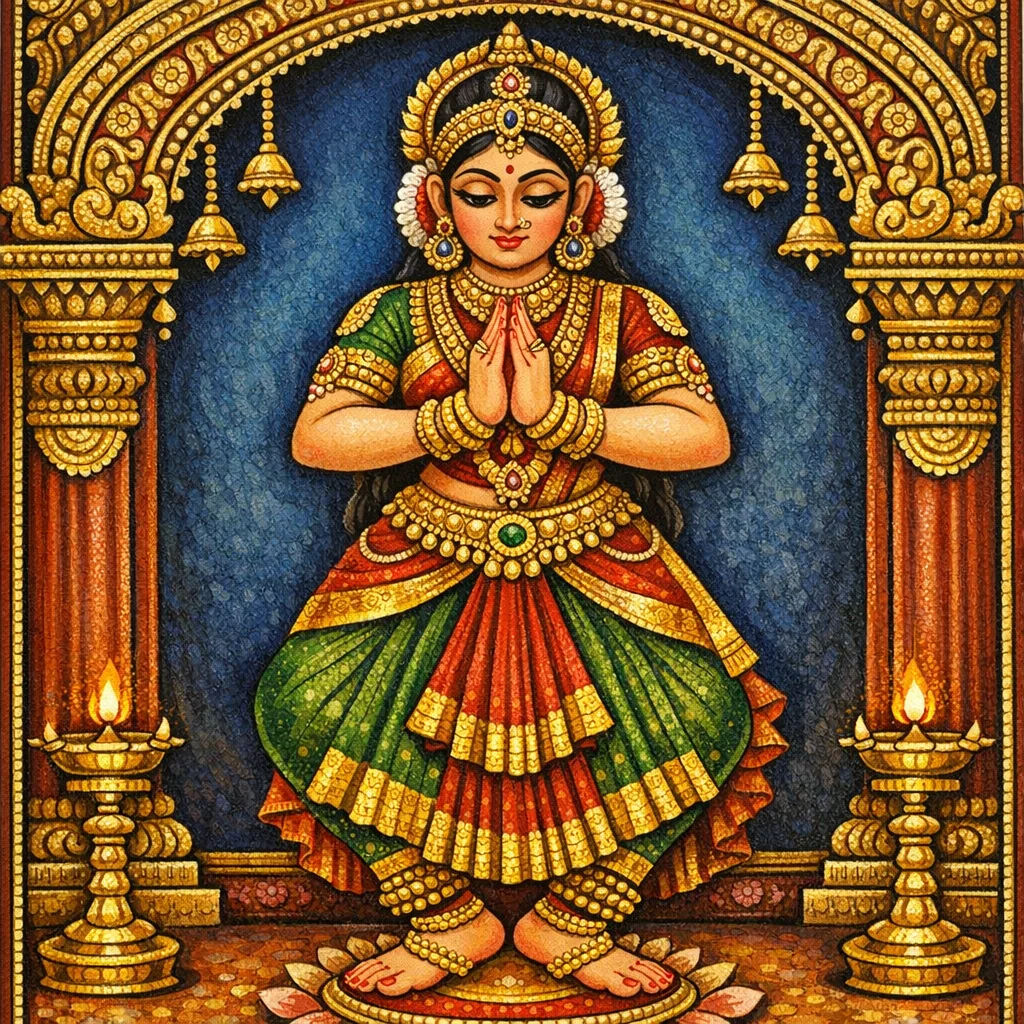
Lord Agni moves from earlier alaṅkāra topics into nāṭya technique, defining bodily expression (aṅgakarma) as arising from (1) specific kinds of movement and (2) the actions of major limbs (aṅga) and minor limbs (pratyaṅga), grounded in an initial supportive stance. He lists refined, often feminine/śṛṅgāra-coded modes of expression—līlā, vilāsa, vicchitti, vibhrama, kilakiñcita, moṭṭāyita, kuṭṭamita, vivvoka, lalita—clarifying subtypes such as kiñcid-vilāsa and kilakiñcita (a blend of affective cues like laughter and crying). The chapter then maps expression anatomically—head, hands, chest, sides, hips/waist, feet—distinguishing spontaneous limb/sub-limb activity from deliberate effort. A technical catalogue follows: 13 head movements, 7 eyebrow actions, gaze/dṛṣṭi typologies linked to rasa and bhāvas (including a 36-fold subdivision and an 8-fold set), 9 ocular/tārakā operations, 6 nasal, 9 breathing, and lists of facial/neck defects. Finally, it classifies hand gestures into single and joined (13 joined, e.g., Añjali, Kapota, Karkaṭa, Svastika), names many hasta forms (Patāka, Tripatāka, Kartarīmukha, etc.), notes textual variants, and concludes with torso/abdomen/flank/leg/foot action taxonomies for dance and drama—presenting embodied aesthetics as a precise śāstric vidyā within dharma.
Shlokas
Verse 1
इत्य् आग्नेये महापुराणे अलङ्कारे रीतिनिरूपणं नामोनचत्वारिंशदधिकत्रिशततमो ऽध्यायः अथ चत्वारिंशदधिकत्रिशततमो ऽध्यायः नृत्यादावङ्गकर्मनिरूपणं अग्निर् उवाच चेष्टाविशेषमप्यङ्गप्रत्यङ्गे कर्म चानयोः शरीरारम्भमिच्छन्ति प्रायः पूर्वो ऽवलाश्रयः
Thus, in the Agni Mahāpurāṇa, the three-hundred-and-fortieth chapter, entitled “Explanation of Rīti (poetic style) in Alaṅkāra (poetics),” concludes. Now begins the three-hundred-and-fortieth chapter: “Explanation of bodily actions (aṅga-karman) in dance and related performance.” Agni said: “In performance, the specific varieties of movement, and the actions of the major and minor limbs—these two are generally regarded as the commencement of bodily expression, founded chiefly upon the support first established (that is, the initial posture as the basis for subsequent movement).”
Verse 2
लीला विलासो विछित्तिर्विभ्रमं किलकिञ्चितं मोट्टायितं कुट्टमितं विव्वोको ललितन्तथा
“Līlā” (playful sport), “vilāsa” (graceful dalliance), “vicchitti” (charming variety), “vibhrama” (coquettish feint), “kilakiñcita” (a slight amorous tremor), “moṭṭāyita” (a dainty swaying or arching movement), “kuṭṭamita” (a bashful pout or feigned sulk), “vivvoka” (a suggestive sidelong glance), and likewise “lalita” (delicate grace)—these are named forms of refined feminine/erotic expression.
Verse 3
विकृतं क्रीडितं केलिरिति द्वादशधैव सः लीलेष्टजनचेष्टानुकरणं संवृतक्षये
“Vikṛta”, “krīḍita”, and “keli”—thus it is indeed twelvefold. In “līlā” there is the imitation of the actions of beloved persons, performed with concealment and restraint, up to the point of its ending.
Verse 4
विशेषान् दर्शयन् किञ्चिद्विलासः सद्भिरिष्यते हसितक्रान्दितादीनां सङ्करः किलकिञ्चितं
A slight, graceful play of expression that reveals subtle distinctions is approved by refined connoisseurs as “kiñcid-vilāsa”; and the blending (saṅkara) of laughter, crying, and the like is called “kilakiñcita”.
Verse 5
विकारः कोपि विव्वोको ललितं सौकुमार्यतः शिरः पाणिरुरः पार्श्वङ्कटिरङ्घ्रिरिति क्रमात्
“Vikāra” is a bodily modification—some distinct expressive movement; “lalita” is that grace which arises from delicacy (saukumārya). In due order, these are applied to the head, the hands, the chest, the sides, the waist/hips, and the feet.
Verse 6
अङ्गानि भ्रूलतादीनि प्रत्यङ्गान्यभिजानते सङ्क्षिप्तकरपातौ चेति ज अङ्गप्रत्यङ्गयोः कर्म प्रयत्नजनितं विना
One recognizes the major limbs (aṅga) and the subsidiary limbs (pratyaṅga)—such as the “eyebrow-creeper,” i.e., the expressive eyebrow and similar parts; likewise, one recognizes the contraction and the dropping of the hands. The activity of limbs and sub-limbs can occur even without being produced by deliberate effort.
Verse 7
न प्रयोगः क्वचिन्मुख्यन्तिरश्चीनञ्च तत् क्वचित् आकम्पितं कम्पितञ्च धूतं विधूतमेव च
At times there is no direct application; at times it is frontal, and at other times it is sideways. Likewise, it may occur as an initial quiver, a full tremor, a shake, or a violent shaking.
Verse 8
परिवाहितमाधूतमवधूतमथाचितं निकुञ्चितं परावृत्तमुत्क्षिप्तञ्चाप्यधोगतम्
Swept around, shaken, cast off, then gathered; bent/contracted, turned back, lifted up, and also driven downward—these are the described modes of movement or handling.
Verse 9
ललितञ्चेति विज्ञेयं त्रयोदशविधं शिरः भ्रूकर्म सप्तधा ज्ञेयं पातनं भ्रूकुटीमुखं
“Lalita” is also to be understood as a distinct type. Thus the movements/positions of the head are to be known as thirteenfold. The actions of the eyebrows are to be known as sevenfold; “pātana” is that eyebrow-action in which the face contracts into a frown (bhrūkuṭī-mukha).
Verse 10
दृष्तिस्त्रिधा रमस्थायिसञ्चारिप्रतिबन्धना षट्त्रिंशद्भेदविधुरा रसजा तत्र चाष्टधा
Aesthetic apprehension (dṛṣṭi) is threefold: it is connected with delight (rama), with the stable emotion (sthāyī), with the transitory emotions (sañcārī), and with obstructive factors (pratibandha). It is said to have thirty-six varieties in its subdivisions, arising from rasa; and in that context it is also eightfold.
Verse 11
नवधा तारकाकर्म भ्रमणञ्चलनादिकं षोढा च नासिका ज्ञेया निश्वासो नवधा मतः
The “tārakā” operation is of nine kinds, consisting of procedures such as whirling and oscillatory movement. The nasal channel is to be understood as sixfold; and the act of breathing (niśvāsa) is regarded as ninefold.
Verse 12
षोटौष्ठकर्मकं पापं सप्तधा चिवुकक्रिया कलुषादिमुखं षोढा ग्रीवा नवविधा स्मृता
Sinful deformities relating to the lips are said to be of sixteen kinds. Abnormalities of the chin are of seven kinds. Defects of the mouth/face—beginning with “kaluṣa” (blemished, dusky)—are of sixteen kinds; and defects of the neck are remembered as ninefold.
Verse 13
असंयुतः संयुतश् च भूम्ना हस्तः प्रमुच्यते पताकस्त्रिपाताकश् च तथा वै कर्तरीमुखः
Hand-gestures (hastas) are, in general, taught as of two kinds: single (asaṃyuta) and joined (saṃyuta). Among them are the Patāka, the Tripatāka, and likewise the Kartarīmukha.
Verse 14
अर्धचन्द्रोत्करालश् च शुकतुण्डस्तथैव च सुष्टिश् च शिखरश् चैव कपित्थः खेटकामुखः
And (these weapon-forms are named) Ardhacandra-utkarāla, Śukatuṇḍa; likewise Suṣṭi and Śikhara; as well as Kapittha and Kheṭakāmukha.
Verse 15
सूच्यास्यः पद्मकोषो हि शिराः समृगशीर्षकाः कांमूलकालपद्मौ* च चतुरभ्रमरौ तथा
The instrument called Sūcyāsya (“needle-mouthed”) has the form of a lotus-bud; its “head” (upper part) is shaped like a deer’s head. Its root/base is like a lotus, and it is also described as fourfold, with “bee-like” (whorled/spiral) turns.
Verse 16
हंसास्यहंसपक्षौ च सन्दंशमुकुलौ तथा आकल्पितं कल्पितञ्चेति ख काङ्गूलकालपद्माविति ञ कांमूलकालपद्मौ काङ्गूलकालपद्मौ एतत्पाठद्वयं न समीचीनं उर्णनाभस्ताम्रचूडश् चतुर्विंशतिरित्यमी
“(These are named:) ‘swan-faced’ and ‘swan-winged’; likewise ‘forceps-like’ and ‘bud-like’; also ‘unarranged’ and ‘arranged’—thus reads the kha-recension. The ña-recension reads ‘kāṅgūla–kāla–padma’; (another has) ‘kāṃmūla–kāla–padma’ / ‘kāṅgūla–padma’. These two variant readings are not satisfactory. ‘Spider-like’ and ‘copper-crested’—these (items) are twenty-four in number.”
Verse 17
असंयुतकराः प्रोक्ताः संयुतास्तु त्रयोदश अञ्जलिश् च कपोतश् च कर्कटः स्वस्तिकस् तथा
The single-hand gestures (asaṃyuta-hastas) have been stated; the joined-hand gestures (saṃyuta-hastas) are thirteen in number—namely, Añjali, Kapota, Karkaṭa, and likewise Svastika (among them).
Verse 18
कटको वर्धमानश्चाप्यसङ्गो निषधस् तथा दोलः पुष्पपुटश् चैव तथा मकर एव च
‘Kaṭaka’, ‘Vardhamāna’, ‘Asaṅga’, ‘Niṣadha’, ‘Dola’, ‘Puṣpa-puṭa’, and ‘Makara’—these too are (recognized) names/types (of ornament-forms/design motifs).
Verse 19
गजदन्तो वहिस्तम्भो वर्धमानो ऽपरे कराः उरः पञ्चविधं स्यात्तु आभुग्ननर्तनादिकम्
“Elephant-tusk,” “fire-pillar,” and “increasing”—these and other named hand-gestures (mudrā) are described. The chest-movements (uraḥ) are said to be of five kinds, beginning with ābhugna and nartana (dance-like motion), and so forth.
Verse 20
उदरन्दुरतिक्षामं खण्डं पूर्णमिति त्रिधा पार्श्वयोः पञ्चकर्माणि जङ्घाकर्म च पञ्चधा अनेकधा पादकर्म नृत्यादौ नाटके स्मृतम्
In dramatic performance and dance, movements are traditionally classified thus: for the abdomen—three modes, namely “prominent/bulging,” “excessively emaciated,” “sectioned/broken,” and “full” (as the standard set); for the flanks—five kinds of actions; for the shanks/legs—also five kinds; and for the feet—manifold kinds of footwork in dance and the like, as remembered in dramaturgy.
Frequently Asked Questions
It formalizes embodied performance as śāstra by enumerating precise taxonomies: expressive modes (e.g., līlā, vilāsa, kilakiñcita), anatomical application (head-to-feet), head movements (13), eyebrow actions (7), gaze/dṛṣṭi systems tied to rasa and bhāvas (including a 36-fold subdivision), breath/nasal/ocular operations, and the twofold hasta system (asaṃyuta/saṃyuta) with named examples.
By treating aesthetic discipline as dhārmic training: controlled movement, gaze, and gesture refine attention, regulate emotion (bhāva) in relation to rasa, and align creative expression with ordered knowledge—supporting ethical culture and inner steadiness that can be integrated into a mukti-oriented life.
Because performance-technical lists were transmitted across recensions; noting pāṭha-bheda preserves scholarly integrity and signals that the Agni Purāṇa functions as a compendium drawing from (and sometimes differing across) established nāṭya traditions.