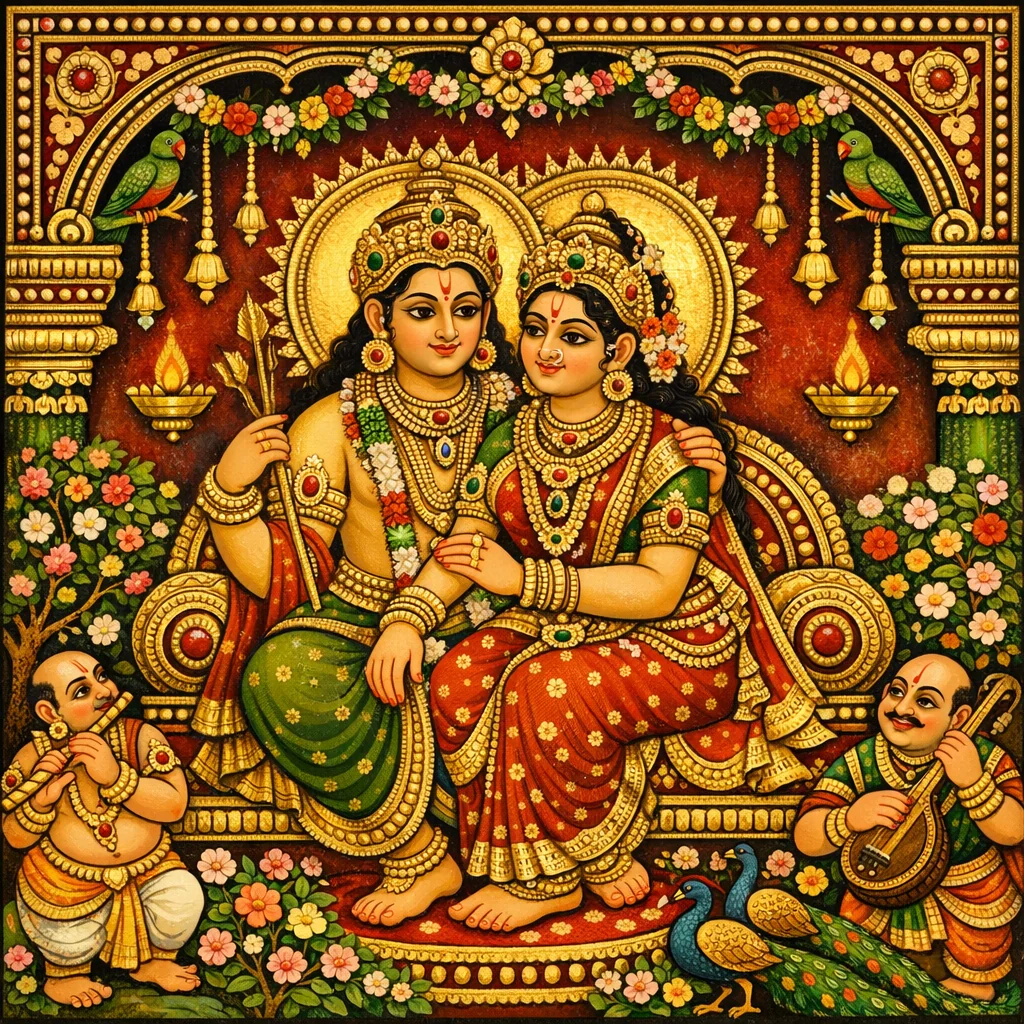
Adhyaya 338
Chapter 338 — शृङ्गारादिरसनिरूपणम् (Exposition of the Rasas beginning with Śṛṅgāra)
Lord Agni opens by rooting aesthetics in metaphysics: the Imperishable Brahman is the one light of consciousness, whose innate bliss manifests as rasa (aesthetic savor). From primordial transformation (ahaṅkāra and abhimāna), the emotional seed rati ripens into Śṛṅgāra when supported by transitory states and expressive factors. The chapter then maps the generation of rasas—Śṛṅgāra, Hāsya, Raudra, Vīra, Karuṇa, Adbhuta, Bhayānaka, Vībhatsa—and notes the place of Śānta, stressing that poetry without rasa is tasteless and that the poet functions as a creator shaping the poetic universe. It affirms the inseparability of rasa and bhāva, classifies enduring states (sthāyins) and many transitory states (vyabhicārins) with brief definitions and bodily/mental symptoms, and introduces dramaturgical tools: vibhāva (ālambana/uddīpana), anubhāva, nāyaka hero-types and aides. It concludes with a taxonomy of speech-initiatives (vāgārambha) and the triad of rīti, vṛtti, and pravṛtti as divisions of effective poetic communication.
Shlokas
Verse 1
इत्य् आग्नेये महापुराणे अलङ्कारे नाटकनिरूपणं नाम सप्तत्रिंशदधिकत्रिशततमो ऽध्यायः अथाष्टत्रिंशदधिकत्रिशततमो ऽध्यायः शृङ्गारादिरसनिरूपणम् अग्निर् उवाच अक्षरं परमं ब्रह्म सनातनमजं विभुं वेदान्तेषु वदन्त्येकं चैतन्यं ज्योतिरीश्वरम्
Thus, in the Agni Mahāpurāṇa, within the section on poetics (alaṅkāra), ends the three-hundred-and-thirty-seventh chapter entitled “The Exposition of Drama (nāṭaka).” Now begins the three-hundred-and-thirty-eighth chapter, “The Exposition of the Rasas beginning with Śṛṅgāra.” Agni said: “The Imperishable (Akṣara)—supreme Brahman—eternal, unborn, all-pervading—spoken of in the Vedāntas as the One: Consciousness (caitanya), Light, the Lord.”
Verse 2
आनन्दः सहजस्तस्य व्यज्यते स कदाचन व्यक्तिः सा तस्य चैतन्यचमत्काररसाह्वया
His bliss (ānanda) is innate; at times it is made manifest. That manifestation of him is called “rasa”—the savor born of the wondrous flash of consciousness (caitanya).
Verse 3
आद्यस्तस्य विकारो यः सो ऽहङ्कार इति स्मृतः ततो ऽभिमानस्तत्रेदं समाप्तं भुवनत्रयं
The first modification of that (Prakṛti, the primordial principle) is remembered as “ahaṅkāra,” the maker of the “I.” From it arises “abhimāna,” self-identification; and within it the entire triad of worlds is comprehended as the manifested cosmos.
Verse 4
अभिमानाद्रतिः सा च परिपोषमुपेयुषी व्यभिचार्यादिसामान्यात् शृङ्गार इति गीयते
That rati (erotic love), arising from abhimāna (possessive self-regard) and reaching full nourishment and maturity, when accompanied by the common presence of transitory emotions and the like, is sung of as Śṛṅgāra, the Erotic Sentiment.
Verse 5
तद्भेदाः काममितरे हास्याद्या अप्यनेकशः स्वस्वस्थादिविशेषोत्थपरिघोषस्वलक्षणाः
Its subdivisions, as one may wish, are many—such as the other forms beginning with Hāsya (laughter) and so on—each bearing its own defining mark, arising from particular conditions like one’s own state of mind, and expressing itself through distinctive vocal outbursts.
Verse 6
सत्त्वादिगुणसन्तानाज्जायन्ते परमात्मनः रागाद्भवति शृङ्गारो रौद्रस्तैक्ष्णात् प्रजायते
From the continuing succession of the guṇas, beginning with sattva, arise the aesthetic states grounded in the Supreme Self (Paramātman). From rāga (passion) arises the Śṛṅgāra rasa, and from taikṣṇya (sharpness, keenness) the Raudra rasa is produced.
Verse 7
वीरो ऽवष्टम्भजः सङ्कोचभूर्वीभत्स इष्यते शृङ्गाराज्ज्यायते हासो रौद्रात्तु करुणो रसः
Vīra, the heroic sentiment, is held to arise from avaṣṭambha (steadfast self-assurance). Bībhatsa, the sentiment of disgust, is said to be grounded in saṅkoca (revulsion and recoil). Hāsya, the comic, is regarded as an outgrowth of Śṛṅgāra (the erotic). And Karuṇa, the pathetic, arises from Raudra (the furious).
Verse 8
वीराच्चाद्भुतनिष्पत्तिः स्याद्वीभत्साद्भयानकः शृङ्गारहास्यकरुणा रौद्रवीरभयानकाः
From the Vīra (heroic) rasa arises the Adbhuta (marvellous) rasa; from the Vībhatsa (disgusting) rasa arises the Bhayānaka (terrifying) rasa. Moreover, Śṛṅgāra (erotic), Hāsya (comic), Karuṇā (pathetic), Raudra (furious), Vīra (heroic), and Bhayānaka (terrifying) are also treated as principal rasas.
Verse 9
वीभत्साद्भुतशान्ताख्याः स्वभावाच्चतुरो रसाः लक्ष्मीरिव विना त्यागान्न वाणी भाति नीरसा
By their inherent nature, four rasas are especially recognized—those called Vībhatsa (disgust), Adbhuta (wonder), and Śānta (tranquility) (together with one more implied by tradition). Just as Lakṣmī (splendour) does not shine without generosity, so speech and poetry, without rasa, do not shine—they become insipid.
Verse 10
अपारे काव्यसंसारे कविरेव प्रजापतिः यथा वै रोचते विश्वं तथेदं परिवर्तते
In the boundless world of poetry, the poet alone is like Prajāpati, the creator; for just as the universe appears pleasing to him, so this poetic world is shaped and transformed accordingly.
Verse 11
शृङ्गारी चेत् कविः काव्ये जातं रसमयं जगत् स चेत् कविर्वीतरागो नीरसं व्यक्तमेव तत्
If the poet is imbued with Śṛṅgāra (erotic sentiment), then in poetry the whole world becomes pervaded by rasa. But if that poet is vītarāga (free from passion), then the poetic world is plainly without rasa—tasteless.
Verse 12
न भावहीनो ऽस्ति रसो न भावो रसवर्जितः भावयन्ति रसानेभिर्भाव्यन्ते च रसा इति
There is no rasa (aesthetic sentiment) devoid of bhāva (emotion), nor is there any bhāva devoid of rasa. Bhāvas give rise to rasas through these factors, and rasas in turn are made manifest and experienced through bhāvas—so it is said.
Verse 13
स्थायिनो ऽष्टौ रतिमुखाः स्तम्भाद्या व्यभिचारिणः मनो ऽनुकूले ऽनुभवः सुखस्य रतिरिष्यते
There are eight enduring (sthāyin) emotional states, beginning with rati (love/delight). The transitory (vyabhicārin) states begin with stambha (stupefaction). When the mind is favorably disposed, the experience of pleasure is recognized as rati.
Verse 14
हर्षादिभिश् च मनसो विकाशो हास उच्यते चित्रादिदर्शनाच्चेतोवैक्लव्यं ब्रुवते भयम्
The blossoming of the mind arising from joy (harṣa) and similar causes is called hāsa (laughter). The mental agitation and confusion produced by seeing something strange and the like is termed bhaya (fear).
Verse 15
जुगुप्सा च पदार्थानां निन्दा दौर्भाग्यवाहिनां विस्मयो ऽतिशयेनार्थदर्शनाच्चित्तविस्तृतिः
Disgust (jugupsā) is revulsion toward objects; censure (nindā) is directed toward those who bring misfortune. Wonder (vismaya) arises from perceiving an extraordinary meaning or thing, and it is an expansion of the mind.
Verse 16
अष्टौ स्तम्भादयः सत्त्वाद्रजसस्तमसः परम् स्तम्भश्चेष्टाप्रतीघातो भयरागाद्युपाहितः
There are eight conditions beginning with stambha (stupefaction) that arise from the guṇas—sattva, rajas, and tamas. Stambha is the obstruction of activity, accompanied by factors such as fear, attachment (rāga), and the like.
Verse 17
श्रमरागाद्युपेतान्तःक्षोभजन्म वपुर्जलं स्वेदो हर्षादिभिर्देहोच्छासो ऽन्तःपुलकोद्गमः
Sweat (sveda) is the body’s “water,” produced from inner agitation accompanied by exertion, passion/attachment (rāga), and the like. From joy (harṣa) and similar emotions there also arises bodily exhilaration—an inner upsurge of pūlaka (horripilation, gooseflesh).
Verse 18
हर्षादिजन्मवाक्सङ्गः स्वरभेदो भयादिभिः मनोवैक्लव्यमिच्छन्ति शोकमिष्टक्षयादिभिः
They recognize that speech becoming obstructed or stammering arises from joy and related emotions; alteration of the voice arises from fear and similar states; and mental derangement arises from grief, the loss of what is dear, and the like.
Verse 19
क्रोधस्तैक्ष्णप्रबोधश् च प्रतिकूलानुकारिणि पुरुषार्थसमाप्त्यार्थो यः स उत्साह उच्यते
That purposeful drive—marked by fiery intensity and keen wakefulness, which persists even amid adverse or contrary circumstances, and is aimed at the accomplishment of the aims of human life—is called utsāha (energetic resolve/enterprise).
Verse 20
चित्तक्षोभभवोत्तम्भो वेपथुः परिकीर्तितः वैवर्ण्यञ्च विषादादिजन्मा कान्तिविपर्ययः
Trembling (vepathu) is described as a rigidity or convulsive stiffness arising from agitation of the mind. Discoloration, born of dejection and similar states, is a perversion of complexion—an abnormal change in bodily lustre (kānti).
Verse 21
दुःखानन्दादिजन्नेत्रजलमश्रु च विश्रुतम् इन्द्रयाणामस्तमयः प्रलयो लङ्घनादिभिः
The well-known term “aśru” (tear) is the water of the eyes produced by sorrow, joy, and the like. “Pralaya” (dissolution/fainting) is the setting—cessation—of the senses, caused by fasting and similar factors.
Verse 22
वैराग्यादिर्मनःखेदो निर्वेद इति कथ्यते मनःपीडादिजन्मा च सादो ग्लानिः शरीरगा
Mental dejection beginning with dispassion (vairāgya) is called nirveda (despondency). And the condition called sāda—arising from mental torment and the like—manifests as glāni, a bodily languor that pervades the body.
Verse 23
शङ्कानिष्टागमोत्प्रेक्षा स्यादसूया च मत्सरः मदिराद्युपयोगोत्थं मनःसंमोहनं मदः
Suspicion, imagining the advent of what is undesirable, and conjecturing ill possibilities—these are envy (asūyā) and jealousy (matsara). Intoxication (mada) is the mind’s bewilderment arising from the use of liquor and the like.
Verse 24
क्रियातिशयजन्मान्तःशरीरोत्थक्लमः श्रमः शृङ्गारादिक्रियाद्वेषश्चित्तस्यालस्यमुच्यते
Fatigue (śrama) is the bodily exhaustion that arises inwardly from excessive activity; and laziness (ālasyam) is said to be the mind’s aversion to activity—such as acts connected with love (śṛṅgāra) and the like.
Verse 25
भयरागाद्युपस्थित इति ख दैन्यं सत्त्वादपभ्रंशश्चिन्तार्थपरिभावनं इतिकर्तव्यतोपायाद्रशनं मोह उच्यते
When fear, attachment (rāga), and the like arise, there is dejection (dainya); there is a falling away from steadiness (sattva); there is obsessive brooding over the matter of one’s anxiety; and there is non-perception of what should be done and of the means to do it—this is called delusion (moha).
Verse 26
स्मृतिः स्यादनुभूतस्य वस्तुनः प्रतिविम्बनं मतिरर्थपरिच्छेदस्तत्त्वज्ञानोपनायितः
Memory (smṛti) is the re-reflection of an object previously experienced; and understanding (mati) is the determinate grasp of a meaning, leading one toward knowledge of reality (tattva-jñāna).
Verse 27
व्रीडानुरागादिभवः सङ्कोचः कोपि चेतसः भवेच्चपलातास्थैर्यं हर्षश्चित्तप्रसन्नता
Saṅkoca (self-contraction/withdrawal) is a particular constriction of the mind arising from shame, affection, and the like. Capalatā (fickleness) is unsteadiness, and harṣa (joy) is the mind’s gladness.
Verse 28
आवेशश् च प्रतीकारः शयो वैधुर्यमात्मनः कर्तव्ये प्रतिभाभ्रंशो जडतेत्यभिधीयते
Possession-like seizure, oppositional resistance, excessive sleep, impairment of one’s own faculties, and—when action is required—loss of initiative and discernment: these are described as the condition called ‘jaḍatā’ (mental dullness/stupor).
Verse 29
इष्टप्राप्तेरूपचितः सम्पदाभ्युदयो धृतिः गर्वाः परेष्ववज्ञानमात्मन्युत्कर्षभावना
From the attainment of what one desires arises accumulation (of gains); from prosperity comes rise in status; from steadfastness arises pride; from pride comes contempt for others and the conceit of one’s own superiority.
Verse 30
भवेद्विषादो दैवादेर्विघातो ऽभीष्टवस्तुनि औत्सुक्यमीप्सिताप्राप्तेर्वाञ्छया तरला स्थितिः
Despondency (viṣāda) arises when, due to fate and the like, there is obstruction with respect to a desired object. Restless longing (autsukya) is the unsteady state produced by desire when the wished-for thing has not been obtained.
Verse 31
चित्तेन्द्रियाणां स्तैमित्यमपस्मारो ऽचला स्थितिः युद्धे बाधादिभीस्त्रासो वीप्सा चित्तचमत्कृतिः
Stupefaction of the mind and senses, epilepsy (apasmāra), rigid immobility; fear in battle due to afflictions and the like; repeated revulsion; and bewildering astonishment of the mind—these are (noted) conditions/symptoms.
Verse 32
क्रोधस्याप्रशमो ऽमर्षः प्रबोधश्चेतनोदयः अवहित्थं भवेद्गुप्तिरिङ्गिताकारगोचरा
Unappeased anger, indignation (amārṣa), sudden alertness, and the rising of consciousness (inner agitation)—these constitute dissimulation; and concealment is to be inferred from gestures and outward expressions.
Verse 33
रोषतो गुरुवाग्दण्डपारुष्यं विदुरुग्रतां ऊहो वितर्कःस्याद्व्याधिर्मनोवपुरवग्रहः
From anger arises harshness—severe speech and punitive blows; by it the wise discern ferocity. From it also come conjecture and anxious overthinking; and disease arises as disturbance and affliction of mind and body.
Verse 34
अनिबद्धप्रलापादिरुन्मादो मदनादिभिः तत्त्वज्ञानादिना चेतःकषायो परमः शमः
The madness (unmāda) that begins with incoherent, unrestrained talk arises from Kāma (desire) and the like; but the supreme tranquility (śama) is the cleansing of the mind’s impurities through knowledge of reality (tattva-jñāna) and related disciplines.
Verse 35
कविभिर्योजनीया वै भावाः काव्यादिके रसाः विभाव्यते हि रत्यादिर्यत्र येन विभाव्यते
In poetry and related compositions, poets must indeed employ bhāvas and rasas; for in that work rati (love) and the other emotional states are made manifest—there, by whatever means, they are made manifest.
Verse 36
विभावो नाम सद्वेधालम्बनोद्दीपनात्मकः रत्यादिभाववर्गो ऽयं यमाजीव्योपजायते
It is called vibhāva because it is of two kinds—ālambana (the supporting determinant) and uddīpana (the exciting determinant). This group of emotional states beginning with rati (love) arises with reference to its proper sustaining basis—the person or object that serves as its locus.
Verse 37
आलम्बनविभावो ऽसौ नायकादिभवस् तथा धीरोदात्तो धीरोद्धतः स्याद्धीरललितस् तथा
This is called the ālambana-vibhāva (the foundational determinant), arising from the nāyaka (hero) and the like; and the nāyaka is classified as dhīrodātta, dhīroddhata, and also dhīralalita.
Verse 38
धीरप्रशान्त इत्य् एवं चतुर्धा नायकः स्मृतः अनुकूलो दक्षिणश् च शठो धृष्टः प्रवर्तितः
Thus the nāyaka (hero) is traditionally remembered in several types: (1) dhīra-praśānta, steady and tranquil; (2) anukūla, agreeable; (3) dakṣiṇa, courteous and tactful; (4) śaṭha, crafty; and (5) dhṛṣṭa, bold—these types being set forth in dramaturgical convention.
Verse 39
पीठमर्दो विटश् चैव विदूषक इति त्रयः शृङ्गारे नर्मसचिवा नायकस्यानुनायकाः
In the erotic sentiment (śṛṅgāra), three—namely the pīṭhamarda, the viṭa, and the vidūṣaka—are the hero’s aides in playful wit (narma-sachivas), serving as his subordinate companions (anunāyakas).
Verse 40
पीठमर्दः सम्बलकः श्रीमांस्तद्वेशजो विटः विदूषको वैहसिकस्त्वष्टनायकनायिकाः
The stage-types are: the pīṭhamarda (the hero’s attendant/parasite), the sambalaka (provider of provisions), the śrīmān (prosperous gentleman), the viṭa born of that urban guise, the vidūṣaka (jester), and the vaihāsika (comic buffoon); likewise, there are eight types of nāyaka (hero) and nāyikā (heroine).
Verse 41
स्वकीया परकीया च पुनर्भूरिति कौशिकाः सामान्या न पुनर्भूरिरित्याद्या बहुभेदतः
The Kauśikas (authorities of that school) describe many subdivisions—such as ‘one’s own wife’ (svakīyā), ‘another man’s wife’ (parakīyā), ‘a remarried woman’ (punarbhū), ‘a common woman’ (sāmānyā), ‘one who is not a punarbhū’ (na punarbhū), and so forth—distinguished in numerous ways.
Verse 42
उद्दिपनविभावास्ते संस्कारैर् विविधैः स्थितैः आलम्बनविभावेषु भावानुद्वीपयन्ति ये
These are called uddīpana-vibhāvas—factors established through various saṃskāras (impressions and conditioning)—which, in relation to the ālambana-vibhāvas (primary supports), kindle and intensify the bhāvas (emotive states).
Verse 43
चतुःषष्टिकला द्वेधा कर्माद्यैर् गीतिकादिभिः कुहकं स्मृतिरप्येषां प्रायो हासोपहारकः
The sixty-four arts are of two kinds: those that begin with practical crafts and works (karman), and those that begin with musical and performative arts (gītikā and the like). Among them, “kuhaka” (conjuring/illusion) is also remembered as being, for the most part, a means of amusement and entertainment.
Verse 44
आलम्बनविभावस्य भावैर् उद्बुद्धसंस्कृतैः मनोवाग्बुद्धिवपुषां स्मृतीछाद्वेषयत्नतः
Through awakened and refined bhāvas, the ālambana-vibhāva is brought into manifestation—affecting mind, speech, intellect, and the body—by the deliberate operation of remembrance, concealment, aversion, and effort.
Verse 45
आरम्भ एव विदुषामनुभाव इति स्मृतः स चानुभूयते चात्र भवत्युत निरुच्यते
The very beginning (of a composition) is remembered by the learned as “anubhāva”—the manifest effect; and here it is also experienced, it truly arises, and is accordingly explained.
Verse 46
मनोव्यापारभूयिष्ठो मन आरम्भ उच्यते द्विविधः पौरुषस्त्रैण ईदृशो ऽपि प्रसिध्यति
That state in which mental activity predominates is called the mind’s “ārambha” (initiative). It is of two kinds—masculine and feminine—and in practice it is known to be of this nature.
Verse 47
शोभा विलासो माधुर्यं स्थैर्यं गाम्भीर्यमेव च ललितञ्च तथौदार्यन्तेजो ऽष्टाविति पौरुषाः
Beauty (śobhā), graceful playfulness (vilāsa), sweetness (mādhurya), firmness (sthairya), depth (gāmbhīrya), elegance (lalita), generosity (audārya), and tejas—splendor and vital energy—these eight are called pauruṣa, the heroic masculine excellences.
Verse 48
नीचनिन्दोत्तमस्पर्धा शौर्यं दाक्षादिकारणं मनोधर्मे भवेच्छोभा शोभते भवनं यथा
Censure of the low, rivalry with the excellent, heroism, and the causes beginning with skill—when these abide as dispositions of the mind, they become an ornament in expression, just as a well-adorned house appears beautiful.
Verse 49
भावो हावश् च हेला च शोभा कान्तिस्तथैव च दीप्तिर्माधुर्यशौर्ये च प्रागल्भ्यं स्यादुदारता
Bhāva (expressive feeling), hāva (amorous gesture), helā (playful coquetry), śobhā (beauty), kānti (radiance), dīpti (splendour), mādhurya (sweetness), śaurya (valour), prāgalbhya (confident boldness), and udāratā (nobility) are recognized as the defining qualities.
Verse 50
स्थैर्यं गम्भीरता स्त्रीणां विभावा द्वादशेरिताः भावो विलासो हावःस्याद्भावः किञ्चिच्च हर्षजः
For women, steadiness and gravity are declared here among the twelve vibhāvas (determinants). From these arises bhāva (an emotive state); its playful manifestation is called vilāsa, and the coquettish expression is termed hāva. Bhāva may also be slight, and it can be born of joy.
Verse 51
वाचो युक्तिर्भवेद्वागारम्भो द्वादश एव सः तत्राभाषणमालापः प्रलापो वचनं वहु
The proper regulation (yukti) of speech is called ‘vāgārambha’ (the undertaking of speech), and it is of twelve kinds. Among these are: abhāṣaṇa (non-speaking), ālāpa (casual talk), pralāpa (incoherent chatter), and bahu-vacana (abundant speaking).
Verse 52
विलापो दुःखवचनमनुलापो ऽसकृद्वचः संलाप उक्तप्रत्युक्तमपलापो ऽन्यथावचः
“Vilāpa” is speech that expresses sorrow; “anulāpa” is repeated utterance; “saṃlāpa” is dialogue consisting of statement and reply; and “apalāpa” is speaking otherwise—namely, a contradictory or evasive utterance.
Verse 53
वार्ताप्रयाणं सन्देशो निर्देशः प्रतिपादनम् तत्त्वदेशो ऽतिदेशो ऽयमपदेशो ऽन्यवर्णनम्
“Vārtā-prayāṇa” (a narrative of departure), “sandeśa” (a message), “nirdeśa” (direct instruction), “pratipādana” (systematic exposition), “tattvadeśa” (teaching of the true principle), “atideśa” (instruction by extension or analogy), “apadeśa” (admonition under the guise of an example or pretext), and “anya-varṇana” (description of something else)—these are the recognized modes of presentation.
Verse 54
उपदेशश् च शिक्षावाक् व्याजोक्तिर्व्यपदेशकः बोधाय एष व्यापारःसुबुद्ध्यारम्भ इष्यते तस्य भेदास्त्रयस्ते च रीतिवृत्तिप्रवृत्तयः
Instruction (upadeśa), a didactic utterance (śikṣā-vāk), indirect statement (vyājokti), and indicative designation (vyapadeśaka)—this operation of speech is accepted as a means to produce understanding and to set right intelligence in motion. Its divisions are said to be three: rīti (style), vṛtti (mode/diction), and pravṛtti (contextual application or field of use).
Frequently Asked Questions
Rasa is described as the manifestation of innate bliss—an aesthetic savor arising from the wondrous flash of consciousness (caitanya-chamatkāra) when made experientially present.
By rooting aesthetics in Brahman-consciousness and treating poetic technique (bhāva, vibhāva, anubhāva, style and diction) as a disciplined refinement of mind and speech, it integrates cultural mastery (bhukti) with contemplative orientation toward truth (mukti).