Adhyaya 216
Gāyatrī-nirvāṇa (The Liberative/Concluding Doctrine of Gāyatrī)
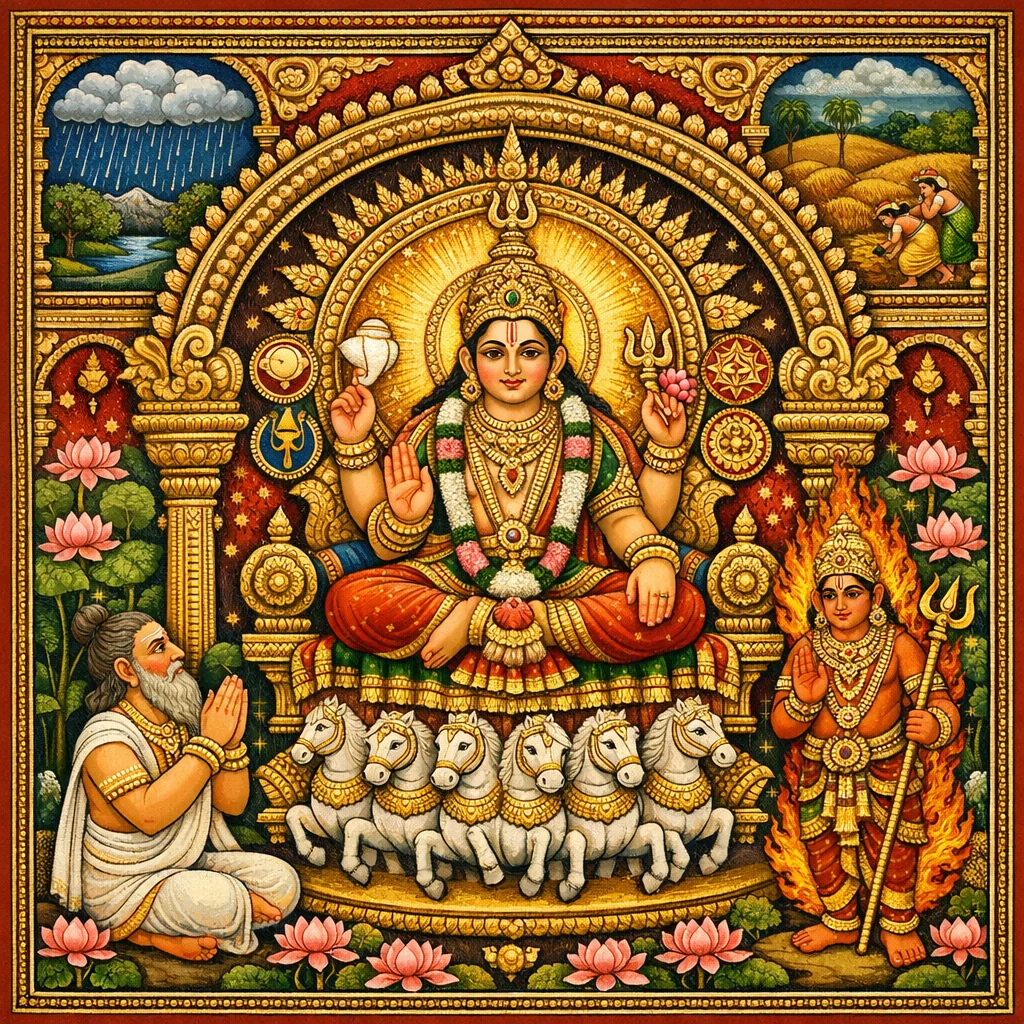
After completing the Sandhyā-vidhi, Agni teaches that one should conclude the rite with Gāyatrī-japa and smaraṇa, stressing mantra as protection (rakṣā) and inner discipline. A philological-theological exegesis follows: Gāyatrī is called Sāvitrī because she illumines, and Sarasvatī because she is Savitṛ’s speech-form (vāc). Bharga is explained from roots of shining and purifying “burning/cooking,” linking radiance with transformative refinement. Vareṇyam is set forth as the supreme, choosable state sought by aspirants of heaven and liberation, while dhīmahi is glossed as sustained mental retention and contemplation. Sectarian readings are reconciled by presenting the mantra’s light as one reality variously recited as Viṣṇu, Śiva, Śakti, Sūrya, or Agni, yet affirming a unitive Brahman at the Veda’s beginning. A ritual cosmology then shows that oblation to Agni supports the Sun and yields rain, food, and beings, so mantra-ritual sustains the world. The climax is advaitic: the supreme light in the solar orb is the turīya reality and the Viṣṇu-parama-pada; through meditation one destroys birth and death and threefold suffering, culminating in the identity statement, “I am Brahman… that Solar Person am I, the Infinite (Oṃ).”
Shlokas
No shlokas available for this adhyaya yet.
Frequently Asked Questions
Completion through Gāyatrī-japa and mental recollection (smaraṇa), framed as both spiritual discipline and protective power for disciples, spouse, and vital breaths (prāṇa).
Bharga is interpreted as tejas (radiance) and purifying brilliance, supported by etymological links to roots meaning ‘to shine’ and ‘to burn/cook’ (purificatory transformation).
It acknowledges multiple recitations (Śiva, Śakti, Sūrya, Agni) while asserting their unity in the one supreme light/Brahman, explicitly identifying that light with Viṣṇu as the world-cause.
It presents a causal chain: oblation to Agni supports Āditya; from the Sun comes rain; from rain food; from food living beings—linking ritual action to world-order.
By meditating on the supreme light as turīya within the solar orb, one destroys birth-death and threefold suffering, culminating in the non-dual recognition ‘I am Brahman’ and identity with the Āditya-Puruṣa.