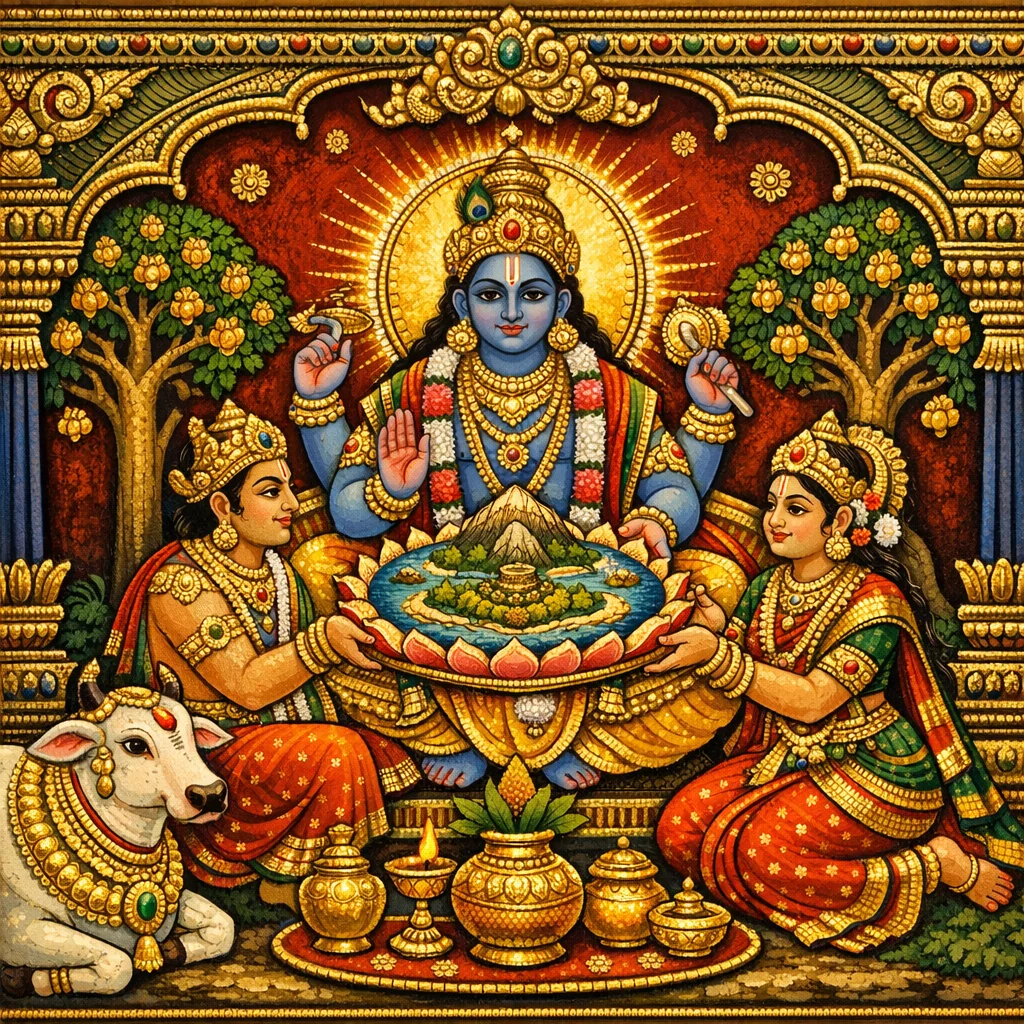
Adhyaya 213
Chapter 213 — पृथ्वीदानानि (Gifts of the Earth)
Lord Agni begins a structured teaching on pṛthvī-dāna (the gift of Earth/land), presenting dāna as both an imitation of cosmic order and a ritual technology. He first defines the Earth by graded measures mapped up to Jambūdvīpa, and prescribes constructing an ideal “earth-model” with specified weights (e.g., bhāras of gold), using kūrma (tortoise) and padma (lotus) designs to signify cosmic support and auspicious unfolding. He then states the merit: the donor reaches Brahmaloka and rejoices with the Pitṛs, while Viṣṇu-centered gifting yields Kāmadhenu as a paradigmatic reward. The text extols go-dāna as the comprehensive gift (sarva-dāna) and adds high-merit donations—offering a kapilā cow before Viṣṇu for lineage deliverance, gifting an adorned woman for Aśvamedha-equivalent merit, and donating fertile land, villages, cities, or market-towns for prosperity and happiness. The chapter closes with the Kārttika bull-release (vṛṣotsarga) as a lineage-liberating rite, completing the arc from cosmic symbolism to social-economic dharma.
Shlokas
No shlokas available for this adhyaya yet.
Frequently Asked Questions
It prescribes graded standards and symbolic constructions for ‘gifting the Earth’ using precise measures and auspicious forms (kūrma/padma), and it links these gifts—along with land, cow, settlement, and bull-release rites—to lineage uplift and attainment of higher worlds such as Brahmaloka.
It treats dāna as a calibrated dharmic act: correct form, material measure, and devotional context (notably before Viṣṇu) convert wealth into merit, benefiting Pitṛs and lineage while orienting the donor toward higher loka-attainments and purified prosperity.