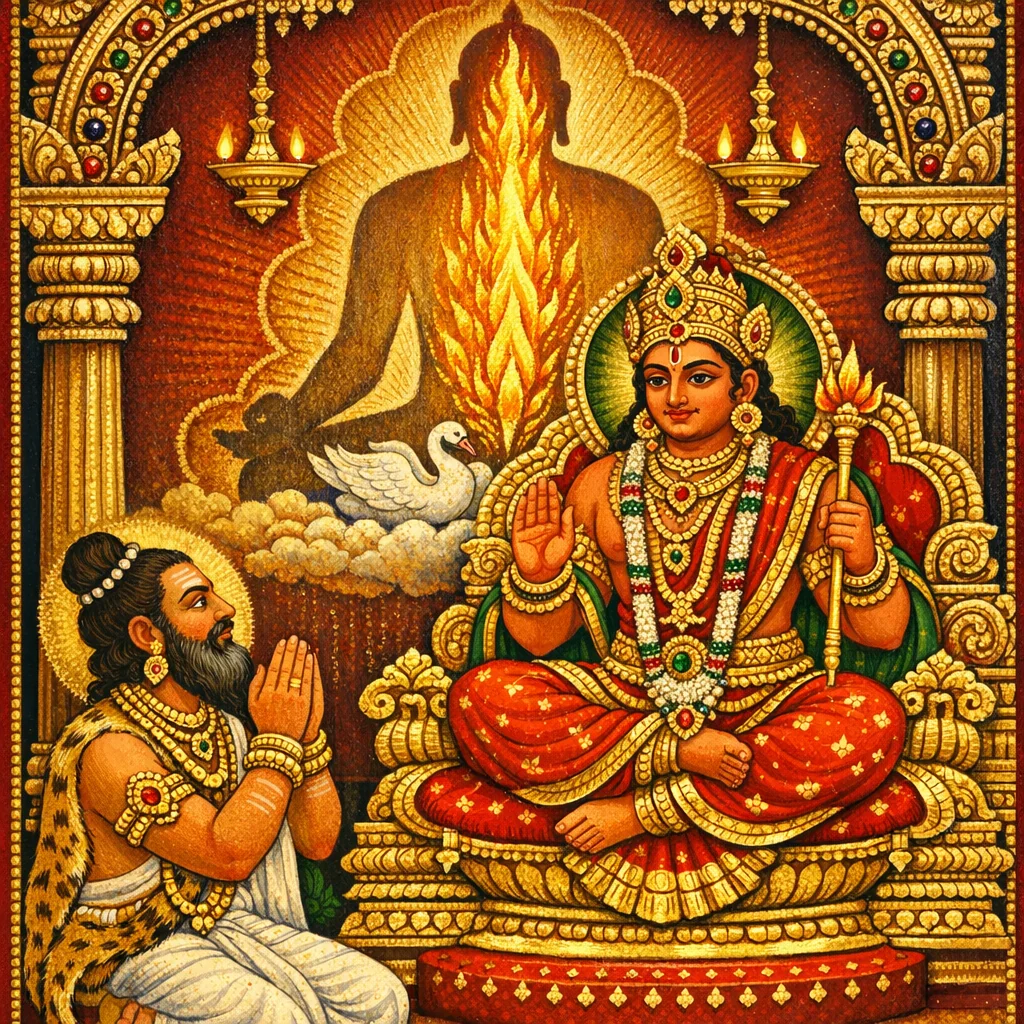
Adhyaya 214
मन्त्रमाहात्म्यकथनम् (Account of the Greatness of Mantras)
After concluding the topic of land-gifts, Lord Agni turns to a technical yogic teaching that draws the merit of dāna inward, into discipline of mantra and prāṇa. He describes the nāḍī-cakra arising from the kanda below the navel, counting 72,000 channels and ten chief nāḍīs (including iḍā, piṅgalā, and suṣumṇā). He then defines the ten vital winds—five primary (prāṇa, apāna, samāna, udāna, vyāna) and five subsidiary (nāga, kūrma, kṛkara, devadatta, dhanañjaya)—linking them to bodily functions and to the day–night polarity of prāṇa and apāna. Calendrical and symbolic correspondences (saṅkrānti, viṣuva, ayana, adhīmāsa, ṛṇa, ūnarātra, dhana) are integrated with physiological signs, suggesting that cosmic time may be read through breath and symptom. Practical prāṇāyāma is taught through pūraka (filling), kumbhaka (retention), and an upward-directed release, culminating in ajapā-japa (Gāyatrī as the spontaneous mantra) and haṃsa practice. The chapter expands into subtle-body theology—Kuṇḍalinī in the heart-region, contemplation of amṛta, and deity-loci within the body (Brahmā in the heart, Viṣṇu in the throat, Rudra in the palate, Maheśvara in the forehead). Finally, mantra is presented as an architectonic “prāsāda” (mantric palace) with phonetic measures (short/long/pluta), ritual applications (phaṭ for māraṇa; heart-mantra for ākṛṣṭi), japa-homa counts, the doctrine of tri-śūnya, and the qualifications of an ācārya/guru grounded in mastery of Oṁ, Gāyatrī, and Rudra-knowledge.
Shlokas
No shlokas available for this adhyaya yet.
Frequently Asked Questions
A structured subtle-physiology: 72,000 nāḍīs from the kanda below the navel; ten principal nāḍīs (including iḍā, piṅgalā, suṣumṇā); and ten vāyus with precise functional definitions, integrated with prāṇāyāma steps (pūraka–kumbhaka–release).
It internalizes dharma through disciplined breath and mantra: ajapā-japa and haṃsa contemplation purify the practitioner, establish deity-awareness within the body via nyāsa, and present mantra as a ‘prāsāda’ whose correct phonetics and method lead to siddhi and, through tri-śūnya insight, liberation.
Gāyatrī is called Ajapā (spontaneous, unforced repetition), identified as embodying Brahmā, Viṣṇu, and Maheśvara; repeating it is said to end rebirth.
An ācārya must be endowed with the thirty-eight kalās; a true guru is described as one who knows Oṁkāra, Gāyatrī, and the Rudra-deities and their principles.