Adhyaya 57
Gadāyuddhe Kṛṣṇopadeśaḥ (Kṛṣṇa’s Counsel in the Mace-Duel) — Śalya-parva 57
Upa-parva: Gadāyuddha (Bhīma–Duryodhana Mace-Duel Episode)
Saṃjaya reports that Arjuna, observing the intensified duel between the two principal combatants, asks Kṛṣṇa to assess comparative superiority. Kṛṣṇa judges Bhīma stronger but Duryodhana more persistently trained, then argues that strict adherence to conventional combat rules may prevent Bhīma’s victory. He invokes precedents of māyā in conflict and recalls Bhīma’s dice-hall vow to break Duryodhana’s thighs, recommending a decisive strike consistent with that pledge. Arjuna then gives a covert signal by striking his own thigh, which Bhīma interprets. The duel is narrated with technical movement patterns (circular maṇḍalas and deceptive footwork), mutual exhaustion, exchanges of heavy blows, and Duryodhana’s attempt to evade. Bhīma capitalizes on the moment and strikes Duryodhana’s thighs, breaking them; Duryodhana falls, after which a sequence of ominous portents (winds, dust and blood-like rain, celestial disturbances, disquiet among beings) is described, marking the event’s cosmic and political gravity.
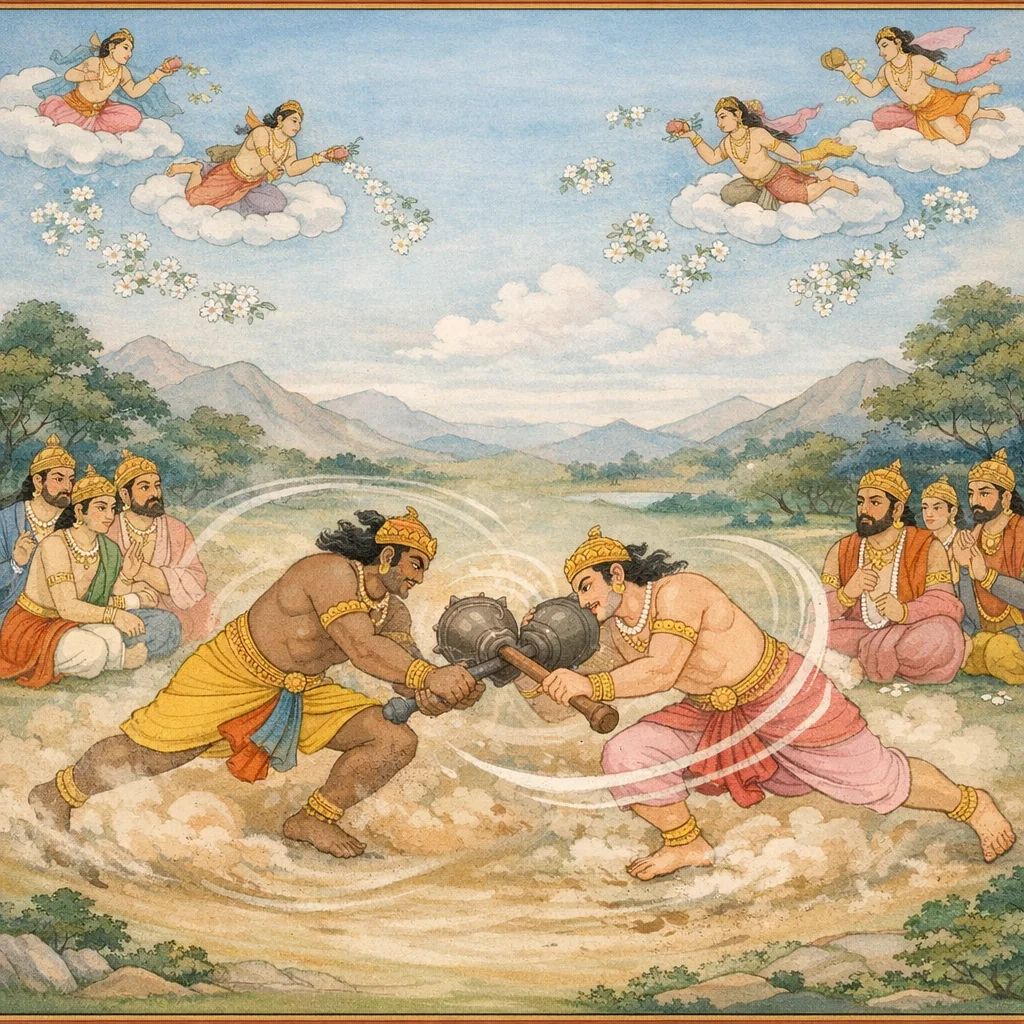
Chapter Arc: संजय धृतराष्ट्र से कहते हैं—भीमसेन को रणभूमि में आते देख दुर्योधन, अपने समस्त अभिमान और अंतिम आशा को समेटे, वेग से प्रत्युद्यत होता है; निर्णायक गदायुद्ध का द्वार खुलता है। → दोनों महाबली सींगवाले वृषभों की भाँति टकराते हैं; गदाओं के प्रहारों का महानिर्घोष उठता है और युद्ध इन्द्र-प्रह्लाद जैसे दैवी प्रतिद्वन्द्वियों के समान लोमहर्षक बन जाता है। रक्त से लथपथ होकर भी वे पीछे नहीं हटते; दुर्योधन की गदा वायु-वेग से घूमती देख पाण्डव-सोमक दल में भय और आशंका फैलती है। → दुर्योधन के प्रचण्ड प्रहार से भीम क्षणभर मूर्च्छित-से होकर कर्तव्य-विमूढ़ हो जाते हैं; पाण्डवों की विजय-आशा डगमगाती है। फिर निकट आकर दुर्योधन भीम के ललाट पर भीषण आघात करता है—पर भीम पर्वत-सा अचल रह जाता है; इसी क्षण आकाश में देव-अप्सराओं का हर्षनाद और पुष्पवर्षा गूँज उठती है। → भीम के अडिग रहने से पाण्डव पक्ष का टूटता मन संभलता है और यह स्पष्ट होता है कि यह द्वन्द्व केवल बल का नहीं, धैर्य और संकल्प का भी है; दोनों योद्धा रक्तरंजित होकर भी युद्ध-लय में टिके रहते हैं। → युद्ध का पलड़ा क्षण-क्षण झूलता है—भीम की स्थिरता के बाद अगला निर्णायक दाँव कौन लगाएगा, यह अनिश्चित रह जाता है।
Shlokas
Verse 1
अतड--णक+ सप्तपञ्चाशत्तमोड ध्याय: भीमसेन और दुर्योधनका गदायुद्ध संजय उवाच ततो दुर्योधनो दृष्टवा भीमसेनं तथागतम् | प्रत्युद्ययावदीनात्मा वेगेन महता नदन्,संजय कहते हैं--राजन! तदनन्तर उदारहृदय दुर्योधनने भीमसेनको इस प्रकार आक्रमण करते देख स्वयं भी गर्जना करते हुए बड़े वेगसे आगे बढ़कर उनका सामना किया
Sanjaya said: Then Duryodhana, seeing Bhimasena advancing in that manner, moved forward to meet him. Unshaken in spirit, he charged with great speed, roaring aloud—setting the stage for the decisive club-duel where pride, resolve, and the burdens of dharma collide on the battlefield.
Verse 2
समापेततुरन्योन्यं शृद्धिणौ वृषभाविव । महानिर्घातघोष श्ष् प्रहाराणामजायत,वे दोनों बड़े-बड़े सींगवाले दो साँड्रोंके समान एक-दूसरेसे भिड़ गये। उनके प्रहारोंकी आवाज महान् वजपातके समान भयंकर जान पड़ती थी
Sañjaya said: The two closed upon one another, like a pair of horned bulls locking in combat. The sound of their blows rose into a tremendous crash, as terrifying as a thunderbolt—signaling the fierce, unrelenting nature of the duel within the larger war.
Verse 3
अभवच्च तयोरय॑द्ध॑ तुमुलं लोमहर्षणम् । जिगीषतोर्यथान्योन्यमिन्द्रप्रह्मादयोरिव,दुर्योधन और भीमका गदायुद्ध एक-दूसरेको जीतनेकी इच्छा रखनेवाले उन दोनोंमें इन्द्र और प्रह्नादके समान भयंकर एवं रोमांचकारी युद्ध होने लगा
Sañjaya said: Then, between those two—each intent on conquering the other—there arose a tumultuous, hair-raising battle, like the dreadful clash of Indra and Prahlāda. The scene underscores how the thirst for victory can turn combat into a terrifying spectacle, overwhelming all restraint.
Verse 4
रुधिरोक्षितसर्वाड्री गदाहस्तौ मनस्विनौ । ददृशाते महात्मानौ पुष्पिताविव किशुकौ,उनके सारे अंग खूनसे लथपथ हो गये थे। हाथमें गदा लिये वे दोनों महामना मनस्वी वीर फूले हुए दो पलाश-वृक्षोंके समान दिखायी देते थे
Sañjaya said: Both those high-souled, resolute warriors appeared with every limb drenched in blood, each gripping a mace in hand—like two kiśuka (palāśa) trees in full bloom. The image underscores the grim splendor of battle: valor and steadfastness shine even as violence leaves the body stained, revealing the tragic dignity of warriors bound to their chosen duty.
Verse 5
तथा तस्मिन् महायुद्धे वर्तमाने सुदारुणे । खटद्योतसंघैरिव खं दर्शनीयं व्यरोचत
Sañjaya said: As that great battle raged on—terrible in its ferocity—the sky shone with a strange, arresting beauty, as though it were filled with swarms of fireflies. The verse underscores a grim moral contrast: even amid mass destruction, the world can appear outwardly splendid, reminding the listener that aesthetic brilliance does not lessen the ethical weight of violence.
Verse 6
उस अत्यन्त भयंकर महायुद्धके चालू होनेपर गदाओंके आघातसे आगकी चिनगारियाँ छूटने लगीं। वे आकाशमें जुगनुओंके दलके समान जान पड़ती थीं और उनसे वहाँके आकाशकी दर्शनीय शोभा हो रही थी ।। तथा तस्मिन् वर्तमाने संकुले तुमुले भूशम् । उभावपि परिश्रान्तौ युध्यमानावरिंदमौ
Verse 7
इस प्रकार चलते हुए उस अत्यन्त भयंकर घमासान युद्धमें लड़ते-लड़ते वे दोनों शत्रुदमन वीर बहुत थक गये ।। तौ मुहूर्त समाश्वस्य पुनरेव परंतपौ । सम्प्रहारयतां चित्रे सम्प्रगृह्म गदे शुभे,फिर उन दोनोंने दो घड़ीतक विश्राम किया। इसके बाद शत्रुओंको संताप देनेवाले वे दोनों योद्धा फिर विचित्र एवं सुन्दर गदाएँ हाथमें लेकर एक-दूसरेपर प्रहार करने लगे
Sañjaya said: After pausing for a moment to regain their breath, those two tormentors of foes once again took up their splendid, variegated maces and resumed striking at one another. Even amid the ferocity of the duel, the brief respite underscores the human limits of warriors and the relentless resolve that drives them back into combat.
Verse 8
तौतु दृष्टवा महावीर्यो समा श्चस्तौ नरर्षभौ । बलिनौ वारणोौ यद्वद् वासितार्थे मदोत्कटौ,उन समान बलशाली महापराक्रमी नरश्रेष्ठ वीरोंने विश्राम करके पुनः हाथमें गदा ले ली और मैथुनकी इच्छावाली हथिनीके लिये लड़नेवाले दो बलवान एवं मदोन्मत्त गजराजोंके समान पुनः युद्ध आरम्भ कर दिया है, यह देखकर देवता, गन्धर्व और मनुष्य सभी अत्यन्त आश्चर्यसे चकित हो उठे
Sañjaya said: Seeing those two bull-like heroes—men of great prowess—who, having regained their breath, had again taken up their maces, the onlookers beheld them resume the combat. Like two powerful lordly elephants, frenzied with rut and contending for a receptive mate, they surged back into battle. Witnessing this renewed clash of strength and will, gods, Gandharvas, and men alike were struck with astonishment.
Verse 9
समानवीर्यो सम्प्रेक्ष्य प्रगृहीतगदावु भौ । विस्मयं परमं जम्मुर्देवगन्धर्वमानवा:,उन समान बलशाली महापराक्रमी नरश्रेष्ठ वीरोंने विश्राम करके पुनः हाथमें गदा ले ली और मैथुनकी इच्छावाली हथिनीके लिये लड़नेवाले दो बलवान एवं मदोन्मत्त गजराजोंके समान पुनः युद्ध आरम्भ कर दिया है, यह देखकर देवता, गन्धर्व और मनुष्य सभी अत्यन्त आश्चर्यसे चकित हो उठे
Sañjaya said: Seeing the two of equal prowess, both having again taken up their maces, the gods, Gandharvas, and men were struck with the highest astonishment. After a brief pause, those foremost heroes resumed the duel with renewed resolve—like two powerful, intoxicated lordly elephants battling for a receptive she-elephant—revealing the relentless momentum of kṣatriya combat and the awe it inspires across worlds.
Verse 10
प्रगृहीतगदौ दृष्टवा दुर्योधनवृकोदरी । संशय: सर्वभूतानां विजये समपद्यत,दुर्योधन और भीमसेनको पुनः गदा उठाये देख उनमेंसे किसी एककी विजयके सम्बन्धमें समस्त प्राणियोंके हृदयमें संशय उत्पन्न हो गया
Sañjaya said: Seeing Duryodhana and Vṛkodara (Bhīma) once again grasping their maces, doubt arose in the hearts of all beings as to which of the two would attain victory. The moment captures the moral tension of the duel—strength and resolve are equalized, and the outcome appears suspended between fate, skill, and adherence to the rules of combat.
Verse 11
समागम्य ततो भूयो भ्रातरौ बलिनां वरौ । अन्योन्यस्यान्तरप्रेप्सू प्रचक्राते$न्तरं प्रति,बलवानोंमें श्रेष्ठ उन दोनों भाइयोंमें जब पुनः भिड़न्त हुई तो दोनों ही दोनोंके चूकनेका अवसर देखते हुए पैंतरे बदलने लगे
Sañjaya said: Then the two brothers—foremost among the mighty—met again in combat. Each, intent on finding an opening in the other, began to shift and circle, seeking the vulnerable interval that would allow a decisive strike. The verse highlights the disciplined, watchful tactics of warriors in a righteous war, where victory depends not only on strength but on alertness, restraint, and timing.
Verse 12
यमदण्डोपमां गुर्वीमिन्द्राशनिमिवोद्यताम् । ददृशुः प्रेक्षका राजन् रौद्रीं विशसनीं गदाम्,राजन्! उस समय युद्धस्थलमें जब भीमसेन अपनी गदा घुमाने लगे, तब दर्शकोंने देखा, उनकी भारी गदा यमदण्डके समान भयंकर है। वह इन्द्रके वज़के समान ऊपर उठी हुई है और शत्रुको छिन्न-भिन्न कर डालनेमें समर्थ है। गदा घुमाते समय उसकी घोर एवं भयानक आवाज वहाँ दो घड़ीतक गूँजती रही
Sañjaya said: “O King, the onlookers beheld that mighty mace—heavy and dreadful like Yama’s staff, raised aloft like Indra’s thunderbolt—fierce and slaughtering, capable of tearing enemies apart. In this moment the poem underscores the terrifying momentum of war: strength and skill become instruments of death, and the battlefield’s spectacle draws even witnesses into awe at violence.”
Verse 13
आविद्धयतो गदां तस्य भीमसेनस्य संयुगे । शब्द: सुतुमुलो घोरो मुहूर्त समपद्यत,राजन्! उस समय युद्धस्थलमें जब भीमसेन अपनी गदा घुमाने लगे, तब दर्शकोंने देखा, उनकी भारी गदा यमदण्डके समान भयंकर है। वह इन्द्रके वज़के समान ऊपर उठी हुई है और शत्रुको छिन्न-भिन्न कर डालनेमें समर्थ है। गदा घुमाते समय उसकी घोर एवं भयानक आवाज वहाँ दो घड़ीतक गूँजती रही
Sañjaya said: “O King, as Bhīmasena whirled his mace in the thick of battle, a tremendously loud and dreadful roar arose and continued for a while. The very sound proclaimed the irresistible force of his weapon, striking terror into the enemy ranks and signaling imminent destruction in the clash of arms.”
Verse 14
आविद्धयन्तमेरिं प्रेक्ष्य धार्तराष्ट्रो<थ पाण्डवम् । गदामतुलवेगां तां विस्मित: सम्बभूव ह,आपका पुत्र दुर्योधन अपने शत्रु पाण्डुकुमार भीमसेनको वह अनुपम वेगशालिनी गदा घुमाते देख आश्र्यमें पड़ गया
Sañjaya said: Seeing the Pāṇḍava—his enemy—whirling that mace of incomparable speed, Dhṛtarāṣṭra’s son (Duryodhana) was struck with astonishment. In the midst of battle, the display of Bhīma’s force momentarily unsettles even the proud, revealing how power and resolve can shake an adversary’s confidence.
Verse 15
चरंश्व विविधान् मार्गान् मण्डलानि च भारत । अशोभत तदा वीरो भूय एव वृकोदर:
Sañjaya said: “O Bhārata, moving along many different paths and wheeling in circles, the hero Vṛkodara shone all the more at that time.”
Verse 16
भरतनन्दन! वीर भीमसेन भाँति-भाँतिके मार्गों और मण्डलोंका प्रदर्शन करते हुए पुनः बड़ी शोभा पाने लगे ।। तौ परस्परमासाद्य यत्तावन्योन्यरक्षणे । मार्जाराविव भक्षार्थ ततक्षाते मुहुर्मुहु:,वे दोनों परस्पर भिड़कर एक-दूसरेसे अपनी रक्षाके लिये प्रयत्नशील हो रोटीके टुकड़ोंके लिये लड़नेवाले दो बिलावोंके समान बारंबार आघात-प्रतिघात कर रहे थे
Sanjaya said: “O descendant of Bharata, the heroic Bhimasena, displaying ever-varied courses and circular manoeuvres, once again shone with great splendour. The two warriors closed upon one another, each striving to guard himself against the other; like two cats fighting over a morsel of food, they struck and counterstruck again and again.”
Verse 17
अचरदू भीमसेनस्तु मार्गान् बहुविधांस्तथा । मण्डलानि विचित्राणि गतप्रत्यागतानि च
Sañjaya said: Bhīmasena then moved along the field in many kinds of courses, tracing varied and intricate circles—advancing and withdrawing again—displaying controlled martial skill amid the chaos of war.
Verse 18
उस समय भीमसेन नाना प्रकारके मार्ग और विचित्र मण्डल दिखाने लगे। वे कभी शत्रुके सम्मुख आगे बढ़ते और कभी उसका सामना करते हुए ही पीछे हट आते थे ।। अस्त्रयन्त्राणि चित्राणि स्थानानि विविधानि च । परिमोक्षं प्रहाराणां वर्जन॑ं परिधावनम्,विचित्र अस्त्र-यन्त्रों और भाँति-भाँतिके स्थानोंका प्रदर्शन करते हुए वे दोनों शत्रुके प्रहारोंसे अपनेको बचाते, विपक्षीके प्रहारको व्यर्थ कर देते और दायें-बायें दौड़ लगाते थे
Sanjaya said: At that time Bhimasena displayed many kinds of tactical paths and intricate battle-formations. Now advancing straight toward the enemy, now withdrawing while still facing him, he exhibited wondrous weapon-devices and varied positions—evading incoming blows, nullifying the opponent’s strikes, and darting to and fro across the field. The passage highlights not mere ferocity but disciplined skill: in war, courage is joined to alertness, restraint, and the intelligent avoidance of needless harm.
Verse 19
अभिद्रवणमाक्षेपमवस्थानं सविग्रहम् । परिवर्तनसंवर्तमवप्लुतमुपप्लुतम्,कभी वेगसे एक-दूसरेके सामने जाते, कभी विरोधीको गिरानेकी चेष्टा करते, कभी स्थिरभावसे खड़े होते, कभी गिरे हुए शत्रुके उठनेपर पुनः उसके साथ युद्ध करते, कभी विरोधीपर प्रहार करनेके लिये चक्कर काटते, कभी शत्रुके बढ़ावको रोक देते, कभी विपक्षीके प्रहारको विफल करनेके लिये झुककर निकल जाते, कभी उछलते-कूदते, कभी निकट आकर गदाका प्रहार करते और कभी लौटकर पीछेकी ओर किये हुए हाथसे शत्रुपर आघात करते थे। दोनों ही गदायुद्धके विशेषज्ञ थे और इस प्रकार पैंतरे बदलते हुए एक- दूसरेपर चोट करते थे
Sañjaya said: They kept shifting their tactics—charging straight at one another, hurling and striking, standing firm in poised resistance, re-engaging when a fallen foe rose again, circling to find an opening for a blow, checking the opponent’s advance, ducking aside to nullify an incoming strike, springing and leaping, closing in to land a mace-hit, and then turning back to strike with a backward-swing of the arm. Both were masters of mace-fighting, and by constantly changing their maneuvers they wounded each other.
Verse 20
उपन्यस्तमपन्यस्तं गदायुद्धविशारदौ । एवं तौ विचरन्तौ तु परस्परमविध्यताम्,कभी वेगसे एक-दूसरेके सामने जाते, कभी विरोधीको गिरानेकी चेष्टा करते, कभी स्थिरभावसे खड़े होते, कभी गिरे हुए शत्रुके उठनेपर पुनः उसके साथ युद्ध करते, कभी विरोधीपर प्रहार करनेके लिये चक्कर काटते, कभी शत्रुके बढ़ावको रोक देते, कभी विपक्षीके प्रहारको विफल करनेके लिये झुककर निकल जाते, कभी उछलते-कूदते, कभी निकट आकर गदाका प्रहार करते और कभी लौटकर पीछेकी ओर किये हुए हाथसे शत्रुपर आघात करते थे। दोनों ही गदायुद्धके विशेषज्ञ थे और इस प्रकार पैंतरे बदलते हुए एक- दूसरेपर चोट करते थे
Sañjaya said: Both of them, masters in the science of mace-fighting, kept shifting their stances—now setting their guard, now withdrawing it—and as they moved in this way, they struck at one another again and again. The scene emphasizes disciplined martial skill rather than rage: each seeks advantage through measured technique, persistence, and control amid the violence of war.
Verse 21
वज्चयानौ पुनश्चैव चेरतु: कुरुसत्तमौ । विक्रीडन्ती सुबलिनौ मण्डलानि विचेरतु:,कुरुकुलके वे दोनों श्रेष्ठ और बलवान वीर विपक्षीको चकमा देते हुए बारंबार युद्धके खेल दिखाते तथा पैंतरे बदलते थे
Sañjaya said: Those two foremost heroes of the Kuru line moved again and again, circling in combat. Strong and agile, they fought as if in a grim sport—feinting, changing stances, and tracing battle-circles to outmaneuver one another. The verse highlights the warrior’s craft: disciplined movement and tactical deception within the accepted codes of battlefield engagement.
Verse 22
तौ दर्शयन्तौ समरे युद्धक्रीडां समन्तत: । गदाभ्यां सहसान्योन्यमाजघ्नतुररिंदमौ,समरांगणमें सब ओर युद्धकी क्रीडाका प्रदर्शन करते हुए उन दोनों शत्रुदमन वीरोंने सहसा अपनी गदाओंद्वारा एक-दूसरेपर प्रहार किया
Sañjaya said: As they displayed, on every side of the battlefield, the fierce sport of war, those two enemy-subduing heroes suddenly struck one another with their maces—turning combat into a grim spectacle where prowess and resolve were tested without restraint.
Verse 23
परस्परं समासाद्य दंष्टा भ्यां द्विरदौ यथा । अशोभेतां महाराज शोणितेन परिप्लुतो,महाराज! जैसे दो हाथी अपने दाँतोंसे परस्पर प्रहार करके लहूलुहान हो जाते हैं, उसी प्रकार वे दोनों एक-दूसरेपर चोट करके खूनसे भीगकर शोभा पाने लगे
Sañjaya said: “O King, having closed with one another, they shone like two elephants that clash with their tusks—both drenched in blood.” The image underscores the brutal symmetry of combat: valor and endurance are displayed, yet the ‘splendor’ is inseparable from the moral cost of mutual wounding in war.
Verse 24
एवं तदभवद् युद्ध घोररूपं परंतप । परिवृत्ते5हनि क्रूरं वृत्रवासवयोरिव
Sañjaya said: Thus that battle became terrifying in form, O scorcher of foes. When the day had turned (toward its close), it grew even more cruel—like the dreadful combat between Vṛtra and Vāsava (Indra).
Verse 25
शत्रुओंको संताप देनेवाले नरेश! इस प्रकार दिनकी समाप्तिके समय उन दोनों वीरोंमें वृत्रासुर और इन्द्रके समान क्रूरतापूर्ण एवं भयंकर युद्ध होने लगा ।। गदाहस्तौ ततस्तौ तु मण्डलावस्थितौ बली । दक्षिणं मण्डलं राजन् धार्तराष्ट्रोडभ्यवर्तत
Sañjaya said: Then those two mighty warriors, clubs in hand, took their positions in circling combat. O King, Dhārtarāṣṭra moved into the right-hand circle, pressing the engagement. The scene underscores how, as daylight wanes, disciplined technique and relentless resolve drive the duel toward a more perilous intensity, where prowess is tested against restraint and duty.
Verse 26
तथा तु चरतस्तस्य भीमस्य रणमूर्थनि
Sañjaya said: And so, as Bhīma moved about on the very forefront of the battlefield,
Verse 27
आहतस्तु ततो भीम: पुत्रेण तव भारत
Sañjaya said: Then Bhīma was struck by your son, O Bhārata—an episode that underscores how, in the chaos of war, even the mightiest are subject to sudden reversals, and how personal loyalties drive the violence on both sides.
Verse 28
इन्द्राशनिसमां घोरां यमदण्डमिवोद्यताम्
Sañjaya said: “(He beheld) a dreadful weapon, like Indra’s thunderbolt, raised aloft like Yama’s staff—an image of irresistible force and impending death on the battlefield.”
Verse 29
ददृशुस्ते महाराज भीमसेनस्य तां गदाम् | राजेन्द्र! दर्शकोंने भीमसेनकी उस भयंकर गदाको इन्द्रके वज्ञ और यमराजके दण्डके समान उठी हुई देखा ।। आविध्यन्तं गदां दृष्टवा भीमसेनं तवात्मज:
Sañjaya said: O great king, the onlookers beheld Bhīmasena’s mace—terrible, raised aloft—like Indra’s thunderbolt and like Yama’s rod of punishment. Seeing Bhīmasena whirling that mace, your son (Duryodhana) looked on, confronted by the imminent force of retribution on the battlefield.
Verse 30
गदामारुतवेगेन तव पुत्रस्य भारत
Sanjaya said: “O Bharata (Dhṛtarāṣṭra), with the wind-like speed of a mace, (the blow/assault) of your son…”
Verse 31
स चरन् विविधान् मार्गान् मण्डलानि च भागश:
Sañjaya said: “Moving along many different routes, he also traced circles and divisions in measured parts.”
Verse 32
आविद्धा सर्ववेगेन भीमेन महती गदा
Sañjaya said: Driven with full force by Bhīma, a massive mace was hurled—an image of unrestrained martial power unleashed in the climactic violence of the war.
Verse 33
आधाूतां भीमसेनेन गदां दृष्टवा सुयोधन:
Sañjaya said: Seeing the mace brought by Bhīmasena, Suyodhana (Duryodhana) took note of it—an ominous sign that the decisive duel was drawing near and that the instruments of violence were being deliberately readied for a final, fate-laden confrontation.
Verse 34
गदामारुतवेगं हि दृष्टवा तस्य महात्मन:
Sañjaya said: Seeing the mighty mace of that great-souled warrior, moving with the speed of the wind, the onlookers were struck with awe—an image of martial power that, in the war’s moral shadow, signals how prowess and fate together drive the conflict toward its grim end.
Verse 35
तौ दर्शयन्तौ समरे युद्धक्रीडां समनन्ततः
Sañjaya said: In the midst of battle, the two of them displayed the sport of war—an unbroken, continuous contest—making the battlefield itself a stage for relentless martial play.
Verse 36
तौ परस्परमासाद्य दंष्टाभ्यां द्विरदौ यथा
Sañjaya said: The two closed in upon each other, meeting head-on like a pair of mighty elephants locking tusks—an image of relentless combat where neither yields and the clash itself becomes the measure of their resolve.
Verse 37
अशोभेतां महाराज शोणितेन परिप्लुतौ | महाराज! जैसे दो हाथी अपने दाँतोंसे परस्पर प्रहार करके लहूलुहान हो जाते हैं, उसी प्रकार वे दोनों एक-दूसरेपर चोट करके खूनसे लथपथ हो अद्भुत शोभा पाने लगे ।। ३६३६ || एवं तदभवद् युद्ध घोररूपमसंवृतम्
Sañjaya said: “O King, the two of them shone, drenched in blood. Thus that battle became terrible in form, unrestrained—an open, ruthless clash in which mutual blows only heightened the dreadful splendor of violence.”
Verse 38
दृष्टवा व्यवस्थितं भीम॑ तव पुत्रो महाबल:
Sañjaya said: Seeing Bhīma standing firmly in battle array, your son—mighty in strength—(was stirred to respond). The line highlights how the sight of steadfast resolve in a righteous opponent can provoke decisive action, intensifying the moral and martial pressure of the war.
Verse 39
तस्य भीमो महावेगां जाम्बूनदपरिष्कृताम्
Sañjaya said: Then Bhīma, with tremendous force, took up (or directed) a weapon splendidly adorned with Jāmbūnada gold, preparing to strike—an image of martial resolve and the relentless momentum of war.
Verse 40
सविस्फुलिड्ो निर्हादस्तयोस्तत्राभिघातज:
Sañjaya said: From the clash of those two there arose, on that spot, a thunderous roar accompanied by flying sparks—an image of battle’s fierce momentum, where skill and wrath collide and the field itself seems to cry out.
Verse 41
प्रादुरासीन्महाराज सृष्टयोर्वज़योरिव । महाराज! उन दोनों गदाओंके टकरानेसे भयंकर शब्द हुआ और आगकी चिनगारियाँ छूटने लगीं। उस समय ऐसा जान पड़ा, मानो दोनों ओरसे छोड़े गये दो वज्र परस्पर टकरा गये हों || ४० ई ।। वेगवत्या तया तत्र भीमसेनप्रमुक्तया
Sañjaya said: O King, a dreadful sound arose, as though two thunderbolts had been hurled and collided with each other. From the violent impact of the two maces, sparks of fire flew out. There, that swift-blown stroke released by Bhīmasena surged forward—signaling how, in the frenzy of war, sheer force and wrath can drown out restraint and counsel.
Verse 42
निपतन्त्या महाराज पृथिवी समकम्पत । राजेन्द्र! भीमसेनकी छोड़ी हुई उस वेगवती गदाके गिरनेसे धरती डोलने लगी ।। ४१६ || तां नामृष्यत कौरव्यो गदां प्रतिहतां रणे
Sanjaya said: O great king, as it fell, the earth shook. O lord of kings, when that swift mace hurled by Bhimasena struck down, the ground itself trembled. But the Kaurava prince could not endure that his mace had been checked in battle.
Verse 43
स सव्यं मण्डलं राजा उदशभ्राम्य कृतनिश्चय:
Sañjaya said: The king, having reached a firm resolve, wheeled about in a leftward circuit—turning his chariot with deliberate intent, as one who has chosen his course amid the moral pressure of war.
Verse 44
आजजनेने मूर्थ्नि कौन्तेयं गदया भीमवेगया । तत्पश्चात् राजा दुर्योधनने अपने मनमें दृढ़ निश्चय लेकर बायें मण्डलसे चक्कर लगाते हुए अपनी भयंकर वेगशाली गदासे कुन्तीकुमार भीमसेनके मस्तकपर प्रहार किया ।। ४३ $ई || तया त्वभिहतो भीम: पुत्रेण तव पाण्डव:
Sanjaya said: Thereafter King Duryodhana, having steeled his mind with firm resolve, circled to the left and struck Kunti’s son Bhimasena on the head with his own mace, driven with terrifying speed. Thus Bhima, the Pandava, was hit by your son. The scene underscores the grim ethic of single combat in war: resolve, technique, and force are praised, yet the violence remains stark and consequential.
Verse 45
आश्चर्य चापि तद् राजन् सर्वसैन्यान्यपूजयन्
Sañjaya said: “O King, it was indeed a marvel—(they) honored all the armies.” The line highlights an unexpected moment of public recognition amid the harsh ethics of war, where even in conflict the act of honoring forces suggests a deliberate assertion of order, morale, and royal duty.
Verse 46
ततो गुरुतरां दीप्तां गदां हेमपरिष्कृताम्
Then he took up a heavier, blazing mace, richly adorned with gold—an image of escalating force and martial resolve as the battle presses toward its decisive violence.
Verse 47
दुर्योधनाय व्यसृजद् भीमो भीमपराक्रम: । तदनन्तर भयंकर पराक्रमी भीमसेनने दुर्योधनपर अपनी सुवर्णजटित तेजस्विनी एवं बड़ी भारी गदा छोड़ी ।। त॑ं प्रहारमसम्भ्रान्तो लाघवेन महाबल:
Sanjaya said: Bhima, whose prowess was terrible, hurled his mace at Duryodhana. Immediately thereafter, Bhimasena—fearsome in valor—cast toward Duryodhana a massive, radiant mace adorned with gold. That blow, however, the mighty one met without confusion, with swift agility—showing steadiness of mind amid the violence of war.
Verse 48
मोघं दुर्योधनश्षक्रे तत्रा भूद् विस््मयो महान् । परंतु महाबली दुर्योधनको इससे तनिक भी घबराहट नहीं हुई। उसने फुर्तीसे इधर-उधर होकर उस प्रहारको व्यर्थ कर दिया। यह देख वहाँ सब लोगोंको महान् आश्चर्य हुआ ।। ४७ न् |! सा तु मोघा गदा राजन् पतन्ती भीमचोदिता,चालयामास पृथिवीं महानिर्घातनि:स्वना । राजन! भीमसेनकी चलायी हुई वह गदा जब व्यर्थ होकर गिरने लगी, उस समय उसने वज्रपातके समान महान् शब्द प्रकट करके पृथ्वीको हिला दिया
Sañjaya said: O King, that mace—hurled by Bhīmasena—fell without effect. As it struck down in vain, it resounded like a thunderbolt’s crash, shaking the earth with a tremendous, impact-born roar. The moment underscores how, in the fury of war, even a failed blow can unleash vast terror and upheaval, while the warriors’ resolve is tested by sudden reversals.
Verse 49
आस्थाय कौशिकान् मागनित्पतन् स पुन: पुनः
Sañjaya said: Taking up the Kauśika weapons, he again and again struck down the Māga warriors as they rushed forward—an image of relentless combat where skill and resolve are repeatedly tested amid the moral weight of war.
Verse 50
गदानिपातं प्रज्ञाय भीमसेनं च वज्चितम् | वज्चयित्वा तदा भीम॑ गदया कुरुसत्तम:
Sañjaya said: Realizing the downward stroke of the mace and seeing Bhīmasena momentarily deceived, the best of the Kurus then outwitted Bhīma and struck him with his mace. The scene underscores how, amid the brutal ethics of war, victory often turns on alertness, timing, and tactical deception rather than sheer strength alone.
Verse 51
ताडयामास संक्रुद्धो वक्षोदेशे महाबल: । जब राजा दुर्योधनने देखा कि भीमसेनकी गदा नीचे गिर गयी और उनका वार खाली गया, तब क्रोधमें भरे हुए महाबली कुरुश्रेष्ठ दुर्योधनने कौशिक मार्गोंका आश्रय ले बार-बार उछलकर भीमसेनको धोखा देकर उनकी छातीमें गदा मारी || ४९-५० है || गदया निहतो भीमो मुहामानो महारणे
Sañjaya said: Enraged, the mighty warrior struck Bhīma on the chest. Smitten by the mace, Bhīma, in the midst of that great battle, was left reeling and bewildered—showing how, in the fury of war, strength and stratagem can suddenly overturn even a formidable fighter’s balance and composure.
Verse 52
तस्मिंस्तथा वर्तमाने राजन् सोमकपाण्डवा:
Sañjaya said: “O King, while matters were unfolding in that very way, the Somakas and the Pāṇḍavas (continued their course accordingly).”
Verse 53
स तु तेन प्रहारेण मातड़़ इव रोषित:
But he, struck by that blow, became enraged—like a maddened elephant—signaling the surge of wrath that battle repeatedly kindles and that can drive a warrior beyond restraint.
Verse 54
हस्तिवद्धस्तिसंकाशमभिदुद्राव ते सुतम् उस प्रहारसे भीमसेन मतवाले हाथीकी भाँति कुपित हो उठे और जैसे एक गजराज दूसरे गजराजपर धावा करता है, उसी प्रकार उन्होंने आपके पुत्रपर आक्रमण किया ।। ५३ ई || ततस्तु तरसा भीमो गदया तनयं तव
Sañjaya said: Then Bhīma, driven by sudden speed and wrath, rushed at your son with his mace—like a maddened elephant charging an elephant-like rival. The image underscores the unchecked momentum of battlefield fury, where personal enmity and martial duty collide and violence escalates beyond restraint.
Verse 55
अभिद॒द्राव वेगेन सिंहो वनगजं यथा । जैसे सिंह जंगली हाथीपर झपटता है, उसी प्रकार भीमसेन गदा लेकर बड़े वेगसे आपके पुत्रकी ओर दौड़े ।। उपसृत्य तु राजानं गदामोक्षविशारद:,राजन! गदाका प्रहार करनेमें कुशल भीमसेनने आपके पुत्र राजा दुर्योधनके निकट पहुँचकर गदा घुमायी और उसे मार डालनेके उद्देश्य्से उसकी पसलीमें आघात किया
Sanjaya said: Like a lion rushing upon a wild elephant, Bhimasena charged at your son with great speed, mace in hand. Closing in on King Duryodhana, Bhima—skilled in delivering mace-blows—whirled his weapon and, intent on finishing him, struck powerfully at his side. The moment underscores how, in the fury of war, prowess and intent can eclipse restraint, pushing combat toward decisive and ethically fraught blows.
Verse 56
आविध्यत गदां राजन् समुद्दिश्य सुतं तव । अताडयदू भीमसेन: पाश्चे दुर्योधनं तदा,राजन! गदाका प्रहार करनेमें कुशल भीमसेनने आपके पुत्र राजा दुर्योधनके निकट पहुँचकर गदा घुमायी और उसे मार डालनेके उद्देश्य्से उसकी पसलीमें आघात किया
Sañjaya said: “O King, whirling his mace and fixing his aim upon your son, Bhīmasena then struck King Duryodhana on the side (at the flank/ribs).” The moment underscores the grim culmination of vowed enmity in war, where personal oaths and rage press against the boundaries of righteous combat.
Verse 57
स विद्दल: प्रहारेण जानुभ्यामगमन्महीम् । तस्मिन् कुरुकुलश्रेष्ठे जानु भ्यामवनीं गते,(ततो यमौ यमसदृशौ पराक्रमे सपार्षत: शिनितनयश्न वीर्यवान् | समाह्वयन्नहमित्यभित्वरं- स्तवात्मजं समभियजुर्जयैषिण: ।। उस समय यमराजके सदृश पराक्रमी नकुल और सहदेव, दृष्टद्युम्न तथा पराक्रमी शिनिपौत्र सात्यकि--ये सब-के-सब विजयके अभिलाषी हो “मैं लड़/ूँगा, मैं लडूँगा” ऐसा कहकर बड़ी उतावलीके साथ आपके पुत्रको ललकारने और उसपर आक्रमण करने लगे। निगृहा[ तान् पुनरपि पाण्डवो बली तवात्मजं स्वयमभिगम्य कालवत् | चचार च व्यपगतखेदवेपथु: सुरेश्वरो नमुचिमिवोत्तमं रणे ।।) परंतु बलवान पाण्डुपुत्र भीमने उन सबको रोककर स्वयं ही आपके पुत्रपर पुनः कालके समान आक्रमण किया और खेद एवं कम्पसे रहित होकर वे रणभूमिमें उसी प्रकार विचरने लगे, जैसे देवराज इन्द्र श्रेष्ठ दैत्य नमुचिपर आक्रमण करके युद्धस्थलमें विचरण करते थे। इति श्रीमहाभारते शल्यपर्वणि गदापर्वणि गदायुद्धे सप्तपञ्चाशत्तमो5ध्याय: ।। ५७ || इस प्रकार श्रीमह्याभारत शल्यपवके अन्तर्गत गदापर्वमें गदायुद्धविषयक सत्तावनवाँ अध्याय पूरा हुआ ॥/
Sañjaya said: Struck by the blow, he collapsed to the earth upon his knees. When that foremost of the Kuru line had thus sunk down on his knees to the ground, the twin brothers—Nakula and Sahadeva—mighty as Yama in prowess, along with Dṛṣṭadyumna and the valiant Sātyaki, son of Śini, all eager for victory, rushed forward, each crying, “I will fight! I will fight!”, challenging and assailing your son. But the powerful Pāṇḍava Bhīma restrained them again and himself advanced upon your son once more like Time incarnate; free from fatigue and trembling, he moved about the battlefield as Indra, lord of the gods, ranges after striking down the eminent demon Namuci. (Thus ends Chapter 57 of the Śalya Parva, in the Gadāparvan, concerning the club-duel.)
Verse 58
उदतिष्ठत् ततो नाद: सृञ्जयानां जगत्पते । राजन! उस प्रहारसे व्याकुल हो आपका पुत्र पृथ्वीपर घुटने टेककर बैठ गया। उस कुरुकुलके श्रेष्ठ वीर दुर्योधनके घुटने टेक देनेपर सूंजयोंने बड़े जोरसे हर्षध्वनि की || ५७३ || तेषां तु निनदं श्रुत्वा सृञ्जयानां नरर्षभ:
Sañjaya said: “O lord of the earth, then a great roar rose from the Sṛñjayas. O King, struck by that blow, your son—overwhelmed—sank down upon the ground, resting on his knees. When the foremost hero of the Kuru line, Duryodhana, thus dropped to his knees, the Sṛñjayas raised a thunderous cry of joy. Hearing that tumultuous shout of the Sṛñjayas, the bull among men…”
Verse 59
अमर्षाद् भरतश्रेष्ठ पुत्रस्ते समकुप्यत । उत्थाय तु महाबाहुर्महानाग इव श्वसन्
Sañjaya said: O best of the Bharatas, your son, overcome by intolerant wrath, flared up in anger. Rising to his feet, the mighty-armed one breathed hard, like a great elephant—his fury swelling into action amid the moral collapse of war.
Verse 60
दिधक्षत्रिव नेत्राभ्यां भीमसेनमवैक्षत । भरतश्रेष्ठ) उन सूंजयोंका वह सिंहनाद सुनकर पुरुषप्रवर आपका महाबाहु पुत्र दुर्योधन अमर्षसे कुपित हो उठा और खड़ा होकर महान् सर्पके समान फुंकार करने लगा। उसने दोनों आँखोंसे भीमसेनकी ओर इस प्रकार देखा, मानो उन्हें भस्म कर डालना चाहता हो ।। ततः स भरतश्रेष्ठो गदापाणिरभिद्रवन्
Sañjaya said: As though he would burn him with his very eyes, he fixed his gaze upon Bhīmasena. Hearing that lion-roar, your mighty-armed son Duryodhana—foremost among men—was inflamed with intolerant rage. Rising up, he began to hiss like a great serpent, and he looked at Bhīma with both eyes as if he wished to reduce him to ashes. Then that best of the Bharatas, mace in hand, charged forward.
Verse 61
प्रमथिष्यन्निव शिरो भीमसेनस्य संयुगे । भरतवंशका वह श्रेष्ठ वीर हाथमें गदा लेकर युद्धस्थलमें भीमसेनका मस्तक कुचल डालनेके लिये उनकी ओर दौड़ा ।। ६० ह || स महात्मा महात्मानं भीम॑ भीमपराक्रम:
Sañjaya said: As if to crush Bhīmasena’s head in the thick of battle, that foremost hero of the Bharata line, gripping his mace, rushed across the battlefield toward him, intent on smashing Bhīma’s skull. Thus that great-souled warrior, of dreadful prowess, charged at the great-souled Bhīma, whose might was itself terrifying. The scene underscores the war’s grim ethic: valor and resolve are exalted, yet they unfold through lethal intent and the hardening of the heart demanded by combat.
Verse 62
स भूय: शुशुभे पार्थस्ताडितो गदया रणे । उद्धिन्नरुधिरो राजन् प्रभिन्न इव कुज्जर:
Sañjaya said: Struck again by the mace in the midst of battle, Pārtha shone all the more, O King—his blood streaming forth, like a rutting elephant that has been pierced. The verse underscores a warrior’s steadfastness: even when wounded, he does not abandon resolve, but manifests a heightened radiance born of courage and duty amid suffering.
Verse 63
राजन! रणभूमिमें उस गदाकी चोट खाकर भीमसेनके मस्तकसे रक्तकी धारा बह चली और वे मदकी धारा बहानेवाले गजराजके समान अधिक शोभा पाने लगे ।। ततो गदां वीरहणीमयोमयीं प्रगृह् वज्ाशनितुल्यनि:स्वनाम् । अताडयच्छत्रुममित्रकर्षणो बलेन विक्रम्य धनंजयाग्रज:,तदनन्तर अर्जुनके बड़े भाई शत्रुसूदन भीमसेनने बलपूर्वक पराक्रम प्रकट करके वज्र और अशनिके तुल्य महान् शब्द करनेवाली वीरविनाशिनी लोहमयी गदा हाथमें लेकर उसके द्वारा अपने शत्रुपर प्रहार किया
Sanjaya said: O King, though struck on the battlefield by that mace, a stream of blood flowed from Bhima’s head; yet he appeared all the more splendid—like a great elephant in rut, pouring forth its must. Then Dhananjaya’s elder brother, Bhima the slayer of foes, displaying forceful valor, seized an iron mace that destroys heroes and roared like a thunderbolt and lightning, and with it he struck his enemy. The passage underscores a warrior’s steadfastness under injury and the grim, duty-bound intensity of battle where endurance and resolve are tested amid violence.
Verse 64
स भीमसेनाभिहतस्तवात्मज: पपात संकम्पितदेहबन्धन: । सुपुष्पितो मारुतवेगताडितो वने यथा शाल इवावघूर्णित:,भीमसेनके उस प्रहारसे आहत होकर आपके पुत्रके शरीरकी नस-नस ढीली हो गयी और वह वायुके वेगसे प्रताड़ित हो झोंके खानेवाले विकसित शालवृक्षकी भाँति काँपता हुआ पृथ्वीपर गिर पड़ा
Sañjaya said: Struck down by Bhīmasena, your son fell, his bodily frame shaken and loosened. Like a śāla tree in the forest—covered with blossoms yet battered by the force of the wind—he reeled and collapsed to the ground. The image underscores the war’s harsh moral irony: even the mighty, seemingly flourishing in power, are brought low by the consequences of violent deeds.
Verse 65
ततः प्रणेदुर्जहृषुश्च॒ पाण्डवा: समीक्ष्य पुत्र पतितं क्षितौ तव । ततः सुतस्ते प्रतिलभ्य चेतनां समुत्पपात द्विरदो यथा हृदात्,आपके पुत्रको पृथ्वीपर पड़ा देख पाण्डव हर्षमें भरकर सिंहनाद करने लगे। इतनेहीमें आपका पुत्र होशमें आ गया और सरोवरसे निकले हुए हाथीके समान उछलकर खड़ा हो गया
Sañjaya said: Then the Pāṇḍavas, seeing your son fallen upon the earth, raised loud cries and exulted. But soon your son regained consciousness and sprang up again—like an elephant leaping out from a lake—showing how swiftly fortune can turn even amid the harsh ethics of war, where triumph and peril follow one another without pause.
Verse 66
स पार्थिवो नित्यममर्षितस्तदा महारथ: शिक्षितवत्् परि भ्रमन् । अताडयत् पाण्डवमग्रत: स्थितं स विह्धलाड़्री जगतीमुपास्पृशत्,सदा अमर्षमें भरे रहनेवाले महारथी राजा दुर्योधनने एक शिक्षित योद्धाकी भाँति विचरते हुए अपने सामने खड़े भीमसेनपर पुन: गदाका प्रहार किया। उसकी चोट खाकर भीमसेनका सारा शरीर शिथिल हो गया और उन्होंने धरती थाम ली
Sañjaya said: Then that king, ever seething with resentment, the great chariot-warrior, moving about like a well-trained fighter, struck the Pāṇḍava who stood before him once again with his mace. Smitten by that blow, Bhīmasena’s limbs slackened; losing steadiness, he sank down and clutched the earth. The scene underscores how wrath and wounded pride can drive a warrior to relentless violence, even as endurance and resolve are tested at the edge of collapse.
Verse 67
स सिंहनादं विननाद कौरवो निपात्य भूमौ युधि भीममोजसा । बिभेद चैवाशनितुल्यमोजसा गदानिपातेन शरीररक्षणम्,भीमसेनको युद्धस्थलमें बलपूर्वक भूमिपर गिराकर कुरुराज दुर्योधन सिंहके समान दहाड़ने लगा। उसने सारी शक्ति लगाकर चलायी हुई गदाके आघातसे भीमसेनके वज्तुल्य कवचका भेदन कर दिया था
Sañjaya said: Having hurled Bhīma down to the ground in the midst of battle by sheer force, the Kaurava king (Duryodhana) roared like a lion. Then, with a mace-blow driven with thunderbolt-like power, he shattered Bhīmasena’s bodily protection—his armor—showing how brute strength and martial skill can overwhelm even formidable defenses in the ruthless ethics of war.
Verse 68
ततोअन्तरिक्षे निनदो महान भूद् दिवौकसामप्सरसां च नेदुषाम् | पपात चोच्चैरमरप्रवेरित॑ विचित्रपुष्पोत्करवर्षमुत्तमम्,उस समय आकाशमें हर्षध्वनि करनेवाले देवताओं और अप्सराओंका महान् कोलाहल गूँज उठा। साथ ही देवताओंद्वारा बहुत ऊँचेसे की हुई विचित्र पुष्पसमूहोंकी वहाँ अच्छी वर्षा होने लगी
Then, in the sky, a great roar arose—the jubilant cries of the gods and the resonant exclamations of the apsarases. And, urged on by the immortals, an excellent shower of heaps of variegated flowers fell from on high, marking divine approval and solemn wonder at the deed just witnessed amid the war’s grim course.
Verse 69
ततः परानाविशदुत्तमं भयं समीक्ष्य भूमौ पतितं नरोत्तमम् | अहीयमानं च बलेन कौरवं निशाम्य भेदं सुदृढस्य वर्मण:,राजन! तदनन्तर यह देखकर कि भीमसेनका सुदृढ़ कवच छित्न-भिन्न हो गया, नरश्रेष्ठ भीम धराशायी हो गये और कुरुराज दुर्योधनका बल क्षीण नहीं हो रहा है, शत्रुओंके मनमें बड़ा भारी भय समा गया
Sañjaya said: Then a supreme fear seized the enemy ranks when they saw the best of men fallen upon the ground; and when they observed that the Kaurava’s strength was not diminishing, even after the breach of that firm armour. In the moral atmosphere of the war, the sight of a mighty warrior brought low while the opposing king remained unshaken intensified dread and uncertainty, reminding all how swiftly fortune turns on the battlefield.
Verse 70
ततो मुहूर्तादुपलभ्य चेतनां प्रमृज्य वक्त्र॑ रुधिराक्तमात्मन: | धृतिं समालम्ब्य विवृत्य लोचने बलेन संस्तभ्य वृकोदर: स्थित:,तत्पश्चात् दो घड़ीमें सचेत हो भीमसेन खूनसे भींगे हुए अपने मुँहको पोंछते हुए उठे और बलपूर्वक अपनेको सँभालकर धैर्यका आश्रय ले आँख खोलकर देखते हुए पुनः युद्धके लिये खड़े हो गये
Sañjaya said: After a short while, Bhīmasena regained consciousness. Wiping his own face, smeared with blood, he steadied himself with resolve; opening his eyes and bracing his body by sheer strength, Vṛkodara stood up again, ready to return to the fight—an image of endurance amid the brutal demands of war.
Verse 253
सव्यं तु मण्डलं तत्र भीमसेनो< भ्यवर्तत । राजन! दोनों ही हाथमें गदा लेकर मण्डलाकार युद्धस्थलमें खड़े थे। उनमेंसे बलवान् दुर्योधन दक्षिण मण्डलमें खड़ा था और भीमसेन बायें मण्डलमें
Sañjaya said: “There, Bhīmasena moved into the left-hand circle of the combat. O King, both warriors stood within the circular arena, each gripping a mace in hand—Duryodhana, the stronger of the two in sheer bodily might, held the right-hand circle, while Bhīma took the left.”
Verse 263
दुर्योधनो महाराज पार्श्देशे5भ्यताडयत् । महाराज! युद्धके मुहानेपर वाममण्डलमें विचरते हुए भीमसेनकी पसलीमें दुर्योधनने गदा मारी
Sañjaya said: O King, Duryodhana struck Bhīmasena on the side. Even as Bhīma moved on the left flank at the very front of the battle, Duryodhana brought down his mace upon Bhīma’s ribs—an episode that underscores how the war’s fury drives warriors to seek decisive, bodily blows rather than restraint, while still remaining within the brutal code of single-combat prowess.
Verse 276
आविद्धयत गदां गुर्वी प्रहारं तमचिन्तयन् । भरतनन्दन! आपके पुत्रद्वारा आहत किये गये भीमसेन उस प्रहारको कुछ भी न गिनते हुए अपनी भारी गदा घुमाने लगे
Sañjaya said: Without giving any weight to that blow, Bhīmasena—struck by your son—began to whirl his massive mace. The scene underscores the grim ethic of battlefield resolve: pain is mastered, not indulged, and retaliation is shaped into disciplined action amid the relentless demands of war.
Verse 293
समुद्यम्य गदां घोरां प्रत्यविध्यत् परंतप: । शत्रुओंको संताप देनेवाले आपके पुत्र दुर्योधनने भीमसेनको गदा घुमाते देख अपनी भयंकर गदा उठाकर उनकी गदापर दे मारी
Sañjaya said: Seeing Bhīmasena whirl his mace, your son Duryodhana—scorcher of foes—lifted his own dreadful mace and struck back, meeting mace with mace. Thus the duel hardened into a test of strength and resolve, where warrior-duty (kṣatra-dharma) expresses itself through direct, disciplined combat rather than retreat.
Verse 303
शब्द आसीत् सुतुमुलस्तेजश्च॒ समजायत । भारत! आपके पुत्रकी वायुतुल्य गदाके वेगसे उस गदाके टकरानेपर बड़े जोरका शब्द हुआ और दोनों गदाओंसे आगकी चिनगारियाँ छूटने लगीं
Sañjaya said: A tremendously loud crash rang out, and a blaze of fiery brilliance arose. When your son’s mace—swift as the wind—struck against the opposing mace, the impact thundered, and sparks of fire flew from both weapons, intensifying the ferocity of the duel.
Verse 316
समशोभत तेजस्वी भूयो भीमात् सुयोधन: । नाना प्रकारके मार्गों और भिन्न-भिन्न मण्डलोंसे विचरते हुए तेजस्वी दुर्योधनकी उस समय भीमसेनसे अधिक शोभा हुई
Sañjaya said: At that moment the radiant Suyodhana (Duryodhana) appeared even more splendid than Bhīma. Moving through many kinds of paths and shifting circles of combat, his prowess and presence seemed to outshine his opponent—an image that underscores how, in war, outward brilliance and tactical motion can momentarily eclipse moral evaluation, even as the larger dharmic reckoning remains unresolved.
Verse 323
सधूमं सार्चिषं चाग्निं मुमोचोग्रमहास्वना । भीमसेनके द्वारा सम्पूर्ण वेगसे घुमायी गयी वह विशाल गदा उस समय भयंकर शब्द करती हुई धूम और ज्वालाओंसहित आग प्रकट करने लगी
Sañjaya said: With a thunderous, dreadful roar, the massive mace—whirled at full speed by Bhīmasena—seemed to release fire, wreathed in smoke and tongues of flame. In the moral atmosphere of the war, the image underscores how wrath and force, once unleashed, take on a consuming, almost elemental power, foreshadowing the grievous consequences of unrestrained violence even when driven by a vow of vengeance.
Verse 336
अद्विसारमयीं गुर्वीमाविध्यन् बह्मशोभत । भीमसेनके द्वारा घुमायी गयी उस गदाको देखकर दुर्योधन भी अपनी लोहमयी भारी गदाको घुमाता हुआ अधिक शोभा पाने लगा
Sanjaya said: As Bhimasena powerfully whirled his massive mace—seemingly fashioned of adamant—its brilliance was striking. Seeing that mace being swung, Duryodhana too began to whirl his own heavy iron mace, seeking to match and surpass the display of martial splendor. The scene underscores how pride and rivalry intensify in war, turning skill and strength into a contest of ego rather than restraint.
Verse 353
गदाभ्यां सहसान्योन्यमाजघ्नतुररिंदमौ | समरांगणमें सब ओर युद्धकी क्रीडाका प्रदर्शन करते उन दोनों शत्रुदमन वीरोंने सहसा अपनी गदाओंद्वारा एक-दूसरेपर प्रहार किया
Sañjaya said: In the midst of the battlefield—displaying the fierce sport of war on every side—the two enemy-subduing heroes suddenly struck one another with their maces. The scene underscores how, in the heat of righteous conflict, valor and restraint are tested at the very moment when violence becomes most immediate.
Verse 376
परिवृत्ते5हनि क्रूरं वृत्रवासवयोरिव । इस प्रकार दिनकी समाप्तिके समय, उन दोनों वीरोंमें प्रकटरूपमें वृत्रासुर और इन्द्रके समान क्रूरतापूर्ण एवं भयंकर युद्ध होने लगा
Sañjaya said: As the day drew to its close, a fierce and dreadful combat became manifest between those two heroes—like the terrible clash of Vṛtra and Vāsava (Indra). In the waning light, the struggle hardens into a test of endurance and resolve, where valor is displayed without softening the moral weight of war’s cruelty.
Verse 383
चरंश्रित्रतरान् मार्गान् कौन्तेयमभिदुद्रुवे । तदनन्तर विचित्र मार्गोंसे विचरते हुए आपके महाबली पुत्रने कुन्तीकुमार भीमसेनको खड़ा देख उनपर सहसा आक्रमण किया
Sañjaya said: Moving along exceedingly varied routes, he rushed toward the son of Kuntī. Then, as your mighty son ranged through those shifting paths, he saw Bhīmasena, Kuntī’s son, standing firm, and in a sudden surge of battle-intent he launched an attack upon him—an act that underscores how, in war, resolve and impulse collide, and strength is tested against steadfastness.
Verse 393
अतिक्कुद्धस्य क्रुद्धस्तु ताडयामास तां गदाम् | यह देख क्रोधमें भरे भीमसेनने अत्यन्त कुपित हुए दुर्योधनकी सुवर्णजटित उस महावेगशालिनी गदापर ही अपनी गदासे आघात किया
Sañjaya said: Enraged beyond measure, Bhīmasena—himself aflame with wrath—struck directly at that mace. In the heat of battle, anger answers anger, and the contest turns into a test of restraint as much as of strength.
Verse 426
मत्तो द्विप इव क्रुद्धः प्रतिकुड्जरदर्शनात् । जैसे क्रोधमें भरा हुआ मतवाला हाथी अपने प्रतिद्वन्द्ी गजराजको देखकर सहन नहीं कर पाता, उसी प्रकार रणभूमिमें अपनी गदाको प्रतिहत हुई देख कुरुवंशी दुर्योधन नहीं सह सका
Sañjaya said: Like an intoxicated elephant, enraged at the sight of a rival tusker, Duryodhana—seeing his mace checked on the battlefield—could not endure it. The image underscores how wounded pride and uncontrolled anger, rather than discernment, can drive a warrior deeper into ruin amid the moral chaos of war.
Verse 446
नाकम्पत महाराज तदद्भुतमिवा भवत् । महाराज! आपके पुत्रके आघातसे पीड़ित होनेपर भी पाण्डुपुत्र भीमसेन विचलित नहीं हुए। वह अद्भुत-सी बात हुई
Sañjaya said: “O King, he did not tremble; it was as though something wondrous had occurred. Even when struck and pained by your son’s blow, the Pāṇḍava Bhīmasena did not waver.”
Verse 453
यद् गदाभिहतो भीमो नाकम्पत पदात् पदम् | राजन्! गदाकी चोट खाकर भी जो भीमसेन एक पग भी इधर-उधर नहीं हुए, वह महान् आश्वर्यकी बात थी, जिसकी सभी सैनिकोंने भूरि-भूरि प्रशंसा की
Sañjaya said: O King, though Bhīma was struck by the mace, he did not so much as shift a single step. This steadfastness in the midst of a crushing blow was a marvel, and the warriors on all sides praised it greatly—an emblem of unshaken resolve amid the fury of battle.
Verse 513
नाभ्यमन्यत कर्तव्यं पुत्रेणाभ्याहतस्तव । उस महासमरमें आपके पुत्रकी गदाकी चोट खाकर भीमसेन मूर्च्छित-से हो गये और एक क्षणतक उन्हें अपने कर्तव्यका ज्ञानतक न रहा
Sañjaya said: Struck down by your son, Bhīmasena for a moment lost awareness of what ought to be done; in that great battle, reeling from the blow of the mace, he became as if unconscious and his sense of duty did not arise even for an instant.
Verse 523
भृशोपहतसंकल्पा न हृष्टमनसो5 भवन् । राजन्! जब भीमसेनकी ऐसी अवस्था हो गयी, उस समय सोमक और पाण्डव बहुत ही खिन्न और उदास हो गये। उनकी विजयकी आशा नष्ट हो गयी
Sañjaya said: “O King, their resolve was grievously shaken and their hearts found no joy. When Bhīmasena fell into such a condition, the Somakas and the Pāṇḍavas became deeply dejected and despondent; their hope of victory was extinguished.”
Verse 613
अताडयच्छड्खदेशे न चचालाचलोपम: । पास पहुँचकर उस भयंकर पराक्रमी महामनस्वी वीरने महामना भीमसेनके ललाटपर गदासे आघात किया, परंतु भीमसेन पर्वतके समान अविचलभावसे खड़े रह गये, तनिक भी विचलित नहीं हुए
Sañjaya said: He struck him on the region of the forehead, yet Bhīmasena—mountain-like—did not waver. The blow, meant to shake a hero’s resolve, instead reveals Bhīma’s steadfast endurance amid the brutal ethics of single combat, where victory is sought through force but true greatness is shown in unshaken courage.
Verse 3436
भयं विवेश पाण्डूंस्तु सवानिव ससोमकान् | उस महामनस्वी वीरकी वायुतुल्य गदाके वेगको देखकर सोमकोंसहित समस्त पाण्डवोंके मनमें भय समा गया
Sanjaya said: Fear entered the Pāṇḍavas—together with the Somakas—like a sudden overpowering force. Seeing the wind-like, rushing speed of that great-souled hero’s mace, dread spread through the minds of all the Pāṇḍavas along with the Somakas, as the battle’s violence made even the steadfast waver.
Frequently Asked Questions
Whether a decisive strike that violates conventional duel norms can be justified by prior vows, strategic necessity, and the opponent’s perceived reliance on deception—balancing procedural fairness against catastrophic political risk.
The chapter frames ethical action as context-sensitive: counsel may prioritize preventing larger harm and fulfilling binding commitments, even when idealized rules of engagement appear to prohibit the needed act.
No explicit phalaśruti is stated; instead, the narrative supplies meta-commentary through portents and communal agitation, signaling that the event carries exceptional moral and cosmic weight within the epic’s evaluative framework.