Adhyaya 139
रात्रौ युद्धप्रवृत्तिः — Night Battle Begins; Duryodhana’s Protective Orders for Droṇa (Droṇa-parva 139)
Upa-parva: Rātri-yuddha (Night Battle) Episode within Droṇa-parva
Saṃjaya reports that, as dust and darkness spread, opposing warriors converge seeking mutual defeat. The battlefield becomes visibly radiant through thousands of lamps and blazing missiles, producing an uncanny, almost celestial illumination. Units engage in like-with-like clashes—warriors with warriors, elephants with elephants, horses with horses, and chariots with chariots—under the directive of Duryodhana. Arjuna then drives rapidly into the Kaurava host, inflicting heavy pressure. Dhṛtarāṣṭra questions Saṃjaya about the Kaurava reaction, Duryodhana’s assessment of the moment, and the protective deployment around Droṇa (including who guarded wings, front, and rear). Saṃjaya describes Duryodhana’s orders to brothers and allies: protect Droṇa from the rear, assign sector guards (right wing under Hārdikya, northern under Śalya), and push surviving Trigarta warriors forward. Duryodhana frames Droṇa as militarily preeminent and identifies Dhṛṣṭadyumna as the singular adversary capable of defeating him; he urges total protection so Droṇa can neutralize Somakas and Sṛñjayas. The chapter closes with the night battle intensifying into a mutually destructive engagement unprecedented in its terror, as both armies press for victory.
Chapter Arc: Sanjaya Dhritarashtra ko batate hain ki Bhimasena ke parakram ka samachar sunte hi Radheya Karna krodh aur pratishodh se bhar utha aur seedha Bhima ko rokne ke liye aage badha. → Karna kuch kshan Bhima ki drishti-seema se hatkar dekhta hai—Duryodhana ke putra aur bandhu Bhima ke haathon gir chuke hain. Unki dasha dekh Karna vishad se bhar kar lambi, garam saans leta hai aur phir aur bhi ugrata se Pandava-senapati Bhima par toot padta hai; dono taraf se baanon ki varsha ghan hoti jaati hai. → Karna ke dhanush se nikle morpankh-sadrish, rangin baan (बर्हिणवासस:) chaaro dishaon se Arjuna ke rath aur sainya-parivesh ko aise bedhte hain jaise pakshi vriksh ko gher lein—yuddh ka kendra ek teekhi, ghan-ghor shar-vrishti ban jaata hai aur Bhima–Karna ka sangharsh sabka dhyan kheench leta hai. → Sangharsh ke beech, yuddh ki kathorta aur kshati ka bodh ubhar aata hai—Pandava-hit mein rat mahatma (Brihaspati-sadrish buddhi wale) ke girne ka shok aur ‘yuddh nishthur hai’ ka nishkarsh bolon mein prakat hota hai; saath hi sabha-apmaan (Draupadi par Karna ke kathor vachan) ka purana paap yuddh ke phal ke roop mein yaad dilaya jaata hai. → Bhima aur Karna ka yuddh aur bhi ugr roop dharan karta hai—purane aparadh aur vartaman raktapat ek-doosre ko bhadkate hue agle kshan ko aur bhi bhayankar banate hain.
Shlokas
Verse 1
अपन क्रात बछ। अर: 2 सप्तत्रिशर्दाधिकशततमोब< ध्याय: भीमसेन और कर्णका युद्ध तथा दुर्योधनके सात भाइयोंका वध संजय उवाच भीमसेनस्य राधेय: श्रुत्वा ज्यातलनि:स्वनम् | नामृष्यत यथा मत्तो गज: प्रतिगजस्वनम्,संजय कहते हैं--राजन्! भीमसेनके धनुषकी टंकार सुनकर राधानन्दन कर्ण उसे सहन न कर सका। जैसे मतवाला हाथी अपने प्रतिपक्षी गजराजकी गर्जनाको नहीं सहन कर पाता
Sañjaya said: O King, hearing the resounding twang of Bhīmasena’s bowstring, Rādheya (Karna) could not endure it—just as an intoxicated elephant cannot bear the trumpet-call of a rival elephant. The verse frames the clash as a contest of pride and martial will, where sound itself becomes a challenge that provokes retaliation in the ethics of battlefield honor.
Verse 2
सो&पक्रम्य मुहूर्त तु भीमसेनस्य गोचरात् । पुत्रांस्तव ददर्शाथ भीमसेनेन पातितान्,उसने थोड़ी देरके लिये भीमसेनकी दृष्टिसे दूर हटनेपर देखा कि भीमसेनने आपके पुत्रोंकी मार गिराया है
Sañjaya said: “Stepping away for a brief moment from the range of Bhīmasena’s sight, I then saw your sons lying fallen—struck down by Bhīmasena.” The line underscores the grim moral weight of fratricidal war: the king’s own heirs are shown as the immediate cost of adharma-driven conflict, witnessed with helpless clarity.
Verse 3
तानवेक्ष्य नरश्रेष्ठ विमना दु:खितस्तदा । नि:श्वसन् दीर्घमुष्णं च पुन: पाण्डवम भ्ययात्,नरश्रेष्ठ उनकी वह अवस्था देखकर उस समय कर्णको बहुत दुःख हुआ। उसका मन उदास हो गया। वह गरम-गरम लंबी साँस खींचता हुआ पुनः पाण्डुनन्दन भीमसेनके सामने आया
Seeing them in that condition, O best of men, he became despondent and deeply distressed. Drawing long, hot breaths, he once again advanced toward the Pāṇḍava—Bhīmasena—returning to face him in the press of battle.
Verse 4
स ताम्रनयन: क्रोधाच्छवसन्निव महोरग: । बभौ कर्ण: शरानस्यन् रश्मीनिव दिवाकर:,उसकी आँखें क्रोधसे लाल हो रही थीं और वह फुफकारते हुए महान् सर्पके समान उच्छवास खींच रहा था। उस समय बाणोंकी वर्षा करता हुआ कर्ण अपनी किरणोंका प्रसार करते हुए सूर्यदेवके समान शोभा पा रहा था
Verse 5
किरणैरिव सूर्यस्य महीध्रो भरतर्षभ । कर्णचापच्युतैर्बाणै: प्राच्छाद्यत वृकोदर:,भरतश्रेष्ठ! जैसे सूर्यकी किरणोंसे पर्वत ढक जाता है, उसी प्रकार कर्णके धनुषसे छूटे हुए बाणोंद्वारा भीमसेन आच्छादित हो गये
Sanjaya said: O bull among the Bharatas, just as a mountain is veiled by the rays of the sun, so was Bhima (Vṛkodara) covered over by the arrows released from Karna’s bow. The image underscores the overwhelming force of Karna’s assault in the righteous yet tragic momentum of war, where valor and endurance are tested amid relentless violence.
Verse 6
ते कर्णचापप्रभवा: शरा बर्हिणवासस: । विविशु: सर्वतः पार्थ वासायेवाण्डजा द्रुमम्
Sañjaya said: Arrows born from Karṇa’s bow—feathered like a peacock’s plumage—entered you from every side, O Pārtha, as young birds crowd into their nest upon a tree. The image underscores the relentless, enveloping pressure of battle, where a warrior’s steadiness and adherence to duty are tested amid overwhelming assault.
Verse 7
कर्णके धनुषसे छूटे हुए वे मयूरपंखधारी बाण सब ओरसे आकर भीमसेनके शरीरमें उसी प्रकार घुसने लगे, जैसे पक्षी बसेरा लेनेके लिये वृक्षोंपर आ जाते हैं ।। कर्णचापच्युता बाणा: सम्पतन्तस्ततस्तत: । रुक्मपुड्खा व्यराजन्त हंसा: श्रेणीकृता इव,कर्णके धनुषसे छूटकर इधर-उधर पड़नेवाले सुवर्णपंखयुक्त बाण श्रेणीबद्ध हंसोंके समान शोभा पा रहे थे
Sañjaya said: Arrows released from Karṇa’s bow came rushing from every direction. With golden fletching they gleamed in ordered lines, like a flight of swans arranged in ranks—an image that heightens the terrible beauty of battle even as it signals the relentless, disciplined force being brought to bear upon Bhīmasena.
Verse 8
चापध्वजोपस्करेभ्यश्छत्रादीषामुखाद् युगात् प्रभवन्तो व्यदृश्यन्त राजन्नाधिरथे: शरा:,राजन्! उस समय अधिरथपुत्र कर्णके बाण केवल धनुषसे ही नहीं, ध्वज आदि अन्य समानोंसे, छत्रसे, ईषादण्ड आदिसे तथा रथके जूएसे भी प्रकट होते दिखायी देते थे
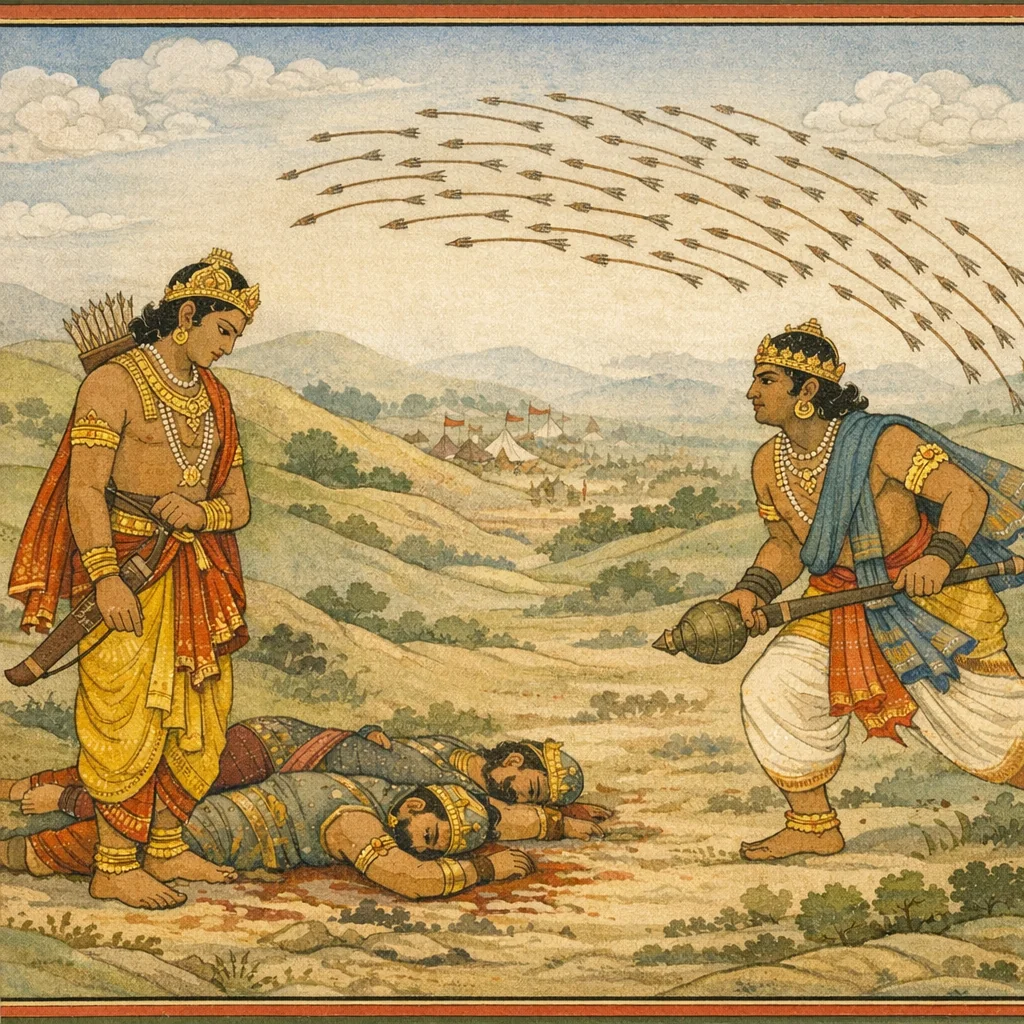
Sañjaya said: O King, arrows of Karṇa, the son of Adhiratha, were seen as though springing forth not only from his bow, but also from the banner and other fittings, from the parasol, from the pole and related parts, and even from the yoke of the chariot—so overwhelming was his martial display in the battle.
Verse 9
खं पूरयन् महावेगान् खगमान् गृध्रवासस: । सुवर्णविकृतां श्षित्रान मुमोचाधिरथि: शरान्,अधिरथपुत्र कर्णने अन्तरिक्षको व्याप्त करते हुए महान् वेगशाली, आकाशमें विचरनेवाले गृध्रके पंखोंसे युक्त और सुवर्णके बने हुए विचित्र बाण चलाये
Sañjaya said: Filling the sky with swift-flying missiles, Karṇa—the son of Adhiratha—released wondrous arrows fashioned of gold, winged like vultures, as they coursed through the air. The scene underscores the escalating ferocity of battle, where martial prowess and dazzling weaponry intensify the destruction rather than restrain it by ethical limits.
Verse 10
तमनन््तकमिवायस्तमापतन्तं वृकोदर: । त्यक्त्वा प्राणानतिक्रम्य विव्याध निशितै: शरै:,कर्णको यमराजके समान आयासयुक्त हो आते देख भीमसेन प्राणोंका मोह छोड़कर पराक्रमपूर्वक उसे पैने बाणोंद्वारा बीधने लगे
Sañjaya said: Seeing him rush forward like Antaka (Death) himself, Vṛkodara (Bhīma), casting aside all fear for his own life and overstepping concern for self-preservation, struck him repeatedly with sharp arrows. The verse highlights Bhīma’s deliberate choice of courage and duty in the midst of mortal danger, where steadfast resolve overrides attachment to one’s own safety.
Verse 11
तस्य वेगमसहां स दृष्टवा कर्णस्य पाण्डव: । महतश्न शरौघांस्तान् न्यवारयत वीर्यवान्,पराक्रमी पाण्डुपुत्र भीमने कर्णके वेगको असह्ां देखकर उसके महान् बाणसमूहोंका निवारण किया
Sañjaya said: Seeing that irresistible onrush of Karṇa, the mighty and valiant Pāṇḍava checked and turned back those great torrents of arrows. In the ethical frame of the war, the verse highlights steadfast courage and disciplined resistance—meeting overwhelming force not with rage, but with controlled prowess and resolve.
Verse 12
ततो विधम्याधिरथे: शरजालानि पाण्डव: | विव्याध कर्ण विंशत्या पुनरन्यै: शिलाशितै:,पाण्डुकुमार भीमने अधिरथपुत्रके शरसमूहोंका निवारण करके शिलापर चढ़ाकर तेज किये हुए बीस अन्य बाणोंद्वारा कर्णको घायल कर दिया
Sañjaya said: Then the Pāṇḍava warrior, having shattered the volleys of arrows shot by Adhiratha’s son, struck Karṇa again—piercing him with twenty more arrows, honed upon a whetstone. The scene underscores the relentless reciprocity of battle: skill answers skill, and injury follows injury, as each fighter strives to uphold his side’s cause amid the harsh ethics of war.
Verse 13
यथैव हि स कर्णेन पार्थ: प्रच्छादित: शरै: । तथैव स रणे कर्ण छादयामास पाण्डव:,जैसे कर्णने अपने बाणोंद्वारा भीमसेनको आच्छादित किया था, उसी प्रकार पाण्डुपुत्र भीमने भी कर्णको ढक दिया
Sañjaya said: Just as Karṇa had covered Pārtha with a dense shower of arrows, so too in that battle did the Pāṇḍava cover Karṇa in return. The verse highlights the fierce reciprocity of combat—prowess answered by prowess—within the relentless momentum of the Kurukṣetra war.
Verse 14
दृष्टवा तु भीमसेनस्य विक्रमं युधि भारत । अभ्यनन्दंस्त्यदीयाश्व सम्प्रहृष्ठा क्ष चारणा:,भरतनन्दन! युद्धमें भीमसेनका वह पराक्रम देखकर आपके योद्धाओं तथा चारणोंने भी प्रसन्न होकर उनका अभिनन्दन किया
Sanjaya said: O Bharata, seeing Bhimasena’s prowess in the battle, your own warriors—and the Cāraṇas as well—became delighted and praised him in admiration. The moment underscores how evident valor can win acclaim even from those on the opposing side, momentarily overriding partisan loyalties amid the pressures of war.
Verse 15
भूरिश्रवा: कृपो द्रौणिर्मद्रराजो जयद्रथ: । उत्तमौजा युधामन्यु: सात्यकि: केशवार्जुनौ
Sañjaya said: Bhūriśravas, Kṛpa, Droṇa’s son (Aśvatthāman), the king of Madra (Śalya), Jayadratha, Uttamaujas, Yudhāmanyu, Sātyaki, and Kṛṣṇa together with Arjuna—these foremost warriors were present (named here) amid the charged movement of the battle. The roll-call underscores how the war draws in renowned heroes from both sides, setting the stage for grave choices where loyalty, duty, and the limits of righteous conduct are tested.
Verse 16
कुरुपाण्डवप्रवरा दश राजन् महारथा: । साधु साध्विति वेगेन सिंहनादमथानदन्
Sañjaya said: O King, ten foremost great chariot-warriors among the Kurus and the Pāṇḍavas, crying “Well done! Well done!” in a surge of ardor, then raised a lion-like roar—an exultant acclaim that both praises valor and steels the will amid the moral strain of war.
Verse 17
राजन! भूरिश्रवा, कृपाचार्य, अश्व॒त्थामा, मद्रराज शल्य, जयद्रथ, उत्तमौजा, युधामन्यु, सात्यकि, श्रीकृष्ण तथा अर्जुन--ये कौरव और पाण्डव-पक्षके दस श्रेष्ठ महारथी 'साधु- साधु” कहकर वेगपूर्वक सिंहनाद करने लगे ।। तस्मिन् समुत्थिते शब्दे तुमुले लोमहर्षणे । अभ्यभाषत पुत्रस्ते राजन् दुर्योधनस्त्वरन्,महाराज! उस रोमांचकारी भयंकर शब्दके प्रकट होनेपर आपके पुत्र राजा दुर्योधनने बड़ी उतावलीके साथ राजाओं, राजकुमारों और विशेषत: अपने भाइयोंसे कहा--*तुम्हारा कल्याण हो, तुम सब लोग भीमसेनसे कर्णकी रक्षा करनेके लिये जाओ
Sanjaya said: “O King, Bhurishravas, Kripa, Ashvatthama, Shalya the king of Madra, Jayadratha, Uttamaujas, Yudhamanyu, Satyaki, Sri Krishna, and Arjuna—these ten foremost maharathas of the Kaurava and Pandava sides, crying ‘Well done! Well done!’, roared like lions with great speed and fervor. When that tumultuous, hair-raising clamor arose, your son King Duryodhana, in haste, addressed the kings and princes—especially his brothers—urging them to go and protect Karna from Bhimasena.”
Verse 18
राज्ञ: सराजपुत्रांश्न॒ सोदर्याश्व विशेषत: । कर्ण गच्छत भद्रें व: परीप्सन्तो वृकोदरात्,महाराज! उस रोमांचकारी भयंकर शब्दके प्रकट होनेपर आपके पुत्र राजा दुर्योधनने बड़ी उतावलीके साथ राजाओं, राजकुमारों और विशेषत: अपने भाइयोंसे कहा--*तुम्हारा कल्याण हो, तुम सब लोग भीमसेनसे कर्णकी रक्षा करनेके लिये जाओ
Sañjaya said: When that thrilling and dreadful roar arose, King Duryodhana, in great haste, addressed the assembled kings and princes—especially his own brothers—saying, “May good befall you. Go at once and protect Karṇa, for he is being sought out by Vṛkodara (Bhīma).” The verse highlights the urgency of battlefield duty and the Kauravas’ protective solidarity around Karṇa in the face of Bhīma’s vowed hostility.
Verse 19
पुरा निध्नन्ति राधेयं भीमचापच्युता: शरा: । ते यतथध्वं महेष्वासा: सूतपुत्रस्य रक्षणे,“कहीं ऐसा न हो कि भीमसेनके धनुषसे छूटे हुए बाण राधानन्दन कर्णको पहले ही मार डालें। अतः महाधनुर्धर वीरो! तुम सब लोग सूतपुत्रकी रक्षाका प्रयत्न करो”
Sañjaya said: “It may happen that the arrows released from Bhīma’s bow strike down Rādheya (Karna) beforehand. Therefore, O great bowmen, exert yourselves to protect the charioteer’s son.” The line underscores the battlefield ethic of guarding a key warrior whose fall could decisively tilt the balance, and it frames protection as an urgent collective duty amid the chaos of war.
Verse 20
दुर्योधनसमादिष्टा: सोदर्या: सप्त भारत | भीमसेनमभिद्रुत्य संरब्धा: पर्यवारयन्,भारत! दुर्योधनकी आज्ञा पाकर उसके सात भाइयोंने कुपित हो भीमसेनपर आक्रमण करके उन्हें चारों ओरसे घेर लिया
Sañjaya said: O Bhārata, commanded by Duryodhana, his seven full brothers, inflamed with anger, rushed at Bhīmasena and surrounded him on all sides. The scene underscores how obedience to an unrighteous command can turn kinship into a weapon and intensify the violence of war.
Verse 21
ते समासाद्य कौन्तेयमावृण्वन् शरवृश्टिभि: । पर्वतं वारिधाराभि: प्रावृषीव बलाहका:,जैसे वर्षा-ऋतुमें मेघ पर्वतपर जलकी धाराएँ बरसाते हैं, उसी प्रकार उन कौरवोंने कुन्तीकुमारके समीप जाकर उन्हें अपने बाणोंकी वर्षासे आच्छादित कर दिया
Sañjaya said: Closing in upon Kuntī’s son, the Kauravas covered him with a shower of arrows—just as, in the rainy season, clouds drench a mountain with streaming sheets of water. The image underscores the war’s relentless pressure: many assail one warrior, seeking to overwhelm him by sheer force rather than by a fair, measured contest.
Verse 22
ते5पीडयन् भीमसेन क्रुद्धा: सप्त महारथा: । प्रजासंहरणे राजन् सोम॑ सप्त ग्रहा इव,राजन! उन सात महारथियोंने कुपित हो भीमसेनको उसी प्रकार पीड़ा दी, जैसे सात ग्रह प्रजाओंके संहारकालमें सोमको पीड़ा देते हैं
Sañjaya said: O King, those seven great chariot-warriors, inflamed with anger, pressed Bhīmasena hard—just as, at the time of the destruction of creatures, the seven planets afflict Soma (the Moon). The image underscores how, in the frenzy of war, many powerful men can converge upon a single hero, turning the battlefield into a scene of cosmic, fate-like oppression.
Verse 23
ततो वेगेन कौन्तेय: पीडयित्वा शरासनम् | मुष्टिना पाण्डवो राजन् दृढेन सुपरिष्कृतम्,महाराज! तब कुन्तीकुमार पाण्डुपुत्र भीमने अत्यन्त स्वच्छ धनुषको सुदृढ़ मुदट्टीसे वेगपूर्वक दबाकर उन सातों भाइयोंको साधारण मनुष्य जानकर उनके लिये धनुषपर सात बाणोंका संधान किया। सूर्यकिरणोंके समान उन चमकीले बाणोंको शक्तिशाली भीमने परिश्रमपूर्वक आपके उन पुत्रोंपर छोड़ दिया
Sañjaya said: Then the son of Kuntī, the Pāṇḍava, forcefully pressed and braced his well-finished bow with his firm fist. In the heat of battle, he prepared to strike swiftly—an image of disciplined martial resolve directed toward the opposing side, where skill and intent are bound to the grim ethics of war.
Verse 24
मनुष्यसमतां ज्ञात्वा सप्त संधाय सायकान् । तेभ्यो व्यसृजदायस्त: सूर्यरश्मिनिभान् प्रभु:,महाराज! तब कुन्तीकुमार पाण्डुपुत्र भीमने अत्यन्त स्वच्छ धनुषको सुदृढ़ मुदट्टीसे वेगपूर्वक दबाकर उन सातों भाइयोंको साधारण मनुष्य जानकर उनके लिये धनुषपर सात बाणोंका संधान किया। सूर्यकिरणोंके समान उन चमकीले बाणोंको शक्तिशाली भीमने परिश्रमपूर्वक आपके उन पुत्रोंपर छोड़ दिया
Sañjaya said: O King, judging them to be no more than ordinary men, the mighty Bhīma swiftly set seven arrows to his bow and, with strenuous force, released those radiant shafts—like the rays of the sun—against your sons. The scene underscores the grim ethic of war: prowess and resolve, not birth or claim, decide the moment on the battlefield.
Verse 25
निरस्यन्निव देहे भ्यस्तनयानामसूंस्तव । भीमसेनो महाराज पूर्ववैरमनुस्मरन्,नरेश्वर! पहलेके वैरका बारंबार स्मरण करके भीमसेनने आपके पुत्रोंके प्राणोंको उनके शरीरोंसे निकालते हुए-से उन बाणोंका प्रहार किया था
Sañjaya said: O great king, O lord of men, Bhīmasena—repeatedly recalling the former enmity—struck with his arrows as though he were tearing the very life-breath of your sons out from their bodies. The scene underscores how remembered hatred can sharpen violence in war, turning combat into personal retribution rather than mere duty.
Verse 26
ते क्षिप्ता भीमसेनेन शरा भारत भारतान् | विदार्य खं समुत्पेतु: स्वर्णपुड्खा: शिलाशिता:,भारत! भीमसेनके चलाये हुए वे बाण सुवर्णमय पंखोंसे सुशोभित तथा शिलापर तेज किये गये थे। वे आपके पुत्रोंको विदीर्ण करके आकाशमें उड़ चले
Sañjaya said: O Bhārata, the arrows loosed by Bhīmasena—gold-feathered and honed upon stone—pierced through your sons and then rose up into the sky. The scene underscores the grim momentum of battle, where martial skill and wrath translate into irreversible harm, reminding the listener that adharma-driven conflict consumes even one’s own lineage.
Verse 27
तेषां विदार्य चेतांसि शरा हेमविभूषिता: । व्यराजन्त महाराज सुपर्णा इव खेचरा:,महाराज! वे स्वर्णविभूषित बाण उन सातों भाइयोंके वक्ष:स्थलको विदीर्ण करके आकाश में विचरनेवाले गरुड़पक्षियोंके समान शोभा पाने लगे
Sañjaya said: “O King, those arrows, adorned with gold, having torn through their hearts, shone brilliantly—like Suparṇas (Garuḍa-like birds) moving through the sky.”
Verse 28
शोणितादिग्धवाजाग्रा: सप्त हेमपरिष्कृता: । पुत्राणां तव राजेन्द्र पीत्वा शोणितमुद्गता:,राजेन्द्र! वे सुवर्णभूषित सातों बाण आपके पुत्रोंका रक्त पीकर लाल हो ऊपरको उछले थे। उनके पंख और अग्रभागोंपर अधिक रक्त जम गया था
Sañjaya said: “O king, seven arrows, their tips smeared with blood and adorned with gold, sprang upward after drinking the blood of your sons.” The image underscores the grim momentum of battle—violence feeding upon itself—while reminding the listener that royal ambition and attachment can culminate in irreversible loss.
Verse 29
ते शरैरभिन्नमर्माणो रथेभ्य: प्रापतन् क्षितौ | गिरिसानुरुहा भग्ना द्विपेनेव महाद्रुमा:,उन बाणोंसे मर्मस्थल विदीर्ण हो जानेके कारण वे सातों वीर रथोंसे पृथ्वीपर गिर पड़े, मानो किसी हाथीने पर्वतके शिखरपर खड़े हुए विशाल वृक्षोंको तोड़ गिराया हो
Sanjaya said: With their vital points pierced and shattered by arrows, those warriors fell from their chariots onto the earth—like great trees standing on a mountain slope, broken and brought down by an elephant. The image underscores the ruthless momentum of battle: once the body’s vulnerable centers are struck, even the mighty are felled, reminding the listener of the fragility of strength amid adharma-driven slaughter.
Verse 30
शत्रुंजयः शत्रुसहश्रित्रश्चित्रायुधो दृढ: । चित्रसेनो विकर्णश्र सप्तैते विनिपातिता:
Sañjaya said: Śatruñjaya, Śatrusahasrī, the firm and resolute Citrāyudha, and also Citrasena and Vikarṇa—these seven warriors were struck down. The report underscores the grim moral weight of the battle: valor and lineage offer no refuge when the tide of adharma-driven slaughter consumes both sides, and the field becomes a ledger of irreversible loss.
Verse 31
शत्रुंजय-, शत्रुसह, चित्र (चित्रवाण), चित्रायुध (अग्रायुध), दृढ़ (दृढवर्मा), चित्रसेन (उग्रसेन) और विकर्ण--इन सातों भाइयोंको भीमसेनने मार गिराया ।। पुत्राणां तव सर्वेषां निहतानां वृकोदर: । शोचत्यतिभृशं दुःखाद् विकर्ण पाण्डव: प्रियम्,राजन! वहाँ मारे गये आपके सभी पुत्रोंमेंसे विकर्ण पाण्डवोंको अधिक प्रिय था। पाण्डुनन्दन भीमसेन उसके लिये अत्यन्त दुःखी होकर शोक करने लगे
Sanjaya said: Bhimasena struck down those seven brothers—Śatruñjaya, Śatrusaha, Citra (also called Citravāṇa), Citrāyudha (also called Agrāyudha), Dṛḍha (also called Dṛḍhavarmā), Citrasena (also called Ugrasena), and Vikarṇa. And among all your sons who were slain there, O King, Vikarṇa was especially dear to the Pāṇḍavas; therefore Vṛkodara (Bhima), overwhelmed by sorrow, grieved intensely for him. The verse highlights a moral complexity of war: even amid rightful combat, personal virtue and prior goodwill can command respect and genuine mourning across enemy lines.
Verse 32
प्रतिज्ञेयं मया वृत्ता निहन्तव्यास्तु संयुगे । विकर्ण तेनासि हत: प्रतिज्ञा रक्षिता मया,वे बोले--'विकर्ण! मैंने यह प्रतिज्ञा कर रखी थी कि युद्धस्थलमें धृतराष्ट्रके सभी पुत्रोंकी मार डालूँगा। इसीलिये तुम मेरे हाथसे मारे गये हो। ऐसा करके मैंने अपनी प्रतिज्ञाका पालन किया है
Sañjaya said: “I had taken a vow: in battle I would slay the sons of Dhṛtarāṣṭra. Therefore, Vikarṇa, you have been killed by me. By doing so, I have upheld my pledge.” The line underscores the grim ethic of wartime vows—personal resolve is presented as binding, even when it culminates in the death of a kinsman on the battlefield.
Verse 33
त्वमागा: समर वीर क्षात्रधर्ममनुस्मरन् । ततो विनिहत: संख्ये युद्धधर्मो हि निछुर:,“वीर! तुम क्षत्रिय-धर्मका विचार करके समरभूमिमें आ गये। इसीलिये इस युद्धमें मारे गये; क्योंकि युद्धरधर्म कठोर होता है
Sanjaya said: “O hero, you came to the battlefield keeping the kṣatriya’s duty in mind. Therefore you were struck down in the clash of arms—for the law of war is indeed harsh.”
Verse 34
विशेषतो हि नृपतेस्तथास्माकं हिते रत: । न्यायतो<न्यायतो वापि हतः शेते महाद्युति:,“जो विशेषत: राजा युधिष्ठिरके और हमारे हितमें तत्पर रहते थे, वे बृहस्पतिके समान अगाध बुद्धिवाले महातेजस्वी गंगानन्दन भीष्म भी न्याय अथवा अन्यायसे मारे जाकर समरभूमिमें सो रहे हैं और प्राणत्यागकी परिस्थितिमें डाल दिये गये हैं। इसीसे कहना पड़ता है कि युद्ध अत्यन्त निष्ठुर कर्म है”
Sañjaya said: “For he was especially devoted to the welfare of King Yudhiṣṭhira and to our own good as well. Yet that radiant hero now lies slain—whether by a just means or an unjust one. Thus even Bhīṣma, the Gaṅgā-born, of unfathomable counsel like Bṛhaspati, has been brought down and cast upon the battlefield, driven to the very brink of giving up his life. From this one must conclude: war is a supremely cruel deed.”
Verse 35
अगाथबुद्धिर्गाड्िय: क्षितौ सुरगुरो: सम: । त्याजित: समरे प्राणांस्तस्माद् युद्ध हि निष्ठरम्,“जो विशेषत: राजा युधिष्ठिरके और हमारे हितमें तत्पर रहते थे, वे बृहस्पतिके समान अगाध बुद्धिवाले महातेजस्वी गंगानन्दन भीष्म भी न्याय अथवा अन्यायसे मारे जाकर समरभूमिमें सो रहे हैं और प्राणत्यागकी परिस्थितिमें डाल दिये गये हैं। इसीसे कहना पड़ता है कि युद्ध अत्यन्त निष्ठुर कर्म है”
Sañjaya said: “Even Bhīṣma, the son of the Gaṅgā—of unfathomable intellect and equal to Bṛhaspati, the preceptor of the gods—lies on the earth, having been brought to the point of relinquishing his very life in the battle. Therefore one must say: war is indeed a most ruthless act.”
Verse 36
संजय उवाच तान् निहत्य महाबाहू राधेयस्यैव पश्यतः । सिंहनादरवं घोरमसृजत् पाण्डुनन्दन:,संजय कहते हैं--राजन्! राधानन्दन कर्णके देखते-देखते उन सातों भाइयोंको मारकर पाण्डुनन्दन महाबाहु भीमने भयंकर सिंहनाद किया
Sanjaya said: O King, after slaying those men right before Radheya Karna’s eyes, the mighty-armed son of Pandu—Bhima—let out a dreadful lion-roar, a cry of triumph meant to shake the enemy’s resolve and proclaim his prowess in the midst of war.
Verse 37
स रवस्तस्य शूरस्य धर्मराजस्य भारत । आचख्याविव तद् युद्ध विजयं चात्मनो महत्,भारत! उस सिंहनादने धर्मराज युधिष्ठिरको शूरवीर भीमके उस युद्धकी तथा अपनी महान् विजयकी मानो सूचना दे दी
Sañjaya said: O Bhārata, that lion-like roar of the heroic Bhīma seemed, as it were, to announce to Dharmarāja Yudhiṣṭhira the outcome of that combat and Bhīma’s own great victory—an assurance that dharma had not been abandoned even amid the violence of war.
Verse 38
त॑ श्रुत्वा तु महानादं भीमसेनस्य धन्विन: । बभूव परमा प्रीतिर्धर्मराजस्य धीमत:,धनुर्धर भीमसेनके उस महानादको सुनकर बुद्धिमान् धर्मराज युधिष्ठिरको बड़ी प्रसन्नता हुई
Sañjaya said: Hearing that mighty roar of Bhīmasena, the bowman, the wise Dharmarāja (Yudhiṣṭhira) was filled with the highest joy. In the midst of war’s dread, the sound becomes a moral reassurance—signaling the steadfast presence of a righteous ally and reviving confidence in the cause upheld by dharma.
Verse 39
ततो हृष्टमना राजन् वादित्राणां महास्वनै: । सिंहनादरवं भ्रातु: प्रतिजग्राह पाण्डव:,राजन! तब प्रसन्नचित्त होकर युधिष्ठिरने वाद्योकी गम्भीर ध्वनिके द्वारा भाईके उस सिंहनादको स्वागतपूर्वक ग्रहण किया इस प्रकार भीमसेनको अपनी प्रसन्नताका संकेत करके सम्पूर्ण शस्त्रधारियोंमें श्रेष्ठ राजा युधिष्ठिरने बड़े हर्षके साथ रणभूमिमें द्रोणाचार्यपर आक्रमण किया
Sañjaya said: Then, O King, with his mind uplifted, the Pāṇḍava (Yudhiṣṭhira) welcomed his brother’s lion-like roar, taking it as an auspicious signal amid the deep thunder of the war-instruments. Thus heartened—and showing his approval to Bhīmasena—King Yudhiṣṭhira, foremost among armed men, advanced with great joy on the battlefield to assail Droṇācārya.
Verse 40
हर्षेण महता युक्त: कृतसंज्ञो वृकोदरे । अभ्ययात् समरे द्रोणं सर्वशस्त्रभूृतां वर:
Sañjaya said: Filled with great exhilaration and fully regaining his composure, Vṛkodara (Bhīma) advanced in the battle toward Droṇa, the foremost among all bearers of weapons. The verse underscores the surge of resolve in a warrior who, having recovered clarity of mind, moves decisively against a formidable teacher-warrior—raising the ethical tension between duty in war and reverence owed to an elder and preceptor.
Verse 41
एकत्रिंशन्महाराज पुत्रांस्तव निपातितान् । हतान् दुर्योधनो दृष्ट्वा क्षत्तु: सस्मार तद् वच:,महाराज! आपके इकतीस (दुःशलको लेकर बत्तीस) पुत्रोंको मारा गया देखकर दुर्योधनको विदुरजीकी कही हुई बात याद आ गयी
Sañjaya said: O King, seeing that thirty-one of your sons had been struck down—lying slain—Duryodhana recalled the words once spoken by Vidura. In that moment, the mounting cost of adharma in war pressed upon his mind, as forewarning turned into lived consequence.
Verse 42
तदिदं समनुप्राप्तं क्षत्तुर्नि:श्रेयसं वच: । इति संचिन्त्य ते पुत्रो नोत्तरं प्रत्यपद्यत,विदुरजीने जो कल्याणकारी वचन कहा था, उसके अनुसार ही यह संकट प्राप्त हुआ है। ऐसा सोचकर आपके पुत्रसे कोई उत्तर देते न बना
Sanjaya said: “This very calamity has come to pass in accordance with the salutary counsel of the Chamberlain (Vidura). Reflecting thus, your son found no reply to give.”
Verse 43
यद् द्यूतकाले दुर्बुद्धिरब्रवीत् तनयस्तव । सभामानाय्य पाज्चालीं कर्णेन सहितो5ल्ल्पथी:,पतिमन्यं वृणीष्वेति तस्येदं फलमागतम् । द्यूतके समय कर्णके साथ आपके मन्दमति पुत्र दुर्बुद्धि दुर्योधनने पांचालराजकुमारी द्रौपदीको सभामें बुलाकर उसके प्रति जो दुर्वचन कहा था तथा प्रजानाथ! महाराज! पाण्डवों और आपके सामने समस्त कौरवोंके सुनते हुए कर्णने सभामें द्रौपदीके प्रति जो यह कठोर वचन कहा था कि “कृष्णे! पाण्डव नष्ट हो गये। सदाके लिये नरकमें पड़ गये। तू दूसरा पति कर ले", उसी अन्यायका आज यह फल प्राप्त हुआ है
Sanjaya said: What your son, in his folly, spoke during the time of the dice-game—having Draupadi of Panchala brought into the royal assembly, and with Karna beside him, uttering cruel words such as, “Choose another husband”—of that wrongdoing this is the consequence that has now come to pass. The insult and injustice inflicted publicly upon Draupadi in the sabha has ripened into the present calamity.
Verse 44
यच्च कर्णोडब्रवीत् कृष्णां सभायां परुषं वच: । प्रमुखे पाण्डुपुत्राणां तव चैव विशाम्पते
Sañjaya said: “And the harsh words that Karṇa spoke to Kṛṣṇā in the royal assembly—spoken in the very presence of the sons of Pāṇḍu, and of you as well, O lord of the people—(all that now returns to mind).” The verse recalls an earlier moral rupture: public humiliation and cruel speech in a court of dharma, witnessed by those responsible to restrain it, becoming a seed of later catastrophe.
Verse 45
शृण्वतस्तव राजेन्द्र कौरवाणां च सर्वश: । विनष्टा: पाण्डवा: कृष्णे शाश्वतं नरकं॑ गता:
Sañjaya said: “O king, while you and all the Kauravas were listening, the Pāṇḍavas were utterly destroyed; and, through Kṛṣṇa, they went to the everlasting hell.” The line is spoken as a grim report meant to shock the listener, framing the war’s outcome in moral terms—suggesting ruin and spiritual consequence rather than merely military defeat.
Verse 46
यच्च षण्ढतिलादीनि परुषाणि तवात्मजै: । श्रावितास्ते महात्मान: पाण्डवा: कोपयिष्णुनि:,आपके पुत्रोंने जो पाण्डवोंको कुपित करनेके लिये षण्ढतिल (सारहीन तिल या नपुंसक) आदि कठोर बातें उन महामनस्वी पाण्डवोंको सुनायी थीं, उसके कारण पाण्षुपुत्र भीमसेनके हृदयमें तेरह वर्षोतक जो क्रोधाग्नि धधकती रही है उसीको निकालते हुए भीमसेन आपके पुत्रोंका अन्त कर रहे हैं
Sañjaya said: And those harsh taunts—such as calling them ‘ṣaṇḍhatila’ and the like—were spoken by your sons with the intent to provoke. Those words were made to be heard by the high-souled Pāṇḍavas; and now Bhīmasena, giving outlet to the fire of anger that has smoldered in his heart for thirteen years, is bringing your sons to their end.
Verse 47
त॑ भीमसेन: क्रोधाग्निं त्रयोदश समा: स्थितम् | उद्गिरंस्तव पुत्राणामन्तं गच्छति पाण्डव:,आपके पुत्रोंने जो पाण्डवोंको कुपित करनेके लिये षण्ढतिल (सारहीन तिल या नपुंसक) आदि कठोर बातें उन महामनस्वी पाण्डवोंको सुनायी थीं, उसके कारण पाण्षुपुत्र भीमसेनके हृदयमें तेरह वर्षोतक जो क्रोधाग्नि धधकती रही है उसीको निकालते हुए भीमसेन आपके पुत्रोंका अन्त कर रहे हैं
Sañjaya said: Bhīmasena, as if venting the fire of wrath that had stood smouldering for thirteen years, now moves toward the end of your sons. The harsh, humiliating taunts once spoken to enrage the Pāṇḍavas have ripened into their consequence: Bhīma is bringing that long-contained anger to its moral and martial conclusion on the battlefield.
Verse 48
विलपंश्च बहु क्षत्ता शमं नालभत त्वयि । सपुत्रो भरतश्रेष्ठ तस्य भुड्क्ष्य फलोदयम्,भरतश्रेष्ठ विदुरजीने आपके समीप बहुत विलाप किया, परंतु उन्हें शान्तिकी भिक्षा नहीं प्राप्त हुई। आपके उसी अन्यायका यह फल प्रकट हुआ है। अब आप पुत्रोंसहित इसे भोगिये
Sañjaya said: “O best of the Bharatas, the chamberlain Vidura lamented much before you, yet he could obtain no peace from you. This is the ripened outcome of that injustice. Now, together with your sons, you must endure its fruit.”
Verse 49
त्वया वृद्धेन धीरेण कार्यतत्त्वार्थदर्शिना । न कृतं सुह्ृदां वाक््यं दैवमत्र परायणम्,आप वृद्ध हैं, धीर हैं, कार्यके तत्त्व और प्रयोजनको देखते और समझते हैं, तो भी आपने हितैषी सुहृदोंकी बातें नहीं मानीं। इसमें दैव ही प्रधान कारण है
Sañjaya said: Though you are aged and steadfast, and though you discern the true principles and purpose of action, you did not heed the counsel of your well-wishing friends. In this matter, fate alone has become the decisive resort.
Verse 50
तन्मा शुचो नरव्यात्र तवैवापनयो महान् | विनाशहेतु: पुत्राणां भवानेव मतो मम,अत: नरश्रेष्ठ आप शोक न कीजिये। इसमें आपका ही महान् अन्याय कारण है। मैं तो आपको ही आपके पुत्रोंके विनाशका मुख्य हेतु मानता हूँ
Sañjaya said: “Do not grieve, O tiger among men. This great calamity is truly of your own making. In my judgment, you yourself are the chief cause of your sons’ destruction. Therefore, O best of men, do not sink into sorrow: it is your own grave injustice that has brought about this disaster, and I regard you as the principal agent behind the ruin of your children.”
Verse 51
हतो विकर्णों राजेन्द्र चित्रसेनश्व वीर्यवान् | प्रवराश्षात्मजानां ते सुताश्चान्ये महारथा:
Sañjaya said: “O king, Vikarna has been slain, and the valiant Citrasena as well. Among your foremost sons, and other sons besides—great chariot-warriors—have also fallen.”
Verse 52
राजेन्द्र! विकर्ण मारा गया। पराक्रमी चित्रसेनको भी प्राणोंका त्याग करना पड़ा। आपके पुत्रोंमें जो प्रमुख थे, वे तथा अन्य महारथी भी कालके गालमें चले गये ।। यानन्यान् ददृशे भीमश्रक्षुर्विषयमागतान् । पुत्रांस्तव महाराज त्वरया तान् जघान ह,महाराज! भीमसेनने अपने नेत्रोंके सामने आये हुए जिन-जिन पुत्रोंको देखा, उन सबको तुरंत ही मार डाला
Sanjaya said: O king of kings, Vikarna has been slain. The valiant Chitrasena too was forced to relinquish his life. Among your sons, those who were foremost—and other great chariot-warriors as well—have gone into the jaws of Time. And, O great king, whichever of your sons Bhimasena saw come within the range of his eyes, he swiftly struck them down. The passage underscores the grim moral atmosphere of war: prowess and lineage offer no refuge when adharma-driven conflict ripens into inevitable destruction under the sovereignty of Time (kāla).
Verse 53
त्वत्कृते हाहमद्राक्षं दह॒मानां वरूथिनीम् । सहस्रश: शरैर्मुक्ते: पाण्डवेन वृषेण च,आपके ही कारण मैंने भीमसेन और कर्णके छोड़े हुए हजारों बाणोंसे राजाओंकी विशाल सेना दग्ध होती देखी है
Sañjaya said: “Because of you, I myself witnessed the great battle-array of kings being consumed in the blaze of destruction, as thousands upon thousands of arrows were released—by the Pāṇḍava Bhīmasena and by Karṇa.”
Verse 136
इस प्रकार श्रीमह्माभारत द्रोणपर्वके अन्तर्गत जयद्रथवधपर्वमें भीमसेनका युद्धविषयक एक सौ छत्तीसवाँ अध्याय पूरा हुआ
Sañjaya said: Thus, in the Śrī Mahābhārata, within the Droṇa Parva—specifically in the section concerning the slaying of Jayadratha—the one-hundred-and-thirty-sixth chapter, dealing with Bhīmasena’s warfare, is concluded. This closing colophon frames the events as part of the larger moral struggle of the war, marking a formal pause in the narration while keeping the focus on duty-bound combat and its consequences.
Verse 137
इति श्रीमहाभारते द्रोणपर्वणि जयद्रथवधपर्वणि भीमयुद्धे सप्तत्रिंशदधिकशततमो<ध्याय:
Sanjaya said: Thus, in the holy Mahābhārata, within the Droṇa Parva—specifically in the section concerning the slaying of Jayadratha—this concludes the one-hundred-and-thirty-seventh chapter, describing the battle involving Bhīma. The colophon frames the episode as part of the larger moral tragedy of war, where personal valor and vengeance unfold within the inexorable movement of fate and duty on the battlefield.
Verse 456
पतिमन्यं वृणीष्वेति तस्येदं फलमागतम् । द्यूतके समय कर्णके साथ आपके मन्दमति पुत्र दुर्बुद्धि दुर्योधनने पांचालराजकुमारी द्रौपदीको सभामें बुलाकर उसके प्रति जो दुर्वचन कहा था तथा प्रजानाथ! महाराज! पाण्डवों और आपके सामने समस्त कौरवोंके सुनते हुए कर्णने सभामें द्रौपदीके प्रति जो यह कठोर वचन कहा था कि “कृष्णे! पाण्डव नष्ट हो गये। सदाके लिये नरकमें पड़ गये। तू दूसरा पति कर ले", उसी अन्यायका आज यह फल प्राप्त हुआ है
Sanjaya said: “This is the fruit that has now come of that wrong. At the time of the dice-game, your foolish son, the evil-minded Duryodhana, brought Draupadi, the princess of the Panchalas, into the assembly and spoke abusive words to her; and in the presence of the Pandavas and of you, O lord of the people, O king—while all the Kauravas listened—Karna too spoke harshly to Draupadi in the hall: ‘O Krishna (Draupadi)! The Pandavas are destroyed, fallen forever into hell; choose another husband.’ The consequence of that injustice has today returned upon them.”
Frequently Asked Questions
The episode implies a tension between the duty to prosecute war effectively and the ethical strain of fighting under darkness and confusion, where recognition, proportionality, and control are impaired, increasing the risk of indiscriminate harm.
The chapter models wartime governance logic: preserve command continuity by protecting the commander, assign clear sector responsibilities, and identify the single most consequential threat (Dhṛṣṭadyumna to Droṇa) to concentrate defensive resources.
No formal phalaśruti appears here; the meta-commentary is narrative—Saṃjaya’s claim that such a terrifying night battle was unprecedented functions as an interpretive marker, underscoring the war’s escalating moral and psychological gravity within the epic’s larger inquiry into dharma.