Adhyaya 29
Garuḍa’s Breach of the Amṛta-Guard and Boons with Viṣṇu; Encounter with Indra (Ādi-parva, Adhyāya 29)
Upa-parva: Āstīka Upākhyāna (Garuda–Amṛta Episode)
Sauti narrates Garuḍa’s approach to the amṛta enclosure in a transformed, radiant form. He observes a continuously rotating, razor-edged wheel (cakra) engineered by the devas as a lethal deterrent to would-be ‘soma/amṛta’ takers. Identifying a narrow interval, Garuḍa compresses his body and passes through the spokes. Beneath the wheel he sees two formidable serpent-guardians with fiery radiance and venomous gaze; to neutralize their vision, he obscures their eyes with dust and moves unseen, stepping upon them to reach the amṛta. He seizes and uproots the amṛta, disrupting the mechanism, and departs swiftly. In the sky he meets Viṣṇu (Nārāyaṇa), who—pleased with Garuḍa’s non-greed and resolve—offers boons. Garuḍa requests perpetual superiority and immortality even without consuming amṛta; in return he offers Viṣṇu a boon, and Viṣṇu asks that Garuḍa become his vehicle and emblem. Indra then pursues and strikes Garuḍa with the vajra; Garuḍa responds without collapse, honoring the vajra’s ascetic origin and voluntarily releasing a single feather, prompting astonishment and Indra’s desire for friendship and recognition of Garuḍa’s extraordinary power.
Chapter Arc: उग्रश्रवा सूत शौनकादि ऋषियों को कश्यप-वंश की एक अद्भुत कथा में ले जाते हैं—गरुड़ की भूख, उसका आकाश-वेग, और उसके पंजों में फँसने वाले दो प्राणी: हाथी और कछुआ, जिनका वैर पूर्वजन्म से चला आ रहा है। → गरुड़ भोजन की खोज में निषादों के बीच एक ब्राह्मण-दम्पति को देखता है, पर धर्म-सीमा पहचानकर कहता है कि ब्राह्मण वध्य नहीं। उधर वह हाथी-कछुए को पकड़कर दिव्य वटवृक्ष की विशाल शाखा पर बैठता है; शाखा के भार से डोलती है, और गरुड़ को नया आधार ढूँढ़ना पड़ता है। → वटवृक्ष की महाशाखा (शत-योजन विस्तार) पर गरुड़ के उतरते ही वह प्रचण्ड कम्पन से टूट पड़ती है; खगोत्तम उसे लेकर उड़ता है और ‘मनोरथफल’ जैसे दिव्य वृक्षों वाले अलम्बतीर्थ/मेरु-प्रदेश की ओर बढ़ता है—जहाँ प्रकृति भी उसके वेग से काँपती है। → गरुड़ सुरक्षित स्थान खोजकर अपने शिकार को थामे रहता है; साथ ही कथा का द्वार खुलता है कि ये हाथी और कछुआ साधारण नहीं—उनका संघर्ष पूर्वजन्म के संस्कारों से बँधा है, और उसी का रहस्य आगे उद्घाटित होना है। → हाथी-कछुए के पूर्वजन्म का ‘तत्त्व’ क्या है, और गरुड़ को ऐसा कौन-सा भोजन चाहिए जो उसे अमृत-हरण के सामर्थ्य तक पहुँचा दे?
Shlokas
Verse 1
ऑपनक्रात छा ्च्ज्टस:, एकोनत्रिशो<ड ध्याय: कश्यपजीका गरुडको हाथी और कछुएके पूर्वजन्मकी कथा सुनाना, गरुडका उन दोनोंको पकड़कर एक दिव्य वटवृक्षकी शाखापर ले जाना और उस शाखाका टूटना सौतिरुवाच तस्य कण्ठमनुप्राप्तो ब्राह्मण: सह भार्यया । दहन् दीप्त इवाड्रारस्तमुवाचान्तरिक्षग:,उग्रश्रवाजी कहते हैं--निषादोंके साथ एक ब्राह्मण भी भार्यासहित गरुडके कण्ठमें चला गया था। वह दहकते हुए अंगारकी भाँति जलन पैदा करने लगा। तब आकाशचारी गरुडने उस ब्राह्मणसे कहा--(द्विजश्रेष्ठ! तुम मेरे खुले हुए मुखसे जल्दी निकल जाओ। ब्राह्मण पापपरायण ही क्यों न हो मेरे लिये सदा अवध्य है”
Sauti said: A brāhmaṇa, together with his wife, had come into Garuḍa’s throat. Burning like a blazing ember, he caused intense scorching within. Then Garuḍa, moving through the sky, addressed that brāhmaṇa—implying that even if a brāhmaṇa is morally fallen, he is not to be slain, and should be released from harm.
Verse 2
द्विजोत्तम विनिर्गच्छ तूर्णममास्यादपावृतात् । नहि मे ब्राह्मणो वध्य: पापेष्वपि रत: सदा,उग्रश्रवाजी कहते हैं--निषादोंके साथ एक ब्राह्मण भी भार्यासहित गरुडके कण्ठमें चला गया था। वह दहकते हुए अंगारकी भाँति जलन पैदा करने लगा। तब आकाशचारी गरुडने उस ब्राह्मणसे कहा--(द्विजश्रेष्ठ! तुम मेरे खुले हुए मुखसे जल्दी निकल जाओ। ब्राह्मण पापपरायण ही क्यों न हो मेरे लिये सदा अवध्य है”
Garuḍa said: “O best of the twice-born, come out quickly from my open mouth. For to me a Brāhmaṇa is never to be slain—even if he is always devoted to sinful acts.”
Verse 3
ब्रुवाणमेवं गरुडं ब्राह्मण: प्रत्यभाषत । निषादी मम भार्येयं निर्गच्छतु मया सह,ऐसी बात कहनेवाले गरुडसे वह ब्राह्मण बोला--'यह निषाद-जातिकी कन्या मेरी भार्या है; अतः मेरे साथ यह भी निकले (तभी मैं निकल सकता हूँ)”
As Garuḍa spoke in this manner, the brāhmaṇa replied: “This Niṣāda woman is my wife. Let her depart together with me—only then can I go.” The statement underscores a moral insistence on marital responsibility and the refusal to accept personal safety or freedom at the cost of abandoning one’s spouse.
Verse 4
गरुड उवाच एतामपि निषादी त्वं परिगृह्माशु निष्पत । तूर्ण सम्भावयात्मानमजीर्ण मम तेजसा,गरुडने कहा--ब्राह्मण! तुम इस निषादीको भी लेकर जल्दी निकल जाओ। तुम अभीतक मेरी जठराग्निके तेजसे पचे नहीं हो; अतः शीघ्र अपने जीवनकी रक्षा करो
Garuḍa said: “O brāhmaṇa, take this Niṣādī woman as well and depart at once. You have not yet been digested by the heat of my inner fire; therefore, quickly preserve yourself—save your life.”
Verse 5
सौतिरुवाच ततः स विदप्रो निष्क्रान्तो निषादीसहितस्तदा । वर्धयित्वा च गरुडमिष्टं देशं जगाम ह,उग्रश्रवाजी कहते हैं--उनके ऐसा कहनेपर वह ब्राह्मण निषादीसहित गरुडके मुखसे निकल आया और उन्हें आशीर्वाद देकर अभीष्ट देशको चला गया
Sauti said: Then, upon those words being spoken, that bestower of sacred knowledge came out (from Garuḍa’s mouth), together with the Niṣādī woman. Having blessed and strengthened Garuḍa with benedictions, he departed for the place he desired. The episode underscores the ethical force of truthfulness and gratitude: one who is rescued and honored responds with a blessing, and the rescuer’s restraint and right conduct bear auspicious fruit.
Verse 6
सहभार्ये विनिष्क्रान्ते तस्मिन् विप्रे च पक्षिराट् । वितत्य पक्षावाकाशमुत्पपात मनोजव:,भार्यासहित उस ब्राह्मणके निकल जानेपर पक्षिराज गरुड पंख फैलाकर मनके समान तीव्र वेगसे आकाशमें उड़े
When that brāhmaṇa departed together with his wife, the king of birds, Garuḍa, spread out his wings and sprang up into the sky, swift as the mind—moving at once to carry forward the task at hand with unwavering resolve.
Verse 7
ततो<पश्यत् स पितरं पृष्टश्चाख्यातवान् पितुः । यथान्यायममेयात्मा तं चोवाच महानृषि:,तदनन्तर उन्हें अपने पिता कश्यपजीका दर्शन हुआ। उनके पूछनेपर अमेयात्मा गरुडने पितासे यथोचित कुशल-समाचार कहा। महर्षि कश्यप उनसे इस प्रकार बोले
Then Garuḍa beheld his father. When questioned, the immeasurable-souled one reported to him, in a manner befitting propriety, his welfare and circumstances. Thereupon the great sage Kaśyapa addressed him in these words.
Verse 8
कश्यप उवाच कच्चिद् व: कुशल नित्यं भोजने बहुलं सुत । कच्चिच्च मानुषे लोके तवाजन्न॑ विद्यते बहु,कश्यपजीने पूछा--बेटा! तुमलोग कुशलसे तो हो न? विशेषतः प्रतिदिन भोजनके सम्बन्धमें तुम्हें विशेष सुविधा है न? क्या मनुष्यलोकमें तुम्हारे लिये पर्याप्त अन्न मिल जाता है
Verse 9
गरुड उवाच माता मे कुशला शाश्वत् तथा भ्राता तथा हाहम् | नहि मे कुशलं तात भोजने बहुले सदा,गरुडने कहा--मेरी माता सदा कुशलसे रहती हैं। मेरे भाई तथा मैं दोनों सकुशल हैं। परंतु पिताजी! पर्याप्त भोजनके विषयमें तो सदा मेरे लिये कुशलका अभाव ही है
Garuḍa said: “My mother is ever well; my brother too is well—and so am I. Yet, dear father, as for abundant food, for me there is never any well-being at all.”
Verse 10
अहं हि सर्प: प्रहित: सोममाहर्तुमुत्तमम् । मातुर्दास्यविमोक्षार्थमाहरिष्ये तमद्य वै,मुझे सर्पोने उत्तम अमृत लानेके लिये भेजा है। माताको दासीपनसे छुटकारा दिलानेके लिये आज मैं निश्चय ही उस अमृतको लाऊँगा
Garuḍa declares that he has been dispatched by the serpents to fetch the supreme Soma (nectar of immortality). He vows that he will bring it that very day, not for personal gain, but to free his mother from the humiliation and bondage of servitude—framing his perilous mission as an act of filial duty and moral resolve.
Verse 11
मात्रा चात्र समादिष्टो निषादान् भक्षयेति ह । न च मे तृप्तिरभवद् भक्षयित्वा सहस्रश:,भोजनके विषयमें पूछनेपर माताने कहा--“निषादोंका भक्षण करो”, परंतु हजारों निषादोंको खा लेनेपर भी मुझे तृप्ति नहीं हुई है
Garuda said: “Here my mother instructed me, ‘Eat the Niṣādas.’ Yet even after devouring them by the thousand, I did not feel satisfied.” The line underscores the moral disquiet of hunger directed into violence: appetite and compulsion, once sanctioned, can become insatiable and ethically corrosive.
Verse 12
तस्माद् भक्ष्यं त्वमपरं भगवन् प्रदिशस्व मे । यद् भुक्त्वामृतमाहर्तु समर्थ: स्यामहं प्रभो
Therefore, O Blessed Lord, appoint for me some other food. Having eaten it, may I become capable, O Master, of bringing back the amṛta. Garuḍa, mindful of his pledge and the moral constraint against harming the innocent, asks for an alternative sustenance that will empower him to fulfill his duty without committing wrongdoing.
Verse 13
कश्यप उवाच इदं सरो महापुण्यं देवलोकेडपि विश्रुतम्,कश्यपजी बोले--बेटा! यह महान् पुण्यदायक सरोवर है, जो देवलोकमें भी विख्यात है
Kashyapa said: “My child, this lake is exceedingly sacred and a source of great merit; its fame is known even in the world of the gods.” The statement frames the place as morally potent—contact with it is implied to elevate one’s conduct and spiritual standing through purity and reverence.
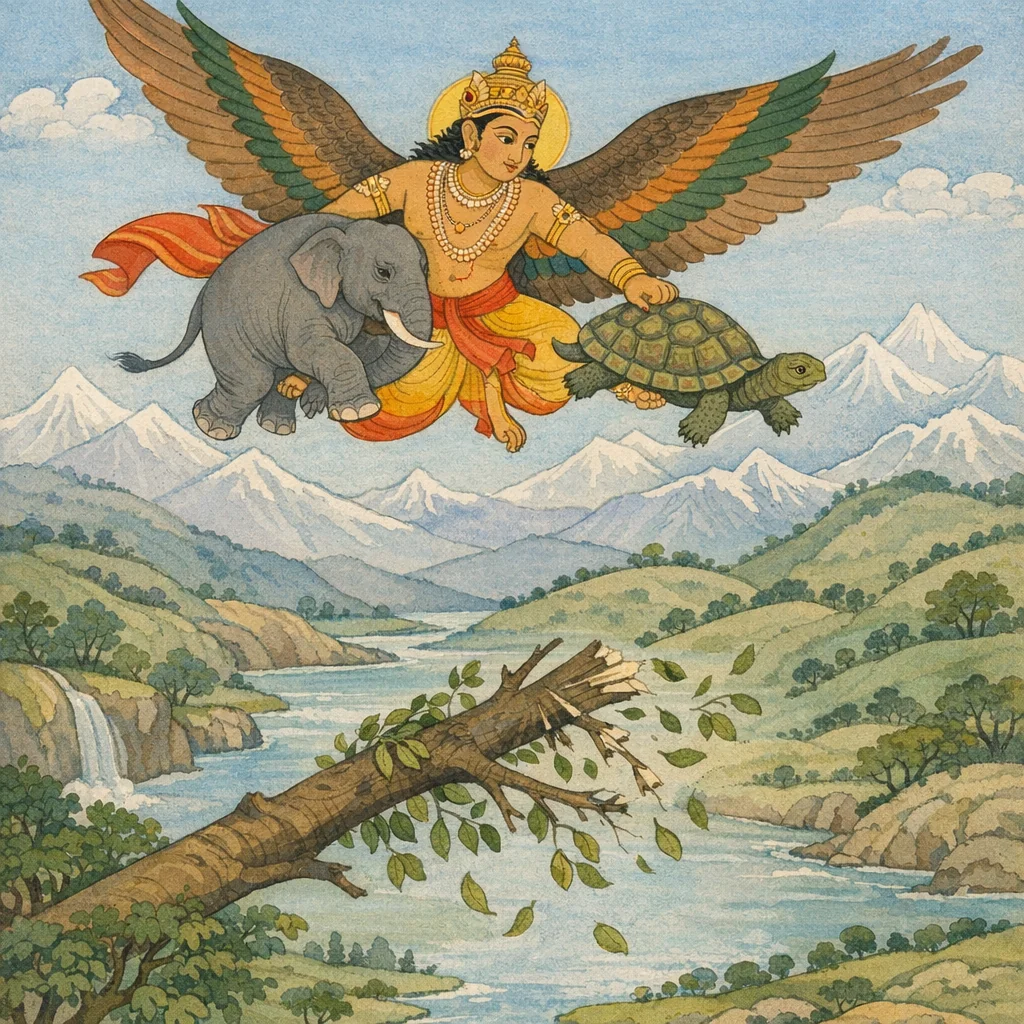
Verse 14
यत्र कूर्माग्रजं हस्ती सदा कर्षत्यवाड्मुख: । तयोर्जन्मान्तरे वैरं सम्प्रवक्ष्याम्यशेषत:
“There, the elephant—its face turned downward—constantly drags along the elder brother of the tortoise. I shall now relate, in full, the enmity that arose between those two in a former birth.”
Verse 15
आसीद् विभावसुर्नाम महर्षि: कोपनो भृशम्,पूर्वकालमें विभावसु नामसे प्रसिद्ध एक महर्षि थे। वे स्वभावके बड़े क्रोधी थे। उनके छोटे भाईका नाम था सुप्रतीक। वे भी बड़े तपस्वी थे। महामुनि सुप्रतीक अपने धनको बड़े भाईके साथ एक जगह नहीं रखना चाहते थे
Kāśyapa said: In former times there lived a sage named Vibhāvasu, widely known and exceedingly quick to anger by nature. He had a younger brother named Supratīka, who was also a great ascetic. Yet Supratīka, the great muni, did not wish to keep his wealth in the same place together with his elder brother—hinting at the ethical tension between ascetic restraint, property, and the risks that arise when anger and possession mix within a family.
Verse 16
भ्राता तस्यानुजश्नासीत् सुप्रतीको महातपा: । स नेच्छति धनं भ्राता सहैकस्थं महामुनि:,पूर्वकालमें विभावसु नामसे प्रसिद्ध एक महर्षि थे। वे स्वभावके बड़े क्रोधी थे। उनके छोटे भाईका नाम था सुप्रतीक। वे भी बड़े तपस्वी थे। महामुनि सुप्रतीक अपने धनको बड़े भाईके साथ एक जगह नहीं रखना चाहते थे
Kāśyapa said: “That sage had a younger brother named Supratīka, a great ascetic. Yet this great muni did not wish that his wealth be kept together in one place with his elder brother.” The passage highlights a tension between kinship and prudent restraint: even among brothers, one may choose separation in matters of property to avoid future conflict and preserve peace.
Verse 17
विभागं कीर्तयत्येव सुप्रतीको हि नित्यश: । अथाब्रवीच्च त॑ भ्राता सुप्रतीक॑ विभावसु:,सुप्रतीक प्रतिदिन बँटवारेके लिये आग्रह करते ही रहते थे। तब एक दिन बड़े भाई विभावसुने सुप्रतीकसे कहा--
Supratīka kept insisting, day after day, on a formal division of shares. Then, on one such day, his elder brother Vibhāvasu addressed Supratīka—setting the stage for a conversation about rightful allotment, restraint, and the ethics of demanding one’s due.
Verse 18
विभागं बहवो मोहात् कर्तुमिच्छन्ति नित्यश: । ततो विभक्तास्त्वन्योन्यं विक्रुध्यन्तेडर्थमोहिता:,'भाई! बहुत-से मनुष्य मोहवश सदा धनका बँटवारा कर लेनेकी इच्छा रखते हैं। तदनन्तर बँटवारा हो जानेपर धनके मोहमें फँसकर वे एक-दूसरेके विरोधी हो परस्पर क्रोध करने लगते हैं
Verse 19
ततः स्वार्थपरान् मूढान् पृथग्भूतान् स्वकैर्धनै: । विदित्वा भेदयन्त्येतानमित्रा मित्ररूपिण:,*वे स्वार्थपरायण मूढ़ मनुष्य अपने धनके साथ जब अलग-अलग हो जाते हैं, तब उनकी यह अवस्था जानकर शत्रु भी मित्ररूपमें आकर मिलते और उनमें भेद डालते रहते हैं
Then, seeing that foolish people—driven by self-interest—have become separated, each clinging to his own wealth, enemies, disguising themselves as friends, approach them and continually sow division among them.
Verse 20
विदित्वा चापरे भिन्नानन्तरेषु पतन्त्यथ । भिन्नानामतुलो नाश: क्षिप्रमेव प्रवर्तते,“दूसरे लोग, उनमें फ़ूट हो गयी है, यह जानकर उनके छिठद्र देखा करते हैं एवं छिद्र मिल जानेपर उनमें परस्पर वैर बढ़ानेके लिये स्वयं बीचमें आ पड़ते हैं। इसलिये जो लोग अलग-अलग होकर आपसमें फूट पैदा कर लेते हैं, उनका शीघ्र ही ऐसा विनाश हो जाता है, जिसकी कहीं तुलना नहीं है
Kashyapa said: Knowing that others have become divided, certain people then slip into the gaps between them. Once a breach is found, they insert themselves to inflame mutual hostility. Therefore, when people split apart and create factional discord among themselves, an incomparable destruction quickly sets in for them.
Verse 21
तस्माद् विभागं भ्रातृणां न प्रशंसन्ति साधव: । गुरुशास्त्रे निबद्धानामन्योन्येनाभिशड्किनाम्,“अतः साधु पुरुष भाइयोंके बिलगाव या बँटवारेकी प्रशंसा नहीं करते; क्योंकि इस प्रकार बँट जानेवाले भाई गुरुस्वरूप शास्त्रकी अलंघनीय आज्ञाके अधीन नहीं रह जाते और एक-दूसरेको संदेहकी दृष्टिसे देखने लगते हैं”
Therefore the virtuous do not praise the separation or partition of brothers; for when brothers are split apart, they no longer remain firmly bound by the authoritative discipline of the elders and the śāstra, and they begin to look upon one another with suspicion.
Verse 22
- नियन्तुं न हि शक््यस्त्वं भेदतो धनमिच्छसि । यस्मात् तस्मात् सुप्रतीक हस्तित्वं समवाप्स्यसि,'सुप्रतीक! तुम्हें वशमें करना असम्भव हो रहा है और तुम भेदभावके कारण ही बँटवारा करके धन लेना चाहते हो, इसलिये तुम्हें हाथीकी योनिमें जन्म लेना पड़ेगा”
Kāśyapa said: “You cannot be restrained; and, driven by divisive thinking, you insist on taking wealth only by partition. Therefore, Supratīka, you shall attain the state of an elephant (be born in an elephant’s womb).” The verse frames an ethical consequence: an ungovernable disposition and insistence on separation for gain lead to a fall into a lower, instinct-driven mode of existence.
Verse 23
शप्तस्त्वेवं सुप्रतीिको विभावसुमथाब्रवीत् । त्वमप्यन्तर्जलचर: कच्छप: सम्भविष्यसि,इस प्रकार शाप मिलनेपर सुप्रतीकने विभावसुसे कहा--'तुम भी पानीके भीतर विचरनेवाले कछुए होओगे'
When he had thus been cursed, Supratīka spoke to Vibhāvasu: “You too shall become a tortoise, moving about within the waters.” The episode underscores the moral symmetry of retribution: one who inflicts suffering through a curse may, in turn, be bound by a counter-curse, illustrating how speech and intent carry ethical consequences.
Verse 24
एवमन्योन्यशापात् तौ सुप्रतीकविभावसू । गजकच्छपतां प्राप्तावर्थार्थ मूढचेतसौ,इस प्रकार सुप्रतीक और विभावसु मुनि एक-दूसरेके शापसे हाथी और कछुएकी योनिमें पड़े हैं। धनके लिये उनके मनमें मोह छा गया था
Thus, through mutual curses, those two—Supratīka and Vibhāvasu—fell into the births of an elephant and a tortoise. Their minds had been deluded by the pursuit of wealth, and that infatuation became the moral cause behind their downfall.
Verse 25
रोषदोषानुषज्ेण तिर्यग्योनिगतावुभौ । परस्परद्वेषरतौ प्रमाणबलदर्पिताौ,रोष और लोभरूपी दोषके सम्बन्धसे उन दोनोंको तिर्यक्-योनिमें जाना पड़ा है। वे दोनों विशालकाय जन्तु पूर्व जन्मके वैरका अनुसरण करके अपनी विशालता और बलके घमण्डमें चूर हो एक-दूसरेसे द्वेष रखते हुए इस सरोवरमें रहते हैं। इन दोनोंमें एक जो सुन्दर महान् गजराज है, वह जब सरोवरके तटपर आता है, तब उसके चिग्घाड़नेकी आवाज सुनकर जलके भीतर शयन करनेवाला विशालकाय कछुआ भी पानीसे ऊपर उठता है। उस समय वह सारे सरोवरको मथ डालता है
Kashyapa said: ‘Because they became entangled in the faults of anger, both of them have fallen into an animal birth. Clinging to their former enmity, intoxicated with their great size and strength, they dwell in this lake, each delighting in hatred of the other.’
Verse 26
सरस्यस्मिन् महाकायोौ पूर्ववैरानुसारिणौ । तयोरन्यतर: श्रीमान् समुपैति महागज:,रोष और लोभरूपी दोषके सम्बन्धसे उन दोनोंको तिर्यक्-योनिमें जाना पड़ा है। वे दोनों विशालकाय जन्तु पूर्व जन्मके वैरका अनुसरण करके अपनी विशालता और बलके घमण्डमें चूर हो एक-दूसरेसे द्वेष रखते हुए इस सरोवरमें रहते हैं। इन दोनोंमें एक जो सुन्दर महान् गजराज है, वह जब सरोवरके तटपर आता है, तब उसके चिग्घाड़नेकी आवाज सुनकर जलके भीतर शयन करनेवाला विशालकाय कछुआ भी पानीसे ऊपर उठता है। उस समय वह सारे सरोवरको मथ डालता है
Kāśyapa said: “In this lake dwell two huge creatures, driven by the momentum of an enmity from a former life. Of the two, one is a splendid great elephant; when he approaches the lake, the other—his rival—stirs in response. The scene underscores how anger and greed, once indulged, can drag beings into lower births and keep them bound to recurring hostility, even after death.”
Verse 27
यस्य बृंहितशब्देन कूर्मोउप्यन्तर्जलेशय: । उत्थितो5सौ महाकाय: कृत्स्नं विक्षोभयन् सर:,रोष और लोभरूपी दोषके सम्बन्धसे उन दोनोंको तिर्यक्-योनिमें जाना पड़ा है। वे दोनों विशालकाय जन्तु पूर्व जन्मके वैरका अनुसरण करके अपनी विशालता और बलके घमण्डमें चूर हो एक-दूसरेसे द्वेष रखते हुए इस सरोवरमें रहते हैं। इन दोनोंमें एक जो सुन्दर महान् गजराज है, वह जब सरोवरके तटपर आता है, तब उसके चिग्घाड़नेकी आवाज सुनकर जलके भीतर शयन करनेवाला विशालकाय कछुआ भी पानीसे ऊपर उठता है। उस समय वह सारे सरोवरको मथ डालता है
Kashyapa said: Hearing the trumpet-like roar of that one, even the tortoise—lying asleep beneath the water—rises up, huge-bodied, and in doing so churns and agitates the entire lake. The scene underscores how pride and hostility, carried over from former enmity, disturb not only the rivals but the whole environment around them.
Verse 28
इस प्रकार श्रीमहाभारत आदिपव॑के अन्तर्गत आस्तीकपर्वमें गरुडचरित्रविषयक अट्ठाईसवाँ अध्याय पूरा हुआ,यं दृष्टवा वेष्टितकर: पतत्येष गजो जलम् | दन्तहस्ताग्रलाडूलपादवेगेन वीर्यवान् उसे देखते ही यह पराक्रमी हाथी अपनी सूँड़ लपेटे हुए जलमें टूट पड़ता है तथा दाँत, सूँड़, पूँछ और पैरोंके वेगसे असंख्य मछलियोंसे भरे हुए समूचे सरोवरमें हलचल मचा देता है। उस समय पराक्रमी कच्छप भी सिर उठाकर युद्धके लिये निकट आ जाता है
Seeing him, the mighty elephant—coiling up his trunk—plunges into the water. With the force of his tusks, the tip of his trunk, his tail, and his feet, he churns the entire lake, crowded with countless fish, into violent turmoil. At that moment, the powerful tortoise too raises his head and draws near, ready for battle.
Verse 29
विक्षोभयंस्ततो नाग: सरो बहुझषाकुलम् । कूर्मोड्प्यभ्युद्यतशिरा युद्धायाभ्येति वीर्यवान्,उसे देखते ही यह पराक्रमी हाथी अपनी सूँड़ लपेटे हुए जलमें टूट पड़ता है तथा दाँत, सूँड़, पूँछ और पैरोंके वेगसे असंख्य मछलियोंसे भरे हुए समूचे सरोवरमें हलचल मचा देता है। उस समय पराक्रमी कच्छप भी सिर उठाकर युद्धके लिये निकट आ जाता है इति श्रीमहाभारते आदिपर्वणि आस्तीकपर्वणि सौपर्णे एकोनत्रिंशो5ध्याय:
Kaśyapa said: Then the mighty nāga, churning up the lake teeming with many fish, set it into turmoil. And the powerful tortoise too, lifting up its head, advanced close—ready for battle. The scene underscores how unchecked force and agitation in a shared habitat quickly escalate into open conflict, drawing even those who might have remained still into confrontation.
Verse 30
षड्डुच्छितो योजनानि गजस्तद्द्विगुणायत: । कूर्मस्त्रियोजनोत्सेधो दशयोजनमण्डल:,हाथीका शरीर छ: योजन ऊँचा और बारह योजन लंबा है। कछुआ तीन योजन ऊँचा और दस योजन गोल है
Kaśyapa said: “The elephant is six yojanas in height and twice that in length. The tortoise is three yojanas in height and has a circumference of ten yojanas.” In this passage, the speaker conveys extraordinary measurements to impress upon the listener the vast, wondrous scale of beings described in the narrative, encouraging attentive reflection on the marvels of creation rather than ordinary human assumptions.
Verse 31
तावुभौ युद्धसम्मत्ती परस्परवधैषिणौ । उपयुज्याशु कर्मेदं साधयेप्सितमात्मन:,वे दोनों एक-दूसरेको मारनेकी इच्छासे युद्धके लिये मतवाले बने रहते हैं। तुम शीघ्र जाकर उन्हीं दोनोंको भोजनके उपयोगमें लाओ और अपने इस अभीष्ट कार्यका साधन करो
Both of them are intoxicated with the urge for battle, each seeking the other’s death. Go quickly and employ those two for food, and thereby accomplish your own desired purpose. The verse frames a pragmatic, morally charged instruction: the mutual violence of the pair is to be redirected into a utilitarian end, raising questions about expediency versus restraint.
Verse 32
महा भ्रघनसंकाशं तं भुक्त्वामृतमानय । महागिरिसमप्रख्यं घोररूपं च हस्तिनम्,कछुआ महान् मेघ-खण्डके समान है और हाथी भी महान् पर्वतके समान भयंकर है। उन्हीं दोनोंको खाकर अमृत ले आओ
Kashyapa said: “Having eaten that great tortoise, dark and massive like a dense cloud-bank, bring back the nectar. And also eat the elephant—huge as a mighty mountain and terrifying in form—and bring the nectar.”
Verse 33
सौतिर्वाच इत्युक्त्वा गरुडं सो5थ माड़ूल्यमकरोत् तदा । युध्यत: सह देवैस्ते युद्धे भवतु मड़लम्,उग्रश्रवाजी कहते हैं--शौनकजी! कश्यपजी गरुडसे ऐसा कहकर उस समय उनके लिये मंगल मनाते हुए बोले--“गरुड! युद्धमें देवताओंके साथ लड़ते हुए तुम्हारा मंगल हो
Ugraśravas (Sauti) said: Having spoken thus to Garuḍa, Kaśyapa then performed an auspicious benediction for him. He said, “Garuḍa, as you fight in battle together with the gods, may there be well-being and good fortune for you in that war.” The moment frames a fatherly blessing that seeks righteous success and protection amid impending conflict.
Verse 34
पूर्णकुम्भो द्विजा गावो यच्चान्यत् किंचिदुत्तमम् । शुभं स्वस्त्ययनं चापि भविष्यति तवाण्डज,'पक्षिप्रवर! भरा हुआ कलश, ब्राह्मण, गौएँ तथा और जो कुछ भी मांगलिक वस्तुए हैं, वे तुम्हारे लिये कल्याणकारी होंगी
Kashyapa said: “A full auspicious water-pot, Brahmins, cows, and whatever else is considered excellent and propitious—may all these become blessings and bring well-being to you, O egg-born one, foremost among birds.”
Verse 35
युध्यमानस्य संग्रामे देवैः सार्थ महाबल । ऋचो यजूंषि सामानि पवित्राणि हवींषि च,“महाबली पक्षिराज! संग्राममें देवताओंके साथ युद्ध करते समय ऋग्वेद, यजुर्वेद, सामवेद, पवित्र हविष्य, सम्पूर्ण रहस्य तथा सभी वेद तुम्हें बल प्रदान करें।” पिताके ऐसा कहनेपर गरुड उस सरोवरके निकट गये
Verse 36
रहस्यानि च सर्वाणि सर्वे वेदाश्व ते बलम् । इत्युक्तो गरुड: पित्रा गतस्तं हृदमन्तिकात्,“महाबली पक्षिराज! संग्राममें देवताओंके साथ युद्ध करते समय ऋग्वेद, यजुर्वेद, सामवेद, पवित्र हविष्य, सम्पूर्ण रहस्य तथा सभी वेद तुम्हें बल प्रदान करें।” पिताके ऐसा कहनेपर गरुड उस सरोवरके निकट गये
Kāśyapa said: “May all the sacred mysteries and all the Vedas be your strength.” Thus addressed by his father, Garuḍa went from there to the nearby lake. The blessing frames Garuḍa’s impending conflict not as mere violence, but as a dharmically sanctioned struggle in which sacred knowledge and purity are invoked as inner power and protection.
Verse 37
अपश्यन्निर्मलजलं नानापक्षिसमाकुलम् | स तत् स्मृत्वा पितुर्वाक्यं भीमवेगो<न्तरिक्षग:,उन्होंने देखा, सरोवरका जल अत्यन्त निर्मल है और नाना प्रकारके पक्षी इसमें सब ओर चहचहा रहे हैं। तदनन्तर भयंकर वेगशाली अन्तरिक्षगामी गरुडने पिताके वचनका स्मरण करके एक पंजेसे हाथीको और दूसरेसे कछुएको पकड़ लिया। फिर वे पक्षिराज आकाशमें ऊँचे उड़ गये
Kashyapa said: He beheld a lake whose waters were perfectly clear, filled all around with many kinds of birds. Then, remembering his father’s instruction, the mighty, fearsome, sky-ranging Garuḍa seized an elephant with one claw and a tortoise with the other, and rose high into the heavens. The episode underscores disciplined obedience to rightful counsel and the controlled use of power in pursuit of one’s appointed task.
Verse 38
नखेन गजमेकेन कूर्ममेकेन चाक्षिपत् । समुत्पपात चाकाशं तत उच्चैविंहंगम:,उन्होंने देखा, सरोवरका जल अत्यन्त निर्मल है और नाना प्रकारके पक्षी इसमें सब ओर चहचहा रहे हैं। तदनन्तर भयंकर वेगशाली अन्तरिक्षगामी गरुडने पिताके वचनका स्मरण करके एक पंजेसे हाथीको और दूसरेसे कछुएको पकड़ लिया। फिर वे पक्षिराज आकाशमें ऊँचे उड़ गये
Kāśyapa said: “With one talon he seized an elephant, and with the other a tortoise. Then that mighty bird sprang up into the sky and soared aloft.” In the narrative context, Garuḍa’s tremendous strength is shown as being directed by remembrance of his father’s instruction—power placed in the service of a vowed purpose rather than mere display.
Verse 39
सो<5लम्बं तीर्थमासाद्य देववृक्षानुपागमत् । ते भीता: समकम्पन्त तस्य पक्षानिलाहता:,उड़कर वे फिर अलम्बतीर्थमें जा पहुँचे। वहाँ (मेरुगिरिपर) बहुत-से दिव्य वृक्ष अपनी सुवर्णमय शाखा-प्रशाखाओंके साथ लहलहा रहे थे। जब गरुड उनके पास गये, तब उनके पंखोंकी वायुसे आहत होकर वे सभी दिव्य वृक्ष इस भयसे कम्पित हो उठे कि कहीं ये हमें तोड़ न डालें। गरुड रुचिके अनुसार फल देनेवाले उन कल्पवृक्षोंको काँपते देख अनुपम रूप-रंग तथा अंगोंवाले दूसरे-दूसरे महावृक्षोंकी ओर चल दिये। उनकी शाखाएँ वैदूर्य मणिकी थीं और वे सुवर्ण तथा रजतमय फलोंसे सुशोभित हो रहे थे। वे सभी महावृक्ष समुद्रके जलसे अभिषिक्त होते रहते थे
Kāśyapa said: Reaching the sacred ford called Alamba, he (Garuḍa) approached the divine trees. Struck by the wind from his wings, those celestial trees trembled in fear, thinking, “He may break us.” The passage underscores how overwhelming power, even when not used with intent to harm, can unsettle the vulnerable—calling for restraint and awareness of one’s impact.
Verse 40
न नो भज्ज्यादिति तदा दिव्या: कनकशाखिन: । प्रचलाज्रान् स तान् दृष्टवा मनोरथफलद्रुमान्,उड़कर वे फिर अलम्बतीर्थमें जा पहुँचे। वहाँ (मेरुगिरिपर) बहुत-से दिव्य वृक्ष अपनी सुवर्णमय शाखा-प्रशाखाओंके साथ लहलहा रहे थे। जब गरुड उनके पास गये, तब उनके पंखोंकी वायुसे आहत होकर वे सभी दिव्य वृक्ष इस भयसे कम्पित हो उठे कि कहीं ये हमें तोड़ न डालें। गरुड रुचिके अनुसार फल देनेवाले उन कल्पवृक्षोंको काँपते देख अनुपम रूप-रंग तथा अंगोंवाले दूसरे-दूसरे महावृक्षोंकी ओर चल दिये। उनकी शाखाएँ वैदूर्य मणिकी थीं और वे सुवर्ण तथा रजतमय फलोंसे सुशोभित हो रहे थे। वे सभी महावृक्ष समुद्रके जलसे अभिषिक्त होते रहते थे
Kashyapa said: “Then those divine trees with golden branches trembled, thinking, ‘May we not be broken.’ Seeing those wish-fulfilling trees shaken (by the force of Garuḍa’s approach), Garuḍa moved on toward other great trees of incomparable beauty—trees with beryl-like branches, adorned with fruits of gold and silver, continually bathed by the waters of the sea.”
Verse 41
अन्यानतुलरूपाज्नुपचक्राम खेचर: । काज्चनै राजतैश्वैव फलैरवैंदूर्यशाखिन: । सागराम्बुपरिक्षिप्तान् भ्राजमानान् महाद्रुमान्,उड़कर वे फिर अलम्बतीर्थमें जा पहुँचे। वहाँ (मेरुगिरिपर) बहुत-से दिव्य वृक्ष अपनी सुवर्णमय शाखा-प्रशाखाओंके साथ लहलहा रहे थे। जब गरुड उनके पास गये, तब उनके पंखोंकी वायुसे आहत होकर वे सभी दिव्य वृक्ष इस भयसे कम्पित हो उठे कि कहीं ये हमें तोड़ न डालें। गरुड रुचिके अनुसार फल देनेवाले उन कल्पवृक्षोंको काँपते देख अनुपम रूप-रंग तथा अंगोंवाले दूसरे-दूसरे महावृक्षोंकी ओर चल दिये। उनकी शाखाएँ वैदूर्य मणिकी थीं और वे सुवर्ण तथा रजतमय फलोंसे सुशोभित हो रहे थे। वे सभी महावृक्ष समुद्रके जलसे अभिषिक्त होते रहते थे
Kāśyapa said: The sky-ranging one (Garuḍa) then moved on toward other great trees of incomparable form and beauty. Their branches were of vaidūrya-gems, and they shone with fruits of gold and silver. Encircled and continually bathed by the waters of the ocean, those mighty trees gleamed brilliantly—an image of celestial abundance that also hints at restraint: even amid splendor, one must proceed without causing harm.
Verse 42
तमुवाच खगश्रेष्ठ तत्र रोहिणपादप: । अतिप्रवृद्ध: सुमहानापतन्तं मनोजवम्,वहीं एक बहुत बड़ा विशाल वटवृक्ष था। उसने मनके समान तीव्र-वेगसे आते हुए पक्षियोंके सरदार गरुडसे कहा
Then, in that place, a mighty tree named Rohiṇa addressed Garuḍa, the foremost of birds, as he came swooping in with mind-like speed. The scene frames a moral pause in the midst of force and momentum: even the swift and powerful are called to heed counsel and restraint when their actions may bring harm to others.
Verse 43
रौहिण उवाच यैषा मम महाशाखा शतयोजनमायता । एतामास्थाय शाखां त्वं खादेमौ गजकच्छपौ,वटवृक्ष बोला--पक्षिराज! यह जो मेरी सौ योजनतक फैली हुई सबसे बड़ी शाखा है, इसीपर बैठकर तुम इस हाथी और कछुएको खा लो
Rauhiṇa said: “This is my largest bough, stretching a hundred yojanas. Perch upon this branch and eat these two—the elephant and the tortoise.” In the narrative setting, the tree offers support to the bird-king so that the act of feeding can be done safely and without harming the tree’s own stability—an image of providing a proper seat and circumstance for an intended action.
Verse 44
ततो द्रुमं पतगसहस्रसेवितं महीधरप्रतिमवपु: प्रकम्पयन् | खगोत्तमो द्रुतमभिपत्य वेगवान् बभज्ज तामविरलपत्रसंचयाम्,तब पर्वतके समान विशाल शरीरवाले, पक्षियोंमें श्रेष्ठ, वेगशशाली गरुड सहस्रों विहंगमोंसे सेवित उस महान् वृक्षको कम्पित करते हुए तुरंत उसपर जा बैठे। बैठते ही अपने असहा वेगसे उन्होंने सघन पल्लवोंसे सुशोभित उस विशाल शाखाको तोड़ डाला
Then the foremost of birds—swift and impetuous—alighted at once upon that great tree, which was attended by thousands of birds, and as he descended he made it tremble, his body vast like a mountain. The moment he settled there, by the force of his irresistible speed and weight he snapped that great bough, dense with unbroken masses of leaves. The scene underscores how unchecked power, even without malice, can bring sudden harm to what supports many lives, and thus calls for restraint and awareness of consequences.
Verse 146
तन्मे तत्त्वं निबोधत्स्व यत्प्रमाणौ च तावुभौ । उसमें एक हाथी नीचेको मुँह किये सदा सूँड़से पकड़कर एक कछुएको खींचता रहता है। वह कछुआ पूर्वजन्ममें उसका बड़ा भाई था। दोनोंमें पूर्वजन्मका वैर चला आ रहा है। उनमें यह वैर क्यों और कैसे हुआ तथा उन दोनोंके शरीरकी लम्बाई-चौड़ाई और ऊँचाई कितनी है, ये सारी बातें मैं ठीक-ठीक बता रहा हूँ। तुम ध्यान देकर सुनो
Kashyapa said: “Understand from me the true account—also the exact measures of those two.” He then proceeds to explain the continuing enmity between an elephant and a tortoise: the elephant, with its face turned downward, constantly drags the tortoise by its trunk. The tortoise had been the elephant’s elder brother in a former birth, and their hostility has carried over. Kashyapa promises to relate precisely why and how that enmity arose, along with the length, breadth, and height of their bodies, urging the listener to attend carefully.
Verse 1236
क्षुत्पिपासाविघातार्थ भक्ष्यमाख्यातु मे भवान् । अतः भगवन्! आप मेरे लिये कोई दूसरा भोजन बताइये। प्रभो! वह भोजन ऐसा हो जिसे खाकर मैं अमृत लानेमें समर्थ हो सकूँ। मेरी भूख-प्यासको मिटा देनेके लिये आप पर्याप्त भोजन बताइये
Garuḍa said: “To ward off my hunger and thirst, please tell me what I may eat. Therefore, O Blessed One, point out some other food for me—food such that, having eaten it, I will be able to bring the nectar of immortality. Tell me a sufficient meal that will fully remove my hunger and thirst.”
Frequently Asked Questions
The chapter stages a tension between transgressive acquisition and obligation: Garuḍa must obtain amṛta to satisfy a binding condition, yet the narrative evaluates his worthiness by emphasizing controlled intent (absence of greed) and avoidance of gratuitous harm.
Power is ethically intelligible when aligned with disciplined purpose and non-attachment; moreover, stable order is achieved not only by force but by formal reciprocity—boons and recognized roles that integrate exceptional agents into cosmic governance.
No explicit phalaśruti is stated in this segment; the meta-commentary is implicit in narrative valuation—Viṣṇu’s approval and the reconfiguration of divine relationships function as the chapter’s interpretive ‘result’ for understanding dharma, merit, and rightful status.