Adhyaya 3
प्रलय-त्रिविध-विभागः एवं प्राकृतप्रलय-वर्णनम्
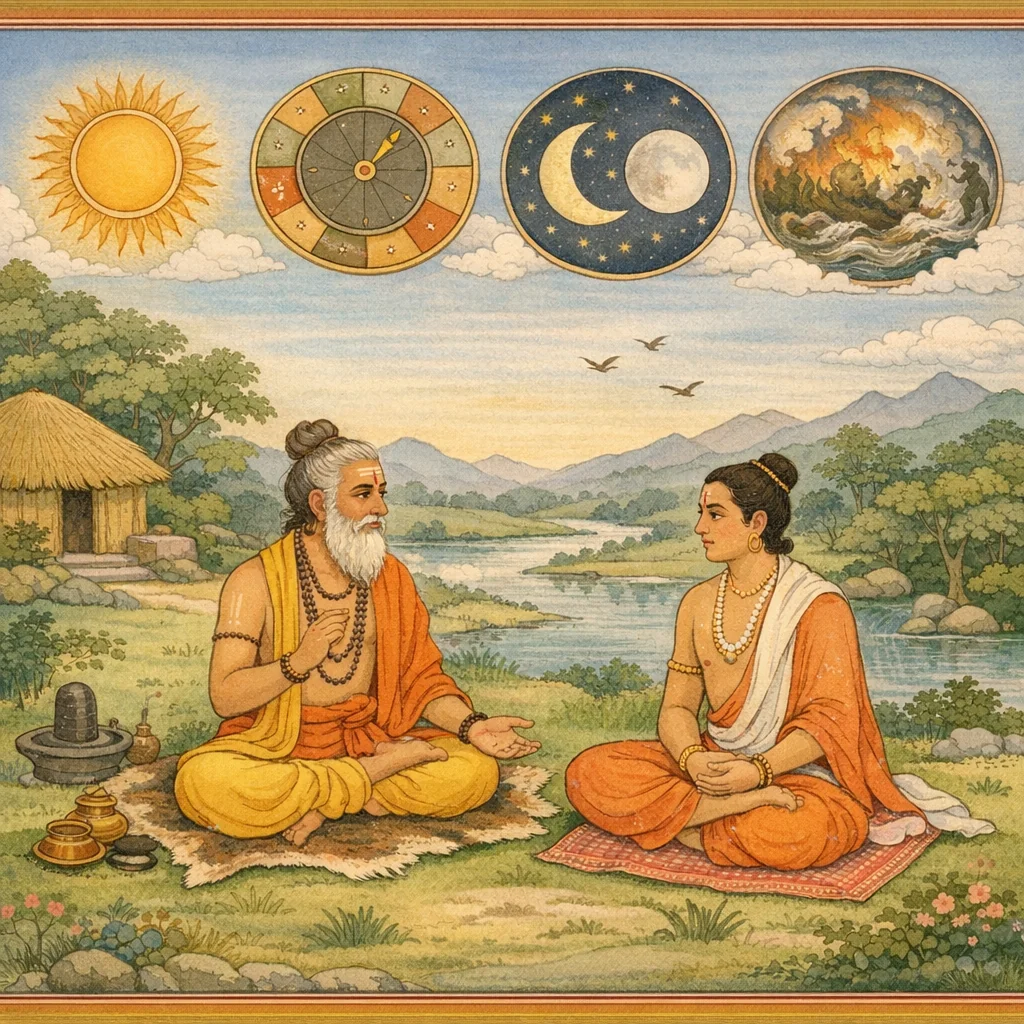
Parāśara formally divides dissolution (pralaya) into three: naimittika (Brahmā’s occasional dissolution at a kalpa’s end), prākṛtika (elemental dissolution after two parārdhas), and ātyantika (final release as mokṣa). Answering Maitreya, he defines a parārdha through a tenfold numerical progression reaching the eighteenth place, and states that prākṛtika dissolution endures for twice a parārdha, when the manifest world returns into the unmanifest causal ground. He then sets out measures of time from nimeṣa through nāḍikā, muhūrta, day, month, year, up to caturyuga and Brahmā’s day, linking cosmology with calculation. At the close of a thousand caturyugas, a hundred-year drought drains the earth; the Lord Hari (Kṛṣṇa) assumes Rudra-form, drinks up the waters, reveals seven suns that scorch the three worlds, and as Kālāgnirudra burns even the pātālas, while survivors rise to higher lokas. Finally Saṁvartaka clouds of many forms and colors pour rain for over a hundred years, flooding all realms and washing creation back toward quiescence under Viṣṇu’s sovereign ordinance.
Shlokas
Verse 1
सर्वेषाम् एव भूतानां त्रिविधः प्रतिसंचरः नैमित्तिकः प्राकृतिकस् तथैवात्यन्तिको मतः
For all beings, the return into dissolution is understood to be of three kinds: the occasional (naimittika), the elemental or primordial (prākṛtika), and the absolute (ātyantika).
Verse 2
ब्राह्मो नैमित्तिकस् तेषां कल्पान्ते प्रतिसंचरः आत्यन्तिकश् च मोक्षाख्यः प्राकृतो द्विपरार्धिकः
Among these dissolutions, the Brahmic (brāhma) and the occasional (naimittika) are the re-absorption that occurs at the end of a kalpa; the absolute dissolution is called liberation (mokṣa); and the elemental (prākṛta) dissolution takes place after the completion of two parārdhas.
Verse 3
परार्धसंख्यां भगवन् ममाचक्ष्व यया तु सः द्विगुणीकृतया ज्ञेयः प्राकृतः प्रतिसंचरः
Revered one, tell me the measure called a parārdha—by which, when that measure is doubled, one should understand the duration of the Prākṛta return, the elemental reabsorption of the cosmos.
Verse 4
स्थानात् स्थानं दशगुणम् एकस्माद् गण्यते द्विज ततो ऽष्टादशमे भागे परार्धम् अभिधीयते
O twice-born one, each successive place-value is reckoned as ten times the one before it. When this progression is carried to its eighteenth division, that measure is called the parārdha.
Verse 5
परार्धद्विगुणं यत् तु प्राकृतः स लयो द्विज तदाव्यक्ते ऽखिलं व्यक्तं स्वहेतौ लयम् एति वै
O twice-born one, the dissolution that lasts for twice a parārdha is called the Prākṛta (primordial) dissolution. Then all that is manifest dissolves into the Unmanifest, returning to its own causal ground.
Verse 6
निमेषो मानुषो यो ऽयं मात्रामात्रप्रमाणतः तैः पञ्चदशभिः काष्ठा त्रिंशत् काष्ठास् तथा कला
A human ‘nimeṣa’ (blink) is defined by the subtlest unit of measure, the mātrā. Fifteen such nimeṣas make one kāṣṭhā, and thirty kāṣṭhās form one kalā.
Verse 7
नाडिका तु प्रमाणेन कला दश च पञ्च च
By the accepted standard of measure, one nāḍikā consists of fifteen kalās.
Verse 8
उन्मानेनाम्भसः सा तु पलान्य् अर्धत्रयोदश हेममाषैः कृतच्छिद्रं चतुर्भिश् चतुरङ्गुलैः मागधेन प्रमाणेन जलप्रस्थस् तु स स्मृतः
Measured by the standard of water, that quantity is said to be thirteen and a half palas. With a perforation made using four hemamāṣas and a measure of four aṅgulas, according to the Māgadha standard, this is remembered as the jala-prastha—the authoritative measure of water.
Verse 9
नाडिकाभ्याम् अथ द्वाभ्यां मुहूर्तो द्विजसत्तम अहोरात्रं मुहूर्तास् तु त्रिंशन् मासो दिनैस् तथा
O best of the twice-born, two nāḍikās make one muhūrta. A day and night are made of muhūrtas; likewise, a month consists of thirty days.
Verse 10
मासैर् द्वादशभिर् वर्षम् अहोरात्रं तु तद् दिवि त्रिभिर् वर्षशतैर् वर्षं षष्ट्या चैवासुरद्विषाम्
Twelve months make a year for humans. But in the heavens, that same span is reckoned as a single day and night. And for the gods, foes of the Asuras, a ‘year’ is made of three hundred such divine day-and-night cycles, with a further extension by sixty in that same reckoning.
Verse 11
तैस् तु द्वादशसाहस्रैश् चतुर्युगम् उदाहृतम् चतुर्युगसहस्रं तु कथ्यते ब्रह्मणो दिनम्
By those twelve thousand divine years, the Caturyuga—the cycle of the four ages—is declared. And a thousand such Caturyugas are said to form a single day of Brahmā, within whose vast order the universe rises and rests, sustained by the Supreme Lord, Viṣṇu.
Verse 12
स कल्पस् तत्र मनवश् चतुर्दश महामुने तदन्ते चैव मैत्रेय ब्राह्मो नैमित्तिको लयः
In that Kalpa, O great sage, there are fourteen Manus. And at its end, O Maitreya, there occurs the Brahmā-dissolution—the naimittika, the occasional withdrawal of the worlds.
Verse 13
तस्य स्वरूपम् अत्युग्रं मैत्रेय गदतो मम शृणुष्व प्राकृतं भूयस् तव वक्ष्याम्य् अहं लयम्
Listen, O Maitreya, as I speak: the form of that Supreme Reality is exceedingly awe-inspiring. Now I shall explain to you more fully the primordial dissolution, prākṛta-laya, by which the manifested order returns to its source.
Verse 14
चतुर्युगसहस्रान्ते क्षीणप्राये महीतले अनावृष्टिर् अतीवोग्रा जायते शतवार्षिकी
At the end of a thousand cycles of the four yugas, when the earth is nearly spent, there arises a most dreadful failure of rain—an unbroken drought lasting a hundred years.
Verse 15
ततो यान्य् अल्पसाराणि तानि सत्त्वान्य् अशेषतः क्षयं यान्ति मुनिश्रेष्ठ पार्थिवान्य् अनुपीडनात्
Therefore, O best of sages, all beings of scant strength and substance—especially the earthly—without exception pass into destruction, crushed by the relentless pressure of material existence.
Verse 16
ततः स भगवान् कृष्णो रुद्ररूपधरो ऽव्ययः क्षयाय यतते कर्तुम् आत्मस्थाः सकलाः प्रजाः
Then the Blessed Lord—Krishna, the imperishable—assuming the form of Rudra, strives to bring about dissolution, for all creatures abide within His own Self.
Verse 18
पीत्वाम्भांसि समस्तानि प्राणिभूमिगतानि वै शोषं नयति मैत्रेय समस्तं पृथिवीतलम्
Having drunk up all the waters—those upon the earth and those that sustain embodied beings—O Maitreya, he brings the whole surface of the world to utter dryness.
Verse 19
समुद्रान् सरितः शैलान् शैलप्रस्रवणानि च पातालेषु च यत् तोयं तत् सर्वं नयति क्षयम्
It draws toward dissolution the waters of the oceans, the rivers, the mountains and their streaming springs—and even whatever waters lie in the nether realms—bringing them all to wasting away.
Verse 20
ततस् तस्यानुभावेन तोयाहारोपबृंहिताः त एव रश्मयः सप्त जायन्ते सप्त भास्कराः
Then, by the potency of that solar orb, those very rays—nourished and increased by drawing in water—become sevenfold; thus are born the seven suns, the seven solar forms.
Verse 21
अधश् चोर्ध्वं च ते दीप्तास् ततः सप्त दिवाकराः दहन्त्य् अशेषं त्रैलोक्यं सपातालतलं द्विज
Blazing both below and above, they then become seven suns; and, O twice-born one, they burn up the entire threefold world together with the nether Pātālas.
Verse 22
दह्यमानं तु तैर् दीप्तैस् त्रैलोक्यं द्विज भास्करैः साद्रिनद्यर्णवाभोगं निःस्नेहम् अभिजायते
But as the three worlds are scorched by those blazing suns, O twice-born one, the whole expanse—mountains, rivers, and the wide oceans—becomes utterly dry, drained of all moisture.
Verse 23
ततो निर्दग्धवृक्षाम्बु त्रैलोक्यम् अखिलं द्विज भवत्य् एषा च वसुधा कूर्मपृष्ठोपमाकृतिः
Thereafter, O twice-born one, the entire threefold world is marked by scorched trees and drying waters; and this very Earth assumes a form resembling the back of a tortoise.
Verse 24
ततः कालाग्निरुद्रो ऽसौ भूत्वा सर्वहरो हरिः शेषाहिश्वाससंभूतः पातालानि दहत्य् अधः
Then Hari Himself becomes Kālāgnirudra—the all-consuming power of Time—manifest as the universal taker-away; born from the breath of Śeṣa, He burns the Pātālas from beneath.
Verse 25
पातालानि समस्तानि स दग्ध्वा ज्वलनो महान् भूमिम् अभ्येत्य सकलं बभस्ति वसुधातलम्
Having consumed all the Pātālas, that mighty Fire rises to the earth and, spreading everywhere, sets the whole surface of the world ablaze.
Verse 26
भुवर्लोकं ततः सर्वं स्वर्लोकं च सुदारुणः ज्वालामालामहावर्तस् तत्रैव परिवर्तते
Thereupon, that exceedingly dreadful vast whirl, encircled by garlands of flame, sweeps over all Bhuvarloka and even Svargaloka, and there it continues to revolve.
Verse 27
अम्बरीषम् इवाभाति त्रैलोक्यम् अखिलं तदा ज्वालावर्तपरीवारम् उपक्षीणचराचरम्
Then the entire threefold world appeared like a blazing furnace, encircled by whirlpools of flame, as all that moves and all that does not move withered away in exhaustion.
Verse 28
ततस् तापपरीतास् तु लोकद्वयनिवासिनः कृताधिकारा गच्छन्ति महर्लोकं महामुने
Then, O great sage, the dwellers of the two worlds, scorched by that torment, having duly fulfilled the required rites and gained the proper qualification, depart and ascend to Maharloka.
Verse 29
तस्माद् अपि महातापतप्ता लोकास् ततः परम् गच्छन्ति जनलोकं ते दशावृत्त्या परैषिणः
Beyond even that, the worlds scorched by intense radiance and their inhabitants, seeking what is higher, proceed onward to Janaloka through the tenfold course of ascent.
Verse 30
ततो दग्ध्वा जगत् सर्वं रुद्ररूपी जनार्दनः मुखनिश्वासजान् मेघान् करोति मुनिसत्तम
Then, having burned the entire universe, Janārdana—assuming the form of Rudra—brings forth clouds born from the breath of His mouth, O best of sages.
Verse 31
ततो गजकुलप्रख्यास् तडिद्वन्तो निनादिनः उत्तिष्ठन्ति तदा व्योम्नि घोराः संवर्तका घनाः
Then, in the sky, the dreadful Saṃvartaka clouds arise—vast as herds of elephants, flashing with lightning and roaring with thunder—heralding the cosmos’ turn toward dissolution.
Verse 32
केचिन् नीलोत्पलश्यामाः केचित् कुमुदसंनिभाः धूम्रवर्णा घनाः केचित् केचित् पीताः पयोधराः
Some clouds are dark as blue lotuses; some gleam like white water-lilies. Some are dense and smoke-hued, and some—bearers of rain—shine yellow.
Verse 33
केचिद् रासभवर्णाभा लाक्षारसनिभास् तथा केचिद् वैडूर्यसंकाशा इन्द्रनीलनिभाः क्वचित्
Some appeared with the hue of a donkey; others gleamed like lac. Some shone like cat’s-eye gem, and in places some were like sapphire.
Verse 34
शङ्खकुन्दनिभाश् चान्ये जात्यञ्जननिभास् तथा इन्द्रगोपनिभाः केचिन् मनःशिलनिभास् तथा
Some are radiant like a conch-shell or jasmine blossoms; others are dark like collyrium. Some glow like the indragopa insect, and some shine with the vermilion brilliance of realgar.
Verse 35
चाषपत्रनिभाः केचिद् उत्तिष्ठन्ति घना घनाः केचित् पुरवराकाराः केचित् पर्वतसंनिभाः
Some dense clouds rise with the sheen of a chāṣa-bird’s wing; some gather into thick, compact banks; some assume the forms of splendid cities; and some appear like mountains—vast, unmoving, piled upon the sky.
Verse 36
कूटागारनिभाश् चान्ये केचित् स्थलनिभा घनाः महारावा महाकायाः पूरयन्ति नभस्तलम्
Some appear like towering mansions with peaked roofs; others are dense and massive like whole tracts of land. With thunderous cries and colossal bodies, they fill the entire expanse of the sky.
Verse 38
नष्टे चाग्नौ शतं ते ऽपि वर्षाणाम् अधिकं घनाः प्लावयन्तो जगत् सर्वं वर्षन्ति मुनिसत्तम
When that fire has been extinguished, then for more than a hundred years the dense clouds pour down—flooding the whole world with their rains, O best of sages.
Verse 39
धाराभिर् अक्षमात्राभिः प्लावयित्वाखिलां भुवम् भुवर्लोकं तथैवोर्ध्वं प्लावयन्ति दिवं द्विज
With streams no broader than the measure of an axle, they flood the whole earth; and the Bhuvar-loka as well—then rising higher still, they inundate even the heavenly region, O twice-born one.
Verse 40
अन्धकारीकृते लोके नष्टे स्थावरजङ्गमे वर्षन्ति ते महामेघा वर्षाणाम् अधिकं शतम्
When the world has been veiled in darkness, and all that is immovable and movable has perished, those vast clouds pour down rain for more than a hundred years.
Frequently Asked Questions
Naimittika (Brahmic) pralaya occurs at the end of a kalpa (Brahmā’s day) as an occasional withdrawal, whereas prākṛtika pralaya is the elemental dissolution after two parārdhas, when the manifest universe dissolves into the unmanifest causal state.
Parāśara depicts Hari (Kṛṣṇa) assuming Rudra/Kālāgnirudra form to execute dissolution—drinking waters, intensifying solar heat, burning worlds, and then releasing Saṁvartaka clouds—showing that dissolution is an act within Viṣṇu’s sovereign causality, not independent of Him.