Adhyaya 5
Vasudeva Meets Nanda; Pūtanā’s Fall; Viṣṇu-Rakṣā (Protective Hymn) in Gokula
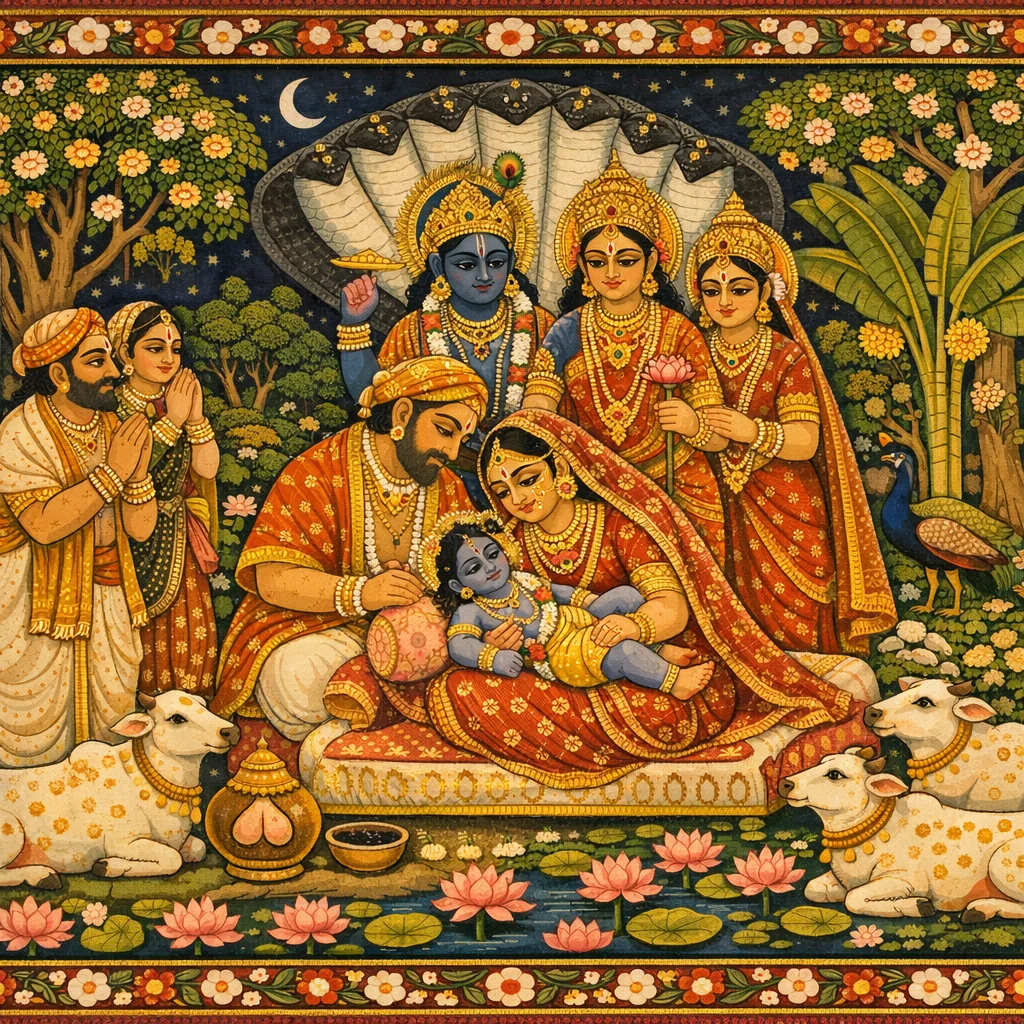
Parashara narrates that Vasudeva meets Nanda and urges him to return to Gokula. There, the demoness Putana tries to kill infant Krishna with a poisoned breast, but the Lord sucks out her life-breath. Yashoda and Nanda perform protective rites and recite the 'Vishnu-Raksha' stotra, invoking avatars like Varaha and Narasimha. The cowherds are left amazed by Putana's massive corpse.
Shlokas
Verse 1
विमुक्तो वसुदेवो ऽपि नन्दस्य शकटं गतः प्रहृष्टं दृष्टवान् नन्दं पुत्रो जातो ममेति वै
Vasudeva too, once released, went to Nanda’s wagon-train. There he saw Nanda radiant with joy, exclaiming, “A son has indeed been born to me!”
Verse 2
वसुदेवो ऽपि तं प्राह दिष्ट्या दिष्ट्येति सादरम् वार्द्धके ऽपि समुत्पन्नस् तनयो यत् तवाधुना
Vasudeva addressed him reverently, again and again saying, “Blessed indeed, blessed indeed!”—for even in your old age, a son has now been born to you.
Verse 3
दत्तो हि वार्षिकः सर्वो भवद्भिर् नृपतेः करः यदर्थम् आगतास् तस्मान् नात्र स्थेयं महाधनाः
Indeed, you have paid in full the king’s annual levy. Since the purpose for which you came has been fulfilled, O wealthy men, you should not remain here any longer.
Verse 4
यदर्थम् आगताः कार्यं तन् निष्पन्नं किम् आस्यते भवद्भिर् गम्यतां नन्द तच् छीघ्रं निजगोकुलम्
The purpose for which you have come has been fulfilled. Why do you still remain here? Go now, O Nanda—return swiftly to your own Gokula.
Verse 5
ममापि बालकस् तत्र रोहिणीप्रसवो हि यः स रक्षणीयो भवता यथायं तनयो निजः
And there, my own child too—he who has been born of Rohiṇī—must be protected by you, just as this child is your very own son.
Verse 6
इत्य् उक्ताः प्रययुर् गोपा नन्दगोपपुरोगमाः शकटारोपितैर् भाण्डैः करं दत्त्वा महाबलाः
Thus instructed, the mighty cowherds set out—led by Nanda—having loaded their goods upon carts and having paid the due levy for the journey.
Verse 7
वसतां गोकुले तेषां पूतना बालघातिनी सुप्तं कृष्णम् उपादाय रात्रौ तस्मै ददौ स्तनम्
While they were living in Gokula, Pūtanā—the slayer of infants—came by night, lifted up the sleeping Kṛṣṇa, and offered him her breast.
Verse 8
यस्मै यस्मै स्तनं रात्रौ पूतना संप्रयच्छति तस्य तस्य क्षणेनाङ्गं बालकस्योपहन्यते
Whichever infant Pūtanā, in the night, offers her breast to—of each and every such child, the body is struck down in an instant.
Verse 9
कृष्णस् तस्याः स्तनं गाढं कराभ्याम् अतिपीडितम् गृहीत्वा प्राणसहितं पपौ कोपसमन्वितः
Then Kṛṣṇa, filled with protective wrath, seized her breast firmly in both hands and pressed it hard; and as he sucked, he drew out with the milk her very life-breath.
Verse 10
सा विमुक्तमहारावा विच्छिन्नस्नायुबन्धना पपात पूतना भूमौ म्रियमाणातिभीषणा
Released, she uttered a vast and dreadful cry; her sinews and bonds were torn apart, and Pūtanā fell upon the earth—terrifying even as she died—overcome by the Lord Viṣṇu’s power abiding in the infant Kṛṣṇa.
Verse 11
तन्नादश्रुतिसंत्रासात् प्रबुद्धास् ते व्रजौकसः ददृशुः पूतनोत्सङ्गे कृष्णं तां च निपातिताम्
Startled awake by that sound, the dwellers of Vraja rose in alarm; and they beheld Kṛṣṇa upon Pūtanā’s lap, and Pūtanā herself lying fallen.
Verse 12
आदाय कृष्णं संत्रस्ता यशोदापि द्विजोत्तम गोपुच्छं भ्राम्य हस्तेन बालदोषम् अपाकरोत्
Alarmed, Yaśodā too—O best of the twice-born—took up little Kṛṣṇa, and, whirling a cow’s tail in her hand, sought to ward off the supposed childish affliction, the evil influence.
Verse 13
गोपुरीषम् उपादाय नन्दगोपो ऽपि मस्तके कृष्णस्य प्रददौ रक्षां कुर्वंश् चैतद् उदीरयन्
Taking cow-dung as a purifying safeguard, Nanda the cowherd placed it upon Kṛṣṇa’s head for protection, uttering the customary words of warding.
Verse 14
रक्षतु त्वाम् अशेषाणां भूतानां प्रभवो हरिः यस्य नाभिसमुद्भूतपङ्कजाद् अभवज् जगत्
May Hari—Vishnu Himself, the source of all beings—protect you; from His navel arose the lotus, and from that lotus the whole universe came forth.
Verse 15
येन दंष्ट्राग्रविधृता धारयत्य् अवनी जगत् वराहरूपधृग् देवः स त्वां रक्षतु केशवः
May Keśava protect you—the divine Lord who assumed the Boar form and, with the tip of His tusk, lifted up the Earth and restored the order of the cosmos.
Verse 16
नखाङ्कुरविनिर्भिन्नवैरिवक्षःस्थलो विभुः नृसिंहरूपी सर्वत्र स त्वां रक्षतु केशवः
May Keshava protect you everywhere—the all-powerful Lord in the form of Narasiṁha, whose claw-tips tore open the enemy’s chest, and whose presence pervades all directions.
Verse 17
वामनो रक्षतु सदा भवन्तं यः क्षणाद् अभूत् त्रिविक्रमक्रमाक्रान्तत्रैलोक्यः स्फुरदायुधः
May Vāmana ever protect you—He who in an instant became Trivikrama, whose stride overran the three worlds, and whose resplendent weapons flashed forth.
Verse 18
शिरस् ते पातु गोविन्दः कण्ठं रक्षतु केशवः गुह्यं सजठरं विष्णुर् जङ्घे पादौ जनार्दनः
May Govinda guard your head; may Keśava protect your throat. May Viṣṇu safeguard your secret parts and your belly; and may Janārdana protect your shanks and feet.
Verse 19
मुखं बाहू प्रबाहू च मनः सर्वेन्द्रियाणि च रक्षत्व् अव्याहतैश्वर्यस् तव नारायणो ऽव्ययः
May Nārāyaṇa—imperishable, whose sovereignty is never obstructed—protect your face, your arms and forearms, your mind, and all your senses.
Verse 20
शार्ङ्गचक्रगदापाणेः शङ्खनादहताः क्षयम् गच्छन्तु प्रेतकूष्माण्डराक्षसा ये तवाहिताः
May all pretas, kūṣmāṇḍas, and rākṣasas hostile to you be burned by the conch-blast of Him whose hands bear Śārṅga, the discus, and the mace—and may they hasten to their final ruin.
Verse 21
त्वां पातु दिक्षु वैकुण्ठो विदिक्षु मधुसूदनः हृषीकेशो ऽम्बरे भूमौ रक्षतु त्वां महीधरः
May Vaikuṇṭha protect you in all directions; may Madhusūdana guard you in the intermediate quarters. In the sky may Hṛṣīkeśa watch over you, and upon the earth may Mahīdhara keep you safe.
Verse 22
एवं कृतस्वस्त्ययनो नन्दगोपेन बालकः शायितः शकटस्याधो बालपर्यङ्किकातले
Thus, after Nanda the cowherd had duly performed the rites of blessing and protection, the infant was laid to rest beneath the cart, on the low cradle-bed made for a child.
Verse 23
ते च गोपा महद् दृष्ट्वा पूतनायाः कलेवरम् मृतायाः परमं त्रासं विस्मयं च तदा ययुः
And the cowherds, seeing the enormous body of Pūtanā lying dead, were at that moment seized by overwhelming terror—and astonishment as well.
Frequently Asked Questions
It demonstrates Bhagavān’s sovereignty and grace: the infant Kṛṣṇa effortlessly negates adharma, and the episode also supports the Purāṇic theme that contact with the Lord can grant liberation even to antagonists.
To convert a village crisis into theology: protection is ultimately Viṣṇu’s own nature, expressed through avatāra-memories and divine names, forming a kavaca (spiritual armor) for devotees and listeners.
They illustrate mādhurya-bhāva and the Lord’s voluntary concealment—Īśvara accepts the role of a child needing protection, revealing that bhakti can ‘bind’ the Infinite in loving intimacy.