Adhyaya 36
द्विविद-वधः, यज्ञ-विध्वंस-निवारणम्, बलदेव-पराक्रम-समाहारः
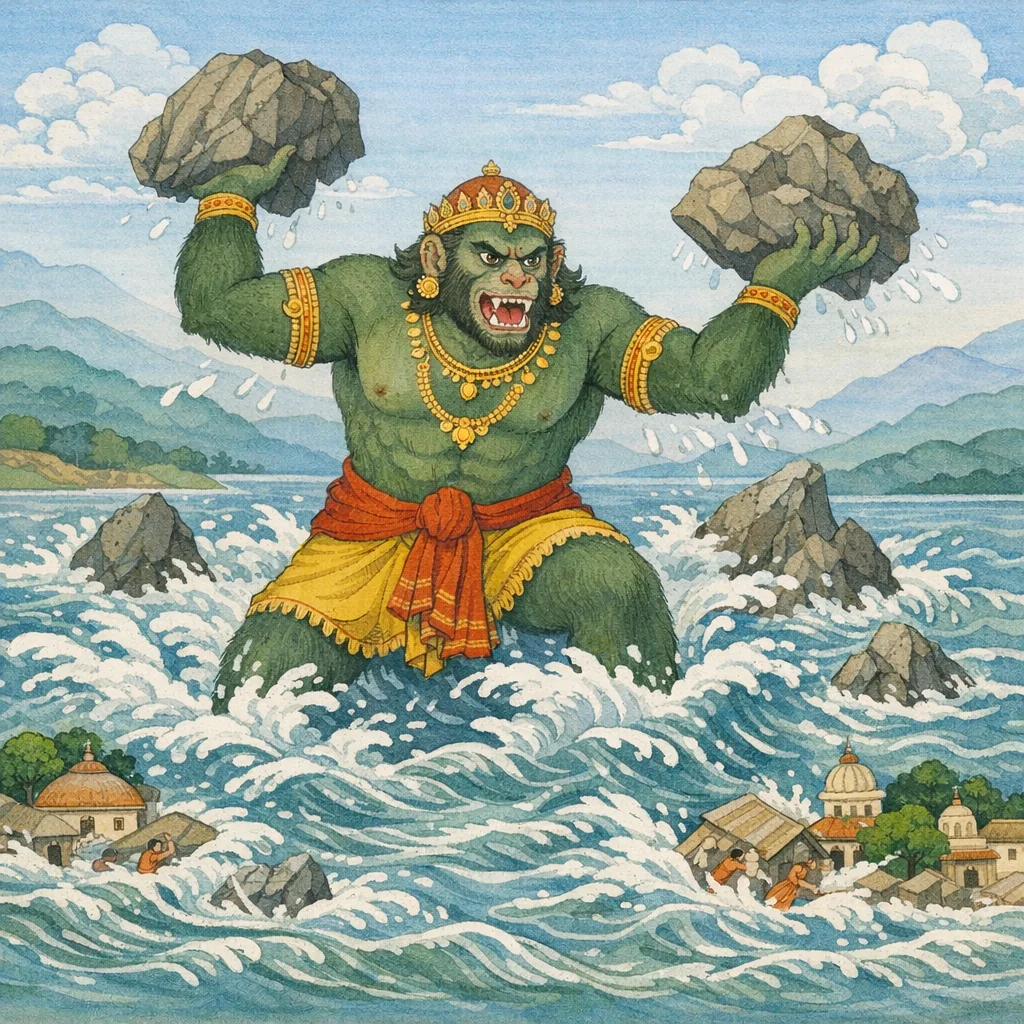
Parashara recounts further deeds of Baladeva (Balarama). Dvivida, a monkey and friend of Narakasura, turns against the gods and, driven by enmity, wrecks sacrifices, violates the bounds of the righteous, burns towns and villages, hurls mountains, churns the sea, floods coastal settlements, and destroys crops—so that the world’s sacred study and the vashat-cry wane. Once, in Raivata’s garden, Baladeva was drinking and sporting with Revati when Dvivida arrived, mocked the plough and club (hala and mushala), jeered even before the women, and flung the drinking vessel. Enraged, Baladeva seized his mushala; the rock Dvivida threw was shattered into a thousand pieces. Though Dvivida struck his chest, Baladeva at last felled him with a blow of the fist upon the head, and the falling body split a mountain peak into a hundred parts. The gods showered flowers, praising that the world’s affliction had ceased. Parashara concludes: such immeasurable exploits are natural to Baladeva, the earth-bearer in the form of Shesha.
Shlokas
Verse 1
मैत्रेय श्रूयतां तस्य बलस्य बलशालिनः कृतं यद् अन्यत् तेनाभूत् तद् अपि श्रूयतां त्वया
O Maitreya, hear now of that mighty one, strong in strength—what further deeds he accomplished, and what else came to pass through him; listen to all of that as well.
Verse 2
नरकस्यासुरेन्द्रस्य देवपक्षविरोधिनः सखाभवन् महावीर्यो द्विविदो नाम वानरः
To Naraka, lord among the Asuras and foe of the hosts of the gods, there was a companion: a mighty hero, the monkey named Dvivida.
Verse 3
वैरानुबन्धं बलवान् स चकार सुरान् प्रति नरकं हतवान् कृष्णो देवराजेन चोदितः
Powerful Naraka maintained an unbroken chain of enmity against the gods; urged by the king of the Devas, Śrī Krishna slew Naraka.
Verse 4
करिष्ये सर्वदेवानां तस्माद् एष प्रतिक्रियाम् यज्ञविध्वंसनं कुर्वन् मर्त्यलोकक्षयं तथा
“Therefore, for the good of all the gods, I shall undertake a counter-measure against him—against this destroyer of sacrifice—who, while shattering the rites, brings ruin upon the world of mortals as well.”
Verse 5
ततो विध्वंसयाम् आस यज्ञान् अज्ञानमोहितः बिभेद साधुमर्यादां क्षयं चक्रे च देहिनाम्
Then, deluded by ignorance, he set about destroying the rites of yajña; he shattered the dharmic bounds upheld by the righteous and brought ruin upon embodied beings.
Verse 6
ददाह चपलो देशान् पुरग्रामान्तराणि च क्वचिच् च पर्वताक्षेपैर् ग्रामादीन् समचूर्णयत्
Restless and unsteady, he burned through regions—cities and villages alike; and in some places, hurling mountains like missiles, he crushed villages and all around them into dust.
Verse 7
शैलान् उत्पाट्य तोयेषु मुमोचाम्बुनिधौ तथा पुनश् चार्णवमध्यस्थः क्षोभयाम् आस सागरम्
Tearing up mountains, he cast them into the waters of the ocean; and then, standing once more in the midst of the sea, he set the great ocean into agitation.
Verse 8
तेन विक्षोभितश् चाब्धिर् उद्वेलो द्विज जायते प्लावयंस् तीरजान् ग्रामान् पुरादीन् अतिवेगवान्
Stirred by that force, O twice-born one, the ocean rose in a wild surge; swift beyond measure, it flooded the shorelands, drowning the coastal villages and even inundating towns and cities.
Verse 9
कामरूपी महारूपं कृत्वा सस्यान्य् अशेषतः लुठन् भ्रमणसंमर्दैः संचूर्णयति वानरः
Assuming forms at will, the monkey expanded into a vast shape; and rolling, whirling, and trampling in his tumult, he utterly crushed the crops without remainder.
Verse 10
तेन विप्रकृतं सर्वं जगद् एतद् दुरात्मना निःस्वाध्यायवषट्कारं मैत्रेयासीत् सुदुःखितम्
By that wicked-souled one, this entire world was thrown into disorder—bereft of Vedic study and the sacred vaṣaṭ-utterances of rite; and Maitreya, seeing the collapse of dharma’s supports, became deeply distressed.
Verse 11
एकदा रैवतोद्याने पपौ पानं हलायुधः रेवती च महाभागा तथैवान्या वरस्त्रियः
Once, in Raivata’s pleasure-garden, Halāyudha (Balarāma) drank a festive liquor; the greatly fortunate Revati did so as well, along with other excellent women.
Verse 12
उपगीयमानो विलसल्ललनामौलिमध्यगः रेमे यदुवरश्रेष्ठः कुबेर इव मन्दरे
As bards and singers praised him in song, the foremost of the Yādavas reveled in royal ease, moving amid the radiant crowns of graceful women, like Kubera sporting on Mount Mandara.
Verse 13
ततः स वानरो ऽभ्येत्य गृहीत्वा सीरिणो हलम् मुसलं च चकारास्य संमुखं सविडम्बनम्
Then that monkey rushed forward; seizing the plough and the club of the Plough-bearer (Balarāma), he mockingly brandished them right before him in deliberate affront.
Verse 14
तथैव योषितां तासां जहासाभिमुखं कपिः पानपूर्णांश् च करकाञ् चिक्षेपाहत्य वै पदा
Likewise, facing those women, the monkey laughed aloud; and with his foot he struck and flung away the drinking-vessels filled to the brim.
Verse 15
ततः कोपपरीतात्मा भर्त्सयाम् आस तं बलः तथापि तम् अवज्ञाय चक्रे किलकिलाध्वनिम्
Then, his mind overwhelmed by anger, Bala began to rebuke him; yet the other, scorning Bala’s words, merely burst into a taunting, rattling cry.
Verse 16
ततः समुत्थाय बलो जगृहे मुसलं रुषा सो ऽपि शैलशिलां भीमां जग्राह प्लवगोत्तमः
Then Balarāma sprang up and, in wrath, seized his mace; and the foremost of the monkey-heroes, in turn, grasped a fearsome crag—an enormous slab of mountain-stone.
Verse 17
चिक्षेप च स तां क्षिप्तां मुसलेन सहस्रधा बिभेद यादवश्रेष्ठः सा पपात महीतले
And he hurled it; and the foremost of the Yadavas, with his iron club, shattered that weapon—once it had been cast—into a thousand pieces, and it fell down upon the earth.
Verse 18
आपतन् मुसलं चासौ समुल्लङ्घ्य प्लवंगमः वेगेनागम्य रोषेण तलेनोरस्य् अताडयत्
Leaping clean over the rushing pestle, the swift-moving plavaṅgama sprang forward with speed; and, inflamed with wrath, he struck him hard upon the chest with the palm of his hand.
Verse 19
ततो बलेन कोपेन मुष्टिना मूर्ध्नि ताडितः पपात रुधिरोद्गारी द्विविदः क्षीणजीवितः
Then, struck on the head by Bala—his fist driven by blazing wrath—Dvivida collapsed to the ground, vomiting blood, his life-force ebbing away.
Verse 20
पतता तच्छरीरेण गिरेः शृङ्गम् अशीर्यत मैत्रेय शतधा वज्रिवज्रेणेव हि ताडितम्
As that body crashed down, O Maitreya, the mountain’s peak shattered into a hundred fragments—like a summit struck again and again by the vajra of the wielder of the vajra.
Verse 21
पुष्पवृष्टिं ततो देवा रामस्योपरि चिक्षिपुः प्रशशंसुस् तथाभ्येत्य साध्व् एतत् ते महत् कृतम्
Then the gods showered a rain of flowers upon Rāma, and, approaching him, they praised him: “Well done! This great deed has been accomplished by you.”
Verse 22
अनेन दुष्टकपिना दैत्यपक्षोपकारिणा जगन् निराकृतं वीर दिष्ट्या स क्षयम् आगतः
By this wicked ape—an accomplice who served the Daitya cause—the world was thrown into disorder, O hero; yet by good fortune he has now met his end.
Verse 23
एवंविधान्य् अनेकानि बलदेवस्य धीमतः कर्माण्य् अपरिमेयानि शेषस्य धरणीभृतः
Thus, in countless ways, the wise Baladeva performed many deeds—deeds beyond measure—for he is Śeṣa himself, the mighty bearer who upholds the earth.
Frequently Asked Questions
In Purāṇic dharma-theory, yajña sustains cosmic reciprocity (deva–manuṣya order). Dvivida’s attacks on yajña, crops, towns, and oceans symbolize adharma’s systemic unraveling; his death marks restoration of r̥ta/dharma under divine guardianship.
Puṣpavṛṣṭi functions as a narrative seal of cosmic approval: the devas acknowledge that Baladeva’s act is not mere violence but loka-saṃgraha—re-establishing the conditions for Vedic study, ritual utterance, and social stability.
Baladeva’s Śeṣa-identity and Krishna’s overarching sovereignty imply that the world’s stability, ritual order, and even the containment of chaotic forces are grounded in Viṣṇu’s own śakti and avatāra-agency—Viṣṇu as both efficient and material ground of order.