Adhyaya 15
नारदेन कंसबोधनम्, कंसस्योपायचिन्ता, अक्रूरप्रेषणम् (मथुरागमनप्रस्तावः)
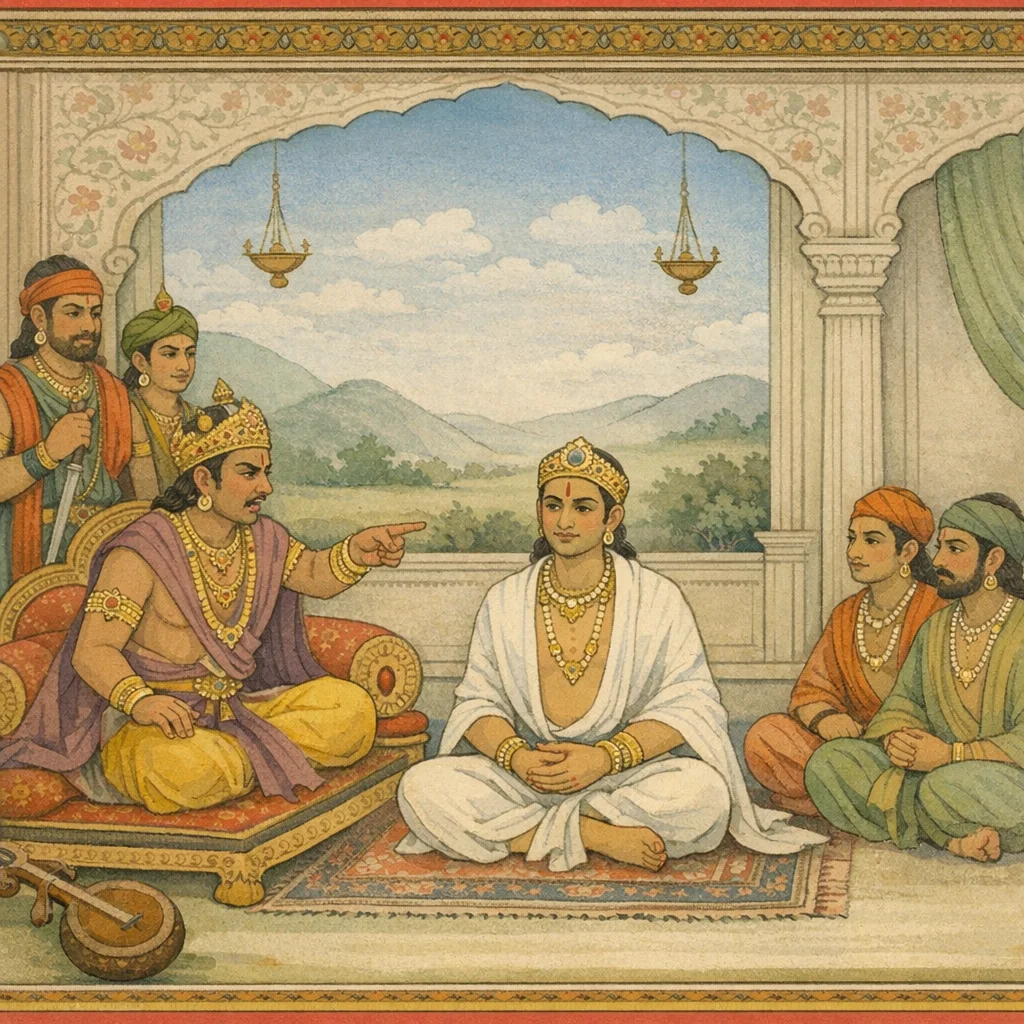
Parāśara recounts to Maitreya, in brief, the gathered deeds of Śrī Kṛṣṇa in Vraja—Govardhana’s lifting, Kāliya’s subduing, Pūtanā’s slaying, the breaking of the Śakaṭa, and the deaths of Dhenuka, Pralamba, and Ariṣṭa. The scene then shifts to Mathurā: Nārada reports these events to Kaṁsa, revealing also the secret infant-exchange between Yaśodā and Devakī. Enraged, Kaṁsa blames Vasudeva and the Yādavas and laments not killing Rāma-Kṛṣṇa earlier. He devises a public snare at the Dhanur-yajña—wrestling through Cāṇūra and Muṣṭika, the elephant Kuvalayāpīḍa, and further violence against Vasudeva, Nanda, and Ugrasena. He orders the devotee Akrūra to go to Gokula and bring the two brothers; Akrūra, inwardly joyful at the prospect of Kṛṣṇa’s darśana, departs swiftly, setting the course toward Mathurā and Kaṁsa’s downfall.
Shlokas
Verse 1
ककुद्मिनि हते ऽरिष्टे धेनुके विनिपातिते प्रलम्बे निधनं नीते धृते गोवर्धनाचले
When Ariṣṭa was slain at Kakudmin, Dhenuka struck down, Pralamba led to death, and Govardhana mountain held aloft, the Lord’s sovereign lila unfolded as the refuge of Vraja—revealing that the Supreme Vishnu, by effortless will, removes the burdens that oppress the world.
Verse 2
दमिते कालिये नागे भग्ने तुङ्गद्रुमद्वये हतायां पूतनायां च शकटे परिवर्तिते
When Kāliya, the serpent, had been subdued; when the pair of lofty arjuna trees had been shattered; when Pūtanā had been slain; and when the cart had been overturned...
Verse 3
कंसाय नारदः प्राह यथावृत्तम् अनुक्रमात् यशोदादेवकीगर्भपरिवर्ताद्य् अशेषतः
Nārada then recounted to Kaṁsa, in due sequence and exactly as it had occurred, the entire course of events—beginning with the exchange of the infants in the wombs of Yaśodā and Devakī—leaving nothing untold.
Verse 4
श्रुत्वा तत् सकलं कंसो नारदाद् देवदर्शनात् वसुदेवं प्रति तदा कोपं चक्रे सुदुर्मतिः
Hearing all of it from Nārada—whose vision is divine—Kaṃsa, darkened by wicked counsel, at once turned his wrath toward Vasudeva.
Verse 5
सो ऽतिकोपाद् उपालभ्य सर्वयादवसंसदि जगर्ह यादवांश् चैव कार्यं चैतद् अचिन्तयत्
Seized by overwhelming wrath, he rebuked them publicly in the full assembly of the Yādavas; and, censuring the Yādava clan, he began to ponder what was now to be done.
Verse 6
यावन् न बलम् आरूढौ रामकृष्णौ सुबालकौ तावद् एव मया वध्याव् असाध्यौ रूढयौवनौ
So long as Rāma and Kṛṣṇa had not yet come into their full strength—while they were still mere boys—then and there they ought to have been slain by me; for once they rise into youth, they will become unassailable.
Verse 7
चाणूरो ऽत्र महावीर्यो मुष्टिकश् च महाबलः एताभ्यां मल्लयुद्धेन घातयिष्यामि दुर्मदौ
Here is Chāṇūra, a warrior of immense prowess, and Muṣṭika of tremendous strength. By these two, in the wrestlers’ contest, I shall have those two arrogant ones struck down.
Verse 8
धनुर्महमहायागव्याजेनानीय तौ व्रजात् तथा तथा यतिष्यामि यास्येते संक्षयं यथा
Under the pretext of a grand sacrifice, I will have the bow brought and draw those two away from Vraja; then, by such stratagems, I shall strive until they are brought to ruin.
Verse 9
श्वफल्कतनयं सो ऽहम् अक्रूरं यदुपुंगवम् तयोर् आनयनार्थाय प्रेषयिष्यामि गोकुलम्
I shall send Akrūra—the son of Śvaphalka, foremost among the Yadus—to Gokula, in order to bring the two of them (Kṛṣṇa and Balarāma) here.
Verse 10
वृन्दावनचरं घोरम् आदेक्ष्यामि च केशिनम् तत्रैवासाव् अतिबलस् ताव् उभौ घातयिष्यति
I shall dispatch the dreadful Keśin, who roams in Vṛndāvana. There, that mighty one will strike down both of them.
Verse 11
गजः कुवलायापीडो मत्समीपम् उपागतौ घातयिष्यति वा गोपौ वसुदेवसुताव् उभौ
The elephant Kuvalayāpīḍa—once the two cowherd youths, the sons of Vasudeva, come near me—will surely strike them down and kill them both.
Verse 12
इत्य् आलोच्य स दुष्टात्मा कंसो रामजनार्दनौ हन्तुं कृतमतिर् वीरम् अक्रूरं वाक्यम् अब्रवीत्
Thus having deliberated, the wicked-souled Kaṃsa—his resolve fixed on slaying Rāma and Janārdana—spoke these words to the heroic Akrūra.
Verse 13
भो भो दानपते वाक्यं क्रियतां प्रीतये मम इतः स्यन्दनम् आरुह्य गम्यतां नन्दगोकुलम्
“Ho there, ho there, O lord of generosity—do as I say to please me: mount the chariot from here at once and go to Nanda’s Gokula.”
Verse 14
वसुदेवसुतौ तत्र विष्णोर् अंशसमुद्भवौ नाशाय किल संभूतौ मम दुष्टौ प्रवर्धतः
“There, the two sons of Vasudeva—born as portions of Viṣṇu Himself—have, it seems, manifested for my destruction, even as my own wickedness continues to swell and grow.”
Verse 15
धनुर्महो ममाप्य् अत्र चतुर्दश्यां भविष्यति आनेयौ भवता गत्वा मल्लयुद्धाय ताव् उभौ
“Here, on the fourteenth day, my own great Festival of the Bow shall take place. Go, and bring both of them here, so that they may be drawn into a wrestlers’ combat.”
Verse 16
चाणूरमुष्टिकौ मल्लौ नियुद्धकुशलौ मम ताभ्यां सहानयोर् युद्धं सर्वलोको ऽत्र पश्यतु
“Let my wrestlers Cāṇūra and Muṣṭika—masters of combat—fight with these two. Let everyone here behold the contest.”
Verse 17
नागः कुवलयापीडो महामात्रप्रचोदितः स वा हनिष्यते पापौ वसुदेवात्मजौ शिशू
Urged on by the royal officials, the elephant Kuvalayāpīḍa will surely slay those two wicked children—Vasudeva’s sons.
Verse 18
तौ हत्वा वसुदेवं च नन्दगोपं च दुर्मतिम् हनिष्ये पितरं चेमम् उग्रसेनं च दुर्मतिम्
“After slaying those two, I shall also kill Vasudeva and that wicked-minded Nanda the cowherd; and I will kill this father of mine as well—Ugrasena—of evil intent.”
Verse 19
ततः समस्तगोपानां गोधनान्य् अखिलान्य् अहम् वित्तं चापहरिष्यामि दुष्टानां मद्वधैषिणाम्
“Therefore, I shall seize all the cattle-wealth of every cowherd—indeed all of it—and I shall also carry off their riches; for these wicked men are intent upon my death.”
Verse 20
त्वाम् ऋते यादवाश् चैते दुष्टा दानपते मयि एतेषां च वधायाहं यतिष्ये ऽनुक्रमात् ततः
“Except for you, O lord of the Dānava race, these Yādavas are corrupt and hostile toward me. Therefore, for their destruction I shall exert myself—one after another, in due sequence—from this point onward.”
Verse 21
ततो निष्कण्टकं सर्वं राज्यम् एतद् अयादवम् प्रशासिष्ये त्वया तस्मान् मत्प्रीत्या वीर गम्यताम्
“Then this whole kingdom—freed of every thorn, with no Yādava left to trouble it—shall be governed under your authority. Therefore, O hero, for my satisfaction, depart and go.”
Verse 22
यथा च माहिषं सर्पिर् दधि चाप्य् उपहार्य वै गोपाः समानयन्त्य् आशु त्वया वाच्यास् तथा तथा
Just as the cowherds swiftly bring buffalo-ghee and curd as offerings, so should you speak to them in that very manner—again and again—so they promptly do what must be done.
Verse 23
इत्य् आज्ञप्तस् तदाक्रूरो महाभागवतो द्विज प्रीतिमान् अभवत् कृष्णं श्वो द्रक्ष्यामीति सत्वरः
Thus commanded, O best of the twice-born, Akrūra—the great devotee—was filled with joy; thinking, “Tomorrow I shall behold Kṛṣṇa,” he hastened at once.
Verse 24
तथेत्य् उक्त्वा च राजानं रथम् आरुह्य शोभनम् निश्चक्राम तदा पुर्या मथुराया मधुप्रियः
Saying, “So be it,” Madhu’s beloved had the king ascend the splendid chariot, and at that very time set forth from the city of Mathurā.
Frequently Asked Questions
It converts dispersed Vraja-līlās into a political crisis for Mathurā, forcing Kaṁsa to externalize his fear into public schemes—thereby advancing the avatāra narrative toward the ordained confrontation.
As a mahā-bhāgavata whose inner intention is darśana of Kṛṣṇa; the Purāṇa frames him as an unwitting/knowing conduit of Bhagavān’s larger design, where tyrannical orders become instruments of divine resolution.
Adharma becomes self-intensifying: fear and envy generate increasingly destructive plans, yet the narrative implies inevitability of dharma’s restoration because Viṣṇu’s avatāra-līlā governs outcomes beyond human calculation.