Adhyaya 5
यजुर्वेदशाखाः, याज्ञवल्क्य–वैशम्पायनसंवादः, सूर्यस्तुतिः (Yajurveda branches and Yājñavalkya’s solar revelation)
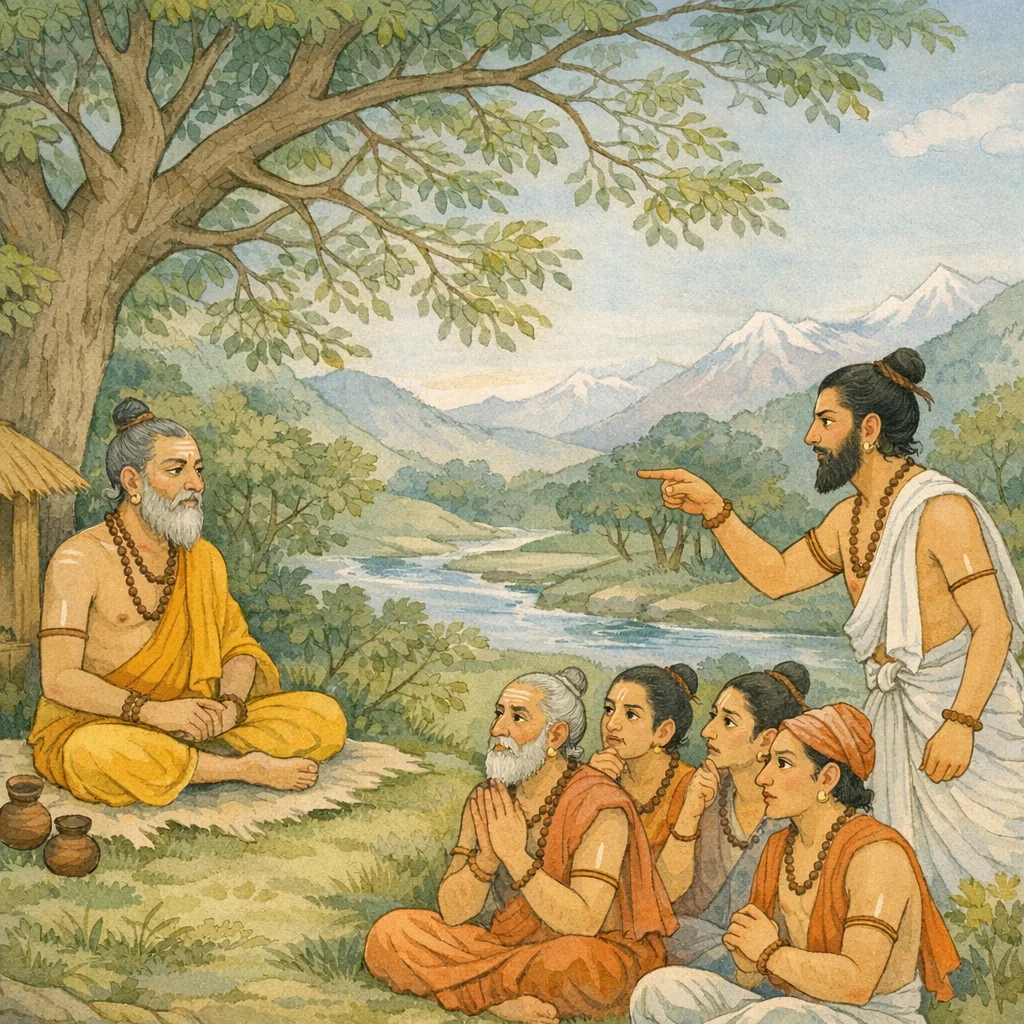
Parāśara tells Maitreyā that Vaiśampāyana, Vyāsa’s disciple, brought forth twenty-seven branches of the Yajurveda and handed them down through lineage. Yājñavalkya, son of Brahmarāta, is a disciplined, dharma-knowing student. Recalling an old covenant of sages about Mahāmeru, Vaiśampāyana oversteps it and, after an insult, kills his sister’s child, incurring the sin of brahma-hatyā; he orders his disciples to undertake an expiatory vow for him. Yājñavalkya, claiming greater tejas, offers to do it alone; the guru, angered, commands him to “return” what he has learned. Yājñavalkya casts out the Yajus mantras; other brāhmaṇas become tittirī birds and gather them—thus the Taittirīya tradition. Then Yājñavalkya performs prāṇāyāma and praises Sūrya (Savitr/Bhāskara/Vivasvān) as the source of the three Vedas, the form of Viṣṇu, lord of time, and purifier of action. Sūrya appears as a horse and grants him the previously unknown Yajus called Ayātayāma; their learners are called Vājins, and fifteen Vājasaneyin branch-lineages beginning with the Kāṇvas are said to proceed from Yājñavalkya.
Shlokas
Verse 1
यजुर्वेदतरोः शाखाः सप्तविंशन् महामतिः वैशम्पायननामासौ व्यासशिष्यश् चकार वै
From the great tree of the Yajurveda, the wise Vaiśampāyana—disciple of Vyāsa—indeed brought forth twenty-seven sacred branches.
Verse 2
शिष्येभ्यः प्रददौ ताश् च जगृहुस् ते ऽप्य् अनुक्रमात्
He bestowed those branches upon his disciples, and they, in due succession, received them according to the proper line of transmission.
Verse 3
याज्ञवल्क्यस् तु तस्याभूद् ब्रह्मरातसुतो द्विज शिष्यः परमधर्मज्ञो गुरुवृत्तिपरः सदा
And among his disciples was Yājñavalkya—O twice-born—son of Brahmarāta: knower of the highest Dharma, ever devoted to the conduct and service due to his teacher.
Verse 4
ऋषिर् यो ऽद्य महामेरौ समाजेनागमिष्यति तस्य वै सप्तरात्रात् तु ब्रह्महत्या भविष्यति
Whichever sage, on this very day, ascends Mahāmeru together with a worldly assembly, for him—after seven nights—there will arise the sin of brahma-hatyā.
Verse 5
पूर्वम् एवं मुनिगणैः समयो ऽभूत् कृतो द्विज वैशम्पायन एकस् तु तं व्यतिक्रान्तवांस् तदा
Formerly, O twice-born, the assemblies of sages had established such a covenant; yet at that time Vaiśampāyana alone transgressed that very agreement.
Verse 6
स्वस्रीयं बालकं सो ऽथ पदा स्पृष्टम् अघातयत्
Then he struck down his sister’s young son, for the child had touched him with his foot—deemed a grievous insult under the stern dharma of kings.
Verse 7
शिष्यान् आह च भोः शिष्या ब्रह्महत्यापहं व्रतम् चरध्वं मत्कृते सर्वे न विचार्यम् इदं तथा
He then addressed his disciples: “O disciples, undertake on my behalf the vow that removes the sin of brahma-slaying. All of you must observe it for my sake; do not hesitate or debate this matter.”
Verse 8
अथाह याज्ञवल्क्यस् तं किम् एभिर् भगवन् द्विजैः क्लेशितैर् अल्पतेजोभिश् चरिष्ये ऽहम् इदं व्रतम्
Then Yājñavalkya said: “Revered sir, what need have I of these twice-born men, worn down by hardship and of little spiritual radiance? I shall undertake this sacred observance by myself.”
Verse 9
ततः क्रुद्धो गुरुः प्राह याज्ञवल्क्यं महामतिः मुच्यतां यत् त्वयाधीतं मत्तो विप्रावमानक
Then the teacher, inflamed with anger, said to the great-minded Yājñavalkya: “Release—give back—whatever you have learned from me, O one who has insulted a brāhmaṇa.”
Verse 10
निस्तेजसो वदस्य् एतान् यस् त्वं ब्राह्मणपुंगवान् तेन शिष्येण नार्थो ऽस्ति ममाज्ञाभङ्गकारिणा
You speak as though bereft of spiritual splendor—yet you are foremost among brāhmaṇas. I have no need of a disciple who breaks my command and violates discipline.
Verse 11
याज्ञवल्क्यस् ततः प्राह भक्त्यैतत् ते मयोदितम् ममाप्य् अलं त्वयाधीतं यन् मया तद् इदं द्विज
Then Yājñavalkya said: “Out of devotion (bhakti) I have declared this to you. O twice-born one, for me too this is enough: what I had learned you have now learned; what was mine has truly become yours.”
Verse 12
इत्य् उक्त्वा रुधिराक्तानि सरूपाणि यजूंषि सः छर्दयित्वा ददौ तस्मै ययौ च स्वेच्छया मुनिः
Having spoken thus, the sage brought forth—like one vomiting—the Yajus formulae, stained with blood yet retaining their proper form, and handed them to him; then, of his own free will, the muni departed.
Verse 13
यजूंष्य् अथ विसृष्टानि याज्ञवल्क्येन वै द्विज जगृहुस् तित्तिरीभूत्वा तैत्तिरीयास् तु ते ततः
Then the Yajus mantras that Yājñavalkya had cast forth were gathered by the twice-born sages; becoming partridges (tittirīs), they collected them—hence they came to be known as the Taittirīyas.
Verse 14
ब्रह्महत्या व्रतं चीर्णं गुरुणा चोदितैस् तु यैः चरकाध्वर्यवस् ते तु चरणान् मुनिसत्तम
Those Caraka-adhvaryu priests who, urged by their preceptor, undertook and completed the expiatory vow for brahma-hatyā—O best of sages, even their feet are worthy of reverence.
Verse 15
याज्ञवल्क्यो ऽपि मैत्रेय प्राणायामपरायणः तुष्टाव प्रणतः सूर्यं यजूंष्य् अभिलषंस् ततः
O Maitreya, Yājñavalkya too—steadfast in the discipline of prāṇāyāma—bowed in reverence and praised the Sun-god; for he longed to obtain the Yajus mantras, and through that devotion he sought them.
Verse 16
नमः सवित्रे द्वाराय मुक्तेर् अमिततेजसे ऋग्यजुःसामभूताय त्रयीधामवते नमः
Salutations to Savitr, the gateway to liberation, of immeasurable splendor; salutations to Him who has become the Ṛg, Yajus, and Sāman, and who abides as the sanctuary of the threefold Veda.
Verse 17
नमो ऽग्नीषोमभूताय जगतः कारणात्मने भास्कराय परं तेजः सौषुम्णम् उरु बिभ्रते
Salutations to Bhāskara, of the nature of Agni and Soma, whose very Self is the causal ground of the universe—who bears aloft, vast and supreme, the transcendent radiance known as the Sauṣumnā light.
Verse 18
कलाकाष्ठानिमेषादिकालज्ञानात्मने नमः ध्येयाय विष्णुरूपाय परमाक्षररूपिणे
Salutations to Him whose very essence is the knowing of Time—of kalā, kāṣṭhā, nimeṣa and all its measures; to the Supreme who is to be meditated upon, who is of the form of Vishnu, and who abides as the highest Imperishable Reality.
Verse 19
बिभर्ति यः सुरगणान् आप्यायेन्दुं स्वरश्मिभिः स्वधामृतेन च पितॄंस् तस्मै तृप्त्यात्मने नमः
Salutations to Him whose very nature is perfect fulfillment—He who sustains the hosts of gods, nourishes the Moon with His own rays, and satisfies the ancestral spirits with the nectar of His own divine abode.
Verse 20
हिमाम्बुघर्मवृष्टीनां कर्ता भर्ता च यः प्रभुः तस्मै त्रिकालभूताय नमः सूर्याय वेधसे
Salutations to that Sun—Lord and ordainer—who is the maker and sustainer of cold, water, heat, and rain; to Him who abides as the reality of the three times, the sovereign intelligence that measures out the world.
Verse 21
अपहन्ति तमो यश् च जगतो ऽस्य जगत्पतिः सत्त्वधामधरो देवो नमस् तस्मै विवस्वते
Salutations to Vivasvān, the Sun—Lord of this universe, sovereign of the world—who dispels darkness and upholds the abode of sattva, the realm of luminous purity.
Verse 22
सत्कर्मयोग्यो न जनो नैवापः शौचकारणम् यस्मिन्न् अनुदिते तस्मै नमो देवाय भास्वते
When He has not yet arisen, no one is fit for righteous action, nor do even the waters become a cause of purity. Obeisance to that radiant Lord, Bhāsvat.
Verse 23
स्पृष्टो यदंशुभिर् लोकः क्रियायोग्यो ऽभिजायते पवित्रताकारणाय तस्मै शुद्धात्मने नमः
When the world is touched by His rays, it becomes fit for sacred action and right observance. Reverence to that Pure-Souled One, the very cause of purification.
Verse 24
नमः सवित्रे सूर्याय भास्कराय विवस्वते आदित्यायादिभूताय देवादीनां नमो नमः
Salutations to Savitṛ, to Sūrya, to radiant Bhāskara, to Vivasvān; salutations to Āditya, the primordial source of beings. To Him who stands at the head of the gods—again and again, reverence.
Verse 25
हिरण्मयं रथं यस्य केतवो ऽमृतधारिणः वहन्ति भुवनालोकचक्षुषस् तं नमाम्य् अहम्
I bow to Him whose chariot is of gold, whose rays bear the stream of deathless amṛta, carrying onward the Eye that illumines all the worlds.
Verse 26
इत्य् एवमादिभिस् तेन स्तूयमानः स्तवै रविः वाजिरूपधरः प्राह व्रीयताम् इति वाञ्छितम्
Thus praised by such and other hymns, Ravi—the Sun—took the form of a horse and said: “Choose the boon you desire; ask for what you wish.”
Verse 27
याज्ञवल्क्यस् तदा प्राह प्रणिपत्य दिवाकरम् यजूंषि तानि मे देहि यानि सन्ति न मे गुरौ
Then Yājñavalkya, bowing in reverence before Divākara, said: “Grant me those Yajus mantras that are not found with my teacher.”
Verse 28
एवम् उक्तो ददौ तस्मै यजूंषि भगवान् रविः अयातयामसंज्ञानि यानि वेत्ति न तद्गुरुः
Thus addressed, the blessed Ravi bestowed upon him the Yajus formulas—those famed as the Ayātayāma recensions—which even his former teacher did not know.
Verse 29
यजूंषि यैर् अधीतानि तानि विप्रैर् द्विजोत्तम वाजिनस् ते समाख्याताः सूर्यो ऽश्वः सो ऽभवद् यतः
O best of the twice-born, the Brahmins who mastered those Yajus hymns came to be known as Vājinas, for from that very cause the Sun became the Horse.
Verse 30
शाखाभेदास् तु तेषां वै दश पञ्च च वाजिनाम् कण्वाद्याः सुमहाभागा याज्ञवल्क्यप्रवर्तिताः
Of those Vājinas there are indeed fifteen distinct branch lineages. Chief among them are the fortunate schools beginning with the Kāṇvas, set in motion and authoritatively propagated by Yājñavalkya.
Frequently Asked Questions
After Yājñavalkya ejects the Yajus-mantras, other brāhmaṇas are said to become tittirī (partridge) birds and gather the scattered formulas; from this event they are called Taittirīyas.
The stuti presents the solar principle as a manifest locus of Vedic revelation and cosmic order—time-measure, purification, and the fitness for dharmic action—while explicitly grounding that power in Viṣṇu as the supreme imperishable reality (paramākṣara), consistent with Viṣṇu as Jagat-kāraṇa.