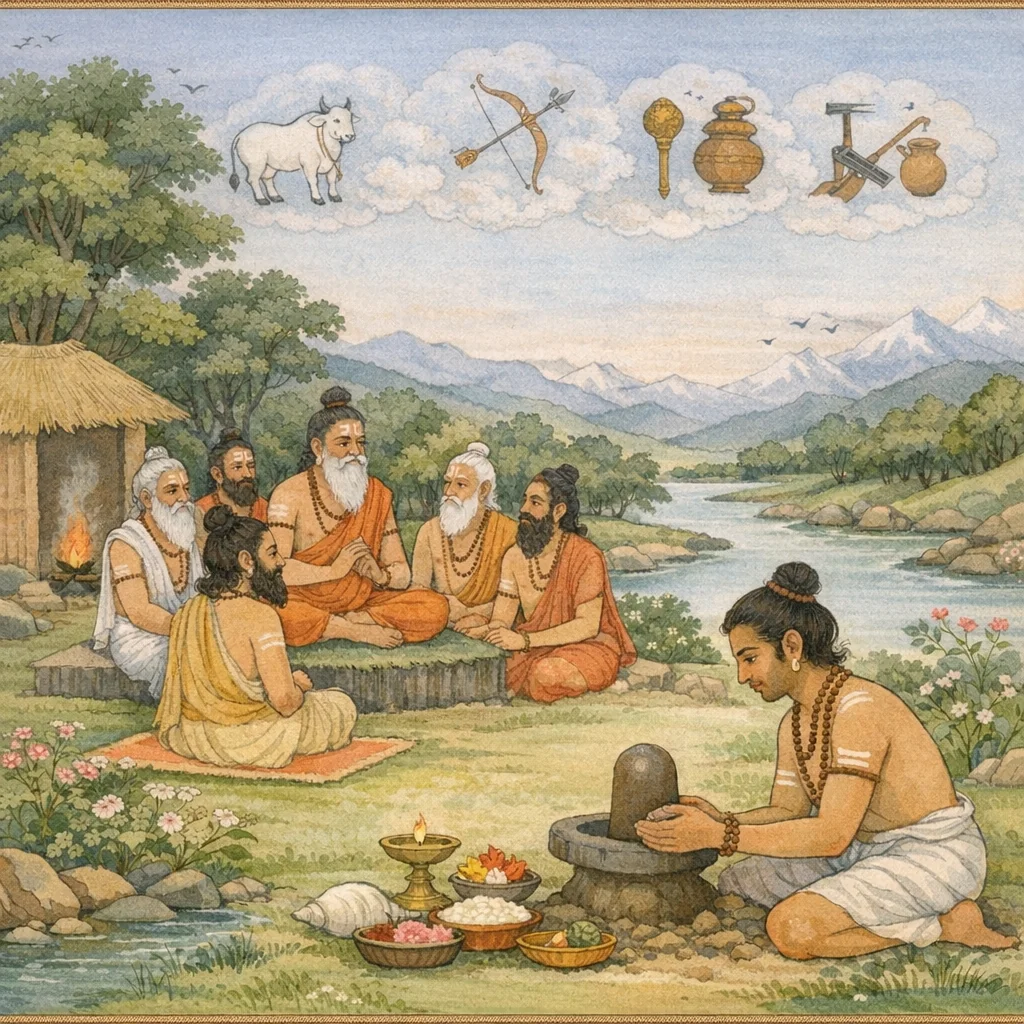
Pārthiva-Śiva-liṅga-māhātmya (The Excellence of the Earthen Śiva Liṅga)
Adhyāya 19 unfolds as a question-and-answer teaching: the ṛṣis ask Sūta, on Vyāsa’s authority, to restate the supreme greatness (māhātmya) of the Pārthiva-Māheśa-liṅga, the Śiva liṅga fashioned from earth. Sūta declares that the exposition bears fruit for those qualified by bhakti, then compares the kinds of liṅgas and proclaims the earthen liṅga foremost among those previously described. As testimony, Brahmā, Hari (Viṣṇu), sages, and Prajāpatis are said to have worshiped the earthen liṅga and attained their desired results; its efficacy is extended across realms to devas, asuras, humans, gandharvas, nāgas, and rākṣasas. A yuga-based teaching on materials follows—jewel liṅgas in Kṛta, gold in Tretā, mercury in Dvāpara, and earth in Kali—thereby presenting the earthen liṅga as the optimal medium for the present age. The discourse links this with Aṣṭamūrti theology by privileging the earthly mūrti and stating that exclusive worship yields great fruit akin to powerful tapas. It concludes with analogical ranking: as Maheśvara is chief among devas and the Gaṅgā among rivers, so the earthen liṅga is chief among all liṅgas.
Shlokas
Verse 1
ऋषय ऊचुः । सूत सूत चिरंजीव धन्यस्त्वं शिवभक्तिमान् । सम्यगुक्तस्त्वया लिंगमहिमा सत्फलप्रदः
The sages said: “O Sūta, O Sūta, may you live long. Blessed are you, for you are devoted to Śiva. You have rightly proclaimed the glory of the Liṅga—bestower of true and auspicious fruits.”
Verse 2
यत्र पार्थिवमाहेशलिंगस्य महिमाधुना । सर्वोत्कृष्टश्च कथितो व्यासतो ब्रूहि तं पुनः
In that context where the glory of the earthen Māheśa Liṅga has now been described as the most excellent of all—please tell it again to us, fully and in detail.
Verse 3
सूत उवाच । शृणुध्वमृषयः सर्वे सद्भक्त्या हरतो खिलाः । शिवपार्थिवलिंगस्य महिमा प्रोच्यते मया
Sūta said: “O sages, listen all with true devotion, casting away every distraction. Now I shall proclaim the glory of Śiva’s earthen (pārthiva) Liṅga.”
Verse 4
उक्तेष्वेतेषु लिंगेषु पार्थिवं लिंगमुत्तमम् । तस्य पूजनतो विप्रा बहवः सिद्धिमागताः
Among the many Liṅgas that have been described, the earthen (pārthiva) Liṅga is the most excellent. By worshipping it, O brāhmaṇas, many have attained siddhi and spiritual perfection.
Verse 5
हरिर्ब्रह्मा च ऋषयः सप्रजापतयस्तथा । संपूज्य पार्थिवं लिंगं प्रापुःसर्वेप्सितं द्विजाः
Hari (Viṣṇu), Brahmā, the sages, and the Prajāpatis as well—having duly worshipped the earthen (pārthiva) Liṅga—attained, O twice-born ones, all that they had desired.
Verse 6
देवासुरमनुष्याश्च गंधर्वोरगराक्षसाः । अन्येपि बहवस्तं संपूज्य सिद्धिं गताः परम्
Devas, Asuras, and human beings—Gandharvas, Nāgas, and Rākṣasas as well—indeed many others too, having worshipped Him with full reverence, attained the highest fulfilment (supreme spiritual perfection).
Verse 7
कृते रत्नमयं लिंगं त्रेतायां हेमसंभवम् । द्वापरे पारदं श्रेष्ठं पार्थिवं तु कलौ युगे
In the Kṛta Yuga, the Liṅga made of jewels is prescribed; in the Tretā Yuga, one fashioned of gold; in the Dvāpara Yuga, the best is the Liṅga of mercury; and in the Kali Yuga, the earthen (clay) Liṅga is recommended.
Verse 8
अष्टमूर्तिषु सर्वासु मूर्तिर्वै पार्थिवी वरा । अनन्यपूजिता विप्रास्तपस्तस्मान्महत्फलम्
Among all the eight manifestations (Aṣṭamūrti) of Śiva, the earthen (pārthivī) form is indeed the best. O brāhmaṇas, when it is worshipped with undivided devotion, that observance becomes an austerity (tapas) yielding very great fruit.
Verse 9
यथा सर्वेषु देवेषु ज्येष्ठः श्रेष्ठो महेश्वरः । एवं सर्वेषु लिंगेषु पार्थिवं श्रेष्टमुच्यते
Just as among all the gods Mahādeva (Maheśvara) is the eldest and the Supreme, so among all modes of Liṅga-worship the earthen (pārthiva) Liṅga is declared the best.
Verse 10
यथा नदीषु सर्वासु ज्येष्ठा श्रेष्ठा सुरापगा । तथा सर्वेषु लिंगेषु पार्थिवं श्रेष्ठमुच्यते
Just as among all rivers the Surāpagā—the heavenly Gaṅgā—is regarded as the eldest and most excellent, so among all Liṅgas the earthen (pārthiva) Liṅga is declared the best.
Verse 11
यथा सर्वेषु मंत्रेषु प्रणवो हि महान्स्मृतः । तथेदं पार्थिवं श्रेष्ठमाराध्यं पूज्यमेव हि
Just as the sacred Praṇava (Oṁ) is remembered as the greatest among all mantras, so too this earthen (pārthiva) Liṅga is the best—truly fit to be propitiated and worshipped.
Verse 12
यथा सर्वेषु वर्णेषु ब्राह्मणःश्रेष्ठ उच्यते । तथा सर्वेषु लिंगेषु पार्थिवं श्रेष्ठमुच्यते
Just as, among all the social orders (varṇas), the Brāhmaṇa is spoken of as the foremost, so too, among all Liṅgas, the earthen (pārthiva) Liṅga is declared the best.
Verse 13
यथा पुरीषु सर्वासु काशीश्रेष्ठतमा स्मृता । तथा सर्वेषु लिंगेषु पार्थिवं श्रेष्ठमुच्यते
Just as Kāśī is remembered as the most excellent among all sacred cities, so too among all Liṅgas the earthen (pārthiva) Liṅga is declared the best for worship.
Verse 14
यथा व्रतेषु सर्वेषु शिवरात्रिव्रतं परम् । तथा सर्वेषु लिंगेषु पार्थिवं श्रेष्थमुच्यते
Just as among all vows the Śivarātri observance is supreme, so too among all Liṅgas the earthen (pārthiva) Liṅga is declared the best.
Verse 15
यथा देवीषु सर्वासु शैवीशक्तिः परास्मृता । तथा सर्वेषु लिंगेषु पार्थिवं श्रेष्ठमुच्यते
Just as among all goddesses the Śaiva Power (Śakti) is remembered as supreme, so too among all forms of the Liṅga the earthen (pārthiva) Liṅga is declared the most excellent (śreṣṭha).
Verse 16
प्रकृत्यपार्थिवं लिंगं योन्यदेवं प्रपूजयेत् । वृथा भवति सा पूजा स्नानदानादिकं वृथा
If one worships a Liṅga that is, by its very nature, not made of earth, or worships a yoni that is not divine, that worship becomes fruitless; likewise, the accompanying rites—such as bathing and charitable gifts—also become fruitless.
Verse 17
पार्थिवाराधनं पुण्यं धन्यमायुर्विवर्धनम् । तुष्टिदं पुष्टिदंश्रीदं कार्यं साधकसत्तमैः
Worship of the earthen (pārthiva) Liṅga is holy and auspicious; it increases one’s lifespan. It bestows contentment, nourishment, and prosperity—therefore it should be performed by the best of spiritual aspirants.
Verse 18
यथा लब्धोपचारैश्च भक्त्या श्रद्धासमन्वितः । पूजयेत्पार्थिवं लिंगं सर्वकामार्थसिद्धिदम्
With whatever offerings one has obtained, and with devotion joined to faith, one should worship Śiva’s earthen (pārthiva) Liṅga—for it bestows the fulfillment of all rightful aims and desired ends.
Verse 19
इति श्रीशिवमहापुराणे विद्येश्वरसंहितायां साध्यसाधनखंडे पार्थिवशिवलिंगपूजनमाहात्म्यवर्णनं नामैकोनविंशोऽध्यायः
Thus, in the Śrī Śiva Mahāpurāṇa—within the Vidyeśvara Saṃhitā, in the Sādhyasādhana Khaṇḍa—ends the nineteenth chapter, entitled “The Account of the Glory of Worshipping the Earthen Śiva-Liṅga.”
Verse 20
त्रिसंध्यं योर्चयंल्लिंगं कृत्वा बिल्वेन पार्थिवम् । दशैकादशकंयावत्तस्य पुण्यफलं शृणु
Hear the meritorious fruit of that person who, at the three sandhyās each day, fashions an earthen (pārthiva) Liṅga and worships it with bilva leaves—continuing this observance for the period of ten or eleven days.
Verse 21
अनेनैव स्वदेहेन रुद्र लोके महीयते । पापहं सर्वमर्त्यानां दर्शनात्स्पर्शनादपि
By this very body alone, one is honored in Rudra’s world. One becomes a destroyer of sins for all mortals—even by merely seeing one or touching one.
Verse 22
जीवन्मुक्तः स वैज्ञानी शिव एव न संशयः । तस्य दर्शनमात्रेण भुक्तिर्मुक्तिश्च जायते
That knower who is liberated while still living is verily Śiva Himself—of this there is no doubt. By the mere sight (darśana) of such a one, both worldly enjoyment (bhukti) and liberation (mukti) arise.
Verse 23
शिवं यः पूजयेन्नित्यं कृत्वा लिंगं तु पार्थिवम् । यावज्जीवनपर्यंतं स याति शिवमन्दिरम्
Whoever worships Lord Śiva daily, having fashioned a Pārthiva-liṅga (an earthen emblem of Śiva), and continues this practice for the whole span of life—he attains Śiva’s abode, the divine temple of Śiva, nearness to the Lord that culminates in liberation through His grace.
Verse 24
मृडेनाप्रमितान्वर्षाञ्छिवलोकेहि तिष्ठति । सकामः पुनरागत्य राजेन्द्रो भारते भवेत्
By the grace of Mr̥ḍa (Śiva), one abides in Śiva’s world for immeasurable years; and if desires still remain, returning again one becomes a sovereign king in Bhārata (India).
Verse 25
निष्कामः पूजयेन्नित्यं पार्थिवंलिंगमुत्तमम् । शिवलोके सदा तिष्ठेत्ततः सायुज्यमाप्नुयात्
One who is free from selfish desire should worship daily the excellent earthen (pārthiva) Liṅga. Such a devotee dwells ever in Śiva’s realm, and thereafter attains sāyujya—complete union with Lord Śiva.
Verse 26
पार्थिवं शिवलिंगं च विप्रो यदि न पूजयेत् । स याति नरकं घोरं शूलप्रोतं सुदारुणम्
If a brāhmaṇa does not worship the earthen Śiva-liṅga, he goes to a dreadful hell—most terrible—where he is impaled upon a trident.
Verse 27
यथाकथंचिद्विधिना रम्यं लिंगं प्रकारयेत् । पंचसूत्रविधानां च पार्थिवेन विचारयेत्
In whatever manner is feasible, following the proper rule, one should fashion a beautiful Liṅga. And with a Liṅga made of earth, one should duly contemplate and apply the prescribed arrangement of the fivefold ‘sūtras’ (ritual principles).
Verse 28
अखण्डं तद्धि कर्तव्यं न विखण्डं प्रकारयेत् । द्विखण्डं तु प्रकुर्वाणो नैव पूजाफलं लभेत्
That should indeed be kept whole; one should not present it in broken pieces. For the one who performs it as a divided, two-part offering does not attain the fruit of worship.
Verse 29
रत्नजं हेमजं लिंगं पारदं स्फाटिकं तथा । पार्थिवं पुष्परागोत्थमखंडं तु प्रकारयेत्
One should prescribe and duly establish for worship the Śiva-liṅga made of gems, of gold, of mercury, and likewise of crystal; also the earthen liṅga, the liṅga fashioned from topaz, and the unbroken, integral liṅga.
Verse 30
अखंडं तु चरं लिंगं द्विखंडमचरं स्मृतम् । खंडाखंडविचारोयं सचराचरयोः स्मृतः
The moving (cara) Liṅga is taught to be ‘undivided’ (akhaṇḍa), while the unmoving (acara) Liṅga is remembered as ‘two-part’ (dvikhaṇḍa). This distinction of divided and undivided is stated with reference to the moving and the unmoving.
Verse 31
वेदिका तु महाविद्या लिंगं देवो महेश्वरः । अतो हि स्थावरे लिंगे स्मृता श्रेष्ठादिखंडिता
The altar (vedikā) is indeed the Great Wisdom (Mahāvidyā), and the Liṅga is the Deity—Mahādeva Maheśvara Himself. Therefore, in the case of a fixed (installed) Liṅga, it is taught that pre-eminence is differentiated into grades, beginning with the ‘best’.
Verse 32
द्विखंडं स्थावरं लिंगं कर्तव्यं हि विधानतः । अखंडं जंगमं प्रोक्तंश् ऐवसिद्धान्तवेदिभिः
According to the prescribed rule, the immovable (sthāvara) Liṅga is to be fashioned in two parts; but the movable (jaṅgama) Liṅga is declared by the knowers of the Siddhānta to be single, unbroken, and undivided (akhaṇḍa).
Verse 33
द्विखंडं तु चरां लिंगं कुर्वन्त्यज्ञानमोहिताः । नैव सिद्धान्तवेत्तारो मुनयः शास्त्रकोविदाः
Deluded by ignorance, some fashion the moveable Liṅga into two separate parts. But the sages who know the Siddhānta—those truly skilled in the śāstras—do not accept such a practice.
Verse 34
अखंडं स्थावरं लिंगं द्विखंडं चरमेव च । येकुर्वन्तिनरामूढानपूजाफलभागिनः
The fixed (sthāvara) Liṅga should be whole and unbroken, while the movable (cara) Liṅga may be made in two parts. Those deluded men who do otherwise are not entitled to the fruit of worship.
Verse 35
तस्माच्छास्त्रोक्तविधिना अखंडं चरसंज्ञकम् । द्विखंडं स्थावरं लिंगं कर्तव्यं परया मुदा
Therefore, in accordance with the method taught in the scriptures, one should fashion the undivided liṅga known as the movable (cara); and one should also, with supreme devotion and joy, fashion the two-part liṅga that is established as the immovable (sthāvara).
Verse 36
अखंडे तु चरे पूजा सम्पूर्णफलदायिनी । द्विखंडे तु चरे पूजामहाहानिप्रदा स्मृता
When worship is performed upon the undivided liṅga, it bestows complete and perfect fruit. But worship performed in a broken or divided manner is remembered to yield great loss of merit and spiritual efficacy.
Verse 37
अखंडे स्थावरे पूजा न कामफलदायिनी । प्रत्यवायकरी नित्यमित्युक्तं शास्त्रवेदिभिः
The knowers of the śāstras declare that worship offered to an unbroken, fixed Liṅga does not grant the desired fruit; rather, it ever becomes a cause of ritual fault (pratyavāya).
Frequently Asked Questions
A theological argument of comparative excellence is presented: Sūta, responding to the sages, asserts that among liṅga types the pārthiva liṅga is supreme, supporting the claim by exemplary precedent (Brahmā, Viṣṇu, ṛṣis, Prajāpatis) and by analogical ranking (Śiva among devas; Gaṅgā among rivers).
The chapter’s rahasya is the alignment of material form with cosmic time: earth (pārthiva) becomes the Kali-yuga-appropriate medium, implying that accessibility and immediacy of ritual contact are themselves theological principles; the liṅga here signifies a universally available locus for siddhi when worship is exclusive and devotionally grounded.
Śiva is highlighted primarily as Maheśvara/Viśveśvara accessed through the pārthiva-liṅga; within the aṣṭamūrti framework the pārthivī mūrti is singled out as superior. Gaurī is not foregrounded in the sampled verses for this chapter.