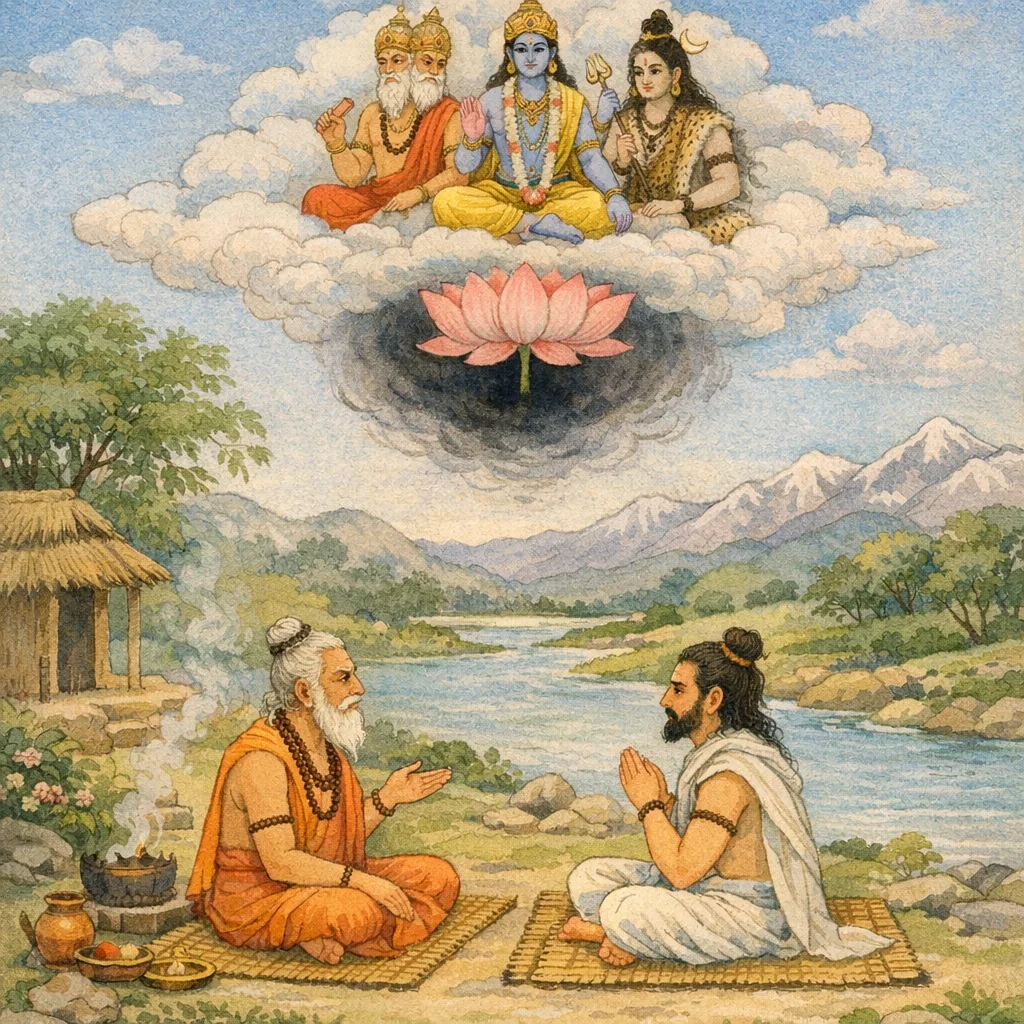
सृष्टिवर्णनम् (Cosmogony and the Roles of the Trimūrti)
Adhyāya 29 follows the classical Purāṇic question–answer form. After hearing the earlier “great narrative” (the Sanatkumāra–Kāleyasaṃvāda), Śaunaka asks Sūta for a precise account of how Brahmā’s creation (sarga) arises, as transmitted through Vyāsa. Sūta frames the teaching as divya-kathā—divine, purifying, and multi-layered—whose repeated hearing or recitation grants religious merit and sustains one’s lineage (svavaṃśadhāraṇa). The cosmogonic teaching then presents pradhāna and puruṣa as the enduring sat/asat matrix from which the world-fashioner proceeds. Brahmā is described as creator of beings and as Nārāyaṇa-parāyaṇa, and the Trimūrti’s functions are stated succinctly: Brahmā creates, Hari preserves, and Maheśvara dissolves, with no other agency in these recurring cosmic phases. The concrete creation sequence begins when the self-born Brahmā first produces the waters (āpas) and places seed/energy (vīrya) within them, preparing for further emanations.
Shlokas
Verse 1
शौनक उवाच । श्रुतं मे महदाख्यानं यत्त्वया परिकीर्तितम् । सनत्कुमारकालेयसंवादं परमार्थदम्
Śaunaka said: I have heard the great sacred narrative that you have recounted—the dialogue between Sanatkumāra and Kāleya, which bestows the highest truth.
Verse 2
अतोहं श्रोतुमिच्छामि यथा सर्गस्तु ब्रह्मणः । समुत्पन्नं तु मे ब्रूहि यथा व्यासाच्च ते श्रुतम्
Therefore I wish to hear how the creation of Brahmā came into being. Tell me clearly how it arose, just as you heard it from Vyāsa.
Verse 3
सूत उवाच । मुने शृणु कथां दिव्यां सर्वपापप्रणाशिनीम् । कथ्यमानां मया चित्रां बह्वर्थां श्रुतविस्तराम्
Sūta said: O sage, listen to this divine account that destroys all sins. As I narrate it, it is wondrous, rich with many meanings, and expansive according to what has been heard in sacred tradition.
Verse 4
यश्चैनां पाठयेत्तां च शृणुयाद्वाऽप्यभीक्ष्णशः । स्ववंशधारणं कृत्वा स्वर्गलोके महीयते
Whoever causes this sacred teaching to be recited, and whoever repeatedly listens to it—having upheld the continuity of one’s lineage and one’s dharmic duty—becomes honored and exalted in the heavenly worlds.
Verse 5
प्रधानं पुरुषो यत्तन्नित्यं सदसदात्मकम् । प्रधानपुरुषो भूत्वा निर्ममे लोकभावनः
That which is called Pradhāna and that which is called Puruṣa are eternal, of the nature of both the manifest and the unmanifest. Becoming one as Pradhāna–Puruṣa, the Lord—the nourisher and sustainer of the worlds—brought creation into being.
Verse 6
स्रष्टारं सर्वभूतानां नारायणपरायणम् । तं वै विद्धि मुनिश्रेष्ठ ब्रह्माणममितौजसम्
Know, O best of sages, that mighty Brahmā—of immeasurable splendour—is the creator of all beings, and that he is devoted to Nārāyaṇa as his supreme support.
Verse 7
यस्मादकल्पयत्कल्पान्तमग्राश्शुचयो यतः । भवंति मुनिशार्दूल नमस्तस्मै स्वयम्भुवे
Salutations to that Self-born Lord (Svayambhū), from whom—even at the end of an aeon—pure and foremost ones arise; O tiger among sages, from Him the sacred seers come into being.
Verse 8
तस्मै हिरण्यगर्भाय पुरुषायेश्वराय च । नमस्कृत्य प्रवक्ष्यामि भूयः सर्गमनुत्तमम्
Having bowed in reverence to Hiraṇyagarbha—the Cosmic Womb—who is also the Supreme Person and the Lord, I shall again expound the unsurpassed doctrine of creation (sarga).
Verse 9
ब्रह्मा स्रष्टा हरिः पाता संहर्ता च महेश्वरः । तस्य सर्गस्य नान्योऽस्ति काले काले तथा गते
Brahmā is the creator; Hari (Viṣṇu) is the protector; and Maheśvara (Śiva) is the withdrawer (dissolver). In that recurring cycle of manifestation, there is no other ultimate agent—when time after time those periods pass.
Verse 10
सोऽपि स्वयंभूर्भगवान्सिसृक्षुर्विविधाः प्रजाः । अप एव ससर्जादौ तासु वीर्यमवासृजत्
That Self-born Lord, desiring to create the many kinds of beings, first brought forth the waters; and into those waters He cast His generative potency.
Verse 11
आपो नारा इति प्रोक्ता आपो वै नरसूनवः । अयनं तस्य ताः पूर्वं तेन नारायणः स्मृतः
“Waters are called ‘nārā’; indeed, the waters are said to be the offspring of Nara. In the beginning they were his resting-place (ayana); therefore he is remembered as Nārāyaṇa.”
Verse 12
हिरण्यवर्णमभवत्तदंडमुदकेशयम् । तत्र जज्ञे स्वयं ब्रह्मा स्वयंभूरिति विश्रुतः
That cosmic Egg became golden-hued and rested upon the waters. Within it, Brahmā was born of himself—therefore renowned as Svayambhū, the Self-born.
Verse 13
हिरण्यगर्भो भगवानुषित्वा परिवत्सरम् । तदंडमकरोद्द्वैधं दिवं भूमि च निर्ममे
The Blessed Hiraṇyagarbha (Brahmā), having dwelt for a full year within that cosmic Egg, then split that Egg into two; and from it he fashioned heaven and the earth.
Verse 14
अधोऽथोर्द्ध्वं प्रयुक्तानि भुवनानि चतुर्द्दश । तयोश्शकलयोर्मध्य आकाशममृजत्प्रभुः
Then the Lord set in place the fourteen worlds—below and above—and, between those two divisions, the Sovereign fashioned the expanse of space (ākāśa).
Verse 15
अप्सु पारिप्लवां पृथ्वीं दिशश्च दशधा दिवि । तत्र काले मनो वाचं कामक्रोधावथो रतिम्
When the earth was inundated by the waters and the ten directions in the sky seemed as though split tenfold, at that time (the yogin should) restrain mind and speech, and also curb desire, anger, and even attachment to sensual delight.
Verse 16
मरीचिमत्र्यंगिरसौ पुलस्त्यं पुलहं क्रतुम । वसिष्ठं तु महतेजास्सोऽसृजत्सप्त मानसान्
Then the supremely radiant Lord (Brahmā) created, by the power of his mind, the seven mind-born sages—Marīci, Atri, Aṅgiras, Pulastya, Pulaha, Kratu, and Vasiṣṭha.
Verse 17
सप्त बह्माण इत्येते पुराणे निश्चयं गताः । ततोऽसृजत्पुनर्ब्रह्मा रुद्रान्क्रोधसमुद्भवान्
Thus the Purāṇa affirms with certainty that there were seven Brahmās. Thereafter, Brahmā again brought forth the Rudras—born from his wrath—who manifest the fierce, transforming power that ultimately leads beings toward Lord Śiva, the supreme Pati.
Verse 18
सनत्कुमारं च ऋषिं सर्वेषामपि पूर्वजम् । सप्त चैते प्रजायंते पश्चाद्रुद्राश्च सर्वतः
And the sage Sanatkumāra arose as well, the primordial elder of all. These seven were born first; thereafter, the Rudras manifested everywhere in all directions.
Verse 19
अतस्सनत्कुमारस्तु तेजस्संक्षिप्य तिष्ठति । तेषां सप्तमहावंशा दिव्या देवर्षिपूजिताः
Therefore Sanatkumāra, having withdrawn and gathered his radiance within himself, remains established in stillness. From that sacred line there arise seven great, divine lineages, revered and worshipped even by the god-sages.
Verse 20
प्रजायन्ते क्रियावन्तो महर्षिभिरलंकृताः । विद्युतोऽशनि मेघांश्च रोहितेन्द्रधनूंषि च
Then arose mighty, efficacious forces—adorned by the great seers—and there appeared as well lightning, thunderbolts, clouds, the crimson glow, and Indra’s bow (the rainbow).
Verse 21
पयांसि च ससर्जादौ पर्जन्यं च ससर्ज ह । ऋचो यजूंषि सामानि निर्ममे यज्ञसिद्धये
In the beginning he brought forth the waters, and he also created the rain-cloud. For the successful accomplishment of sacrifice, he fashioned the Ṛk hymns, the Yajus formulas, and the Sāman chants.
Verse 22
पूज्यांस्तैरयजन्देवानित्येवमनुशुश्रुम । मुखाद्देवानजनयत्पितॄंश्चैवाथ वक्षसः । प्रजनाच्च मनुष्यान्वै जघनान्निर्ममेऽसुरान्
Thus have we heard: they worshipped the Devas, deeming them worthy of reverence. From his mouth he brought forth the Devas; from his chest he produced the Pitṛs, the ancestral fathers; from his generative power he fashioned human beings; and from his loins he created the Asuras.
Verse 23
उच्चावचानि भूतानि गात्रेभ्यस्तस्य जज्ञिरे । आपवस्य प्रजासर्गं सृजतो हि प्रजापतेः
As Prajāpati (Brahmā), lord of progeny, brought forth the creation of beings, diverse orders of creatures—high and low—arose from his very limbs.
Verse 24
सृज्यमानाः प्रजाश्चैव नावर्द्धन्त यदा तदा । द्विधा कृत्वात्मनो देहं स्त्री चैव पुरुषोऽभवत्
But when the beings being created did not increase, then he divided his own body into two, and thus became both woman and man.
Verse 25
ससृजेऽथ प्रजास्सर्वा महिम्ना व्याप्य विश्वतः । विराजमसृजद्विष्णुस्स सृष्टः पुरुषो विराट्
Then, pervading the entire universe with His majesty, he brought forth all beings. Viṣṇu created Virāj, and from that creation arose the Cosmic Person, the Virāṭ (the universal form).
Verse 26
द्वितीयं तं मनुं विद्धि मनोरन्तरमेव च । स वैराजः प्रजास्सर्वास्ससर्ज पुरुषः प्रभुः
Know him as the second Manu, and as the very interval (manvantara) of Manu. That sovereign Person, Vairāja, the Lord, created all beings.
Verse 27
नारायणविसर्गस्य प्रजास्तस्याप्ययोनिजः । आयुष्मान्कीर्तिमान्धन्यः प्रजावांश्चाभवत्ततः
From that progeny manifested by Nārāyaṇa, there also arose one who was not born from a womb. Thereafter he became long-lived, renowned, blessed, and endowed with progeny.
Verse 28
इत्येवमादिसर्गस्ते वर्णितो मुनिसत्तम । आदिसर्गं विदित्वैवं यथेष्टां प्राप्नुयाद्गतिम्
Thus, O best of sages, the account of Ādisarga—the primordial creation—has been declared to you. Knowing Ādisarga in this way, one attains the destined course, indeed the very state one seeks, by the grace of right understanding.
Verse 29
इति श्रीशिवमहापुराणे पञ्चम्यामुमासंहितायामादिसर्गवर्णनं नाम एकोनत्रिंशोऽध्यायः
Thus, in the Śrī Śiva Mahāpurāṇa, in the Fifth Book—the Umāsaṃhitā—ends the twenty-ninth chapter called “The Description of Ādisarga, the Primordial Creation.”
Frequently Asked Questions
It presents a cosmogonic argument: creation proceeds through Brahmā (Svayaṃbhū/Hiraṇyagarbha) operating within a pradhāna–puruṣa metaphysical frame, while the cosmic functions are distributed across the Trimūrti—Brahmā creates, Viṣṇu preserves, and Śiva dissolves—repeating across cycles of time.
The chapter’s key symbols—pradhāna/puruṣa and the primordial waters (āpas)—encode a layered cosmogony: undifferentiated potential (pradhāna) and conscious principle (puruṣa) precede manifest forms, while ‘waters’ function as a generative substrate into which creative potency (vīrya) is placed, signaling the transition from metaphysical principles to tangible emanation.
No distinct iconographic manifestation of Śiva or Umā/Gaurī is foregrounded in the provided verses; instead, Śiva appears chiefly as Maheśvara in his cosmic function as saṃhartā (dissolver), within a theological schema that coordinates Śiva with Brahmā and Hari.