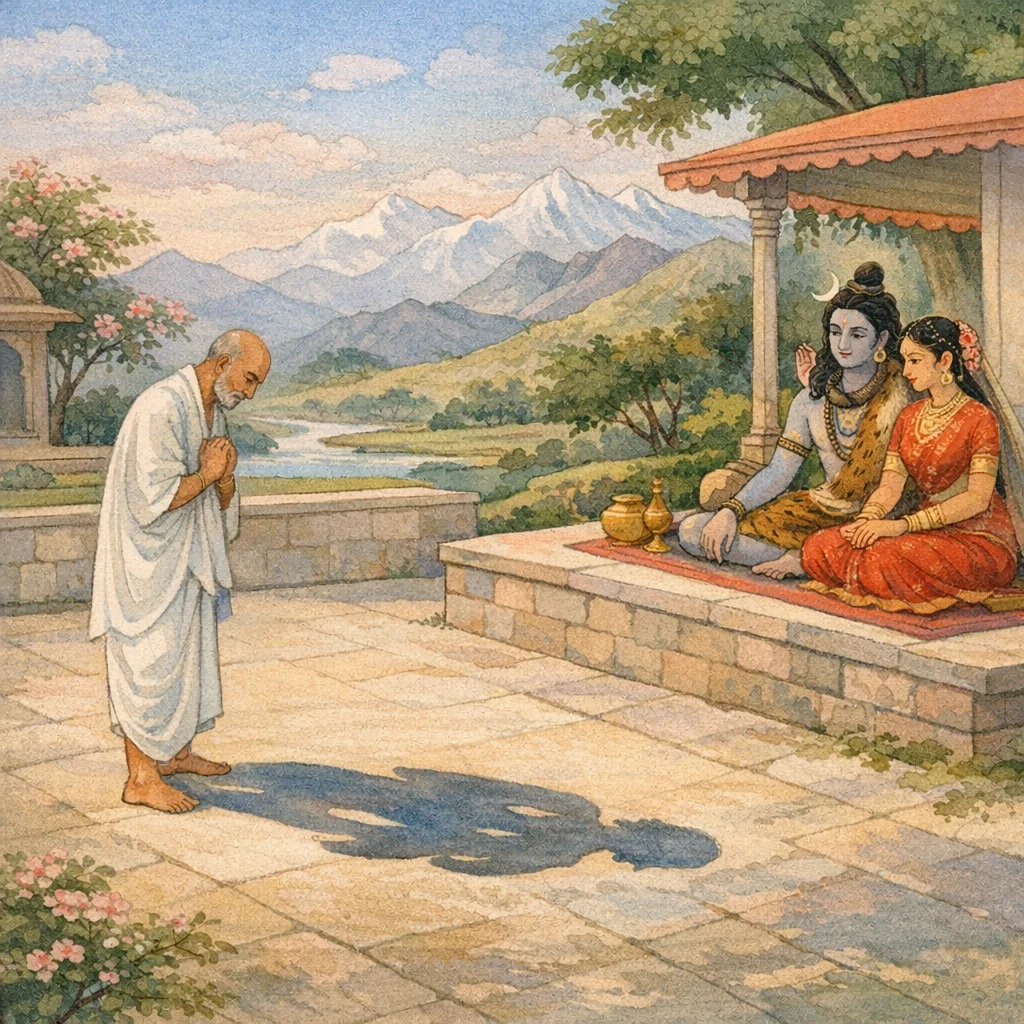
छायापुरुषलक्षणवर्णनम् (Description of the Marks of the Shadow-Person)
Adhyāya 28 unfolds as a dialogue between Devī and Śaṅkara. Devī asks for a fuller explanation of a previously summarized esoteric teaching, termed “chāyikaṃ jñānam,” connected with śabda-brahman and yogic signs. Śaṅkara then sets out the method and rules of interpretation for “chāyāpuruṣa-lakṣaṇa,” the diagnostic marks perceived in one’s own shadow. The practice is taught as a ritualized yogic observation: one positions oneself in relation to the sun or moon, remains purified in white garments with fragrances, recollects a Śiva mahāmantra described as “navātmaka” and “piṇḍabhūta,” and then examines the shadow. The chapter encodes a system of omens: the shadow’s forms, colors, and anomalies are correlated with outcomes—spiritual (vision of Śiva as the supreme cause, attainment of Brahman, release from grievous sins) and prognostic (time-bound loss, danger, or life-events). In sum, it is a compact Shaiva manual of divinatory-yogic semiotics, uniting mantra, purity, perception, and interpretive rules into a single operational protocol.
Shlokas
Verse 1
देव्युवाच । देवदेव महादेव कथितं कालवंचनम् । शब्दब्रह्मस्वरूपं च योगलक्षणमुत्तमम्
The Goddess said: O God of gods, O Mahādeva—please explain the transcending of Time (kāla-vañcana), the nature of Śabda-Brahman (Brahman as sacred sound), and the supreme characteristics of Yoga.
Verse 2
कथितं ते समासेनच्छायिकं ज्ञानमुत्तमम् । विस्तरेण समाख्याहि योगिनां हितकाम्यया
You have explained, in brief, the excellent “shadow-like” knowledge (as an outline). Now, out of compassion and for the welfare of yogins, please expound it in detail.
Verse 3
शंकर उवाच । शृणु देवि प्रवक्ष्यामिच्छायापुरुषलक्षणम् । यज्ज्ञात्वा पुरुषः सम्यक्सर्वपापैः प्रमुच्यते
Śaṅkara said: “Listen, O Devī; I shall declare the marks of the Chhāyā-Puruṣa, the ‘shadow-person.’ Knowing this rightly, one is wholly freed from all sins.”
Verse 4
सूर्य्यं हि पृष्ठतः कृत्वा सोमं वा वरवर्णिनि । शुक्लाम्बरधरस्स्रग्वी गंधधूपादिवासितः
O fair-complexioned lady, placing the Sun behind him—or else the Moon—he should wear white garments, a garland, and be perfumed with fragrance, incense, and the like.
Verse 5
संस्मरेन्मे महामंत्रं सर्वकामफलप्रदम् । नवात्मकं पिंडभूतं स्वां छायां संनिरीक्षयेत्
One should recollect My great mantra, bestower of the fruits of all rightful desires. Contemplating it as ninefold and embodied as a subtle whole, one should steadily behold one’s own shadow as a support for inward meditation.
Verse 6
दृष्ट्वा तां पुनराकाशे श्वेतवर्णस्वरूपिणीम् । स पश्यत्येकभावस्तु शिवं परमकारणम्
Having again beheld Her in the sky, in a radiant white form, he—becoming single-pointed in contemplation—perceives Śiva, the Supreme Cause of all.
Verse 7
ब्रह्मप्राप्तिर्भवेत्तस्य कालविद्भिरितीरितम् । ब्रह्महत्यादिकैः पापैर्मुच्यते नात्र संशयः
The knowers of sacred time and right observance declare that such a devotee attains Brahman, the Supreme Reality. There is no doubt that he is freed from sins such as brahmin-slaying and the like.
Verse 8
शिरोहीनं यदा पश्येत्षड्भिर्मासैर्भवेत्क्षयः । समस्तं वाङ्मयं तस्य योगिनस्तु यथा तथा
If one sees a headless form, then within six months decline and loss arise. For that person, all knowledge and articulated speech (vāṅmaya)—whether of an ordinary man or even a yogin—become impaired in one way or another.
Verse 9
शुक्ले धर्मं विजानीयात्कृष्णे पापं विनिर्दिशेत् । रक्ते बंधं विजानीयात्पीते विद्विषमादिशेत्
Whiteness should be understood as a sign of dharma; blackness is to be taken as pāpa (sin). Redness is to be recognized as bondage (bandha); and yellowness is to be inferred as hostility (vidveṣa).
Verse 10
विवाहो बंधुनाशस्स्याद्द्वितुंडे चैव क्षुद्भयम् । विकटौ नश्यते भार्य्या विजंघे धनमेव हि
In the form called Dvitunḍa, it is said there is an occasion of marriage but also the destruction of kinsmen, along with fear of hunger. In the form called Vikaṭa, the wife is lost; and in the form called Vijaṅgha, indeed wealth alone is lost.
Verse 11
पादाभावे विदेशस्स्यादित्येतत्कथितं मया । तद्विचार्य्यं प्रयत्त्नेन पुरुषेण महेश्वरि
O Maheśvarī, I have thus declared that when the proper “place of footing” is absent, one becomes as though in a foreign land. Therefore, let a person reflect upon this with earnest effort.
Verse 12
सम्यक्तं पुरुषं दृष्ट्वा संनिवेश्यात्मनात्मनि । जपेन्नवात्मकं मंत्रं हृदयं मे महेश्वरि
Having rightly contemplated the Supreme Person, and having seated the self within the Self, one should repeat the ninefold mantra—O Maheshvari—this is My heart-essence, the innermost teaching.
Verse 13
वत्सरे विगते मंत्री तन्नास्ति यन्न साधयेत् । अणिमादिगुणानष्टौ खेचरत्वं प्रपद्यते
When a full year has passed, the mantra-practitioner finds nothing that cannot be accomplished. He attains the eight powers beginning with aṇimā, and even the state of moving through the sky.
Verse 14
पुनरन्यत्प्रवक्ष्यामि शक्तिं ज्ञातुं दुरासदाम् । प्रत्यक्षं दृश्यते लोके ज्ञानिनामग्रतः स्थितम्
Again I shall declare something further: Śakti, the sacred Power, is exceedingly difficult to comprehend; yet in this world She is seen directly—standing manifest before the foremost of the wise.
Verse 15
अज्ञेया लिख्यते लोके या सर्पीकृतकुण्डली । सा मात्रा यानसंस्थापि दृश्यते न च पठ्यते
In the world there is an unknowable sign, written in the form of a serpent coiled (kuṇḍalī). That ‘mātrā’, though seen as set upon a carrier-like form, is not read as a pronounceable letter-sound.
Verse 16
ब्रह्माण्डमूर्ध्निगा या च स्तुता वेदैस्तु नित्यशः । जननी सर्वविद्यानां गुप्तविद्येति गीयते
She who abides upon the very crown of the cosmic egg (brahmāṇḍa) and is ceaselessly praised by the Vedas—She is sung as the Mother of all knowledges, known as the ‘Secret Wisdom’.
Verse 17
खेचरा सा विनिर्दिष्टा सर्वप्राणिषु संस्थिता । दृश्यादृश्याचला नित्या व्यक्ताव्यक्ता सनातनी
She is declared to be ‘Khecarā’—moving in the inner space (kha). Abiding within all living beings, she is both seen and unseen; unmoving, eternal; both manifest and unmanifest—everlasting in her nature.
Verse 18
अवर्णा वर्णसंयुक्ता प्रोच्यते बिंदुमालिनी । तां पश्यन्सर्वदा योगी कृतकृत्योऽभिजायते
That supreme power which is beyond all letters yet united with all letters is called Bindu-mālinī, the Garland of Bindu. The yogin who continually beholds that reality becomes fulfilled—his human purpose accomplished.
Verse 19
सर्वतीर्थकृतस्नानाद्भवेद्दानस्य यत्फलम् । सर्वयज्ञफलं यच्च मालिन्या दर्शनात्तदा
The fruit of charity gained by bathing in all sacred pilgrimage waters, and the merit arising from all sacrifices—these are obtained then merely by beholding Mālinī.
Verse 20
प्राप्नोत्यत्र न संदेहस्सत्यं वै कथितं मया । सर्वतीर्थेषु यत्स्नात्वा दत्त्वा दानानि सर्वशः
Here one surely attains that merit—there is no doubt. What I have spoken is indeed true: it equals the fruit gained by bathing in all sacred tīrthas and by giving every kind of charity in full measure.
Verse 21
सर्वेषां देवि यज्ञानां यत्फलं तल्लभेत्पुमान् । किं बहूक्त्या महेशानि सर्वान्कामान्समश्नुते
O Goddess, a person attains the very fruit that comes from all sacrifices. Indeed, what need is there to say more, O Maheshani? He comes to enjoy the fulfillment of all desired ends.
Verse 22
तस्माज्ज्ञानं यथायोगमभ्यसेत्सततं बुधः । अभ्यासाज्जायते सिद्धिर्योगोऽभ्यासात्प्रवर्धते
Therefore, the wise should constantly cultivate spiritual knowledge in a manner suited to Yoga. From steady practice arises siddhi (attainment), and through practice Yoga itself grows and becomes firmly established.
Verse 23
संवित्तिर्लभ्यतेऽभ्यासादभ्यासान्मोक्षमश्नुते । अभ्यासस्सततं कार्यो धीमता मोक्षकारणम्
Through steady practice, saṃvitti—true spiritual awareness—is attained; and through that very practice one reaches mokṣa (liberation). Therefore, the discerning seeker should continually engage in practice, for it is the direct cause of mokṣa.
Verse 24
इत्येतत्कथितं देवि भुक्तिमुक्तिफलप्रदम् । किमन्यत्पृच्छ्यते तत्त्वं वद सत्यं ब्रवीमि ते
Thus, O Goddess, this has been explained—bestowing the fruits of both bhukti (worldly enjoyment) and mukti (liberation). What other truth do you wish to ask? Speak; I shall tell you the truly established reality.
Verse 25
सूत उवाच । इति श्रुत्वा ब्रह्मपुत्रवचनं परमार्थदम् । प्रसन्नोऽभूदति व्यासः पाराशर्य्यो मुनीश्वराः
Sūta said: Having thus heard the words of Brahmā’s son, bestowing the highest truth, sage Vyāsa—the illustrious son of Parāśara—became greatly pleased, O foremost of sages.
Verse 26
सनत्कुमारं सर्वज्ञं ब्रह्मपुत्रं कृपानिधिम् । व्यासः परमसंतुष्टः प्रणनाम मुहुर्मुहुःष
Utterly delighted, Vyāsa repeatedly bowed down to Sanatkumāra—the all-knowing son of Brahmā, an ocean of compassion.
Verse 27
ततस्तुष्टाव तं व्यासः कालेयस्स मुनीश्वरः । सनत्कुमारं मुनयः सुरविज्ञानसागरम्
Then the sage Vyāsa, the venerable Kālēya, praised that Sanatkumāra—whom the sages knew as an ocean of divine wisdom.
Verse 28
इति श्रीशिवमहापुराणे पञ्चम्यामुमासंहितायां छायापुरुषदर्शनवर्णनं नामाष्टाविंशोऽध्यायः
Thus, in the Śrī Śiva Mahāpurāṇa, in the Fifth Book—the Umāsaṃhitā—ends the twenty-eighth chapter, entitled “The Description of the Vision of the Shadow-Person.”
Verse 29
सूत उवाच । इति स्तुत्वा स कालेयो ब्रह्मपुत्रं महामुनिम् । तूष्णीं बभूव सुप्रीतः परमानंदनिर्भरः
Sūta said: Having thus praised the great sage—Brahmā’s son—Kāleya became silent, deeply gratified and wholly immersed in supreme bliss.
Verse 30
ब्रह्मपुत्रस्तमामंत्र्य पूजितस्तेन शौनकः । ययौ स्वधाम सुप्रीतो व्यासोऽपि प्रीतमानसः
Having taken leave of him, the son of Brahmā—Śaunaka—duly honored by him, departed for his own abode, greatly pleased; and Vyāsa too went away with a heart full of joy.
Verse 31
इति मे वर्णितो विप्राः सुखदः परमार्थयुक् । सनत्कुमारकालेयसंवादो ज्ञानवर्द्धनः
Thus, O brāhmaṇa sages, I have described to you this dialogue between Sanatkumāra and Kāleya—bestowing spiritual happiness, grounded in the highest truth, and increasing true knowledge.
Frequently Asked Questions
It presents chāyāpuruṣa-lakṣaṇa: a technique that combines mantra recollection, ritual purity, and controlled observation of one’s shadow (relative to sun/moon) to derive both soteriological claims (Śiva-vision, brahma-prāpti, pāpa-kṣaya) and prognostic readings (omens based on form/color anomalies).
The shadow becomes a semiotic interface: perceived qualities are treated as externalized signs of internal condition and impending karmic fruition. Color mappings (e.g., white→dharma, black→pāpa, red→bondage, yellow→hostility) function as a rule-set that translates perception into ethical-spiritual diagnosis within a Shaiva mantra-yoga frame.
Śiva is emphasized as the paramakāraṇa (supreme causal reality) apprehended through ekabhāva (single-pointed unitive awareness). The chapter’s culmination is not iconographic variety but the doctrinal apex: realization of Śiva as the one underlying principle accessed through mantra and yogic perception.