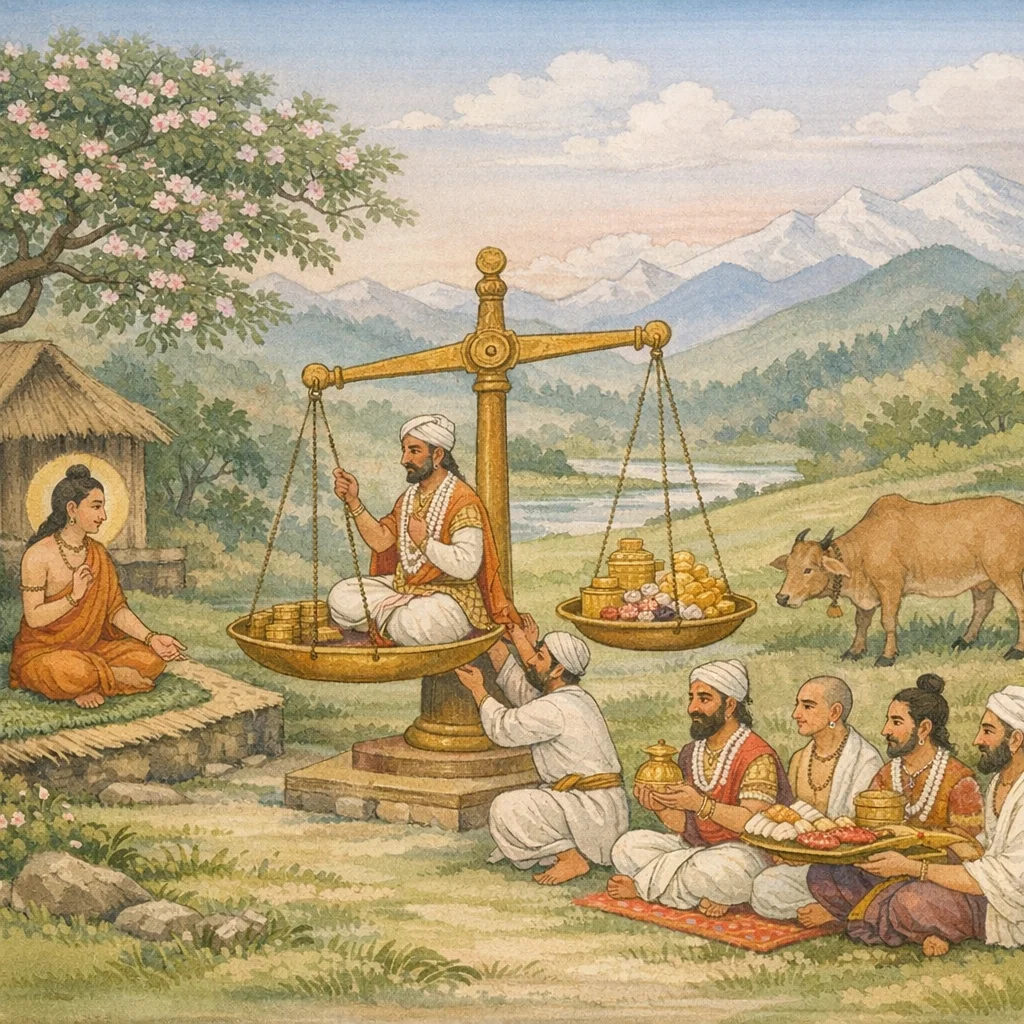
Mahādāna-prakaraṇa (The Doctrine of Great Gifts): Suvarṇa–Go–Bhūmi and Tulā-dāna
Adhyāya 14 is a didactic discourse by Sanatkumāra that sets out a hierarchy of dāna (religious gifts) and the conditions that make giving spiritually effective. It opens by declaring that the regular (nitya) performance of “great” gifts—even severe/ghora gifts—when offered to a worthy recipient (pātra), becomes salvific (tāraka). The chapter then highlights paradigmatic, highly purifying gifts—gold (hiraṇya/suvarṇa), cows (go), and land (bhūmi/pṛthivī)—and recognizes tulā-dāna (gift by weighing) as a meritorious form. It expands into practical charity ethics: daily support items (cow, umbrella, clothing, footwear), food and drink for petitioners, and the crucial role of saṃkalpa (formal intention) in establishing ritual validity. A canonical list of the “ten mahādānas” is given (including gold, sesame, elephants, maiden, female servant, house, chariot, gems, and tawny cows), followed by the claim that learned brāhmaṇas, by receiving and redistributing or mediating merit, can “save” donors. The closing emphasis elevates suvarṇa-dāna by linking gold with Agni and thus with all deities, implying that gifting gold is symbolically equivalent to offering to the entire divine order.
Shlokas
Verse 1
सनत्कुमार उवाच । शस्तानि घोरदानानि महादानानि नित्यशः । पात्रेभ्यस्तु प्रदेयानि आत्मानं तारयंति च
Sanatkumāra said: “Commendable gifts—great gifts, even those that are difficult and awe-inspiring to undertake—should be given regularly, and indeed only to worthy recipients. Such offerings also become a means of delivering one’s own self.”
Verse 2
हिरण्यदानं गोदानं भूमिदानं द्विजोत्तम । गृह्णंतो वै पवित्राणि तारयंति स्वमेव तम्
O best of the twice-born, those who accept gifts of gold, cows, and land—indeed, these sanctifying offerings—thereby deliver their own selves.
Verse 3
सुवर्णदानं गोदानं पृथिवीदानमेव च । एतानि श्रेष्ठदानानि कृत्वा पापैः प्रमुच्यते
The gifting of gold, the gifting of cows, and the gifting of land—these are declared the foremost of gifts. Having performed such supreme acts of charity, one is released from sins.
Verse 4
तुलादानानि शस्तानि गावः पृथ्वी सरस्वती । द्वे तु तुल्यबले शस्ते ह्यधिका च सरस्वती
Among gifts made by weighing (tulā-dāna), the gifts of cows, of land, and of Sarasvatī—sacred learning—are praised. Of these, two are said to be equal in meritorious power, yet the gift of Sarasvatī is held to be superior.
Verse 5
नित्य ह्यनुडुहो गावच्छत्रं वस्त्रमुपानहौ । देयानि याचमानेभ्यः पानमन्नं तथैव च
Indeed, each day one should give—especially to those who ask—an unmilked cow, a parasol, clothing, and footwear, and likewise water to drink and food. Such daily giving purifies the bound soul (paśu) and supports the dharmic path that pleases Lord Śiva.
Verse 6
संकल्पविहितोयोऽर्थो ब्राह्मणेभ्यः प्रदीयते । अर्थिभ्योऽपीडितेभ्यश्च मनस्वी तेन जायते
Wealth set aside through a deliberate vow and given to brāhmaṇas—and also bestowed upon the needy and the afflicted—makes a person truly strong-minded and steadfast in dharma.
Verse 7
कनकं च तिला नागाः कन्या दासी गृहं रथः । मणयः कपिला गावो महादानानि वै दश
“Gold, sesame seeds, elephants, a maiden (given in marriage), a maidservant, a house, a chariot, gems, tawny kapilā cows, and cows—these are indeed the ten ‘great gifts’ (mahādānas).”
Verse 8
गृहीत्वैतानि सर्वाणि ब्राह्मणो ज्ञानवित्सदा । वदान्यांस्तारयेत्सद्यो ह्यात्मानं च न संशयः
Having taken up all these in full, a learned and ever-discerning brāhmaṇa should at once ferry across the generous devotees—and thereby save his own self as well; of this there is no doubt.
Verse 9
सुवर्णं ये प्रयच्छंति नराश्शुद्धेन चेतसा । देवतास्तं प्रयच्छंति समंतादिति मे श्रुवम्
Those people who give gold with a purified mind—about such a giver I have heard this: the deities, from all sides, bestow their blessings upon him.
Verse 10
अग्निर्हि देवतास्सर्वाः सुवर्णं च हुताशनः । तस्मात्सुवर्णं दत्त्वा च दत्तास्स्युस्सर्वदेवताः
Fire itself embodies all the deities, and gold is of the very nature of Hutāśana, the oblation-bearing Fire. Therefore, by gifting gold, it is as though one has duly given to all the gods.
Verse 11
पृथ्वीदानं महाश्रेष्ठं सर्वकामफलप्रदम् । सौवर्णं च विशेषेण यत्कृतं पृथुना पुरा
The gift of land is supremely excellent, the very best, and it bestows the fruits of all desired aims. Most especially is the gifting of land accompanied by gold, as King Pṛthu performed in ancient times.
Verse 12
दीयमानां प्रपश्यंति पृथ्वीं रुक्मसमन्विताम् । सर्वपापविनिर्मुक्तास्ते यांति परमां गतिम्
Those who behold the earth being gifted in due rite, adorned with gold, are freed from all sins. Thus purified, by the grace of Lord Śiva they attain the supreme state.
Verse 13
अथान्यच्च प्रवक्ष्यामि दानं सर्वोत्तमं मुने । कांतारं यन्न पश्यंति यमस्य बहुदुःखदम्
Now, O sage, I shall speak of another gift—an offering that is supreme: by it one does not behold the dreadful wilderness of Yama, which brings manifold suffering.
Verse 14
इति श्रीशिवमहापुराणे पञ्चम्यामुमासंहितायां सामान्यदानवर्णनं नाम चतुर्दशोऽध्यायः
Thus, in the Śrī Śiva Mahāpurāṇa—within the fifth, the Umā-saṃhitā—ends the fourteenth chapter, entitled “The Description of General Charity.”
Verse 15
तिलप्रस्थमयीं कृत्वा धेनुं सर्वगुणान्विताम् । धेनुवत्सं सुवर्णं च सुदिव्यं सर्वलक्षणम्
Having fashioned a cow (as an offering) measured by a prastha of sesame and endowed with every auspicious quality, one should also prepare a calf of the cow in gold—radiant, sacred, and complete with all the proper marks.
Verse 16
पद्ममष्टदलं कृत्वा कुंकुमाक्ताक्षतैश्शुभैः । पूजयेत्तत्र रुद्रादीन्सर्वान्देवान्सुभक्तितः
Having fashioned an eight-petaled lotus (maṇḍala), and using auspicious unbroken rice grains anointed with saffron, one should worship there—beginning with Rudra—all the deities, with sincere devotion.
Verse 17
एवं संपूज्य तां दद्याद्ब्राह्मणाय स्वशक्तितः । सरत्नां सहिरण्यां च सर्वाभरणभूषिताम्
Thus, after duly worshipping her, one should, according to one’s own capacity, give her to a Brāhmaṇa—adorned with jewels and gold, and decorated with every kind of ornament.
Verse 18
ततो नक्तं समश्नीयाद्दीपान्दद्यात्तु विस्तरात् । कार्तिक्यामिति कर्तव्यं पूर्णिमायां प्रयत्नतः
Thereafter, one should take the vow’s meal at night (naktabhojana) and, in due detail, offer lamps as charity. This observance is to be performed with earnest effort on the full-moon day of Kārtika.
Verse 19
एवं यः कुरुते सम्यग्विधानेन स्वशक्तितः । यममार्गभयं घोरं नरकं च न पश्यति
Thus, whoever performs it correctly—according to the prescribed rule and to the best of one’s ability—does not behold the terrible fear of Yama’s path, nor does he see hell.
Verse 20
कृत्वा पापान्यशेषाणि सबंधुस्ससुहृज्जनः । दिवि संक्रीडते व्यास यावदिन्द्राश्चतुर्दश
Having completely destroyed all sins, together with his relatives and dear friends, he sports in heaven, O Vyāsa, for as long as fourteen Indras endure.
Verse 21
विधितो गोश्च दानं वै सर्वोत्तममिह स्मृतम् । न तेन सदृशं व्यास परं दानं प्रकीर्तितम्
When performed according to the rule of the śāstras, the gift of a cow is remembered here as the very best. O Vyāsa, no higher gift equal to it is proclaimed.
Verse 22
प्रयच्छते यः कपिलां सवत्सां स्वर्णशृंगिकाम् । कांस्यपात्रां रौप्यखुरां सर्वलक्षणलक्षिताम्
Whoever donates a tawny cow (kapilā) together with her calf—adorned with golden horns, with hooves plated in silver, accompanied by a bronze vessel, and marked with every auspicious sign—truly performs a greatly meritorious dāna, pleasing Lord Śiva and upholding the path of dharma.
Verse 23
तैस्तैर्गुणैः कामदुघा भूत्वा सा गौरुपैति तम् । प्रदातारं नरं व्यास परत्रेह च जन्मनि
Endowed with those very virtues, that cow becomes a wish-fulfilling giver and follows the man who offered her—O Vyāsa—in this world and beyond, even through his future births.
Verse 24
यद्यदिष्टतमं लोके यदस्ति दयितं गृहे । तत्तद्गुणवते देयं तदेवाक्षयमिच्छता
Whatever is most cherished in the world, and whatever is most beloved in one’s own home—one who longs for the imperishable fruit should offer precisely that to the truly worthy and virtuous, for such a gift becomes inexhaustible.
Verse 25
तुलापुरुषदानं हि दानानां दानमुत्तमम् । तुलासंरोहणं कार्यं यदीच्छेच्छ्रेय आत्मनः
Indeed, the gift called tulāpuruṣa-dāna—donating wealth equal to one’s own weight—is the highest among gifts. Therefore, if one seeks spiritual welfare for oneself, one should perform the rite of ascending the balance (tulā-saṃrohaṇa).
Verse 26
यत्कृत्वा मुच्यते पापैर्वधबंधकृतोद्भवैः । तुलादानं महत्पुण्यं सर्वपापक्षयंकरम्
By performing it, one is freed from sins arising from acts such as killing and imprisoning. Tulā-dāna—the gift made by weighing—is a great merit that brings about the destruction of all sins.
Verse 27
कृत्वा पापान्यशेषाणि तुलादानं करोति यः । सर्वैस्तु पातकैर्मुक्तः स दिवं यात्यसंशयम्
Whoever, even after committing sins without remainder, performs tulā-dāna—the gift by weighing—becomes freed from all sinful stains; and, without doubt, he attains the heavenly realm.
Verse 28
पापं कृतं यद्दिवसे निशायां द्विसंध्योर्मध्यदिने निशांते । कालत्रये कायमनोवचोभिस्तुलापुमान्वै तदपाकरोति
Whatever sin a person has committed—by day or by night, at the junctions of dawn and dusk, at midday, or at the end of night—he surely removes it by performing the Tulā-dāna rite at the three sacred times, with body, mind, and speech aligned in devotion.
Verse 29
बालेन वृद्धेन मया हि यूना विजानता ज्ञानपरेण पापम् । तत्सर्वमेवाशु कृतं मदीयं तुलापुमान्वै हरतु स्मरारिः
Whether as a child, an old man, or a youth—though I knew what is right and was devoted to knowledge—I have committed sin. May Smarāri, the foe of Kāma, swiftly remove all I have done, as though weighing it on a balance and taking it away.
Verse 30
पात्रे प्रयुक्तं द्रविणं मयाऽद्य प्रमाणपूर्णं निहितं तुलायाम् । तेनैव सार्धं तु ममावशेषं कृताकृतं यत्सुकृतं समेतु
Today I have placed wealth into a worthy vessel, measured in full and set upon the balance. Along with that very offering, may whatever remains with me—whether done or left undone—together with whatever merit I possess, be gathered and brought to fulfillment.
Verse 31
सनत्कुमार उवाच । एवमुच्चार्य्य तं दद्यात् द्विजेभ्यः सर्वदा हितः । नैकस्यापि प्रदातव्यं न निस्तारस्ततो भवेत्
Sanatkumāra said: “Having recited it thus, one who is ever intent on what is beneficial should give that gift to the twice-born—worthy Brāhmaṇas. It should not be given to only one person, for from that there would be no true deliverance.”
Verse 32
ददात्येवं तु यो व्यास तुलापुरुषमुत्तमम् । हत्वा पापं दिव्यं तिष्ठेद्यावदिन्द्राश्चतुर्द्दश
O Vyāsa, whoever thus bestows the excellent Tulāpuruṣa gift destroys sin and abides in the divine state for as long as fourteen Indras endure.
Frequently Asked Questions
It argues that gold-gifting reaches the entire pantheon because gold is ritually and symbolically linked to Agni (Hutāśana), and Agni is identified as the mouth/presence of all deities; therefore, giving gold is framed as giving to all devatās.
Pātra functions as a ritual-ethical filter ensuring that the gift becomes a valid carrier of merit (puṇya), while saṃkalpa supplies the formal intentionality that ‘codes’ the act as dharmic and spiritually operative; together they convert material transfer into a soteriological instrument (pāpa-kṣaya/tāraṇa).
No specific named form (svarūpa) of Śiva or Gaurī is foregrounded in the sampled content; the chapter is primarily a prescriptive dharma-ritual unit focused on dāna, with divine reference mediated through Agni and the devatā economy rather than iconographic Śaiva forms.