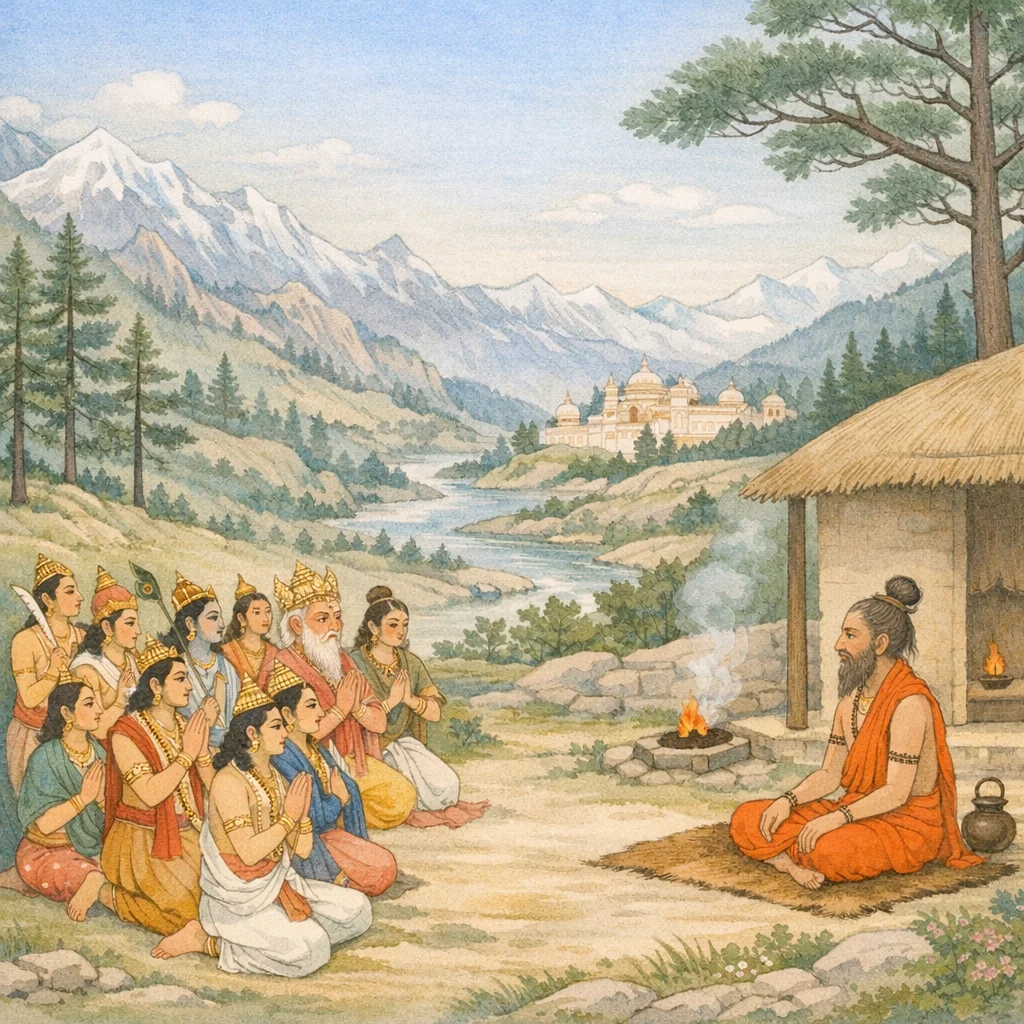
साधुवेषद्विजाह्वयावतारकथनम् | Account of the ‘Sādhu-veṣa’ Brahmin-Named Incarnation (Prelude)
Adhyāya 35 begins with Nandīśvara speaking to Sanatkumāra, introducing an avatāra of Śiva called “sādhu-veṣa-dvijāhvaya,” an incarnation appearing in the guise of a holy ascetic with a brahminic designation. The devas grow strategically anxious on seeing the supreme devotion (mahottamā bhakti) of Menā and Himālaya toward Śiva: they infer that if Himālaya, with single-pointed faith, offers his daughter to Śambhu, he will swiftly attain nirvāṇa/mokṣa and even sārūpya—divine nearness and likeness—through Śiva’s anugraha. Viewing this as potentially disruptive to the cosmic order, the devas confer and go to a guru’s residence, petitioning him to visit Himālaya’s house and, by criticizing Maheśa, obstruct the mountain’s devotion, explicitly to prevent the liberating result that would follow the gift of the daughter to Śiva. The chapter thus sets a doctrinal lesson: celestial power-politics may oppose bhakti, yet liberation rests decisively on devotion and Śiva’s grace.
Shlokas
Verse 1
नन्दीश्वर उवाच । सनत्कुमार सर्वज्ञ शिवस्य परमात्मनः । अवतारं शृणु विभोस्साधुवेषद्विजाह्वयम्
Nandīśvara said: “O all-knowing Sanatkumāra, listen, O mighty one, to the incarnation of Śiva—the Supreme Self—who appeared in the guise of a holy ascetic and was known by the name of a brāhmaṇa.”
Verse 2
मेनाहिमालयोर्भक्तिं शिवे ज्ञात्वा महोत्तमाम् । चिन्तामापुस्तुरास्सर्वे मन्त्रयामासुरादरात्
When the kings learned of the supremely exalted devotion that Menā and Himālaya had for Lord Śiva, they were seized by concern and, with earnest attention, began to deliberate together.
Verse 3
एकान्तभक्त्या शैलश्चेत्कन्यां दास्यति शम्भवे । ध्रुवं निर्वाणतां सद्यः सम्प्राप्स्यति शिवस्य वै
If the Mountain (Śaila) gives his daughter to Śambhu with one-pointed devotion, then surely and at once he will attain the state of nirvāṇa—indeed, the liberating grace of Śiva.
Verse 4
अनन्तरत्नाधारोऽसौ चेत्प्रयास्यति मोक्षताम् । रत्नगर्भाभिधा भूमिर्मिथ्यैव भविता ध्रुवम्
If that support which bears infinite jewels were to depart into liberation, then the earth famed as “Ratnagarbhā” (the jewel-wombed one) would certainly become a mere false name—indeed, an empty claim.
Verse 5
अस्थिरत्वम्परित्यज्य दिव्यरूपं विधाय सः । कन्यां शूलभृते दत्त्वा शिवालोकं गमिष्यति
Casting off his former instability, he will assume a divine form; and, having offered the maiden to the Trident-bearer, Lord Śiva, he shall go to Śivaloka.
Verse 6
महादेवस्य सारूप्यं प्राप्य शम्भोरनुग्रहात् । तत्र भुक्त्वा महाभोगांस्ततो मोक्षमवाप्स्यति
By the gracious favor of Śambhu, one attains sārūpya—likeness to Mahādeva. There, having enjoyed the great divine felicities, one thereafter attains mokṣa, final liberation.
Verse 7
इत्यालोच्य सुरास्सर्वे जग्मुर्गुरुगृहं मुने । चक्रुर्निवेदनं गत्वा गुरवे स्वार्थसाधकाः
Having thus deliberated, O sage, all the gods went to their teacher’s abode; and, seeking the fulfillment of their own purpose, they approached the Guru and submitted their petition.
Verse 8
देवा ऊचुः । गुरो हिमालयगृहं गच्छास्मत्कार्य्यसिद्धये । कृत्वा निंदां महेशस्य गिरिभक्तिं निवारय
The gods said: “O Guru, go to the house of Himālaya so that our purpose may be accomplished. By voicing censure of Mahesha, restrain the Mountain-king’s devotion to Śiva.”
Verse 9
स्वश्रद्धया सुतां दत्त्वा शिवाय स गिरिर्गुरो । लभेत मुक्तिमत्रैव धरण्यां स हि तिष्ठतु
O revered Guru, that Mountain (Himālaya), giving his daughter to Śiva with his own heartfelt faith, attained liberation then and there; indeed, he remains established upon the earth as the steadfast support of the world.
Verse 10
इति देववचः श्रुत्वा प्रोवाच च विचार्य्य तान्
Having heard the words of the gods, he reflected upon them and then spoke in reply.
Verse 11
गुरुरुवाच । कश्चिन्मध्ये च युष्माकं गच्छेच्छैलान्तिकं सुराः । सम्पादयेत्स्वाभिमतमहं तत्कर्तुमक्षमः
The Guru said: “O gods, let someone from among you go to the mountain’s vicinity and accomplish what is desired. I am not capable of doing that task.”
Verse 12
अथवा गच्छत सुरा ब्रह्मलोकं सवासवाः । तस्मै वृत्तं कथय स्वं स वः कार्यं करिष्यति
“Or else, O gods—along with Indra—go to Brahmā’s world. Tell him what has occurred; he will accomplish your task.”
Verse 13
नन्दीश्वर उवाच । तच्छ्रुत्वा ते समालोच्य जग्मुर्विधिसभां सुराः । सर्वं निवेदयामासुस्तद्वृत्तं पुरतो विधेः
Nandīśvara said: Hearing that, the gods deliberated together and went to the assembly of Vidhātā (Brahmā). Standing before Brahmā, they reported in full the entire course of events.
Verse 14
अवोचत्तान्विधिः श्रुत्वा तद्वचः सुविचिंत्य वै । नाहं करिष्ये तन्निंदां दुःखदां कहरां सदा
Having heard their words, Vidhi (Brahmā) reflected deeply and then spoke: “I shall never engage in that censure—ever sorrow-giving and destructive.”
Verse 15
सुरा गच्छत कैलासं संतोषयत शङ्करम् । प्रस्थापयत तं देवं हिमालयगृहं प्रति
“O Devas, go to Kailāsa and gratify Śaṅkara. Then escort that God and send Him onward toward the home of Himālaya.”
Verse 16
स गच्छेदथ शैलेशमात्मनिन्दां करोतु वै । परनिन्दा विनाशाय स्वनिन्दा यशसे मता
Then he should go to Śaileśa (Lord Śiva, the Lord of the mountain) and indeed practice self-criticism. Criticizing others leads to ruin, whereas self-reproach is regarded as a cause of true honor and good repute.
Verse 17
नन्दीश्वर उवाच । ततस्ते प्रययुः शीघ्रं कैलासं निखिलास्सुराः । सुप्रणम्य शिवं भक्त्या तद्द्रुतं निखिला जगुः
Nandīśvara said: Then all the gods swiftly set out for Kailāsa. Bowing to Śiva with devotion, they all at once sang His praises there.
Verse 18
तच्छ्रुत्वा देववचनं स्वीचकार महेश्वरः । देवान्सुयापयामास तानाश्वास्य विहस्य सः
Hearing the words spoken by the gods, Mahādeva accepted their request. Then, smiling, he consoled the devas and sent them away in peace.
Verse 19
ततः स भगवाञ्छम्भुर्महेशो भक्तवत्सलः । गन्तुमैच्छच्छैलमूलं मायेशो न विकारवान्
Then the Blessed Lord Śambhu—Maheśa, ever affectionate to His devotees—willed to go to the foot of the mountain. Though He is the Lord of Māyā, He is without any modification or change.
Verse 20
दण्डी छत्री दिब्यवासा बिभ्रत्तिलकमुज्ज्वलम् । करे स्फटिकमालां च शालग्रामं गले दधत्
He appeared as an ascetic bearing a staff and an umbrella, clad in radiant divine garments, his forehead shining with a bright tilaka. In his hand he held a crystal rosary, and upon his neck he wore a Śālagrāma—thus assuming a distinct, visible form for the sake of devotees.
Verse 21
जपन्नाम हरेर्भक्त्या साधुवेषधरो द्विजः । हिमाचलं जगामाशु बन्धुवर्गेस्समन्वितम्
With devotion he kept repeating Hari’s Name; the twice-born man, having assumed the guise of a holy ascetic, swiftly went to Himācala, accompanied by his circle of relatives.
Verse 22
तं च दृष्ट्वा समुत्तस्थौ सगणोऽपि हिमालयः । ननाम दण्डवद्भूमौ साष्टाङ्गं विधिपूर्वकम्
Seeing Him, Himalaya—along with his attendants—rose at once, and then, following the prescribed rite, bowed upon the earth like a staff, offering full prostration with all eight limbs.
Verse 23
ततः पप्रच्छ शैलेशस्तं द्विजं को भवानिति । उवाच शीघ्रं विप्रेन्द्रस्स योग्यद्रिम्महादरात्
Then Śaileśa questioned that twice-born: “Who are you?” The foremost of brāhmaṇas replied at once, with fitting discernment and great respect.
Verse 24
साधुद्विज उवाच । साधु द्विजाह्वः शैलाहं वैष्णवः परमार्थदृक् । परोपकारी सर्वज्ञः सर्वगामी गुरोर्बलात्
Sādhudvija said: “I am the mountain named Sādhu, also known as Dvijāhva. I am a devotee of Viṣṇu and a seer of the highest truth. I work for the welfare of others, am all-knowing, and can go everywhere—by the power and grace of my Guru.”
Verse 25
मया ज्ञातं स्वविज्ञानात्स्वस्थाने शैलसत्तम । तच्छृणु प्रीतितो वच्मि हित्वा दम्भन्तवांतिकम्
O best of mountains, in my own true state I have known this through direct inner realization. Now listen: with affection I shall speak, setting aside all pride and pretence in your presence.
Verse 26
शङ्कराय सुतान्दातुन्त्वमिच्छसि निजोद्भवाम् । इमाम्पद्मासमां रम्यामज्ञातकुलशीलिने
“You wish to give your own daughter, born of yourself, in marriage to Śaṅkara—this lovely maiden, equal to Padmā (Lakṣmī)—even though his lineage and conduct are unknown.”
Verse 27
इयं मतिस्ते शैलेन्द्र न युक्ता मङ्गलप्रदा । निबोध ज्ञानिनां श्रेष्ठ नारायणकुलोद्भव
O Lord of the mountains, this opinion of yours is not appropriate and does not bestow auspiciousness. Understand this well, O best among the wise, born in the lineage of Nārāyaṇa.
Verse 28
पश्य शैलाधिपत्वं च न तस्यैकोऽस्ति बान्धवः । बान्धवान्स्वान्प्रयत्नेन पृच्छ मेनां च स्वप्रियाम्
Behold—though he holds the lordship of the mountains, he has not even a single kinsman. Therefore, with due effort, inquire about his own relatives, and also ask Menā, your beloved.
Verse 29
सर्वान्संपृच्छ यत्नेन मेनादीन्पा र्वती विना । रोगिणे नौषधं शैल कुपथ्यं रोचते सदा
O Himālaya, consult everyone with care—Menā and the rest—yet do not involve Pārvatī. For to one who is diseased, medicine never tastes pleasing; only harmful food seems ever agreeable.
Verse 30
न ते पात्रानुरूपश्च पार्वतीदानकर्म्मणि । महाजनः स्मेरमुखः श्रुति मात्राद्भविष्यति
In giving charity on behalf of Pārvatī, you have no recipient truly worthy and fitting to you. The people at large will only smile—content with merely hearing of it.
Verse 31
निराश्रयस्सदासङ्गो विरूपो निगुर्णोऽव्ययः । स्मशानवासी विकटो व्यालग्राही दिगम्बरः
He is without dependence, ever unattached, beyond all form, nirguṇa and imperishable. He dwells in the cremation-ground, awe-inspiring in aspect, the tamer of serpents, and the sky-clad Lord (Digambara).
Verse 32
विभूतिभूषणो व्यालवरावेष्टितमस्तकः । सर्वाश्रमपरिभ्रष्टस्त्वविज्ञातगतिस्सदा
Adorned with vibhūti as his ornament, with his head encircled by a noble serpent, he stood beyond all the āśramas of worldly life—ever moving in a way unknown to ordinary beings.
Verse 33
ब्रह्मोवाच । इत्याद्युक्त्वा वचस्तथ्यं शिवनिन्दापरं स हि । जगाम स्वालयं शीघ्रन्नाना लीलाकरः शिवः
Brahmā said: Having spoken thus, he uttered words that were in truth aimed at censuring Śiva; then he quickly departed to his own abode. Thus did Śiva, the Lord who enacts manifold divine līlās, proceed.
Verse 34
तच्छ्रुत्वा विप्रवचनमभूताञ्च तनू तयोः । विपरीतानर्थपरे किं करिष्यावहे ध्रुवम्
Hearing the brāhmaṇa’s words, both were stricken with dismay. “When the meaning has turned contrary and harmful,” they said, “what indeed can we certainly do now?”
Verse 35
ततो रुद्रो महोतिं च कृत्वा भक्तमुदावहाम् । विवाहयित्वा गिरिजां देवकार्य्यं चकार सः
Thereafter Rudra performed a great rite and duly honored His devoted worshipper. He married Girijā (Pārvatī) and then carried out the divine work for the sake of the gods.
Verse 36
इति प्रोक्तस्तु ते तात साधुवेषो द्विजाह्वयः । शिवावतारो हि मया देवकार्य्यकरः प्रभो
Thus, dear son, I have told you of the one called Dvijāhvaya, who bore the guise of a holy ascetic. He is indeed an incarnation of Śiva, manifested by me, O Lord, to accomplish the work of the gods.
Verse 37
इदमाख्यानमनघं स्वर्ग्यमायुष्यमुत्तमम् । यः पठेच्छृणुयाद्वापि स सुखी गतिमाप्नुयात्
This spotless sacred narrative is supremely life-giving and heaven-leading. Whoever recites it or even hears it attains happiness and reaches the blessed state (the auspicious goal).
Frequently Asked Questions
The chapter frames a conflict scenario: devas foresee that Himālaya’s single-pointed devotion and the offering of his daughter to Śiva will yield immediate liberation and divine proximity, so they enlist a guru to undermine that devotion—demonstrating the text’s argument that bhakti plus Śiva’s grace is liberative and can provoke resistance from other cosmic stakeholders.
“Sādhu-veṣa” signifies Śiva’s capacity to veil sovereignty in ascetic simplicity, while “sārūpya” and “nirvāṇa” encode a graded soteriology: devotion triggers grace, grace yields transformative likeness to the deity, and final liberation follows—implying that external status (deva rank) is inferior to inner orientation (ekānta-bhakti).
Śiva is foregrounded as Paramātman/Maheśa/Śambhu and introduced via an avatāra characterized as “sādhu-veṣa-dvijāhvaya”; Gaurī is not directly described in the sampled verses, but the narrative hinge is the prospective gifting of Himālaya’s daughter to Śiva, anticipating the Śiva–Pārvatī theological arc.