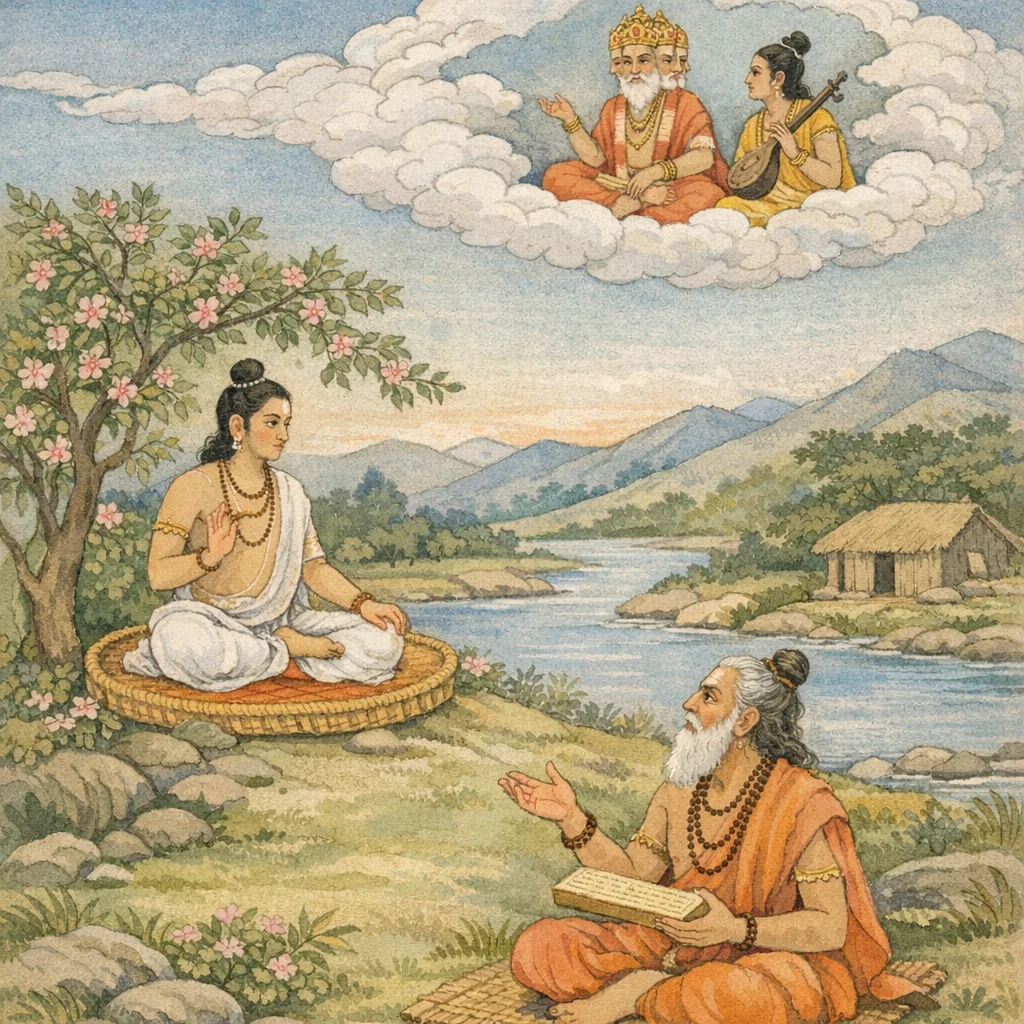
अन्धक-प्रश्नः — Inquiry into Andhaka (Genealogy and Nature)
Adhyāya 42 begins with Nārada feeling fully satisfied after hearing of Śaṅkhacūḍa’s slaying, and praising Mahādeva for His brahmaṇya conduct and His māyā-līlā that delights devotees. Brahmā then recalls that, after news of Jalaṃdhara’s death, Vyāsa questioned the Brahmā-born sage Sanatkumāra on the same theological point: Śiva’s wondrous greatness as the protector of those who take refuge and as the Lord who loves His bhaktas through many līlās. Sanatkumāra invites Vyāsa to hear an auspicious carita explaining how Andhaka, after a former great conflict, attained gaṇapatya—an office among Śiva’s gaṇas—by repeated propitiation. Vyāsa then asks formally: who is Andhaka, of what lineage, what is his nature, and whose son is he? Though he has learned much from Skanda, he seeks a complete, secret-laden account through Sanatkumāra’s grace. The chapter thus sets the inquiry-framework for Andhaka’s origin and identity, and for the devotional logic by which even formidable beings are integrated into Śiva’s order.
Shlokas
Verse 1
नारद उवाच । शंखचूडवधं श्रुत्वा चरितं शशिमौलिनः । अयं तृप्तोऽस्मि नो त्वत्तोऽमृतं पीत्वा यथा जनः
Nārada said: “Having heard the slaying of Śaṅkhacūḍa and the sacred deeds of the Moon-crested Lord (Śiva), I am satisfied—just as one is satisfied after drinking nectar from you.”
Verse 2
ब्रह्मन्यच्चरितं तस्य महेशस्य महात्मनः । मायामाश्रित्य सल्लीलां कुर्वतो भक्तमोददाम्
O Brahmin, the Brahman-blessed sacred deeds of that great-souled Mahesha: resorting to His divine Māyā, He performs auspicious līlās that bestow joy upon His devotees.
Verse 3
ब्रह्मोवाच । जलंधरवधं श्रुत्वा व्यासस्सत्यवतीसुतः । अप्राक्षीदिममेवार्थं ब्रह्मपुत्रं मुनीश्वरम्
Brahmā said: Having heard of the slaying of Jalandhara, Vyāsa—the son of Satyavatī—asked this very matter of the great sage, the son of Brahmā.
Verse 4
सनत्कुमारः प्रोवाच व्यासं सत्यवतीसुतम् । सुप्रशंस्य महेशस्य चरितं मंगलायनम्
Sanatkumāra spoke to Vyāsa, the son of Satyavatī; and, after extolling with great praise the auspicious, blessing-bestowing deeds of Maheśa (Lord Śiva), he continued his narration.
Verse 5
सनत्कुमार उवाच । शृणु व्यास महेशस्य चरितं मंगलायनम् । यथान्धको गाणपत्यं प्राप शंभोः परात्मनः
Sanatkumāra said: “Listen, O Vyāsa, to the auspicious, merit-bestowing account of Maheśa—how Andhaka obtained lordship over Śiva’s gaṇas from Śambhu, the Supreme Self.”
Verse 6
कृत्वा परमसंग्रामं तेन पूर्वं मुनीश्वर । प्रसाद्य तं महेशानं सत्त्वभावात्पुनः पुनः
O best of sages, after he had earlier waged a most formidable battle, he again and again sought to please Lord Maheśāna, propitiating Him from a pure, sāttvika disposition of heart.
Verse 7
माहात्म्यमद्भुतं शंभोश्शरणागतरक्षिणः । सुभक्तवत्सलस्यैव नानालीलाविहारिणः
Wondrous indeed is the glory of Śambhu—protector of those who take refuge in Him, ever tender toward His true devotees, and sporting in manifold divine līlās.
Verse 8
माहात्म्यमेतद्वृषभध्वजस्य श्रुत्वा मुनिर्गंधवतीसुतो हि । वचो महार्थं प्रणिपत्य भक्त्या ह्युवाच तं ब्रह्मसुतं मुनींद्रम्
Hearing this account of the glory of the Bull-bannered Lord (Śiva), the sage—son of Gaṃdhavatī—bowed down in devotion. Then, honoring the profound import of those words, he addressed that foremost of sages, the son of Brahmā.
Verse 9
व्यास उवाच । को ह्यंधको वै भगवन्मुनीश कस्यान्वये वीर्यवतः पृथिव्याम् । जातो महात्मा बलवान् प्रधानः किमात्मकः कस्य सुतोंऽधकश्च
Vyāsa said: “O blessed lord among sages, who indeed is this Andhaka? In whose lineage was this mighty one born upon the earth—this great soul, powerful and foremost? Of what nature is he, and whose son is Andhaka?”
Verse 10
एतत्समस्तं सरहस्यमद्य ब्रवीहि मे ब्रह्मसुतप्रसादात् । स्कंदान्मया वै विदितं हि सम्यक् महेशपुत्रादमितावबोधात्
Therefore, tell me today this entire matter, together with its inner secret, by the grace of Brahmā’s son. For I have indeed understood it well from Skanda—the son of Mahādeva—whose comprehension is immeasurable.
Verse 11
गाणपत्यं कथं प्राप शंभोः परमतेजसः । सोंधको धन्य एवाति यो वभूव गणेश्वरः
“How did Sondhaka attain the state of Gaṇapati through Śambhu of supreme splendor? Truly, Sondhaka alone is most blessed, for he became the Lord of the Gaṇas.”
Verse 12
ब्रह्मोवाच । व्यासस्य चैतद्वचनं निशम्य प्रोवाच स ब्रह्मसुतस्तदानीम् । महेश्वरोतीः परमाप्तलक्ष्मीस्संश्रोतुकामं जनकं शुकस्य
Brahmā said: Having heard these words of Vyāsa, the son of Brahmā spoke at that very moment to Śuka’s father, who longed to hear the sublime accounts of Maheśvara—accounts that bestow the highest fortune and spiritual attainment.
Verse 13
सनत्कुमार उवाच । पुराऽऽगतो भक्तकृपाकरोऽसौ कैलासतश्शैलसुता गणाढ्यः । विहर्तुकामः किल काशिका वै स्वशैलतो निर्जरचक्रवती
Sanatkumāra said: Formerly, Śailasutā (Pārvatī), the compassionate benefactress of devotees, came from Kailāsa, richly attended by her gaṇas. Desiring to sport, she departed her own mountain and went to Kāśikā, accompanied by a retinue of divine beings.
Verse 14
स राजधानीं च विधाय तस्यां चक्रं परोतीः सुखदा जनानाम् । तद्रक्षकं भैरवनामवीरं कृत्वा समं शैलजयाहि बह्वीः
Then he established a royal capital there and set within it a sacred protective circuit, a boon-giver to the people. Appointing as its guardian a heroic warrior named Bhairava, he—together with Śailajā (Pārvatī)—proceeded onward to many further tasks.
Verse 15
स एकदा मंदरनामधेयं गतो नगे तद्वरसुप्रभावात् । तत्रापि मानागणवीरमुख्यैश्शिवासमेतो विजहार भूरि
Once, by the excellent power of that boon, he went to the mountain famed as Mandara. There too, accompanied by Śiva and by the foremost heroic leaders of His gaṇas, he sported and enjoyed greatly.
Verse 16
पूर्वे दिशो मन्दर शैलसंस्था कपर्द्दिनश्चंडपराकमस्य । चक्रे ततो नेत्रनिमीलनं तु सा पार्वती नर्मयुतं सलीलम्
In the eastern quarter, upon Mount Mandara, Pārvatī, in gentle play and sportive delight, closed the eyes of the matted-haired Lord Śiva, whose might is fierce and irresistible.
Verse 17
प्रवालहेमाब्जधृतप्रभाभ्यां कराम्बुजाभ्यां निमिमील नेत्रे । हरस्य नेत्रेषु निमीलितेषु क्षणेन जातः सुमहांधकारः
With lotus-like hands, radiant as coral, gold, and the lotus bloom, Hara closed his eyes. The very moment the eyes of Lord Hara were shut, a vast and dreadful darkness arose in an instant.
Verse 18
तत्स्पर्शयोगाच्च महेश्वरस्य करौ च तस्याः स्खलितं मदांभः । शंभोर्ललाटे क्षणवह्नितप्तो विनिर्गतो भूरिजलस्य बिन्दुः
By the very touch of Mahādeva, an ichor-like moisture slipped from her hands. Striking Śambhu’s forehead, that drop—heated in an instant as by fire—burst forth, a single bead from an abundance of water.
Verse 19
गर्भो बभूवाथ करालवक्त्रो भयंकरः क्रोधपरः कृतघ्नः । अन्धो विरूपी जटिलश्च कृष्णो नरेतरो वैकृतिकस्सुरोमा
Then there came forth a being, as though a womb of wrath made manifest—dread-mouthed and terrifying, devoted to anger and devoid of gratitude. Blind, misshapen, matted-haired, and black of hue, he was not truly human, but a monstrous, unnatural creature, bristling with hair.
Verse 20
गायन्हसन्प्ररुदन्नृत्यमानो विलेलिहानो घरघोरघोषः । जातेन तेनाद्भुतदर्शनेन गौरीं भवोऽसौ स्मितपूर्वमाह
Singing, laughing, and then weeping, he danced on—licking his lips and roaring with a dreadful, thunderous sound. Beholding that astonishing spectacle, Lord Bhava (Śiva) first smiled and then spoke to Gaurī (Pārvatī).
Verse 21
श्रीमहेश उवाच । निमील्य नेत्राणि कृतं च कर्म बिभेषि साऽस्माद्दयिते कथं त्वम् । गौरी हरात्तद्वचनं निशम्य विहस्यमाना प्रमुमोच नेत्रे
Śrī Maheśa said: “Beloved, having closed your eyes and done that deed, why do you fear me now?” Hearing Hara’s words, Gaurī—smiling—opened her eyes.
Verse 22
जाते प्रकाशे सति घोररूपो जातोंधकारादपि नेत्रहीनः । तादृग्विधं तं च निरीक्ष्य भूतं पप्रच्छ गौरी पुरुषं महेशम्
When light arose, there appeared a being of dreadful form—born of darkness and yet bereft of eyes. Seeing such a creature, Gaurī questioned the Supreme Person, Mahēśa (Śiva), about him.
Verse 23
गौर्य्युवाच । कोयं विरूपो भगवन्हि जातो नावग्रतो घोरभयंकरश्च । वदस्व सत्यं मम किं निमित्तं सृष्टोऽथ वा केन च कस्य पुत्रः
Gaurī said: “O Lord, who is this misshapen being that has come into existence—so dreadful and fearsome in appearance? Tell me the truth: for what purpose was he created? By whom was he produced, and whose son is he?”
Verse 24
सनत्कुमार उवाच । श्रुत्वा हरस्तद्वचनं प्रियाया लीलाकरस्सृष्टिकृतोंऽधरूपाम् । लीलाकरायास्त्रिजगज्जनन्या विहस्य किंचिद्भगवानुवाच
Sanatkumāra said: Hearing the words of his beloved—she who, for the sake of divine play (līlā), had assumed a form that brought forth creation, the Mother who gives birth to the three worlds—Lord Hara smiled a little and then spoke.
Verse 25
महेश उवाच । शृण्वंबिके ह्यद्भुतवृत्तकारे उत्पन्न एषोऽद्भुतचण्डवीर्यः । निमीलिते चक्षुषि मे भवत्या स स्वेदजो मेंधकनामधेयः
Mahesha said: “Listen, O Ambikā, you who bring about wondrous turns of events. This one has arisen—marvelous and fierce in potency. When you caused my eyes to close, he was born from my sweat; his name is Meṇḍhaka.”
Verse 26
त्वं चास्य कर्तास्ययथानुरूपं त्वया ससख्या दयया गणेभ्यः । स रक्षितव्यस्त्व यि तं हि वैकं विचार्य बुद्ध्या करणीयमार्ये
“You are indeed his maker, acting in a manner befitting the situation; and through your friendship and compassion toward the Gaṇas, that one must be protected by you alone. Reflecting with clear discernment, O noble one, do what ought to be done—guard him as your very own.”
Verse 27
सनत्कुमार उवाच । गौरी ततो भृत्यवचो निशम्य कारुण्यभावात्सहिता सखीभिः । नानाप्रकारैर्बहुभिर्ह्युपायैश्चकार रक्षां स्वसुतस्य यद्वत्
Sanatkumara said: Then Gaurī, hearing the words of her attendants and moved by compassion, together with her friends, arranged protection for her own son—employing many different methods and numerous practical means, just as a mother would.
Verse 28
कालेऽथ तस्मिञ्शिशिरे प्रयातो हिरण्यनेत्रस्त्वथ पुत्रकामः । स्वज्येष्ठबंधोस्तनयप्रतानं संवीक्ष्य चासीत्प्रियया नियुक्तः
Then, in that season of winter, Hiraṇyanetra set out, longing for a son. Seeing the flourishing line of children of his elder brother, he was urged on by his beloved wife (to obtain offspring).
Verse 29
अरण्यमाश्रित्य तपश्चकारासुरस्तदा कश्यपजस्सुतार्थम् । काष्ठोपमोऽसौ जितरोषदोषस्संदर्शनार्थं तु महेश्वरस्य
Then that Asura took refuge in a forest and performed austerities for the sake of obtaining a son born of Kaśyapa. Becoming like a piece of wood—steady and unmoving—and having conquered the fault of anger, he undertook that penance solely to gain the vision (darśana) of Maheśvara.
Verse 30
तुष्टः पिनाकी तपसास्य सम्यग्वरप्रदानाय ययौ द्विजेन्द्र । तत्स्थानमासाद्य वृषध्वजोऽसौ जगाद दैत्यप्रवरं महेशः
Pleased by his rigorous austerities, Pinākī (Lord Śiva), intending to bestow a boon, went there, O best of the twice-born. Reaching that place, Mahēśa, whose banner bears the Bull, addressed that foremost among the Dāityas.
Verse 31
महेश उवाच । हे दैत्यनाथ कुरु नेन्द्रियसंघपातं किमर्थमेतद्व्रतमाश्रितं ते । प्रब्रूहि कामं वरदो भवोऽहं यदिच्छसि त्वं सकलं ददामि
Mahēśa said: “O lord of the Dāityas, do not ruin the host of your senses. For what purpose have you undertaken this vow? Tell me the desire in your heart. I am Bhava, the giver of boons—whatever you wish, I shall grant you in full.”
Verse 32
सनत्कुमार उवाच । सरस्यमाकर्ण्य महेशवाक्यं ह्यतिप्रसन्नः कनकाक्षदैत्यः । कृतांजलिर्नम्रशिरा उवाच स्तुत्या च नत्वा विविधं गिरीशम्
Sanatkumāra said: Hearing the words of Mahēśa, the Dāitya Kanakākṣa became exceedingly delighted. With folded hands and head bowed low, he spoke—having offered many kinds of salutations and hymns to Girīśa (Lord Śiva).
Verse 33
हिरण्याक्ष उवाच । पुत्रस्तु मे चन्द्रललाट नास्ति सुवीर्यवान्दैत्यकुलानुरूपी । तदर्थमेतद्व्रतमास्थितोऽहं तं देहि देवेश सुवीर्यवंतम्
Hiraṇyākṣa said: “O Moon-crested Lord, I have no son who is mighty and worthy of the Dāitya lineage. For that very purpose I have undertaken this sacred vow. Therefore, O Lord of the Devas, grant me a son endowed with great valor.”
Verse 34
यस्माच्च मद्भ्रातुरनंतवीर्याः प्रह्लादपूर्वा अपि पंचपुत्राः । ममेह नास्तीति गतान्वयोऽहं को मामकं राज्यमिदं बुभूषेत्
“Moreover, my brother had five sons of boundless prowess, beginning with Prahlāda. Yet my own lineage here is ended—there is none of mine. So who would now desire this kingdom that belongs to me?”
Verse 35
राज्यं परस्य स्वबलेन हृत्वा भुंक्तेऽथवा स्वं पितुरेव दृष्टम् । च प्रोच्यते पुत्र इह त्वमुत्र पुत्री स तेनापिभवेत्पितासौ
He who, by his own strength, seizes another’s kingdom and enjoys it—or even enjoys what is his own as viewed from the father’s standpoint—is here and hereafter called a “son.” In that same sense, a daughter too becomes, as it were, a “son,” and thus the father is accounted her father as the source of her right and lineage.
Verse 36
ऊर्द्ध्वं गतिः पुत्रवतां निरुक्ता मनीषिभिर्धर्मभृतां वरिष्ठैः । सर्वाणि भूतानि तदर्थमेवमतः प्रवर्तेत पशून् स्वतेजसः
The wise—foremost among the upholders of dharma—have declared that those who have worthy progeny attain an upward course (a higher destiny). Since all beings exist for that very purpose, therefore one should, by one’s own spiritual ardour, set the cattle and dependents upon the right path, guiding and protecting them properly.
Verse 37
निरन्वयस्याथ न संति लोकास्तदर्थमिच्छंति जनाः सुरेभ्यः । सदा समाराध्य सुरात्रिपंकजं याचंत इत्थं सुतमेकमेव
For one who has no lineage, it is said there is no lasting ‘world’—no continuity of name and station. Therefore people seek that very end from the gods. Ever worshipping the lotus-like Lord, adored by the gods, they thus pray for one thing alone: a single son.
Verse 38
सनत्कुमार उवाच । एतद्भवस्तद्वचनं निशम्य कृपाकरो दैत्यनृपस्य तुष्टः । तमाह दैत्यातप नास्ति पुत्रस्त्वद्वीर्यजः किंतु ददामि पुत्रम्
Sanatkumāra said: Hearing these words of Bhava (Lord Śiva), the Compassionate One was pleased with the king of the Dānavas. He said to him, “O Daityātapa, no son will be born from your own virility; nevertheless, I shall grant you a son.”
Verse 39
ममात्मजं त्वंधकनामधेयं त्वत्तुल्यवीर्यं त्वपराजितं च । वृणीष्व पुत्रं सकलं विहाय दुःखं प्रतीच्छस्व सुतं त्वमेव
“Accept my son, named Andhaka—one whose valour equals yours and who is unconquered. Choose him as your own child; cast away all sorrow, and receive this son—yes, you yourself, take him as yours.”
Verse 40
सनत्कुमार उवाच । इत्येवमुक्त्वा प्रददौ स तस्मै हिरण्यनेत्राय सुतं प्रसन्नः । हरस्तु गौर्य्या सहितो महात्मा भूतादिनाथस्त्रिपुरारिरुग्रः
Sanatkumāra said: Having spoken thus, he—well pleased—bestowed a son upon Hiraṇyanetra. And Hara, the great-souled Lord, accompanied by Gaurī—fierce, the primordial Master of beings, the Destroyer of Tripura—thus brought that boon to pass.
Verse 41
नतो हरात्प्राप्य सुतं स दैत्यः प्रदक्षिणीकृत्य यथाक्रमेण । स्तोत्रैरनेकैरभिपूज्य रुद्रं तुष्टस्स्वराज्यं गतवान्महात्मा
Having bowed to Hara and received his son, that Daitya then circumambulated Him in due order. Worshipping Rudra with many hymns, the great-souled one—now fully satisfied—returned to his own sovereignty.
Verse 42
ततस्तु पुत्रं गिरिशादवाप्य रसातलं चंडपराक्रमस्तु । इमां धरित्रीमनयत्स्वदेशं दैत्यो विजित्वा त्रिदशानशेषान्
Then that Daitya of fierce prowess, having obtained the son from Girīśa (Lord Śiva), went down to Rasātala. After conquering all the gods without remainder, he carried this Earth away to his own realm.
Verse 43
ततस्तु देवेर्मुनिभिश्च सिद्धैः सर्वात्मकं यज्ञमयं करालम् । वाराहमाश्रित्य वपुः प्रधानमाराधितो विष्णुरनंतवीर्यः
Then the gods—together with the sages and the Siddhas—worshipped Viṣṇu of infinite prowess, who pervades all as the very Self. Assuming his formidable, sacrifice-embodied Boar form (Varāha), he manifested the supreme body and was duly propitiated.
Verse 44
घोणाप्रहारैर्विविधैर्धरित्रीं विदार्य पातालतलं प्रविश्य । तुंडेन दैत्याञ्शतशो विचूर्ण्य दंष्ट्राभिरग्र्याभि अखंडिताभिः
With manifold blows of his snout, he tore open the earth and plunged into the realm of Pātāla. There, with his beak he crushed hundreds of Daityas to dust, and with his foremost, unbroken tusks he shattered them again and again.
Verse 45
पादप्रहारैरशनिप्रकाशैरुन्मथ्य सैन्यानि निशाचराणाम् । मार्तंडकोटिप्रतिमेन पश्चात्सुदर्शनेनाद्भुतचंडतेजाः
With foot-strikes flashing like thunderbolts, he churned and shattered the armies of the night-roamers; then, with the Sudarśana discus—whose wondrous, fierce radiance was like ten million suns—he struck them down.
Verse 46
हिरण्यनेत्रस्य शिरो ज्वलंतं चिच्छेद दैत्यांश्च ददाह दुष्टान् । ततः प्रहृष्टो दितिजेन्द्रराजं स्वमंधकं तत्र स चाभ्यषिंचत्
He severed the blazing head of Hiraṇyanetra and burned the wicked Daityas. Then, rejoicing, he performed the consecration and enthroned his own Andhaka there as king of the Daityas.
Verse 47
स्वस्थानमागत्य ततो धरित्रीं दृष्ट्वांकुरेणोद्धरतः प्रहृष्टः । भूमिं च पातालतलान्महात्मा पुपोष भागं त्वथ पूर्वकं तु
Returning to his own abode and seeing the Earth raised up by the sprout, the great-souled one rejoiced. Then, lifting the Earth from the levels of Pātāla, he nourished and restored her, setting her portion again as it had been before.
Verse 48
देवैस्समस्तैर्मुनिभिःप्रहृष्टै रभिषुतः पद्मभुवा च तेन । ययौ स्वलोकं हरिरुग्रकायो वराहरूपस्तु सुकार्यकर्ता
Praised with joyful hymns by all the gods and sages, and duly consecrated by Padmabhū (Brahmā), Hari—terrible in the form of Varāha—having accomplished the noble task, departed to his own celestial realm.
Verse 49
हिरण्यनेत्रेऽथ हतेऽसुरेशे वराहरूपेण सुरेण देवाः । देवास्समस्ता मुनयश्च सर्वे परे च जीवास्सुखिनो बभूवुः
When Hiraṇyanetra, the lord of the asuras, was slain by the divine one who assumed the form of the Boar (Varāha), all the gods, all the sages, and the other beings as well became happy and at peace.
Frequently Asked Questions
The chapter primarily frames the transition from earlier slayings (Śaṅkhacūḍa, Jalaṃdhara) to the Andhaka cycle by introducing Vyāsa’s formal inquiry into Andhaka’s origin and status.
It emphasizes ‘rahasya’ as devotional epistemology: true understanding of Śiva’s līlā and governance is accessed through guru/sage-prasāda and reverent listening, not mere narrative curiosity.
Śiva is highlighted through epithets—Śaśimauli, Vṛṣabhadhvaja, Śambhu, Maheśa—stressing his auspiciousness, sovereignty, and role as protector and delight of devotees.