संध्यायाः शुद्धिः सूर्यलोकप्रवेशश्च — Purification of Sandhyā and Her Entry into the Solar Sphere
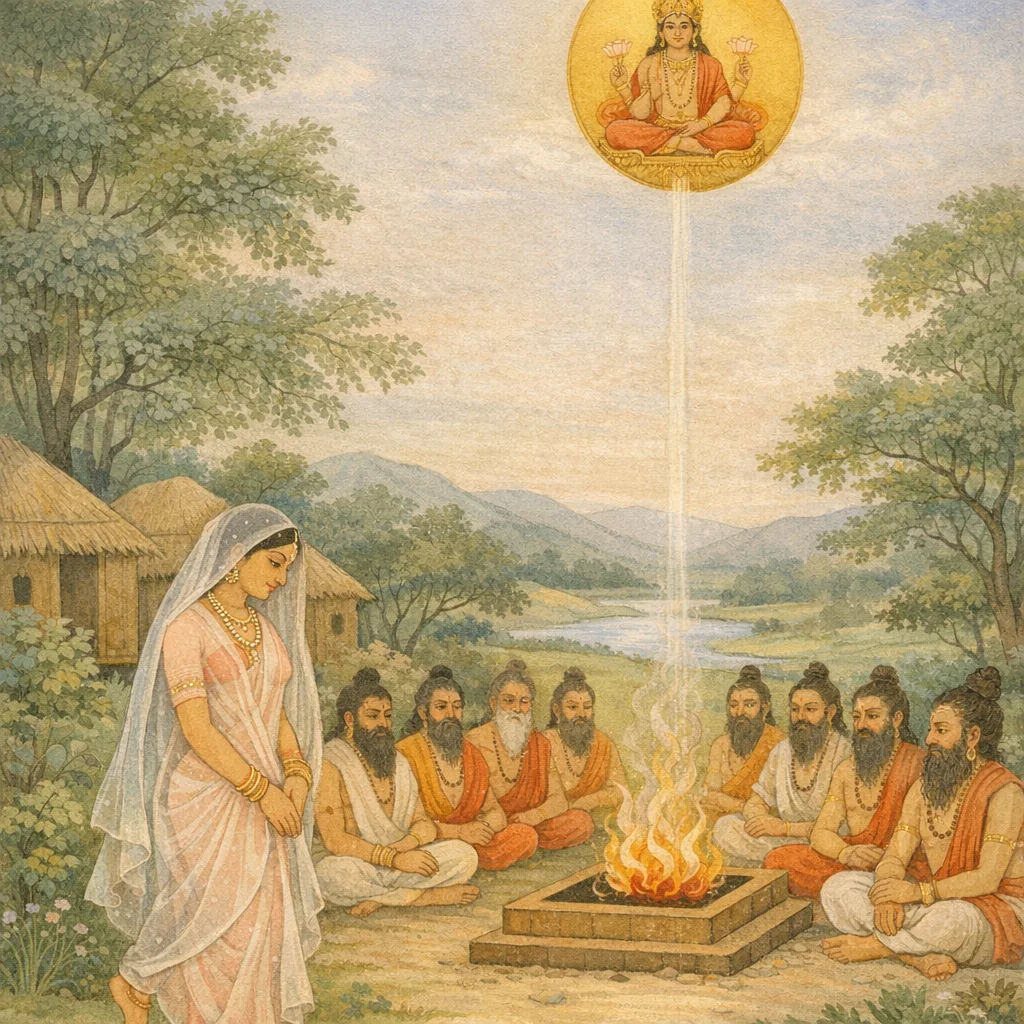
Adhyāya 7 narrates a closely linked sequence: Brahmā, after granting a boon to a muni, departs for the place where Medhātithi dwells. By Śambhu’s (Śiva’s) grace, Sandhyā remains unrecognized by others, yet she remembers the brāhmaṇa-brahmacārin who instructed her in tapas—an instruction traced to Vasiṣṭha acting under the command of Parameṣṭhin (Brahmā). Holding that teacher in mind, Sandhyā adopts a spousal orientation (patitva) toward the brahmacārin, revealing an overlap of ritual discipline, social role, and inner intention. During a great yajña with kindled fire, she again enters the sacrificial sphere unnoticed by the assembled munis, perceived only through Śiva’s favor. Her body, said to be “made of puroḍāśa,” is instantly burned; the fire consumes it and, by Śiva’s command, carries the purified remainder into the solar orb (sūryamaṇḍala). The Sun then divides the transformed body into three portions for the satisfaction of pitṛs and devas: the upper portion becomes the morning Sandhyā within the order of day and night, and the chapter continues to systematize Sandhyā’s tripartite manifestation and its cosmological-ritual meaning.
Shlokas
Verse 1
ब्रह्मोवाच । वरं दत्त्वा मुने तस्मिन् शंभावंतर्हिते तदा । संध्याप्यगच्छत्तत्रैव यत्र मेधातिथिर्मुनिः
Brahmā said: After granting that boon to the sage, when Lord Śambhu had disappeared from sight, the sage went to perform his sandhyā-vandana (twilight worship) and proceeded to that very place where the muni Medhātithi was.
Verse 2
तत्र शंभोः प्रसादेन न केनाप्युपलक्षिता । सस्मार वर्णिनं तं वै स्वोपदेशकरं तपः
There, by Śambhu’s grace, she was not noticed by anyone at all. Then she remembered that ascetic brāhmacārin—the one who had given her personal instruction in tapas (austerity).
Verse 3
वसिष्ठेन पुरा सा तु वर्णीभूत्वा महामुने । उपदिष्टा तपश्चर्तुं वचनात्परमेष्ठिनः
O great sage, in former times she became a brahmacāriṇī, a maiden devoted to sacred discipline. At the command of Parameṣṭhin (Brahmā), Vasiṣṭha instructed her to undertake austerities (tapas).
Verse 4
तमेव कृत्वा मनसा तपश्चर्योपदेशकम् । पतित्वेन तदा संध्या ब्राह्मणं ब्रह्मचारिणम्
Then Saṃdhyā, fixing her mind on him alone as the instructor of austerity, accepted that brahmin celibate (brahmacārin) as her husband.
Verse 5
समिद्धेग्नौ महायज्ञे मुनिभिर्नोपलक्षिता । दृष्टा शंभुप्रसादेन सा विवेश विधेः सुता
In that great sacrifice, when the fire was fully kindled, the daughter of Brahmā entered the blaze unnoticed by the sages; yet, by Śambhu’s grace, she was truly beheld in her inner reality and divine passage.
Verse 6
तस्याः पुरोडाशमयं शरीरं तत्क्षणात्ततः । दग्धं पुरोडाशगंधं तस्तार यदलक्षितम्
At that very instant, her body—made (as it were) of the sacrificial puroḍāśa—was burned. A fragrance like that of roasted puroḍāśa spread everywhere, though its source could not be perceived.
Verse 7
वह्निस्तस्याः शरीरं तु दग्ध्वा सूर्यस्य मंडलम् । शुद्धं प्रवेशयामास शंभोरेवाज्ञया पुनः
Having burned her body, Agni—again, by Śambhu’s very command—caused the purified essence to enter the orb of the Sun.
Verse 8
सूर्यो त्र्यर्थं विभज्याथ तच्छरीरं तदा रथे । स्वकेशं स्थापयामास प्रीतये पितृदेवयोः
Then the Sun-god divided that body into three portions and set them upon the chariot; and he placed his own hair there, for the satisfaction of the Pitṛs (ancestors) and the Devas.
Verse 9
तदूर्द्ध्वभागस्तस्यास्तु शरीरस्य मुनीश्वर । प्रातस्संध्याभवत्सा तु अहोरात्रादिमध्यगा
O lord of sages, the upper portion of her body became the Morning Sandhyā (dawn-twilight), that sacred junction which stands at the beginning of day and night and at their midway meeting-point.
Verse 10
तच्छेषभागस्तस्यास्तु अहोरात्रांतमध्यगा । सा सायमभवत्संध्या पितृप्रीतिप्रदा सदा
That remaining portion became the twilight at the junction of day and night. It manifested as the evening Sandhyā, ever bestowing satisfaction and delight upon the Pitṛs (ancestral spirits).
Verse 11
सूर्योदयात्तु प्रथमं यदा स्यादरुणोदयः । प्रातस्संध्या तदोदेति देवानां प्रीतिकारिणी
Just before sunrise, when the first glow of dawn (aruṇodaya) appears, the Morning Sandhyā arises then—an observance that brings delight and satisfaction to the gods.
Verse 12
अस्तं गते ततः सूर्य्ये शोणपद्मनिभे सदा । उदेति सायं संध्यापि पितॄणां मोदकारिणी
When the sun—ever like a red lotus—has set, the evening twilight (sandhyā) arises; it becomes a source of gladness for the Pitṛs (ancestral spirits).
Verse 13
तस्याः प्राणास्तु मनसा शंभुनाथ दयालुना । दिव्येन तु शरीरेण चक्रिरे हि शरीरिणः
Then, out of compassion, Lord Śambhunātha (Śiva) willed it in His mind, and her life-breath returned; indeed, the embodied one was restored with a divine body.
Verse 14
मुनेर्यज्ञावसाने तु संप्राप्ते मुनिना तु सा । प्राप्ता पुत्री वह्निमध्ये तप्तकांचनसुप्रभा
When the sage’s sacrifice had reached its conclusion, that sage received her as a daughter—she appeared from within the sacrificial fire, radiant with the splendor of molten gold.
Verse 15
तां जग्राह तदा पुत्रीं मुनुरामोदसंयुतः । यज्ञार्थं तान्तु संस्नाप्य निजक्रोडे दधौ मुने
Then the sage, filled with joy, took that daughter into his arms. Having bathed her for the sake of the sacrificial rite, O sage, he placed her upon his own lap.
Verse 16
अरुंधती तु तस्यास्तु नाम चक्रे महामुनिः । शिष्यैः परिवृतस्तत्र महामोदमवाप ह
Then the great sage bestowed upon her the name “Arundhatī.” Surrounded there by his disciples, he experienced profound joy.
Verse 17
विरुणद्धि यतो धर्मं सा कस्मादपि कारणात् । अतस्त्रिलोके विदितं नाम संप्राप तत्स्वयम्
Because, for some reason, she checked the course of dharma, she thereby herself came to bear a name that became renowned throughout the three worlds.
Verse 18
यज्ञं समाप्य स मुनिः कृतकृत्यभावमासाद्य संपदयुतस्तनया प्रलंभात् । तस्मिन्निजाश्रमपदे सह शिष्यवर्गैस्तामेव सततमसौ दयिते सुरर्षे
Having completed the yajña, that sage—feeling his duty wholly fulfilled—became prosperous; and, through the persistent urging of his daughter Satī. Then, in his own hermitage, together with his circle of disciples, he continually attended upon her alone, O beloved listener, best among gods and seers.
Verse 19
अथ सा ववृधे देवी तस्मिन्मुनिवराश्रमे । चन्द्रभागानदीतीरे तापसारण्यसंज्ञके
Thereafter, the Goddess grew and flourished in that excellent sage’s hermitage, on the bank of the river Candrabhāgā, in the forest renowned as Tāpasāraṇya—the woodland of ascetics.
Verse 20
संप्राप्ते पञ्चमे वर्षे चन्द्रभागां तदा गुणैः । तापसारण्यमपि सा पवित्रमकरोत्सती
When the fifth year arrived, Satī—by her own noble virtues—made the river Candrabhāgā, and even the forest hermitage of the ascetics, become holy and sanctified.
Verse 21
विवाहं कारयामासुस्तस्या ब्रह्मसुतेन वै । वसिष्ठेन ह्यरुंधत्या ब्रह्मविष्णुमहेश्वराः
Brahmā, Viṣṇu, and Maheśvara had her marriage duly solemnized indeed through Vasiṣṭha—the son of Brahmā—together with Arundhatī.
Verse 22
तद्विवाहे महोत्साहो वभूव सुखवर्द्धनः । सर्वे सुराश्च मुनयस्सुखमापुः परं मुनो
At that wedding celebration, a great festivity arose, increasing joy. All the gods and the sages attained supreme happiness, O sage.
Verse 23
ब्रह्मविष्णुमहेशानां करनिस्सृततोयतः । सप्तनद्यस्समुत्पन्नाश्शिप्राद्यास्सुपवित्रकाः
From the water that flowed forth from the hands of Brahmā, Viṣṇu, and Maheśa, the seven sacred rivers arose—beginning with the Shiprā—exceedingly purifying to all beings.
Verse 24
अरुंधती महासाध्वी साध्वीनां प्रवरोत्तमा । वसिष्ठं प्राप्य संरेजे मेधातिथिसुता मुने
O sage, Arundhatī—most virtuous, the foremost among chaste women—having attained Vasiṣṭha, shone in blessed union; she was the daughter of Medhātithi.
Verse 25
यस्याः पुत्रास्समुत्पन्नाः श्रेष्ठाश्शक्त्यादयश्शुभाः । वसिष्ठं प्राप्य तं कांतं संरेजे मुनिसत्तमाः
From her were born noble and auspicious sons—foremost among them Śakti and the rest. Having attained Vasiṣṭha, her beloved, she delighted in him; thus, O best of sages, she lived rejoicing.
Verse 26
एवं संध्याचरित्रं ते कथितं मुनिसत्तम । पवित्रं पावनं दिव्यं सर्वकामफलप्रदम्
Thus, O best of sages, the sacred account of Sandhyā-worship has been told to you—pure, purifying, and divine—bestowing the fruits of all rightful aspirations. From the Śaiva standpoint, such disciplined worship becomes a means of inner purification (śuddhi) and devotion (bhakti) that supports the soul’s approach to Pati (Śiva).
Verse 27
य इदं शृणुयान्नारी पुरुषो वा शुभव्रतः । सर्वान्कामानवाप्नोति नात्र कार्या विचारणा
Any woman or man of auspicious conduct who listens to this attains all desired aims; of this there is no need for doubt or further deliberation.
Frequently Asked Questions
Sandhyā—by Śiva’s grace—enters the great yajña unnoticed, her ‘puroḍāśa-like’ body is burned by Agni, and she is conveyed into the Sun’s orb where her form is divided into three ritual-temporal functions.
Agni functions as a purifier and transformer, while the solar sphere represents cosmic ordering and illumination; together they encode the doctrine that divine command (Śiva’s ājñā) converts embodied/ritual substance into universal temporal-spiritual regulation.
A tripartite division associated with Sandhyā’s three temporal stations; the sample explicitly notes the upper portion becoming prātaḥ-sandhyā (morning twilight), with the chapter continuing to formalize the remaining portions.