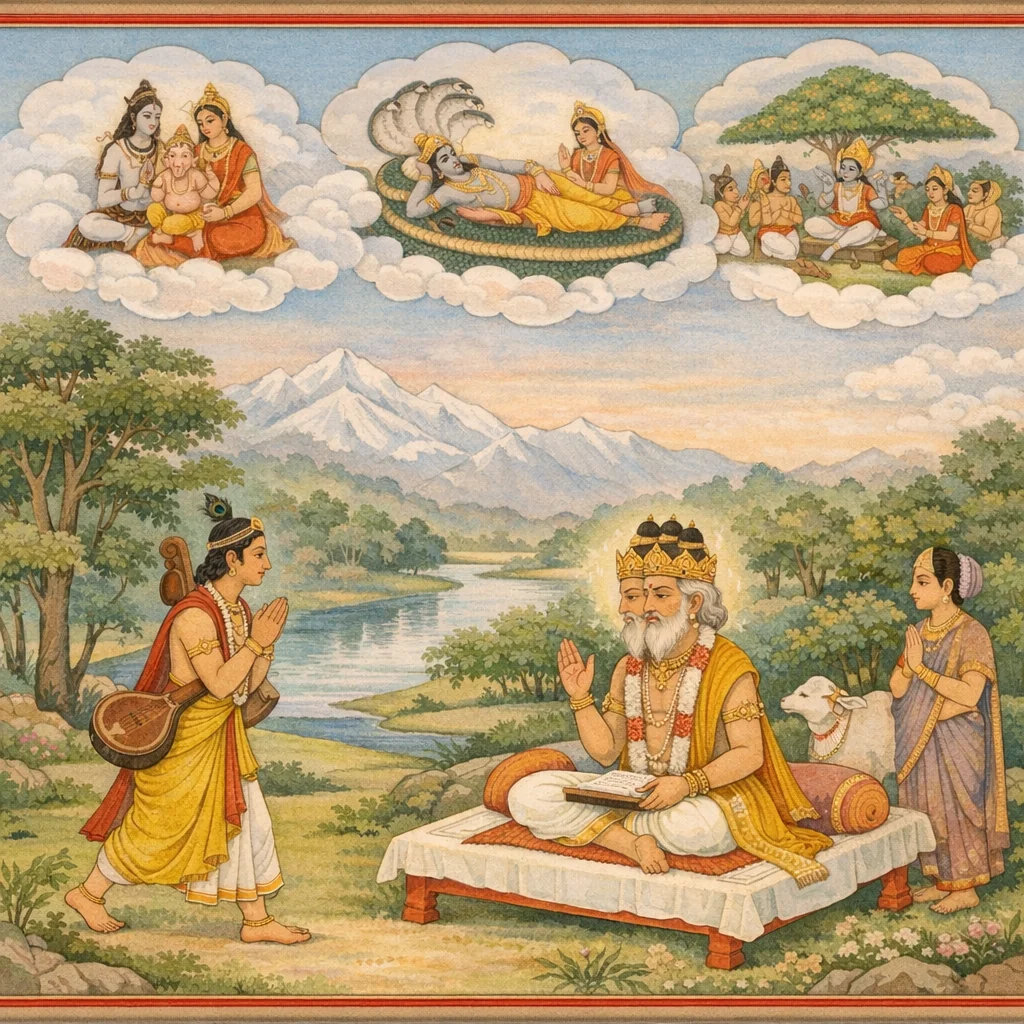
तारकासुर-पूर्ववृत्त-प्रश्नः (Questions on Tārakāsura and Śivā’s tapas) / “Inquiry into Tārakāsura’s origin and Śivā–Śiva narrative”
Adhyāya 14 begins a didactic dialogue in which Nārada asks Brahmā for a precise, complete account of: who Tārakāsura is and how he oppressed the devas; how Śaṅkara burned Kāma (Smara) to ashes; and how Śivā, though the primordial Ādiśakti, performed intense tapas and attained Śambhu as her husband. Brahmā answers by setting these questions within a cosmic genealogy: from Marīci → Kaśyapa and Kaśyapa’s wives (especially Diti) arise Hiraṇyakaśipu and Hiraṇyākṣa. Viṣṇu destroys them as Narasiṃha and Varāha, restoring divine security, yet the tale serves as a prelude to the later asuric menace of Tāraka and the need for Śiva–Śivā’s salvific intervention to reassert dharma.
Shlokas
Verse 1
नारद उवाच । विष्णुशिष्य महाशैव सम्यगुक्तं त्वया विधे । चरितं परमं ह्येतच्छिवायाश्च शिवस्य च
Nārada said: O disciple of Viṣṇu, O great devotee of Śiva, O Vidhi (Brahmā), what you have spoken is indeed correct. This is the supreme sacred account—of Śivā (Pārvatī) and of Śiva.
Verse 2
कस्तारकासुरो ब्रह्मन्येन देवाः प्रपीडिताः । कस्य पुत्रस्य वै ब्रूहि तत्कथां च शिवाश्रयाम्
O Brahman, who is this demon Tārakāsura by whom the Devas have been grievously oppressed? Tell us, indeed, whose son he is—and also relate that account which takes refuge in Śiva (i.e., whose resolution and meaning depend upon Lord Śiva).
Verse 3
भस्मी चकार स कथं शंकरश्च स्मरं वशी । तदपि ब्रूहि सुप्रीत्याद्भुतं तच्चरितं विभोः
How did Śaṅkara—the self-restrained Lord—reduce Smara (Kāmadeva) to ashes? Tell us also, with deep affection, of that wondrous deed and divine episode of the all-pervading Lord.
Verse 4
कथं शिवा तपोऽत्युग्रं चकार सुखहेतवे । कथं प्राप पतिं शंभुमादिशक्तिर्जगत्परा
How did Śivā (Pārvatī) undertake exceedingly intense austerities for the sake of true blessedness? And how did that Supreme Ādi-Śakti, transcending the world, attain Śambhu as her Lord?
Verse 5
एतत्सर्वमशेषेण विशेषेण महाबुध । ब्रूहि मे श्रद्दधानाय स्वपुत्राय शिवात्मने
O great sage, tell me all this in full, leaving nothing out, and with special detail—tell it to me, full of faith, as to your own son, whose very self is devoted to Śiva.
Verse 6
ब्रह्मोवाच पुत्रवर्य महाप्राज्ञ सुरर्षे शंसितव्रतः । वच्म्यहं शंकरं स्मृत्वा सर्वं तच्चरितं शृणु
Brahmā said: “O best of sons, O greatly wise one, O divine seer of praised vows—remembering Śaṅkara, I shall recount in full His sacred conduct and story. Listen.”
Verse 7
प्रथमं तारकस्यैव भवं संशृणु नारद । यद्वधार्थं महा यत्नः कृतो दैवैश्शिवाश्रयैः
First, O Nārada, listen to the very origin and rise of Tāraka; for the sake of his destruction, the gods—taking refuge in Śiva—undertook a great effort.
Verse 8
मम पुत्रो मरीचिर्यः कश्यपस्तस्य चात्मजः । त्रयोदशमितास्तस्य स्त्रियो दक्षसुताश्च याः
“My son is Marīci, and Kaśyapa is his son. Kaśyapa’s wives are said to be thirteen in number—those who are the daughters of Dakṣa.”
Verse 9
दितिर्ज्येष्ठा च तत्स्त्री हि सुषुवे सा सुतद्वयम् । हिरण्यकशिपुर्ज्येष्ठो हिरण्याक्षोऽनुजस्ततः
“Diti, the elder wife of Kaśyapa, indeed gave birth to two sons. Of them, Hiraṇyakaśipu was the elder, and thereafter Hiraṇyākṣa was born as the younger.”
Verse 10
तौ हतौ विष्णुना दैत्यौ नृसिंहक्रोडरूपतः । सुदुःखदौ ततो देवाः सुखमापुश्च निर्भयाः
“Those two demons were slain by Viṣṇu, who assumed the forms of Narasiṁha and Varāha. When the two great causers of suffering were destroyed, the gods thereafter attained happiness and became free from fear.”
Verse 11
दितिश्च दुःखितासीत्सा कश्यपं शरणं गता । पुनस्संसेव्य तं भक्त्या गर्भमाधत्त सुव्रता
“Diti, afflicted with sorrow, sought refuge in Kaśyapa. Serving him again with devotion, that virtuous lady conceived a child.”
Verse 12
तद्विज्ञाय महेंद्रोऽपि लब्धच्छिद्रो महोद्यमी । तद्गर्भं व्यच्छिनत्तत्र प्रविश्य पविना मुहुः
Realizing this, Mahendra (Indra) too—having found an opening and being greatly determined—repeatedly entered there and, with his thunderbolt, cut apart the embryo within.
Verse 13
तद्व्रतस्य प्रभावेण न तद्गर्भो ममार ह । स्वपंत्या दैवयोगेन सप्त सप्ताभवन्सुताः
By the power of that sacred vow, her pregnancy did not perish. And, by divine ordinance, while she slept, seven sons were born—seven in number.
Verse 14
इति श्रीशिवमहापुराणे द्वितीयायां रुद्रसंहितायां तृतीये पार्वतीखण्डे तारकोत्पत्तौ वज्रांगोत्पत्तितपोवर्णनं नाम चतुर्दशोऽध्यायः
Thus, in the Śrī Śiva Mahāpurāṇa—within the Second Book, the Rudra Saṃhitā, and in the Third section, the Pārvatī-khaṇḍa—ends the Fourteenth Chapter, entitled “The account of Tāraka’s birth and the description of the austerities performed by Vajrāṅga.”
Verse 15
पुनर्दितिः पतिं भेजेऽनुतप्ता निजकर्मतः । चकार सुप्रसन्नं तं मुनिं परमसेवया ऽ
Thereafter Diti, repentant because of her own past deed, again approached her husband. By devoted and excellent service, she made that sage exceedingly pleased.
Verse 16
कश्यप उवाच । तपः कुरु शुचिर्भूत्वा ब्रह्मणश्चायुतं समाः । चेद्भविष्यति तत्पूर्वं भविता ते सुतस्तदा
Kaśyapa said: “Perform austerity, becoming pure, for ten thousand years by Brahmā’s measure. If that is fulfilled first, then indeed a son will be born to you.”
Verse 17
तथा दित्या कृतं पूर्णं तत्तपश्श्रद्धया मुने । ततः पत्युः प्राप्य गर्भं सुषुवे तादृशं सुतम्
Thus, O sage, Diti completed that austerity with steadfast faith. Thereafter, having conceived through her husband, she gave birth to a son of that very nature, in accord with the power and intent of her tapas.
Verse 18
वजांगनामा सोऽभूद्वै दितिपुत्रोऽमरोपमः । नामतुल्यतनुर्वीरस्सुप्रताप्युद्भवाद्बली
Indeed, there arose Diti’s son named Vajāṅga, godlike in splendor. A heroic warrior whose body befitted his very name, he was exceedingly mighty and powerful from the moment of his birth.
Verse 19
जननीशासनात्सद्यस्स सुतो निर्जराधिपम् । बलाद्धृत्वा ददौ दंडं विविधं निर्जरानपि
At his mother’s command, that son at once seized the lord of the gods by force and inflicted varied punishments—even upon the other deities as well.
Verse 20
दितिस्सुखमतीवाप दृष्ट्वा शक्रादिदुर्दशाम् । अमरा अपि शक्राद्या जग्मुर्दुःखं स्वकर्मतः
Seeing the grievous plight of Indra and the other gods, Diti became exceedingly pleased; yet even the immortals—Indra and the rest—fell into suffering as the consequence of their own deeds.
Verse 21
तदाहं कश्यपेनाशु तत्रागत्य सुसामगीः । देवानत्याजयंस्तस्मात्सदा देवहिते रतः
Then I, swiftly arriving there with Kaśyapa and with all the proper sacred requisites well prepared, made the Devas victorious. Therefore I remain ever devoted to the welfare of the gods.
Verse 22
देवान्मुक्त्वा स वज्रांगस्ततः प्रोवाच सादरम् । शिवभक्तोऽतिशुद्धात्मा निर्विकारः प्रसन्नधीः
Released by the gods, Vajrāṅga then spoke with reverence—he was a devotee of Śiva, of exceedingly pure soul, free from inner agitation, and of serene understanding.
Verse 23
वज्रांग उवाच । इंद्रो दुष्टः प्रजाघाती मातुर्मे स्वार्थसाधकः । स फलं प्राप्तवानद्य स्वराज्यं हि करोतु सः
Vajrāṅga said: “Indra is wicked, a slayer of beings, and one who pursues his own ends even at the cost of my mother. Today he has obtained the fruit of his deeds; let him indeed rule his own kingdom.”
Verse 24
मातुराज्ञावशाद्ब्रह्मन्कृतमेतन्मयाखिलम् । न मे भोगाभिलाषो वै कस्यचि द्भुवनस्य हि
O Brahman, all this has been done by me only under the command of my mother. Truly, I have no desire at all for worldly enjoyments in any realm.
Verse 25
तत्त्वसारं विधे सूत मह्यं वेदविदाम्वर । येन स्यां सुसुखी नित्यं निर्विकारः प्रसन्नधीः
O Sūta—foremost among the knowers of the Vedas—please teach me the essential truth, by which I may become ever well-contented, free from inner modifications, and endowed with a clear and tranquil understanding.
Verse 26
तच्छ्रुत्वाहं मुनेऽवोचं सात्त्विको भाव उच्यत । तत्त्वसार इति प्रीत्या सृजाम्येकां वरां स्त्रियम्
Hearing that, O sage, I spoke: “This is called a sāttvika disposition. Out of affection, I shall create a single excellent woman, named Tattvasārā—the very essence of truth.”
Verse 27
वरांगीं नाम तां दत्त्वा तस्मै दितिसुताय वै । अयां स्वधाम सुप्रीतः कश्यपस्तत्पितापि च
Having given her—named Varāṅgī—to that son of Diti, Kaśyapa, her father as well, being highly pleased, went back to his own abode.
Verse 28
ततो दैत्यस्य वज्रांगस्सात्विकं भावमाश्रितः । आसुरं भावमुत्सृज्य निर्वैरस्सुखमाप्तवान्
Thereupon Vajrāṅga, the daitya, took refuge in a sāttvika disposition. Abandoning the asuric temper, he became free from enmity and attained peace and happiness.
Verse 29
न बभूव वरांग्या हि हृदि भावोथ सात्विकः । सकामा स्वपतिं भेजे श्रद्धया विविधं सती
In that noble woman’s heart, no truly sāttvika resolve arose. Still driven by desire, the virtuous lady approached her own husband with many forms of faith and devotion.
Verse 30
अथ तत्सेवनादाशु संतुष्टोऽभून्महाप्रभुः । स वज्रांगः पतिस्तस्या उवाच वचनं तदा
Then, by that devoted service, the Great Lord was quickly pleased. Thereupon Vajrāṅga, her husband, spoke these words to her.
Verse 31
वज्रांग उवाच । किमिच्छसि प्रिये ब्रूहि किं ते मनसि वर्तते । तच्छुत्वानम्य तं प्राह सा पतिं स्वमनोरथम्
Vajrāṅga said: “Beloved, tell me—what do you desire? What dwells in your mind?” Hearing this, she bowed in reverence and then spoke to her husband of the heartfelt wish within her.
Verse 32
वरांग्युवाच । चेत् प्रसन्नोऽभवस्त्वं वै सुतं मे देहि सत्पते । महाबलं त्रिलोकस्य जेतारं हरिदुःखदम्
The noble lady (Pārvatī) said: “If you have truly become gracious, O virtuous Lord, then grant me a son—of great strength, a conqueror of the three worlds, and a remover of Hari’s (Viṣṇu’s) sorrow.”
Verse 33
ब्रह्मोवाच । इति श्रुत्वा प्रियावाक्यं विस्मितोऽभूत्स आकुलः । उवाच हृदि स ज्ञानी सात्विको वैरवर्जितः
Brahmā said: Hearing those pleasing words, he was astonished and inwardly stirred. That wise one—sattvic in nature and free from enmity—then spoke from his heart.
Verse 34
प्रियेच्छति विरोधं वै सुरैर्मे न हि रोचते । किं कुर्यां हि क्व गच्छेयं कथं नश्ये न मे पणः
“My beloved seeks a quarrel with the gods, but such hostility does not please me. What should I do? Where should I go? How could I even perish—when my resolve (my stake) must not be lost?”
Verse 35
प्रियामनोरथश्चैव पूर्णस्स्यात्त्रिजगद्भवेत् । क्लेशयुङ्नितरा भूयो देवाश्च मुनयस्तथा
Then the beloved wish would indeed be fulfilled, and welfare would arise for the three worlds. Otherwise, the gods and the sages would again be burdened with even greater affliction.
Verse 36
न पूर्णस्स्यात्प्रियाकामस्तदा मे नरको भवेत् । द्विधापि धर्महानिर्वै भवतीत्यनुशुश्रुवान्
“If my beloved’s wish is not fulfilled, then for me it would be hell. And if I act in either of the two ways, indeed there would be a loss of dharma”—so he reflected, having thus heard and understood.
Verse 37
वज्रांग इत्थं बभ्राम स मुने धर्मसंकटे । बलाबलं द्वयोस्तत्र विचिचिंत च बुद्धितः
Thus, O sage, Vajrāṅga wandered amid a crisis of dharma; and there, with discerning intellect, he reflected upon the strength and weakness of both sides.
Verse 38
शिवेच्छया स हि मुने वाक्यं मेने स्त्रियो बुधः । तथास्त्विति वचः प्राह प्रियां प्रति स दैत्यराट्
O sage, by Śiva’s will that wise lord of the Daityas accepted the woman’s words as true; and saying, “So be it,” he spoke thus to his beloved.
Verse 39
तदर्थमकरोत्तीव्रं तपोन्यद्दुष्करं स तु । मां समुद्दिश्य सुप्रीत्या बहुवर्षं जितेंद्रियः
For that purpose, he indeed undertook an intense and otherwise difficult austerity—directing it toward me with loving devotion—and for many years he remained self-controlled, having conquered his senses.
Verse 40
वरं दातुमगां तस्मै दृष्ट्वाहं तत्तपो महत् । वरं ब्रूहि ह्यवोचं तं सुप्रसन्नेन चेतसा
Seeing the greatness of that austerity, I went to grant him a boon. With a heart fully pleased, I said to him: “Speak—choose a boon.”
Verse 41
वज्रांगस्तु तदा प्रीतं मां दृष्ट्वा स्थितं विभुम् । सुप्रणम्य बहुस्तुत्वा वरं वव्रे प्रियाहितम्
Then Vajrāṅga, delighted on beholding Me—the all-pervading Lord—standing there, bowed down deeply and praised Me at length. After that, seeking what would be truly beneficial and dear, he chose a boon.
Verse 42
वज्रांग उवाच । सुतं देहि स्वमातुर्मे महाहितकरं प्रभो । महाबलं सुप्रतापं सुसमर्थं तपोनिधिम्
Vajrāṅga said: “O Lord, grant my mother a son—one who will bring her great welfare: mighty in strength, radiant in valor, fully capable, and a treasury of austerity (tapas).”
Verse 43
ब्रह्मोवाच । इत्याकर्ण्य च तद्वाक्यं तथास्त्वित्यब्रवं मुने । अया स्वधाम तद्दत्त्वा विमनास्सस्मरच्छिवम्
Brahmā said: “O sage, having heard those words, I replied, ‘So be it.’ Then, sending her back to her own abode and granting what was asked, I remained downcast and remembered Lord Śiva.”
Frequently Asked Questions
It prepares the Tārakāsura cycle by asking who Tāraka is and why devas suffer, then begins the causal prehistory through Kaśyapa’s lineage and the earlier daitya figures whose defeat frames later asuric resurgence.
It models tapas as cosmic principle: even primordial power is narrated as adopting discipline and vow to manifest divine order in time, making spiritual practice the bridge between transcendent reality and historical restoration.
Viṣṇu’s Narasiṃha and Varāha forms are cited as slayers of Hiraṇyakaśipu and Hiraṇyākṣa, while Śiva’s act of burning Smara (Kāma) is flagged as a key event to be explained.