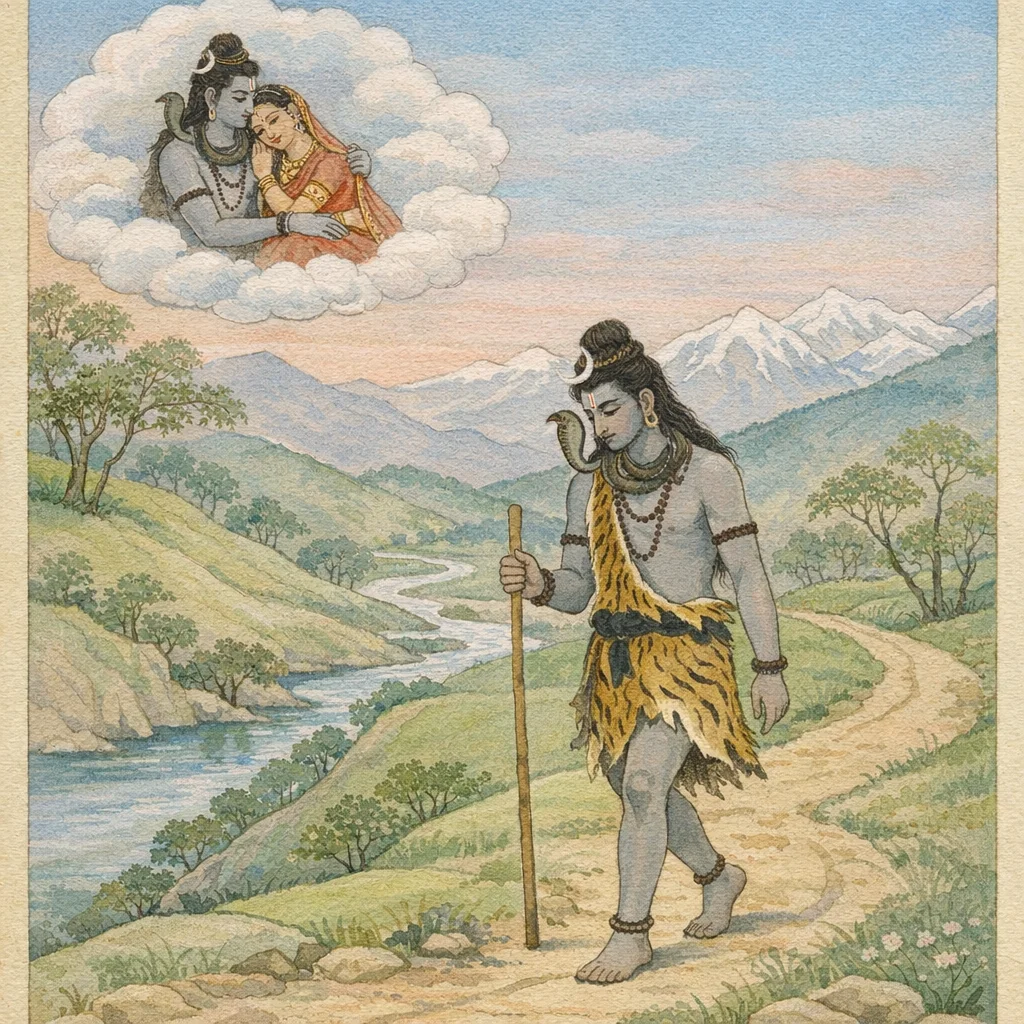
सतीविरहानन्तरं शम्भोश्चरितम् / Śiva’s Conduct After Satī’s Separation
Adhyāya 10 is cast as a question–answer teaching: Nārada asks Brahmā (Vidhi) to recount Śiva’s līlā and conduct after Satī’s departure—how he endured the pain of separation, what he did thereafter, when and why he moved toward the Himavat region for tapas (austerities), and how the conditions were set for Pārvatī to attain Śiva. Brahmā replies with an auspicious, purifying narrative meant to increase bhakti. The chapter portrays Śiva’s sorrowful remembrance of Satī, his turn to renunciation (digambara, abandoning the householder’s way), his wandering through the worlds with occasional darśana, and his eventual return to the mountain realm. Serving as a narrative hinge, it interprets divine grief as yogic detachment and prepares the ground for Pārvatī’s tapas, the waning of Kāma-related motifs (kāmakṣaya), and the theology of reunion.
Shlokas
Verse 1
नारद उवाच । विष्णुशिष्य महाभाग विधे शैववर प्रभो । शिवलीलामिमां व्यासात्प्रीत्या मे वक्तुमर्हसि
Nārada said: “O noble one, disciple of Viṣṇu—O venerable Brahmā, best among the devotees of Śiva! Out of affection, please be gracious to tell me this divine play of Śiva, just as you heard it from Vyāsa.”
Verse 2
सतीविरहयुक्शंम्भुः किं चक्रे चरितन्तथा । तपः कर्तुं कदायातो हिमवत्प्रस्थमुत्तमम्
Bound to the sorrow of separation from Satī, what did Śambhu do then, and how did he live? And when did he go to the most excellent heights of Himavān to undertake tapas, the holy austerity?
Verse 3
शिवाशिवशिवादो ऽभूत्कथं कामक्षयश्च मे । तपः कृत्वा कथम्प्राप शिवं शम्भुं च पार्वती
“How did the utterance and contemplation of ‘Śiva—Aśiva—Śiva’ arise? And how, for me, was desire brought to exhaustion? Having performed austerity, how did Pārvatī attain Śiva—Śambhu Himself?”
Verse 4
तत्सर्वमपरं चापि शिवसच्चरितं परम् । वक्तुमर्हसि मे ब्रह्मन्महानन्दकरं शुभम्
O Brahman, beyond all that, you should also recount to me the supreme, true sacred account of Śiva—auspicious and a bestower of great bliss.
Verse 6
गणानाभाष्य शोचंस्तां तद्गुणान्प्रे मवर्धनान् । वर्णयामास सुप्रीत्या दर्शयंल्लौकिकीं गतिम्
Addressing the Gaṇas, he lamented for her, and with great affection he described her virtues—those that increase love—thereby revealing the course of worldly dealings and conduct.
Verse 7
आगत्य स्वगिरिं शम्भुः प्रियाविरहकातरः । सस्मार स्वप्रियां देवीं सतीं प्राणाधिकां हृदा
Having returned to His own mountain abode, Śambhu—distressed by separation from His beloved—remembered in His heart His dearest Goddess Satī, who was dearer to Him than life itself.
Verse 9
दिगम्बरो बभूवाथ त्यक्त्वा गार्हस्थ्यसद्गतिम् । पुनर्बभ्राम लोकन्वै सर्वांल्लीलाविशारदः
Then, having renounced the flawed course of worldly householder-attachment, he became Digambara (sky-clad, free of possessions) and again wandered through all the worlds—adept in divine sport (līlā).
Verse 10
इति श्रीशिवमहापुराणे द्वितीयायां रुद्रसंहितायां तृतीये पार्वतीखण्डे भौमोत्पत्तिशिवलीलावर्णनं नाम दशमोऽध्यायः
Thus, in the Śrī Śiva Mahāpurāṇa—within the Second section, the Rudra-saṃhitā, in the Third division called the Pārvatī-khaṇḍa—ends the Tenth Chapter, entitled “The Description of the Origin of Bhūmi (Earth) and Śiva’s Divine Play.”
Verse 11
समाधाय मनो यत्नात्समाधिन्दुःखनाशिनम । चकार च ददर्शासौ स्वरूपं निजमव्ययम्
With deliberate effort he steadied the mind and entered samādhi, the state that destroys sorrow; and in that absorption he beheld his own true form—his imperishable essential nature.
Verse 12
इत्थं चिरतरं स्थाणुस्तस्थौ ध्वस्तगुणत्रयः । निर्विकारी परम्ब्रह्म मायाधीशस्स्वयंप्रभुः
Thus, for a very long time, Sthāṇu (Lord Śiva) remained unmoving—having transcended the three guṇas. Changeless, the Supreme Brahman, the Lord of Māyā, self-luminous and sovereign, He stood established in His own nature.
Verse 13
ततस्समाधिन्तत्त्याज व्यतीय ह्यमितास्समाः । यदा तदा बभूवाशु चरितं तद्वदामि वः
Then He came out of that samādhi; immeasurable years had passed in the meantime. Whatever happened thereafter, and how it swiftly came to be—I shall now narrate that account to you.
Verse 14
प्रभोर्ललाटदेशात्तु यत्पृषच्छ्रमसंभवम् । पपात धरणौ तत्र स बभूव शिशुर्द्रुतम्
From the Lord’s forehead, a drop born of exertion fell upon the earth; and there, at that very spot, it swiftly became a child.
Verse 15
चतुर्भुजोऽरुणाकारो रमणीयाकृतिर्मुने । अलौकिकद्युतिः श्रीमांस्तेजस्वी परदुस्सहः
O sage, he was four-armed and crimson-hued, of a most charming form. His radiance was otherworldly; he was auspicious and resplendent, blazing with brilliance and unbearable for others to withstand.
Verse 16
रुरोद स शिशुस्तस्य पुरो हि परमेशितुः । प्राकृतात्मजवत्तत्र भवाचाररतस्य हि
That infant wept there, indeed, in front of that Supreme Lord, behaving like an ordinary son—showing the natural conduct of worldly life.
Verse 17
तदा विचार्य सुधिया धृत्वा सुस्त्रीतनुं क्षितिः । आविर्बभूव तत्रैव भयमानीय शंकरात्
Then, after reflecting with clear intelligence, the Earth assumed the form of a noble woman and manifested right there, having been seized by fear of Śaṅkara (Lord Śiva).
Verse 18
तम्बालं द्रुतमुत्थाय क्रोडयां निदधे वरम् । स्तन्यं सापाययत्प्रीत्या दुग्धं स्वोपरिसम्भवम्
Quickly rising, she lifted the excellent child and placed him upon her lap; then, with affection, she made him drink her breast-milk—milk that had arisen within her own being.
Verse 19
चुचुम्ब तन्मुखं स्नेहात्स्मित्वा क्रीडयदात्मजम् । सत्यभावात्स्वयं माता परमेशहितावहा
Out of tender affection she kissed his face, smiling as she played with her own child. By the power of her truthful, unwavering nature, that Mother herself became the bearer of auspicious good for Parameśa (Lord Śiva).
Verse 20
तद्दृष्ट्वा चरितं शम्भुः कौतुकी सूतिकृत्कृती । अन्तर्यामी विहस्याथोवाच ज्ञात्वा रसां हरः
Seeing that conduct, Śambhu—playful yet fully accomplished in the role of a midwife—Hara, the Antaryāmin who knows all hearts, smiled. Having understood the inner relish of the moment, he then spoke.
Verse 21
धन्या त्वं धरणि प्रीत्या पालयैतं सुतं मम । त्वय्युद्भूतंश्रमजलान्महातेजस्विनो वरम्
Blessed are you, O Earth. With loving care, protect this son of mine—this excellent one, greatly radiant—whose beads of perspiration have arisen upon you.
Verse 22
मम श्रमकभूर्बालो यद्यपि प्रियकृत्क्षिते । त्वन्नाम्ना स्याद्भवेत्ख्यातस्त्रितापरहितस्सदा
O Earth, although this child of mine is born of toil and is yet but a boy, still—by bearing your name—he will become renowned, and will ever remain free from the threefold afflictions.
Verse 23
असौ बालः कुदाता हि भविष्यति गुणी तव । ममापि सुखदाता हि गृहाणैनं यथारुचि
This boy will indeed become a giver of worthy gifts and a virtuous one for you; and for me also he will surely be a bestower of happiness. Accept him, as you please.
Verse 24
ब्रह्मोवाच । इत्युक्त्वा विररामाथ किंचिद्विरहमुक्तधीः । लोकाचारकरो रुद्रो निर्विकारी सताम्प्रियः
Brahmā said: Having spoken thus, Rudra then fell silent. His mind was free from even the slightest sense of separation. Establishing the right conduct of the worlds, Rudra—unchanging and without modification—was dear to the virtuous.
Verse 25
अपि क्षितिर्जगामाशु शिवाज्ञामधिगम्य सा । स्वस्थानं ससुता प्राप सुखमात्यंतिकं च वै
Then Kṣiti (Pārvatī), having swiftly understood Śiva’s command, departed at once; and with her son she reached her own abode, truly attaining the supreme and unending bliss.
Verse 27
विश्वेश्वरप्रसादेन ग्रहत्वं प्राप्य भूमिजः । दिव्यं लोकं जगामाशु शुक्रलोकात्परं वरम्
By the grace of Viśveśvara (Lord Śiva), Bhūmija attained the status of a planet and swiftly went to a divine and excellent realm, higher even than the world of Śukra.
Verse 28
इत्युक्तं शम्भुचरितं सतीविरहसंयुतम् । तपस्याचरणं शम्भोश्शृणु चादरतो मुने
Thus has been told the sacred account of Śambhu, marked by His separation from Satī. Now, O sage, listen with reverence to the manner in which Lord Śambhu undertook austerities.
Verse 276
स बालो भौम इत्याख्यां प्राप्य भूत्वा युवा द्रुतम् । तस्यां काश्यां चिरं कालं सिषेवे शंकरम्प्रभुम्
That boy, obtaining the name “Bhauma,” quickly grew into youth; and in that Kāśī he worshipped Lord Śaṅkara, the Supreme Master, for a long time.
Frequently Asked Questions
The aftermath of Satī’s separation/death: Śiva’s grief, renunciant shift (digambara, leaving household life), wandering across worlds, and return toward the mountain region—narratively preparing for Pārvatī’s tapas and eventual union.
Śiva’s viraha is presented as yogic transmutation: sorrow becomes detachment and universal wandering becomes a līlā that reorders cosmic conditions for Śakti’s re-manifestation and disciplined approach through tapas.
Śiva as Śambhu/Śaṅkara in ascetic mode (digambara), as the devotee-protecting ‘bhaktaśaṅkara’, and as the līlā-adept wanderer whose movements create the narrative space for Pārvatī’s attainment.