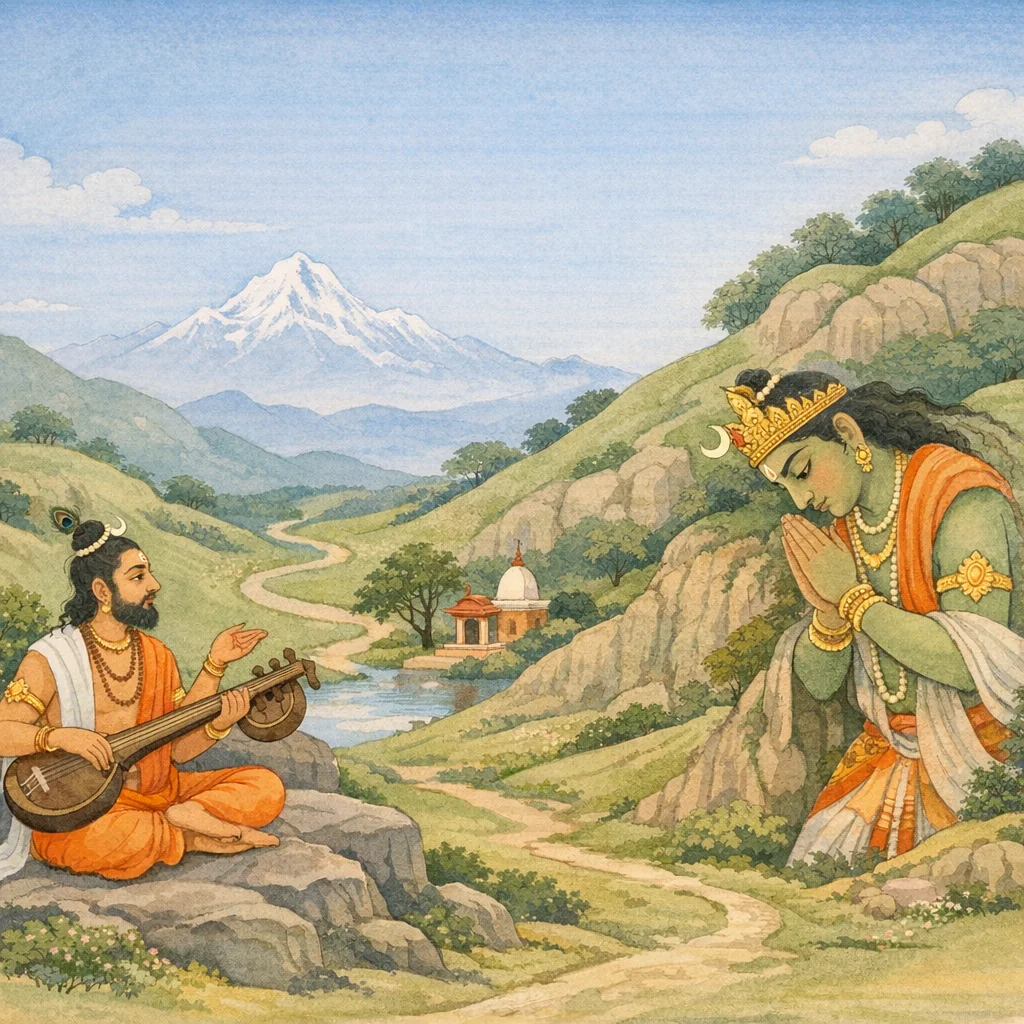
ओंकार-परमेश-लिङ्गकथा — The Narrative of the Oṃkāra Parameśa Liṅga (Gokarṇa–Vindhya Episode)
This adhyāya unfolds as a sacred dialogue: the ṛṣis ask Sūta to explain the “fourth Jyotirliṅga,” identified as Oṃkāra/Parameśa and praised as the remover of all sins. Sūta then begins a framed tale in which Nārada, a supreme devotee, goes to Gokarṇa to worship Śiva. The Vindhya mountain falls into māna (pride), claiming, “Everything is in me; nothing is lacking.” Nārada corrects this by pointing to a hierarchy—Meru is higher—thereby breaking Vindhya’s self-assessment. Distressed, Vindhya repents, undertakes tapas, worships Viśveśvara/Śaṃbhu, and seeks refuge (śaraṇāgati) in Śaṅkara. The teaching is that pride blocks right relation to Śiva, while discernment (viveka) and surrender to Śiva rectify moral and metaphysical error and lead toward liberation.
Shlokas
Verse 1
ऋषय ऊचुः । त्वया सूत महाभाग श्राविता ह्यद्भुता कथा । महाकालाख्यलिंगस्य निजभक्तसुरक्षिकः
The sages said: “O Sūta, O greatly fortunate one, you have indeed made us hear a wondrous account—how the Liṅga known as Mahākāla stands as the steadfast protector of His own devotees.”
Verse 2
ज्योतिर्लिंगं चतुर्थं च कृपया वद वित्तम । ओंकारं परमेशस्य सर्वपातकहारिणः
O best among the wise, please tell with compassion of the fourth Jyotirlinga—Oṃkāra, belonging to the Supreme Lord (Parameśvara), the remover of all sins.
Verse 4
सूत उवाच । ओंकारे परमेशाख्यं लिंगमासीद्यथा द्विजाः । तथा वक्ष्यामि वः प्रीत्या श्रूयतां परमर्षयः । कस्मिंश्चित्समये चाञ नारदो भगवान्मुनिः । गोकर्णाख्यं शिवं गत्वा सिषेवे परभक्तिमान्
Sūta said: “O twice-born ones, just as the Liṅga known as Parameśvara manifested in Oṃkāra, so shall I lovingly narrate it to you—listen, O great sages. At a certain time, the venerable sage Nārada, endowed with supreme devotion, went to Śiva at Gokarṇa and worshipped Him.”
Verse 5
ततस्स आगतो विन्ध्यं नगेशं मुनिसत्तमः । तत्रैव पूजितस्तेन बहुमानपुरस्सरम्
Thereafter, that foremost of sages arrived at Vindhya, the lord of mountains. There itself he was duly honoured and worshipped by him, with great esteem and reverence.
Verse 6
मयि सर्वं विद्यते च न न्यूनं हि कदाचन । इति भावं समास्थाय संस्थितो नारदाग्रतः
Holding firmly to the conviction, “In me everything exists, and I am never lacking in anything at any time,” he remained steady, standing before Nārada.
Verse 7
तन्मानं तत्तदा श्रुत्वा नारदो मानहा ततः । निश्श्वस्य संस्थितस्तत्र श्रुत्वाविन्ध्योऽब्रवीदिदम्
Hearing that proud claim then and there, Nārada—the humbler of pride—sighed deeply and stood silently in that place. Then Vindhya spoke as follows.
Verse 8
विन्ध्य उवाच । किं न्यूनं च त्वया दृष्टं मयि निश्श्वासकारणम् । तच्छ्रुत्वा नारदो वाक्यमब्रवीत्स महामुनिः
Vindhya said: “What deficiency have you seen in me, that has become the cause of your sighing?” Hearing those words, the great sage Nārada replied.
Verse 9
नारद उवाच । विद्यते त्वयि सर्वं हि मेरुरुच्चतरः पुनः । देवेष्वपि विभागोऽस्य न तवास्ति कदाचन
Nārada said: “Indeed, everything is found in you—greater even than Mount Meru. Even among the gods there are distinctions and divisions, but in you there is never any such division at any time.”
Verse 10
सूत उवाच । इत्युक्त्वा नारदस्तस्माज्जगाम च यथागतम् । विन्ध्यश्च परितप्तो वै धिग्वै मे जीवितादिकम्
Sūta said: Having spoken thus, Nārada departed from that place and went away as he had come. And Vindhya, scorched with remorse, indeed exclaimed, “Fie upon my life and all that pertains to it!”
Verse 11
विश्वेश्वरं तथा शंभुमाराध्य च तपाम्यहम् । इति निश्चित्य मनसा शंकर शरणं गतः
Resolving in his heart, “I shall perform austerities and worship Viśveśvara—Śambhu Himself,” he went to Śaṅkara and took refuge in Him.
Verse 12
जगाम तत्र सुप्रीत्या ह्योंकारो यत्र वै स्वयम् । चकार च पुनस्तत्र शिवमूर्तिश्च पार्थिवीम्
With great joy, Oṃkāra went to that very place where he himself was manifest; and there again he fashioned an earthly icon-form of Śiva.
Verse 13
आराध्य च तदा शंभुं षण्मासं स निरन्तरम् । न चचाल तपस्थानाच्छिवध्यानपरायणः
Having then worshipped Śambhu continuously for six months, he did not move away from his place of austerity, being wholly devoted to meditation on Śiva.
Verse 14
एवं विंध्यतपो दृष्ट्वा प्रसन्नः पार्वतीपतिः । स्वरूपं दर्शयामास दुर्ल्लभं योगिनामपि
Seeing the austerity performed at Vindhya, the Lord of Pārvatī became gracious; and He revealed His own true form—one that is difficult to attain even for yogins.
Verse 15
प्रसन्नस्स तदोवाच ब्रूहि त्वं मनसेप्सितम् । तपसा ते प्रसन्नोस्मि भक्तानामीप्सितप्रदः
Pleased, He then said: “Tell Me what you desire in your heart. By your tapas (austerity) I am satisfied with you; I am the One who grants the cherished wishes of My devotees.”
Verse 16
विन्ध्य उवाच । यदि प्रसन्नो देवेश बुद्धिं देहि यथेप्सिताम् । स्वकार्यसाधिनीं शंभो त्वं सदा भक्तवत्सलः
Vindhya said: “O Lord of the gods, if You are pleased, grant me the understanding I desire—an insight that will accomplish my own purpose. O Śambhu, You are ever affectionate to Your devotees.”
Verse 17
सूत उवाच । तच्छ्रुत्वा भगवाञ्छंभुश्चिचेत हृदये चिरम् । परोपतापदं विन्ध्यो वरमिच्छति मूढधीः
Sūta said: Hearing that, the Blessed Lord Śambhu reflected within His heart for a long time: “Vindhya, of deluded understanding, seeks a boon that would become a cause of torment to others.”
Verse 18
इति श्रीशिवमहापुराणे चतुर्थ्यां कोटिरुद्रसंहितायामोंकारेश्वरज्योतिर्लिंगमाहात्म्यवर्णनं नामाष्टादशोऽध्यायः
Thus, in the Śrī Śiva Mahāpurāṇa, in the Fourth section, the Koṭirudra Saṃhitā, ends the eighteenth chapter entitled “The Description of the Greatness of the Oṃkāreśvara Jyotirliṅga.”
Verse 19
सूत उवाच । तथापि दत्तवाञ् शंभुस्तस्मै तद्वरमुत्तमम् । विध्यपर्वतराज त्वं यथेच्छसि तथा कुरु
Sūta said: Even so, Śambhu granted him that supreme boon, saying: “O king of the Vindhya mountain, do exactly as you wish.”
Verse 20
एवं च समये देवा ऋपयश्चामलाशयाः । संपूज्य शंकरं तत्र स्थातव्यमिति चाबुवन्
At that very time, the gods and the sages—pure in heart—having duly worshipped Śaṅkara, declared, “Here itself we should remain.”
Verse 21
तच्छुत्वा देववचनं प्रसन्नः परमेश्वरः । तथैव कृतवान्प्रीत्या लोकानां सुखहेतवे
Hearing the words of the gods, Parameśvara (Lord Śiva) became gracious and pleased; and, out of loving goodwill, He did exactly as requested, for the sake of the happiness and welfare of all worlds.
Verse 22
ॐ कारं चैव यल्लिंगमेकं तच्च द्विधा गतम् । प्रणवे चैव ओंकारनामासीत्स सदाशिवः
That single Liṅga, the sacred syllable Oṁ, indeed became twofold. In the Praṇava, the one called “Oṅkāra” is none other than Sadāśiva Himself.
Verse 23
पार्थिवे चैव यज्जातं तदासीत्परमेश्वरः । भक्ताभीष्टप्रदौ चोभौ भुक्तिमुक्तिप्रदौ द्विजाः
O brāhmaṇas, whatever manifested there in the earthen (pārthiva) form was indeed Parameśvara Himself. Both became bestowers of the devotees’ desired aims, granting bhukti (worldly enjoyment) as well as mukti (liberation).
Verse 24
तत्पूजां च तदा चक्रुर्देवाश्च ऋषयस्तथा । प्रापुर्वराननेकांश्च संतोष्य वृषभध्वजम्
Then the gods and the sages performed that worship. Having pleased the Bull-bannered Lord (Śiva), they obtained many boons.
Verse 25
स्वस्वस्थानं ययुर्देवा विन्ध्योपि मुदितोऽधिकम् । कार्य्यं साधितवान्स्वीयं परितापं जहौ द्विजाः
O twice-born sages, the gods returned each to their own abode; even the Vindhya mountain became exceedingly delighted. Having accomplished his own purpose, he cast off his distress.
Verse 26
य एवं पूजयेच्छंभुं मातृगर्भं वसेन्न हि । यदभीष्टफलं तच्च प्राप्नुयान्नात्र संशय
Whoever thus worships Śambhu (Lord Śiva) shall surely not dwell again in the mother’s womb. He attains the very fruit he desires—of this there is no doubt.
Verse 27
सूत उवाच । एतत्ते सर्वमाख्यातमोंकारप्रभवे फलम् । अतः परं प्रवक्ष्यामि केदारं लिंगमुत्तमम्
Sūta said: “Thus I have fully narrated to you the fruit that arises from the manifestation of Oṃkāra. Now, hereafter, I shall describe the supreme Liṅga at Kedāra.”
Frequently Asked Questions
It introduces the Oṃkāra/Parameśa Jyotirliṅga frame and narrates how Nārada’s intervention exposes Vindhya’s pride (māna) by invoking Meru’s superiority, catalyzing Vindhya’s resolve to seek Śiva through tapas and refuge (śaraṇāgati).
Oṃkāra signifies Śiva as the sonic-ontological ground (praṇava as consciousness), while the “mountain hierarchy” functions as an ethical allegory: elevation becomes a metaphor for spiritual maturity, and the correction of māna is presented as necessary for receiving the liṅga’s purificatory power.
Śiva is referenced through the Oṃkāra-Parameśa Liṅga (Jyotirliṅga framing) and through epithets Viśveśvara, Śaṃbhu, and Śaṅkara—names that emphasize sovereignty (lord of all), beneficence, and the refuge-giving aspect of the deity.