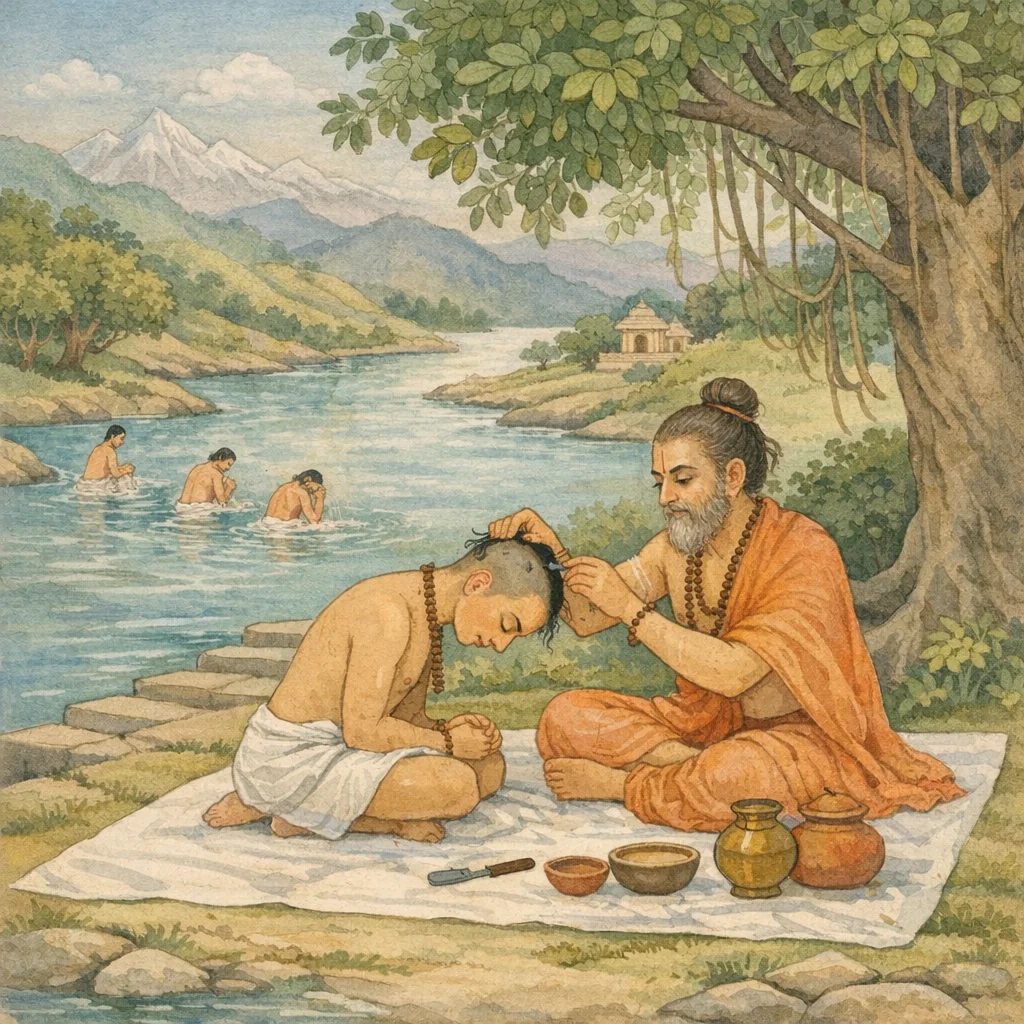
Kṣaura-Snāna-Vidhi — Rite of Tonsure/Shaving and Purificatory Bath (Śaiva Procedure)
This chapter is a technical ritual manual in dialogue form, where Subrahmaṇya instructs the sage Vāmadeva in the kṣaura-snāna-vidhi—tonsure/shaving joined to a purificatory bath as an immediate means of śuddhi for an ascetic or vow-observer. It stresses adhikāra: the disciple must be properly prepared (including yogapaṭṭa-related readiness and completion of the vow), bow to the guru, receive explicit permission, and perform ācamana and preliminary cleansing. Implements such as cloth, razor, water, and clay are washed and ritually empowered with Śaiva mantra-utterance (e.g., repeating “śivaṃ śivam”) and protective ‘astra’ mantras. The shaving is done with directional and ritual care, beginning on the right side, followed by proper handling/disposal of the hair and ancillary grooming like beard and nails. The chapter then details obtaining clay from sanctified tree-sites (bilva, aśvattha, tulasī), repeated immersion, dividing the clay into measured portions, and further consecration, presenting layered purity through physical cleaning, mantra-sanctification, and correct handling of ritual substances. Overall, the adhyāya codifies a Śaiva regimen of purity in which bodily acts become liturgical actions under guru authority and mantra protection.
Shlokas
Verse 1
सुब्रह्मण्य उवाच । क्षौरस्नानविधिं वक्ष्ये वामदेव महामुने । यस्य सद्यो विधानेन शुद्धिस्स्याद्यतिनः परा
Subrahmaṇya said: “O great sage Vāmadeva, I shall explain the procedure for the rite of shaving and the purificatory bath. By performing it according to the prescribed rule, the ascetic attains immediate and supreme purity.”
Verse 2
योगपट्टप्रकारस्य विधिम्प्राप्य मुनीश्वर । स शिष्यस्स्याद्व्रती पूर्णः क्षौरकर्म्मोद्यतो भवेत्
O lord among sages, having learned the proper method of the yogapaṭṭa, that disciple becomes fully established in vrata-observance. He should then set himself to the kṣaura rite of shaving as a preparatory purification.
Verse 3
गुरुं नत्वा विशेषेण लब्धानुज्ञस्ततो गुरोः । शिरस्संक्षाल्य चाचम्य सवासाः क्षौरमाचरेत्
Having bowed with special reverence to the Guru and obtained his permission, one should wash the head and perform ācamana. Then, remaining clothed, one should undertake the kṣaura rite of shaving as a preparatory purification for Śiva-worship.
Verse 4
क्षालयेद्वसनं पश्चान्मृदम्भोभिः क्षुरादिकम् । तद्धस्तौ च मृदालिप्य क्षालयेति मृदं ददेत्
Afterwards, he should wash his garments; and with water mixed with cleansing clay (mṛd) he should also wash the razor and related implements. Smearing that clay upon his hands as well, he should rinse them, and then set aside the used clay, saying, “Wash away impurity.”
Verse 5
स्थापितम्प्रोक्षितन्तोयैश्शिवं शिवमितीरयन् । स्वनेत्रे पिहिते चैवानामांगुष्ठाभिमंत्रिते
Having set it in place and sprinkled it with water, they uttered, “Śiva, Śiva.” Then, with their own eyes gently closed, and with the ring-finger and thumb consecrated by mantra, they proceeded in worship.
Verse 6
अस्त्रेणोन्मील्य संदृश्य क्षुरा दिक्षौ रसाधनम् । अभिमन्त्र्य द्वादशाथ प्रोक्षयेदस्त्रमंत्रतः
Having ‘opened’ (ritually activated) it with the Astra-mantra and duly inspected it, one should empower the razor and the consecrated ritual substance with mantra; then, after reciting (the mantra) twelve times, one should sprinkle (them) in accordance with the Astra-mantra for purification and protection.
Verse 7
क्षुरं गृहीत्वा तारेण दक्षभागे निकृन्तयेत् । केशांश्च कांश्चि दग्रेषु वप्त्वा सर्वं च वापयेत्
Taking a razor and uttering the Tāraka (the Praṇava, ‘Oṃ’), one should shave on the right side first. Having clipped some portions of the hair at the front, one should then shave off everything completely.
Verse 8
पृथिव्यां पर्णमादाय विक्षिपेन्न भुवः स्थले । श्मश्रूणि हस्तपादस्थनखानि च निकृंतयेत्
Taking up a leaf, one should not scatter (impurities) upon the ground. One should also trim the beard and the nails that grow on the hands and feet.
Verse 9
बिल्वाश्वत्थतुलस्यादिस्थाने संगृह्य मृतिकाम् । द्विषट्वारं निमज्याप्सु तीरं गत्वोपविश्य च
Gather sacred earth from a place where bilva, aśvattha, tulasī, and other holy plants grow. Immerse it in water twelve times; then go to the riverbank and sit down for the rite.
Verse 10
शुद्धे देशे तु संस्थाप्य मृदं त्रेधा विभज्य च । एवम्पुनस्त्रिधा कृत्वा प्रोक्ष्यास्त्रेणाभिमन्त्रयेत्
Set the earth (clay) in a purified place and divide it into three portions. Then, in the same way, make it threefold again; sprinkle it with consecrated water and sanctify it by invoking the Astra-mantra.
Verse 11
तत्रैकां मृदमादाय दापयित्वान्यपाणिना । करौ द्वादशधा लिप्य प्रत्येकं केन क्षालयेत्
There, taking a single lump of purifying earth and placing it in the other hand, smear both hands in twelve divisions; then wash each part in proper order and cleanse them duly.
Verse 12
पुनरेकाम्पादयोश्च मुखे चान्यां करे क्रमात् । संलिप्याक्षाल्य चाम्भोभिः पुनश्च जलमाविशेत्
Again, in due order, one should touch water to one foot and then the other, to the mouth, and then to the other parts of the body and the hands. Having thus touched and washed with water, one should once more sip water (ācaman), thereby re-entering ritual purity fit for Śiva’s worship.
Verse 13
अन्यां मृदम्भागयित्वा शिरसि द्वादश क्रमात् । आलिप्य मृदमास्यान्तनिमज्य च पुनः पुनः
Then, taking another portion of the sacred clay, one should apply it upon the head in twelve successive placements; and after smearing it, one should repeatedly dip the clay to the end of the mouth (up to the lips) again and again—thus performing the prescribed Śaiva rite of purification.
Verse 14
तीरं गत्वा तु गंडूषान्षोडशाचमनं द्विधा । प्राणानायम्य च पुनः प्रणवं द्व्यष्टसंख्यया
Having gone to the water’s edge, he should rinse the mouth and perform sixteen ācamana sippings in two sets; then, restraining the life-breath through prāṇāyāma, he should again repeat the Praṇava (Oṁ) twenty-six times.
Verse 15
मृदमन्यां पुनस्त्रेधा विभज्य च तदेकया । कटिशौचं पादशौचं विधायाचम्य च द्विधा
Then, taking another portion of clean earth, he should again divide it into three parts. With one part he should cleanse the region of the waist (the lower body), and with another he should cleanse the feet. Having thus purified himself, he should perform ācamana twice (sipping water for inner purification).
Verse 16
प्रणवेनाथ षोडश प्राणानायम्य वाग्यतः । पुनरन्यां स्वोरुदेशे त्रिधा विन्यस्य चोमिति
Then, restraining the sixteen vital currents by the Pranava (Oṁ) and keeping speech controlled, one should again place the mantric power upon one’s own thigh-region in three divisions, and thereafter utter “Oṁ.”
Verse 17
प्रोक्ष्याभिमंत्रयेत्सप्त स्वपाण्योस्तलमेकधा । त्रिधालिप्याथ सम्पश्येत्सूर्य्यमूर्तिं च पावनीम्
Having sprinkled the sanctifying water and consecrated it with mantra seven times, one should join the two palms into a single hollow. Then, after applying the three lines of vibhūti (sacred ash), one should contemplate the purifying solar form within that rite.
Verse 18
स्वकक्षयोः समालिप्य व्यत्यस्ताभ्यामथान्यया । पाणिभ्याञ्च मृदा शिष्यस्सुमतिर्दृढमानसः
Then the disciple Sumati, firm in resolve, smeared sacred earth (mṛdā, purifying clay/ash) upon his own armpits, using his two hands crossed one over the other, and with the other hand as well—applying the purifying mud with reverence as part of the Śaiva observance.
Verse 19
गृहीत्वान्यां मृदं शुद्धां तथासौ गुरुभक्तिमान् । शिर आरभ्य पादान्तं विलिप्यादित्यदृष्टया
Then that devotee of the Guru, taking other pure clay, should smear it over the body from the head down to the feet, while facing the Sun.
Verse 20
इति श्रीशिवमहापुराणे षष्ठ्यां कैलाससंहितायां क्षौरस्नानविधिवर्णनं नाम विंशोऽध्यायः
Thus, in the Śrī Śiva Mahāpurāṇa, in the sixth book, within the Kailāsa-saṃhitā, ends the twentieth chapter entitled “The Description of the Procedure for the Shaving-rite and Sacred Bath.”
Verse 21
ततस्साम्बं महेशानं शंकरं चन्द्रशेखरम् । संस्मरेद्भक्तितश्शिष्य सर्वेश्वर्यपतिं शिवम्
Then, O disciple, one should devoutly remember Śiva—Sāmba, Maheśāna, Śaṅkara, the moon-crested Lord Candrasekhara—sovereign Master of all aiśvarya, divine powers and lordships.
Verse 22
त्रिवारम्प्रणमेत्प्रीत्या साष्टांगं च गुरु शिवम् । पञ्चाङ्गेनैकवारञ्च समुत्थाय च वन्दयेत्
With loving devotion, one should bow three times in full prostration (sāṣṭāṅga) before Guru Śiva. Then, rising up, one should again offer reverence once with the five-limbed salutation (pañcāṅga), and thus worship Him.
Verse 23
तीर्थं प्रविश्य तन्मध्ये निमज्योन्मज्य ताम्मृदम् । स्कन्धे संस्थाप्य पूर्वोक्तप्रकारेण विलेपयेत्
Entering the tīrtha, the sacred bathing-place, and within it dipping down and rising up again, one should take that holy clay; placing it upon the shoulder, one should apply it to the body in the manner described earlier.
Verse 24
तत्रावशिष्टं संगृह्य जलमध्ये प्रविश्य च । विलोड्य सम्यक् तां तत्र सर्वांगेषु विलिप्य च
Gathering up what remains there, one should enter into the water; then, having churned it well, one should anoint that mixture upon all the limbs of the body.
Verse 25
त्रिवारमोमिति प्रोच्य शिवपादाम्बुजं स्मरन् । संसाराम्बुधिसंतारं सदा यद्विधितो हि सः
Uttering “Om” three times and meditating on the lotus-feet of Lord Śiva, he is indeed ordained to cross the ocean of saṃsāra, worldly existence—always.
Verse 26
अभिषिच्योमिति जलं विरजाभस्मलोलितम् । अंगोपमार्ज्जनं कृत्वा सुस्नायाद्भस्मना ततः
Reciting “Om,” one should sprinkle water mingled with pure, stainless vibhūti (bhasma). Having cleansed the limbs by wiping, one should then bathe well with that sacred ash.
Verse 27
त्रिपुंड्रं च विधायाथ यथोक्तविधिना शुभम् । यथोक्तांगेषु सर्वेषु सावधान तया मुने
Then, O sage, having applied the auspicious Tripuṇḍra in the prescribed manner, one should place it carefully upon all the limbs exactly as enjoined.
Verse 28
ततश्शुद्धमना भूत्वा कुर्य्यान्मध्यंदिनक्रियाः । महेश्वरं नमस्कृत्य गुरूंस्तीर्थादिकानि च
Then, having made the mind pure, one should perform the midday observances. Bowing first to Maheśvara, Lord Śiva, and also offering reverence to one’s gurus and to the sacred tīrthas and the like, one should proceed with the rite.
Verse 29
सम्पूजयेन्महेशानं भक्त्या परमया मुने । साम्बिकं ज्ञानदातारं पातारं त्रिभवस्य वै
O sage, one should worship Maheśāna with the highest devotion—He who is united with Ambikā, the giver of true knowledge, and indeed the Protector and Savior of the three worlds.
Verse 30
ततोसौ दृढचेतस्को यतिः स्ववृषसंस्थितः । भिक्षार्थम्प्रव्रजेच्छुद्धो विप्रवर्गेषु साधुषु
Thereafter, that steadfast-minded ascetic, established in his own sacred discipline, set forth in purity to seek alms among the righteous communities of brāhmaṇas and sādhus.
Verse 31
ततस्तत्र च शुद्धात्मा पञ्चधा परिकल्पितम् । भैक्ष्यं यथोचितं कुर्य्याद्दूषितान्नं विवर्ज्जयेत्
Then, being pure in mind, he should accept alms in the fivefold manner as prescribed there, taking only what is proper, and he should avoid food that is tainted or impure.
Verse 32
शौचं स्नानं तथा भिक्षां नित्यमेकान्तसेवनम् । भिक्षौश्चत्वारि कर्म्माणि पञ्चमं नैव विद्यते
Purity, bathing, living on alms, and constant resort to solitude—these are the four duties of a mendicant (bhikṣu). For a true bhikṣu, there is no fifth obligation beyond these.
Verse 33
अलाबुं वेणुपात्रं च दारवम्मृण्मयन्तथा । भिक्षोश्चत्त्वारि पात्राणि पञ्चमन्नैव विद्यते
For a mendicant devoted to the Śaiva path, there are only four permissible alms-bowls: one made from a gourd, one of bamboo, one of wood, and one of clay; a fifth kind of vessel is not approved.
Verse 34
ताम्बूलं तैजसम्पात्रं रेतस्सेकं सितांबरम् । दिवास्वापो हि नक्तान्नं यतीनां षड्विवर्जिताः
For yatis (renunciants), six things are to be avoided: chewing tāmbūla (betel), keeping shining metal vessels, wasting semen, wearing white garments, sleeping by day, and eating at night. By such restraints, the ascetic guards purity and steadiness of mind on the path to Śiva-realization.
Verse 35
साक्षरा विपरीताश्च राक्षसास्त इति स्मृताः । तस्माद्वै विपरीतं च कर्म्म नैवाचरेद्यतिः
Those who act in a perverse and inverted way—though learned in letters—are remembered as “Rākṣasas”. Therefore, a renunciate should never perform any action that is contrary to right conduct.
Verse 36
यतिः प्रयत्नतः कुर्य्यात्क्षौरस्नानं च शुद्धये । संस्मरन्मनसा शुद्धं परं ब्रह्म सदाशिवम्
A renunciant should diligently perform shaving and ritual bathing for purification, while inwardly remembering with a purified mind Sadāśiva—the Supreme Brahman, ever pure.
Verse 37
इत्यैव मुनिशार्द्दूल तव स्नेहान्मयाखिलः । क्षौरस्नानविधिः प्रोक्तः किम्भूयः श्रोतुमिच्छसि
Thus, O tiger among sages, out of affection for you I have explained in full the rite of shaving and ritual bathing. What more do you wish to hear?
Frequently Asked Questions
Subrahmaṇya teaches Vāmadeva the kṣaura-snāna-vidhi: a step-by-step Śaiva procedure combining shaving/tonsure with purificatory bathing, including guru permission, ācamana, cleansing of tools, mantra-empowerment, the act of shaving, and subsequent purity handling.
The rahasya is that purification is not merely hygienic: implements and substances become ritually ‘fit’ through mantra-saṃskāra. The repeated “śivaṃ śivam” and protective astra-mantra function as sacral authorization and energetic safeguarding, converting ordinary actions into Śaiva liturgy aligned with Śiva-tattva.
Rather than a narrative iconographic form, the chapter highlights Śiva’s presence as mantra and sanctifying principle—invoked through Śiva-nāma utterance and astra-mantra protection—showing a functional theology where Śiva operates as purifier, protector, and the ground of ritual efficacy.