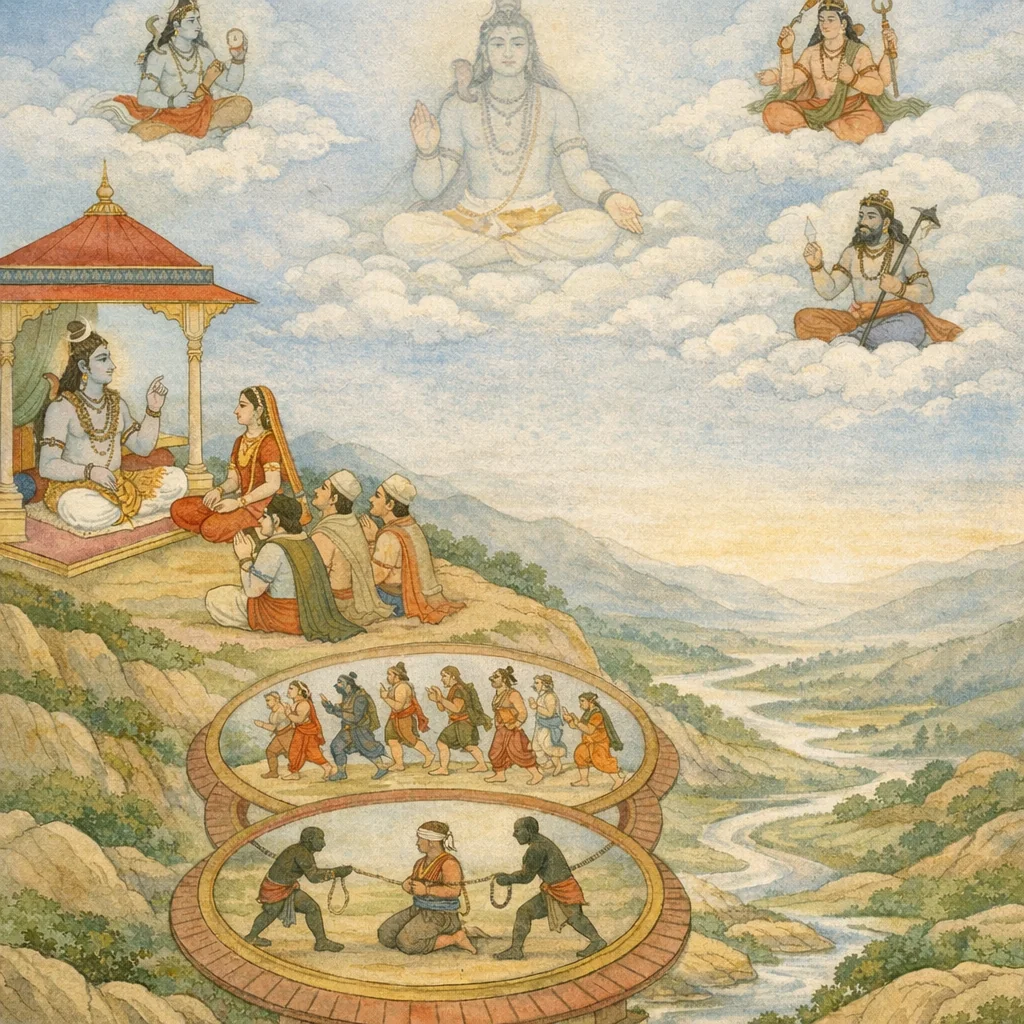
सृष्टिपद्धतिवर्णनम् (Exposition of the Supreme Method of Creation and the Tirodhāna-Cakra)
This chapter presents a doctrinal discourse by Īśvara, proclaiming an “excellent procedure of creation” (sṛṣṭi-paddhati). It outlines a technical Śaiva cosmology: Sadāśiva is the collective (samaṣṭi) lord of ākāśa, while a corresponding tetrad (catuṣṭaya) such as Maheśa and related forms appears as the particular/distributed (vyaṣṭi) manifestation. Further divine modalities are distinguished (including an Īśvara-tetrad), and the tirodhāna power is introduced as an ordered cakra with two modes—one accessible to Rudra-class divinities and another operating through embodied limitation for bound beings (paśu). Concealment is linked to karmic experience, and when karma reaches equilibrium the Lord becomes grace-filled (anugrahamaya). The “Sarveśvara” deities are described as non-dual, disease-free, nirvikalpa reality, and a tirodhāna-cakra is associated with Maheśvara. Finally, attaining Maheśa’s “pada” is taught as the liberating path for Maheśvara-devotees, culminating in release through stages such as sālokya.
Shlokas
Verse 1
ईश्वर उवाच । ततः परं प्रवक्ष्यामि सृष्टिपद्धतिमुत्तमाम् । सदाशिवान्महेशादिचतुष्कस्य वरानने
Īśvara said: “Now, O fair-faced one, I shall expound the supreme procedure of creation—how the fourfold principle beginning with Maheśa proceeds forth from Sadāśiva.”
Verse 2
सदाशिवस्समष्टिस्स्यादाकाशधिपतिः प्रभुः । अस्यैव व्यष्टितापन्नम्महेशादिचतुष्टयम्
Sadāśiva is the integral, undivided Totality—the sovereign Lord presiding over ākāśa, the all-pervasive ether. From Him alone, by assuming differentiated (individual) modes, arises the fourfold set beginning with Maheśa.
Verse 3
सदाशिवसहस्रांशान्महेशस्य समुद्भवः । पुरुषाननरूपत्वाद्वायोरधिपतिश्च सः
He arises from Maheśa as a manifestation of a thousandfold portion of Sadāśiva. Because he bears the form with a man-like face (puruṣānana), he is also the lord and governor of Vāyu, the wind-principle.
Verse 4
मायाशक्तियुतो वामे सकलश्च क्रियाधिकः । अस्यैव व्यष्टिरूपं स्यादीश्वरादिचतुष्टयम्
On the left is the Lord united with the power of Māyā—manifest (sakala) and predominant in divine activity. From this very reality arises, in its individual (vyaṣṭi) aspect, the fourfold group beginning with Īśvara.
Verse 5
ईशो विश्वेश्वरः पश्चात्परमेशस्ततः परम् । सर्वेश्वर इतीदन्तु तिरोधाचक्रमुत्तमम्
He is called Īśa; then Viśveśvara; thereafter Parameśa; and beyond that, Sarveśvara. These successive designations indeed pertain to the supreme “Tirodhāna-cakra”—the Lord’s exalted power of veiling, concealing and regulating revelation.
Verse 6
तिरोभावो द्विधा भिन्न एको रुद्रादिगोचरः । अन्यश्च देहभावेन पशुवर्गस्य सन्ततेः
Concealment (tirobhāva) is of two distinct kinds. One is perceptible to Rudra and other divine beings; the other, arising through identification with the body, belongs to the continuing line of bound souls (paśu).
Verse 7
भोगानुरंजनपरः कर्मसाम्यक्षणावधि । कर्मसाम्ये स एकः स्यादनुग्रहमयो विभुः
He who delights in the enjoyment of experiences (bhoga) remains bound only until the moment when his karmas come into equilibrium. When that equilibrium of karma is attained, the One all-pervading Lord becomes wholly gracious and bestows His favor.
Verse 8
तत्र सर्वेश्वरा यास्ते देवताः परिकीर्त्तिताः । परब्रह्मात्मकाः साक्षान्निर्विकल्पा निरामयाः
There, the deities praised as the Lords of all are in truth of the very nature of the Supreme Brahman—directly manifest, beyond all conceptual distinctions, and untouched by any stain of suffering or disease.
Verse 9
तिरोभावात्मकं चक्रं भवेच्छान्तिकलामयम् । महेश्वराधिष्ठितं च पदमेतदनुत्तमम्
The wheel whose very essence is veiling (tirobhāva) becomes constituted of the power of peace (śānti-kalā). This unsurpassed state (pada) is presided over by Maheśvara Himself.
Verse 10
एतदेव पदं प्राप्यं महेशपदसेविनाम् । माहेश्वराणां सालोक्यक्रमादेव विमुक्तिदम्
This alone is the state to be attained by those who serve the feet—the supreme station—of Mahesha. For the devotees of Maheshvara, liberation is granted by the very progression beginning with sālokya, dwelling in His world, and onward.
Verse 11
महेश्वरसहस्रांशाद्रुद्रमूर्तिरजायत । अघोरवदनाकारस्तेजस्तत्त्वाधिपश्च सः
From a thousandfold ray of Maheshvara, the form of Rudra came into manifestation. He bore the countenance of Aghora and presided as lord over the principle of Tejas, radiant fire.
Verse 12
गौरीशक्तियुतो वामे सर्व्वसंहारकृत्प्रभुः । अस्यैव व्यष्टिरूपं स्याच्छिवाद्यथ चतुष्टयम्
On His left He is united with Gaurī-Śakti; that Lord is the sovereign who brings about the dissolution of all. Of that very Supreme, the differentiated manifestation (vyasṭi) is spoken of as the fourfold reality beginning with Śiva.
Verse 13
शिवो हरो मृडभवौ विदितं चक्रमद्भुतम् । संहाराख्यं महादिव्यं परमं हि मुनीश्वर
O lord of sages, it is well known that Śiva—Hara, Mṛḍa the gracious, the source of auspicious becoming—possesses a wondrous discus, supremely divine and unsurpassed, renowned as “Saṃhāra”, the power and weapon of dissolution.
Verse 14
स संहारस्त्रिधा प्रोक्तो बुधैर्नित्यादिभेदतः । नित्यो जीवसुषुप्त्याख्यो विधेर्नैमित्तिकः स्मृतः
The wise declare dissolution (saṃhāra) to be threefold, distinguished as the “eternal” and the other kinds. The eternal dissolution is called the jīva’s state of deep sleep (suṣupti), while the occasional (naimittika) dissolution is said to pertain to Brahmā (Vidhī, the Ordainer).
Verse 15
इति श्रीशिवमहापुराणे षष्ठ्यां कैलाससंहितायामुपासनामूर्त्तिवर्णनं नाम पंचदशोऽध्यायः
Thus, in the Śrī Śiva Mahāpurāṇa—within the Sixth Book, the Kailāsa Saṃhitā—ends the fifteenth chapter, entitled “Description of the Worship-Form (of Śiva).”
Verse 16
विश्रांत्यर्थं मुनिश्रेष्ठ कर्मणां पाकहेतवे । संहारः कल्पितस्त्रेधा रुद्रेणामिततेजसा
O best of sages, for the sake of repose and for the ripening of actions into their fruits, dissolution (saṃhāra) was ordained in a threefold way by Rudra of immeasurable splendor.
Verse 17
रुद्रस्यैव तु कृत्यानां त्रयमेतदुदाहृतम् । संहृतवपि सृष्ट्यादिकृत्यानां पञ्चकं विभोः
Thus this triad has been declared among Rudra’s divine functions. Yet, O all-pervading Lord, even in dissolution the five acts—beginning with creation—belong to Him as well.
Verse 18
मुने तत्र भवाद्यास्ते देवताः परिकीर्त्तिताः । परब्रह्मस्वरूपाश्च लोकानुग्रहकारकाः
O sage, there the deities beginning with Bhava (Śiva) are celebrated—those whose true nature is the Supreme Brahman, and who act for the gracious uplift of the worlds.
Verse 19
संहाराख्यमिदं चक्रं विद्यारूपकलामयम् । अधिष्ठितं च रुद्रेण पदमेतन्निरामयम्
This wheel, known as “Saṃhāra” (dissolution), is constituted of the powers of knowledge in the form of divine kalās. It is presided over by Rudra; this state (pada) is free from all affliction and disease.
Verse 20
एतदेव पदं प्राप्यं रुद्राराधनकांक्षिणाम् । रुद्राणां तद्धि सालोक्यक्रमात्सायुज्यदम्मुने
This alone is the supreme state to be attained by those who long to worship Rudra. For devotees of Rudra, it is indeed the wondrous attainment that proceeds from residing in Rudra’s world (sālokya) and culminates in complete union with Him (sāyujya), O sage.
Verse 21
रुद्रमूर्त्तेस्सहस्रांशाद्विष्णोश्चैवाभवज्जनिः । स वामदेवचक्रात्मा वारितत्त्वैकनायकः
From a thousandfold portion of Rudra’s manifested form, the birth of Viṣṇu indeed arose. He is of the nature of the Vāmadeva-cakra, the single sovereign of the principle of water—the sustaining power presiding over that tattva.
Verse 22
रमाशाक्तियुतो वामे सर्व्वरक्षाकरो महान् । चतुर्भुजोऽरविंदाक्षः श्यामश्शंखादिचिह्नभृत्
On the left is the great Lord who bestows complete protection, accompanied by Ramā (Lakṣmī) and Śakti. He is four-armed, lotus-eyed, dark-hued, and bears the emblems beginning with the conch—thus manifesting as a protective, gracious form within the sacred vision.
Verse 23
अस्यैव वासुदेवादिचतुष्कं व्यष्टितां गतम् । उपासनरतानां वै वैष्णवानां विमुक्तिदम्
This very Supreme Reality becomes differentiated as the fourfold set beginning with Vāsudeva. For the Vaiṣṇavas devoted to worship, that fourfold manifestation is indeed the giver of liberation (mokṣa).
Verse 24
वासुदेवोऽनिरुद्धश्च ततस्संकर्षणः परः । प्रद्युम्नश्चेति विख्यातं स्थितिचक्रमनुत्तमम्
“Vāsudeva and Aniruddha, then the supreme Saṅkarṣaṇa, and Pradyumna—thus is renowned the unsurpassed wheel of sustenance (sthiti-chakra).” From the Śaiva standpoint, such sustaining powers operate within the Lord’s governance, while Śiva remains the transcendent Pati beyond all cycles.
Verse 25
स्थितिस्सृष्टस्य जगतस्तत्कर्त्रा सह पालनम् । आरब्धकर्मभोगान्तं जीवानां फलभोगिनाम्
The “sustenance” (sthiti) of the created universe is its protection and orderly maintenance, carried out together with its Creator. For embodied souls who experience the fruits of karma, this continues until their already-begun karma (ārabdha) is exhausted through lived experience.
Verse 26
विष्णोरेवेदमाख्यातं कृत्यं रक्षाविधायिनः । स्थितावपि तु सृष्ट्यादि कृत्यानां पंचकं विभोः
This has been declared as the function of Viṣṇu, the one who ordains protection. Yet even in the state of preservation, O mighty one, the five divine operations—beginning with creation—are present in Him.
Verse 27
तत्र प्रद्युम्नमुख्यास्ते देवताः परिकीर्तिताः । निर्विकल्पा निरातंका मुक्तानंदकरास्सदा
There, the deities headed by Pradyumna are celebrated. Ever free from mental constructions and free from fear, they continually bestow the bliss of liberation.
Verse 28
स्थितिचक्रमिदं ब्रह्मन्प्रतिष्ठारूपमुत्तमम् । जनार्दनाधिष्ठितं च परमं पदमुच्यते
O Brahman, this wheel of sustentation is of the highest kind, having the nature of firm establishment. Presided over by Janārdana (Viṣṇu), it is spoken of as the supreme station.
Verse 29
एवदेव पदं प्राप्यं विष्णुपादाब्जसेविनाम् । वैष्णवानां चक्रमिदं सालोक्यादिपदप्रदम्
This indeed is the state attained by those who serve the lotus-feet of Viṣṇu. This divine discus (cakra), cherished by the Vaiṣṇavas, bestows the stations beginning with sālokya and the like (forms of liberation).
Verse 30
विष्णोरेव सहस्रांशात्संबभूव पितामहः । सद्योजातमुखात्मा यः पृथिवीतत्त्वनायकः
From Viṣṇu indeed, from a thousandth part of His potency, Pitāmaha (Brahmā) came into being—he whose very self is the Sadyojāta face of Śiva, and who presides over the earth-principle (pṛthivī-tattva).
Verse 31
वाग्देवीसहितो वामे सृष्टिकर्त्ता जगत्प्रभुः । चतुर्मुखो रक्तवर्णो रजोरूपस्वरूपवान्
On the left stands the Lord of the world, the Creator, accompanied by the Goddess of Speech (Vāgdevī); four-faced, red-hued, whose very essence is the form of rajas.
Verse 32
हिण्यगर्भाद्यस्यैव व्यष्टिरूपं चतुष्टयम् । हिरण्यगर्भोथ विराट् पुरुषः काल एव च
Indeed, the fourfold individual (vyaṣṭi) manifestation beginning with Hiraṇyagarbha is declared—Hiraṇyagarbha, then Virāṭ, the Puruṣa, and also Kāla, Time.
Verse 33
सृष्टि चक्रमिदं ब्रह्म पुत्रादिऋषिसेवितम् । सर्व्वकामार्थदं ब्रह्मन्परिवारसुखप्रदम्
O Brahmā, this wheel of creation is attended and upheld by your sons and the sages. It grants the fulfillment of all desired aims and, O Brahmā, bestows happiness and well-being upon one’s family and retinue.
Verse 34
सृष्टिस्तु संहृतस्यास्य जीवस्य प्रकृतौ बहिः । आनीय कर्मभोगार्थ साधनांगफलैस्सह
Creation is the bringing forth—outward into Prakṛti—of this embodied soul that had been withdrawn (at dissolution), so that it may experience the fruits of its actions, together with the body, senses, and other instruments that serve as the means for such experience.
Verse 35
संयोजनमितीदं तु कृत्यं पैतामहं विदुः । जगत्सृष्टिक्रियाविज्ञा यावद्व्यूहं सुखावहम्
This act is indeed known as “saṃyojana” (joining together), a work belonging to the Grandsire (Brahmā). Those skilled in the operations of cosmic creation understand the entire arrangement (vyūha) of manifestation as conducive to well-being and ease.
Verse 36
जगत्सृष्टावपि मुने कृत्यानां च पंचकं विभोः । अस्ति कालोदयस्तत्र देवताः परिकीर्त्तिताः
O sage, even in the creation of the universe, the all-pervading Lord possesses a fivefold set of cosmic functions. There too the arising of Kāla, Time, is present, and the presiding deities have been duly enumerated.
Verse 37
निवृत्तिरूपमाख्यातं सृष्टिचक्रमिदं बुधैः । पितामहाधिष्ठितं च पदमेतद्धि शोभनम्
The wise declare this revolving cycle of creation to be of the nature of nivṛtti—withdrawal that turns back toward liberation. This too is the splendid station presided over by Pitāmaha (Brahmā).
Verse 38
एतदेव प्रदं प्राप्यं ब्रह्मार्पितधियां नृणाम् । पैतामहानामेतद्धि सालोक्या दिविमुक्तिदम्
This indeed is the supreme boon to be attained by men whose understanding is offered to Brahman, the Supreme. For the followers of Pitāmaha (Brahmā) as well, this alone truly bestows Sālokya—abiding in the same divine realm—and grants liberation in heaven.
Verse 39
अस्मिन्नपि चतुष्के तु चक्राणां प्रणवो भवेत् । महेशादिक्रमादेव गौण्या वृत्त्या स वाचकः
Even in this set of four, the Praṇava “Oṁ” is said to be the designation of the cakras. Indeed, by the sequence beginning with Maheśa, that Praṇava becomes their indicator in a secondary (figurative) sense.
Verse 40
इदं खलु जगच्चक्रं श्रुतिविश्रुतवैभवम् । पञ्चारं चक्रमिति ह स्तौति श्रुतिरिदम्मुने
O sage, this indeed is the revolving wheel of the universe, whose grandeur is renowned in the Vedas. The Śruti itself praises it as “the five-spoked wheel,” indicating the ordered cosmic process under the Lord (Pati), known through revealed wisdom.
Verse 41
एकमेव जगच्चक्रं शम्भोश्शक्तिविजृंभितम् । सृष्ट्यादिपंचांवयवं पंचारमिति कथ्यते
This entire wheel of the universe is one alone—an expansive manifestation of Śambhu’s Power (Śakti). Having five constituents beginning with creation, it is therefore called the “five-spoked” (pañcāra) wheel.
Verse 42
अलातचक्रभ्रमिवदविच्छिन्नलयोदयम् । परितो वर्तते यस्मात्तस्माच्चक्रमितीरितम्
Like the whirling of a firebrand that seems to form a wheel, it appears as an unbroken continuum of dissolution and manifestation. Since it thus moves all around, it is therefore called a “chakra” (wheel/cycle).
Verse 43
सृष्ट्यादिपृथुसृष्टित्वात्पृथुत्वेनोपदृश्यते । हिरण्मयस्य देवस्य शम्भोरमिततेजसः
Because, from the very beginning of creation, His manifestation is vast, He is perceived as “the Expansive.” Thus is Śambhu, the golden divine Lord, understood—of immeasurable radiance.
Verse 44
शक्तिकार्यमिदं चक्रं हिरण्यज्योतिराश्रितम् । सलिलेनावृतमिदं सलिलं वह्निनावृतम्
This cosmic wheel—an operation of Śakti—abides in a golden radiance. It is veiled by water, and that very water is, in turn, veiled by fire.
Verse 45
आवृतो वायुना वह्निराकाशेनावृतं महत् । भूतादिना तथाकाशो भूतादिर्महतावृतः
Fire is enveloped by air; the Great Principle (mahat) is enveloped by space. Likewise, space is enveloped by bhūtādi, the source of the elements, and that bhūtādi is enveloped by mahat—thus the cosmic principles are described as mutually enclosing in the graded order of manifestation.
Verse 46
अव्यक्तेनावृतस्तद्वन्महानित्येवमास्तिकैः । ब्रह्माण्डमिति संप्रोक्तमाचार्य्यैर्मुनिसत्तम
O best of sages, the Great (the cosmic egg) is likewise enveloped by the Unmanifest (avyakta). Therefore the theistic teachers have declared it to be the “Brahmāṇḍa,” the cosmic egg of Brahmā.
Verse 47
उक्तानि सप्तावरणान्यस्य विश्वस्य गुप्तये । चक्राद्दशगुणाधिक्यं सलिलस्य विधीयते
For the concealment and safeguarding of this universe, the seven coverings have been described. Beyond the cosmic circle, the expanse of the water-envelope is ordained to be ten times greater.
Verse 48
उपर्युपरि चान्योन्यमेवं दशगुणाधिकम् । ब्रह्माण्डमिति विज्ञेयं तद्द्विजैर्मुनिनायक
Layer upon layer, each succeeding realm is tenfold greater than the one below. Know this totality as the cosmic egg (Brahmāṇḍa), O leader of sages—so it is understood by the twice-born.
Verse 49
इममर्थमुरीकृत्य चक्रसामीप्यवर्त्तनात् । सलिलस्य च तन्मध्ये इति प्राह श्रुतिस्स्वयम्
Accepting this very meaning, the Śruti itself declares: because of the water’s movement close to the whirling wheel, the (subtle) reality is understood as abiding ‘in the midst of that water’.
Verse 50
अनुग्रहतिरोभावसंहृतिस्थितिसृष्टिभिः । करोत्यविरतं लीलामेकश्शक्तियुतश्शिवः
United with His one supreme Power (Śakti), the one Lord Śiva ceaselessly performs His divine play through the five acts—creation, preservation, dissolution, veiling (concealment), and grace.
Verse 51
बहुनेह किमुक्तेन मुने सारं वदामि ते । शिव एवेदमखिलं शक्तिमानिति निश्चितम्
O sage, what need is there for many words here? I shall tell you the essence: this entire universe is truly Śiva alone—Śiva endowed with the supreme Power (Śakti); this is firmly established.
Frequently Asked Questions
It systematizes creation and divine governance by mapping Sadāśiva as the collective principle and presenting tetrads (catuṣṭaya) as particularized manifestations, culminating in the doctrine of tirodhāna (concealment) as a structured cosmic function.
Tirodhāna is treated as a controlled concealment that produces experiential limitation: one mode pertains to higher divine domains, while another binds paśu through embodiment, bhoga, and karma—yet it is teleological, since karmic equilibrium becomes a condition for the rise of anugraha (grace).
The chapter foregrounds Sadāśiva, Maheśa/Maheśvara, and the ascending designations Īśa → Viśveśvara → Parameśa → Sarveśvara, presenting them as non-dual (parabrahmātmaka), nirvikalpa modalities within a Shaiva hierarchy.