Ṣaḍvidhārtha-Parijñāna: Praṇavārtha and the Sixfold Unity of Meaning (षड्विधार्थपरिज्ञानम् / प्रणवार्थपरिज्ञानम्)
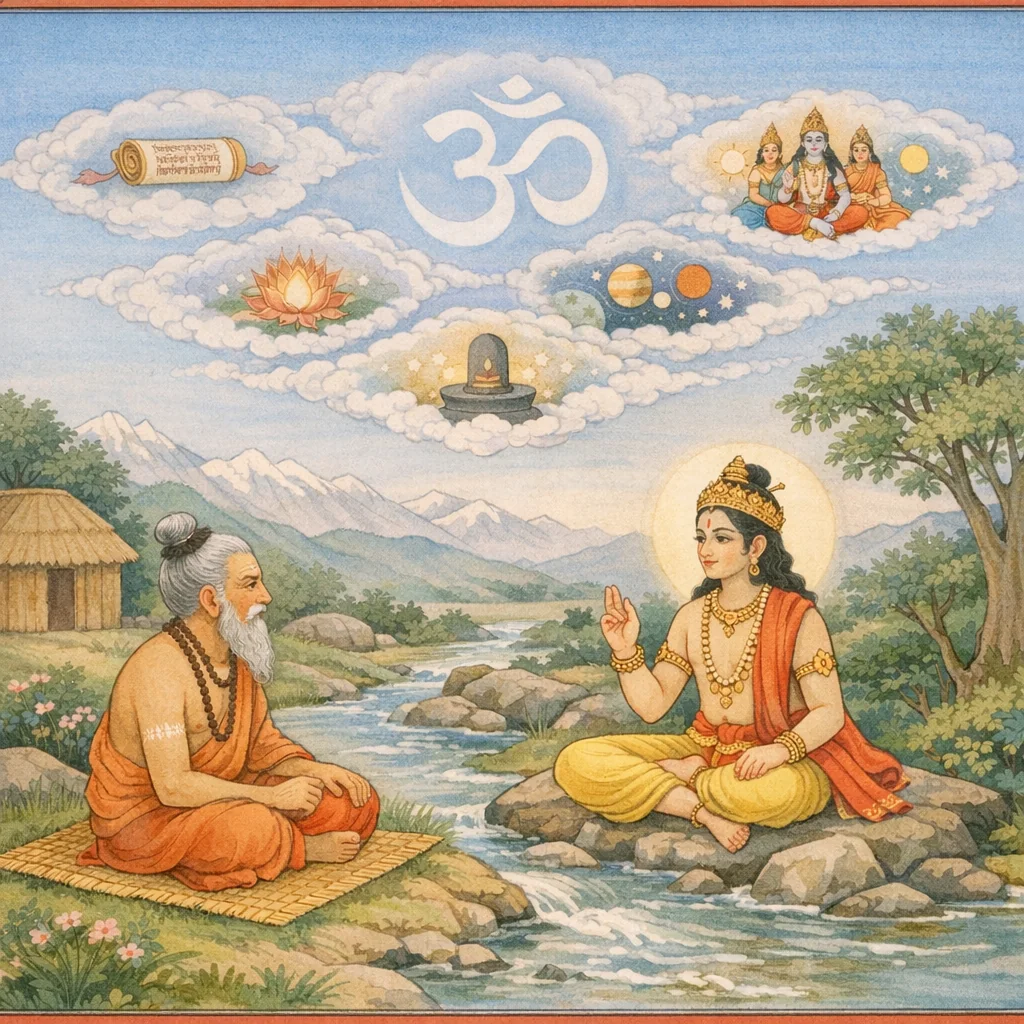
Adhyāya 14 unfolds as a didactic dialogue: Vāmadeva petitions Guha/Skanda (Subrahmaṇya) for a precise teaching on ṣaḍvidhārtha-parijñāna, the “sixfold knowledge of meaning,” praised as iṣṭada, bestower of the desired goal. Vāmadeva confesses his epistemic plight: without this ‘artha’ one is misled by inferior, paśu (animal-like) frameworks and remains bewildered by Śiva-māyā; he seeks Śiva-pada-jñāna as a rasāyana, an elixir that removes saṃmoha (delusion). Subrahmaṇya promises to explain it in both the collective and individual modes (samaṣṭi-vyaṣṭi), identifying it as praṇavārtha-parijñāna—knowledge of the meaning of Oṃ—and as the unity (aikya) of six meanings. The chapter then begins to enumerate the six ‘arthas’: mantra-form, mantra-impregnation (mantra-bhāvita), deity-meaning (devatārtha), moving toward cosmological/phenomenal meaning (prapañcārtha) and the remaining levels that culminate in unified comprehension. Its technical thrust is epistemological: it maps how mantra, deity, and cosmos are progressively known as one Śaiva reality, yielding the fruit of liberation-oriented clarity.
Shlokas
Verse 1
वामदेव उवाच । भगवन्षण्मुखाशेष विज्ञानामृतवारिधे । विश्वामरेश्वरसुत प्रणतार्त्तिप्रभञ्जन
Vāmadeva said: “O Blessed Lord, O Six-faced One (Ṣaṇmukha), ocean of the nectar of boundless spiritual knowledge; O son of the Lord of the gods of the universe—destroyer of the distress of those who bow to you.”
Verse 2
षड्विधार्त्थपरिज्ञानमिष्टदं किमुदाहृतम् । के तत्र षड्विधा अर्थाः परिज्ञानञ्च किं प्रभो
O Lord, what is that “sixfold knowledge of artha (meaning/purpose)” said to bestow the desired fruit? What indeed are those six kinds of artha, and what exactly is meant by this knowledge, O Master?
Verse 3
प्रतिपाद्यश्च कस्तस्य परिज्ञाने च किं फलम् । एतत्सर्वं समाचक्ष्व यद्यत्पृष्टं मया गुह
Also, who is the One to be expounded as the Supreme Principle, and what fruit arises from fully knowing Him? O Guha, explain all of this—everything that I have asked.
Verse 4
एतमर्त्थमविज्ञाय पशुशास्त्रविमोहितः । अद्याप्यहम्महासेन भ्रान्तश्च शिवमायया
Not understanding this truth, I—Mahāsena—was deluded by doctrines meant for bound souls (paśu). Even now I remain bewildered by Śiva’s māyā.
Verse 5
अहं शिवपदद्वंद्वज्ञानामृतरसायनम् । पीत्त्वा विगतसम्मोहो भविष्यामि यथा तथा
Having drunk the nectarean elixir of knowledge that is the pair of Śiva’s feet, I shall be free from delusion and abide as I truly am—just so.
Verse 6
कृपामृतार्द्रया दृष्ट्या विलोक्य सुचिरं मयि । कर्त्तव्योऽनुग्रहः श्रीमत्पादाब्जशरणागते
Gazing upon me for a long time with a look moistened by the nectar of compassion, bestow your grace upon me—who has taken refuge at your glorious lotus-feet.
Verse 7
इति श्रुत्वा मुनीन्द्रोक्तं ज्ञानशक्तिधरो विभुः । प्राहान्यदर्शनमहासंत्रासजनकं वचः
Having thus heard what the lord among sages had spoken, that all-pervading one—endowed with the power of true knowledge—then uttered other words whose very import could arouse great dread, for they foretold an unseen (unfavorable) outcome.
Verse 8
सुब्रह्मण्य उवाच । श्रूयताम्मुनिशार्दूल त्वया यत्पृष्टमादरात् । समष्टिव्यष्टिभावेन परिज्ञानम्महेशितुः
Subrahmaṇya said: “O tiger among sages, listen to what you have asked with reverence. I shall explain the true knowledge of Maheśa—known both as the universal Whole and as the indwelling reality within the individual.”
Verse 9
प्रणवार्त्थपरिज्ञानरूपं तद्विस्तरादहम् । वदामि षड्विधार्थैक्य परिज्ञानेन सुव्रत
O you of excellent vows, I shall explain in detail that realization which is the knowledge of the true meaning of the Praṇava (Oṃ), attained through understanding the unity of its sixfold meanings.
Verse 10
प्रथमो मंत्ररूपः स्याद्द्वितीयो मंत्रभावितः । देवतार्त्थस्तृतीयोऽर्थः प्रपञ्चार्थस्ततः परम्
The first meaning is the mantra itself; the second is that which is infused and empowered by the mantra. The third meaning pertains to the Deity—the Lord indicated by it; and beyond these is the higher meaning that reveals the truth of the manifested universe.
Verse 11
चतुर्थः पञ्चमार्थस्स्याद्गुरुरूपप्रदर्शकः । षष्ठश्शिष्यात्मरूपोऽर्थः षड्विधार्थाः प्रकीर्त्तिताः
The fourth and fifth meanings are said to be those that reveal the Guru’s form; the sixth meaning is that whose form is the disciple’s very Self. Thus the sixfold meanings have been proclaimed.
Verse 12
तत्र मन्त्रस्वरूपन्ते वदामि मुनिसत्तम । येन विज्ञातमात्रेण महाज्ञानी भवेन्नरः
There, O best of sages, I shall declare to you the very nature of the mantra—by the mere understanding of which a person becomes a great knower of truth.
Verse 13
आद्यस्स्वरः पंचमश्च पञ्चमान्तस्ततः परः । बिन्दुनादौ च पञ्चार्णाः प्रोक्ता वेदैर्न चान्यथा
The primal vowel-sound, the fifth note, and that which ends in the fifth—beyond these; and also the bindu and the nāda: thus are the five sacred syllables declared by the Vedas, and not otherwise.
Verse 14
एतत्समष्टिरूपो हि वेदादिस्समुदाहृतः । नादस्सर्व्वसमष्टिः स्याद्बिंद्वाढ्यं यच्चतुष्टयम्
This is proclaimed as the collective, integral form of the Vedas and the rest. Indeed, Nāda is said to be the totality of all aggregates; and that fourfold principle, enriched by Bindu, is its complete expression.
Verse 15
व्यष्टिरूपेण संसिद्धं प्रणवे शिववाचके । यंत्ररूपं शृणु प्राज्ञ शिवलिंगं तदेव हि
O wise one, listen: the Pranava “Om,” which directly expresses Śiva, is perfectly established in its individual (manifest) form; that very Pranava, in the form of a sacred yantra, is indeed the Śiva-liṅga.
Verse 16
सर्व्वाधस्ताल्लिखेत्पीठं तदूर्ध्वम्प्रथमं स्वरम् । उवर्णं च तदूर्द्ध्वं स्थम्पवर्गान्तं तदूर्ध्वगम्
At the very bottom one should draw the pedestal (pīṭha). Above it, one should write the first vowel; above that, the letter “u”; above that, one should place “stha”; and above that, the series beginning with “pa” up to its end—arranged progressively upward.
Verse 17
तन्मस्तकस्थं बिंदुं च तदूर्द्ध्वं नादमालिखेत् । यंत्रे संपूर्णतां याति सर्वकामः प्रसिध्यति
One should draw the bindu placed at its crown, and above that inscribe the nāda. By this, the yantra becomes complete, and every intended aim is fulfilled.
Verse 18
एतं यंत्रं समालिख्य प्रणवे नव वेष्टयेत् । तदुत्थेनैव नादेन विद्यन्नादावसानकम्
Having carefully drawn this sacred diagram (yantra), one should encircle it nine times with the Praṇava, “Oṁ.” By the nāda—the sound arising from that very Praṇava—the practitioner should realize the inner current of sound, up to its final cessation, where the manifested vibration returns to its end.
Verse 19
देवतार्त्थम्प्रवक्ष्यामि गूढं सर्व्वत्र यन्मुने । तव स्नेहाद्वामदेव यथा शंकरभाषितम्
O sage, I shall now explain the divine purport—subtle and hidden in every context—just as it was spoken by Śaṅkara. Out of affection for you, O Vāmadeva, I reveal it.
Verse 20
सद्योजातम्प्रपद्यामीत्युपक्रम्य सदाशिवोम् । इति प्राह श्रुतिस्तारं ब्रह्मपंचकवाचकम्
Beginning with the words, “I take refuge in Sadyojāta,” and uttering “Oṁ Sadāśiva,” the Śruti declares this sacred essence—an utterance that proclaims the fivefold Brahman, the five aspects of Śiva.
Verse 21
विज्ञेया ब्रह्मरूपिण्यस्सूक्ष्माः पंचैव देवताः । एता एव शिवस्यापि मूर्तित्वे नोपबृंहिताः
One should understand that there are precisely five subtle deities, whose nature is Brahman. These very five are not to be regarded as additions that ‘increase’ or limit even the embodied manifestation (mūrti) of Śiva.
Verse 22
शिवस्य वाचको मन्त्रश्शिवमूर्त्तेश्च वाचकः । मूर्त्तिमूर्तिमतोर्भेदो नात्यन्तं विद्यते यतः
The mantra is a direct utterance of Śiva, and it also signifies Śiva’s manifest form. Since the distinction between Form (mūrti) and Formless (amūrti) is not absolute, the mantra can denote both.
Verse 23
ईशानमुकुटोपेत इत्यारभ्य पुरोदितः । शिवस्य विग्रहः पञ्चवक्त्राणि शृणु सांप्रतम्
Beginning with the words “adorned with the crown of Īśāna,” the form of Lord Śiva has already been described earlier. Now listen attentively as I speak of Śiva’s five faces.
Verse 24
पंचमादि समारभ्य सद्योजाताद्यनुक्रमात् । उर्द्ध्वांतमीशानांतं च मुखपंचकमीरितम्
Beginning from the fifth and proceeding in the proper sequence starting with Sadyojāta, the five faces (of Śiva) are thus taught—culminating above in Īśāna.
Verse 25
ईशानस्यैव देवस्य चतुर्व्यूहपदे स्थितम् । पुरुषाद्यं च सद्यांतं ब्रह्मरूपं चतुष्टयम्
Established in the fourfold emanational station of the Lord Īśāna alone is the Brahman-form as a set of four—beginning with Puruṣa and ending with Sadya.
Verse 26
पंच ब्रह्मसमष्टिस्स्यादीशानं ब्रह्म विश्रुतम् । पुरुषाद्यं तु तद्व्यष्टिस्सद्योजातान्तिकं मुने
The collective (samaṣṭi) reality of the five Brahmas is renowned as Īśāna-Brahman. Yet their individual (vyaṣṭi) manifestation begins from Puruṣa and extends up to Sadyojāta, O sage.
Verse 27
अनुग्रहमयं चक्रमिदं पंचार्त्थकारणम् । परब्रह्मात्मकं सूक्ष्मं निर्विकारमनामयम्
This wheel is made of grace (anugraha); it is the cause of the five fundamental realities. It is of the nature of the Supreme Brahman—subtle, unchanging, and free from all affliction.
Verse 28
अनुग्रहोऽपि द्विविधस्तिरोभावादिगोचरः । प्रभुश्चान्यस्तु जीवानां परावरविमुक्तिदः
Grace (anugraha), too, is of two kinds—one operating through veiling (tirobhāva) and the other divine acts; and the Lord is distinct from the individual souls, bestowing liberation from both the higher and the lower states of bondage.
Verse 29
एतत्सदाशिवस्यैव कृत्यद्वयमुदाहृतम् । अनुग्रहेऽपि सृष्ट्यादिकृत्यानां पंचकं विभोः
Thus, the twofold function of Sadāśiva alone has been declared. Yet, through His act of grace (anugraha), the Lord also manifests the five functions beginning with creation—though He remains the all-pervading Sovereign.
Verse 30
मुने तत्रापि सद्याद्या देवताः परिकीर्त्तिताः । परब्रह्मस्वरूपास्ताः पंच कल्याणदास्सदा
O sage, there too the deities beginning with Sadya have been proclaimed. Those five are ever of the nature of the Supreme Brahman and are always bestowers of auspicious welfare.
Verse 31
अनुग्रहमयं चक्रं शांत्यतीतकलामयम् । सदाशिवाधिष्ठितं च परमं पदमुच्यते
That supreme realm is called the Highest Abode: a cakra wrought of grace, constituted of the kalās beyond even Śānti, and presided over by Sadāśiva Himself.
Verse 32
एतदेव पदं प्राप्यं यतीनां भवितात्मनाम् । सदाशिवोपासकानां प्रणवासक्तचेतसाम्
This alone is the state to be attained by renunciants of purified being—by the worshippers of Sadāśiva whose minds are devoted to the Praṇava (Oṃ).
Verse 33
एतदेव पदं प्राप्य तेन साकं मुनीश्वराः । भुक्त्वा सुविपुलान्भोगान्देवेन ब्रह्मरूपिणा
Attaining that very supreme state, the great sage-lords—abiding in communion with Him—enjoyed exceedingly vast divine experiences, bestowed by the Deva who manifests in the form of Brahman.
Verse 34
महाप्रलयसंभूतौ शिवसाम्यं भजंति हि । न पतंति पुनः क्वापि संसाराब्धौ जनाश्च ते
Indeed, at the time of the Great Dissolution, such beings attain equality with Śiva (śiva-sāmya). They never again fall anywhere into the ocean of worldly becoming (saṃsāra).
Verse 35
ते ब्रह्मलोक इति च श्रुतिराह सनातनी । ऐश्वर्य्यं तु शिवस्यापि समष्टिरिदमेव हि
The eternal Śruti indeed declares that realm to be “Brahmaloka.” Yet this very totality, as a composite whole, is also an expression of Śiva’s sovereign lordship (aiśvarya).
Verse 36
सर्वैश्वर्येण सम्पन्न इत्याहाथर्व्वणी शिखा । सर्वैश्वर्य्यप्रदातृत्वमस्यैव प्रवदन्ति हि
The Atharvaṇī śikhā declares: “He is endowed with all lordly powers.” Indeed, they proclaim that He alone bestows every kind of sovereignty and prosperity.
Verse 37
चमकस्य पदान्नान्य दधिकं विद्यते पदम् । ब्रह्मपंचकविस्तारप्रपंचः खलु दृश्यते
In the Camaka hymn, no word is found greater than this “padam” (sacred utterance). Indeed, within it the entire manifold expansion of the Brahma-pañcaka—the fivefold Brahmic principle—is seen to unfold.
Verse 38
ब्रह्मभ्य एवं संजाता निवृत्त्याद्याः कला मताः । सूक्ष्मभूतस्वरूपिण्यः कारणत्वेन विश्रुताः
Thus, from Brahman arise the kalās beginning with Nivṛtti. They are regarded as subtle principles taking the form of the tanmātras (subtle elements) and are renowned as the causal bases of manifestation.
Verse 39
स्थूलरूपस्वरूपस्य प्रपंचस्यास्य सुव्रत । पंचधावस्थितं यत्तद्ब्रह्मपंचकमिष्यते
O noble one of excellent vows, this manifested cosmos—both in gross form and in essential nature—abides in five modes; therefore it is spoken of as the “fivefold Brahman”.
Verse 40
पुरुषः श्रोत्रवाण्यौ च शब्दकाशौ च पंचकम् । व्याप्तमीशानरूपेण ब्रह्मणा मुनिसत्तम
O best of sages, the fivefold set—Puruṣa, hearing (the ear), speech, sound, and ether—was pervaded by Brahmā in the form of Īśāna, the sovereign aspect of Śiva.
Verse 41
प्रकृतिस्त्वक्च पाणिश्च स्पर्शो वायुश्च पंचकम् । व्याप्तं पुरुषरूपेण ब्रह्मणैव मुनीश्वर
O lord among sages, the fivefold set—Prakṛti (primordial Nature), the skin, the hand, touch, and wind—is pervaded by Brahman Himself in the form of the Puruṣa, the indwelling Conscious Being.
Verse 42
अहंकारस्तथा चक्षुः पादो रूपं च पावकः । अघोरव्रह्मणा व्याप्तमेतत्पंचकमंचितम्
Egoity, the eye, the foot, form, and fire—this illustrious set of five is wholly pervaded by Aghora-Brahman, Śiva’s auspicious, non-terrifying Absolute.
Verse 43
बुद्धिश्च रसना पायू रस आपश्च पंचकम् । ब्रह्मणा वामदेवेन व्याप्तं भवति नित्यशः
Intellect, the tongue, the anus, taste, and the element water—this fivefold group is at all times pervaded by Brahmā through the power of Vāmadeva.
Verse 44
मनो नासा तथोपस्थो गन्धो भूमिश्च पंचकम् । सद्येन ब्रह्मणा व्याप्तं पंचब्रह्ममयं जगत्
Mind, nose, the generative organ, fragrance, and earth—these five are pervaded by Brahman in the Sadyojāta aspect; thus the world is constituted of the Pañcabrahma, the Five-Brahman reality.
Verse 45
यंत्ररूपेणोपदिष्टः प्रणवश्शिववाचकः । समष्टिः पंचवर्णानां बिंद्वाद्यं यच्चतुष्टयम्
The Praṇava (Oṁ), which signifies Śiva, is taught in the form of a yantra. It is the unified totality of the five sacred syllables, together with the fourfold set beginning with the bindu, the point of origin.
Verse 46
शिवोपदिष्टमार्गेण यंत्ररूपं विभावयेत् । प्रणवम्परमं मन्त्राधिराजं शिवरूपिणम्
Following the method taught by Śiva, one should contemplate the yantra-form; and contemplate the supreme Praṇava (Oṁ), the sovereign king of mantras, which is of the very form of Śiva.
Frequently Asked Questions
The chapter argues that authentic knowledge of Maheśvara is attained through a graded, sixfold semantics (ṣaḍvidhārtha) anchored in the Praṇava: mantra-form, mantra-infusion, deity-referent, and cosmic referent are not separate domains but progressively unified modes of knowing Śiva.
Its rahasya is hermeneutic and yogic: ‘meaning’ is not only lexical but ontological. By moving from mantra’s phonemic body to deity and then to the manifest cosmos, the practitioner learns to read all levels as one Śaiva reality—transforming cognition from fragmentation (moha) into integrated realization (aikya-parijñāna).
Subrahmaṇya/Guha (Ṣaṇmukha) is highlighted as the jñāna-śakti bearer who authoritatively explicates praṇavārtha and sixfold meaning. His role underscores the Purāṇic idea that mantra-knowledge is transmitted through a competent divine/initiatory teacher, not inferred solely through speculation.