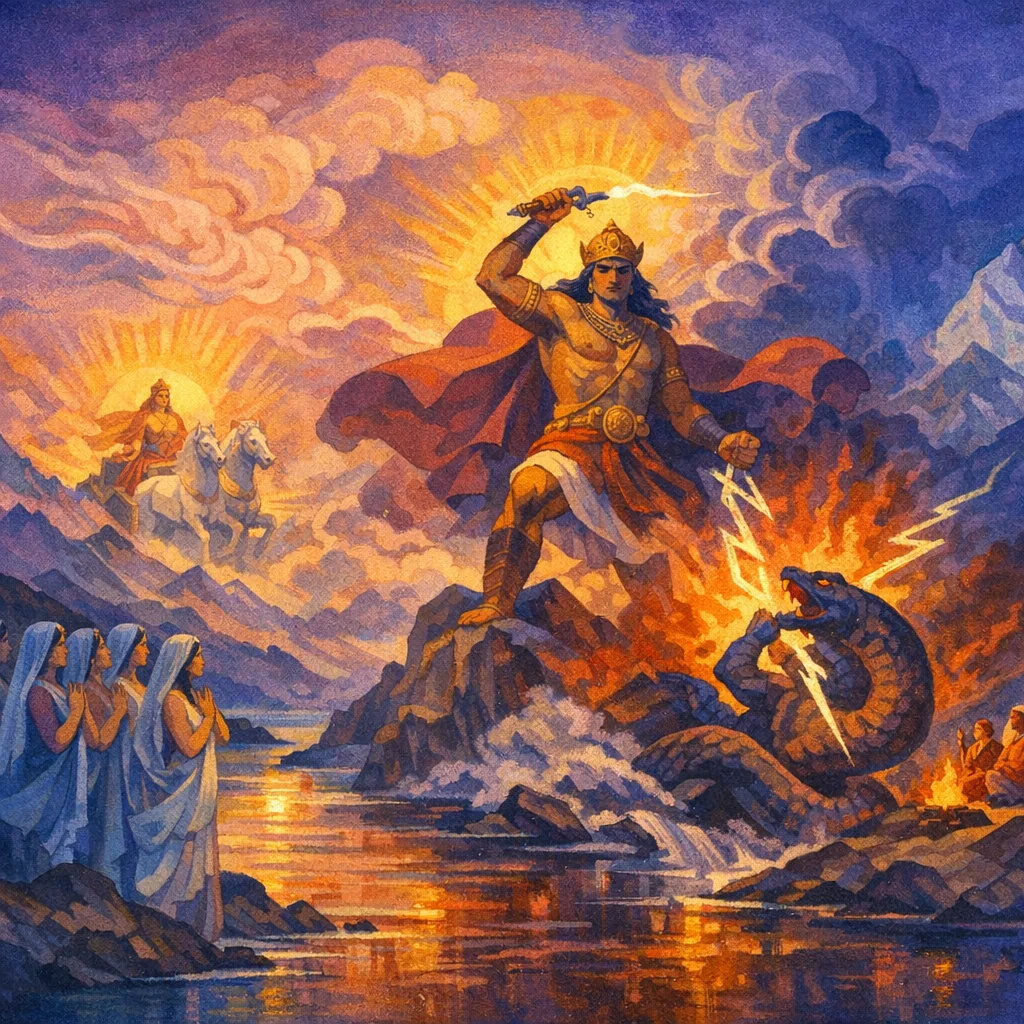
Sukta 96
Sukta 8.96
Indra (with supporting powers: Uṣas, Āpas/Sindhus)
Trishtubh (probable)
This hymn praises Indra as the power who enables a safe “crossing”—from night to dawn, from obstruction to passage—assisted by Uṣas (Dawn) and the nourishing Waters/Rivers (Āpas/Sindhus). It asks Indra to carry the inspired Word (uktha) and to propel the seeker’s understanding like a boat toward the farther shore, culminating in Indra’s Vr̥tra-slaying, skillful, swift-to-manifest help.
Mantras
Mantra 1
अस्मा उषास आतिरन्त याममिन्द्राय नक्तमूर्म्याः सुवाचः । अस्मा आपो मातरः सप्त तस्थुर्नृभ्यस्तराय सिन्धवः सुपाराः ॥
For this soul, the Dawns have crossed beyond the night’s journey, bringing to Indra the well-spoken waves of inspiration. For this one, the Waters—seven Mothers—stand ready as rivers of a good passage, to carry the human being safely across.
Mantra 2
अतिविद्धा विथुरेणा चिदस्त्रा त्रिः सप्त सानु संहिता गिरीणाम् । न तद्देवो न मर्त्यस्तुतुर्याद्यानि प्रवृद्धो वृषभश्चकार ॥
Even weapons, pierced through by the violent shock, and the thrice-seven joined ridges of the mountains—none, neither god nor mortal, can overtake those deeds that the grown Bull has done.
Mantra 3
इन्द्रस्य वज्र आयसो निमिश्ल इन्द्रस्य बाह्वोर्भूयिष्ठमोजः । शीर्षन्निन्द्रस्य क्रतवो निरेक आसन्नेषन्त श्रुत्या उपाके ॥
Indra’s thunderbolt is of iron, flashing in an instant; in Indra’s arms is the greatest might. On the head of Indra, the powers of will stand clear and distinct, pressing near for the hearing that receives the inspired word.
Mantra 4
मन्ये त्वा यज्ञियं यज्ञियानां मन्ये त्वा च्यवनमच्युतानाम् । मन्ये त्वा सत्वनामिन्द्र केतुं मन्ये त्वा वृषभं चर्षणीनाम् ॥
I hold you to be the true power of sacrifice among all sacrificial powers; I hold you to be the mover of what is otherwise immovable. I hold you, O Indra, to be the beacon of all strengths, the Bull of the peoples—he who leads the human races to victory.
Mantra 5
आ यद्वज्रं बाह्वोरिन्द्र धत्से मदच्युतमहये हन्तवा उ । प्र पर्वता अनवन्त प्र गावः प्र ब्रह्माणो अभिनक्षन्त इन्द्रम् ॥
When you set the thunderbolt in your arms, O Indra—pouring out the ecstasy of force—to slay the Serpent, then the mountains yield their resistance, the rays (cows) press forward, and the mantras of the seers move to meet Indra.
Mantra 6
तमु ष्टवाम य इमा जजान विश्वा जातान्यवराण्यस्मात् । इन्द्रेण मित्रं दिधिषेम गीर्भिरुपो नमोभिर्वृषभं विशेम ॥
Him we would affirm with praise—he who has brought forth these worlds and all that is born below. With Indra may we establish friendship by our inspired words; with acts of reverence may we enter the Bull-power and abide in it.
Mantra 7
वृत्रस्य त्वा श्वसथादीषमाणा विश्वे देवा अजहुर्ये सखायः । मरुद्भिरिन्द्र सख्यं ते अस्त्वथेमा विश्वाः पृतना जयासि ॥
When you were striving from the breath of Vṛtra’s oppression, all the gods who are comrades did not abandon you. With the Maruts may your friendship stand, O Indra; then you win all these battles.
Mantra 8
त्रिः षष्टिस्त्वा मरुतो वावृधाना उस्रा इव राशयो यज्ञियासः । उप त्वेमः कृधि नो भागधेयं शुष्मं त एना हविषा विधेम ॥
Thrice sixty the Maruts, growing in strength, increase you—like bright herds, like heaped riches, worthy of sacrifice. Come near; make for us our rightful share: with this offering we would build up your force of ardour.
Mantra 9
तिग्ममायुधं मरुतामनीकं कस्त इन्द्र प्रति वज्रं दधर्ष । अनायुधासो असुरा अदेवाश्चक्रेण ताँ अप वप ऋजीषिन् ॥
The Maruts’ front is a sharp weapon; who, O Indra, can withstand your thunderbolt? The weaponless Asuras, the godless, cast them away with your wheel, O R̥jīṣin, and clear the path for the truth-force.
Mantra 10
मह उग्राय तवसे सुवृक्तिं प्रेरय शिवतमाय पश्वः । गिर्वाहसे गिर इन्द्राय पूर्वीर्धेहि तन्वे कुविदङ्ग वेदत् ॥
Send forth a well-fashioned hymn for the Great, the fierce, the strong—towards the most auspicious increase of our inner herds (powers). For the word-bearing Indra, place the many ancient utterances into our very body; perhaps indeed he will know and awaken in us.
Mantra 11
उक्थवाहसे विभ्वे मनीषां द्रुणा न पारमीरया नदीनाम् । नि स्पृश धिया तन्वि श्रुतस्य जुष्टतरस्य कुविदङ्ग वेदत् ॥
O bearer of the inspired hymn, O all-pervading Power, set in motion our illumined understanding, as one drives a wooden vessel toward the farther shore of the rivers. Touch down into us by the thought-power, into the subtle body of what is truly heard; may one indeed come to know that which is more and more delightful to the inner hearing.
Mantra 12
तद्विविड्ढि यत्त इन्द्रो जुजोषत्स्तुहि सुष्टुतिं नमसा विवास । उप भूष जरितर्मा रुवण्यः श्रावया वाचं कुविदङ्ग वेदत् ॥
Discern well that by which Indra is truly pleased: hymn the good praise and serve with the soul’s obeisance. Adorn it, O singer; do not cry out in vain—make the Word heard, so that one indeed may come to know.
Mantra 13
अव द्रप्सो अंशुमतीमतिष्ठदियानः कृष्णो दशभिः सहस्रैः । आवत्तमिन्द्रः शच्या धमन्तमप स्नेहितीर्नृमणा अधत्त ॥
Down came the drop upon the radiant one; moving on, the dark force advanced with ten thousand (powers). Indra by his effective might came to it, to the one that was blowing/forging; and with manly mind he put away the clinging obscurations.
Mantra 14
द्रप्समपश्यं विषुणे चरन्तमुपह्वरे नद्यो अंशुमत्याः । नभो न कृष्णमवतस्थिवांसमिष्यामि वो वृषणो युध्यताजौ ॥
I saw the drop moving apart in its own courses, in the winding recess where the ray-filled rivers flow. It stood there like a black cloud-mass; I urge you on, O mighty ones, to fight in the battle.
Mantra 15
अध द्रप्सो अंशुमत्या उपस्थेऽधारयत्तन्वं तित्विषाणः । विशो अदेवीरभ्याचरन्तीर्बृहस्पतिना युजेन्द्रः ससाहे ॥
Then the drop, in the lap of the radiant one, held and sustained its own body, blazing. Indra, yoked with Bṛhaspati, overcame the ungodly clans that moved against (the light).
Mantra 16
त्वं ह त्यत्सप्तभ्यो जायमानोऽशत्रुभ्यो अभवः शत्रुरिन्द्र । गूळ्हे द्यावापृथिवी अन्वविन्दो विभुमद्भ्यो भुवनेभ्यो रणं धाः ॥
You, indeed, born from the Seven, became the enemy of the enemyless (the hostile powers), O Indra. You found out Heaven-and-Earth hidden away, and for the wide-spread worlds you established the battle-field (the decisive arena).
Mantra 17
त्वं ह त्यदप्रतिमानमोजो वज्रेण वज्रिन्धृषितो जघन्थ । त्वं शुष्णस्यावातिरो वधत्रैस्त्वं गा इन्द्र शच्येदविन्दः ॥
You, indeed, with the thunderbolt, O wielder of the bolt, struck down that immeasurable might. You drove down Śuṣṇa with the weapons of death; you found the rays of Light (the Cows), O Indra, by your effective power.
Mantra 18
त्वं ह त्यद्वृषभ चर्षणीनां घनो वृत्राणां तविषो बभूथ । त्वं सिन्धूँरसृजस्तस्तभानान्त्वमपो अजयो दासपत्नीः ॥
You, the Bull of the peoples, became the smiter of the obstructers, mighty in force. You released the rivers that were held fast; you won the Waters that were made to serve the Dāsa (the dark power).
Mantra 19
स सुक्रतू रणिता यः सुतेष्वनुत्तमन्युर्यो अहेव रेवान् । य एक इन्नर्यपांसि कर्ता स वृत्रहा प्रतीदन्यमाहुः ॥
He is the good-in-will, the victor, who in the soma-pressings has an unsurpassed ardour, who is rich like a serpent (in stored power). He alone is the doer of the works for man; him, the slayer of obstruction, they call the match for every other.
Mantra 20
स वृत्रहेन्द्रश्चर्षणीधृत्तं सुष्टुत्या हव्यं हुवेम । स प्राविता मघवा नोऽधिवक्ता स वाजस्य श्रवस्यस्य दाता ॥
That Indra, slayer of obstruction, upholder of the peoples, him we call with the well-formed praise as the offering. He is our protector, the bounteous one, our over-speaker (advocate); he is the giver of plenitude of force and of luminous fame.
Mantra 21
स वृत्रहेन्द्र ऋभुक्षाः सद्यो जज्ञानो हव्यो बभूव । कृण्वन्नपांसि नर्या पुरूणि सोमो न पीतो हव्यः सखिभ्यः ॥
He—Indra the slayer of the Coverer, the power of skillful formation—born at once into manifestation, becomes worthy to be invoked. He accomplishes many humanly-helpful works; like Soma when drunk, he becomes an offering of delight for the comrades (the inner powers that accompany the seeker).
Frequently Asked Questions
It asks Indra to remove obstacles and carry the worshipper safely across danger and darkness, with Dawn and the Waters helping open the way and awaken clear understanding.
They are supportive powers that symbolize the opening of light and the release of life-energy. In the hymn, they prepare the passage that Indra makes victorious and secure.
It can be recited in Indra-focused worship, especially around dawn or in Soma-related rites, to pray for protection, success in difficult transitions, and stronger inspired speech and insight.