Sukta 2
Sukta 4.2
Vāmadeva Gautama (traditional attribution for RV 4.2)
Agni
Triṣṭubh (probable for RV 4.2; this verse conforms to Triṣṭubh cadence)
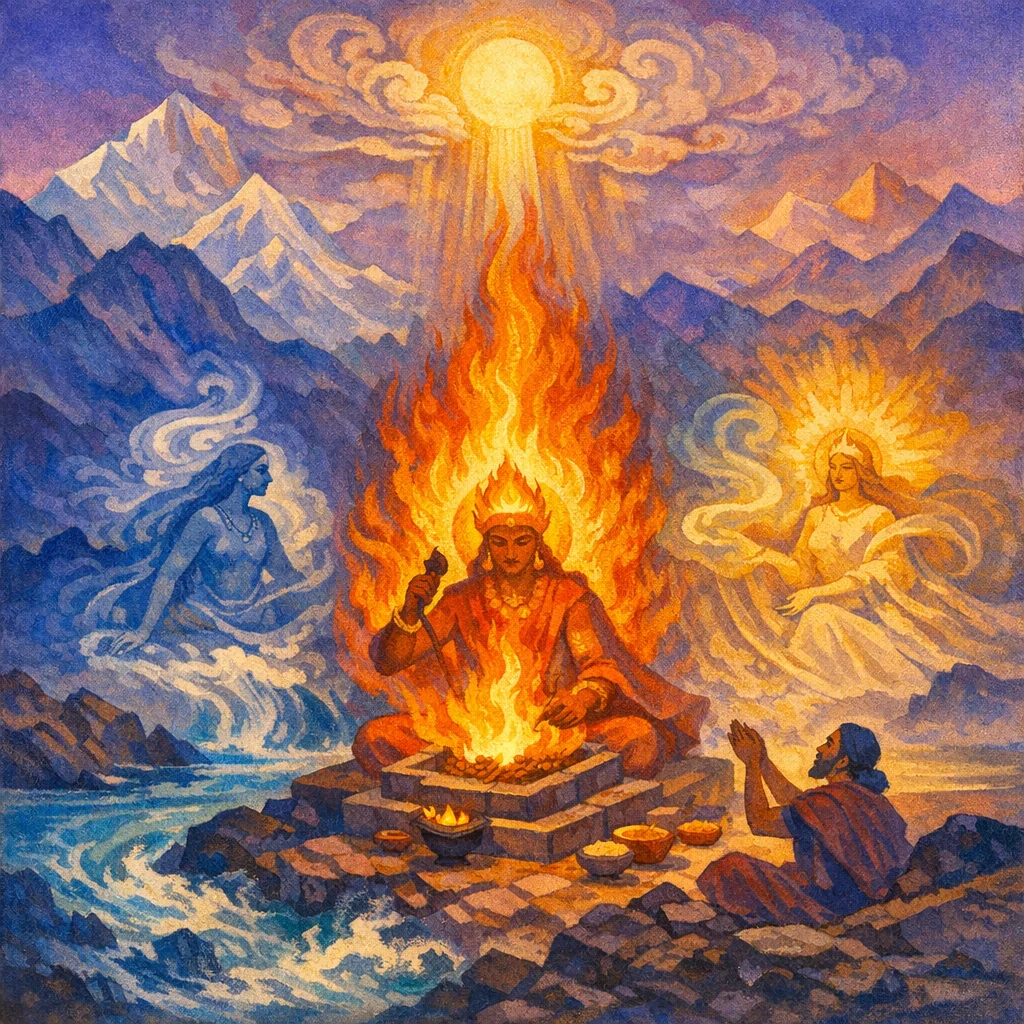
RV 4.2 is a Vāmadeva hymn to Agni as the immortal within mortals—hotṛ, seer, and active power among the gods—who establishes ṛta (truth-order) in human life through sacrifice and inspiration. It asks Agni to kindle luminous intelligence, to separate right discernment from confused and crooked impulses, and to bestow a wide, many-formed prosperity that supports posterity. The hymn closes with the poet’s offerings of speech and a call for Agni to blaze forth and grant the “great wealth” of a fuller good.
Mantras
Mantra 1
यो मर्त्येष्वमृत ऋतावा देवो देवेष्वरतिर्निधायि । होता यजिष्ठो मह्ना शुचध्यै हव्यैरग्निर्मनुष ईरयध्यै ॥
He who, immortal amid mortals, the god who bears the Truth (ṛta-vān), has been set as the active mover among the gods—Agni, the Hotar, most skilled in offering: by his greatness he kindles the luminous intelligence, and by the oblations he impels the human being upward.
Mantra 2
इह त्वं सूनो सहसो नो अद्य जातो जाताँ उभयाँ अन्तरग्ने । दूत ईयसे युयुजान ऋष्व ऋजुमुष्कान्वृषणः शुक्राँश्च ॥
Here, O son of force, born today for us, enter between both births (both worlds), O Agni. As messenger you go, yoking the high energies—strong, straight-driven, and brilliant—so that the journey between the human and the divine may be made.
Mantra 3
अत्या वृधस्नू रोहिता घृतस्नू ऋतस्य मन्ये मनसा जविष्ठा । अन्तरीयसे अरुषा युजानो युष्माँश्च देवान्विश आ च मर्तान् ॥
Swift are your coursers, growing in strength, ruddy and dripping with the ghee of delight; by mind I perceive them as the most rapid for the Truth. Thus you move between, yoking the ruddy powers, bringing together you gods and the human clans as one movement toward ṛta.
Mantra 4
अर्यमणं वरुणं मित्रमेषामिन्द्राविष्णू मरुतो अश्विनोत । स्वश्वो अग्ने सुरथः सुराधा एदु वह सुहविषे जनाय ॥
Bring Aryaman, Varuna, Mitra—bring Indra and Vishnu, the Maruts and the Ashvins. O Agni, with good steeds, good chariot, and good accomplishings, carry them indeed to the people who offer well: let the human vessel receive the full assembly of the powers.
Mantra 5
गोमाँ अग्नेऽविमाँ अश्वी यज्ञो नृवत्सखा सदमिदप्रमृष्यः । इळावाँ एषो असुर प्रजावान्दीर्घो रयिः पृथुबुध्नः सभावान् ॥
O Agni, the sacrifice becomes rich in rays of light (cows), rich in formative powers (sheep), rich in swift energies (horses); it has the noble as comrades and is invincible in its seat. This is your might, O luminous Asura: a sacrifice full of Ila (revelation), full of progenitive force; it yields a long-lasting plenitude (rayi), broad-based and fit for the assembly of the inner powers.
Mantra 6
यस्त इध्मं जभरत्सिष्विदानो मूर्धानं वा ततपते त्वाया । भुवस्तस्य स्वतवाँ: पायुरग्ने विश्वस्मात्सीमघायत उरुष्य ॥
Whoever brings you the fuel with eager kindling, or heats his very head for you (in ardor of tapas), for him you become the self-strong protector, O Agni; from every ill-willer, from all hostility, widen and guard him.
Mantra 7
यस्ते भरादन्नियते चिदन्नं निशिषन्मन्द्रमतिथिमुदीरत् । आ देवयुरिनधते दुरोणे तस्मिन्रयिर्ध्रुवो अस्तु दास्वान् ॥
Who brings you food even when it is scarce, who seats the gladdening Guest and lifts him up—when the god-seeking one kindles you in the home, for that giver let there be a steady plenitude (rayi) that does not fail.
Mantra 8
यस्त्वा दोषा य उषसि प्रशंसात्प्रियं वा त्वा कृणवते हविष्मान् । अश्वो न स्वे दम आ हेम्यावान्तमंहसः पीपरो दाश्वांसम् ॥
Who praises you by night and who at dawn, or who makes you dear by his offering—like a horse in its own stable, come home to him. O Agni, you who hold the rein, carry that giver across distress and narrowness.
Mantra 9
यस्तुभ्यमग्ने अमृताय दाशद्दुवस्त्वे कृणवते यतस्रुक् । न स राया शशमानो वि योषन्नैनमंहः परि वरदघायोः ॥
Who offers to you, O Agni, to the Immortal, and makes his reverent service in you with disciplined ladle—he does not fall away from plenitude though he strives; distress does not close around him, nor the malice of the ill-willer.
Mantra 10
यस्य त्वमग्ने अध्वरं जुजोषो देवो मर्तस्य सुधितं रराणः । प्रीतेदसद्धोत्रा सा यविष्ठासाम यस्य विधतो वृधासः ॥
Whose path of offering you accept, O Agni—shining god delighting in the well-ordered work of the mortal—then the priestly power (hotrā) sits there in joy. O youngest, for that one who serves, the growths of being increase.
Mantra 11
चित्तिमचित्तिं चिनवद्वि विद्वान्पृष्ठेव वीता वृजिना च मर्तान् । राये च नः स्वपत्याय देव दितिं च रास्वादितिमुरुष्य ॥
O Agni, the knower, discern and gather for us the right discriminations and separate them from the false and confused movements; like one who chooses the sound support, set apart the crooked mortal impulses. Give us the plenitude (rāyí) and the power to found a noble posterity; grant us Diti (the right division and ordering), and safeguard for us Aditi (the undivided infinity).
Mantra 12
कविं शशासुः कवयोऽदब्धा निधारयन्तो दुर्यास्वायोः । अतस्त्वं दृश्याँ अग्न एतान्पड्भिः पश्येरद्भुताँ अर्य एवैः ॥
The seers, unbetrayed, have instructed the Seer and have set him firmly within the dwelling-places of life-force. Therefore, O Agni, do thou behold these visible wonders with thy paths—thou who art the noble one by thy goings.
Mantra 13
त्वमग्ने वाघते सुप्रणीतिः सुतसोमाय विधते यविष्ठ । रत्नं भर शशमानाय घृष्वे पृथु श्चन्द्रमवसे चर्षणिप्राः ॥
Thou, O Agni, art the perfect leader for the giver of the offering, for the sacrificer who presses Soma; O youngest, bring the treasure to the striving one, to the ardent. Wide and luminous be thy aid for the peoples who advance.
Mantra 14
अधा ह यद्वयमग्ने त्वाया पड्भिर्हस्तेभिश्चकृमा तनूभिः । रथं न क्रन्तो अपसा भुरिजोॠतं येमुः सुध्य आशुषाणाः ॥
And then, O Agni, when we have fashioned with our paths, our hands, our very bodies a work for thee—advancing like a chariot by our labour—may the clear-minded, swift in impulse, hold fast to the Truth (ṛta).
Mantra 15
अधा मातुरुषसः सप्त विप्रा जायेमहि प्रथमा वेधसो नॄन् । दिवस्पुत्रा अङ्गिरसो भवेमाद्रिं रुजेम धनिनं शुचन्तः ॥
Then may we be born as the seven inspired ones from the Mother Dawn, first among the fashioners of man. May we become the Angirases, sons of Heaven; shining with purity, may we break the stone and release the wealth that is held within.
Mantra 16
अधा यथा नः पितरः परासः प्रत्नासो अग्न ऋतमाशुषाणाः । शुचीदयन्दीधितिमुक्थशासः क्षामा भिन्दन्तो अरुणीरप व्रन् ॥
Then, as our fathers of old, the ancient ones, eager for the Truth, did—so also, O Agni: pure, proclaiming the word, they brought the shining flame; breaking open the earth, they uncovered the ruddy lights and cast them free.
Mantra 17
सुकर्माणः सुरुचो देवयन्तोऽयो न देवा जनिमा धमन्तः । शुचन्तो अग्निं ववृधन्त इन्द्रमूर्वं गव्यं परिषदन्तो अग्मन् ॥
Doing the good work, bright of light, turning godward, they forged their birth like gods with their breath of power. Purifying themselves, they increased Agni and strengthened Indra; they went and sat around the wide pen of the luminous herds (rays of knowledge).
Mantra 18
आ यूथेव क्षुमति पश्वो अख्यद्देवानां यज्जनिमान्त्युग्र । मर्तानां चिदुर्वशीरकृप्रन्वृधे चिदर्य उपरस्यायोः ॥
Like a herd, the rich life-powers came into view when the mighty birth of the gods drew near. Even for mortals the Urvaśīs (wide-shining inspirations) were fashioned; even for increase the noble one found the higher life-force.
Mantra 19
अकर्म ते स्वपसो अभूम ऋतमवस्रन्नुषसो विभातीः । अनूनमग्निं पुरुधा सुश्चन्द्रं देवस्य मर्मृजतश्चारु चक्षुः ॥
We have become thy good workers, O Agni; the Dawns, shining out, have poured forth the Truth. In many ways they have made Agni flawless and beautifully luminous; they polish the god’s lovely eye (the vision of fire).
Mantra 20
एता ते अग्न उचथानि वेधोऽवोचाम कवये ता जुषस्व । उच्छोचस्व कृणुहि वस्यसो नो महो रायः पुरुवार प्र यन्धि ॥
These utterances, O Agni the Ordainer, we have spoken to thee the Seer; accept them. Blaze out; make for us a greater good. Send forth toward us the great plenitude, rich in many desirable forms.
Frequently Asked Questions
It presents Agni as the divine fire who brings truth-order (ṛta) into human life—through worship he awakens clear intelligence and leads the seeker upward, while also granting protection and prosperity.
The hymn asks Agni to help us recognize true understanding (citti) and separate it from confusion or wrong movement (acitti), so our actions become straight and well-ordered rather than crooked.
Here Diti points to right division, measure, and ordering in life, while Aditi points to the undivided, expansive wholeness; the prayer seeks both: good order without losing inner freedom and infinity.