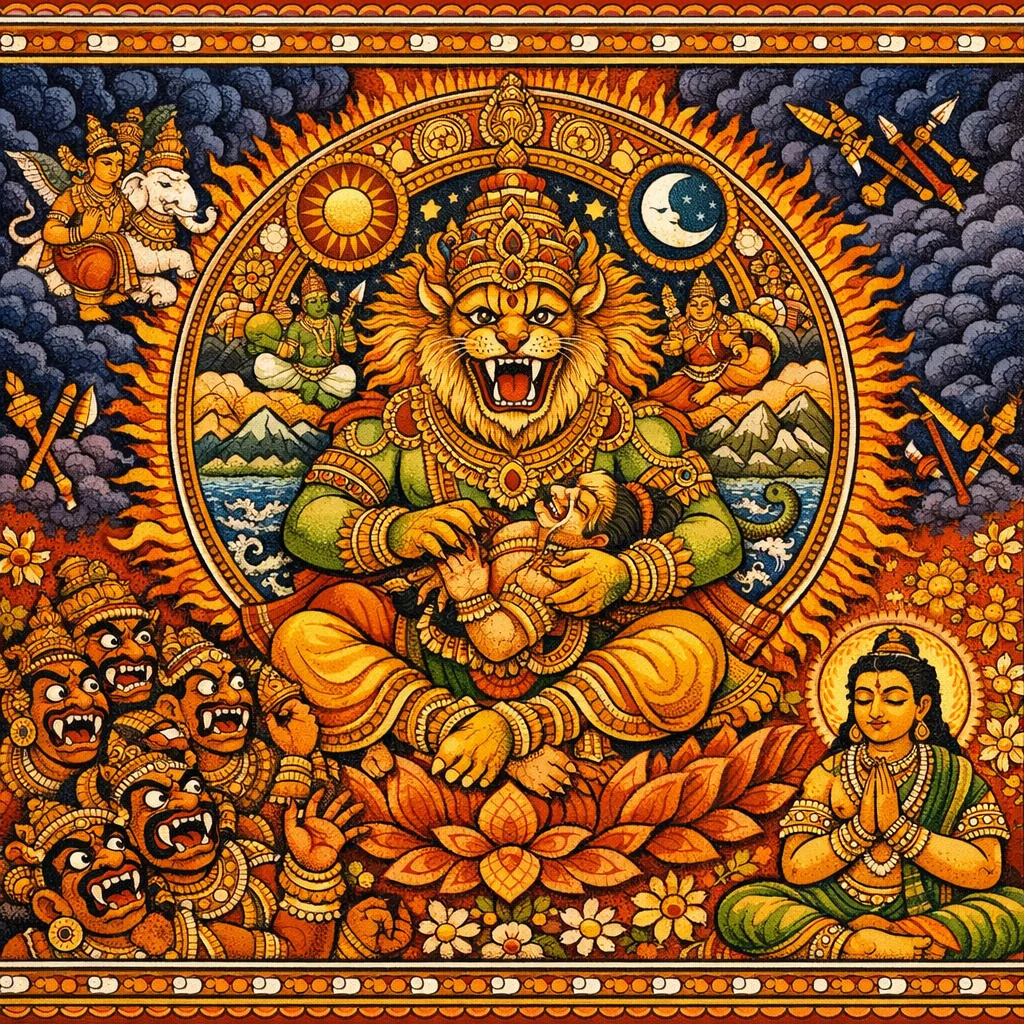
Adhyaya 162: The Advent of Narasiṃha and Hiraṇyakaśipu’s Weapon-Assault
नरसिंहागमनं हिरण्यकशिप्वस्त्रप्रयोगश्च
Speaker: Sūta, Prahlāda, Hiraṇyakaśipu
Adhyāya 162 unfolds as a high-theology battle tableau framed in Sūta’s narration. Narasiṃha arrives as the very “Wheel of Time,” a liminal form (man-lion) that destabilizes Daitya certainty and signals divine intervention beyond ordinary categories. Prahlāda, endowed with divine sight, interprets the form through a cosmic lens: within Narasiṃha are contained gods, worlds, mountains, oceans, luminaries, ethical ordinances (lokadharma), and even inner states such as desire, wrath, delusion, and steadfastness—echoing Purāṇic viśvarūpa logic and asserting the Lord as the totality of cosmos and moral order. Hiraṇyakaśipu responds with political-martial arrogance, commanding seizure and death, then unleashing an encyclopedic catalogue of astras/mantras (daṇḍa, kālacakra, viṣṇucakra, pāśupata, nārāyaṇa, etc.). Yet the text emphasizes the Lord’s immovability: despite being enveloped by blazing missiles and Daitya forces, Narasiṃha stands unshaken like Himālaya, while the Daityas reel in fear—teaching the supremacy of dharma-aligned divine order over coercive power.
Key Concepts
Shlokas in Adhyaya 162
Verse 1
*सूत उवाच ततो दृष्ट्वा महात्मानं कालचक्रमिवागतम् नरसिंहवपुश्छन्नं भस्मच्छन्नमिवानलम् //
Sūta said: Then, seeing that great-souled being arrive like the very Wheel of Time, veiled in a man-lion form—like fire covered over with ash—(they were struck with awe).
Verse 2
हिरण्यकशिपोः पुत्रः प्रह्लादो नाम वीर्यवान् दिव्येन चक्षुषा सिंहम् अपश्यद्देवमागतम् //
Prahlāda, the valiant son of Hiraṇyakaśipu, with divine sight beheld the Lion-like Deity arriving.
Verse 3
ते दृष्ट्वा रुक्मशैलाभम् अपूर्वां तनुमाश्रितम् विस्मिता दानवाः सर्वे हिरण्यकशिपुश्च सः //
Seeing that unprecedented form—resembling a mountain of gold—all the Dānavas were struck with amazement, and Hiraṇyakaśipu as well.
Verse 4
*प्रह्लाद उवाच महाबाहो महाराज दैत्यानामादिसंभव न श्रुतं न च नो दृष्टं नारसिंहमिदं वपुः //
Prahlāda said: “O mighty-armed great king, prime progenitor of the Daityas—this man-lion form has neither been heard of by us nor ever seen by us.”
Verse 5
अव्यक्तप्रभवं दिव्यं किमिदं रूपमागतम् दैत्यान्तकरणं घोरं संशतीव मनो मम //
“Born of the Unmanifest, truly divine—what is this form that has come forth? Terrible, a destroyer of the Daityas—my mind seems to tremble with anxious doubt.”
Verse 6
अस्य देवाः शरीरस्थाः सागराः सरितश्च याः हिमवान्पारियात्रश्च ये चान्ये कुलपर्वताः //
Within his very body abide the gods; and within it are the oceans and the rivers—Himavān (the Himalaya), Pāriyātra, and all the other lineage-mountains (kulaparvatas) as well.
Verse 7
चन्द्रमाश्च सनक्षत्रैर् आदित्यैर् वसुभिः सह धनदो वरुणश्चैव यमः शक्रः शचीपतिः //
And the Moon, together with the constellations; along with the Ādityas and the Vasus; as well as Dhanada (Kubera), Varuṇa, Yama, and Śakra—Indra, the lord of Śacī.
Verse 8
मरुतो देवगन्धर्वा ऋषयश्च तपोधनाः नागा यक्षाः पिशाचाश्च राक्षसा भीमविक्रमाः //
The Maruts, the divine Gandharvas, and the sages rich in ascetic power; the Nāgas, Yakṣas, Piśācas, and the Rākṣasas of dreadful might—(all are spoken of here).
Verse 9
ब्रह्मा देवः पशुपतिर् ललाटस्था भ्रमन्ति वै स्थावराणि च सर्वाणि जङ्गमानि तथैव च //
Brahmā, the divine Lord Paśupati, and the beings abiding at (his) forehead—indeed all stationary things and all moving creatures alike—begin to reel and whirl about.
Verse 10
भवांश्च सहितो ऽस्माभिः सर्वैर्दैत्यगणैर्वृतः विमानशतसंकीर्णा तथैव भवतः सभा //
And you too, together with us—surrounded by all the hosts of Daityas—(stand here); likewise, your assembly-hall is crowded with hundreds of aerial chariots (vimānas).
Verse 11
सर्वं त्रिभुवनं राजंल् लोकधर्माश्च शाश्वताः दृश्यन्ते नारसिंहे ऽस्मिंस् तथेदमखिलं जगत् //
O King, in this Narasiṃha all the three worlds are seen, along with the eternal ordinances of the worlds; likewise, the entire universe is seen in Him.
Verse 12
प्रजापतिश्चात्र मनुर् महात्मा ग्रहाश्च योगाश्च महीरुहाश्च उत्पातकालश्च धृतिर्मतिश्च रतिश्च सत्यं च तपो दमश्च //
Here are spoken of Prajāpati and the great-souled Manu; the planets (grahas) and the sacred disciplines (yogas); the trees of the earth; the times of portents; and also steadfastness, understanding, desire, truth, austerity, and self-restraint.
Verse 13
सनत्कुमारश्च महानुभावो विश्वे च देवा ऋषयश्च सर्वे क्रोधश्च कामश्च तथैव हर्षो धर्मश्च मोहः पितरश्च सर्वे //
Sanatkumāra, the great-souled one, and the Viśvedevas, and all the sages; likewise Wrath and Desire, and also Joy; Dharma and Delusion; and all the Pitṛs (ancestral fathers)—all of these are (to be understood as present/operative within the cosmic order).
Verse 14
प्रह्लादस्य वचः श्रुत्वा हिरण्यकशिपुः प्रभुः उवाच दानवान्सर्वान् गणांश्च स गणाधिपः //
Having heard Prahlāda’s words, the lord Hiraṇyakaśipu—chief of the hosts—addressed all the Dānavas and the assembled groups.
Verse 15
मृगेन्द्रो गृह्यतामेष अपूर्वां तनुमास्थितः यदि वा संशयः कश्चिद् वध्यतां वनगोचरः //
“Let this lord of beasts be seized—he has assumed an unprecedented form. And if there is any doubt at all, then let this forest-roaming creature be slain.”
Verse 16
ते दानवगणा सर्वे मृगेन्द्रं भीमविक्रमम् परिक्षिपन्तो मुदितास् त्रासयामासुरोजसा //
All those bands of Dānavas, delighted, surrounded the lion-king of beasts—terrible in valor—and with their sheer force they struck fear (and caused panic).
Verse 17
सिंहनादं विमुच्याथ नरसिंहो महाबलः बभञ्ज तां सभां दिव्यां व्यादितास्य इवान्तकः //
Then the mighty Narasiṃha, releasing a lion-like roar, shattered that wondrous assembly hall—like Death (Antaka) with jaws gaping wide.
Verse 18
सभायां भज्यमानायां हिरण्यकशिपुः स्वयम् चिक्षेपास्त्राणि सिंहस्य रोषाद्व्याकुललोचनः //
When the assembly-hall was being shattered, Hiraṇyakaśipu himself—his eyes trembling in fury at the Lion—hurled his weapons.
Verse 19
सर्वास्त्राणामथ ज्येष्ठं दण्डमन्त्रं सुदारुणम् कालचक्रं तथाघोरं विष्णुचक्रं तथा परम् //
Then (is named) the foremost among all weapons—the dreadfully fierce Daṇḍa-mantra; also the terrible Wheel of Time (Kāla-cakra), and, supreme above all, the Wheel of Viṣṇu.
Verse 20
पैतामहं तथात्युग्रं त्रैलोक्यदहनं महत् विचित्रामशनीं चैव शुष्कार्द्रं चाशनिद्वयम् //
“(There is) the Paitāmaha (Brahmā-born) thunderbolt; and also the exceedingly fierce, mighty (one) that burns the three worlds; likewise the variegated thunderbolt; and the pair of thunderbolts—one ‘dry’ and one ‘moist’.”
Verse 21
रौद्रं तथोग्रं शूलं च कङ्कालं मुसलं तथा मोहनं शोषणं चैव संतापनविलापनम् //
‘Raudra’ and ‘Ugra’, ‘Śūla’, ‘Kaṅkāla’, and ‘Musala’; likewise ‘Mohana’ and ‘Śoṣaṇa’, as well as ‘Saṃtāpana’ and ‘Vilāpana’—these are (the named) mantras/astric forces to be employed.
Verse 22
वायव्यं मथनं चैव कापालमथ कैङ्करम् तथाप्रतिहतां शक्तिं क्रौञ्चमस्त्रं तथैव च //
“(He also taught/mentioned) the Vāyavya weapon, the Mathana weapon, the Kāpāla weapon, the Kaiṅkara weapon; likewise the unfailing Śakti (spear/power), and also the Kraunca weapon.”
Verse 23
अस्त्रं ब्रह्मशिरश्चैव सोमास्त्रं शिशिरं तथा कम्पनं शातनं चैव त्वाष्ट्रं चैव सुभैरवम् //
“(There are) the Astra called Brahmaśiras, and also the Soma-astra; likewise the Śiśira (chilling) weapon; the Kampana (trembling) and Śātana (destroying) weapons; and also the Tvāṣṭra weapon, as well as the Subhairava (very-terrifying) weapon.”
Verse 24
कालमुद्गरमक्षोभ्यं तपनं च महाबलम् संवर्तनं मोहनं च तथा मायाधरं परम् //
“(He is) Kālamudgara, the Unshakable (Akṣobhya), Tapana, the Greatly Mighty (Mahābala), Saṃvartana, Mohana, and the supreme Māyādhara (Bearer of divine illusion).”
Verse 25
गान्धर्वमस्त्रं दयितम् असिरत्नं च नन्दकम् प्रस्वापनं प्रमथनं वारुणं चास्त्रमुत्तमम् अस्त्रं पाशुपतं चैव यस्याप्रतिहता गतिः //
Beloved to him was the Gāndharva missile; he also possessed the jewel-like sword Nandaka—along with the sleep-inducing weapon, the crushing (Pramathana) weapon, and the excellent Vāruṇa weapon. He further held the Pāśupata weapon, whose course is unstoppable.
Verse 26
अस्त्रं हयशिरश्चैव ब्राह्ममस्त्रं तथैव च नारायणास्त्रमैन्द्रं च सार्पमस्त्रं तथाद्भुतम् //
Also (there are) the Hayashiras weapon, the Brahmā-weapon, the Nārāyaṇa weapon, the Indra-weapon, and likewise the Serpent weapon—truly wondrous.
Verse 27
पैशाचमस्त्रमजितं शोषदं शामनं तथा महाबलं भावनं च प्रस्थापनविकम्पने //
“(These are) the Paiśāca weapon-formula, the Unconquered (Ajita) formula, the drying-up (Śoṣada) and the pacifying (Śāmana) formulae; likewise the Great-strength (Mahābala) and the Empowering/Consecrating (Bhāvana) formulae—along with those for installing (the deity/image) and for causing tremor (vikampana).”
Verse 28
एतान्यस्त्राणि दिव्यानि हिरण्यकशिपुस्तदा असृजन्नरसिंहस्य दीप्तस्याग्नेरिवाहुतिम् //
Then Hiraṇyakaśipu hurled these divine missiles at Narasiṃha—like offerings cast into a blazing fire.
Verse 29
अस्त्रैः प्रज्वलितैः सिंहम् आवृणोदसुरोत्तमः विवस्वान् घर्मसमये हिमवन्तमिवांशुभिः //
With blazing missiles, that foremost of Asuras enveloped the lion—just as the Sun, in the heat of summer, covers Himavat with his rays.
Verse 30
स ह्यमर्षानिलोद्भूतो दैत्यानां सैन्यसागरः क्षणेन प्लावयामास मैनाकमिव सागरः //
For the ocean-like army of the Daityas, risen as if from a wind of wrath, in a moment flooded everything—like the sea engulfing Mount Maināka.
Verse 31
प्रासैः पाशैश्च खड्गैश्च गदाभिर्मुसलैस्तथा वज्रैरशनिभिश्चैव साग्निभिश्च महाद्रुमैः //
With spears and nooses, with swords, with maces and clubs as well; with thunderbolt-like weapons and lightning strikes, and also with blazing great trees, (they fought/assailed one another).
Verse 32
मुद्गरैर्भिन्दिपालैश्च शिलोलूखलपर्वतैः शतघ्नीभिश्च दीप्ताभिर् दण्डैरपि सुदारुणैः //
With maces and bhindipāla-spears, with rocks, stone mortars, and mountain-like boulders; with blazing śataghnī weapons as well, and with exceedingly dreadful staves—(they fought/assailed).
Verse 33
ते दानवाः पाशगृहीतहस्ता महेन्द्रतुल्याशनिवज्रवेगाः समन्ततो ऽभ्युद्यतबाहुकायाः स्थितास्त्रिशीर्षा इव नागपाशाः //
Those Dānavas, with nooses gripped in their hands, swift as Indra’s thunderbolt and lightning, stood all around with their arms raised—like serpent-nooses, as though triple-headed, poised to strike.
Verse 34
सुवर्णमालाकुलभूषिताङ्गाः पीतांशुकाभोगविभाविताङ्गाः मुक्तावलीदामसनाथकक्षा हंसा इवाभान्ति विशालपक्षाः //
Their limbs are richly adorned with garlands of gold; their bodies are made resplendent by the flowing drape of yellow garments; their waists are girded and beautified by strings of pearl-necklaces—thus they shine like broad-winged swans.
Verse 35
तेषां तु वायुप्रतिमौजसां वै केयूरमौलीवलयोत्कटानाम् तान्युत्तमाङ्गान्यभितो विभान्ति प्रभातसूर्यांशुसमप्रभाणि //
And of those beings whose vigor is like the wind, adorned with splendid armlets, crowns, and bracelets, their noble heads shine all around with a brilliance equal to the rays of the rising sun.
Verse 36
क्षिपद्भिर् उग्रैर् ज्वलितैर् महाबलैर् महास्त्रपूगैः सुसमावृतो बभौ / गिरिर्यथा संततवर्षिभिर् घनैः कृतान्धकारान्तरकंदरो द्रुमैः //
Covered on all sides by volleys of mighty, blazing, fierce missiles, he appeared enveloped completely—like a mountain continually rained upon by dense clouds, whose ravines and inner caves become darkened amid the trees.
Verse 37
तैर्हन्यमानो ऽपि महास्त्रजालैर् महाबलैर् दैत्यगणैः समेतैः / नाकम्पताजौ भगवान्प्रतापस्थितः प्रकृत्या हिमवानिवाचलः //
Though struck by volleys of mighty, interlaced weapons hurled together by hosts of powerful Daityas, the Blessed Lord did not tremble on the battlefield; established in His own splendor by His very nature, He stood unmoving—like the Himālaya, steadfast and unshaken.
Verse 38
संत्रासितास्तेन नृसिंहरूपिणा दितेः सुताः पावकतुल्यतेजसा / भयाद्विचेलुः पवनोद्धुताङ्गा यथोर्मयः सागरवारिसंभवाः //
Terrified by Him in the form of Narasiṃha, blazing with a radiance equal to fire, the sons of Diti reeled and staggered in fear— their bodies shaken as if struck by wind—like the waves that arise from the ocean’s waters.
Frequently Asked Questions
The chapter teaches that the Lord’s dharma-rooted cosmic sovereignty (seen as Narasiṃha/Time and as the universe itself) cannot be overpowered by mere astric force or political violence. Prahlāda’s vision frames Narasiṃha as the total order—worlds, gods, and lokadharma—so Hiraṇyakaśipu’s weapon-catalogue becomes a demonstration of how coercion collapses before the divine principle that upholds reality.
This adhyāya is primarily Dharma and avatāra-itihāsa: Narasiṃha’s advent, Prahlāda’s theological interpretation, and the defeat of Daitya aggression. It also contains an astra/mantra-vidyā style catalogue (martial knowledge). Vāstu-śāstra and architectural prescriptions are not the focus here, except for the narrative detail of the assembly hall being shattered.
It is a viśvarūpa-type statement: the Lord is presented as the ground of both the physical cosmos (lokas, rivers, mountains, luminaries) and the moral-psychological cosmos (dharma, moha, kāma, krodha). This establishes Narasiṃha not as a mere combatant but as the totality in whom all forces operate—making resistance ultimately futile.
Named weapons/mantras include Daṇḍa-mantra, Kāla-cakra, Viṣṇu-cakra, Paitāmaha vajra, Raudra, Ugra, Śūla, Kaṅkāla, Musala, Mohana, Śoṣaṇa, Saṃtāpana, Vilāpana, Vāyavya, Mathana, Kāpāla, Kaiṅkara, (unfailing) Śakti, Krauñca, Brahmaśiras, Soma-astra, Śiśira, Kampana, Śātana, Tvāṣṭra, Subhairava, Kālamudgara, Akṣobhya, Tapana, Mahābala, Saṃvartana, Māyādhara, Gāndharva astra, sword Nandaka, Prasvāpanā, Pramathana, Vāruṇa, Pāśupata, Hayāśiras, Brāhma, Nārāyaṇa, Aindra, Sārpa, Paiśāca, Ajita, Śoṣada, Śāmana, Bhāvana, and formulas for Prasthāpana and Vikampana.