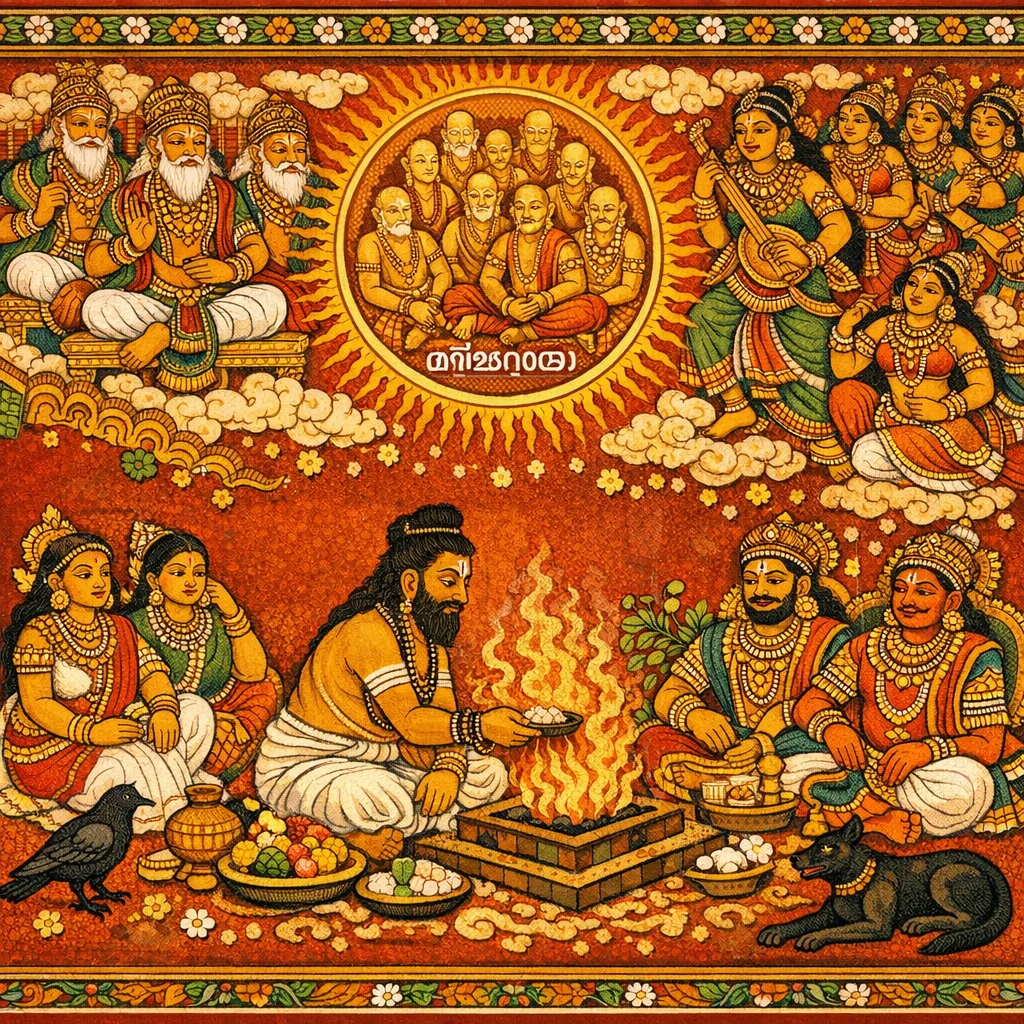
Adhyaya 15: Pitṛ Worlds (Pitṛ-lokas) and the Śrāddha Rite: Lineages, Benefits, and Offerings to Avoid
पितृलोकवर्णनं श्राद्धविधिश्च
Speaker: Sūta
Sūta continues a dharma-centered account, describing radiant Pitṛ realms (Vibhrājā and others) where performers of śrāddha rejoice and many celestial beings join in worship. He introduces the Yoginī/Yogamātā Pīvarī, whose austerities win Hari’s boon: she will marry Śuka and bear Kṛtvī, linking ascetic power with royal lineages. The chapter then lists Pitṛ classes and their worlds—Mānasas (sons of Vasiṣṭha), Haviṣmān (sons of Aṅgiras in Marīcigarbhā within the Sun), Susvadhā, Ājyapā (of Prajāpati Kardama), and Somapā (beyond the cosmic egg). Mind-born daughters—Gaur, Yaśodā, Lokā/Kāmadughā, Virajā, Narmadā—bridge cosmic ancestry, dynastic history, and sacred rivers. Sūta finally codifies śrāddha: its primordial institution, essential materials (silver vessel, water, tila, kuśa), proper orientation (south), recommended offerings and explicit prohibitions, concluding with the Pitṛs’ boons and their gentle, swift-to-favor nature.
Key Concepts
Shlokas in Adhyaya 15
Verse 1
*सूत उवाच विभ्राजा नाम चान्ये तु दिवि सन्ति सुवर्चसः लोका बर्हिषदो यत्र पितरः सन्ति सुव्रताः //
Sūta said: In heaven there are radiant worlds as well; among them is one called Vibhrājā. There dwell the Pitṛs known as the Barhiṣads, steadfast in sacred vows and observances.
Verse 2
यत्र बर्हिणयुक्तानि विमानानि सहस्रशः संकल्प्या बर्हिषो यत्र तिष्ठन्ति फलदायिनः //
There, by mere resolve, thousands of aerial vimānas appear, adorned with peacock-feathers; and there the ritual grasses called barhis, duly arranged, stand ever as bestowers of fruits—merits.
Verse 3
यत्राभ्युदयशालासु मोदन्ते श्राद्धदायिनः यांश् च देवासुरगणा गन्धर्वाप्सरसां गणाः //
There, in halls meant for auspicious rites, the performers of Śrāddha rejoice; and there too the hosts of gods and asuras, and the companies of Gandharvas and Apsarases, take delight.
Verse 4
यक्षरक्षोगणाश्चैव यजन्ति दिवि देवताः पुलस्त्यपुत्राः शतशस् तपोयोगसमन्विताः //
The hosts of Yakṣas and Rākṣasas too worship the gods in heaven; and the sons of Pulastya—by the hundreds—endowed with austerity and yogic discipline, likewise perform that worship.
Verse 5
महात्मानो महाभागा भक्तानामभयप्रदाः एतेषां पीवरी कन्या मानसी दिवि विश्रुता //
They are great-souled and greatly fortunate, granting fearlessness to their devotees. Among them, the maiden Pīvarī—mind-born (mānasa)—has become renowned in heaven.
Verse 6
योगिनी योगमाता च तपश्चक्रे सुदारुणम् प्रसन्नो भगवांस्तस्या वरं वव्रे तु सा हरेः //
The Yoginī—also called Yogamātā—undertook exceedingly severe austerities. Pleased with her, the Blessed Lord (Hari) granted her a boon, and she chose a boon from Hari.
Verse 7
योगवन्तं सुरूपं च भर्तारं विजितेन्द्रियम् देहि देव प्रसन्नस्त्वं पतिं मे वदतां वरम् //
O God, be gracious: grant me a husband endowed with yogic discipline, handsome in form, and master of his senses—indeed, the best among those who speak with wisdom.
Verse 8
उवाच देवो भविता व्यासपुत्रो यदा शुकः भविता तस्य भार्या त्वं योगाचार्यस्य सुव्रते //
The Lord said: “When Śuka, the son of Vyāsa, comes into being, you—O virtuous woman—will become the wife of that great teacher of Yoga.”
Verse 9
भविष्यति च ते कन्या कृत्वी नाम च योगिनी पाञ्चालाधिपतेर्देया मानुषस्य त्वया तदा //
And a daughter will be born to you, named Kṛtvī, who will be a yoginī. At that time you should give her in marriage to Mānuṣa, the lord of Pañcāla.
Verse 10
जननी ब्रह्मदत्तस्य योगसिद्धा च गौः स्मृता कृष्णो गौरः प्रभुः शम्भुर् भविष्यन्ति च ते सुताः //
Brahmadatta’s mother is remembered as Yogasiddhā, also called Gau. And her sons will be Kṛṣṇa, Gaura, Prabhu, and Śambhu.
Verse 11
महात्मानो महाभागा गमिष्यन्ति परं पदम् तानुत्पाद्य पुनर् योगात् सवरा मोक्षमेष्यसि //
Those great-souled, highly fortunate ones will attain the supreme state. And when you have brought them forth as progeny, then again—through Yoga—you too, together with Savarā, will reach liberation (mokṣa).
Verse 12
सुमूर्तिमन्तः पितरो वसिष्ठस्य सुताः स्मृताः नाम्ना तु मानसाः सर्वे सर्वे ते धर्ममूर्तयः //
The Pitṛs are remembered as embodied beings of proper and fair form, and as the sons of Vasiṣṭha; by name they are all called the Mānasas, and every one of them is an embodiment of Dharma.
Verse 13
ज्योतिर्भासिषु लोकेषु ये वसन्ति दिवः परम् विराजमानाः क्रीडन्ति यत्र ते श्राद्धदायिनः //
Those who dwell in the radiant, light-filled worlds beyond heaven—shining resplendently and sporting there—are the recipients of the śrāddha offerings.
Verse 14
सर्वकामसमृद्धेषु विमानेष्वपि पादजाः किं पुनः श्राद्धदा विप्रा भक्तिमन्तः क्रियान्विताः //
Even those born from the feet attain celestial mansions (vimānas) abounding in every desired enjoyment; how much more, then, do Brahmins who perform śrāddha—endowed with devotion and diligent in proper rites—attain excellent results.
Verse 15
गौर् नाम कन्या येषां तु मानसी दिवि राजते शुक्रस्य दयिता पत्नी साध्यानां कीर्तिवर्धिनी //
Among them there is a maiden named Gaur, a mind-born (mānasī) being who shines in heaven; she is the beloved wife of Śukra and an increaser of the fame of the Sādhyas.
Verse 16
मरीचिगर्भा नाम्ना तु लोका मार्तण्डमण्डले पितरो यत्र तिष्ठन्ति हविष्मन्तो ऽङ्गिरःसुताः //
Within the orb of Mārtaṇḍa (the Sun) there is a world named Marīcigarbhā, where the Pitṛs abide—those Haviṣmān Pitṛs who are the sons of Aṅgiras.
Verse 17
तीर्थश्राद्धप्रदा यान्ति ये च क्षत्रियसत्तमाः राज्ञां तु पितरस्ते वै स्वर्गमोक्षफलप्रदाः //
Those foremost Kṣatriyas who perform Śrāddha at sacred pilgrimage sites (tīrthas) attain the highest goal; indeed, the Pitṛs of kings bestow the fruits of heaven and even liberation (mokṣa).
Verse 18
एतेषां मानसी कन्या यशोदा लोकविश्रुता पत्नी ह्य् अंशुमतः श्रेष्ठा स्नुषा पञ्चजनस्य च //
Among them there was a mind-born daughter, Yaśodā, renowned throughout the world; she became the excellent wife of Aṃśumat and also the daughter-in-law of Pañcajana.
Verse 19
जनन्यथ दिलीपस्य भगीरथपितामही लोकाः कामदुघा नाम कामभोगफलप्रदाः //
And Dilīpa’s queen—who was also the grandmother of Bhagīratha—was named Lokā. She was called Kāmadughā, for she bestowed the fruits of desired enjoyments and pleasures.
Verse 20
सुस्वधा नाम पितरो यत्र तिष्ठन्ति सुव्रताः आज्यपा नाम लोकेषु कर्दमस्य प्रजापतेः //
In that realm dwell the Pitṛs known as Susvadhā—virtuous and faithful to their vows. In the worlds assigned to the ancestral hosts are also those called Ājyapā, belonging to Prajāpati Kardama.
Verse 21
पुलहाङ्गजदायादा वैश्यास्तान्भावयन्ति च यत्र श्राद्धकृतः सर्वे पश्यन्ति युगपद्गताः //
There, the Vaiśyas—descendants in the line of Pulaha—also honor and satisfy the Pitṛs; and in that place all who have performed the śrāddha behold the ancestral beings as though they had arrived together at the same moment.
Verse 22
मातृभ्रातृपितृस्वसृसखिसम्बन्धिबान्धवान् अपि जन्मायुतैर्दृष्टान् अनुभूतान्सहस्रशः //
Mothers, brothers, fathers, sisters, friends, relatives, and kinsmen too—one has seen and experienced them through tens of thousands of births, again and again, in countless ways.
Verse 23
एतेषां मानसी कन्या विरजा नाम विश्रुता या पत्नी नहुषस्यासीद् ययातेर्जननी तथा //
Of these, there was a mind-born daughter renowned as Virajā; she became the wife of Nahusha and, likewise, the mother of Yayāti.
Verse 24
एकाष्टकाभवत् पश्चाद् ब्रह्मलोके गता सती त्रय एते गणाः प्रोक्ताश् चतुर्थं तु वदाम्यतः //
Afterwards, she became Ekāṣṭakā and, as the virtuous one, went to Brahmā’s world (Brahmaloka). These three groups (gaṇas) have been declared; now I shall speak of the fourth.
Verse 25
लोकास्तु मानसा नाम ब्रह्माण्डोपरि संस्थिताः येषां तु मानसी कन्या नर्मदा नाम विश्रुता //
There are worlds known as the Mānasas, situated above the cosmic egg (Brahmāṇḍa). From them was born a mind-born daughter, renowned by the name Narmadā.
Verse 26
सोमपा नाम पितरो यत्र तिष्ठन्ति शाश्वताः धर्ममूर्तिधराः सर्वे परतो ब्रह्मणः स्मृताः //
There dwell eternally the ancestral Fathers known as the Somapās; all of them bear the very form of Dharma, and they are remembered as existing beyond (or higher than) Brahmā.
Verse 27
उत्पन्नाः स्वधया ते तु ब्रह्मत्वं प्राप्य योगिनः कृत्वा सृष्ट्यादिकं सर्वं मानसे साम्प्रतं स्थिताः //
Born through their own inner power, those yogins—having attained the state of Brahman—performed the entire process beginning with creation; and now they abide in the mental (subtle) realm.
Verse 28
नर्मदा नाम तेषां तु कन्या तोयवहा सरित् भूतानि या पावयति दक्षिणापथगामिनी //
Among them is the maiden named Narmadā—a river that bears waters—who purifies living beings as she flows along the southern route (the Dakṣiṇāpatha).
Verse 29
तेभ्यः सर्वे तु मनवः प्रजाः सर्गेषु निर्मिताः ज्ञात्वा श्राद्धानि कुर्वन्ति धर्माभावे ऽपि सर्वदा //
From them, all the Manus and the generations of beings are produced in the successive creations; and knowing this (ancestral lineage), they always perform the śrāddha rites—even when dharma is in decline.
Verse 30
तेभ्य एव पुनः प्राप्तुं प्रसादाद्योगसंततिम् पितॄणामादिसर्गे तु श्राद्धमेव विनिर्मितम् //
And in order to obtain again—by their very grace—the continuous succession of yogic attainment, the rite of Śrāddha was instituted at the very beginning of creation for the Pitṛs (ancestral spirits).
Verse 31
सर्वेषां राजतं पात्रम् अथवा रजतान्वितम् दत्तं स्वधा पुरोधाय पितॄन् प्रीणाति सर्वदा //
For all classes of Pitṛs, the gift of a silver vessel—or a vessel adorned with silver—when offered with the Svadhā-formula as the rite’s preface, continually brings satisfaction to the ancestors.
Verse 32
अग्नीषोमयमानां तु कार्यमाप्यायनं बुधः अग्न्यभावे ऽपि विप्रस्य प्राणाव् अपि जले ऽथवा //
But for those engaged in the Agnīṣoma rite, the wise prescribe the act of ‘āpyāyana’ (ritual replenishment/strengthening). Even if fire is unavailable for a brāhmaṇa, it may be performed by using water—indeed, even by sustaining life through water as the substitute means.
Verse 33
अजाकर्णे ऽश्वकर्णे वा गोष्ठे वा सलिलान्तिके पितॄणाम् अम्बरं स्थानं दक्षिणा दिक्प्रशस्यते //
Whether at a place called Ajākarṇa or Aśvakarṇa, or in a cowshed, or near water—(for rites to) the Pitṛs, the open space and proper seat should be arranged with the southern direction regarded as especially commendable.
Verse 34
प्राचीनावीतमुदकं तिलाः सव्याङ्गमेव च दर्भा मांसं च पाठीनं गोक्षीरं मधुरा रसाः //
Water offered with the sacred thread worn in the ancestral manner (prācīnāvīta), sesame seeds, and the left-side disposition (savyāṅga) are prescribed; likewise kuśa grass, the meat of the pāṭhīna fish, cow’s milk, and sweet-tasting juices (sweet offerings) are recommended.
Verse 35
खड्गलोहामिषमधुकुशश्यामाकशालयः यवनीवारमुद्गेक्षुशुक्लपुष्पघृतानि च //
Swords and iron, meat and honey, kuśa-grass, the grains śyāmāka and śāli-rice, barley, nīvāra wild-rice, mudga (green gram), sugarcane, white flowers, and clarified butter (ghee) as well.
Verse 36
वल्लभानि प्रशस्तानि पितॄणामिह सर्वदा द्वेष्याणि सम्प्रवक्ष्यामि श्राद्धे वर्ज्यानि यानि तु //
I have spoken here of the offerings and observances that are ever dear and praiseworthy to the Pitṛs (ancestors); now I shall plainly declare those things that displease them and therefore must be avoided in the śrāddha rite.
Verse 37
मसूरशणनिष्पावराजमाषकुसुम्भिकाः पद्मबिल्वार्कधत्तूरपारिभद्राटरूषकाः //
“(These are to be included:) lentil, flax, niṣpā (a pulse), āvara (a kind of bean), rāja-māṣa (a superior variety of black gram), and safflower; likewise lotus, bilva, arka, dhattūra, pārijāta (pāribhadrā), and aṭarūṣaka.”
Verse 38
न देयाः पितृकार्येषु पयश्चाजाविकं तथा कोद्रवोदारचणकाः कपित्थं मधुकातसी //
In rites meant for the ancestors (pitṛ-kārya), one should not offer goat’s milk; likewise kodrava grain, wild chickpeas, the kapittha fruit, and the madhukā and ātasi (linseed/flax) are also not to be given.
Verse 39
एतान्यपि न देयानि पितृभ्यः प्रियमिच्छता पितॄन् प्रीणाति यो भक्त्या ते पुनः प्रीणयन्ति तम् //
Even these should not be offered to the Pitṛs by one who seeks what is dear (their favor). Whoever satisfies the ancestors with devotion—those Pitṛs, in turn, satisfy and bless him.
Verse 40
यच्छन्ति पितरः पुष्टिं स्वर्गारोग्यं प्रजाफलम् देवकार्यादपि पुनः पितृकार्यं विशिष्यते //
The Pitṛs (ancestral spirits) bestow nourishment and well-being, heaven, freedom from disease, and the blessing of progeny. Therefore, even compared to rites offered to the gods, ancestral rites (pitṛ-kārya) are declared superior.
Verse 41
देवतानां च पितरः पूर्वमाप्यायनं स्मृतम् शीघ्रप्रसादास्त्वक्रोधा निःशस्त्राः स्थिरसौहृदाः //
The Pitṛs (ancestral beings) of the gods are remembered as those who are first to be nourished and satisfied; they are swift to grant favor, free from anger, unarmed, and steadfast in friendship.
Verse 42
शान्तात्मानः शौचपराः सततं प्रियवादिनः भक्तानुरक्ताः सुखदाः पितरः पूर्वदेवताः //
The Pitṛs (ancestral beings) are tranquil in spirit, devoted to purity, ever sweet-spoken, affectionate toward the devoted, and bestowers of happiness; they are the ancient deities of old.
Verse 43
हविष्मतामाधिपत्ये श्राद्धदेवः स्मृतो रविः एतद्वः सर्वमाख्यातं पितृवंशानुकीर्तनम् पुण्यं पवित्रम् आयुष्यं कीर्तनीयं सदा नृभिः //
In the sovereignty of the Haviṣmats, the Sun (Ravi) is remembered as Śrāddhadeva. Thus, I have fully narrated to you the recitation of the ancestral lineage—meritorious, purifying, and life-prolonging—ever to be recited by men.
Frequently Asked Questions
The chapter teaches that śrāddha is a primordial, creation-era institution meant to satisfy the Pitṛs and sustain dharma, lineage, and even yogic continuity. It provides a cosmological frame (Pitṛ-worlds and Pitṛ classes) and then gives practical ritual guidance—what to offer, how to orient the rite, and what to avoid—stating that Pitṛs grant health, prosperity, progeny, heaven, and even liberation when properly honored.
This adhyāya is primarily Dharma and Genealogy. Dharma appears as śrāddha-vidhi (rules, materials, prohibitions, benefits, and hierarchy of rites). Genealogy appears through mind-born maidens and dynastic links (Śuka, Śukra, Aṃśumat, Nahusha, Yayāti, Dilīpa, Bhagīratha). Vastu/architecture is not a core topic in this chapter, except indirectly through ritual spatial setup (proper seat/space and southern orientation) for pitṛ rites.
Recommended items include a silver vessel (or silver-adorned vessel) offered with Svadhā, water offered in prācīnāvīta mode, sesame (tila), kuśa/darbha grass, cow’s milk, sweet juices, ghee, white flowers, grains such as śāli rice, śyāmāka, barley, nīvāra, mudga, sugarcane, honey and meat (including pāṭhīna fish meat as specified), alongside proper arrangement facing/valuing the southern direction.
The text lists several items as displeasing/forbidden, including masūra (lentil), śaṇa/ātasi (flax/linseed), niṣpā, āvara, rāja-māṣa, kusumbha (safflower), and certain plants/flowers such as lotus, bilva, arka, dhattūra, pārijāta/pāribhadrā, and aṭarūṣaka. It additionally states goat’s milk should not be offered, and also mentions kodrava grain, wild chickpeas, kapittha fruit, and madhukā among items not to be given in pitṛ-kārya.
Because the Pitṛs are portrayed as ancient, benevolent ‘prior deities’ who are quickly pleased, free from anger, and steadfast friends; when satisfied, they directly bestow concrete life benefits—nourishment, health, freedom from disease, progeny—as well as heaven and even liberation. The chapter therefore frames ancestral rites as exceptionally efficacious for householders and rulers alike.