Adhyaya 108: Glory of Prayaga: The Fruit of the Anashaka Fast and the Merit of the Yamuna
प्रयागमाहात्म्यं तथा अनाशकव्रतफलं यमुनापुण्यकथनम्
Speaker: Yudhiṣṭhira, Mārkaṇḍeya
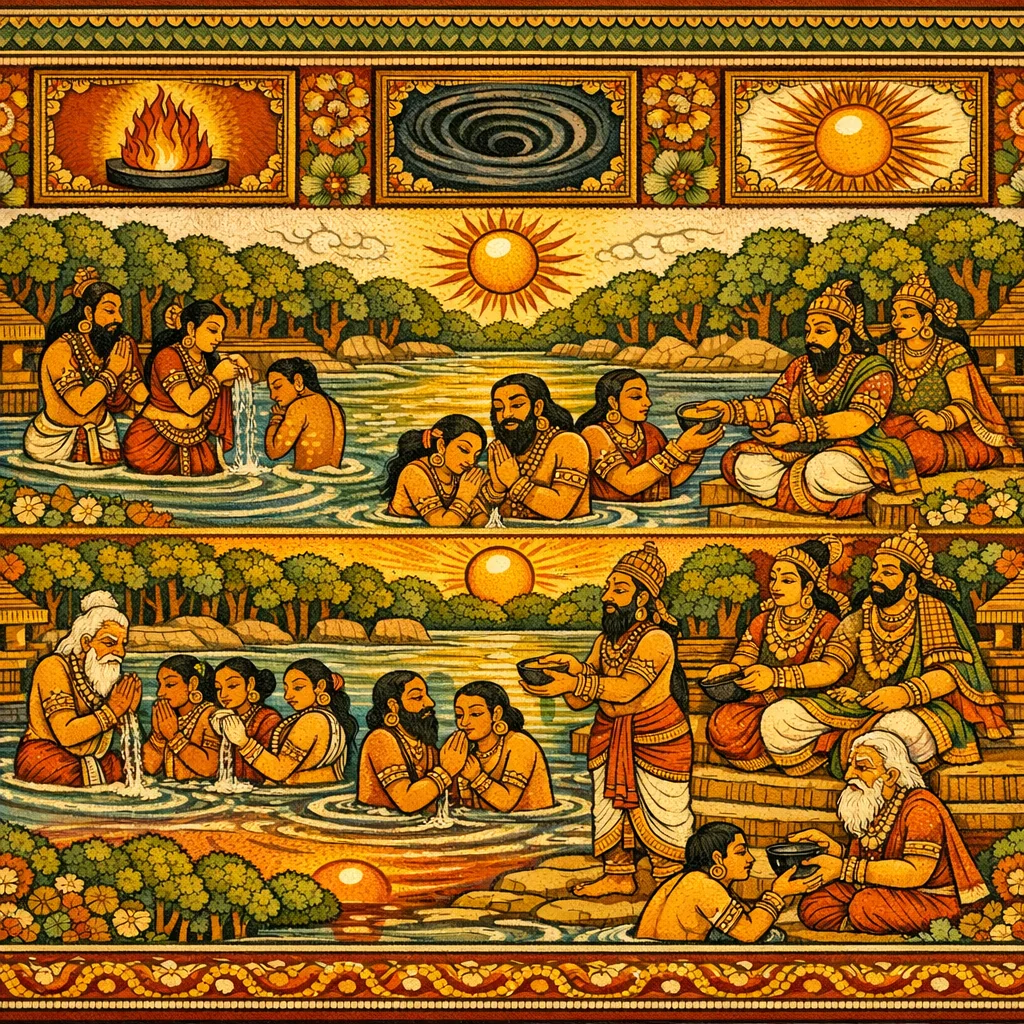
Moved by the earlier praise of Prayāga, Yudhiṣṭhira asks Mārkaṇḍeya about the nature and fruit of the anāśaka observance (fasting without food) and the world attained after sins are purified. Mārkaṇḍeya replies that faithful, self-restrained practice at Prayāga grants step-by-step merit equal to the Aśvamedha and uplifts one’s lineage. Yudhiṣṭhira then questions how small vows can match great sacrifices, and what becomes of pilgrims driven by attachment, greed, or desire. Citing Brahmā’s ancient teaching, Mārkaṇḍeya says Prayāga’s maṇḍala extends five yojanas; mere entry produces Aśvamedha merit; bhakti and śraddhā are essential, while faithless sinners cannot reach the protected tīrtha. He describes expiations—regulated bathing for a month, and for grave sins thrice-daily snāna with an alms-diet—and adds that even imperfectly understood pilgrimages may bring prosperity and heavenly honor. Yudhiṣṭhira gives thanks and asks about Yamunā’s merit; Mārkaṇḍeya praises her origin, kīrtana and snāna, lists key tīrthas, and concludes with the equal fruit of Gaṅgā and Yamunā and the power of dawn recitation and hearing.
Key Concepts
Shlokas in Adhyaya 108
Verse 1
*युधिष्ठिर उवाच एतच्छ्रुत्वा प्रयागस्य यत्त्वया परिकीर्तितम् विशुद्धं मे ऽद्य हृदयं प्रयागस्य तु कीर्तनात् //
Yudhiṣṭhira said: Having heard the glory of Prayāga as you have described it, my heart has today become purified—simply through the recitation and remembrance of Prayāga.
Verse 2
अनाशकफलं ब्रूहि भगवंस्तत्र कीदृशम् यं च लोकमवाप्नोति विशुद्धः सर्वकिल्बिषैः //
Tell me, O Blessed Lord, what is the fruit of the anāśaka observance (abstaining from food) there, and of what kind is it? And to which world does one attain, purified of all sins?
Verse 3
*मार्कण्डेय उवाच शृणु राजन्प्रयागे तु अनाशकफलं विभो प्राप्नोति पुरुषो धीमाञ् श्रद्दधानो जितेन्द्रियः //
Mārkaṇḍeya said: Listen, O King—at Prayāga, a wise man who is faithful and self-restrained, O mighty one, attains the fruit of the anāśaka observance.
Verse 4
अहीनाङ्गो ऽप्यरोगश्च पञ्चेन्द्रियसमन्वितः अश्वमेधफलं तस्य गच्छतस्तु पदे पदे //
Even if he has no bodily deficiency, he remains free from disease and endowed with all five senses; for him, the merit of an Aśvamedha sacrifice accrues at every step as he proceeds.
Verse 5
कुलानि तारयेद्राजन् दश पूर्वान्दशापरान् मुच्यते सर्वपापेभ्यो गच्छेत्तु परमं पदम् //
O King, he uplifts his lineage—ten generations before and ten generations after. He is freed from all sins and indeed attains the supreme abode.
Verse 6
*युधिष्ठिर उवाच महाभाग्यं हि धर्मस्य यत्त्वं वदसि मे प्रभो अल्पेनैव प्रयत्नेन बहून्धर्मानवाप्नुते //
Yudhiṣṭhira said: “O Lord, what you are telling me about Dharma is indeed most auspicious; for by only a small effort one can attain many forms of righteousness.”
Verse 7
अश्वमेधैस्तु बहुभिः प्राप्यते सुव्रतैरिह इमं मे संशयं छिन्द्धि परं कौतूहलं हि मे //
By performing many Aśvamedha sacrifices, or here (in this world) by observing excellent vows, one attains that supreme goal. Please cut through this doubt of mine—for my curiosity is very great.
Verse 8
*मार्कण्डेय उवाच शृणु राजन्महावीर यदुक्तं ब्रह्मयोनिना ऋषीणां संनिधौ पूर्वं कथ्यमानं मया श्रुतम् //
Mārkaṇḍeya said: Listen, O king—great hero—to what was spoken by Brahmā, the Source-born, in the presence of the sages long ago, as I heard it being recounted.
Verse 9
पञ्चयोजनविस्तीर्णं प्रयागस्य तु मण्डलम् प्रविष्टमात्रे तद्भूमाव् अश्वमेधः पदे पदे //
The sacred circuit (maṇḍala) of Prayāga extends for five yojanas; the moment one enters that holy ground, the merit of an Aśvamedha sacrifice arises at every step.
Verse 10
व्यतीतान्पुरुषान्सप्त भविष्यांश्च चतुर्दश नरस्तारयते सर्वान् यस्तु प्राणान्परित्यजेत् //
A man who gives up his life (for the sake of this dharma) delivers them all—seven generations of forefathers who have passed away, and fourteen generations yet to come.
Verse 11
एवं ज्ञात्वा तु राजेन्द्र सदा सेवापरो भवेत् अश्रद्दधानाः पुरुषाः पापोपहतचेतसः न प्राप्नुवन्ति तत्स्थानं प्रयागं देवरक्षितम् //
Knowing this, O best of kings, one should always remain devoted to service. Men who lack faith—whose minds are struck down by sin—do not attain that sacred place: Prayāga, protected by the gods.
Verse 12
*युधिष्ठिर उवाच स्नेहाद्वा द्रव्यलोभाद्वा ये तु कामवशं गताः कथं तीर्थफलं तेषां कथं पुण्यफलं भवेत् //
Yudhiṣṭhira said: Those who go to sacred places driven by attachment, or by greed for wealth, and who have fallen under the sway of desire—how can such people obtain the fruit of a pilgrimage? How can spiritual merit (puṇya) arise for them?
Verse 13
विक्रयः सर्वभाण्डानां कार्याकार्यमजानतः प्रयागे का गतिस्तस्य तन्मे ब्रूहि पितामह //
For one who lives by selling all kinds of goods, yet does not understand what ought to be done and what ought not to be done—what is that person’s fate at Prayāga? Tell me that, O Grandfather.
Verse 14
*मार्कण्डेय उवाच शृणु राजन्महागुह्यं सर्वपापप्रणाशनम् मासमेकं तु यः स्नायात् प्रयागे नियतेन्द्रियः मुच्यते सर्वपापेभ्यः स गच्छेत्परमं पदम् //
Mārkaṇḍeya said: Listen, O King, to this great secret that destroys all sins. Whoever, with senses restrained, bathes at Prayāga for a full month is freed from all sins and attains the supreme state.
Verse 15
विश्रम्भघातकानां तु प्रयागे शृणु यत्फलम् त्रिकालमेव स्नायीत आहारं भैक्ष्यमाचरेत् त्रिभिर्मासैः स मुच्येत प्रयागे तु न संशयः //
Now hear the spiritual result at Prayāga for those who slay one who trusted them: if one bathes there at the three junctures of the day and lives on alms as one’s food, then within three months one is released from that sin at Prayāga—of this there is no doubt.
Verse 16
अज्ञानेन तु यस्येह तीर्थयात्रादिकं भवेत् सर्वकामसमृद्धस्तु स्वर्गलोके महीयते स्थानं च लभते नित्यं धनधान्यसमाकुलम् //
But even if, in this world, one undertakes pilgrimage to sacred fords (tīrthas) and similar pious acts unknowingly, one becomes endowed with the fulfillment of all desires; one is honored in the heavenly realm and attains an abiding station ever filled with wealth and grain.
Verse 17
एवं ज्ञानेन सम्पूर्णः सदा भवति भोगवान् तारिताः पितरस्तेन नरकात्प्रपितामहाः //
Thus, one perfected by this knowledge ever becomes a true enjoyer of life; by him the Fathers (Pitṛs)—indeed even the great-grandfathers—are delivered from hell.
Verse 18
धर्मानुसारि तत्त्वज्ञ पृच्छतस्ते पुनः पुनः त्वत्प्रियार्थं समाख्यातं गुह्यमेतत्सनातनम् //
O follower of Dharma, O knower of truth—since you have asked again and again, for your own benefit I have explained this eternal, confidential teaching.
Verse 19
*युधिष्ठिर उवाच अद्य मे सफलं जन्म अद्य मे तारितं कुलम् प्रीतो ऽस्म्यनुगृहीतो ऽस्मि दर्शनादेव ते मुने //
Yudhiṣṭhira said: “Today my birth has borne fruit; today my lineage has been delivered. I am filled with joy; I have been shown grace—simply by beholding you, O sage.”
Verse 20
त्वद्दर्शनात्तु धर्मात्मन् मुक्तो ऽहं चाद्य किल्बिषात् इदानीं वेद्मि चात्मानं भगवन्गतकल्मषम् //
O righteous-souled one, by the very sight of you I have today been freed from sin. Now, O Lord, I know myself to be cleansed—my impurities have departed.
Verse 21
*मार्कण्डेय उवाच दिष्ट्या ते सफलं जन्म दिष्ट्या ते तारितं कुलम् कीर्तनाद्वर्धते पुण्यं श्रुतात्पापप्रणाशनम् //
Mārkaṇḍeya said: “Fortunate indeed is your life—your birth has become fruitful; fortunate indeed is your lineage, for it has been carried across to safety. Through recitation, merit increases; through hearing, sins are destroyed.”
Verse 22
*युधिष्ठिर उवाच यमुनायां तु किं पुण्यं किं फलं तु महामुने एतन्मे सर्वमाख्याहि यथादृष्टं यथाश्रुतम् //
Yudhiṣṭhira said: “O great sage, what is the sacred merit in the Yamunā, and what phala (spiritual result) does it grant? Tell me all of this fully—just as you have seen it and as you have heard it in tradition.”
Verse 23
*मार्कण्डेय उवाच तपनस्य सुता देवी त्रिषु लोकेषु विश्रुता समाख्याता महाभागा यमुना तत्र निम्नगा //
Mārkaṇḍeya said: The goddess Yamunā—daughter of Tapana (the Sun)—is renowned throughout the three worlds; she is celebrated as supremely fortunate, and there she flows as the descending river-current.
Verse 24
येनैव निःसृता गङ्गा तेनैव यमुना गता योजनानां सहस्रेषु कीर्तनात्पापनाशिनी //
From the very source from which the Gaṅgā issued forth, from that same source the Yamunā too proceeded. Even from thousands of yojanas away, the mere recitation of her name and glory destroys sin.
Verse 25
तत्र स्नात्वा च पीत्वा च यमुनायां युधिष्ठिर कीर्तनाल्लभते पुण्यं दृष्ट्वा भद्राणि पश्यति //
O Yudhiṣṭhira, by bathing there and drinking the waters of the Yamunā, and by praising her, one gains religious merit; and having beheld her, one comes to see auspicious good fortune.
Verse 26
अवगाह्य च पीत्वा च पुनात्यासप्तमं कुलम् प्राणांस्त्यजति यस्तत्र स याति परमां गतिम् //
By bathing there and also drinking that sacred water, one purifies one’s lineage up to the seventh generation. And whoever gives up his life there attains the supreme destination.
Verse 27
अग्नितीर्थमिति ख्यातं यमुनादक्षिणे तटे पश्चिमे धर्मराजस्य तीर्थं तु नरकं स्मृतम् //
On the southern bank of the Yamunā there is a sacred ford renowned as Agni-tīrtha. And on the western side lies Dharma-rāja’s holy place, remembered by the name Naraka-tīrtha.
Verse 28
तत्र स्नात्वा दिवं यान्ति ये मृतास्ते ऽपुनर्भवाः एवं तीर्थसहस्राणि यमुनादक्षिणे तटे //
Having bathed there, those who die there go to heaven; they become ‘not born again’. Thus are found thousands of sacred fords (tīrthas) along the southern bank of the Yamunā.
Verse 29
उत्तरेण प्रवक्ष्यामि आदित्यस्य महात्मनः तीर्थं निरञ्जनं नाम यत्र देवाः सवासवाः //
Now, further to the north, I shall describe the sacred tīrtha of the great-souled Āditya, called Nirañjana, where the gods, together with Indra, are present.
Verse 30
उपासते स्म संध्यां ये त्रिकालं हि युधिष्ठिर देवाः सेवन्ति तत्तीर्थं ये चान्ये विबुधा जनाः //
O Yudhiṣṭhira, those who worship Sandhyā at the three appointed times—indeed, the gods resort to that tīrtha, and other enlightened beings do so as well.
Verse 31
श्रद्दधानपरो भूत्वा कुरु तीर्थाभिषेचनम् अन्ये च बहवस्तीर्थाः सर्वपापहराः स्मृताः तेषु स्नात्वा दिवं यान्ति ये मृतास्ते ऽपुनर्भवाः //
Be devoted and full of faith, and perform the consecratory bathing at a tīrtha. Many other tīrthas too are remembered as destroyers of all sins. Those who bathe in them and then die go to heaven; they do not return again to rebirth.
Verse 32
गङ्गा च यमुना चैव उभे तुल्यफले स्मृते केवलं ज्येष्ठभावेन गङ्गा सर्वत्र पूज्यते //
The Gaṅgā and the Yamunā are both remembered as yielding equal spiritual merit; yet, solely because of her seniority, the Gaṅgā is worshipped everywhere.
Verse 33
एवं कुरुष्व कौन्तेय सर्वतीर्थाभिषेचनम् यावज्जीवकृतं पापं तत्क्षणादेव नश्यति //
Therefore, O son of Kuntī, perform this ablution that bears the merit of bathing in all tīrthas; the sin accumulated over an entire lifetime is destroyed at that very instant.
Verse 34
यस्त्विमं कल्य उत्थाय पठते च शृणोति च मुच्यते सर्वपापेभ्यः स्वर्गलोकं स गच्छति //
Whoever rises at dawn and recites this teaching, and also listens to it, is freed from all sins and goes to the heavenly world.
Frequently Asked Questions
The chapter teaches that Prayāga and Yamunā are powerful loci of purification, but tīrtha-phala depends on śraddhā (faith), self-restraint, and disciplined practice. It emphasizes that vows like anāśaka, regulated snāna (including month-long bathing), and trikāla bathing with an alms-diet can remove sins, generate Aśvamedha-like merit at Prayāga, and uplift one’s lineage—while pilgrimage motivated by greed or desire is spiritually compromised.
This adhyaya centers on Dharma (vrata, snāna, Sandhyā-upāsanā, prāyaścitta) and sacred geography (tīrtha-māhātmya of Prayāga and Yamunā). It also includes a genealogical/ancestral salvation theme (kula-tāraṇa: delivering multiple generations of forefathers and descendants). It does not address Vāstu-śāstra or architectural measurements in this chapter.
Prayāga’s sacred circuit (maṇḍala) is stated to extend for five yojanas. Upon entering that holy ground, and as one proceeds step by step, Aśvamedha-like merit is said to arise, highlighting Prayāga as an exceptionally potent tīrtha.
Key practices include anāśaka (fasting/abstinence) with restraint, month-long bathing at Prayāga with controlled senses, and trikāla snāna (three times daily) while living on alms. The text frames these as effective prāyaścittas capable of releasing even severe moral faults when performed with discipline.
The chapter names Agni-tīrtha on the southern bank of Yamunā, Naraka-tīrtha associated with Dharma-rāja on the western side, and further north the Āditya tīrtha called Nirañjana, frequented by gods and those devoted to Sandhyā worship.
Yes. It states Gaṅgā and Yamunā are remembered as equal in fruit (tulya-phala), while Gaṅgā is worshipped everywhere primarily due to her ‘seniority’ (jyēṣṭha-bhāva).