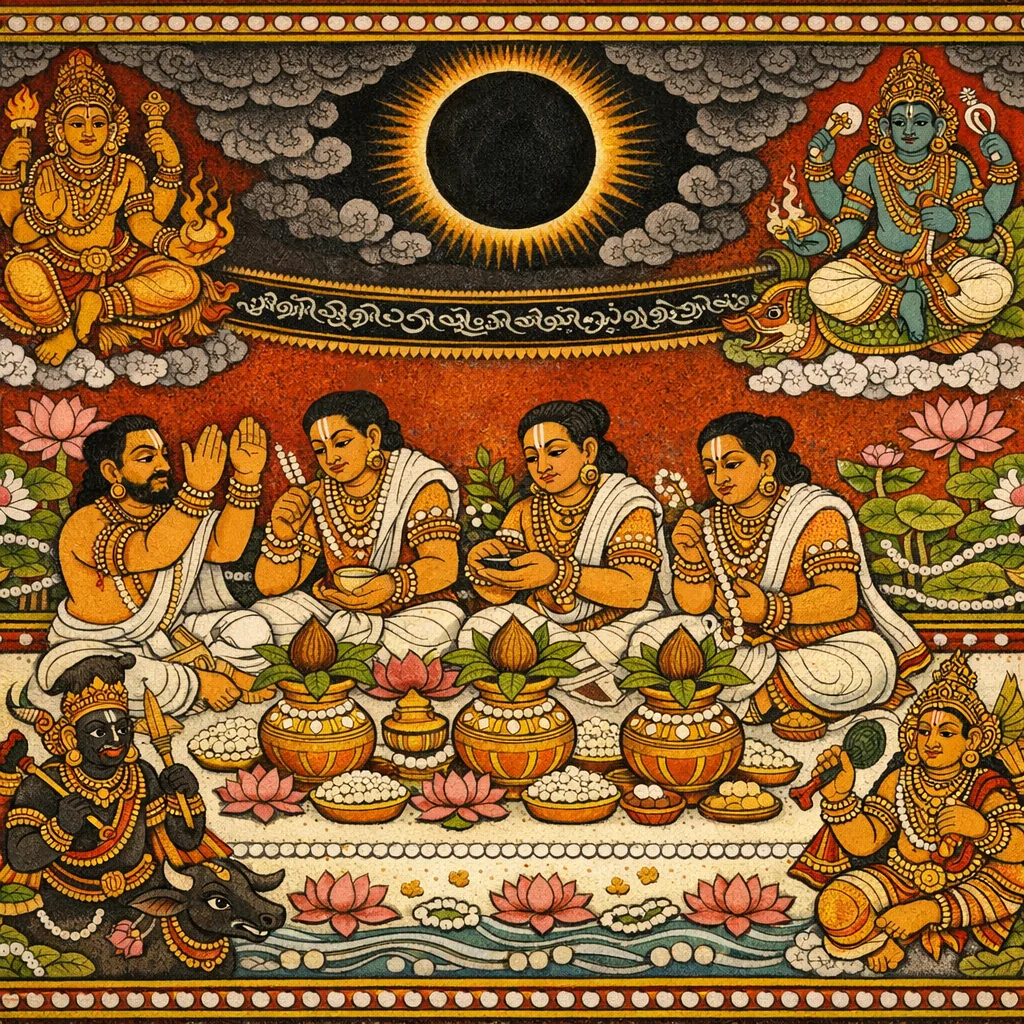
Adhyaya 67: Eclipse-Time Planetary Bath (Graha-snāna) Procedure and Mantras
ग्रहणकाले ग्रहस्नानविधानम्
Speaker: Inquirer (unnamed questioner within the dialogue), Lord Matsya
The questioner asks for the exact eclipse-time bathing rite—materials, mantras, and procedure. Lord Matsya explains eclipses as a kind of “grahaṇa-samplava,” an eclipse-like planetary calamity affecting one’s rāśi, and teaches a standardized graha-snāna. (1) Pre-eclipse preparation: Vedic recitation by brāhmaṇas, honoring four brāhmaṇas, gathering herbs and requisites, and installing four flawless kumbhas. (2) Consecrating the kumbhas with specified substances—earth from designated places; pañcagavya; pearls; gorocanā; lotus; conch; pañcaratna; crystal; white sandalwood; tīrtha-water; mustard; royal toothwood; vetiver; guggulu—while invoking deities. (3) Mantras petition purifying waters and gods to dispel lunar-eclipse and planetary afflictions. (4) Abhiṣeka with Vedic mantras, worship of brāhmaṇas and one’s iṣṭa-devatā, gifting cloth and cows, writing the mantras with mudrās on cloth/lotus-diagram placed on the head, keeping observances until the eclipse ends, and donating the inscribed cloth—bringing freedom from graha-pīḍā and higher spiritual attainment; for solar eclipses, the Sun’s name is inserted into the mantras.
Key Concepts
Shlokas in Adhyaya 67
Verse 1
चन्द्रादित्योपरागे तु यत्स्नानमभिधीयते तदहं श्रोतुमिच्छामि द्रव्यमन्त्रविधानवित् //
I wish to hear about the bathing rite prescribed at the time of a lunar or solar eclipse—together with its required materials, mantras, and the proper procedure.
Verse 2
*मत्स्य उवाच यस्य राशिं समासाद्य भवेद्ग्रहणसम्प्लवः तस्य स्नानं प्रवक्ष्यामि मन्त्रौषधविधानतः //
Lord Matsya said: “When, upon reaching a person’s rāśi (zodiacal sign), an eclipse-like calamity—namely a planetary affliction—arises, I shall prescribe for him the proper bathing rite, according to the ordained method of mantras and medicinal herbs.”
Verse 3
चन्द्रोपरागं सम्प्राप्य कृत्वा ब्राह्मणवाचनम् सम्पूज्य चतुरो विप्राञ् शुक्लमाल्यानुलेपनैः //
When the lunar eclipse has begun, having arranged for Brahmins to recite the sacred texts, one should duly honor four Brahmins with white garlands and white fragrant unguents.
Verse 4
पूर्वमेवोपरागस्य समासाद्यौषधादिकम् स्थापयेच् चतुरः कुम्भान् अव्रणान्सागरानिति //
Well before the eclipse, having procured medicinal herbs and the related requisites, one should set up four water-pots (kumbhas), unblemished and filled full like the ocean.
Verse 5
गजाश्वरथ्यावल्मीकसंगमाद्ध्रदगोकुलात् राजद्वारप्रदेशाच्च मृदमानीय चाक्षिपेत् //
One should bring earth from places such as an elephant-stable, a horse-stable, a chariot-road, a meeting-point near an anthill, from a pond and a cattle-settlement, and also from the area near the royal gate; then one should cast or sprinkle that earth as prescribed.
Verse 6
पञ्चगव्यं च कुम्भेषु शुद्धमुक्ताफलानि च रोचनां पद्मशङ्खौ च पञ्चरत्नसमन्वितम् //
Place pañcagavya in the ritual pots, together with pure pearls, gorocanā, a lotus and a conch (śaṅkha), and let the set be furnished with the five precious gems.
Verse 7
स्फटिकं चन्दनं श्वेतं तीर्थवारि ससर्षपम् राजदन्तं सकुमुदं तथैवोशीरगुग्गुलम् एतत्सर्वं विनिक्षिप्य कुम्भेष्वावाहयेत्सुरान् //
Placing crystal (sphaṭika), white sandalwood, sacred tīrtha-water together with mustard seeds, rājadanta (royal-toothwood), the kumuda lotus, as well as vetiver and guggulu—having deposited all these into the ritual pots, one should invoke the deities into the kumbhas.
Verse 8
सर्वे समुद्राः सरितस् तीर्थानि जलदा नदाः आयान्तु यजमानस्य दुरितक्षयकारकाः //
May all the oceans, rivers, sacred fords (tīrthas), rain-bearing clouds, and streams come to the sacrificer (yajamāna), bringing about the destruction of his sins.
Verse 9
यो ऽसौ वज्रधरो देव आदित्यानां प्रभुर्मतः सहस्रनयनश्चेन्द्रो ग्रहपीडां व्यपोहतु //
May that god Indra—the bearer of the thunderbolt (vajra), regarded as the lord among the Ādityas, the thousand‑eyed—drive away the affliction caused by the planets.
Verse 10
मुखं यः सर्वदेवानां सप्तार्चिरमितद्युतिः चन्द्रोपरागसम्भूताम् अग्निः पीडां व्यपोहतु //
May Agni—who is the very mouth of all the gods, whose seven flames shine with immeasurable splendor—remove the affliction that has arisen from a lunar eclipse.
Verse 11
यः कर्मसाक्षी भूतानां धर्मो महिषवाहनः यमश्चन्द्रोपरागोत्थां मम पीडां व्यपोहतु //
May Yama—Dharma himself—who witnesses the deeds of all beings and rides the buffalo, remove my suffering that has arisen from the lunar eclipse.
Verse 12
रक्षोगणाधिपः साक्षात् प्रलयानलसंनिभः खड्गव्यग्रो ऽतिभीमश्च रक्षःपीडां व्यपोहतु //
May the very Lord of the hosts of Rakṣasas—appearing directly, blazing like the fire at cosmic dissolution (pralaya), fierce with a sword and exceedingly terrifying—drive away the affliction caused by Rakṣasas.
Verse 13
नागपाशधरो देवः साक्षान्मकरवाहनः स जलाधिपतिश् चन्द्रग्रहपीडां व्यपोहतु //
May that divine Lord—bearing the serpent-noose, manifestly the rider of the Makara and sovereign of the waters—remove the affliction caused by the planet Moon (Candra).
Verse 14
प्राणरूपेण यो लोकान् पाति कृष्णमृगप्रियः वायुश्चन्द्रोपरागोत्थां पीडामत्र व्यपोहतु //
May Vāyu—who, as the very form of prāṇa (life-breath), protects the worlds, and who is dear to the black antelope—here remove the affliction that has arisen from a lunar eclipse.
Verse 15
यो ऽसौ निधिपतिर्देवः खड्गशूलगदाधरः चन्द्रोपरागकलुषं धनदो मे व्यपोहतु //
May that divine Lord of treasures—Dhanada (Kubera), bearer of sword, spear, and mace—remove from me the taint of inauspiciousness arising from a lunar eclipse.
Verse 16
यो ऽसाविन्दुधरो देवः पिनाकी वृषवाहनः चन्द्रोपरागजां पीडां विनाशयतु शंकरः //
May Śaṅkara—that god who bears the Moon, who wields the Pināka bow, and whose mount is the bull—destroy the suffering that arises from a lunar eclipse.
Verse 17
त्रैलोक्ये यानि भूतानि स्थावराणि चराणि च ब्रह्मविष्ण्वर्कयुक्तानि तानि पापं दहन्तु वै //
May all beings in the three worlds—both immobile and moving—endowed with the power of Brahmā, Viṣṇu, and the Sun, indeed burn away my sin.
Verse 18
एवमामन्त्र्य तैः कुम्भैर् अभिषिक्तो गुणान्वितैः ऋग्यजुःसाममन्त्रैश्च शुक्लमाल्यानुलेपनैः पूजयेद्वस्त्रगोदानैर् ब्राह्मणानिष्टदेवताः //
Thus, having invoked the deities and been consecrated with those water-jars endowed with auspicious qualities, and with mantras from the Ṛg, Yajus, and Sāma Vedas—adorned with white garlands and unguents—one should worship the brāhmaṇas and one’s chosen deity, offering gifts of garments and cows.
Verse 19
एतानेव ततो मन्त्रान् विलिखेत् करकान्वितान् वस्त्रपट्टे ऽथवा पद्मे पञ्चरत्नसमन्वितान् //
Thereafter, one should write down these very mantras—together with the prescribed hand-signs (mudrās)—either upon a strip of cloth or upon a lotus-diagram, and prepare them furnished with the five gems.
Verse 20
यजमानस्य शिरसि निदध्युस्ते द्विजोत्तमाः ततो ऽतिवाहयेद्वेलाम् उपरागानुगामिनीम् //
Those excellent brāhmaṇas should place it upon the sacrificer’s head; thereafter he should pass the time in observances that continue for the duration of the eclipse.
Verse 21
प्राङ्मुखः पूजयित्वा तु नमस्यन्निष्टदेवताम् चन्द्रग्रहे विनिर्वृत्ते कृतगोदानमङ्गलः कृतस्नानाय तं पट्टं ब्राह्मणाय निवेदयेत् //
Facing east, one should worship and bow to one’s chosen deity. When the lunar eclipse has ended, having duly performed the auspicious rite of gifting a cow, and having bathed, one should present that cloth (paṭṭa) to a brāhmaṇa.
Verse 22
अनेन विधिना यस्तु ग्रहस्नानं समाचरेत् न तस्य ग्रहपीडा स्यान् न च बन्धुजनक्षयः //
Whoever performs the prescribed ‘planetary bath’ (graha-snāna) in this manner will not suffer affliction from the planets, nor will there be loss or destruction among his kinsmen.
Verse 23
परमां सिद्धिमाप्नोति पुनरावृत्तिदुर्लभाम् सूर्यग्रहे सूर्यनाम सदा मन्त्रेषु कीर्तयेत् //
He attains the supreme siddhi, rarely obtained and hard to fall back into worldly return through rebirth. Therefore, at the time of the Sun’s influence (Sūrya-graha), one should always utter the Sun’s name within one’s mantras.
Verse 24
अधिकाः पद्मरागाः स्युः कपिलां च सुशोभनाम् प्रयच्छेच्च निशां पत्ये चन्द्रसूर्योपरागयोः //
Let there be abundant padmarāgas (rubies), and one should also gift a beautiful tawny cow. These offerings should be presented to the Lord of the Night (the Moon), especially at the times of lunar and solar eclipses.
Verse 25
य इदं शृणुयान्नित्यं श्रावयेद्वापि मानवः सर्वपापविनिर्मुक्तः शक्रलोके महीयते //
Any person who regularly listens to this teaching, or causes it to be recited, is freed from all sins and is honored in the world of Śakra (Indra).
Frequently Asked Questions
Adhyaya 67 teaches a complete eclipse-time purification and graha-śānti method called Graha-snāna. It gives (1) the setup—four kumbhas, brāhmaṇa recitation, honoring four brāhmaṇas with white garlands/unguents; (2) the exact substances to place into the pots (earth from specified places, pañcagavya, pearls, gorocanā, lotus, conch, pañcaratna, crystal, white sandalwood, tīrtha-water, mustard, royal-toothwood, vetiver, guggulu); (3) mantras invoking cosmic waters and deities to remove eclipse-born and planetary affliction; and (4) concluding acts—Vedic abhiṣeka, worship, dāna (cloth/cows), mantra-inscription with mudrās placed on the head through the eclipse, and donation afterward—promising freedom from graha-pīḍā and high spiritual attainment.
This chapter is primarily Dharma/Ācāra (ritual conduct) and Graha-śānti (astrological remediation). It does not treat Vāstu-śāstra measurements, temple architecture, royal statecraft (rājadharma), or purāṇic genealogy directly; instead it focuses on eclipse observances, purification materials, mantra-prayogas, and dāna as a means to neutralize planetary afflictions.
The rite is presented as an eclipse/planetary-affliction bath applicable to grahaṇa contexts, but it adds a specific rule: at the time of a solar eclipse (sūrya-graha), one should always include/recite the Sun’s name within the mantras. It also recommends offerings (notably gems and a tawny cow) to the Moon’s lordship specifically at lunar and solar eclipses.
The mantras first call all oceans, rivers, tīrthas, clouds, and streams to bring sin-destruction, then invoke deities to dispel affliction: Indra (for graha-pīḍā generally), Agni (for lunar-eclipse-born affliction), Yama (as Dharma and karmasākṣin), a fierce Rakṣasa-lord (for rakṣaḥ-pīḍā), Varuṇa (as jalādhipati, for Candra-graha affliction), Vāyu (as prāṇa-form), Kubera/Dhanada (for eclipse impurity), and Śaṅkara (to destroy lunar-eclipse suffering).