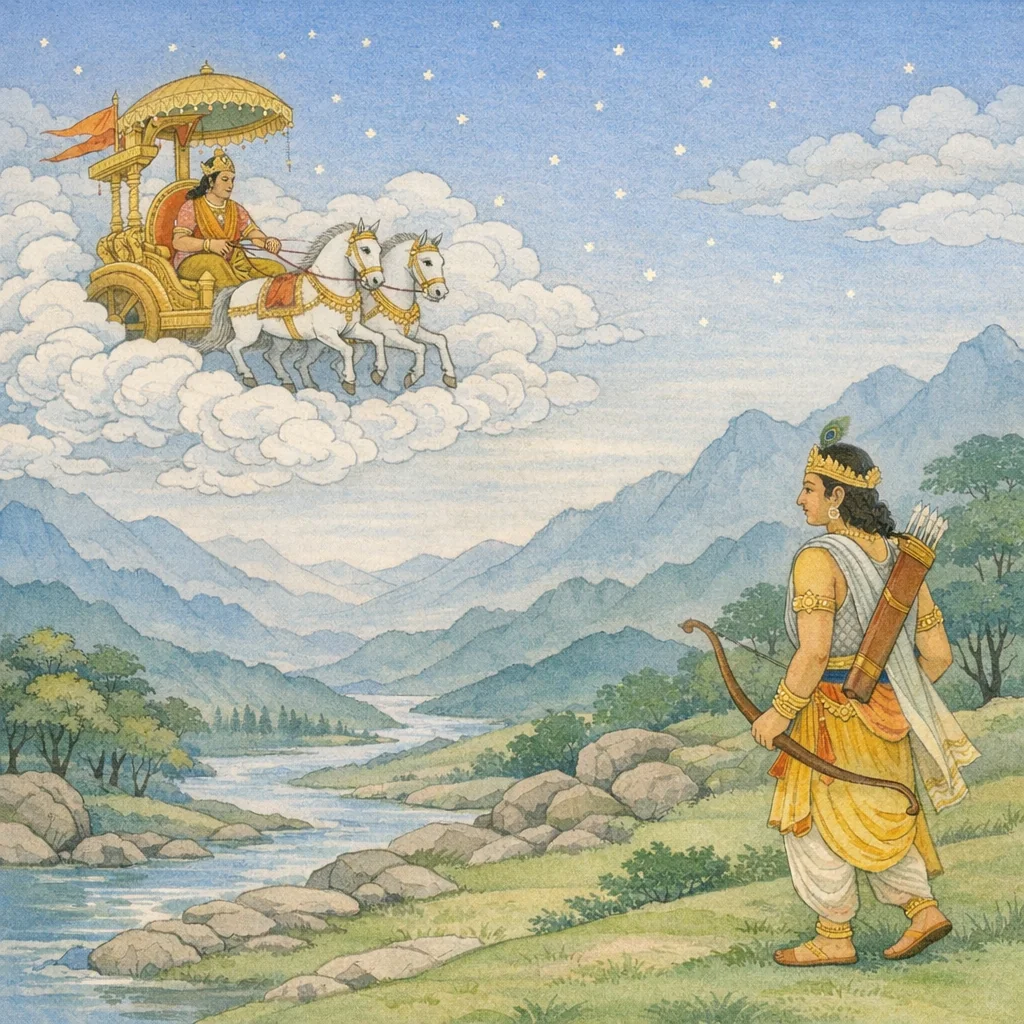
Adhyaya 42
Lokapāla-samāgamaḥ—Arjuna Receives Astras from the World-Guardians (Book 3, Chapter 42)
Upa-parva: Kirātārjunīya / Arjuna’s Penance and the Lokapāla-Encounter Episode (Āraṇyaka-parva context)
Vaiśaṃpāyana reports that after Arjuna’s direct encounter with Pinākī (Śiva) vanishes from sight, Arjuna reflects on the encounter as a completed purpose: he has seen and even touched Tryambaka, interpreting this as divine favor and as confirmation of inner resolve. Immediately thereafter, the Lokapālas arrive in a ceremonially vivid sequence: Varuṇa approaches with aquatic retinues; Kubera arrives with Yakṣas in a radiant aerial conveyance; Yama appears with Pitṛs and beings of mixed embodiment; and Indra comes mounted on Airāvata, praised by Gandharvas and ascetics. Yama addresses Arjuna, identifying him with an ancient identity (Nara) and situating his birth and strength within a cosmic mandate. The discourse frames forthcoming tasks and adversarial realities, then proceeds to formal bestowals: Yama grants an irresistible daṇḍa-astra with full operational protocol (mantra, upacāra, release and withdrawal). Varuṇa grants the Vāruṇa pāśas, described as inescapable bonds with precedent in earlier divine conflicts. Kubera grants the Antardhāna astra (concealment) and a sleep-inducing, enemy-subduing power. Indra consoles Arjuna, declares a major divine work ahead, and instructs preparation for ascent to Svarga, promising further weapons there via Mātali’s chariot. Arjuna worships the assembled Lokapālas with words, water, and fruits; they depart as they came. The chapter closes with Arjuna’s satisfaction and composure, characterized as fulfillment through disciplined acquisition rather than mere spectacle.
Chapter Arc: हिमालय-शिखरों पर तप और चिन्तन में स्थित गुडाकेश अर्जुन के पास अचानक मातलि-युक्त दिव्य रथ का आगमन होता है—मेघ-गर्जना-सा नाद, निर्मल नभ, और स्वर्ग-यात्रा का संकेत। → मातलि बताता है कि स्वयं शतक्रतु इन्द्र ने आदेश दिया है—त्रिदशालय के देव, ऋषि, गन्धर्व और अप्सराएँ अर्जुन को देखने को प्रतीक्षारत हैं। अर्जुन के भीतर संकोच, कर्तव्य-बोध और अलौकिक लोक में प्रवेश की गंभीरता एक साथ उठती है; मार्ग में वह पर्वतराज से विदा लेता है और दिव्य लोकों के संकेत (तारारूप पुण्यात्माएँ) देखता है। → अर्जुन दिव्य रथ पर आरूढ़ होकर स्वर्गलोक की ओर प्रस्थान करता है—मानो सूर्य-सा दीप्तिमान; और मार्ग में मातलि से उन तारारूप पुण्यात्माओं का रहस्य पूछता है, जिससे स्वर्ग-मार्ग का नैतिक-आध्यात्मिक अर्थ उद्घाटित होता है। → पर्वतराज को कृतज्ञता-पूर्वक प्रणाम कर अर्जुन का हिमालय-आश्रय समाप्त होता है; मातलि के मार्गदर्शन में उसका गमन निश्चित हो जाता है और स्वर्ग के द्वारों की ओर कथा स्थिर गति पकड़ती है। → इन्द्र के सभामण्डल में अर्जुन का प्रथम साक्षात्कार और वहाँ होने वाली परीक्षा/वरदान अभी शेष है।
Shlokas
Verse 1
हि आय न [हुक हि २ आम (इन्द्रलोकाभिगमनपर्व) द्विचत्वारिशो< ध्याय: अर्जुनका हिमालयसे विदा होकर मातलिके साथ स्वर्गलोकको प्रस्थान वैशम्पायन उवाच गतेषु लोकपालेषु पार्थ: शत्रुनिबर्हण: । चिन्तयामास राजेन्द्र देवराजरथं प्रति
Vaiśampāyana said: “O king (Janamejaya), after the guardians of the worlds had departed, Pārtha—Arjuna, the crusher of foes—turned his mind toward the chariot of the king of the gods (Indra).”
Verse 2
ततश्चिन्तयमानस्य गुडाकेशस्य धीमत: । रथो मातलिसंयुक्त आजगाम महाप्रभ:,निद्राविजयी बुद्धिमान् पार्थके चिन्तन करते ही मातलिसहित महातेजस्वी रथ वहाँ आ गया
Vaiśampāyana said: As the wise Guḍākeśa (Arjuna) sat absorbed in thought, a splendid, radiant chariot—yoked and attended by Mātali—arrived there.
Verse 3
नभो वितिमिरं कुर्वज्जलदान् पाटयन्निव । दिश: सम्पूरयन् नादैर्महामेघरवोपमै:,वह रथ आकाशको अन्धकारशून्य मेघोंकी घटाको विदीर्ण और महान् मेघकी गर्जनाके समान गम्भीर शब्दसे दिशाओंको परिपूर्ण-सा कर रहा था
Vaiśampāyana said: “That chariot seemed to make the sky free of darkness, as though it were tearing apart the masses of rain-clouds; and with its deep, thunder-like roar—like the rumbling of great clouds—it filled all the directions with sound.”
Verse 4
असय: शक्तयो भीमा गदाश्षोग्रप्रदर्शना: । दिव्यप्रभावा: प्रासाश्न विद्युतश्न महाप्रभा:
Vaiśampāyana said: In that chariot were kept swords, fearsome śakti-spears, and a terrible mace, formidable to behold—along with prāsa-javelins of divine potency, lightning-like weapons, and a blazing thunderbolt like the vajra.
Verse 5
तथैवाशनयश्वैव चक्रयुक्तास्तुलागुडा: । वायुस्फोटा: सनिर्घाता महामेघस्वनास्तथा
Vaiśampāyana said: “Likewise there were thunderbolt-like missiles and heavy, wheel-hurled stone balls and maces, which, when launched, tore through the air with a sharp whirring; and they struck with crashes like thunder and with a deep roar like that of great storm-clouds.”
Verse 6
तत्र नागा महाकाया ज्वलितास्या: सुदारुणा: । सिताभ्रकूटप्रतिमा: संहताश्च॒ तथोपला:
There, huge serpents were present—terrifying, with blazing mouths. And there too were heaps of stones, massed together and fit to be hurled in battle, resembling clusters of white clouds.
Verse 7
दशवाजिसहस्राणि हरीणां वातरंहसाम् । वहन्ति य॑ नेत्रमुषं दिव्यं मायामयं रथम्,वायुके समान वेगशाली दस हजार श्वेत-पीत रंगवाले घोड़े नेत्रोंमें चकाचौंध पैदा करनेवाले उस दिव्य मायामय रथको वहन करते थे
Vaiśampāyana said: Ten thousand swift horses, fast as the wind—dappled in hue—were drawing that radiant, divine chariot, wondrous and illusory in its making, dazzling to the eyes. The scene shows that extraordinary power and splendor may attend a greater purpose, yet still remain a display of māyā rather than the true measure of dharma.
Verse 8
तत्रापश्यन्महानीलं वैजयन्तं महाप्रभम् | ध्वजमिन्दीवरश्यामं वंशं कनकभूषणम्
There they beheld the great, dark-blue banner named Vaijayanta, radiant with splendor—Indra’s standard—its deep hue outshining the blue lotus. Its staff was of bamboo, adorned with gold. The sight signaled divine sanction and royal authority, marking the chariot as guarded by celestial power and thus calling for reverence and restraint in action.
Verse 9
तस्मिन् रथे स्थितं सूतं तप्तहेमविभूषितम् । दृष्टवा पार्थों महाबाहुर्देवमेवान्वतर्कयत्
Seeing the charioteer seated upon that chariot, adorned with ornaments of burnished gold, the mighty-armed Pārtha (Arjuna) judged him to be none other than a god. The scene underscores how divine radiance and noble bearing can inspire reverence, while also hinting at the epic’s recurring theme that the divine may appear in human roles to guide events toward dharma.
Verse 10
तथा तर्कयतस्तस्य फाल्गुनस्याथ मातलि: । संनतः प्रस्थितो भूत्वा वाक्यमर्जुनमब्रवीत्,इस प्रकार विचार करते हुए अर्जुनके सम्मुख उपस्थित हो मातलिने विनीतभावसे कहा
As Arjuna (Phālguna) was thus reflecting, Mātali approached him with respectful humility. Having bowed and made ready to speak, he addressed Arjuna—signaling that counsel and duty are to be offered with reverence, especially when a hero is weighing the right course of action.
Verse 11
मातलिस्वाच भो भो: शक्रात्मज श्रीमाउछक्रस्त्वां द्रष्टमिच्छति । आरोहतु भवाज्छीघ्रं रथमिन्द्रस्य सम्मतम्
Mātali said: “Ho there, illustrious son of Śakra (Indra)! Śakra wishes to see you. Mount quickly this chariot approved and beloved of Indra.” The summons carried both urgency and honor: the divine king’s messenger called the hero to respond promptly and respectfully, marking a passage from human struggle to a meeting guided by celestial will.
Verse 12
आह माममरश्रेष्ठ: पिता तव शतक्रतुः । कुन्तीसुतमिह प्राप्तं पश्यन्तु त्रिदशालया:
Vaiśampāyana said: “Your father, Śatakratu—foremost among the immortals—told me: ‘Bring here Kuntī’s son who has arrived, so that the dwellers of the heaven of the Thirty Gods may behold him.’” The passage frames Arjuna’s summons to the divine assembly as a public recognition of merit and fitness, implying that extraordinary power is to be conferred and witnessed within a moral order, not seized in secrecy.
Verse 13
एष शक्रः परिवृतो देवैरऋषिगणैस्तथा । गन्धर्वैरप्सरोभिश्र त्वां दिदृक्षु: प्रतीक्षते
Vaiśampāyana said: “Here is Śakra (Indra), surrounded by the gods and hosts of sages, as well as Gandharvas and Apsarases. Desiring to see you, he is waiting.” In narrative context, the scene underscores Arjuna’s rising spiritual and heroic stature: even the celestial assembly seeks his presence, signaling divine recognition and the ethical legitimacy of his forthcoming trials and responsibilities.
Verse 14
अस्माल्लोकाद् देवलोक॑ पाकशासनशासनात् | आरो ह त्वं मया सार्ध लब्धास्त्र: पुनरेष्यसि,आप देवराजकी आज्ञासे इस लोकसे मेरे साथ देवलोकको चलिये। वहाँसे दिव्यास्त्र प्राप्त करके लौट आइयेगा
Vaiśaṃpāyana said: “By the command of Pākaśāsana (Indra), come with me from this world to the world of the gods. There, after obtaining the divine weapons, you will return again.”
Verse 15
अजुन उवाच मातले गच्छ शीघ्रं त्वमारोहस्व रथोत्तमम् | राजसूयाश्दमेधानां शतैरपि सुदुर्लभम्
Arjuna said: “Mātali, go quickly. Mount this excellent chariot. Even hundreds of Rājasūya and Aśvamedha sacrifices are exceedingly hard to obtain (in merit and reward).”
Verse 16
अर्जुनने कहा--मातले! आप जल्दी चलिये। अपने इस उत्तम रथपर पहले आप चढ़िये। यह सैकड़ों राजसूय और अश्वमेधयज्ञोंद्वारा भी अत्यन्त दुर्लभ है ।।
Arjuna said: “Mātali, make haste. Mount this excellent chariot first. This chariot is exceedingly rare—hard to obtain even through hundreds of Rājasūya and Aśvamedha sacrifices. Even highly fortunate kings devoted to sacrifice and lavish in gifts, or even gods and Dānavas, would find it difficult to ascend this supreme chariot.”
Verse 17
नातप्ततपसा शक््य एष दिव्यो महारथ: । द्रष्ट वाप्यथवा स्प्रष्टमारोढुं कुत एव च
Arjuna said: “This divine, great chariot cannot be beheld or even touched by one who has not undergone austerities; how much less could such a person ever mount it.”
Verse 18
त्वयि प्रतिछ्ठिते साधो रथस्थे स्थिरवाजिनि । पश्चादहमथारो क्ष्ये सुकृती सत्प्ं यथा
Arjuna said: “O good man, when you are firmly seated upon the chariot and have the steady horses under control, then I shall mount it afterward—just as a virtuous person, having taken up the true path, proceeds along it. Well done, O charioteer.”
Verse 19
वैशम्पायन उवाच तस्य तद् वचन श्रुत्वा मातलिः शक्रसारथि: । आरुरोह रथं शीघ्र हयान् येमे च रश्मिभि:
Vaiśampāyana said: Hearing those words of his, Mātali—the charioteer of Śakra (Indra)—quickly mounted the chariot and, drawing the reins, brought the horses under control.
Verse 20
ततोडर्जुनो हृष्टमना गज्जायामाप्लुत: शुचि: । जजाप जप्यं कौन्तेयो विधिवत् कुरुनन्दन:
Then Arjuna, his mind gladdened, bathed in the Gaṅgā and became purified. Thereafter, the son of Kuntī—delight of the Kurus—performed, in due ritual order, the recitation of a mantra fit to be repeated.
Verse 21
ततः पितृन् यथान्यायं तर्पयित्वा यथाविधि । मन्दरं शैलराजं तमाप्रष्टमुपचक्रमे,फिर विधिपूर्वक न्यायोचित रीतिसे पितरोंका तर्पण करके विस्तृत शैलराज हिमालयसे विदा लेनेका उपक्रम किया
Then, having duly satisfied the ancestral fathers in the proper and prescribed manner, he began to take leave of that king of mountains, Mandara—acting in accordance with right conduct and ritual propriety.
Verse 22
साधूनां पुण्यशीलानां मुनीनां पुण्यकर्मणाम् । त्वं सदा संश्रय: शैल स्वर्गमार्गाभिकाड्क्षिणाम्
Vaiśampāyana said: “O mountain, you are ever a благотворный refuge for the virtuous and holy—those sages of pure conduct and those whose deeds are meritorious—especially for people who long to tread the path that leads to heaven.”
Verse 23
त्वत्प्रसादात् सदा शैल ब्राह्मणा: क्षत्रिया विश: । स्वर्ग प्राप्ताश्चरन्ति सम देव: सह गतव्यथा:
Vaiśampāyana said: “O mountain, by your gracious favor, many Brahmins, Kshatriyas, and Vaishyas continually attain heaven and, freed from suffering, move about there in the company of the gods.”
Verse 24
अद्विराज महाशैल मुनिसंश्रय तीर्थवन् | गच्छाम्यामन्त्रयामि त्वां सुखमस्म्युषितस्त्वयि
Vaiśampāyana said: “O king of mountains, O mighty peak—sanctuary of sages and adorned with holy fords! I have dwelt happily upon you; therefore, taking your leave with reverence, I now depart.”
Verse 25
तव सानूनि कुज्जाश्न नद्यः प्र्रवणानि च । तीर्थानि च सुपुण्यानि मया दृष्टान्यनेकश:,“तुम्हारे शिखर, कुंजवन, नदियाँ, झरने और परम पुण्यमय तीर्थस्थान मैंने अनेक बार देखे हैं
Vaiśampāyana said: “Your mountain-slopes, your groves, your rivers and waterfalls, and your supremely sacred pilgrimage-fords—these I have seen many times.”
Verse 26
फलानि च सुगन्धीनि भक्षितानि ततस्तत: । सुसुगन्धाश्च वार्योघास्त्वच्छरीरविनि:सृता:
Vaiśampāyana said: “Fragrant fruits were eaten again and again; and from his skin and body there flowed streams of water, exceedingly sweet-smelling.”
Verse 27
शिशुर्यथा पितुरड्के सुसुखं वर्तते नग
Vaiśaṃpāyana said: “O king, as a little child rests in perfect ease upon his father’s lap, so does one dwell in safety and contentment when sheltered by rightful protection—an image that proclaims the moral duty of guardianship and the trust it ought to awaken.”
Verse 28
अप्सरोगणसंकीर्णे ब्रह्मघोषानुनादिते
Vaiśampāyana said: “That place was thronged with companies of Apsarases, and it resounded with sacred Brahmanical chants.”
Verse 29
एवमुकक््त्वार्जुन: शैलमामन्त्रय परवीरहा
Having spoken thus, Arjuna—the slayer of enemy-heroes—took leave of the mountain, formally addressing it before departing, as befits the respectful conduct of a disciplined warrior.
Verse 30
स तेनादित्यरूपेण दिव्येनाद्भुतकर्मणा
Vaiśaṃpāyana said: “Then Arjuna, the delight of the Kurus—supremely intelligent and filled with joy—set out upward in that divine chariot, radiant like the Sun and wondrous in its powers and movement. Gradually, the righteous-souled hero passed beyond the range of human sight.”
Verse 31
ऊर्ध्वमाचक्रमे धीमान् प्रहृष्ट: कुरुनन्दन: । सो<दर्शनपथं यातो मर्त्यानां धर्मचारिणाम्
Vaiśaṃpāyana said: “The wise Kurunandana, filled with joy, began to ascend upward. Gradually he passed beyond the range of sight of mortal men who walk in righteousness, disappearing from their view as he rose.”
Verse 32
ददर्शाद्भधुतरूपाणि विमानानि सहस्रश: । न तत्र सूर्य: सोमो वा द्योतते न च पावक:
Vaiśampāyana said: Ascending higher, he beheld thousands of wondrous aerial chariots. In that realm neither the sun nor the moon gives light, and even fire’s radiance is of no use—suggesting a domain whose splendor is not dependent on ordinary, worldly sources of illumination.
Verse 33
स्वयैव प्रभया तत्र द्योतन्ते पुण्यलब्धया । तारारूपाणि यानीह दृश्यन्ते द्युतिमन्ति वै
Vaiśampāyana said: There, the inhabitants of heaven shine by their own radiance, a light gained through the merit of their righteous deeds. What appear here as star-like, luminous forms—seen from afar as small and great points of light—are in truth those beings, each resplendent in their own station, revealed to Arjuna, the son of Pāṇḍu. The passage underscores an ethical vision: the splendor of the higher worlds is not granted arbitrarily, but is the fruit of earned merit.
Verse 34
दीपवद् विप्रकृष्टत्वात् तनूनि सुमहान्त्यपि । तानि तत्र प्रभास्वन्ति रूपवन्ति च पाण्डव:
Vaiśampāyana said: Because they are far away, even very great bodies appear like lamps—small points of light. There, those forms shine forth in their own radiance; and the Pāṇḍavas beheld them as luminous, beautiful presences.
Verse 35
ददर्श स्वेषु धिष्ण्येषु दीप्तिमन्त: स्वयार्चिषा । तत्र राजर्षय: सिद्धा वीराश्व निहता युधि
Vaiśampāyana said: He beheld, in their own celestial stations, radiant beings shining by their own innate splendor. There dwelt perfected royal seers, and also heroic warriors who, having fallen in battle, had attained those worlds—each abiding in his appointed sphere, self-luminous through the merit of his deeds.
Verse 36
तपसा च जित स्वर्ग सम्पेतु: शतसड्घश: । गन्धर्वाणां सहस्राणि सूर्यज्वलिततेजसाम्
Vaiśaṃpāyana said: “In hundreds and in clustered multitudes, ascetics were departing for heaven—having won it by the power of their austerities. And there were thousands of Gandharvas, their splendor blazing like the sun.”
Verse 37
गुहाकानामृषीणां च तथैवाप्सरसां गणान् | लोकानात्मप्रभान् पश्यन् फाल्गुनो विस्मयान्वित:
Vaiśampāyana said: As Phālguna (Arjuna) beheld hosts of Guhyakas, sages, and likewise companies of Apsarases—and their realms that shone by their own inherent radiance—he was filled with wonder. The scene evokes the moral order of the cosmos: through austerity and merit, beings attain luminous worlds, and the disciplined seeker is humbled by the vast hierarchy of spiritual accomplishment.
Verse 38
पप्रच्छ मातलिं प्रीत्या स चाप्येनममुवाच ह । एते सुकृतिन:ः पार्थ स्वेषु धिष्ण्येष्ववस्थिता:
Vaiśaṃpāyana said: With affection he questioned Mātali, and Mātali in turn replied to him: “O Pārtha, these are the meritorious ones, abiding each in his own appointed celestial station.”
Verse 39
ततो<पश्यत् स्थितं द्वारि शुभं वैजयिनं गजम्
Vaiśaṃpāyana said: Then he saw, stationed at the gate, a splendid, victorious elephant. In the narrative context, this marks Arjuna’s approach to the celestial threshold, where merit and divine order are symbolized by a guardian presence; ethically, it underscores that entry into higher realms is portrayed as regulated by auspicious signs and rightful attainment rather than mere force.
Verse 40
ऐरावतं चतुर्दन्तं कैलासमिव शृद्धिणम् । स सिद्धमार्गमाक्रम्य कुरुपाण्डवसत्तम:
Vaiśampāyana said: Arjuna, the foremost among the Kurus and the Pāṇḍavas, beheld Airāvata—the splendid, victorious lord of elephants—four-tusked and towering like Mount Kailāsa adorned with many peaks. Advancing upon the path frequented by the Siddhas, Arjuna himself appeared radiant and exalted, reminiscent of the ancient royal exemplar Māndhātṛ in his glory. The scene underscores the idea that spiritual merit and disciplined striving grant access to higher realms and their wondrous guardians.
Verse 41
व्यरोचत यथापूर्व मान्धाता पार्थिवोत्तम: । अभिचक्राम लोकान् स राज्ञां राजीवलोचन:
Vaiśaṃpāyana said: Just as in former times the best of kings, Māndhātā, shone in glory, so too did the lotus-eyed Arjuna shine. He then moved through the worlds of the righteous kings—an image of earned splendor—suggesting that true radiance follows merit and disciplined conduct rather than mere power.
Verse 42
एवं स संक्रमंस्तत्र स्वर्गलोके महायशा: । ततो ददर्श शक्रस्य पुरीं ताममरावतीम्
Thus the greatly renowned Pārtha wandered there in the heavenly world; then he beheld Śakra’s city—Amarāvatī.
Verse 263
अमृतास्वादनीया मे पीता: प्रस्रवणोदका: । 'यहाँके विभिन्न स्थानोंसे सुगन्धित फल लेकर भोजन किये हैं। तुम्हारे शरीरसे प्रकट हुए परम सुगन्धित प्रचुर जलका सेवन किया है। तुम्हारे झरनेका अमृतके समान स्वादिष्ट जल मैंने प्रतिदिन पान किया है
Vaiśampāyana said: “I have drunk the waters of your springs—sweet as nectar. Day after day I have partaken of that abundant, exquisitely fragrant water that issues forth from you.”
Verse 273
तथा तवाड्के ललितं शैलराज मया प्रभो । 'प्रभो नगराज! जैसे शिशु अपने पिताके अंकमें बड़े सुखसे रहता है, उसी प्रकार मैंने भी तुम्हारी गोदमें आमोदपूर्वक क्रीड़ाएँ की हैं
Vaiśampāyana said: “O lord, O king of mountains, I too was tenderly cherished in your lap. Just as a child rests in comfort in his father’s embrace, so did I rejoice and play within your protecting bosom.”
Verse 283
सुखमस्म्युषित: शैल तव सानुषु नित्यदा । 'शैलराज! अप्सराओंसे व्याप्त और वैदिक मन्त्रोंके उच्चघोषसे प्रतिध्वनित तुम्हारे शिखरों पर मैंने प्रतिदिन बड़े सुखसे निवास किया है”
Vaiśampāyana said: “O king of mountains! I have dwelt in happiness upon your slopes day after day. On your peaks—filled with Apsarases and echoing with the loud recitation of Vedic mantras—I lived each day with great contentment.”
Verse 293
आरुरोह रथं दिव्यं द्योतयन्निव भास्कर: । ऐसा कहकर शत्रुवीरोंका संहार करनेवाले अर्जुन शैलराजसे आज्ञा माँगकर उस दिव्य रथको देदीप्यमान करते हुए-से उसपर आखरूढ़ हो गये
Vaiśampāyana said: Arjuna, famed as the slayer of enemy-heroes, having sought leave from the lord of mountains, mounted that celestial chariot, making it blaze with splendor—as though the sun itself were lighting up all the directions.
Verse 383
तान् दृष्टवानसि विभो तारारूपाणि भूतले । अर्जुनने प्रसन्नतापूर्वक मातलिसे उनके विषयमें पूछा
O mighty one! You have seen them upon the earth in the form of stars. When Arjuna, with gladness, asked Mātali about them, Mātali replied: “O son of Kuntī! These are those meritorious, pure-souled men who dwell each in his own world. O lordly one! It was they whom you beheld shining on the earth as stars.”
Frequently Asked Questions
How exceptional martial capability should be acquired and used: the chapter insists power must be received through disciplined merit and precise instruction, and deployed only within an articulated duty-framework.
Identity and obligation are framed as cosmically situated: Arjuna is reminded of an antecedent, higher role (Nara) and is directed to treat forthcoming engagements as mandated responsibility rather than personal hostility.
While no explicit phalaśruti formula is stated, the closing characterization—Arjuna as ‘labdhāstra’ and ‘kṛtārtha’—functions as an implicit result-marker: disciplined pursuit culminating in authorized capacity and inner completion.
Read Mahabharata in the Vedapath app
Scan the QR code to open this directly in the app, with audio, word-by-word meanings, and more.